How to Run a Surf School and Board Rental Business: The Complete Guide (2026)
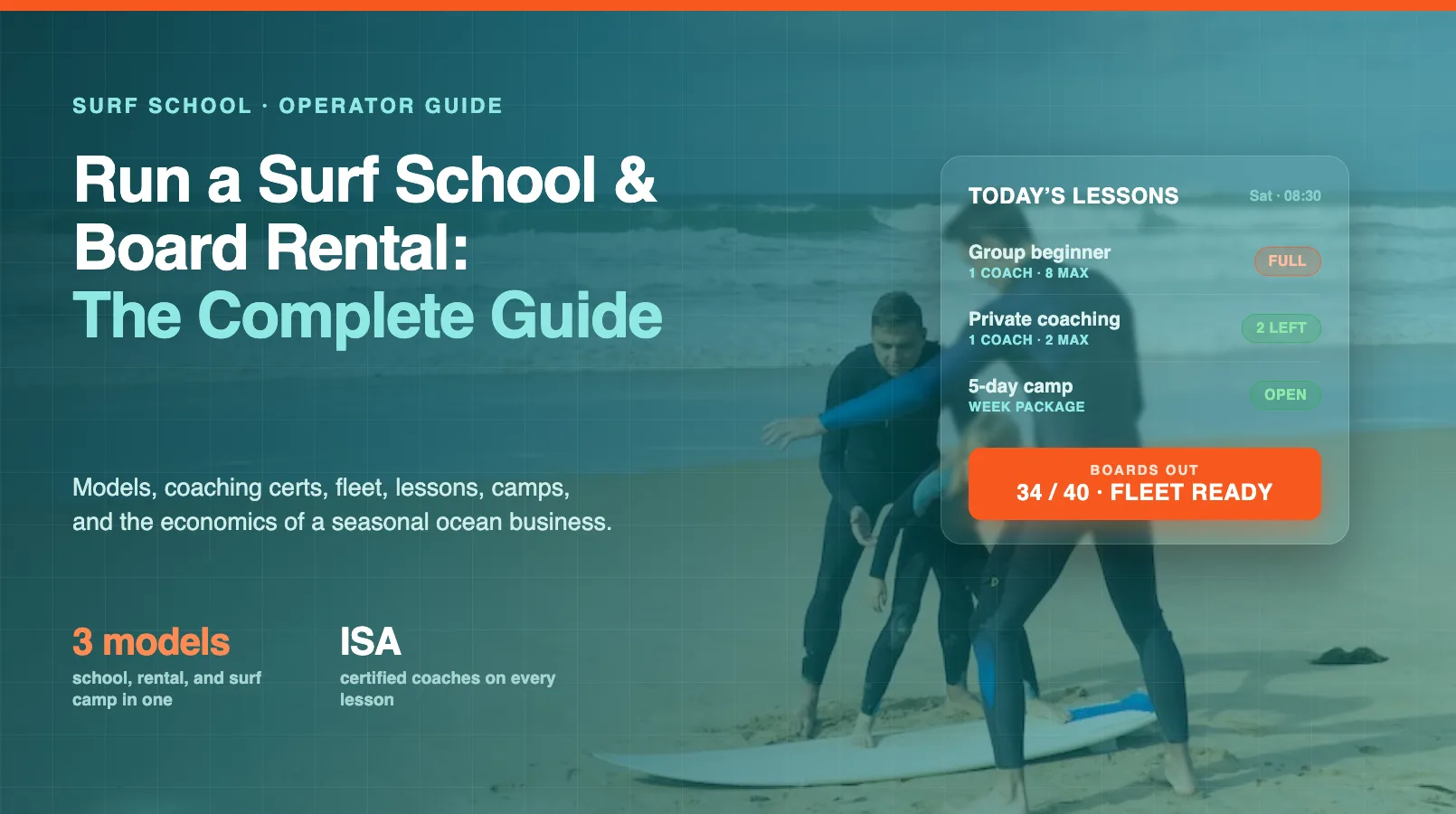
A surf school looks like the easiest business in the world from the beach: a coach, a stack of foamies, and a line of grinning beginners catching their first waves in the whitewater. Behind that scene sits a genuinely complex operation: a fleet of gear that lives in saltwater, staff who need real qualifications, a timetable ruled by tide and swell, and a liability profile that most retail owners never carry.
This guide walks through the whole thing: the three business models you can build, how to certify and staff your coaches, how to run a board and wetsuit fleet without it falling apart, the lesson and camp formats that actually make money, and how to manage a seasonal, weather-exposed business through the quiet months. Whether you are opening a single-beach lesson operation or scaling toward a full surf camp, the fundamentals below are the same.
Three business models: surf school, board rental, and surf camp
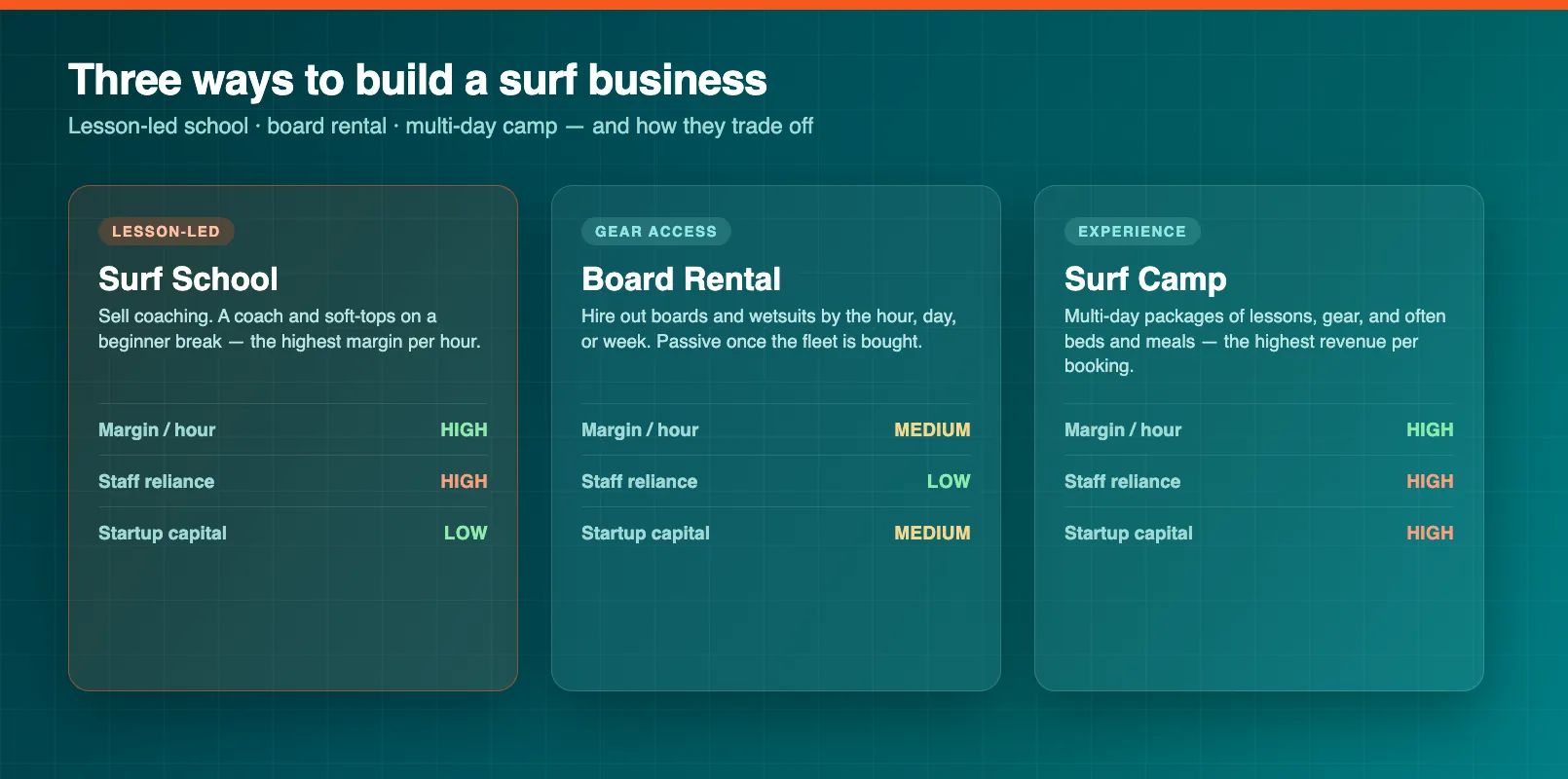
Almost every surf business is built from three building blocks, and knowing which one leads determines your staffing, your capital, and your margin.
A lesson-led surf school sells instruction. Your product is a coach and a beginner-friendly break, and your gear exists mostly to support lessons. This is the highest-margin model per hour because you are charging for expertise, but it is also the most staff-dependent, no coach, no revenue. It is the easiest model to start lean, since you can run it with a handful of soft-tops and a van before you ever sign a lease.
A board and wetsuit rental business sells access to gear. Walk-in surfers, holidaymakers, and locals hire boards and wetsuits by the hour, day, or week. Margins per transaction are lower than lessons, but the model is far more passive: once the fleet is bought, it earns while you sleep, and it scales without adding payroll. The trade-off is that a rental fleet in saltwater is a maintenance operation, and dead stock (the wrong sizes, damaged boards, worn wetsuits) quietly eats your return.
A surf camp sells an experience. Multi-day packages bundle lessons, board and wetsuit use, sometimes accommodation and meals, and a progression from first stand-up to confident green-wave surfing. Camps carry the highest revenue per booking and the best marketing story, but they are operationally the heaviest: you are running lessons, gear, logistics, and often beds and food all at once, and one under-filled week can swallow the profit from a sold-out one.
Most successful operators blend all three. Lessons anchor the brand and the margin, rentals monetize the fleet in the gaps between lessons, and camps lift peak-season yield. The mistake is trying to do all three at full scale from day one. Pick the model that fits your break and your capital, prove it, then layer the others on.
Instructor certification: ISA, lifesaving, and first aid
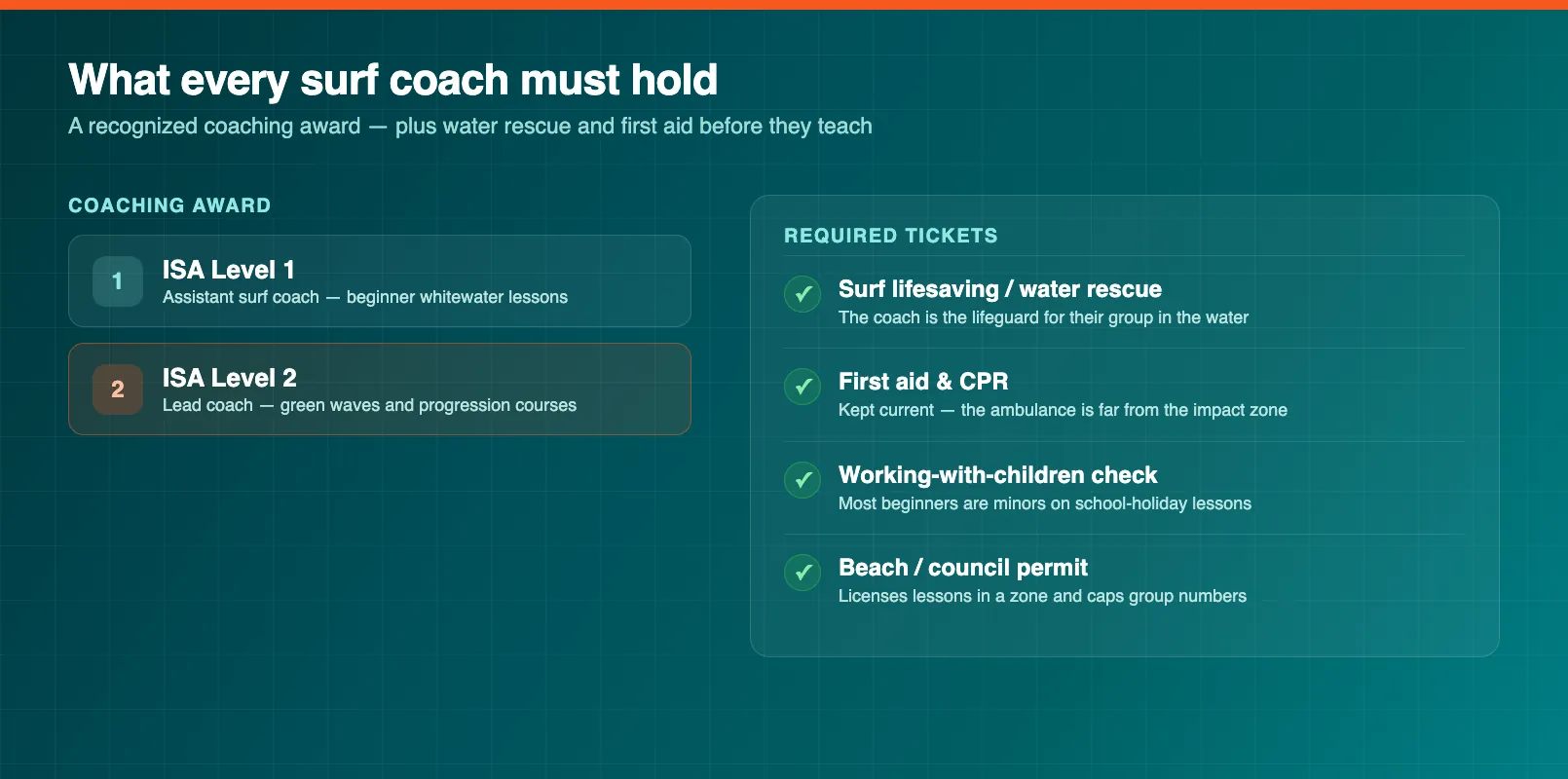
The single thing standing between a fun morning and a coronial inquiry is the quality of your coaching staff, and that starts with certification. In surf coaching the most widely recognized pathway is run by the ISA, the International Surfing Association, whose Level 1 and Level 2 coaching awards are accepted around the world. Many countries also have a national governing body qualification (Surfing Australia, Surf England, and others) that maps to the same framework.
An ISA or equivalent coaching qualification is only half the ticket. The other half is water safety and first aid. Reputable schools, and virtually every insurer, require each coach to also hold:
- A current surf lifesaving or ocean water-rescue certificate, because your coach is the lifeguard for their group the moment the lesson starts.
- A first aid and CPR qualification, kept in date, because the nearest ambulance is a long way from the impact zone.
- Often a working-with-children check where you teach minors, which is most of the beginner market.
On top of individual qualifications, most beaches sit under a council or land-manager permit that licenses commercial lessons in a defined zone, caps numbers, and dictates insurance minimums. Operating without it is the fastest way to lose your business, and permits are frequently the limiting factor on how many lessons you can run at once.
Finally, decide your student-to-instructor ratio and enforce it like a safety rule, because it is one. Beginner group lessons in whitewater commonly cap around six to eight students per coach, tighter for children and tighter again in bigger surf. Breaching the ratio to squeeze in one more booking voids your insurance and puts a coach in an impossible position if two students get into trouble at once.
Building and maintaining your board and wetsuit fleet
Your fleet is both a revenue engine and a liability that lives in the harshest environment a product can face: sun, sand, and salt. Boards get dinged, leashes fray, and wetsuits stretch, stink, and split. Treating the fleet as a maintenance operation rather than a pile of stock is what separates a school with a five-year lifespan on its gear from one replacing everything every second season.
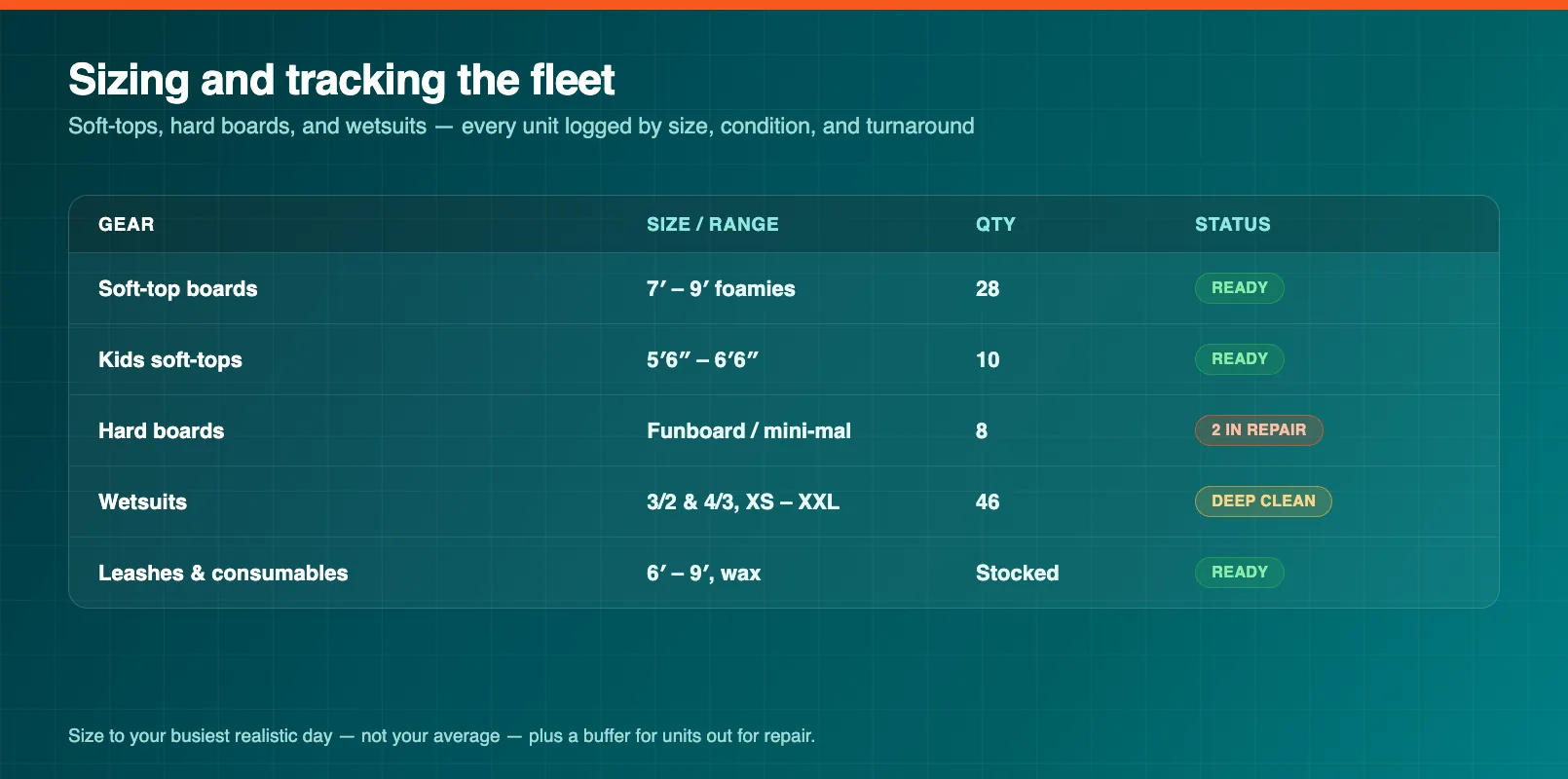
A working fleet for a lesson-led school centers on soft-top boards in a spread of sizes — 7-foot to 9-foot foamies are the workhorse for beginners, with a few smaller boards for kids and lighter progressers. Add a quiver of hard boards if you rent to intermediate surfers, and stock wetsuits across the full size and thickness range your water demands, plus leashes, rash vests, and wax as consumables. Size the fleet to your busiest realistic day plus a buffer for units out for repair, not to your average day — the sold-out Saturday is the one that exposes a thin fleet.
The part that protects your margin and your customers is the maintenance cycle:
- Boards need a ding and leash-plug inspection on every return; a cracked board takes on water and becomes both useless and, in the wrong hands, unsafe. A repeatable surfboard inspection checklist run at each turnaround catches damage before the next customer does.
- Wetsuits need rinsing, proper drying, and periodic deep cleaning, or they degrade fast and become a hygiene complaint waiting to happen. A standard wetsuit cleaning and care routine keeps the fleet lasting and your reviews clean.
- Leashes and fins are the cheap parts that fail at the worst time — replace on wear, not on breakage.
The operational challenge is tracking condition and availability across a fleet that is constantly out on the sand and in customers' hands. Paper sign-out sheets fail here: the wetsuit that never came back and the board with the hairline crack are exactly the units that slip through. Tracking each item's status, condition, and next service belongs in a system, not on a clipboard by the door.
Lesson formats: group, private, and multi-day
The shape of your lesson menu determines both your revenue per coach-hour and the kind of customer you attract. Three formats do most of the work.
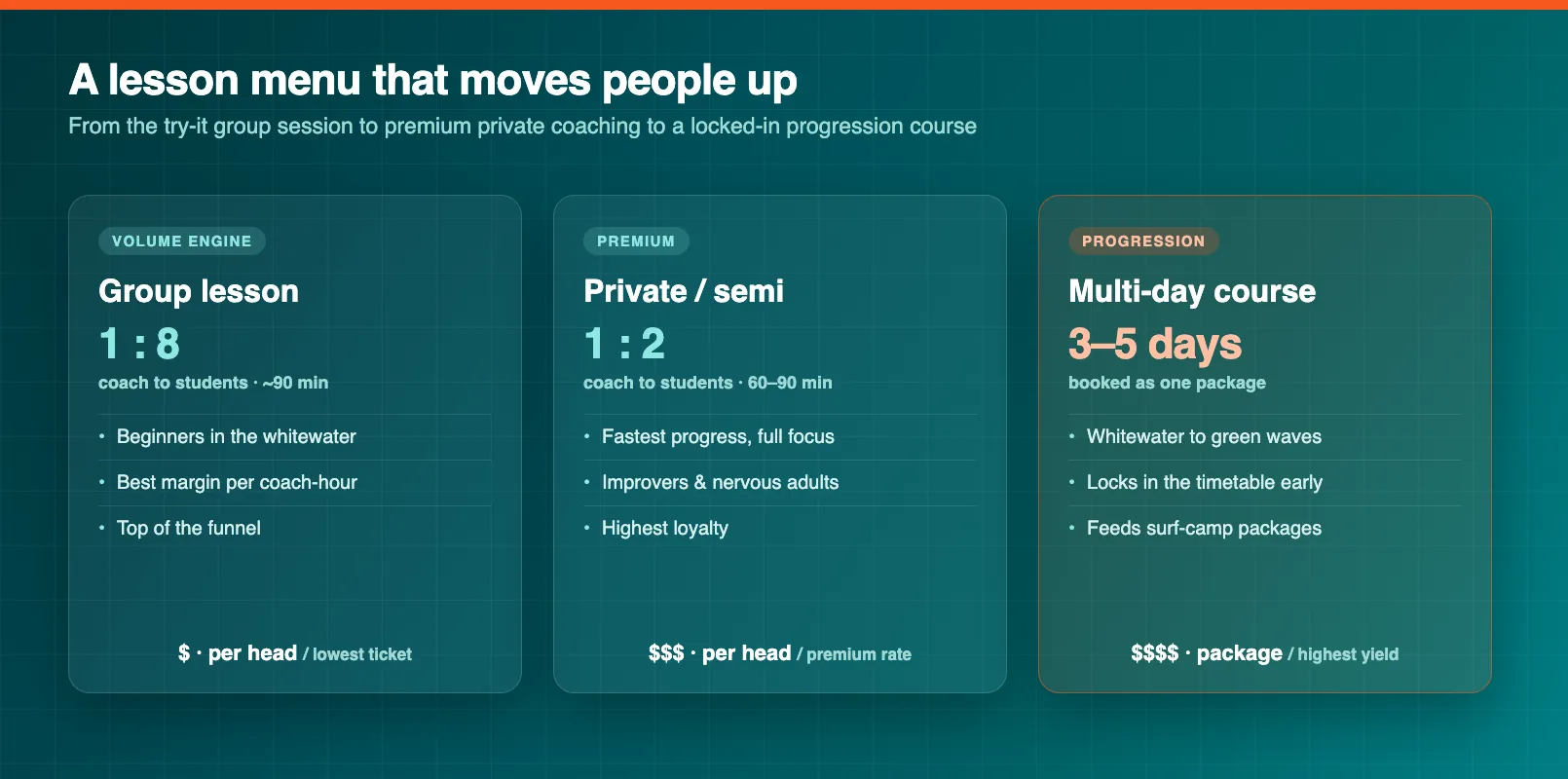
Group lessons are the volume engine and the top of the funnel. A single coach takes a group of beginners, typically six to eight, through a beach briefing, safety, and their first waves in the whitewater. The economics are strong: one coach and a stack of soft-tops can gross several hundred dollars in ninety minutes. Groups are where holidaymakers, birthday parties, and school groups enter, and where a nervous first-timer decides whether surfing is for them.
Private and semi-private lessons sell attention. One to three students to a coach means faster progress, and you can charge a premium per head for it. Privates suit improvers, anxious adults, and parents who want a coach's full focus on their child. They are lower volume but higher margin per student and tend to convert into the most loyal repeat customers.
Multi-day progression courses are where a beginner becomes a surfer. A block of lessons across several days, or a full week, takes a student from whitewater to catching unbroken waves, and they book as a package rather than a single session. Multi-day courses lift your yield per customer, smooth your timetable because the bookings are locked in advance, and feed naturally into surf-camp packages.
The operators who thrive treat these formats as a journey, not a menu. The group lesson is the try-before-you-commit, the multi-day course is the progression sale, and the private is the premium upgrade. Selling the next step at the end of each lesson (while the stoke is high and the customer is still dripping) is where a one-off booking becomes a repeat one.
Surf camp packages and accommodation
A surf camp is the highest-value product a surf business can sell, because it bundles days of instruction, gear, and often food and a bed into one high-ticket booking. Done well, a camp turns a $70 lesson customer into a $1,200 package customer and gives you a marketing story (transformation, travel, community) that a single lesson never can.
Camps come in two broad shapes. A day camp runs multi-day lessons without accommodation, usually aimed at locals, families, and school-holiday kids. It is the easiest camp to run because you are not in the hospitality business. You deliver lessons and gear across consecutive days and the students go home each night. A residential camp adds accommodation and meals, targets travelers, and commands the highest price, but it drags you into logistics that have nothing to do with surfing: beds, food, transfers, and the guest experience between sessions.
The operational reality of camps is that capacity planning is everything. You are committing coaches, boards, and often accommodation for a fixed block, and the difference between a profitable week and a loss is whether the week fills. That means selling camps well in advance, managing deposits and payment schedules, holding gear and beds against confirmed bookings, and having a clear policy for cancellations and weather. An under-filled residential week with staff and accommodation already committed is one of the most expensive mistakes in the business.
Camps also live or die on the experience between the surfs. The surfing is the reason people book, but the community, the food, the photos, and the progression are what fill your reviews and drive the referrals that fill next season. Build the package so every touchpoint, from the welcome to the graduation video, reinforces why they paid a premium.
Per-lesson economics: where the money actually is
New operators often assume the money is in the biggest, flashiest product. In reality, healthy surf businesses are built on understanding the margin of each product per coach-hour and per unit of gear, then weighting the mix toward what actually pays.
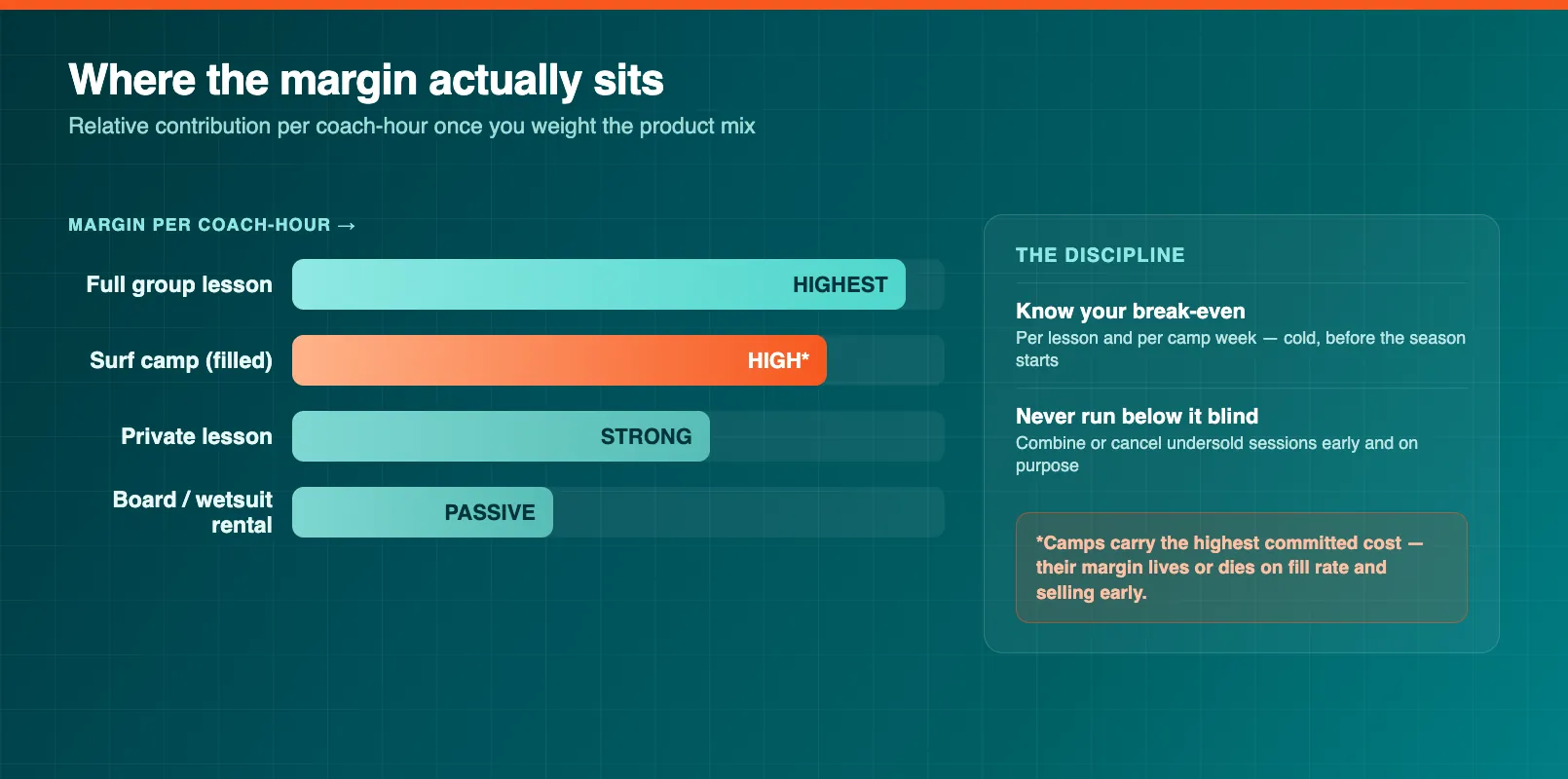
A group lesson is usually your best margin per hour. One coach, one permit slot, and a stack of soft-tops you already own can turn over several hundred dollars in ninety minutes, and the only true variable cost is the coach's wage and a little gear wear. Fill the group and the economics are excellent; run it half-empty and you have paid a coach to teach three people for the price of eight.
Private lessons trade volume for rate. You gross less per session than a full group but at a higher price per student, and with almost no gear pressure. They are the product to push when demand is soft or the group slots are full.
Board and wetsuit rental is lower margin but nearly passive. The board is a sunk cost; every rental after it has paid for itself is close to pure contribution, minus a little maintenance. The trap is fleet size and mix: capital tied up in the wrong sizes or in boards nobody hires is dead money, and a damaged board earns nothing while it waits for repair.
Camps carry the highest revenue per booking but the highest committed cost, so their economics hinge entirely on fill rate and on selling early. The discipline across every product is the same: know your break-even headcount for each lesson and each camp week cold, and never let a session or a week run below it without a deliberate decision. This is the same pricing and packaging thinking covered in more depth across the surf operations hub.
Seasonality and cash flow
Nearly every surf school is seasonal, and the operators who fail usually fail on cash flow, not on demand. Whether your peak is driven by summer, a tourist calendar, or a particular swell season, you earn a disproportionate share of the year's revenue in a few months and then have to carry fixed costs (rent, insurance, core staff, gear) through the quiet stretch.
The financial discipline is to treat peak-season profit as money that has to last. Build a cash buffer during the busy months instead of spending it, and know your monthly off-season break-even so a slow winter never catches you short. Many surf businesses that look healthy in January are gone by the following spring because they spent the summer.
The operational side is filling the quiet months with the right work. The off-season is when you:
- Service the fleet: the ding repairs, deep wetsuit cleans, and leash and fin replacements you can never spare a unit for in peak.
- Retrain and recertify staff, refresh first aid and rescue tickets, and run coach development so you start the season sharp.
- Sell into the future: pre-sell next season's lesson packages, take early-bird camp deposits, and push gift vouchers and gear rental to locals.
- Do the marketing you never have time for when the beach is full: the content, the reviews, the partnerships.
A glossary of the seasonal, tidal, and coaching terms in this guide is worth keeping handy for new staff; the surf terminology reference covers the language your team needs from day one.
Running it all on one system
The thread running through every section above is record-keeping. A surf school juggles lesson bookings, camp packages, board and wetsuit inventory, instructor timetables, waivers, and minor-consent forms, and the traditional answer is a stack of spreadsheets, a paper waiver folder, and a whiteboard for the day's lessons. That stack is exactly what causes the double-booked coach, the over-issued fleet, and the unsigned waiver discovered at the water's edge.
Modern operators consolidate all of it onto a single booking and operations platform: online reservations for lessons and camps, real-time board and wetsuit availability, instructor scheduling against confirmed bookings, digital waivers and minor consent captured before the customer arrives, and point of sale for retail and rentals. When one system holds the whole operation, the front desk sees who is booked, what gear is out, and whose waiver is signed at a glance, and the office sees which sessions are under break-even in time to act.
This is also where automation earns its keep. Dash AI can chase an unsigned waiver before a lesson, remind a camp customer that their balance is due, and nudge a rained-off group to rebook — the routine follow-ups that fall through the cracks when the surf is pumping and the shop is slammed.
Putting it together
Running a surf school is three businesses in one (instruction, gear rental, and experiences) wrapped in a layer of ocean safety and liability that most retail owners never carry. The operators who thrive are the ones who choose a model that fits their break and their capital, certify and staff their coaches properly, run their fleet like the maintenance operation it is, build a lesson menu that moves customers from first wave to loyal regular, and manage cash across a seasonal year with their eyes open.
Do those things well and the surfing takes care of itself. A nervous beginner walks down to the whitewater, stands up for the first time, and comes back for the next step. Your job on the sand is to make sure the coach, the boards, the waivers, and the timetable are all ready when they do.
FAQ
How much does it cost to start a surf school?
A lean, lesson-led surf school can open for roughly $15,000 to $40,000 once you cover a fleet of soft-top boards and wetsuits, insurance, instructor certification, a booking system, and marketing. Adding a retail rental shopfront, a vehicle, or surf-camp accommodation pushes the figure well past $80,000 depending on location and whether you lease or own the space. Many operators start lesson-led and lean, then reinvest into fleet and premises once demand is proven.
What qualifications do surf instructors need?
Most reputable schools require a recognized surf coaching qualification such as an ISA (International Surfing Association) Level 1 or 2 award, plus a current surf lifesaving or water rescue certificate and a first aid and CPR ticket. Many regions and beach councils also require a permit or license to run lessons on a public beach, and your insurer will usually mandate certified coaches and a maximum student-to-instructor ratio.
Is a surf school or a board rental business more profitable?
Lessons usually carry a higher margin per hour because you are selling instructor expertise, not just gear, and a full group lesson can gross several hundred dollars from one coach and a stack of soft-tops. Board and wetsuit rental is lower margin but far more passive and scales without adding staff. The strongest operators run both, using rentals to monetize the fleet between lessons and camps to lift yield in peak season.
What is the ideal student-to-instructor ratio for surf lessons?
For beginner group lessons in whitewater, a common maximum is around eight students per instructor, and many schools and insurers cap it tighter at six, or lower again for children. Private and semi-private lessons run one to three students per coach. Your ratio should reflect conditions, student age and ability, and whatever your insurance and local permit require, since breaching it is both a safety and a coverage problem.
How do surf schools make money in the off-season?
Off-season income comes from board and wetsuit rentals to locals, indoor or pool-based training, gift vouchers, pre-sold lesson packages and camp deposits for the coming season, and retail sales of wax, leashes, and accessories. Quiet months are also when smart operators service the fleet, retrain and recertify staff, and run the marketing they never have time for when the beach is full.
What software do surf schools use to manage bookings?
Modern surf schools run on a single booking and operations platform that handles online lesson and camp reservations, board and wetsuit rental inventory, digital waivers and minor-consent forms captured before arrival, instructor scheduling, and point of sale. Consolidating replaces the paper waivers and whiteboard timetables that cause double-booked coaches, over-issued boards, and unsigned waivers discovered at the water's edge.
in one place