Eleven Turnarounds a Day: Running a Cart Kiosk That Keeps Up
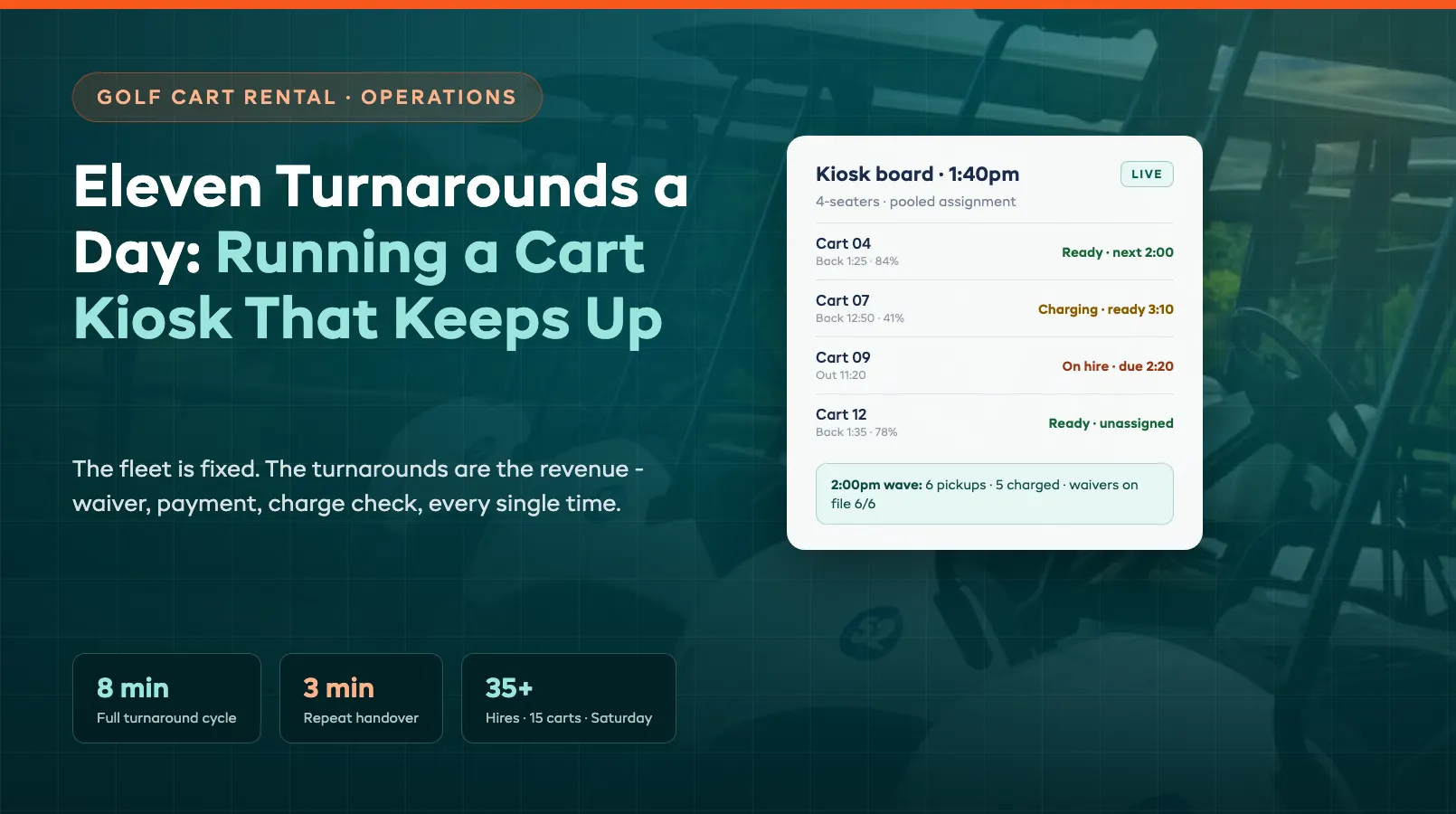
Count the rentals, not the carts. A 15-cart kiosk at a resort or boardwalk does not do 15 hires on a good Saturday - it does 30 or 40, because the same cart goes out at 9am, again at 1pm, and again at 4:30pm. The fleet is fixed; the turnarounds are where the revenue is. And every turnaround is the same three-part transaction: a waiver signed, a payment taken, a charge level checked. Miss any one and you either hand over a cart you should not have, or you hold the line while you chase paperwork.
That is the real job of a cart kiosk. Not renting carts - turning them around. An operation that turns each cart in eight minutes runs a different business from one that takes twenty, even with identical fleets, identical prices, and identical demand. This guide maps the turnaround end to end: the clock, the charge board, the repeat handover, the battery ledger behind it, and the staffing pattern that keeps a queue from forming at 10am. It assumes you already have the platform basics in place - if you are still choosing software, start with the golf cart rental software page and our guide to why charging time is your real fleet constraint, then come back here for the day-to-day.
Mapping the Turnaround, Minute by Minute
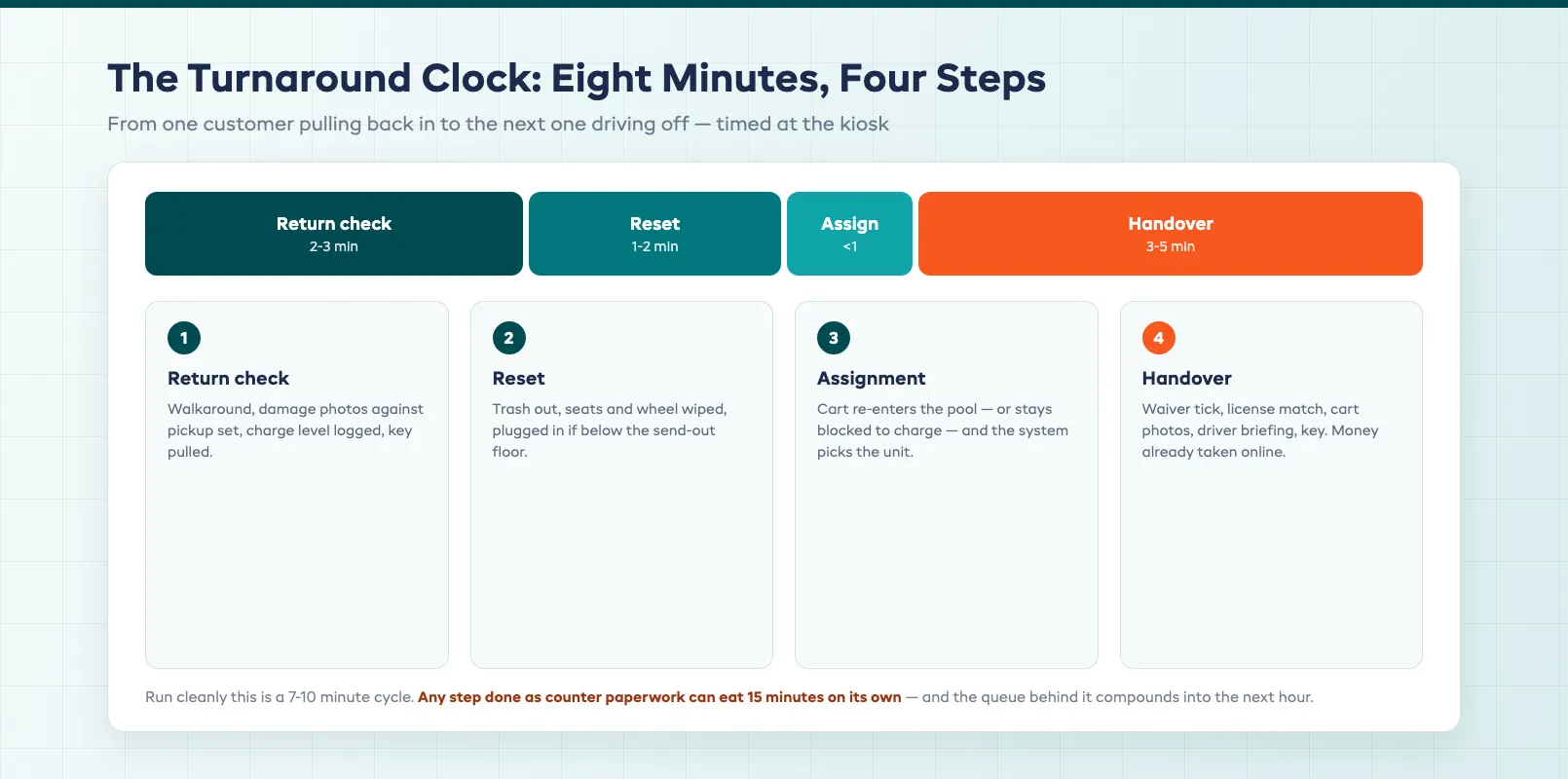
Before you can speed a turnaround up, write down what it actually contains. Stand at the kiosk with a stopwatch for one busy morning and time each step. A typical cart turnaround, from the moment a customer pulls back in to the moment the next customer drives off, looks like this:
- Return check (2-3 minutes). Walk around the cart, photograph any new damage against the pickup photos, note the charge level, pull the key.
- Reset (1-2 minutes). Clear out trash and left items, wipe the seats and wheel, plug in if the charge is below your send-out floor.
- Assignment (under 1 minute if the system does it). The cart re-enters the pool - or does not, if it needs a charge - and the software assigns the next booking to whichever unit is ready.
- Handover (3-5 minutes). Confirm the waiver is signed, sight and photograph the license, take or confirm payment, photograph the cart, brief the driver, hand the key.
Run cleanly, that is a seven-to-ten-minute cycle. Run badly - waiver not sent, card declined at the counter, nobody sure which cart is charged - any single step can eat fifteen minutes on its own, and the queue behind it compounds. The customer waiting at 10:05 makes the 10:30 handover late, which makes 11am worse.
Two rules fall out of the mapping exercise. First, everything that can happen before the customer arrives should. Waivers, license upload, and payment can all be done from the customer's phone at booking time - that alone moves three to five minutes of counter work off the clock. Second, the steps that must happen at the kiosk - the damage photos, the charge check, the briefing - should be a fixed checklist the software walks staff through, not a routine that lives in the head of whoever has worked there longest. Checklists survive August; tribal knowledge does not.
Once the steps are mapped, the number that matters is turnarounds per cart per day. Eleven turnarounds across a 15-cart fleet is a quiet day. On a peak Saturday with staggered slots and a tight handover, the same fleet can clear 35 or more. The difference is never the carts.
Charge State Belongs on the Board
The question staff ask most on a busy day is "which cart can I give them?" If the answer requires walking the lot and squinting at battery gauges, every assignment costs three minutes and gets guessed under pressure. The fix is a live board - a screen at the kiosk showing every unit, its state, and its next commitment.
The board earns its place when it shows, for each cart:
- Status - on hire, back and ready, charging, or flagged for maintenance.
- Charge level - logged at every return, updated when a charging cart crosses the send-out floor.
- Next booking - what the unit is committed to and when, so nobody hands the 2pm cart to a walk-up at 1:40.
- Time to ready - for charging units, when they re-enter the pool, based on chemistry and the level they came back at.
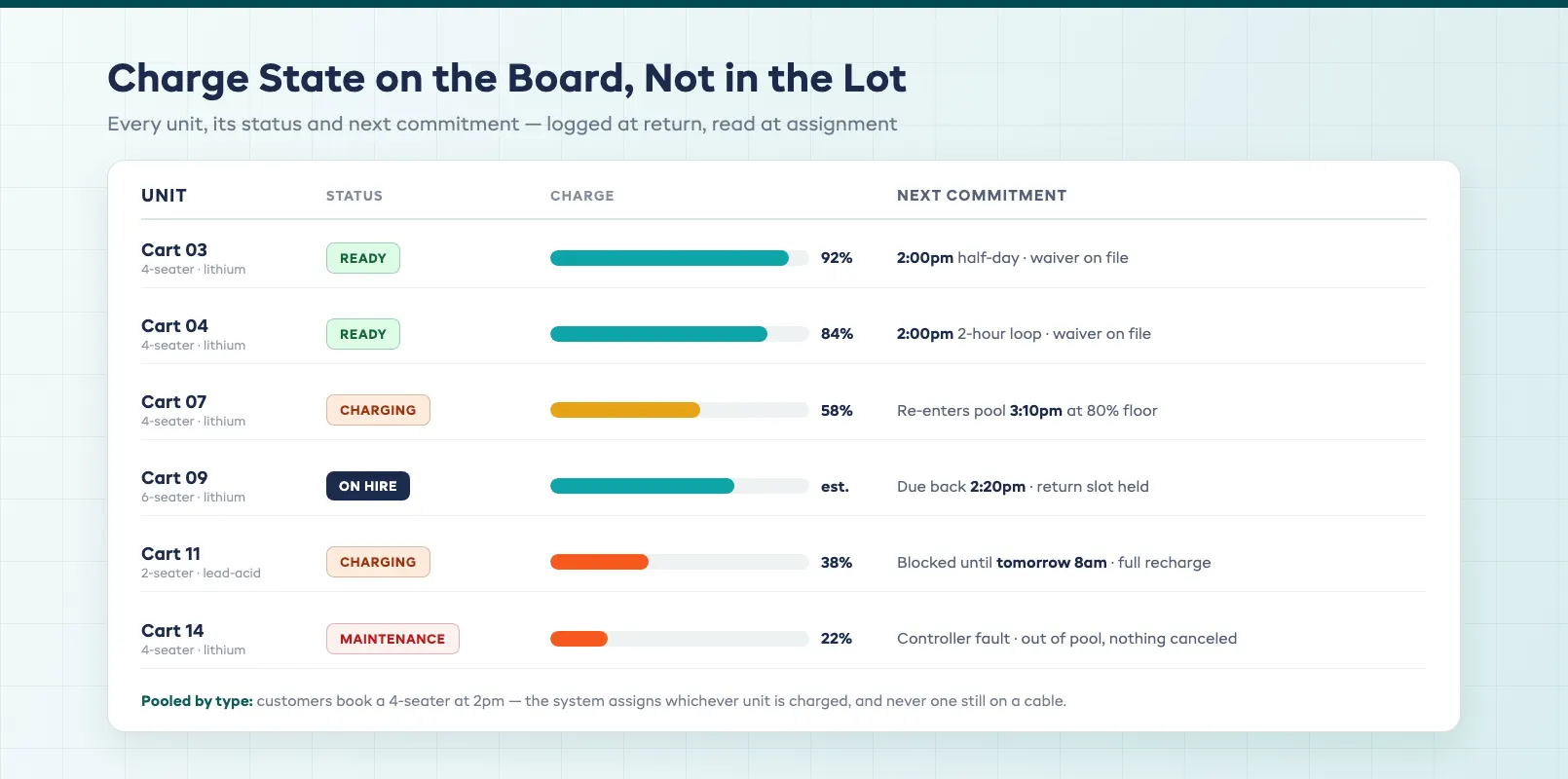
The board only works if return data goes in at return time. That is why the charge check belongs inside the return checklist: staff log the level as part of the same 30-second walkaround that captures the damage photos. Skip it and the board decays into fiction by lunchtime - and staff go back to walking the lot.
The payoff shows up in assignment. With charge state on the board, the software can pool bookings by cart type and assign whichever unit is genuinely ready - a returned lithium cart that crossed 80% re-enters the pool automatically, a lead-acid cart that came back at 40% stays blocked until tomorrow. Customers book "a 4-seater at 2pm"; the system decides which 4-seater, and it never picks one that is still on a cable. That single behavior removes the most common kiosk failure: promising capacity the batteries cannot honor, then discovering it in front of the customer. The operations tools that drive this - live availability, per-unit status, return checklists - are the same ones that run the rest of the day.
Fast Repeat Handovers Are Built Before the Customer Arrives
The first handover of the day to a new customer takes five minutes and should. The eleventh handover of the day should take three, and the handover to a returning customer should take less. Speed at the counter is not about rushing steps - it is about having already done them.
The pre-arrival work:
- Waiver at booking, not at pickup. The confirmation email and SMS carry the waiver link; a reminder goes out the morning of the hire to anyone who has not signed. By the time a well-run kiosk opens, 80-90% of the day's waivers are already on file, and the counter conversation starts at "you're all set" instead of "fill this in."
- License upload from the phone. Customers photograph their license during checkout or from the reminder link. Staff sight the physical card at pickup and match it - ten seconds - rather than photographing and typing details while the queue watches.
- Payment and deposit taken online. Card charged and deposit pre-authorized at booking. The counter handles zero money on a clean handover.
What remains at the kiosk is the part that has to be physical: match the license, photograph the cart, brief the driver, hand the key. Run as a checklist on a tablet, that is a three-minute transaction.
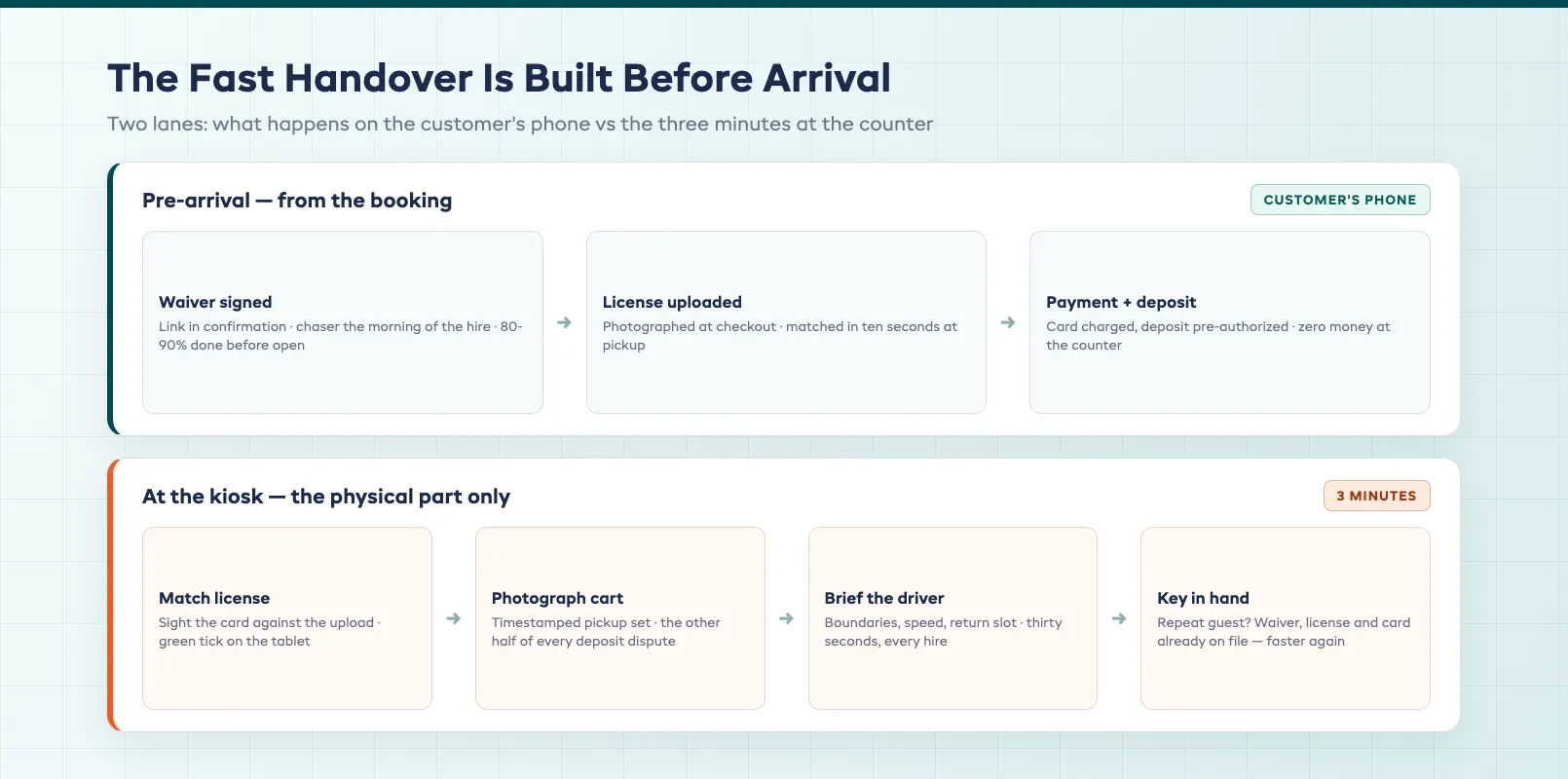
Repeat customers compound the gain. A guest staying the week who hired Monday should not re-enter their details Thursday - their waiver, license, and card are on file, and the handover collapses to photos, briefing, key. Resort and community operators see the same faces all season; a system that recognizes the returning customer turns your most frequent hires into your fastest ones. That is also the group most sensitive to friction: the guest who waited twenty minutes on Monday books the competitor's kiosk on Thursday.
One caution: fast must not mean skipped. The waiver gate stays hard - no signature on file, no key, whoever is asking and however long the line is. The point of pre-staging the paperwork is that enforcing the gate costs nothing; the check is a glance at a green tick, not a clipboard hunt while the queue grows.
Battery Health Is a Per-Unit Ledger, Not a Fleet Average
Charge level tells you whether a cart can go out this afternoon. Battery health tells you whether it should still be in the fleet next season. They are different numbers, and the second one only exists if you record the first one consistently.
Every return logs a charge level against a unit. Over a season, that log becomes a health record: cart 7 goes out at 100% and comes back from a two-hour loop at 55%, while identical cart 12 comes back from the same loop at 70%. Cart 7's pack is fading. Without per-unit logs you find that out when it strands a customer on the far side of the property in August; with them, the pattern is visible in June, and the pack gets replaced on your schedule instead of the customer's.
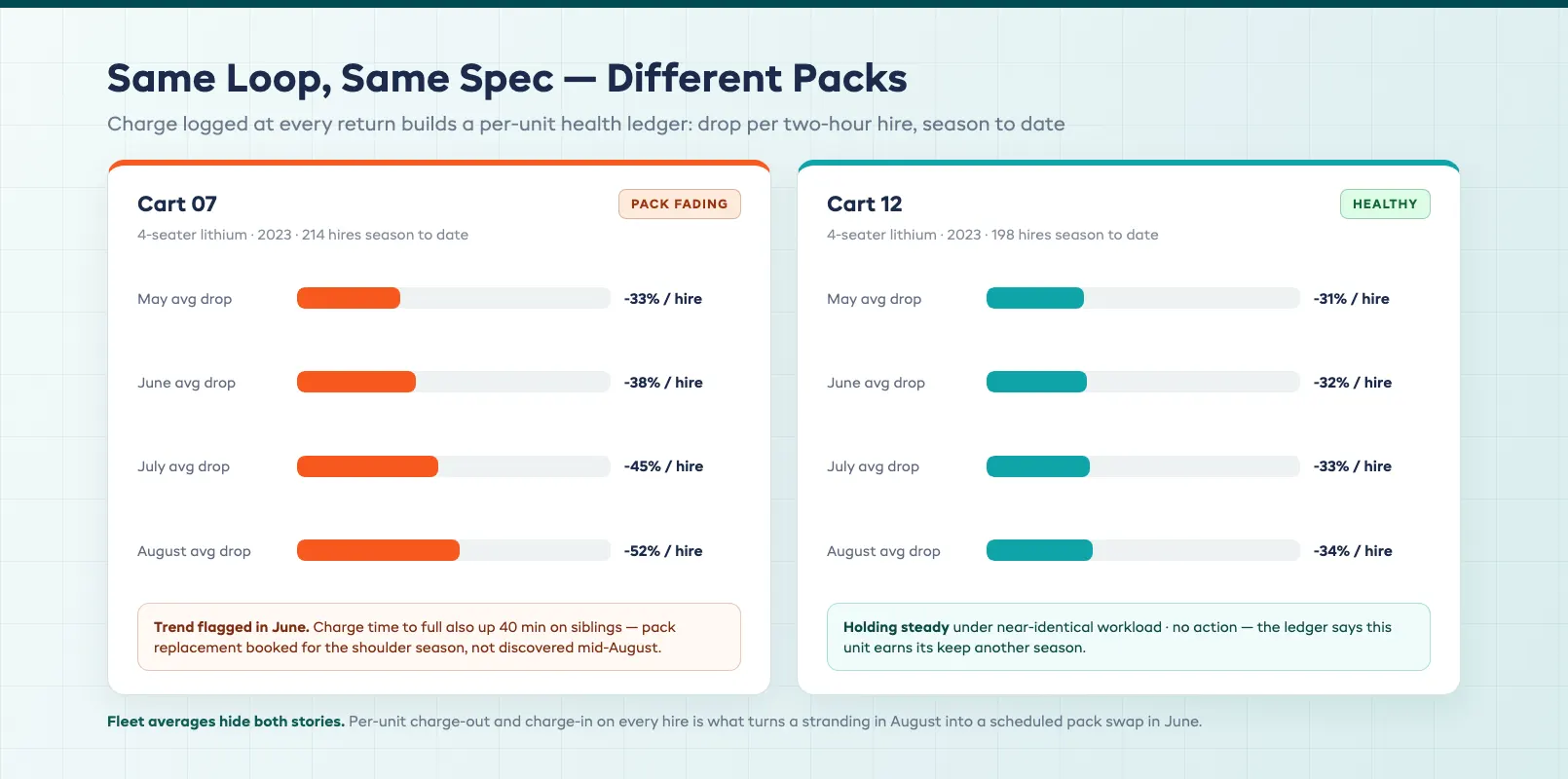
What the ledger should capture per unit:
- Charge out and charge in on every hire, so drop-per-hour of use is a trend line, not an anecdote.
- Hires and hours - a cart doing double the turnarounds ages faster; its numbers should be read against its workload.
- Charging exceptions - a unit that takes longer to reach full than its siblings, or will not hold overnight charge, flagged automatically.
- Maintenance history - tires, brakes, controller faults - so the replace-or-repair decision reads from one screen.
The commercial side matters as much as the operational one. A pack replacement on a lead-acid cart runs $600-900; on a lithium cart the pack is the majority of the vehicle's value. Set against the unit's revenue - which the same system already tracks per cart - the ledger answers the question every operator faces at season's end: which carts earn their keep, which need packs, and which should be sold before the next deposit season. Fleet averages hide all three answers; per-unit records surface them.
Staffing the Peak Hours
A cart kiosk's demand curve is not flat. It is a 9-11am wall of pickups, a lunchtime churn of returns and re-hires, and a 4-6pm wall of returns. Staffing it flat - two people all day - means being overstaffed at 2:30pm and buried at 10am.
Work from the turnaround math. If a solo handover takes five minutes, one staffer clears twelve an hour. If Saturday's board shows 22 pickups between 9 and 11, one person at the counter guarantees a queue; two clear it with margin, provided the waivers are pre-signed. The booking calendar tells you this on Thursday - the whole point of taking bookings online is that the peak is visible before it arrives.
Split the roles at peak. One person owns the counter: license checks, briefings, keys. The other owns the lot: return walkarounds, damage photos, plugging in, staging the next carts at the front. Both work faster than two people doing everything, because neither breaks focus mid-task - and the lot role is where new seasonal staff start, since a photographed checklist is hard to get wrong.
Three staffing rules that hold across cart operations:
- Roster to the booking curve, not the opening hours. The 9-11 peak gets double cover; the mid-afternoon trough runs solo. A four-hour peak shift is a real shift - students and semi-retired locals fill it happily.
- Pre-stage before the wall. The first hour's carts are checked, charged, and lined up before open, keys sorted. The 9am wall is handovers only, not preparation.
- Let automation carry the messages. Booking confirmations, waiver chasers, "your cart is ready" texts, and return-time reminders all go out on their own. At peak, staff should talk to the customer in front of them, not type to the ones who are not there yet.
Avoiding the Queue Altogether
Everything above shortens the queue. The last lever removes it: shape the schedule so the wall never forms.
- Stagger the slots. Sell 9:00, 9:20, and 9:40 starts instead of nine bookings "from 9am." Same capacity, one-third the concurrent arrivals. Do the same with returns - 11am, 12pm, and 1pm return slots at identical prices spread the midday churn and feed charged carts back into the afternoon in a rolling stream instead of one heap.
- Cap walk-ups when the board says so. Walk-up trade is real money, but at peak it competes with booked customers for the same staff minutes. When the board shows the next hour fully committed, quote walk-ups the next genuinely free slot - and take their booking on the spot from a QR code at the counter, so the queue moves to the phone instead of the pavement.
- Text the running order. "Your cart is ready at bay 3" beats a crowd at the counter asking if theirs is. Customers who know their slot is held do not queue to defend it.
- Make the return an appointment. A named return slot with a grace window, backed by the late fee schedule the customer agreed to at booking, brings carts back on a rhythm the chargers can keep up with. Returns that drift 45 minutes late are not a customer-service problem - they are a fleet-capacity problem wearing one's clothes.
None of this needs more carts or more staff. It needs the booking layer, the board, and the messaging to run as one system - which is what a platform built for rental operations does all day. Plans start at $23/month on annual billing; the golf cart rental software page covers the full feature set, and the operations features page shows the board, checklists, and per-unit tracking in detail. Once the turnaround is running, the next lever is the rate card itself - see pricing cart hire by the hour, day, and week.
The kiosk that keeps up is not the one with the most carts. It is the one where the eleventh turnaround of the day runs exactly like the first: waiver already signed, charge already known, cart already staged, three minutes at the counter, key in hand.
FAQ
How long should a golf cart turnaround take between rentals?
Seven to ten minutes for a full cycle: two to three minutes for the return walkaround and damage photos, one to two minutes to reset and plug in if needed, under a minute for the system to assign the next unit, and three to five minutes for the handover. The handover shrinks to about three minutes when the waiver, license upload, and payment were completed at booking time, which is the single biggest lever. Anything over fifteen minutes usually means paperwork is being done at the counter that should have happened on the customer's phone.
How many times can one golf cart go out per day?
On a staggered schedule, a lithium cart can run three hire blocks in a day - morning, afternoon, and late afternoon - with top-up charging between them, or five to six one-hour hires. A lead-acid cart realistically manages one long hire or two short ones, because its 6-10 hour recharge swallows the rest of the day. Fleet-wide, the bigger lever is staggering start and return slots so carts come back in a rolling stream the chargers can process, rather than all at noon.
What should staff check every time a cart comes back?
Four things, as a fixed checklist: a walkaround with photos compared against the pickup photos, the battery charge level logged against the unit, a quick cabin reset for trash and left items, and a plug-in decision if the charge is below the send-out floor. The charge log matters beyond the same afternoon - recorded at every return, it becomes the per-unit battery health record that flags fading packs months before they strand a customer.
How do I stop queues forming at my rental kiosk?
Move the paperwork off the counter and the arrivals off the hour. Send waivers and license upload links at booking so 80-90% are done before customers arrive, take payment and deposits online, and sell staggered start times - 9:00, 9:20, 9:40 - instead of a single 9am wave. At peak, split staff into a counter role and a lot role, pre-stage the first hour's carts before open, and when the next hour is fully booked, quote walk-ups the next free slot via a QR code instead of holding the line.
How many staff does a cart rental kiosk need at peak?
Work it from the handover math rather than a rule of thumb. One staffer clears roughly twelve five-minute handovers an hour, so if the booking calendar shows 20-plus pickups in a two-hour morning window, one person guarantees a queue and two clear it with margin. Roster to the booking curve - double cover across the 9-11am and 4-6pm walls, solo through the afternoon trough - and put the second person on the lot handling returns, photos, and staging rather than doubling up at the counter.
in one place