Golf Cart Rental Software: Why Charging Time Is Your Real Constraint
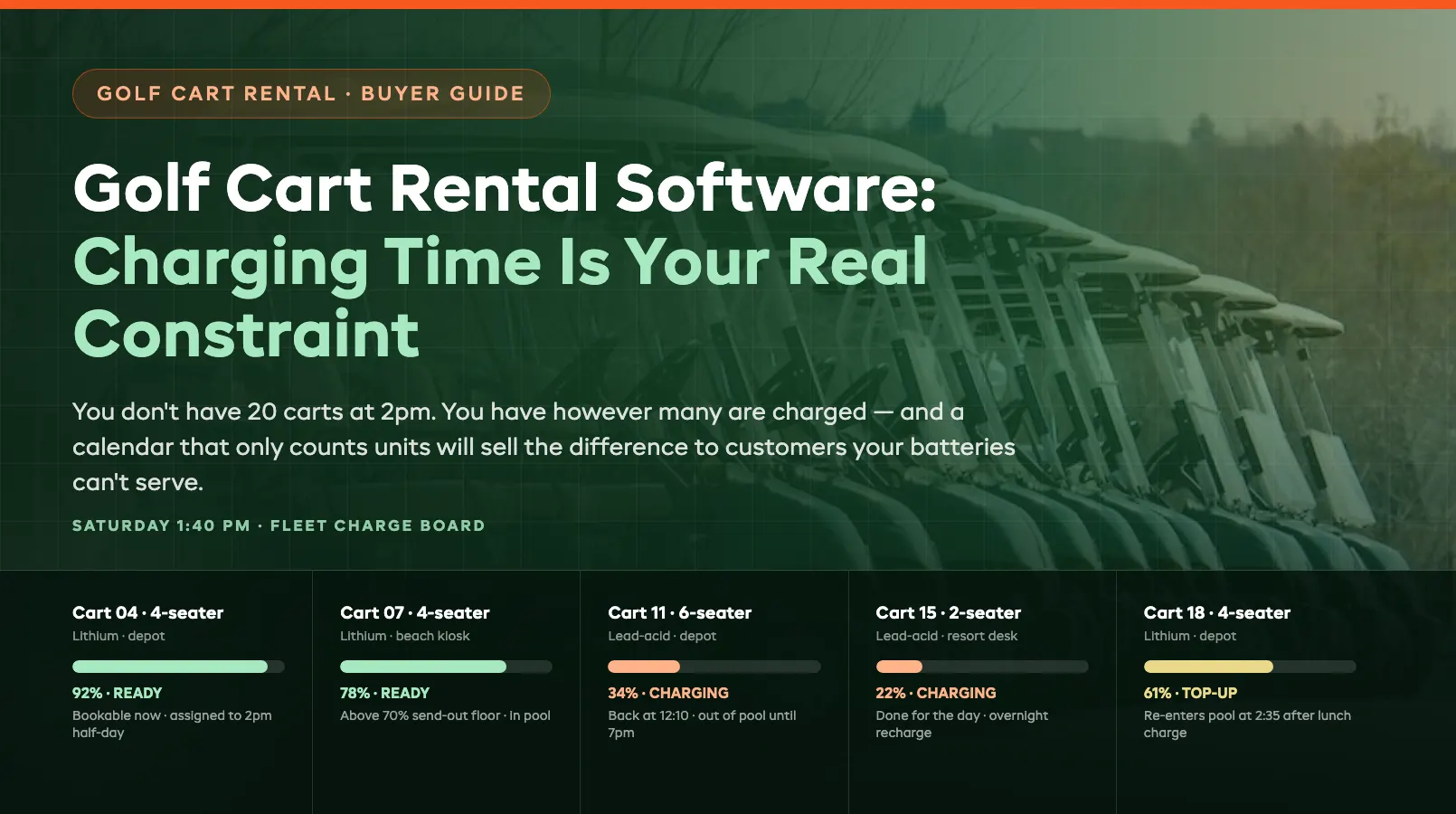
Ask a cart rental operator how big their fleet is and they will give you a number - 12 carts, 20 carts, 40 carts. Ask how many of those carts can take a booking at 2pm on a Saturday and the honest answer is "depends what came back this morning." A lead-acid cart that returns at noon on 30% battery is not inventory for the afternoon; it is a parking space with a cable in it for the next six to eight hours. That gap - between carts owned and carts charged - is where cart rental businesses overbook, walk customers, and quietly lose their best-rated season.
Most booking software never sees the gap. It counts units. If the calendar says 20 carts and 14 bookings, it will happily sell six more afternoon slots that your batteries cannot honor. The fix is not more carts; it is software that treats charging the way it treats any other turnaround constraint. This guide covers how to model that, plus the rate ladder, waiver gate, multi-location setup, and deposit structure that round out a cart operation. For the feature-by-feature platform breakdown, see our golf cart rental software page - this guide is about running the fleet on top of it.
Charging Is Scheduled Downtime, Not Dead Time
Start with the physics, because every operational decision hangs off it:
- Lead-acid packs take 6-10 hours to charge from a half-day of hard use, and they resent partial charging - repeated shallow top-ups shorten pack life. A lead-acid cart is realistically a one-long-hire-per-day or two-short-hires-per-day asset.
- Lithium packs charge in 2-4 hours, take opportunity charging between hires without damage, and hold rate in heat. A lithium cart can run a morning block, top up over lunch, and run an afternoon block - roughly double the sellable hours per day of the same cart with a lead-acid pack.
- Heat and terrain tax both. A cart that does hills, sand paths, or four adults in August burns through its range figure well below spec. Fleets that plan on brochure range overpromise by 20-30%.
The operational translation: every return should carry a battery state, and availability should respect it. In practice that means three rules built into the booking system:
- A charge buffer per unit, set by chemistry. A returned lead-acid cart is blocked for its full recharge window before it re-enters the pool. A lithium cart gets a shorter buffer, or re-enters early once it crosses your minimum send-out threshold.
- A send-out floor. No cart goes out below a set charge level - 70-80% is the common floor for half-day hires. Sending a 50% cart on a four-hour booking is how you end up towing your own inventory off a beach road.
- Booking by type, not by unit. Customers book "a 4-seater for the afternoon," and the system assigns whichever unit is charged. Pooling absorbs the charging carts the same way it absorbs a unit that is off for repairs - which the calendar handles automatically when charging is modeled as downtime.
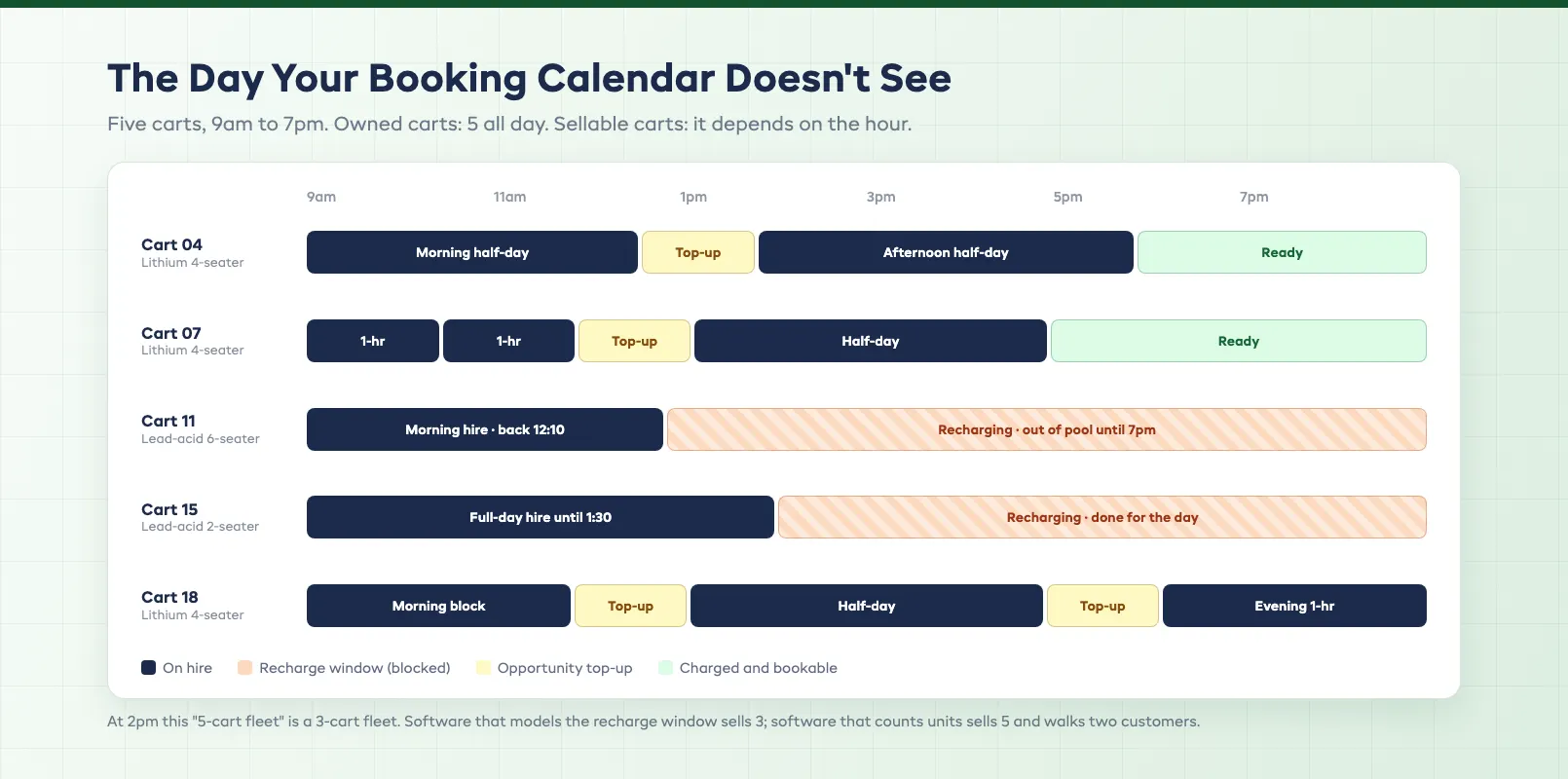
Lay a day out on a timeline and the shape becomes obvious: a 20-cart mixed fleet might genuinely offer 20 morning slots but only 12-14 afternoon slots, and which 12-14 depends on what came back when. A system that models the recharge window sells exactly that. A system that counts carts sells 20 twice and leaves you choosing which customer to disappoint in person.
Staggering helps too. If every morning hire ends at 12pm, every cart hits the chargers at once and the afternoon starts thin. Offering 11am, 12pm, and 1pm return slots - priced identically - spreads returns across three hours and keeps a rolling supply of charged carts through the peak. For the minute-by-minute kiosk routine that makes this work - the return checklist, the live board, and the three-minute handover - see our guide to running a cart kiosk at eleven turnarounds a day.
Price Hourly and Half-Day Blocks Around the Charge Cycle
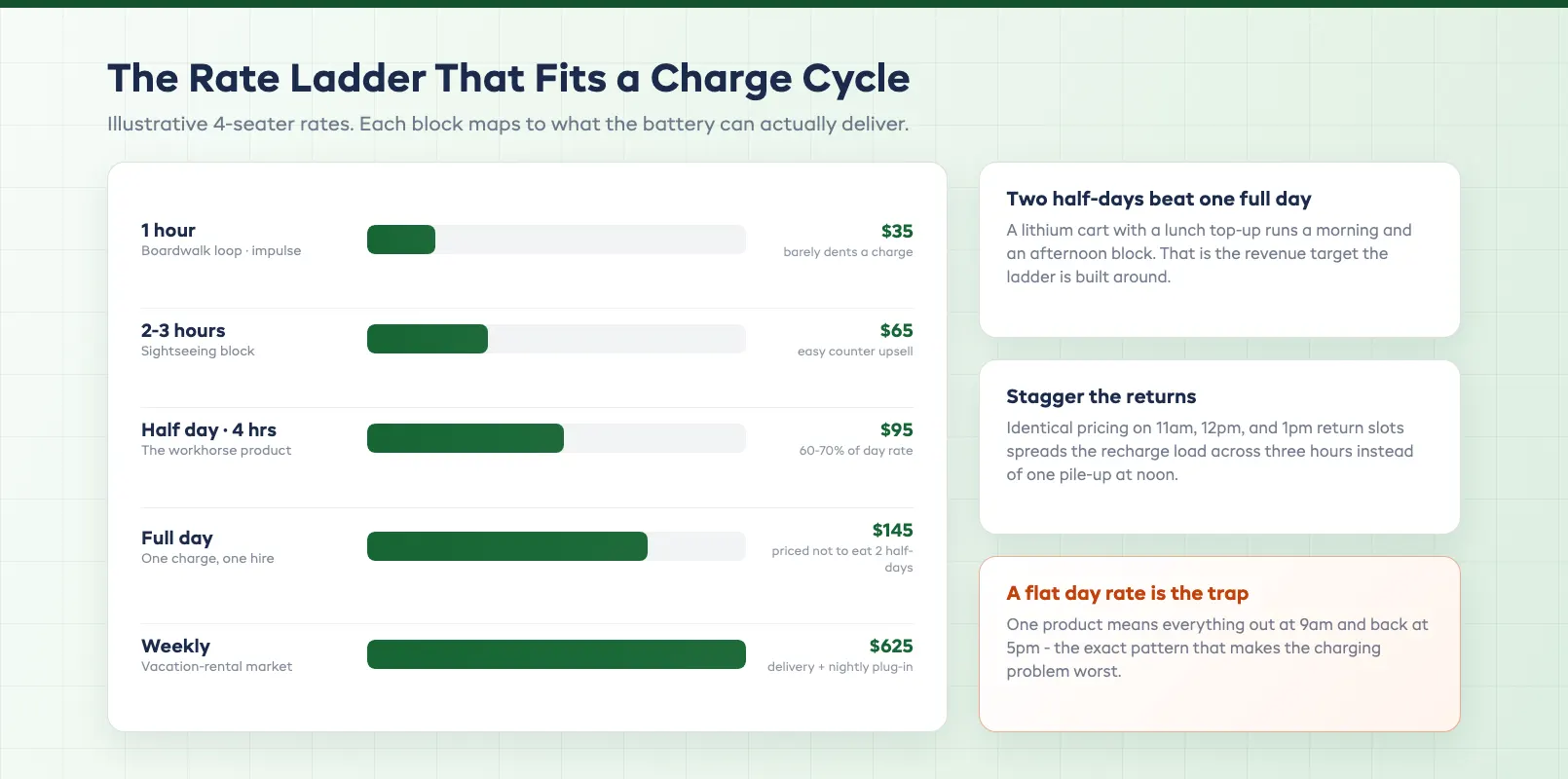
The cart rate ladder that fits both customer demand and battery reality:
- One hour - the impulse product for boardwalks and resort loops, typically $25-45 depending on cart size. Hourly hires barely dent a charge, so a lithium cart can run five or six of them back to back.
- Two to three hours - the sightseeing block, priced at a modest discount per hour so the upsell from one hour is easy at the counter.
- Half day (4 hours) - the workhorse product at 60-70% of the day rate. Two half-day blocks per cart per day is the revenue target a lithium fleet can actually hit, because the lunch top-up sits between them.
- Full day - priced so the customer who will genuinely use eight hours takes it, but not so cheap that it cannibalizes two half-days. On a lead-acid fleet, full-day hires are often the better product - one charge, one hire, one clean overnight recharge.
- Multi-day and weekly - for the vacation-rental market, where the cart lives at the customer's rental house. These hires need a charging briefing at handover ("plug it in every night, here is the cable") and carry the delivery logistics covered below.
For the full rate card - seasonal multipliers, the weekly community rate, deposits and the damage schedule, and the add-ons that lift the average ticket - see our guide to pricing cart hire by the hour, day, and week.
The mistake to avoid is a flat day rate as the only product. It leaves the hourly and half-day money on the table, and it books your fleet in the exact pattern - everything out at 9am, everything back at 5pm - that makes the charging problem worst. A ladder with staggered blocks is a battery-management tool wearing a price tag.
Seasonality belongs on the ladder as well: shoulder-season weekday rates 20-30% under peak keep carts turning when demand softens, and the booking data will tell you which blocks sell out first - that sell-out pattern is your instruction for what to buy next, and it is worth reviewing monthly.
No Signature, No Key: The Waiver Gate
A golf cart is a motor vehicle that customers drive themselves, often on public roads, sometimes with their kids aboard. The liability profile is closer to car rental than to renting a kayak, and the paperwork has to run like it:
- A signed waiver before every hire, no exceptions. Sent at booking so most customers sign from their phone the night before, checked at pickup, and stored against the booking. The waiver names the risks, the rules, and the damage liability the customer accepts.
- A driver check at the counter. Valid driver's license, sighted and photographed, for every person who will drive - not just the person paying. Where carts are street-legal LSVs, road rules apply and your insurance will care who was behind the wheel. Set your own minimum driver age to your policy and jurisdiction, and enforce it in the booking flow so an underage group finds out at booking time, not at the kiosk.
- A rules briefing that is recorded, not recited. Passenger limits, no beach or dune driving, curfew hours, where the cart may and may not go, what happens if it comes back on a flatbed. Ninety seconds, delivered from a checklist on the booking, with the customer's acknowledgment captured alongside the waiver.
- A hard gate in the software. The booking cannot move to "on hire" until the waiver is signed and the license is on file. When the gate is enforced by the system, a busy Saturday cannot talk your newest staff member out of it.
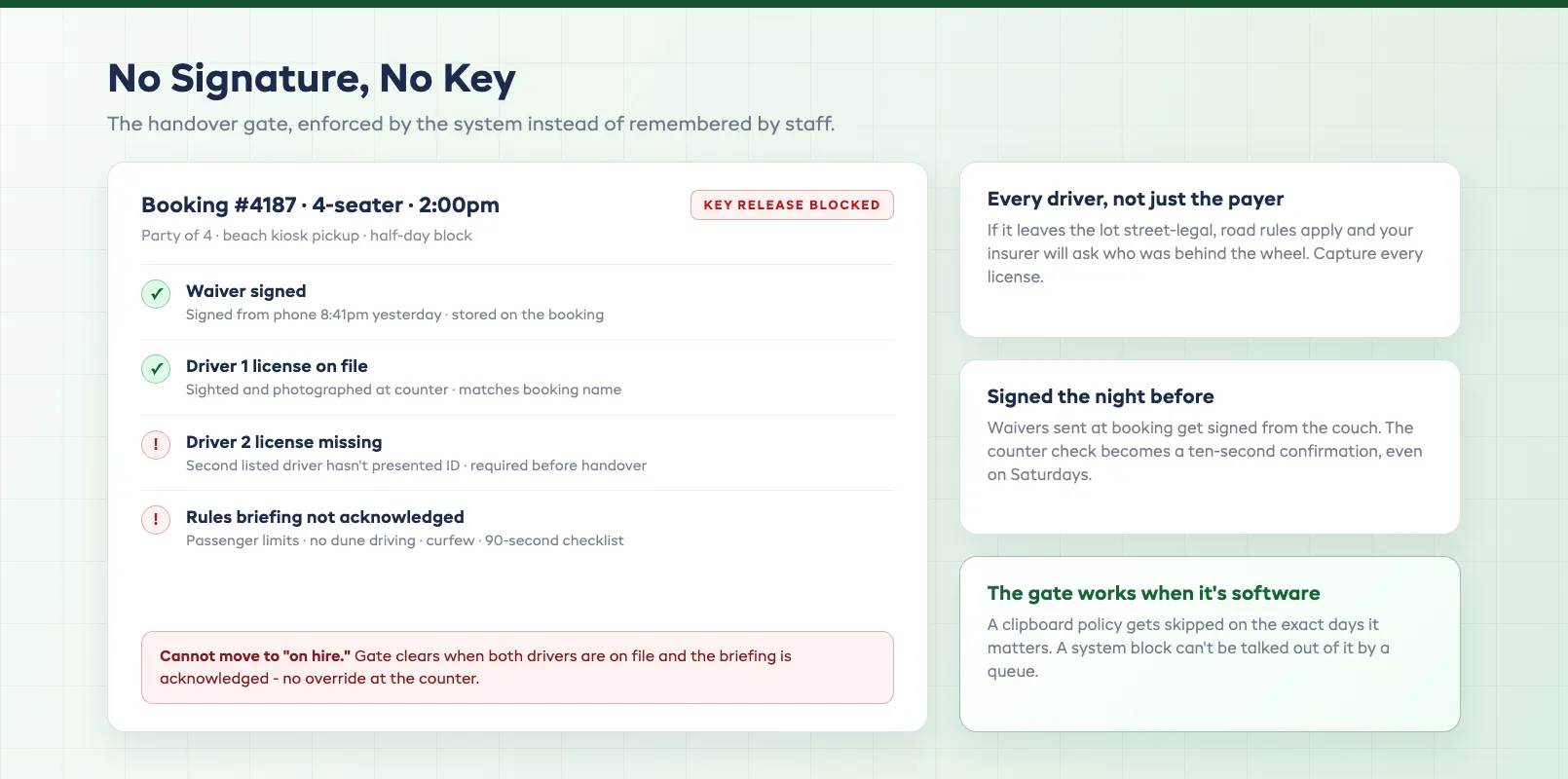
The gate matters most on your busiest days, which are exactly the days it gets skipped when it lives on a clipboard. Digital waivers tied to the booking turn the gate from a policy into a mechanism - and when an incident does happen, the waiver, the license photo, and the briefing acknowledgment are all attached to the hire that generated them.
Multiple Pick-Up Points, One Fleet
Cart rental rarely happens from a single counter. The typical operation grows into some mix of a main lot, a beach or marina kiosk, a resort partnership desk, and delivery to vacation rentals. Each of those points needs its own availability - and running them as separate fleets is how carts sit idle at one location while another turns customers away.
The structure that works is one pooled fleet with per-location allocation:
- Availability is real-time per pick-up point. The customer booking the beach kiosk sees the beach kiosk's carts, not the depot's. Overselling a location because "the fleet" had carts eight minutes' drive away is a walk-up-era mistake that software should have retired.
- Rebalancing is a scheduled job, not a panic. The morning board shows tomorrow's bookings by location; today's last task is moving carts to where tomorrow's demand is. One trailer run at 5pm beats three apology conversations at 10am.
- Delivery is a bookable slot with a route. For vacation-rental delivery, the delivery window is inventory too - a two-person crew can place only so many carts per morning. Selling delivery slots the way you sell carts keeps Saturday's route physically possible, and pairs naturally with a check-in call that confirms the charging cable is plugged in.
- Chargers are per-location capacity. A kiosk with four outlets cannot turn eight carts overnight. The rebalancing plan has to respect where the charging capacity lives, which usually means the depot does the heavy overnight work and kiosks run the topped-up morning fleet.
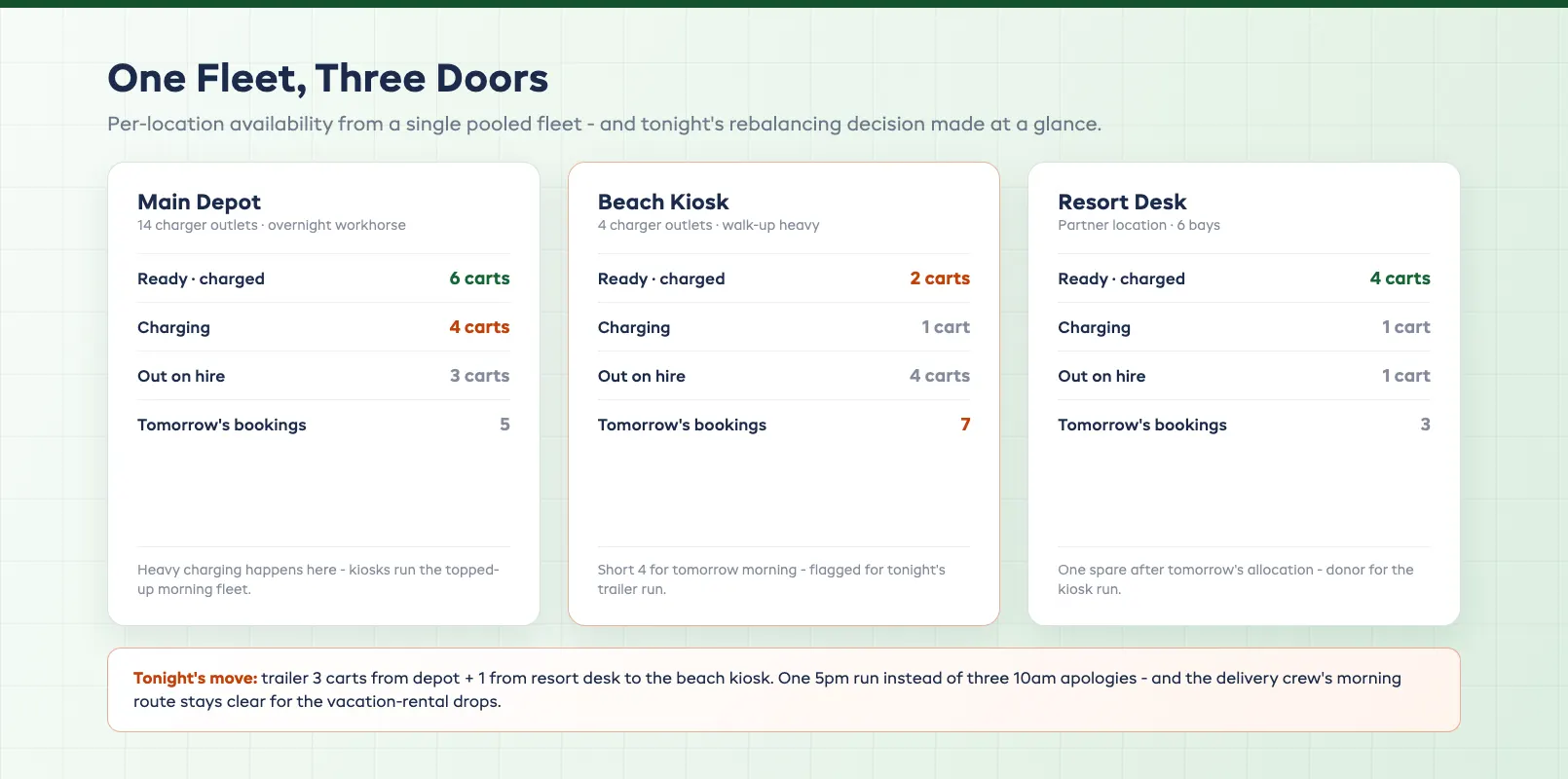
One fleet, many doors. The pooling logic that handles charging downtime handles location allocation with the same move: the customer books a type at a place and a time, and the system does the assignment.
Deposits That Survive an Argument
Cart damage is frequent, small, and almost always disputable without evidence: a cracked cowl, a bent wheel, a lost key fob, an upholstery burn. The deposit structure that wins those disputes:
- A card pre-authorization, not cash - $200-300 on standard fleet carts, $500 and up on street-legal LSVs and premium 6-seaters. Taken automatically at booking or pickup, released automatically on a clean return. Nobody counts bills, nobody forgets a release, and the card on file is what makes every other fee below collectible.
- Photo pairs on every hire. Four corners plus the dash and seats at handover, the same set at return, timestamped against the booking. Cart damage disputes settle by comparison in about a minute; without photos they settle by whoever argues longest.
- A published damage schedule with flat prices for the usual suspects: windshield, body panel, wheel and rim, mirror, key fob, charger cable. A number the customer saw and signed at booking collects; a number invented at the counter gets contested.
- A low-charge return fee. The cart-world equivalent of a fuel policy: multi-day hires that come back near-flat cost you the recharge window plus the next booking. Publish a flat fee for returns below your threshold, and most customers plug the cart in every night exactly as briefed.
- Late fees that defend the charge cycle. A cart back 90 minutes late did not just miss a booking - it missed its charging window, which can cost the following hire too. A published per-half-hour late fee, charged to the card on file, turns chronic lateness around within a season.
The Buying Checklist
Walking into a software evaluation, a cart operator's list looks like this. A platform earns a place on the shortlist only if it can:
- Model charge time as per-unit downtime - configurable buffers between hires, by unit or by battery type, so availability reflects charged carts rather than owned carts.
- Pool bookings by cart type - customers book a 4-seater, the system assigns the unit, and charging or workshop carts drop out of the pool without canceling anything.
- Sell an hourly-to-weekly rate ladder - hourly, multi-hour, half-day, full-day, and weekly products on the same calendar, with seasonal pricing and staggered return slots.
- Enforce the waiver gate - digital waivers sent at booking, license capture at pickup, and a hard block on handover until both are on file.
- Run multiple pick-up points from one fleet - per-location real-time availability, delivery windows as bookable slots, and a board that makes rebalancing a five-minute morning decision.
- Automate deposits and fees - card pre-authorizations tiered by cart class, automatic release on clean return, and one-tap charging of scheduled damage, late, and low-charge fees.
- Show per-cart numbers - hires and revenue per unit against its maintenance and battery cost, so replacement and re-fleeting decisions come out of a ledger instead of a hunch.
Plans that fit a cart fleet start at $23/month on annual billing - see pricing for current tiers, and the golf cart rental software page for the full feature rundown.
FAQ
How long does a golf cart take to charge between rentals?
It depends on the battery chemistry and how hard the previous hire ran it. Lead-acid packs typically need 6-10 hours after a half-day of use and are best charged fully overnight rather than topped up between hires. Lithium packs recharge in 2-4 hours and tolerate opportunity charging, so a lithium cart can top up over lunch and go back out the same afternoon. Practically, treat a returned lead-acid cart as done for the day unless it came back nearly full, and give lithium carts a shorter buffer with a minimum send-out charge level of 70-80%.
How many rentals can one golf cart do per day?
A lithium cart running a staggered schedule can handle two half-day hires, or five to six one-hour hires, with top-ups between blocks. A lead-acid cart realistically manages one full-day hire or two short hires, because its recharge window swallows the rest of the day. The bigger lever is the fleet pattern: staggering return times across 11am-1pm instead of collecting everything at noon keeps a rolling supply of charged carts and lifts the whole fleet's daily turn rate.
Do customers need a driver's license to rent a golf cart?
For any cart driven on public roads - and for every street-legal LSV - yes, and your insurer will expect a licensed driver regardless of local nuance. The workable policy is to require a valid driver's license from every person who will drive, sight and photograph it at pickup, and set a minimum driver age that matches your jurisdiction and your policy. Enforce the requirement in the booking flow and gate the key handover behind a signed waiver plus the license on file, so the check happens on every hire including the busy ones.
How much deposit should a golf cart rental take?
Tier it by cart class: $200-300 as a card pre-authorization on standard 2- and 4-seaters, $500 or more on street-legal LSVs and premium 6-seaters. Take it automatically at booking or pickup and release it automatically on a clean return. Pair the deposit with timestamped photo sets at handover and return plus a published damage schedule - flat prices for windshield, body panel, wheel, mirror, key fob, and charger cable - so the common small disputes settle by comparison against a schedule the customer signed.
What should golf cart rental software actually do?
Seven things: model charging as per-unit downtime so availability counts charged carts, not owned carts; pool bookings by cart type; sell an hourly-to-weekly rate ladder with staggered return slots; enforce a waiver-and-license gate before handover; run multiple pick-up points and delivery windows from one fleet; automate tiered deposits, damage schedules, and late and low-charge fees against the card on file; and report per-cart revenue against maintenance and battery cost. If a platform cannot model the charge cycle, the rest is decoration - the calendar will keep selling capacity the batteries cannot honor.
in one place