LOTO, Ride Safety, and Regulatory Compliance for Attractions
Safety is the one part of an attraction where the cost of getting it wrong isn't a bad review — it's a hospitalised guest, a shut ride, an insurance claim, or a regulator standing in your queue line on a busy Saturday. Most operators know this and still run safety the way they run a fire drill: a flurry of attention after something goes wrong, then quiet until the next scare. That gap is exactly where incidents and failed inspections live. A real safety compliance program isn't a binder you wave at your insurer once a year. It's a set of habits — locking out a ride before maintenance, inspecting on a fixed cadence, logging every near-miss — that run the same way whether you're there or not.
This guide lays out the working parts of attraction safety compliance: the regulations you answer to, a lockout/tagout (LOTO) program your team will actually follow, ride inspection schedules, safety training, incident reporting, and the documentation that protects you when a claim or an auditor arrives. It sits under our complete guide to running a ticketed attraction; start there if you're building the operation from the ground up.
Map the Regulatory Landscape You Answer To
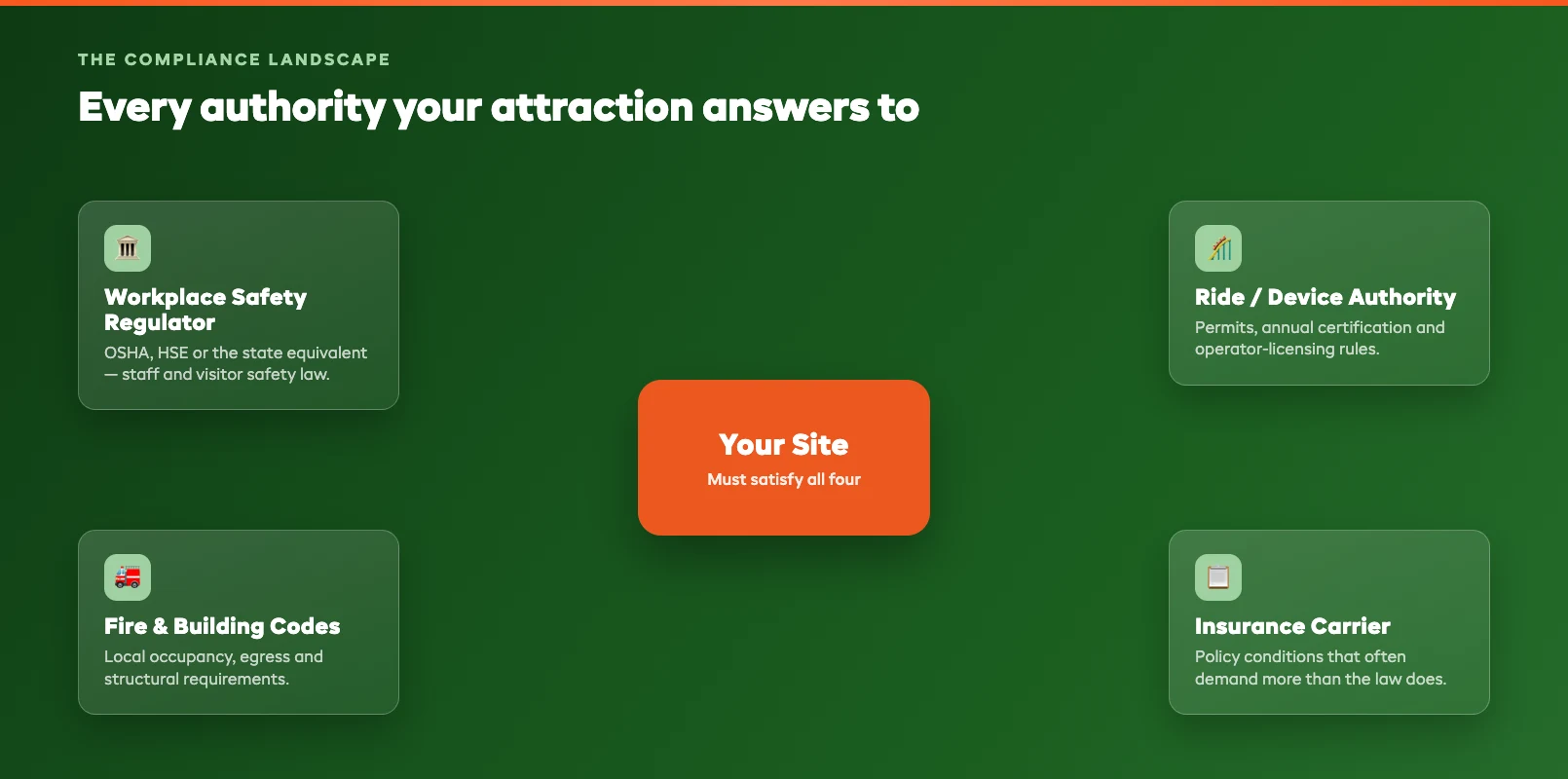
Before you can comply with anything, you need to know who you're complying with — and for attractions that's rarely a single body. Most operators answer to a stack of overlapping authorities: a national or state workplace-safety regulator (OSHA in the US, the HSE in the UK, or the state equivalent), an amusement-ride or device authority that governs ride permits and annual certification, your local fire and building codes, and — quietly the strictest of all — your insurance carrier, whose policy conditions often demand more than the law does.
The trap is assuming theme park regulations are uniform. Ride certification rules, inspection intervals, and operator-licensing requirements vary by state and country, and a device that's grandfathered in one jurisdiction needs recertification in another. Build a one-page register of every authority that touches your site, what each one requires, and when each requirement comes due. That single document turns "I think we're covered" into something you can actually prove.
Keep the language plain in your own register. The glossary in our attractions terms guide is worth bookmarking if any of the certification or device terminology is unfamiliar to a new manager.
Build a Lockout/Tagout Program Your Team Will Follow
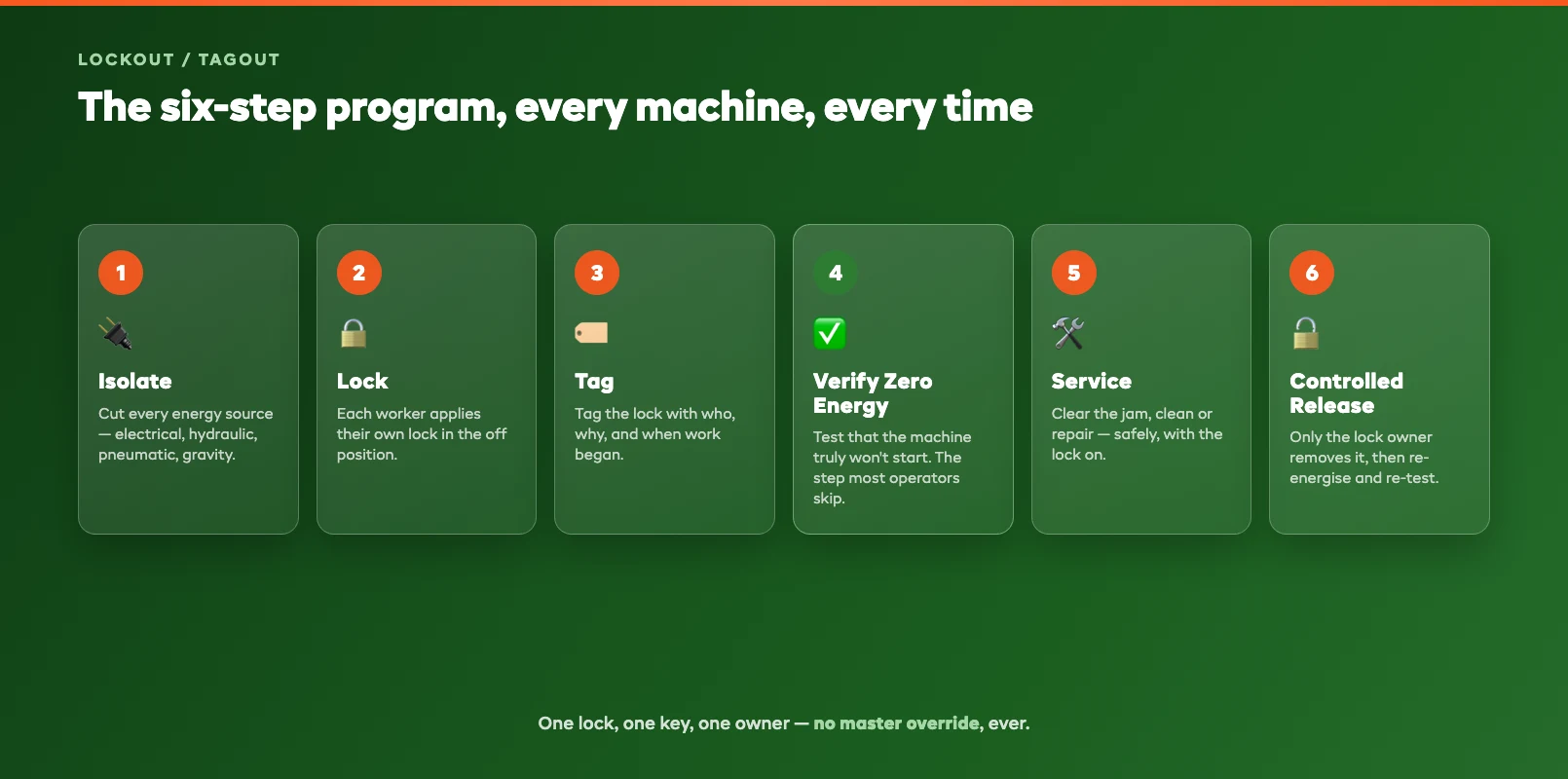
Lockout/tagout is the single most important safety control on any ride or powered attraction, and it's also the one most often skipped under time pressure. The principle is simple: before anyone services, cleans, or clears a jam on a ride, its energy sources — electrical, hydraulic, pneumatic, stored gravity — are isolated, locked in the off position, and tagged so no one can re-energise the machine while a person is inside it. Skip it once on a busy day and a maintenance tech becomes the reason your park is in the news.
A LOTO program that works has four fixed parts: a written procedure for each piece of equipment, the physical locks and tags, named authorized employees who are trained to apply them, and a verification step that confirms zero energy before work begins. The verification step is the one operators drop — applying the lock but never testing that the machine actually won't start. Each authorized person uses their own lock and their own key, and only that person removes it. No master override, no "the supervisor unlocked it so we could finish faster."
Turn the procedure for each ride into a posted checklist at the machine itself, not a page in an office binder. Our ride lockout/tagout checklist template gives you a structure to adapt per device so the steps are identical no matter which technician is on shift.
Set Ride Inspection Cadences and Stick to Them
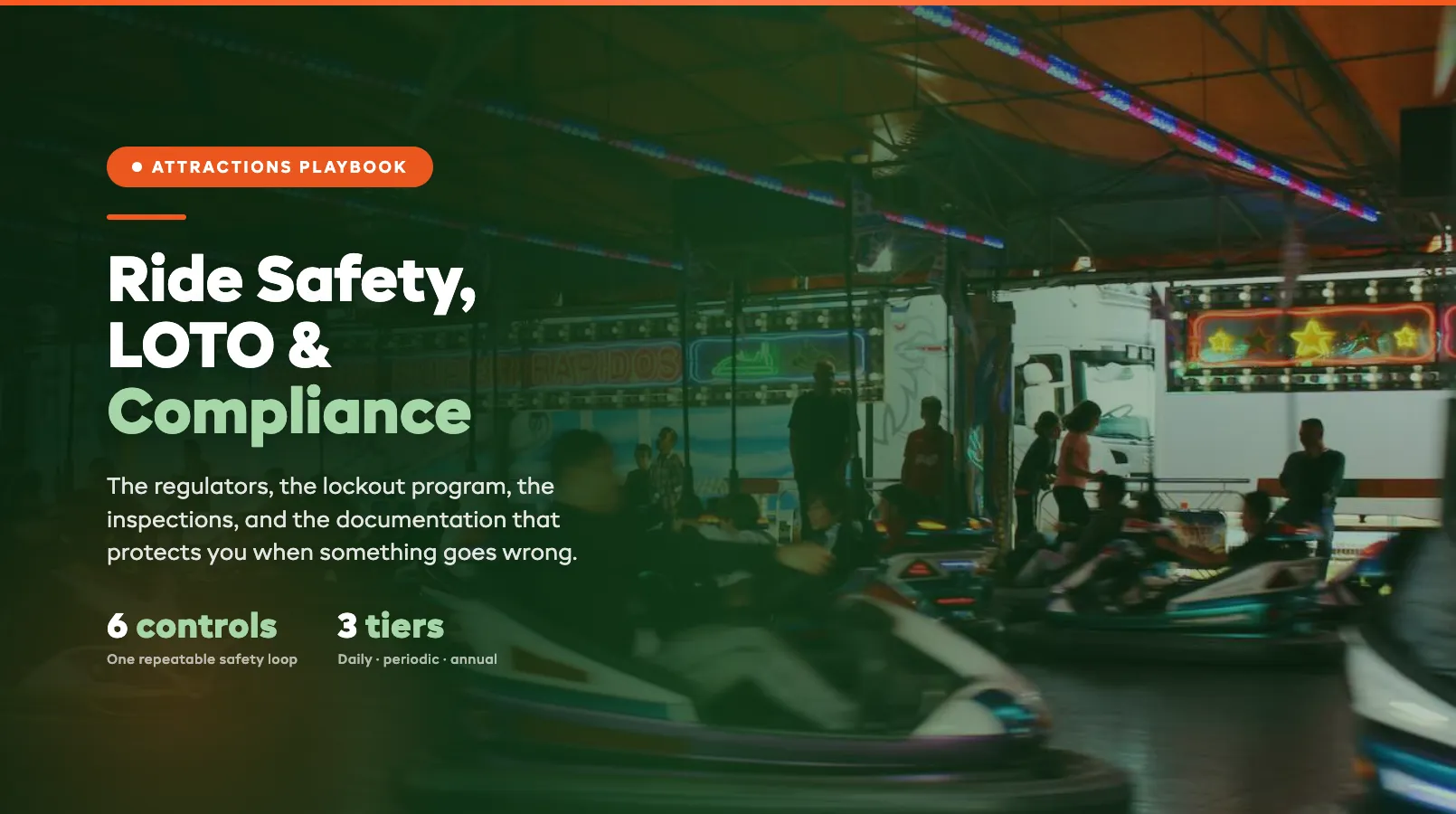
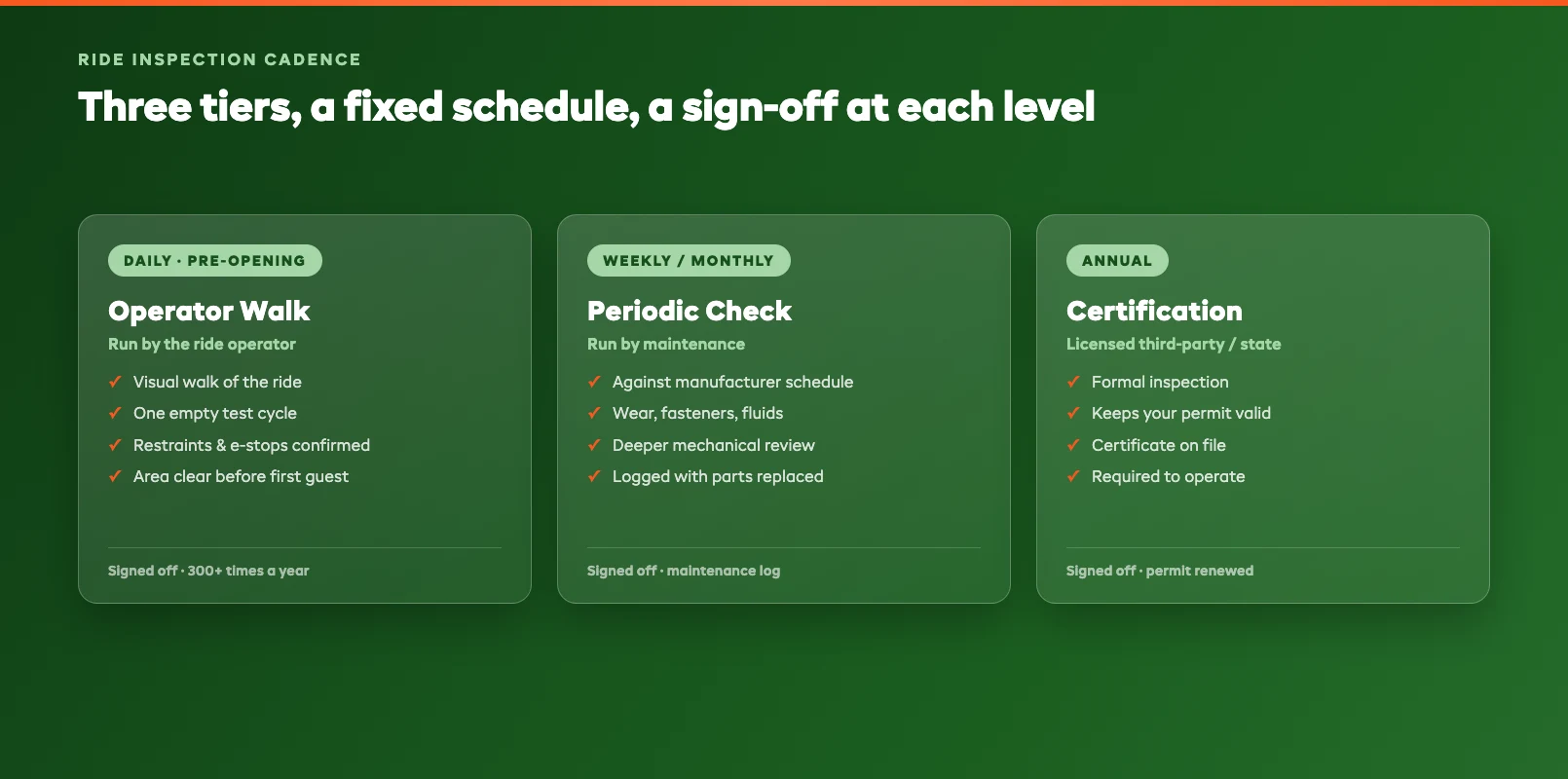
Inspections are where ride safety either becomes routine or becomes theater. The difference is cadence — a fixed schedule of who checks what, how often, with a record at each level. A workable program runs on three tiers. Daily pre-opening checks are run by ride operators before the first guest: a walk of the ride, a test cycle empty, restraints and e-stops confirmed, the area clear. Periodic checks — weekly or monthly — are deeper, run by your maintenance team against the manufacturer's maintenance schedule. Annual certification is the formal inspection by a licensed third-party or state inspector that keeps your operating permit valid.
The daily check is the one that catches most real problems, because it happens 300-plus times a year. A frayed restraint, an unusual noise, a sticky e-stop — these show up to the operator who runs the same ride every morning long before they'd show up in an annual report. Give that operator a fixed, signed-off checklist and the authority to keep a ride closed until a concern is cleared. A ride that opens an hour late is an annoyance; a ride that opens with a known fault is a lawsuit.
Standardize the daily walk with a fixed daily safety inspection checklist so every operator checks the same points in the same order, and the sign-off lands in the same place every day. The discipline of the daily check is what makes your capacity and operations run smoothly the rest of the day, because a ride that fails mid-morning is the fastest way to wreck a schedule.
Train Every Role on Safety, Not Just the Maintenance Team
Safety training fails when operators treat it as a maintenance-department concern. The booth attendant who knows the evacuation route, the floor host who spots a guest climbing a barrier, the ride operator who refuses to dispatch with a loose restraint — these are your real safety system, and most of them are seasonal hires who've been with you three weeks. Every role needs safety training pitched to what that role actually does, refreshed often enough that it's still there in August, not just on day one in May.
Build it in layers. Universal training that every hire gets before their first shift: emergency procedures, evacuation routes, e-stop locations, who to call and how. Role-specific training for the people who run rides, apply LOTO, or handle guest incidents. And a refresh cadence — short, regular safety briefings rather than one annual marathon nobody remembers. This is the safety slice of the broader program in our attraction staff training guide; the two are designed to be run together. Where a tool like Dash AI helps is keeping each staffer's certification and refresh dates visible so a lapsed qualification surfaces before the person is rostered, not after.
Standardize Incident Reporting Before You Need It
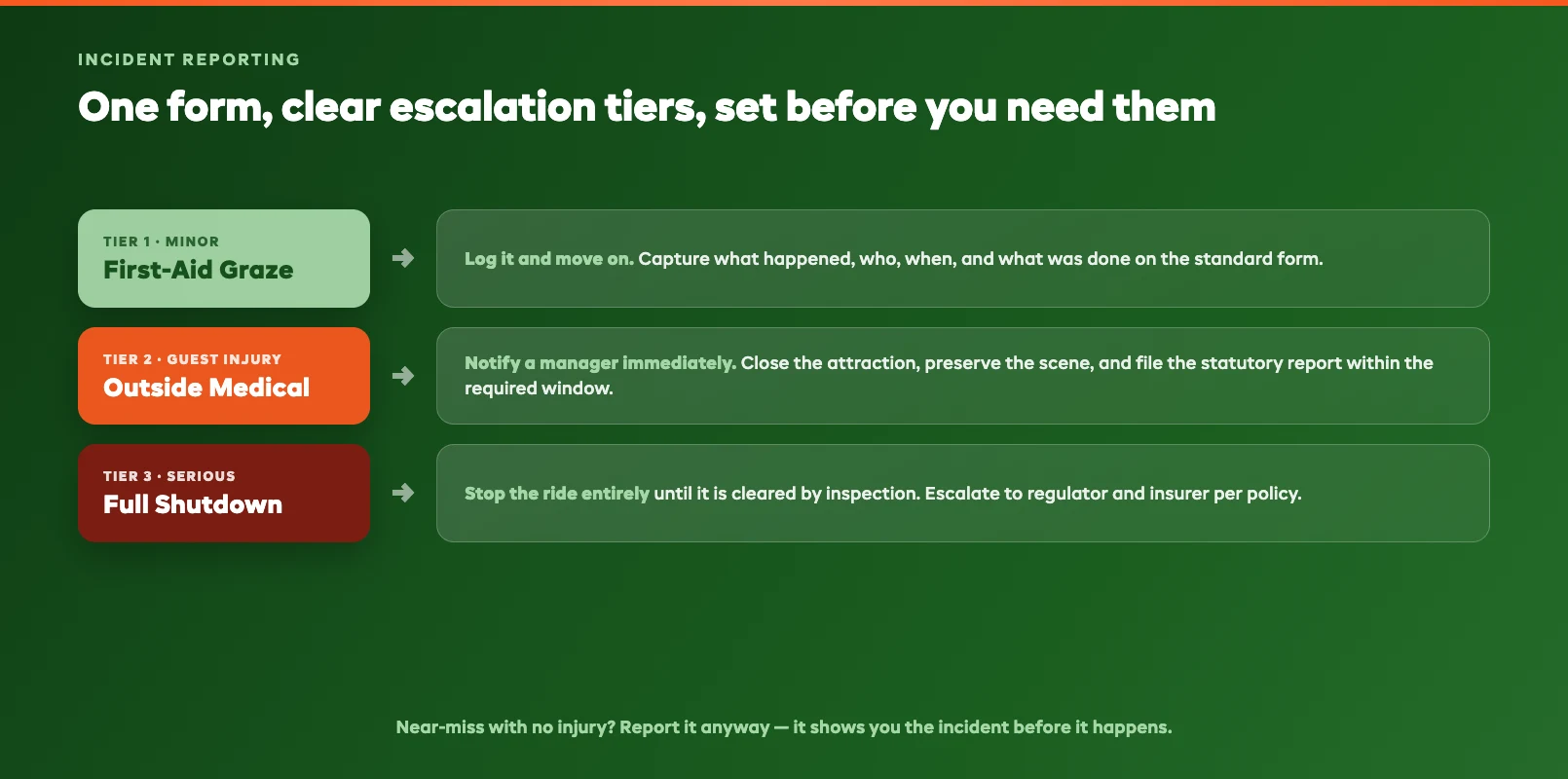
The worst time to design an incident report is twenty minutes after an incident. By then memories are already softening, witnesses are leaving, and the details that decide an insurance claim are slipping away. Standardize the form, the flow, and the escalation rules in advance so any staff member can capture a clean record under pressure — what happened, when, who was involved, who witnessed it, what was done, and who was notified.
Set clear escalation tiers so staff aren't guessing. A minor first-aid graze gets logged and moves on. A guest injury that needs outside medical attention triggers an immediate manager notification, ride closure, scene preservation, and in many jurisdictions a regulatory report within a fixed window. A serious incident stops the ride entirely until it's cleared by inspection. Near-misses — the close calls where nothing actually happened — are the most valuable reports you'll ever collect, because they show you the incident before it happens. Train staff that reporting a near-miss is a win, never a confession.
The same discipline underpins fair handling of guest disputes elsewhere in the operation — the clear-record habit you build here carries straight into your weather and refund decisions, where a documented reason protects you just as much.
Keep Documentation That's Audit-Ready, Not Just Filed
Everything above produces records, and records are worthless if you can't find them when an inspector or an insurer asks. Audit-ready documentation means every inspection sign-off, LOTO log, training certificate, incident report, and maintenance entry is captured, dated, attributed to a named person, and retrievable in minutes — not buried in a drawer or trapped in one supervisor's phone. When a claim lands or a permit comes up for renewal, the operation that can produce a clean, time-stamped trail settles fast and renews quietly. The one that can't spends weeks reconstructing what it should have logged.
Keep retention periods deliberate — many jurisdictions and insurers require records held for years, and a serious-incident file may need to survive far longer. Moving these logs off paper and into a single system removes the gaps where a missing daily check or an unsigned form quietly disappears. This is the documentation backbone behind the whole attractions operation, and it's what turns your season-long programs — including your season pass, group and school bookings, and OTA distribution — into a business an insurer is comfortable underwriting.
Putting It Together
Safety compliance isn't six separate projects — it's one habit loop. You map who you answer to, lock out what's being serviced, inspect on a fixed cadence, train every role, report every incident, and keep the records that prove all of it. Each part feeds the next: the daily inspection generates a log, the log becomes documentation, the documentation satisfies the regulator and the insurer. Build the loop once, run it the same way every day, and safety stops being the thing you scramble on after a scare. It becomes the quiet, boring, well-documented reason nothing made the news.
FAQ
What does attraction safety compliance actually require?
At minimum it requires meeting the rules of every authority that touches your site — typically a workplace-safety regulator, a ride or amusement-device authority, local fire and building codes, and your insurance carrier's policy conditions. In practice that means a written LOTO program, scheduled ride inspections with sign-offs, role-based safety training, standardized incident reporting, and retrievable documentation. Exact requirements vary by state and country, so build a register of who you answer to and what each one demands.
What is LOTO and why does it matter for rides?
LOTO stands for lockout/tagout — the procedure of isolating and locking a ride's energy sources (electrical, hydraulic, pneumatic, stored mechanical) before anyone services or clears it, then verifying zero energy before work begins. It matters because re-energising a machine while a person is inside it is one of the most common causes of serious attraction injuries. Each authorized worker uses their own lock and key, and only they remove it — no master overrides.
How often should attraction rides be inspected?
Run three tiers. Daily pre-opening checks by the ride operator before the first guest — a visual walk, an empty test cycle, restraints and e-stops confirmed. Periodic checks (weekly or monthly) by maintenance against the manufacturer's schedule. And an annual third-party or state certification that keeps your operating permit valid. The daily check catches the most real problems because it happens hundreds of times a year.
Who is responsible for ride safety at an attraction?
Legally the operator and named responsible managers, but in practice everyone on shift. Ride operators run pre-opening checks and refuse unsafe dispatches, maintenance handles periodic inspections and LOTO, booth and floor staff manage evacuations and spot hazards, and management owns the program and the records. Safety fails when it's treated as the maintenance team's job alone.
How should staff report a safety incident?
With a standardized form completed at the time, not from memory later — capturing what happened, when, who was involved, who witnessed it, what was done, and who was notified. Set escalation tiers in advance: minor issues get logged, guest injuries trigger immediate manager notification and ride closure, and serious incidents stop the ride until cleared. Encourage near-miss reporting too; those close calls show you an incident before it happens.
How long do I need to keep safety and inspection records?
It depends on your jurisdiction and insurer, but many require records held for several years, and serious-incident files often need to survive much longer. Keep every inspection sign-off, LOTO log, training certificate, incident report, and maintenance entry dated, attributed to a named person, and retrievable in minutes. The retention period should be a deliberate policy, not whatever happens to still be in the drawer.
Do small attractions really need a formal compliance program?
Yes — the regulator and your insurer don't scale their requirements to your size, and a single ride incident can be just as serious at a small site as a large one. The good news is the program scales down cleanly: a one-page authority register, posted LOTO checklists at each machine, a daily inspection sheet, layered staff training, and a single place for records. It's far less work than reconstructing everything after a claim or a failed inspection.
in one place