Weather Refund Policies for Outdoor Attractions: Fair Rules That Protect Revenue
Every outdoor attraction lives and dies by the sky, and the policy you write for bad weather is the one your guests judge you on hardest. Get it wrong in the generous direction and a single gray week can refund your whole margin back out the gate. Get it wrong in the stingy direction and a soaked family with a screenshot of your terms turns into a one-star review that costs you ten future bookings. A good weather refund policy isn't a legal shield bolted on at checkout — it's an operating decision you make once, in calm conditions, so that nobody has to improvise at 8am with a storm rolling in and forty bookings on the books. This guide walks through the six decisions that make a weather policy fair to the guest and survivable for the business. It sits under our complete guide to running a ticketed attraction; read that first if you're building your operation from the ground up.
Architect the Policy Before the First Cloud
A weather policy fails when it's written as one vague sentence — "refunds at management's discretion" — because discretion means every staff member improvises and every guest argues. The fix is to architect the policy as a small set of clear conditions, each tied to one predetermined response. When the forecast does X, you do Y, and everyone already knows it.
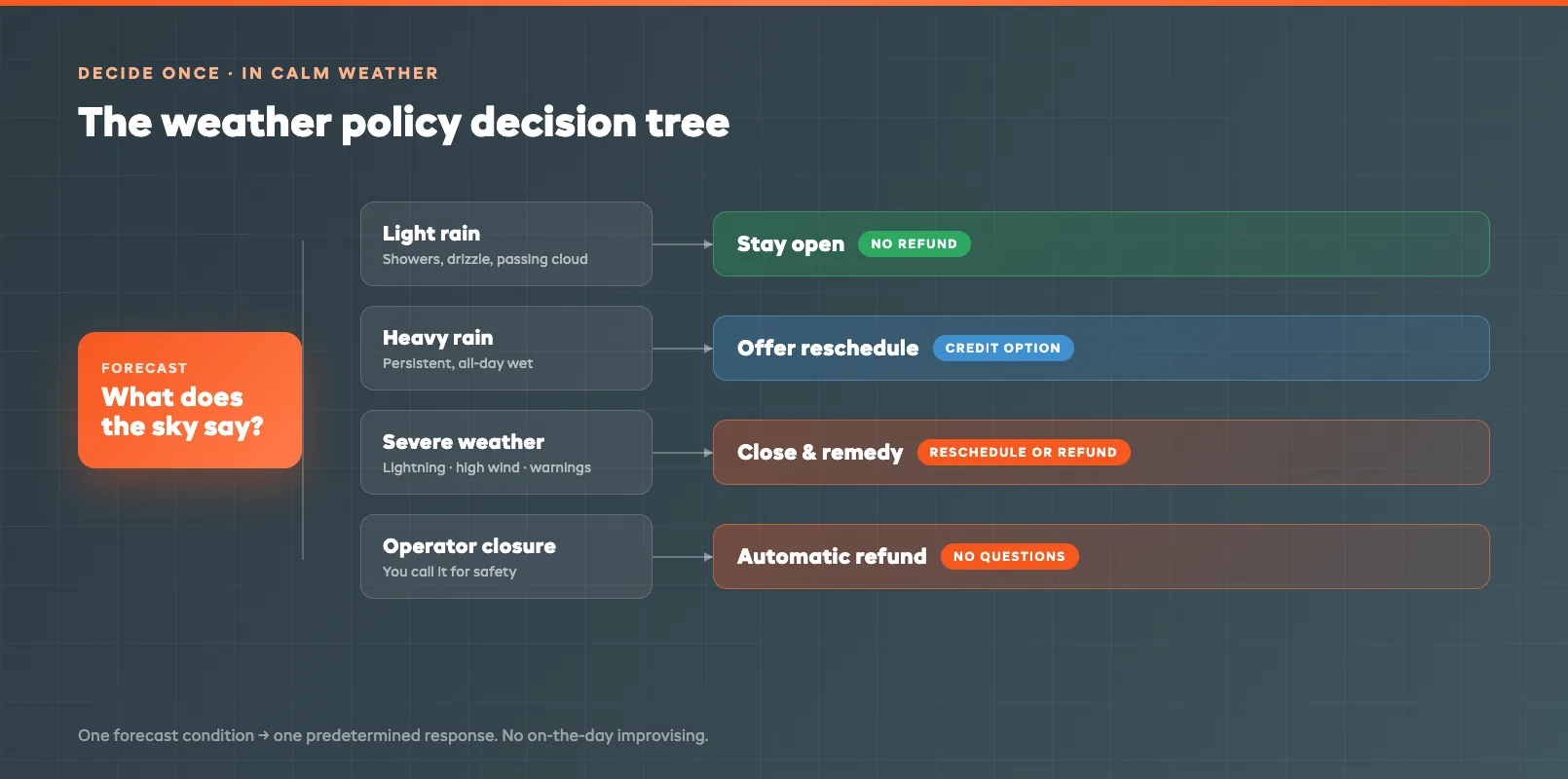
Start by naming the three or four weather states that actually change whether a guest has a good visit: light rain, heavy rain, severe weather, and your operational closure. For each one, decide in advance what the guest gets — full access, a reschedule, a credit, or a refund — and write it down in plain language. The point isn't to cover every meteorological edge case; it's to remove the on-the-day judgment call from a stressed staff member and replace it with a rule they can read off a card.
The decision tree below is the shape worth building before launch — every forecast condition flowing to one clear guest outcome, so the answer is the same whether the guest asks the gate, the call center, or the booking page.
Draw the Line Between Rain and Severe Weather
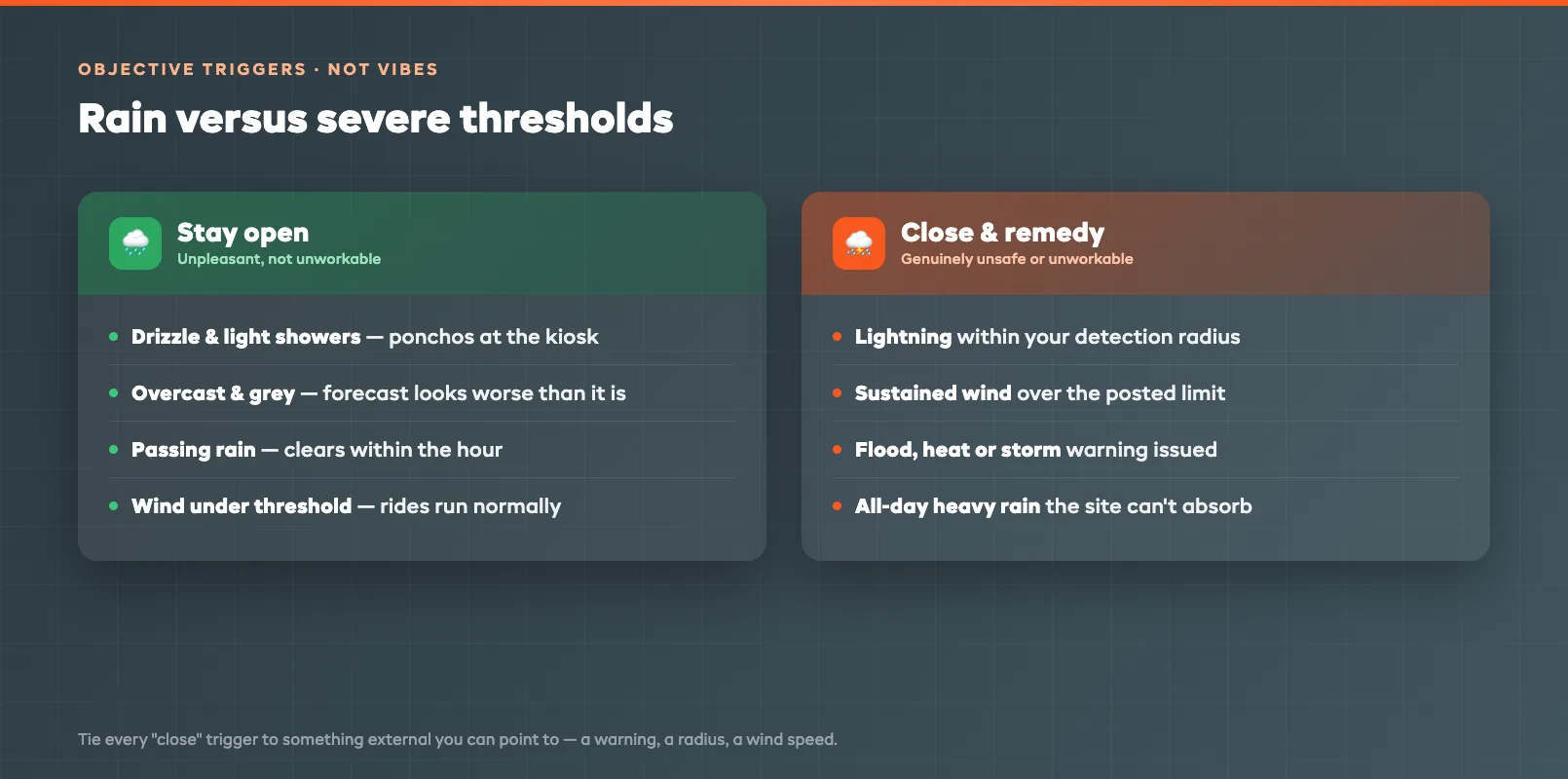
The single most important line in your policy is the one between weather that's merely unpleasant and weather that's genuinely unworkable. Rain is the trap. An outdoor attraction that refunds for any rain has handed every guest a free option to cancel the moment the forecast looks gray, and forecasts are gray far more often than the weather actually is. Most rain is a visit that's slightly worse, not a visit that didn't happen — and your policy should say so, kindly but clearly.
Set objective thresholds rather than vibes. "Light rain — we stay open, ponchos at the kiosk, no refund" is a policy. "We'll see how it looks" is not. Severe weather is where the line moves: lightning within a set distance, sustained winds over a threshold, flood or heat warnings, or anything that makes the site genuinely unsafe. Those are the conditions where you, not the guest, make the call to close — and where a refund or free reschedule is the right and obvious answer.
Tie your severe-weather triggers to something you can point to: a National Weather Service warning, a lightning-detection radius, a wind speed. When the trigger is external and objective, the guest can't argue it's arbitrary and your staff don't have to defend a judgment call. This safety line should match the thresholds in your daily safety inspection routine so the team closes for the same reasons every time.
Reach for Reschedule and Credit Before Refund
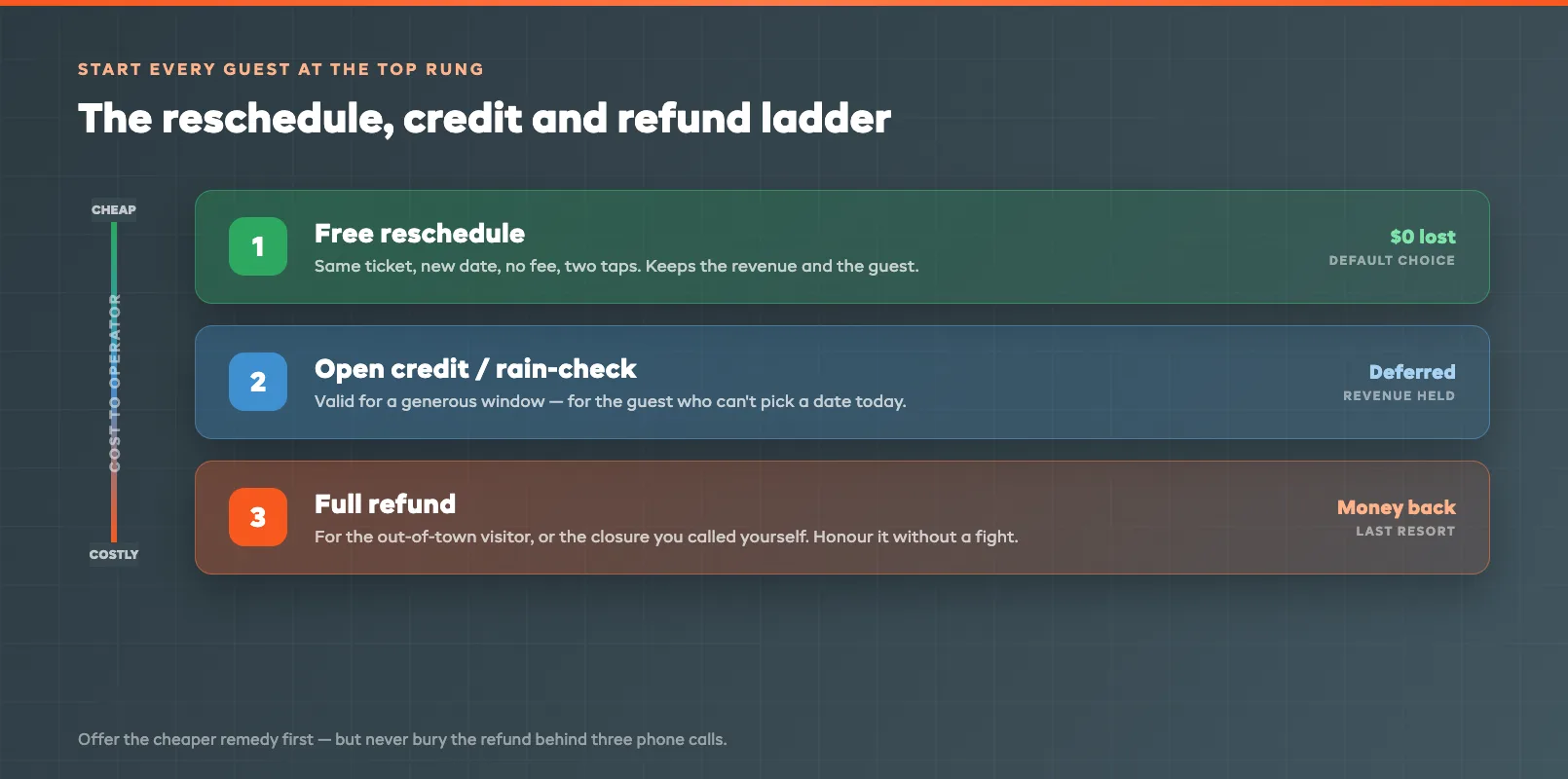
When weather does ruin a visit, the instinct is to reach straight for the refund — but a refund is the most expensive remedy you can offer, because it hands the money back and ends the relationship in the same move. A reschedule or a credit keeps the revenue, keeps the guest, and usually leaves them feeling just as fairly treated. Build your policy as a ladder, and start the guest at the top rung.
The top rung is the free reschedule: same ticket, new date, no fee, booked in two taps. Most guests genuinely planned to visit you and are happy to come another day — they wanted the experience, not their money back. The middle rung is an open credit or rain-check valid for a generous window, for the guest who can't commit to a date today. The bottom rung, the full refund, is for the guest a reschedule can't help: the out-of-town visitor flying home tomorrow, or the closure you called yourself.
Default every guest to the reschedule and make it the easiest path, but never make a refund a fight. The fastest way to turn a weather problem into a reputation problem is to bury the refund behind three phone calls when the guest genuinely needs one. Offer the cheaper remedy first, honour the expensive one without drama.
Communicate the Policy Before, During, and After
A weather policy that lives only in the terms-and-conditions link does nothing — guests don't read it until they're already angry. The policy has to be visible at the moment of booking, again the day before the visit, and one more time when the weather actually turns. Said three times, calmly and early, it reads as fairness; said once, after the fact, it reads as fine print.
At booking, put the weather policy in plain sight next to the date picker — one line, "rain or shine, here's what happens if the weather turns," linked to the detail. The day before a questionable forecast, send a proactive heads-up: here's what we're seeing, here's your reschedule link if you'd rather move, here's why we'll likely still run. That single message converts a furious next-day refund demand into a calm, guest-initiated reschedule, and it's the cheapest customer-service move you'll ever make.
When you do close, lead with the message before the guest has to chase you. A clear "we've closed today for lightning — your ticket is automatically valid for any future date, or reply for a refund" sent the moment you make the call turns a ruined plan into a tidy, handled inconvenience. The tone matters as much as the terms: a guest who feels informed forgives the weather, while a guest who feels ignored blames you for it.
Adjust the Policy by Season
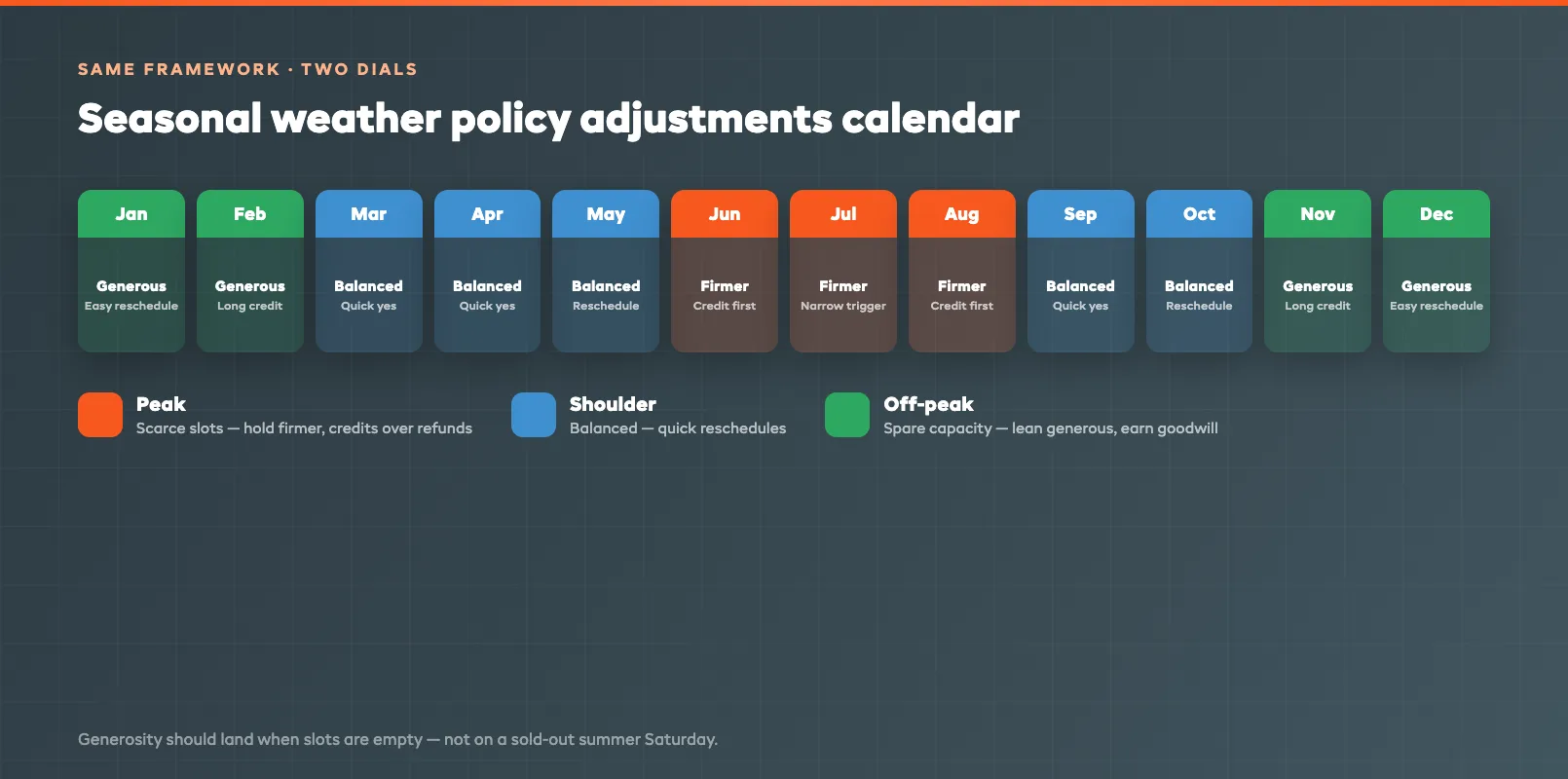
One weather policy can't serve a business whose risk changes month to month. A summer afternoon thunderstorm that clears in twenty minutes is a different problem from a winter day that's cold and wet from open to close, and a policy that treats them identically will be too loose in one season and too tight in the other. The smart move is to set seasonal versions of the same framework, not a brand-new policy each time.
Tune two dials by season: how generous the remedy is, and how easily the trigger fires. In your peak months, when demand is high and reschedule dates are scarce, you can hold a firmer line — credits over refunds, narrower closure triggers — because a missed slot is genuinely costly to give back. In shoulder and off-peak months, when you've got spare capacity and you're fighting for goodwill, lean generous: easy reschedules, longer credit windows, a quicker yes. The forecast you build the policy around should also shift — heat and storm thresholds in summer, wind and cold-exposure thresholds in winter.
This seasonal tuning works best when it's planned on the same calendar as your pricing and capacity, not bolted on. A wet shoulder-season Tuesday with empty slots is exactly when a generous reschedule costs you nothing and earns you a loyal guest; the same generosity on a sold-out summer Saturday gives away inventory you could have sold twice.
Automate the Whole Thing
A weather policy that depends on a manager watching the radar and hand-typing refund emails will break on exactly the day it's needed most — the busy Saturday when the storm hits and there are sixty bookings to contact at once. The parts of this that should run themselves are the repetitive, time-critical ones: watching the forecast against your triggers, messaging affected guests the moment a threshold trips, and processing the reschedules and credits without a queue forming at the desk.
This is the kind of timed, conditional, high-volume work worth handing to automation rather than a stressed supervisor. An attraction weather refund agent can watch the forecast against the thresholds you set, flag the day's at-risk bookings before opening, send the proactive reschedule offer the night before, and — when you call a closure — message every affected guest at once with their automatic options. Software handles the volume and the timing so your team handles the handful of guests who need a real conversation.
Keep the human in the loop for the call itself: a person decides to close, the system executes the consequences. That division — judgment stays human, execution gets automated — is what lets a small team run a fair, fast weather policy across a packed book without anyone melting down at the gate. The same logic underpins your wider capacity and timed-entry planning, where a weather-driven wave of reschedules has to land against slots you can actually fill.
Putting It Together
A weather refund policy that works isn't a generous gesture or a tight legal clause — it's a clear set of conditions decided in calm weather, a firm line between rain and danger, a remedy ladder that reaches for reschedule before refund, and comms that say the same thing three times before anyone's upset. Tune it by season, automate the repetitive parts, and keep the closure call human. Get that architecture right and a gray forecast becomes a handled inconvenience instead of a margin event. When you're ready to extend the same discipline across the rest of your operation, the attractions resource hub and attractions glossary cover the surrounding pieces — from group and school bookings to season pass programs and OTA distribution, where keeping this refund policy consistent across every marketplace matters most.
FAQ
Should outdoor attractions refund tickets for rain?
Usually not for light or moderate rain. Most rain makes a visit slightly worse, not impossible, and a blanket rain refund hands every guest a free option to cancel the moment the forecast looks gray. The fairer and more sustainable approach is to stay open, offer ponchos or covered areas, and reserve refunds and free reschedules for severe weather — lightning, high winds, flooding, heat or storm warnings — where the site is genuinely unsafe or you choose to close. Say this clearly at booking so nobody feels ambushed by it later.
Where should I draw the line between rain and severe weather?
Use objective, external triggers rather than judgment calls. Define light and heavy rain as "open, no refund" with comfort measures, and tie severe-weather closures to things you can point to: a National Weather Service warning, a lightning-detection radius, a sustained wind speed, or a flood or heat advisory. When the trigger is external and measurable, guests can't argue it's arbitrary and staff don't have to defend a personal decision. Match those thresholds to your daily safety inspection routine so the team closes for the same reasons every time.
Is it better to offer a reschedule or a refund for bad weather?
Lead with a reschedule. A free date change keeps the revenue and the relationship, and most guests genuinely wanted the experience rather than their money back. Build a ladder: a free reschedule first, an open credit or rain-check for guests who can't pick a date today, and a full refund for the cases a reschedule can't help — out-of-town visitors or closures you called yourself. Default everyone to the reschedule and make it the easiest path, but never bury the refund behind three phone calls when a guest genuinely needs one.
How should I communicate my weather policy to guests?
Say it three times. Show the policy in plain language next to the date picker at booking, send a proactive heads-up the day before a questionable forecast with a reschedule link, and message guests the moment you actually close. Said early and calmly, the policy reads as fairness; said once after the fact, it reads as fine print. The day-before message in particular turns a furious next-day refund demand into a calm, guest-initiated reschedule, which is the cheapest customer-service move you'll make.
Should my weather refund policy change by season?
Yes — tune the same framework rather than writing a new policy each time. In peak months with scarce reschedule dates, hold a firmer line: credits over refunds and narrower closure triggers, because a given-back slot is costly. In shoulder and off-peak months with spare capacity, lean generous with easy reschedules and longer credit windows to earn goodwill. The forecast thresholds should shift too — heat and storm in summer, wind and cold exposure in winter. Plan this on the same calendar as your pricing and capacity so generosity lands when slots are empty, not when you're sold out.
Can weather refunds and reschedules be automated?
The repetitive, time-critical parts should be. Automation can watch the forecast against your thresholds, flag at-risk bookings before opening, send proactive reschedule offers the night before, and — when you call a closure — message every affected guest at once with their options and process the changes without a desk queue. Keep the closure decision itself human: a person decides to close, the system executes the consequences. That split lets a small team run a fast, fair weather policy across a fully booked day without anyone improvising under pressure.
in one place