Attraction Staff Training: From Ticket Booth to Guest Experience
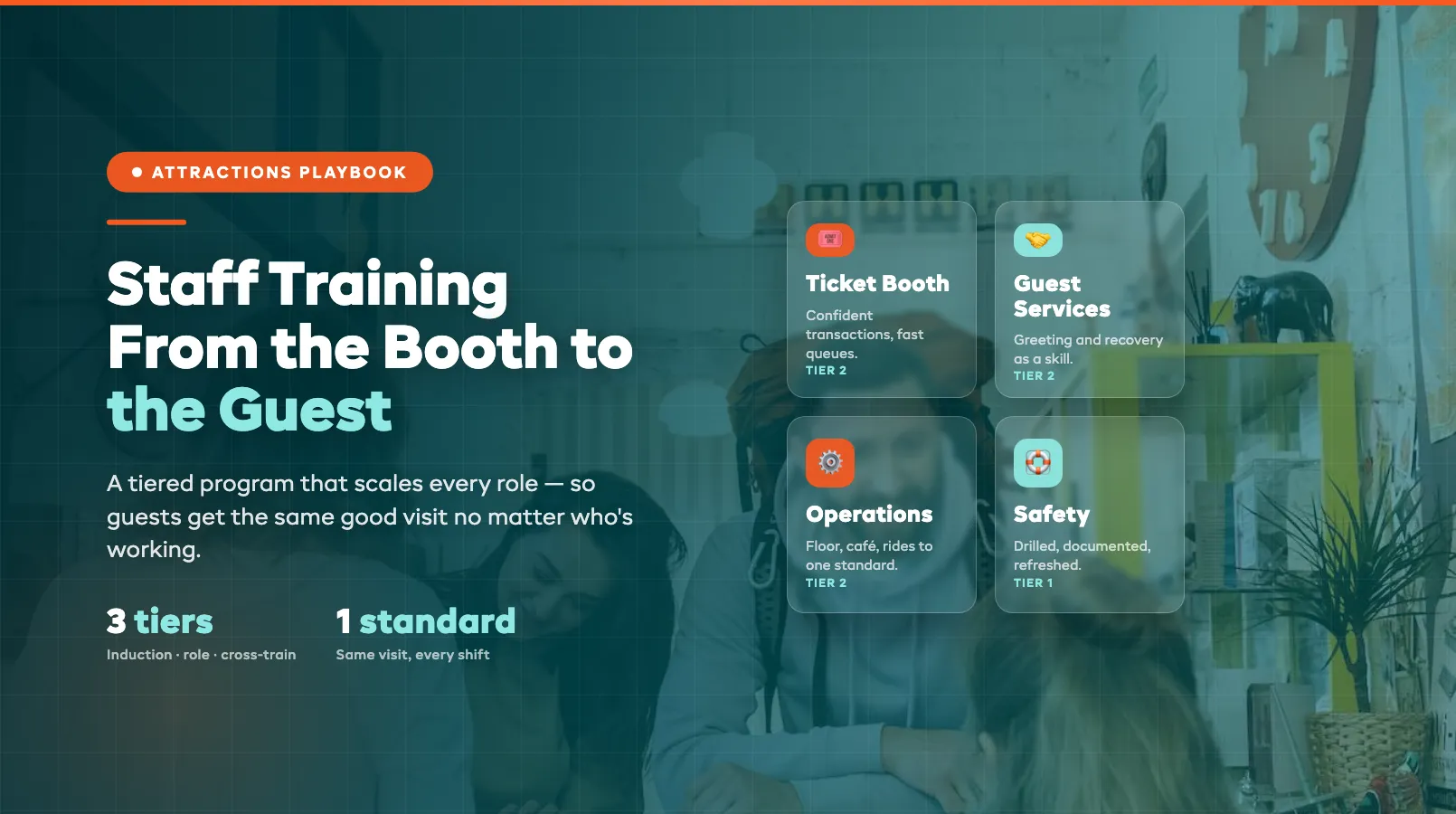
The guest at your gate never sees your booking system, your insurance file, or your maintenance log. They see a person in a polo shirt — and that person, in the first thirty seconds, decides whether the visit feels welcoming or like a hassle. Most attractions hire seasonal, hire fast, and hire young, then wonder why the guest reviews swing wildly from week to week. The answer is almost never the people. It's that nobody taught them the same things in the same way before they were handed a till and a queue. Training is the cheapest fix in the building, and the one most operators put off until a bad week forces it. This guide lays out a staff training program that scales across every role — from the ticket booth to the floor — so a guest gets the same good visit no matter who happens to be working. It sits under our complete guide to running a ticketed attraction; read that first if you're building the operation from scratch.
Build a Training Curriculum That Scales
The mistake most attractions make is treating training as a single all-day firehose on someone's first shift, after which they're "trained" forever. People forget most of a one-day dump within a week, and a new hire in March gets a completely different briefing than one in June because whoever ran it was busy. A curriculum fixes both problems. It's the same content, in the same order, taught the same way, every time — so quality stops depending on which manager had a spare hour.
Build it in tiers rather than one block. Tier one is the universal induction every single hire gets before they touch a guest: who you are, what a good visit looks like, where things are, what to do in an emergency. Tier two is role-specific training — the booth, the floor, the ride, the café — taught only to the people who'll do that job. Tier three is the advanced and cross-training layer that turns a competent staffer into someone who can cover three positions and train the next intake. Most operators only ever build tier one and wonder why their floor staff freeze the first time something goes wrong.
The roadmap below is the shape worth building before your hiring season opens — a clear path from day-one induction through role specialization to the cross-training that gives you scheduling flexibility when someone calls in sick.
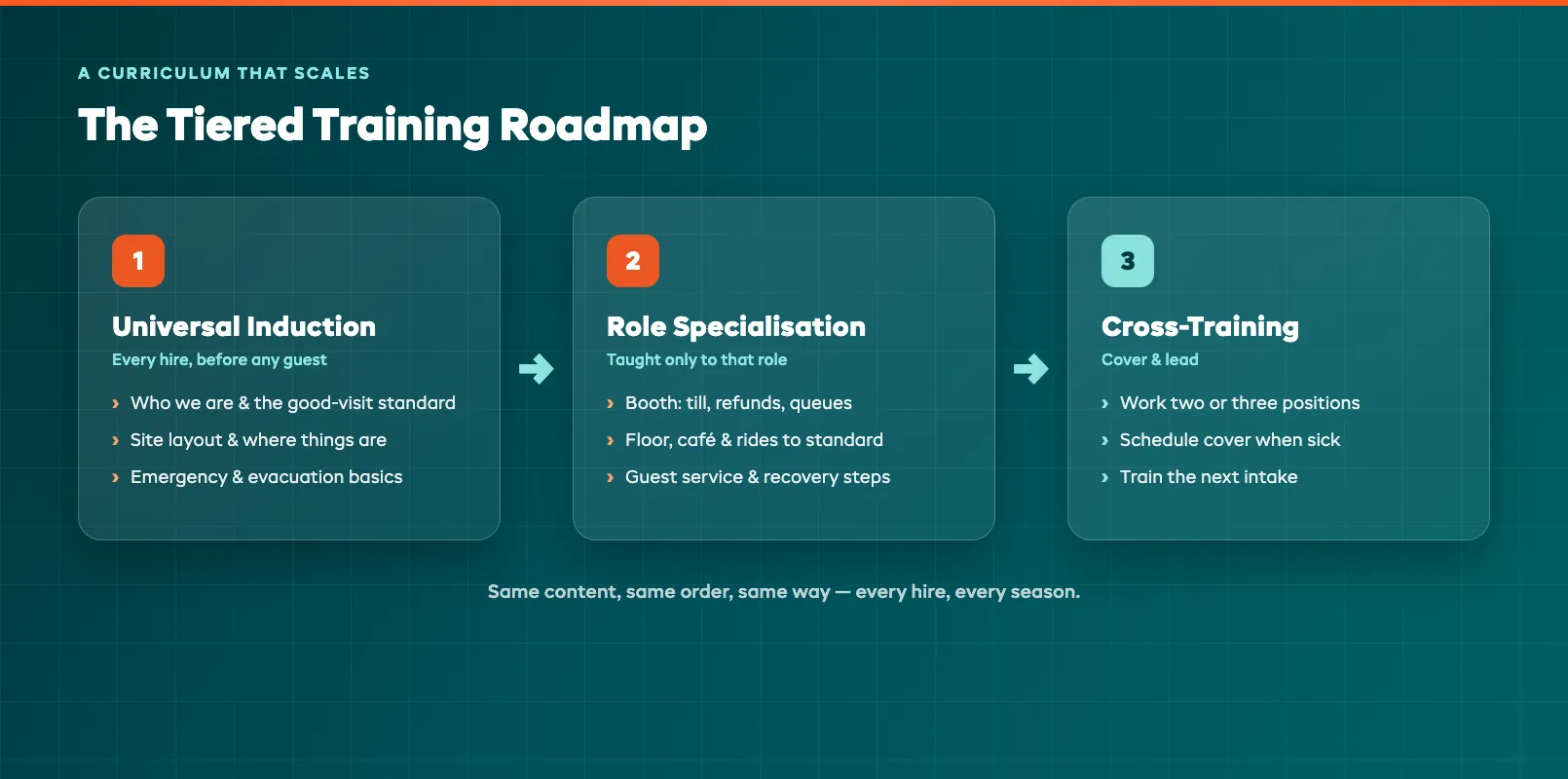
Write each tier as a short checklist a manager can actually follow, not a binder nobody opens. The goal is that any supervisor can onboard a new hire to the same standard without you in the room.
Get the Ticket Booth Right First
The booth is where the most money moves and the most first impressions are made, so it earns the most structured onboarding. A booth attendant who hesitates over a refund, can't find the group rate, or freezes when a card declines creates a queue that sours every guest behind the one they're helping. Booth training is part transaction mechanics and part composure under a growing line.
Start with the system itself. New booth staff should run a full set of real transactions in a training mode before they ever face a guest — a standard admission, a family with mixed ticket types, a discount code, a partial refund, a reprint, a card decline. Muscle memory at the till is what keeps the line moving when it's busy. Pair every new hire with an experienced one for their first shifts so the hard cases get handled with a calm second person right there. The faster a booth attendant gets to confident, the shorter your peak-hour queues run — and queue length is one of the few things guests complain about before they've even walked in.
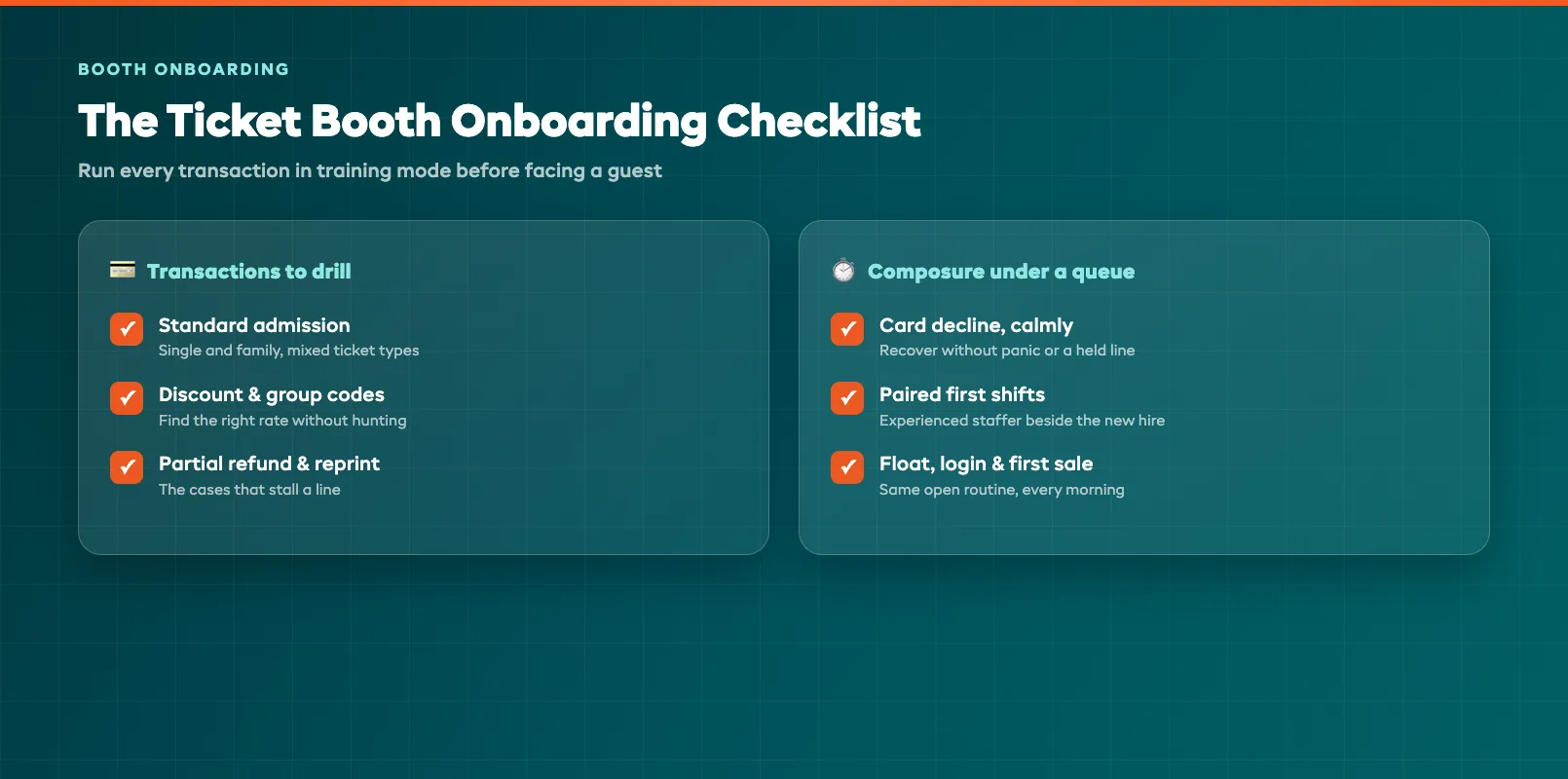
The same opening routine the booth team runs each morning is worth turning into a fixed opening-day checklist so the float, the system login, and the first-sale test happen the same way every day, by whoever opens.
Teach Guest Services as a Skill, Not a Personality
"Be friendly" is not training. Plenty of naturally warm people still don't know what to do when a guest is angry about something that isn't their fault, and plenty of quiet staff are excellent once they're given the words. Guest service is a set of teachable behaviors — greeting, reading a guest's mood, answering the same ten questions clearly, and recovering when something goes wrong. Treat it as a skill with steps, and you stop relying on hiring perfect personalities.
The highest-value piece is service recovery: the playbook for when a guest is unhappy. Most complaints are small — a closed ride, a long wait, a missed photo — and most are salvageable if the first staff member responds well instead of defensively. Teach a simple ladder: listen without interrupting, acknowledge the frustration, offer the one thing in your power to fix it, and escalate cleanly if it's beyond your authority. A guest whose problem is handled well often leaves happier than one who had no problem at all.
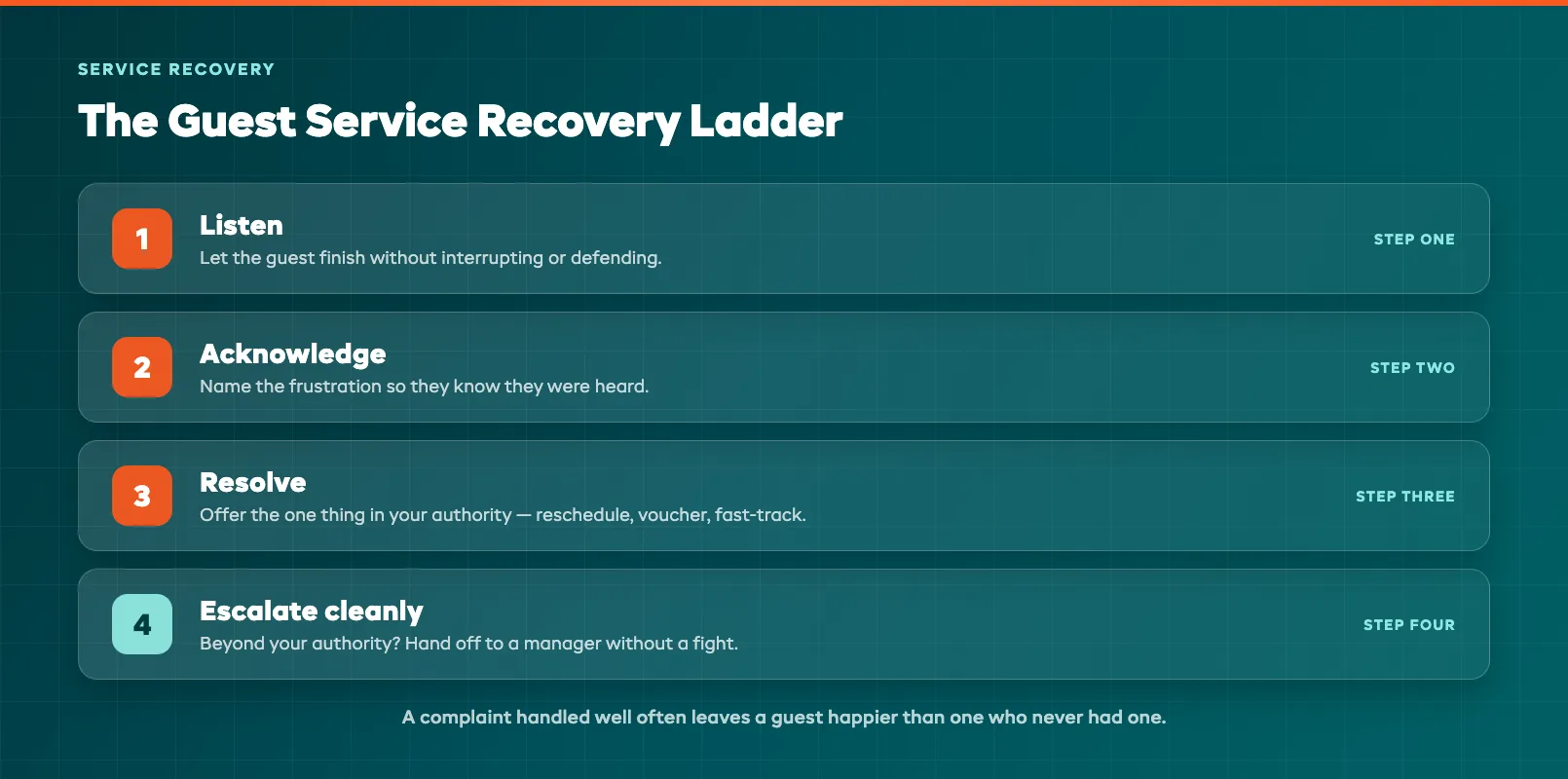
Give staff the boundaries of what they can offer without a manager — a free reschedule, a drink voucher, a fast-track pass — so a small problem gets solved on the spot instead of waiting in a queue for someone with a key. Authority handed down in advance is what makes recovery fast.
Train the Operations Roles to Their Own Standard
Behind the booth and the smile sits the machinery of the day — the floor staff, the ride operators, the café, the gift shop, the cleaning rota. Each of these is a distinct job with its own standard, and lumping them under "general staff" is how things slip. Operations training is about consistency: the café opens the same way every morning, the floor gets walked on the same schedule, the gift shop reconciles the same way at close. When the routine is documented, a new hire reaches competence in days instead of guessing for weeks.
The roles that touch capacity and flow deserve extra attention. Floor staff who understand how guests move through your site can spot a bottleneck forming and ease it before it becomes a complaint — which ties directly into how you manage capacity and flow across the day. Group-facing staff need their own briefing on how a school or corporate group is handled differently from walk-ups, because a coach of forty arriving at once breaks a routine built for trickling families. Cross-train your operations staff across two or three of these roles and you buy yourself scheduling flexibility that single-skilled staffing never gives you.
Make Safety Training Non-Negotiable
Every other kind of training improves a guest's day. Safety training is the kind that stops a good day from becoming the worst one of your operating life — and the one a regulator, an insurer, and a lawyer will all ask about if anything goes wrong. It cannot be the rushed last twenty minutes of an induction. It has to be specific, documented, and refreshed, because the cost of getting it wrong is measured in people, not reviews.
Build safety training around the real hazards of your site, not a generic template. Ride operators need lockout procedures and load limits drilled until they're automatic. Water attractions need supervision ratios and rescue protocols. Every staff member, regardless of role, needs to know the evacuation routes, the incident-reporting process, and who to call. Run it as part of the daily rhythm, not a once-a-year certificate — the same daily safety inspection routine that keeps your equipment checked is the natural place to keep your team's safety habits sharp. Document every session with names and dates; the record is what protects the business when the worst-case question gets asked.
Don't Stop at Onboarding — Build Ongoing Development
Most attraction training ends the day a hire is declared competent, and that's exactly where the good operators keep going. A staffer who learns one job and then does it unchanged for two seasons gets bored, gets sloppy, and starts looking for the next thing. Ongoing development is cheap insurance against both the boredom and the turnover — it keeps your best people sharp and gives your average people a reason to become good.
Keep it light and regular rather than grand and rare. A ten-minute pre-shift huddle to flag the day's groups and any changes does more than a quarterly all-hands nobody remembers. Short refreshers on the cases that actually go wrong — the angry-guest scenario, the busted card reader, the lost child — keep the rare-but-critical skills from rusting. And give people a visible path: a booth attendant who can become a shift lead, a floor staffer who can train the next intake. The progression chart below is the kind of map worth showing a new hire on day one, because people stay longer when they can see where the job goes.
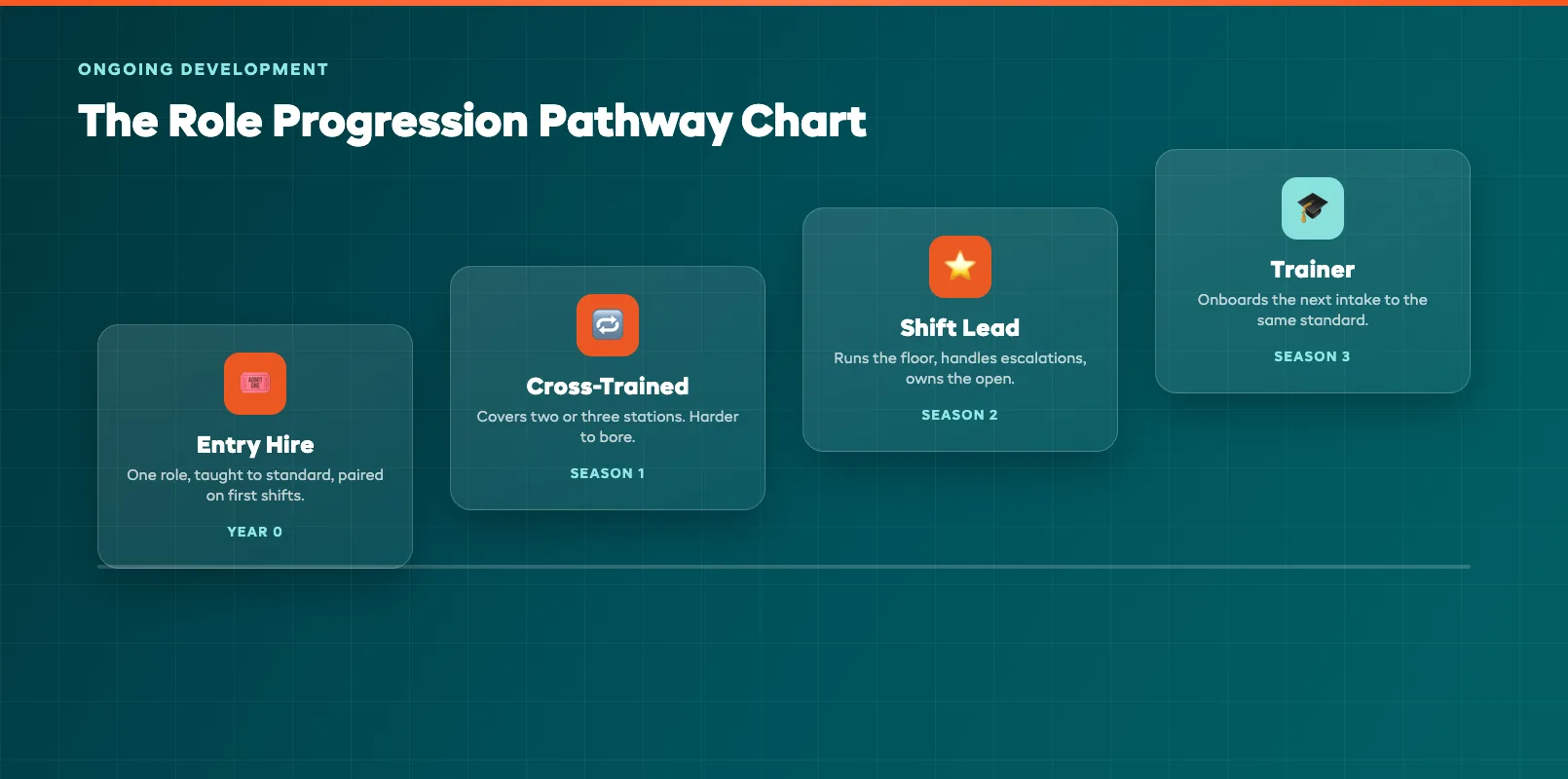
A few operators are starting to lean on Dash AI to surface which guest complaints cluster around which shifts or stations, which turns training from a guess into a targeted fix. But the engine of development is still the habit of regular, specific feedback — the tool just tells you where to point it.
Train for Retention, Not Just Competence
Every hire you lose is a hire you have to recruit, onboard, and train again from zero — and in an industry that runs on seasonal labor, that cost compounds fast. The attractions that keep their people aren't the ones paying the most; they're the ones where the job is clear, the training made people feel capable, and there's somewhere to go. Retention starts on day one, in how organized the onboarding feels. A new hire who's thrown to the floor unprepared quietly decides within a week that this place is chaos.
The same things that make training good make staff stay: a clear role, the confidence that comes from being properly taught, a manager who gives feedback instead of only catching mistakes, and a visible next rung. Cross-training helps here too — people who can work three stations are more engaged and harder to bore than people stuck at one. When you invest in the program, your seasonal staff come back next season instead of starting somewhere new, and a returning staffer is worth two new ones on day one. Keeping the experience consistent for guests also depends on closing the loop on feedback, which a post-visit review routine can help you do without chasing every guest by hand.
Putting It Together
A staff training program isn't a binder you write once — it's the system that makes a guest's visit good regardless of who's working. Build it in tiers so it scales, get the ticket booth confident first because that's where money and first impressions meet, teach guest service and recovery as skills with steps, hold operations and safety to documented standards, and keep developing people after onboarding so they stay. Get this right and the wild week-to-week swing in your reviews flattens into something you can be proud of. For the wider operation this training sits inside, the attractions hub and the attractions glossary cover the systems and the language your team works within every day. And if you run a season pass program or a weather refund policy, well-trained staff are what make those promises feel real at the gate — the same goes for the bookings that arrive through OTA distribution.
FAQ
How long should attraction staff training take?
There's no single number, because it depends on the role. A universal induction every hire gets can run two to four hours. Ticket booth staff need several supervised shifts on the till before they're solo. Safety-critical roles like ride operators take longer and should never be rushed. The better way to think about it is in tiers — induction, role-specific, then advanced — rather than one block of hours. Spreading it out beats a single firehose day people forget within a week.
What should a new ticket booth attendant learn first?
The transaction mechanics, in a training mode, before they ever face a real guest. Have them run a standard admission, a mixed-ticket family, a discount code, a partial refund, a reprint, and a card decline until those are muscle memory. Then pair them with an experienced attendant for their first live shifts so the hard cases get a calm second person. Confidence at the till is what keeps your peak-hour queue moving.
How do you train staff to handle angry or upset guests?
Teach service recovery as a ladder, not a personality trait. The steps are: listen without interrupting, acknowledge the frustration, offer the one thing in your power to fix it, and escalate cleanly if it's beyond your authority. Crucially, give staff a set of things they can offer without a manager — a reschedule, a voucher, a fast-track pass — so small problems get solved on the spot. A complaint handled well often leaves a guest happier than one who never had a problem.
How often should safety training be refreshed?
Far more often than the annual certificate most operators settle for. Core safety habits — evacuation routes, incident reporting, ride lockout procedures, supervision ratios — should be reinforced as part of the daily and weekly rhythm, not parked until a once-a-year session. The simplest approach is to attach safety checks to routines staff already run, like the daily inspection, and to re-drill the rare-but-critical scenarios in short refreshers. Document every session with names and dates.
Is cross-training attraction staff worth it?
For most attractions, yes. Cross-trained staff who can cover the booth, the floor, and a ride give you scheduling flexibility that single-skilled staffing never does — when someone calls in sick, you're not scrambling. It also fights boredom and turnover, because people who rotate across roles stay more engaged than people stuck at one station. The trade-off is the upfront training time, but it pays back the first time a peak Saturday loses a key person and the day still runs.
How does staff training affect guest reviews?
Directly, and more than almost anything else you can control. The wild week-to-week swing in attraction reviews is usually a training problem, not a people problem — guests are reacting to inconsistent service from staff who were taught different things in different ways. When everyone is onboarded to the same standard, the experience flattens into something reliable, and reliability is what earns steady high ratings. The fastest way to raise your average review is rarely a new ride; it's a better-trained team at the gate.
What's the best way to keep seasonal staff coming back?
Make the job clear, the training thorough, and the path visible. Seasonal staff who feel capable because they were properly taught — and who can see a next rung like shift lead or trainer — come back next season instead of starting somewhere new. Organized onboarding matters most in the first week, when a new hire quietly decides whether the place is run well or chaotic. A returning trained staffer is worth two new hires on day one, so retention is one of the highest-return investments in the whole operation.
in one place