Booqable vs Checkfront: Which Is Better? (2026)
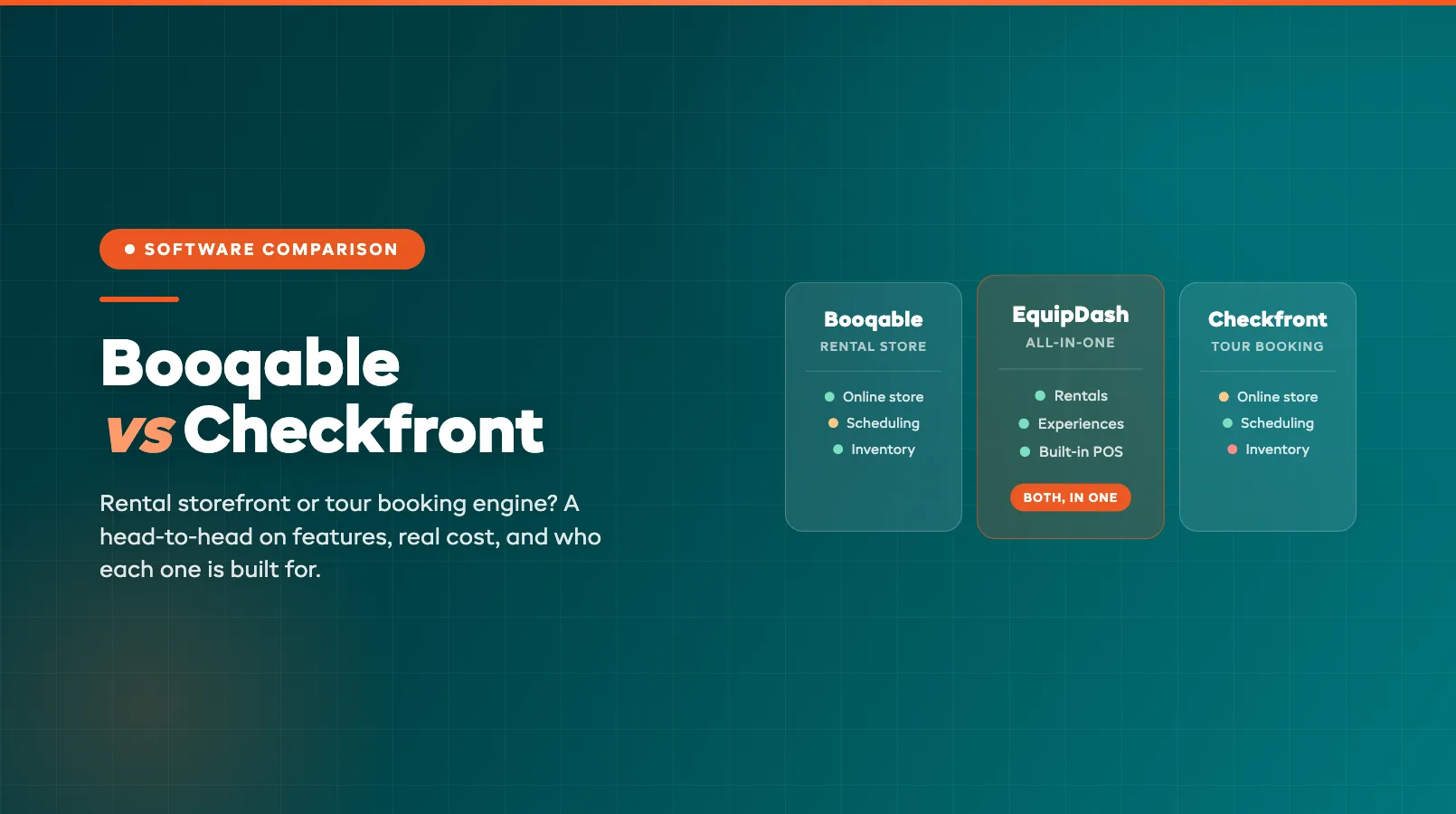
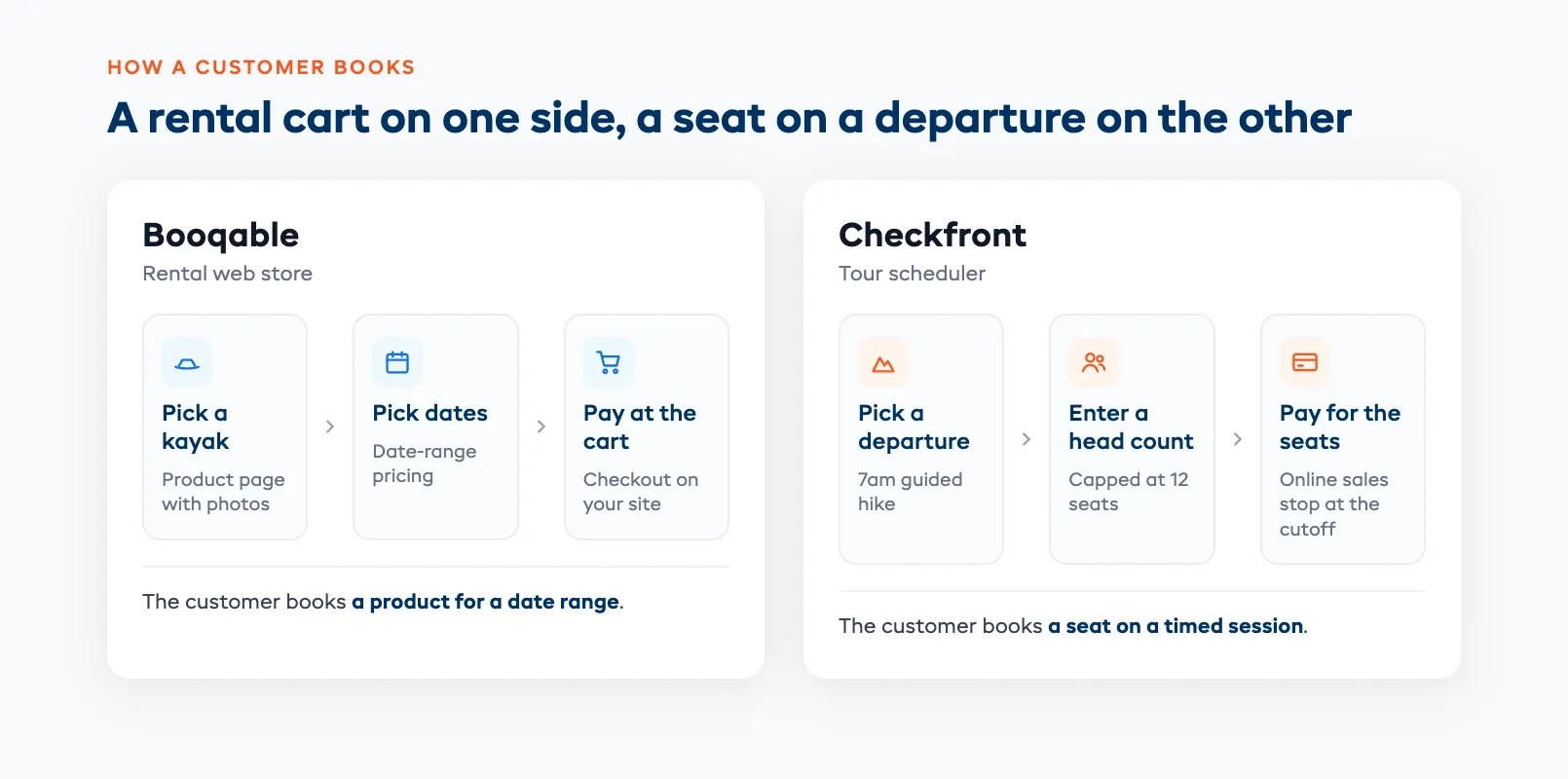
Booqable vs Checkfront is a rental web store against a tour scheduler. On Booqable a customer picks a kayak or camera, picks dates and pays at a cart. On Checkfront they buy a seat on a timed session, like a 7am guided hike capped at 12 that stops selling online the night before.
If you run guided hikes and rent nothing beyond trekking poles, skip Booqable. Your real choice is Checkfront against what you run now, whether that's Google Calendar and Smartwaiver, a spreadsheet and a group text, or Bokun or Rezdy. The hiking section below is for you.
If you rent gear off your website and run no tours, the reverse holds. E-bike and paddle tour companies sell seats and also need to know which bike went on which tour; that's the third option below.
Comparing the wider field too? See our equipment rental software comparison for ten platforms scored side by side.
Quick Comparison Table
Prices come from Booqable's pricing page and Checkfront's pricing page, checked in November 2026, in US dollars as each vendor shows them. Checkfront notes its pricing may vary by region and currency.
| Feature | Booqable | Checkfront |
|---|---|---|
| Best for | Rental shops selling online | Tour & activity operators |
| Pricing model | Plan by users and locations, no commission | One plan plus 3% on online bookings |
| Price | From $29/mo billed yearly ($35 monthly) | $99/mo plus 3% on online bookings |
| Online store | Strong (rental website builder) | Booking pages and widget |
| Equipment rentals | Strong: per item or in bulk; barcode scanning is an add-on | Assets by day or timeslot; per-unit status not described |
| Tours & activities | Rental time slots, no departures or guides | Strong: capacity, cutoffs, shared resources |
| Waivers | E-signed contracts, no waiver listed | Built into the booking flow |
| Viator and GetYourGuide | None listed | Integrations for both |
| Point of sale | Mobile Point of Sale add-on, $9 per user a month billed yearly | No built-in register; Stripe Terminal card readers at the desk (US and Canada) |
| Card processing | Stripe or PayPal, at their rates | Checkfront Payments or Stripe, at their rates |
Features Comparison
Online store and checkout. Booqable gives you a rental website with product pages, photos, a cart and date-range pricing, plus a checkout you can embed on your own site.
Checkfront's booking pages are built around the departure. The guest picks a departure and start time, enters a head count and pays.
Scheduling and availability. Scheduling is Checkfront's strength. Its features page lists capacity limits, booking cutoff times and shared resources to stop double booking.
Your permit's group cap goes in as the departure's capacity, so the 13th seat on a 12-person hike never sells.

Two things decide Checkfront for a guided company: a guide set up as a shared resource, so two overlapping departures can't both book her, and a departure that needs four to run. Its features page lists guest min/max rules but doesn't say whether a departure can be set to run only at four or more, so ask on the demo. Booqable has rental time slots but no departures, no per-session head count and no guide assignment.
Inventory. Booqable tracks individually managed items and bulk items, and barcode scanning at checkout and return is a paid add-on. It knows you have eight e-bikes, five are reserved Saturday, and which five.
Checkfront lists inventory management and assets booked by the day, night, timeslot or flextime, so bike sizes set up as inventory cover availability. Per-unit status isn't listed: which bike is out, and how you pull the one with a flat before the 10am group books it.
Channels and waivers. Checkfront has Viator and GetYourGuide integrations that pull your pricing and availability, and its pricing page says it adds no fee of its own on OTA bookings. Viator's own cut is far bigger, a standard 20% of the advertised price (Rezdy's Viator supplier guide). Get the sync interval in minutes; a slow one sells the same 10am seat twice.
It also has online waivers inside the booking flow, so a direct guest signs while booking. A Viator guest never sees that flow, so someone texts them a waiver link the night before or chases signatures at the meeting point. Booqable lists neither, fine for a shop that sells only from its own site.
Broken gear. Booqable lets you schedule downtime to block an item from being booked while it's in maintenance or under repair. Checkfront's features page describes nothing like it, so an e-bike back with a flat at 9:40 stays on sale until someone blocks it by hand.
Pricing Comparison
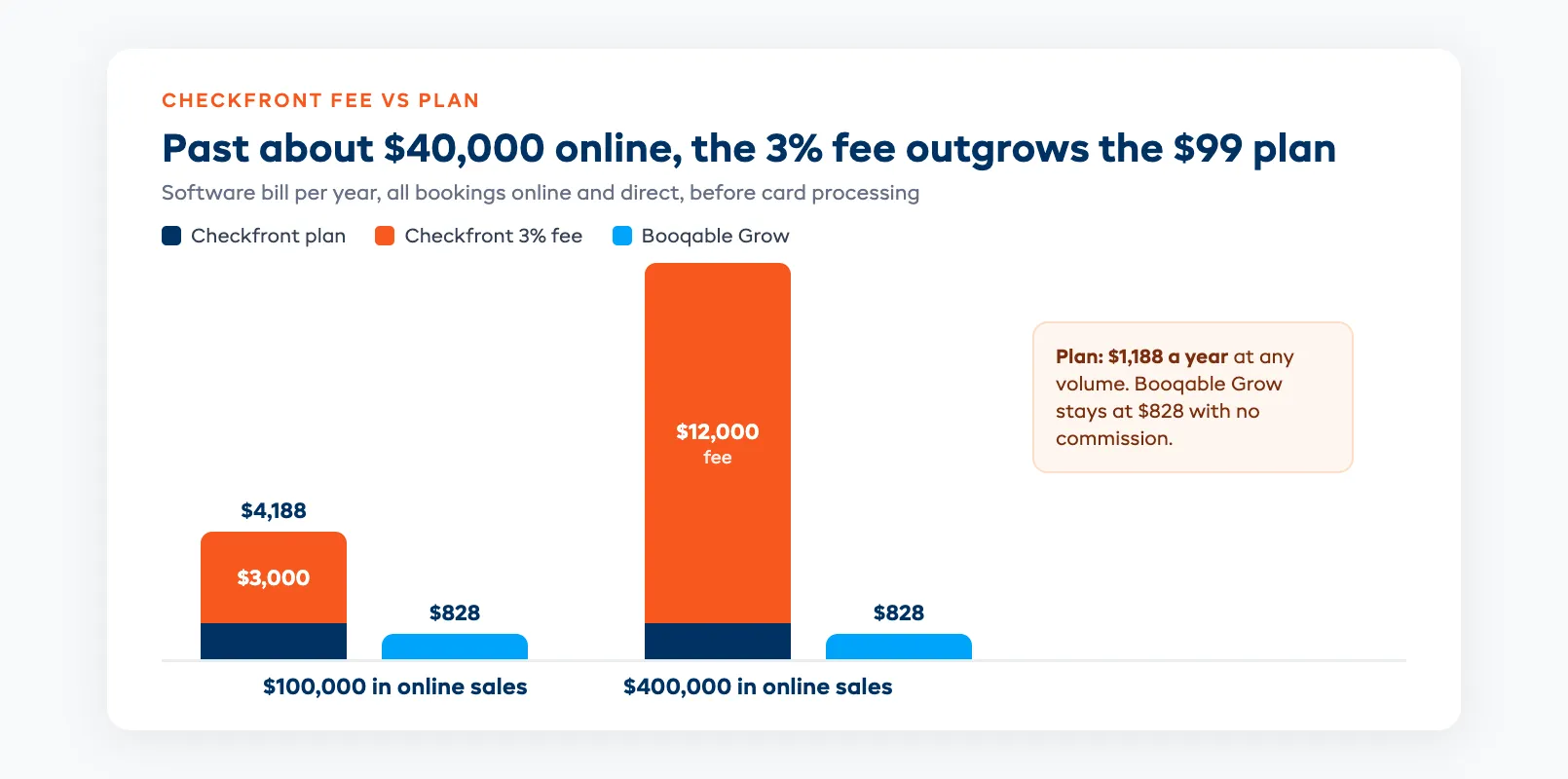
Read the fee lines first. Checkfront's 3% outgrows its $99 plan once online sales pass about $40,000 a year.
Booqable lists Start at $29 a month billed yearly ($35 monthly), Grow at $69 ($87), Scale at $149 ($187) and Custom from $349. Every plan has unlimited inventory and orders and no commission on bookings.
What moves you up is people and places: Start lists no extra user seats, Grow adds 5 users and Scale adds 10. The rental website builder ($19 a month billed yearly), Mobile Point of Sale and barcode scanning ($9 per user a month each, billed yearly) are add-ons.
Checkfront lists one plan: $99 a month plus a 3% fee on online bookings, charged at booking, which you can pass to guests or absorb. Offline, OTA and API bookings carry no Checkfront fee, and there's no setup fee.
Sell 220 seats online at $60 in July and the fee is about $400 that month, on top of the $99.
Card processing is extra on every option. In the US, Stripe charges 2.9% plus 30 cents a card payment, and the rate differs by country.
What a year costs at $100,000 in bookings
Assume all $100,000 comes in online and direct, none through a marketplace. The software bill, before card processing:
| Feature | Plan per year | Booking fee | Total |
|---|---|---|---|
| Booqable Start | $348 | None | $348 |
| Booqable Grow | $828 | None | $828 |
| Checkfront | $1,188 | $3,000 (3%), or $0 if guests pay it | $1,188 to $4,188 |
| EquipDash Starter (annual) | $279 | $2,000 (2%) | $2,279 |
| EquipDash Growth (annual) | $660 | $1,500 (1.5%) | $2,160 |
| EquipDash Pro (annual) | $1,428 | $1,000 (1%) | $2,428 |
Phone and walk-up bookings you enter yourself carry no fee on Checkfront, or on EquipDash when they pay cash or by bank transfer, so if half your bookings come in that way, halve that fee column. At $400,000 online the gap widens: Checkfront's fee is $12,000 a year against $4,000 on EquipDash Pro, while Booqable Grow stays at $828.
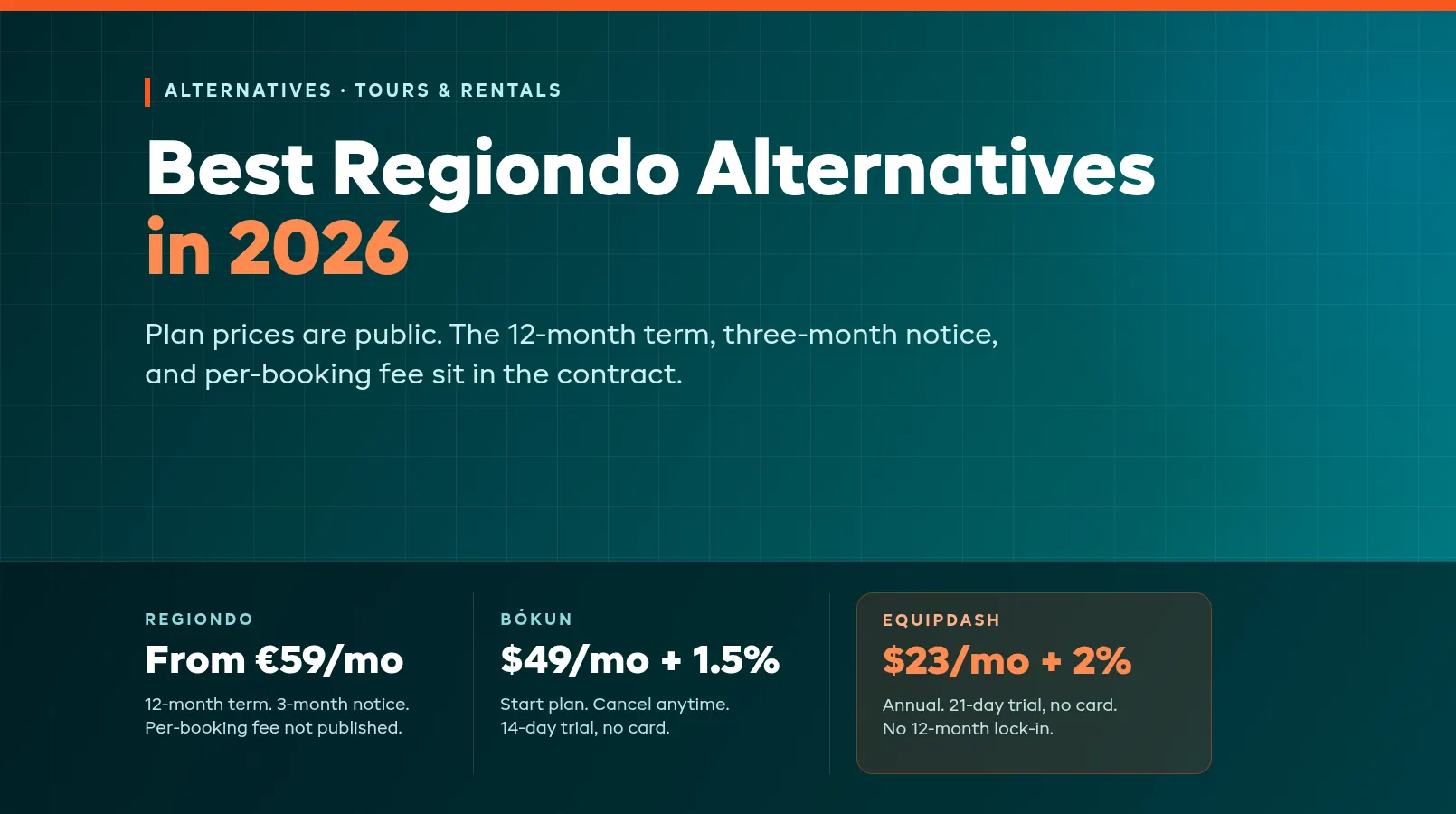
EquipDash charges a plan plus a booking fee on card payments only: Starter at $23/month with a 2% fee, Growth at $55/month at 1.5%, and Pro at $119/month at 1%, billed annually ($29, $69 and $149 billed monthly). OTA bookings carry no EquipDash fee on Growth and Pro, and you can pass the fee to guests. The tour-plus-rental setup in the next section needs Growth or above: waivers and forms, staff management, inventory management, and integrations including Viator and GetYourGuide all start on Growth.
Our fee is most of our bill too: at $100,000, Pro costs more than Growth. Growth beats Starter from about $76,000 a year in online sales, and Pro only beats Growth past about $154,000.
Now say $25,000 of it comes through Viator, which keeps about $5,000 at 20% before any software fee. Checkfront's fee falls to $2,250 ($3,438 a year in all), Growth's to $1,125 ($1,785) and Pro's to $750 ($2,178). Booqable and EquipDash Starter have no Viator connection, so they drop out.
Best For: When to Choose Each
Choose Booqable if you rent gear through your website and the storefront is the heart of it: bikes, cameras, party rentals, camping gear. Per-item stock, a real cart and a $29 starting price make it the better pure-rental tool, with barcode scanning as an add-on. If a second person needs their own login, price Grow, not Start.
Choose Checkfront if you mainly sell timed tours and activities and your rate card is complicated: a weekday price, a Saturday price, kids at half, a group rate from eight. If scheduling is solid but rentals feel thin, scan alternatives to Checkfront before you commit.
If you've already decided to leave it, the Checkfront migration guide covers the switch.
Guided hiking with no gear to rent
Your shortlist is Checkfront against other tour-first systems, which our list of the best software for tour operators covers. Coming off Google Calendar or a spreadsheet, ask each vendor on a demo:
- Who loads your departures and past guests, and will they load the next 60 days before you pay?
- Can a departure hold your permit's group cap, need a minimum to run, and stop online sales at your cutoff while the phone can still book?
- When lightning, heat or smoke kills a day, can you cancel or move every booking on a departure and refund, email or text every guest in one step?
- Does the guest get the trailhead, the parking pass or gate fee and what to bring the day before, so the 10pm "is it still on?" texts stop?
Already on Bokun or Rezdy? Checkfront is another tour-first system, so moving only pays if its fees come out lower; our Bokun vs Rezdy comparison prices those two. If you're also weighing FareHarbor, see our FareHarbor vs Checkfront comparison.
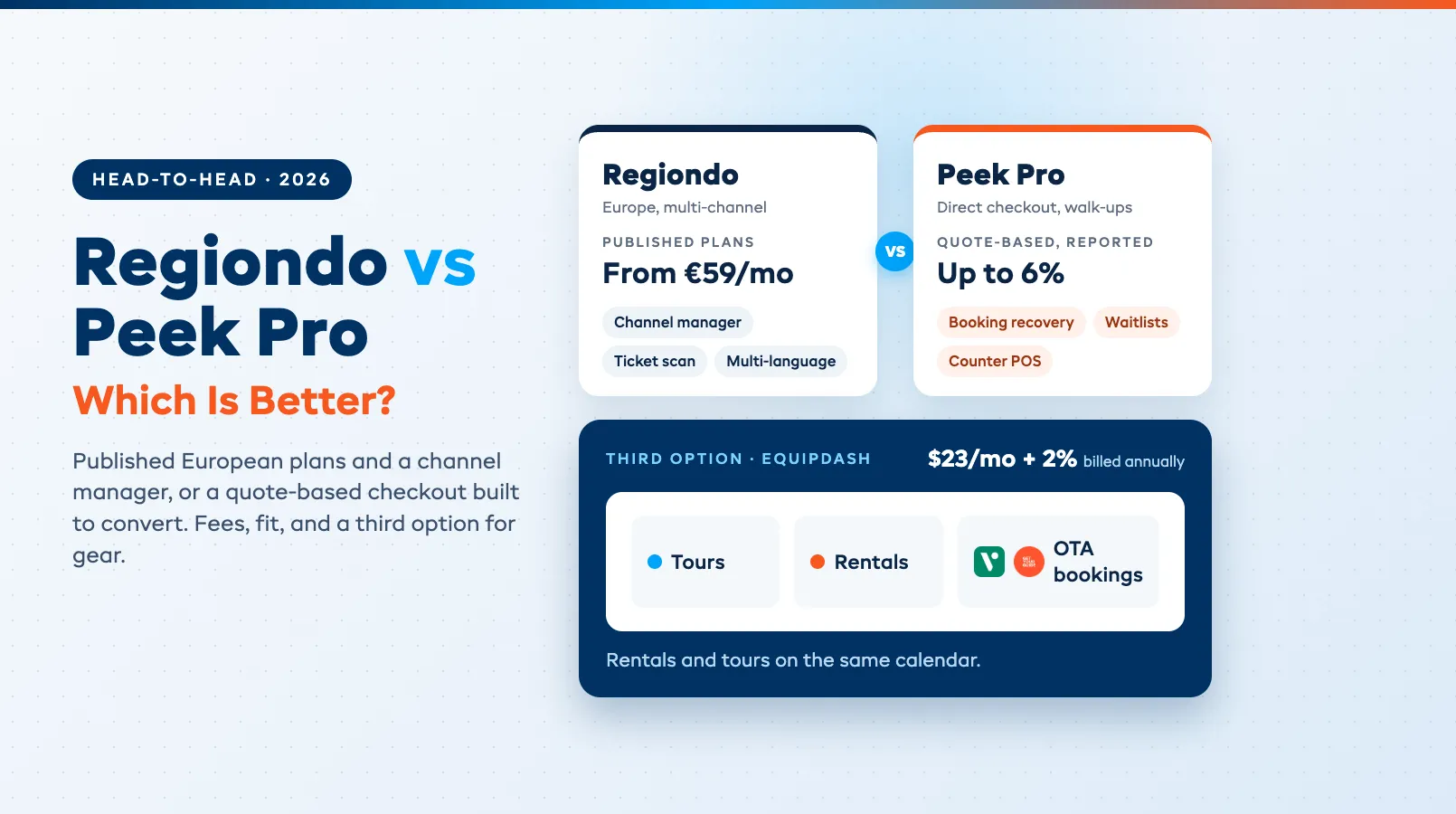
A Third Option: Rentals, Tours, and the Front Counter in One
Run tours on one tool and bikes on a spreadsheet, and no bike is tied to a rider's name, so the guide hands out whatever is left. Our alternatives to Booqable page covers that business.
Say the 10am guided paddle and walk-in rentals off the beach draw on the same 12 kayaks. Booqable has no tour to put eight of them on. On Checkfront, the four walk-ins become desk bookings typed in while the line waits.

EquipDash, our product, books eight kayaks onto the paddle and sells the other four at its point of sale, on one calendar with one record per guest.
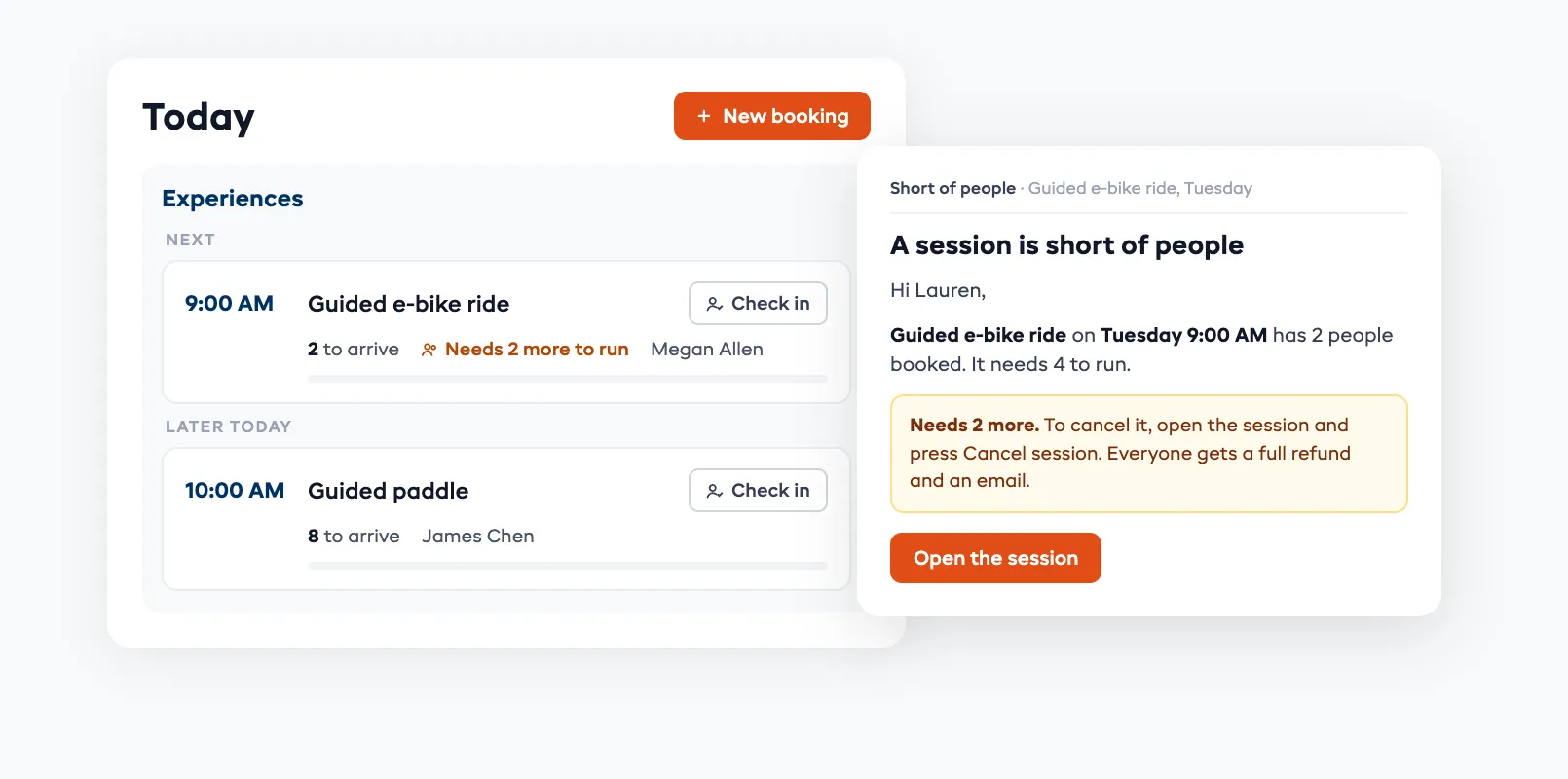
- Group size and minimums. Say Tuesday's 9am has two riders and "Runs with at least" is set to four. It shows "Needs 2 more to run" on Today and the manifests, and you get an email 24 hours out. "Cancel session" then refunds every booking in full and emails each guest why.
- Guides. Turn on "Need a guide to run?" and a slot only sells while one of its assigned guides is free. You get a warning when you assign someone whose first aid or other cert is missing or expired.
- Weather. Set wind, gust, rain, temperature or thunderstorm limits per location; EquipDash checks the forecast every 30 minutes and warns you or closes slots that cross one. "Reschedule slot" moves every booking on a departure and emails each guest your reason. Smoke and closure orders aren't in any forecast, so you block those dates under Settings, then Closures.
- Waivers. Waivers go out by email when the booking is confirmed, and Consent reminders chase anyone unsigned by email or text until they sign. There's no Smartwaiver connection; setup turns your current waiver, a link or a PDF, into an EquipDash form you approve.
- Guest emails. "Arrival details" goes out a set number of hours before the start with your directions, the experience's what-to-bring list and a waiver link.
- Viator and GetYourGuide. Both check your live seat count and refuse a sale when it's full or no guide is free, and a seat sold on your own site is pushed to both about 30 seconds later. Viator holds the seat while its guest pays, and seats in your own booking-page carts count as taken. Their bookings land on your departure.
- No-shows. "Mark as no show" keeps the booking paid, puts the gear back on the shelf, releases a held security deposit and sends the guest a "We missed you" email.
- Gear. Each paddleboard or e-bike is its own unit. The one that came back with a broken fin goes to the workshop, where it can't be booked, while its twins stay on sale.
Tell Dash, the built-in AI assistant, to cancel the 3pm session that's short of its minimum, and it shows you the change to approve first. It can also draft a guest text from your SMS templates, sent once you approve.
For a shop that only rents online, Booqable is cheaper. Past about $3,600 a year in card payments, EquipDash Starter's 2% fee outruns the $72 a year its plan saves against Booqable Start.
For a hiking company with no gear, Checkfront does the core job; we'd only argue the guide and weather tools above. We'd steer the shop typing every tour-plus-rental booking into two systems to EquipDash.
Weighing the field? Read our best Booqable alternatives for 2026 and best Checkfront alternatives for 2026.
FAQ
What's the main difference between Booqable and Checkfront?
Booqable is rental e-commerce: an online store with per-item stock tracking, where a customer books a product for a date range. Checkfront is a booking engine for timed sessions, with capacity limits, cutoffs and shared resources, where a booking is a seat on a departure, so a guided tour company fits Checkfront and a shop renting off its website fits Booqable.
Which is better for an equipment rental shop?
Booqable, in most cases, because its rental website, date-range pricing and per-item and bulk stock are built for renting gear online, from $29 a month billed yearly with no commission. Barcode scanning is an add-on at $9 per user a month billed yearly. Checkfront takes rental bookings too, but its features page doesn't describe tracking each unit.
Which is better for tours and activities?
Checkfront, which lists capacity limits, booking cutoffs, shared resources, built-in waivers and Viator and GetYourGuide integrations. Booqable offers rental time slots but no departures, per-session head count or guide assignment, so a day of timed tours on it means workarounds.
How much do Booqable and Checkfront cost?
Booqable starts at $29 a month billed yearly ($35 monthly), with Grow at $69 and Scale at $149, and no commission on bookings, while Checkfront lists one plan at $99 a month plus a 3% fee on online bookings, which you can pass to guests, with no Checkfront fee on offline or OTA bookings. On $100,000 of online bookings that's $348 a year on Booqable Start and $1,188 to $4,188 on Checkfront, with card processing extra on both.
Can one platform handle both rentals and tours?
Not with Booqable or Checkfront alone. Booqable has no departures or guides, and Checkfront doesn't list per-unit tracking. EquipDash runs timed experiences, per-unit equipment rentals and a walk-in point of sale in one system, with one calendar and one customer record, so a booking with a guided paddle and two rental boards goes in once.
Do Booqable or Checkfront work as a point of sale for walk-ins?
Only partly: Booqable sells a Mobile Point of Sale add-on at $9 per user a month billed yearly. Checkfront has no built-in register, so walk-ins go in as desk bookings, paid by card on Stripe Terminal readers at the desk (US and Canada). If walk-ins are a real part of your day, ask about deposits tied to a specific unit on both demos.
in one place