Rezdy vs FareHarbor: Which Is Better? (2026)
Rezdy vs FareHarbor: Which Is Better? (2026)
Rezdy and FareHarbor sit on opposite sides of the biggest fork in tour booking software: pay a subscription, or pay a commission. Both platforms sell seats, sync availability across channels, and run a checkout your customers won't complain about. But they charge you in fundamentally different ways, they distribute your tours through different networks, and they suit different operators. This guide breaks down the features, the real cost math at your booking volume, and who should pick which — plus a third option if gear hire is part of your business.
Weighing up Rezdy specifically? See how it stacks against an all-in-one platform in our EquipDash vs Rezdy comparison — and if you've already decided to move, the Rezdy migration guide walks through the switch step by step.
Quick Comparison Table
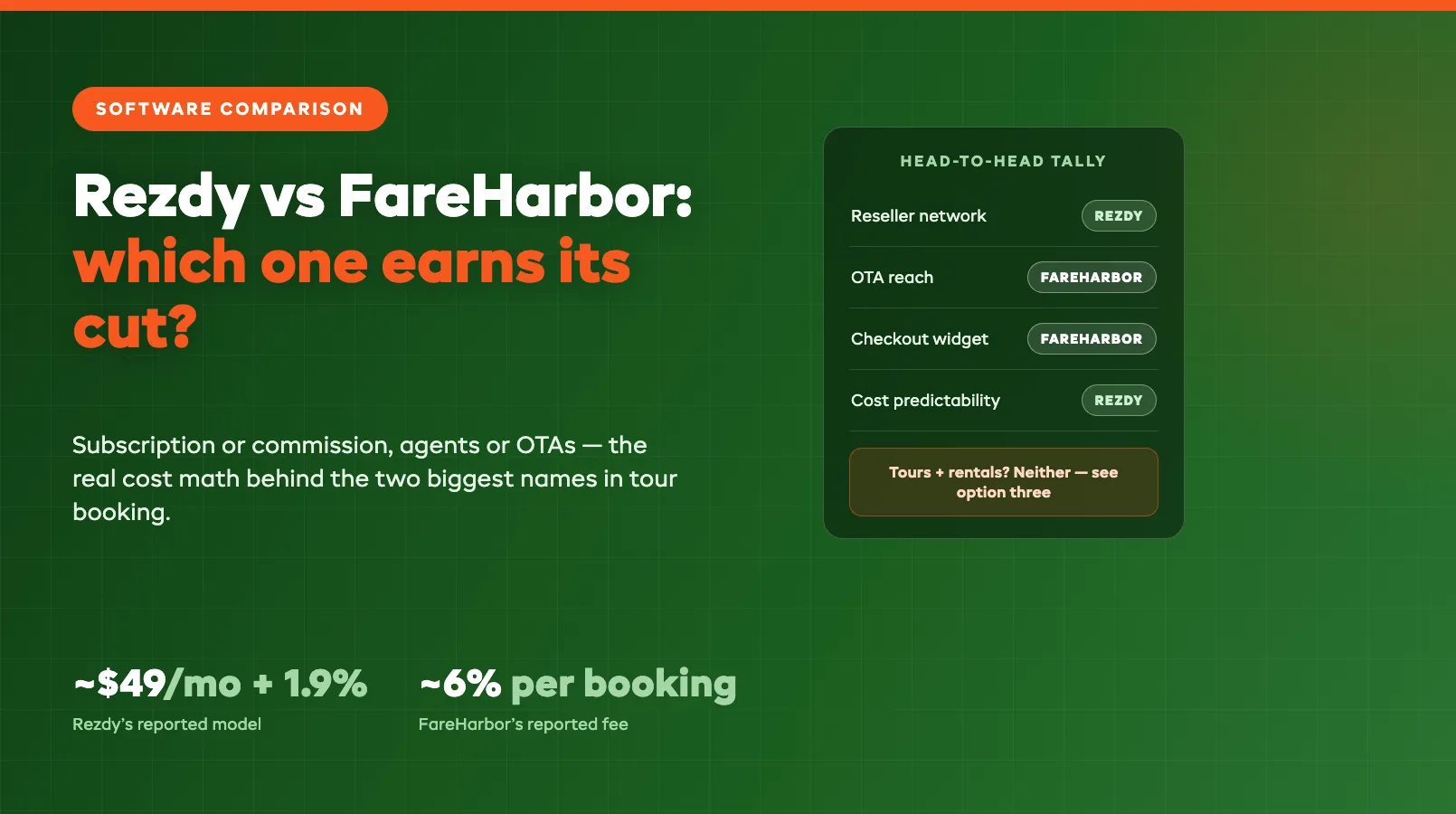
Here's the head-to-head at a glance. Rezdy publishes subscription tiers; FareHarbor keeps its exact rate behind a sales call, so its column reflects what operators consistently report.
| Rezdy | FareHarbor | |
|---|---|---|
| Best for | Reseller and agent-driven operators | OTA-heavy tour operators |
| Pricing model | Subscription + small per-booking fee | ~6% booking fee (paid by customer) |
| Monthly software fee | From ~$49/mo | None |
| Per-booking fee | ~1.9% | ~6%, typically passed to customer |
| OTA connections | Viator, GetYourGuide, Expedia + channel manager | Booking.com network + partners |
| Reseller/agent portal | Yes — commissions handled natively | No equivalent |
| Booking widget | Solid, functional | Excellent, built for you free |
| Equipment rentals | Minimal | Minimal |
| Support | Business hours + help center | 24/7 phone |
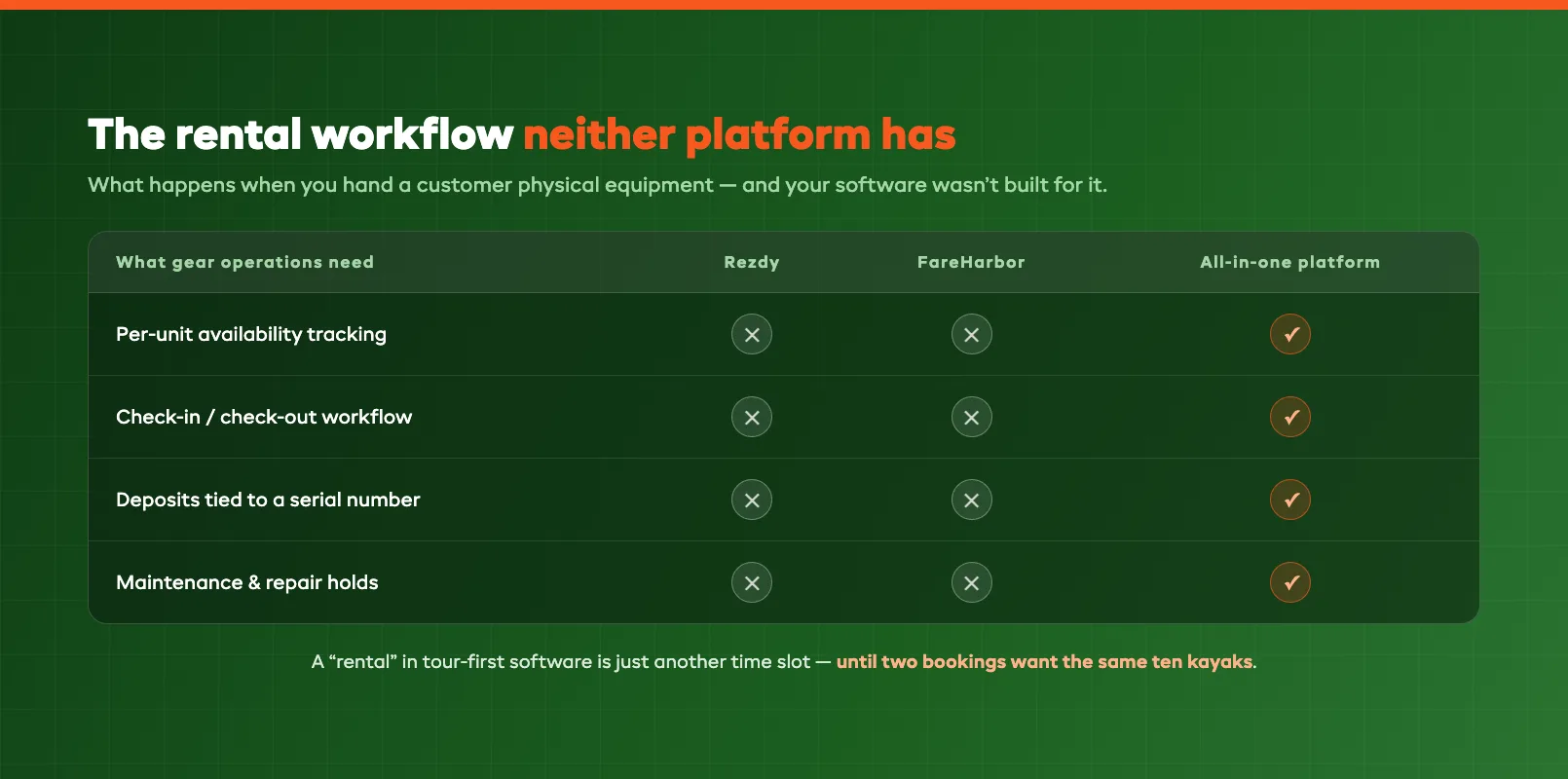
Both are proven for pure tours. Neither was built to manage rental inventory — hold that thought if bikes, kayaks or ski gear are part of your revenue.
Features Comparison
On core booking mechanics, Rezdy and FareHarbor are closer than either sales team admits. The real differences live in how each platform gets your tours in front of buyers.
Distribution. This is the defining split. FareHarbor is owned by Booking Holdings, so its OTA muscle through Booking.com and its partner network is hard to beat — if third-party marketplaces drive your calendar, that ownership matters. Rezdy answers with breadth and control: its channel manager connects to Viator, GetYourGuide, Expedia and dozens more with real-time availability sync, and its agent portal handles the offline network — hotel concierges, travel agencies, partner operators — with commissions tracked automatically. FareHarbor has nothing equivalent for local resellers.
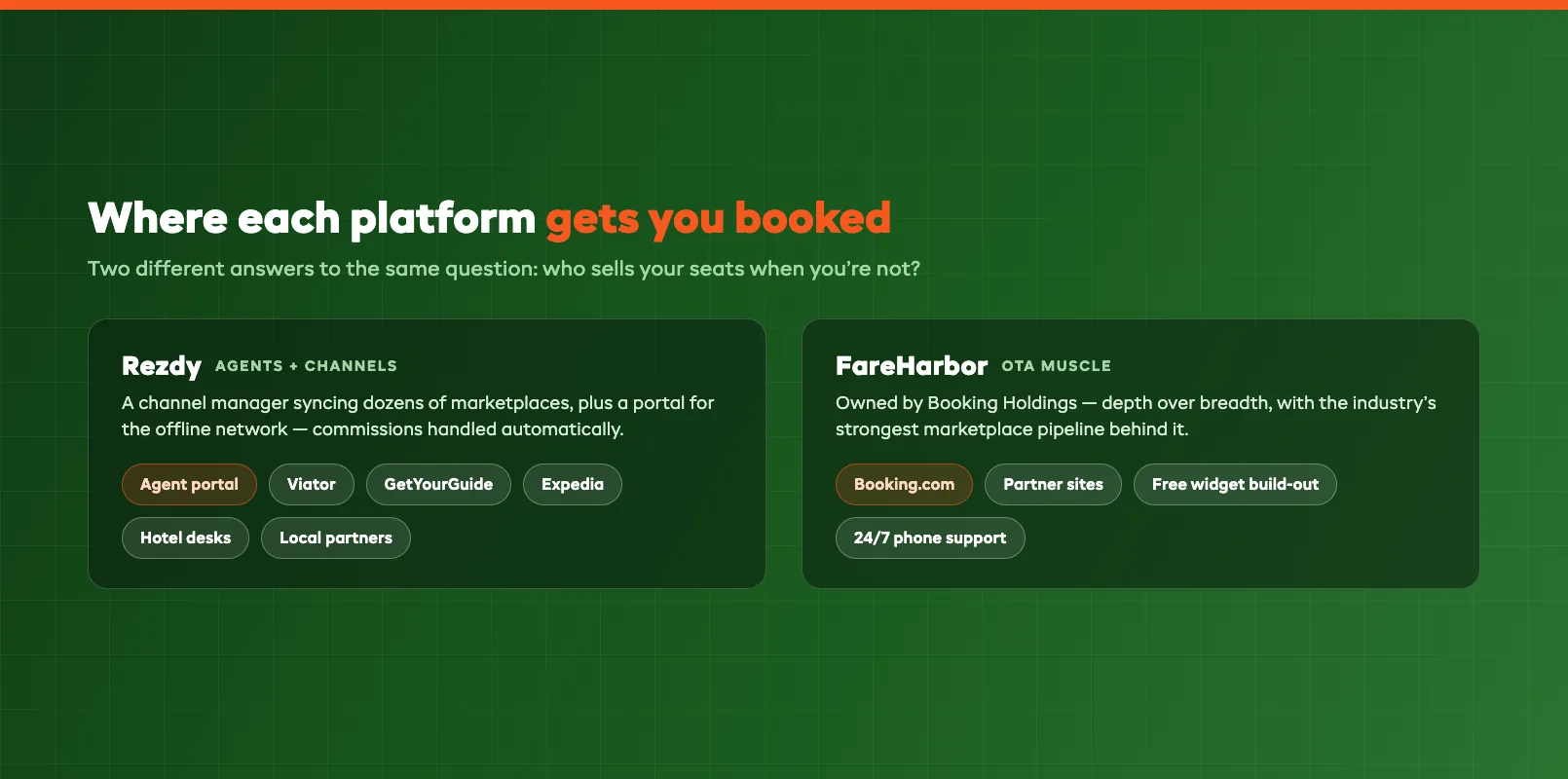
Booking widget and checkout. FareHarbor wins here. Its widget is famously fast, high-converting, and its team builds it into your site for free. Rezdy's checkout is perfectly capable but plainer, and setup is more on you. If your website is your main sales channel, that difference shows up in conversion rate.
Scheduling and operations. Departure schedules, capacity caps, cutoffs, guide assignment — both handle the daily grind well. Rezdy users with 20+ products and seasonal variations report the interface gets cluttered at scale, and complex pricing rules take more clicks than they should. FareHarbor's back office stays tidier under load.
Support. FareHarbor runs 24/7 phone support, which earns its keep the first time a booking bug hits at 6am on a Saturday. Rezdy offers business-hours support and a solid help center — fine most days, thinner in a peak-season emergency.
Where both fall short. Physical gear. Neither platform tracks per-unit inventory, check-in/check-out, damage deposits against a serial number, or maintenance windows. A "rental" in tour-first software is just another time slot — which collapses the moment two bookings want the same ten kayaks on overlapping windows.
Pricing Comparison
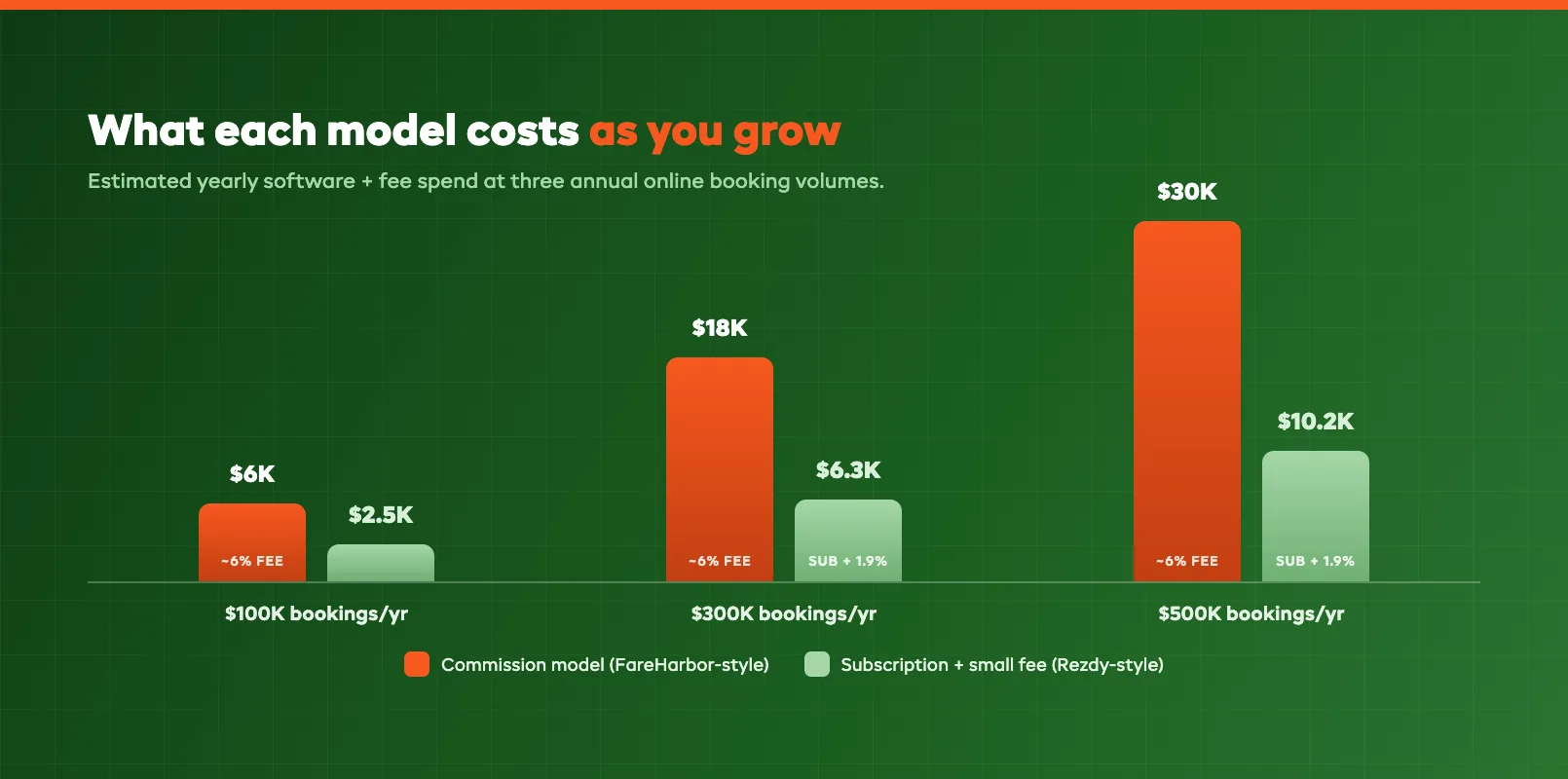
This is where most Rezdy vs FareHarbor decisions actually get made, because the two models behave very differently as you grow.
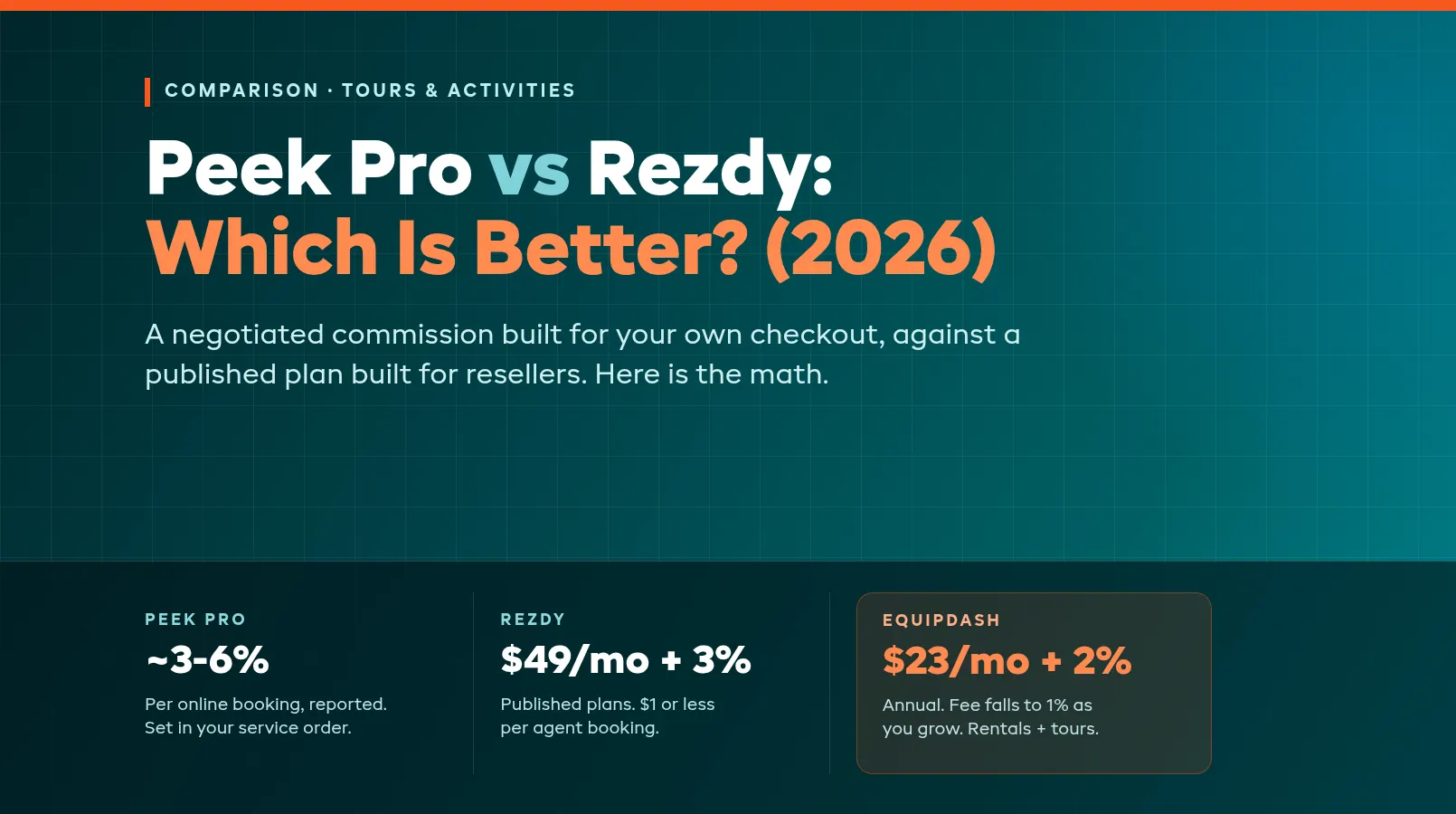
Rezdy charges a monthly subscription starting around $49, plus a per-booking fee of roughly 1.9%. Your baseline is predictable: you know what the software costs before the season starts, and the variable portion is small. The trade-off is that you pay the subscription in your quiet months too.
FareHarbor charges no monthly software fee at all. Instead it takes roughly a 6% booking fee, which is typically added to the customer's total at checkout rather than coming out of your margin. Your headline software bill is zero — but your customers see inflated prices, which can dent conversion on price-sensitive trips, and the platform's take scales with every dollar you sell.
Run the math at real volumes. At $100,000 in annual online bookings, FareHarbor's model moves about $6,000 through fees while Rezdy lands near $2,500 all-in. At $300,000, the gap widens to roughly $18,000 versus $6,300. The commission model is painless when you're small and increasingly expensive as you grow — even when the customer nominally pays it, it's priced into your product.
Both platforms push annual agreements, so run last season's numbers through each model before you sign — not the volume you had two years ago.
Best For: When to Choose Each
Neither platform is simply "better." They're tuned for different ways of selling.
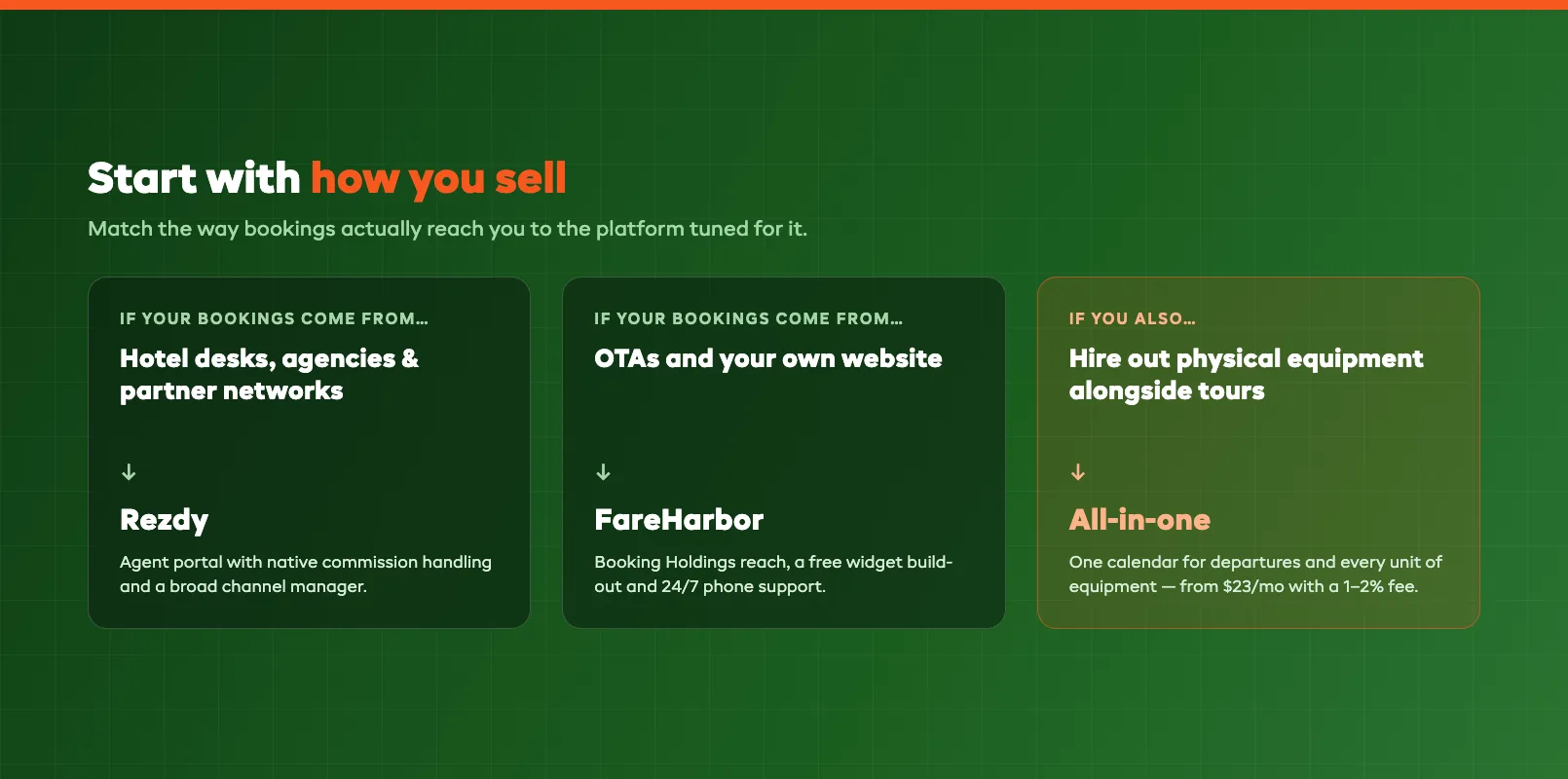
Choose Rezdy if resellers and agents drive your bookings. The agent portal, native commission handling, and broad channel manager make it the strongest pick for operators plugged into hotel desks, local agencies and partner networks. The predictable subscription also suits operators who want software costs fixed before the season starts.
Choose FareHarbor if OTAs and your own website drive your growth. The Booking Holdings distribution network, the free widget build-out, and 24/7 phone support make it the safe default for established operators who live on channel volume and can't afford checkout friction — or downtime at dawn.
Choose neither if equipment hire is a real slice of your revenue. That's no knock on either platform; they were never built to track physical inventory. Forcing gear through tour software means a second system, double data entry, and a standing risk of double bookings.
A Third Option: Rentals + Tours
If your business sells both — guided tours and equipment hire — Rezdy and FareHarbor both leave you running two systems. That's the gap an all-in-one platform closes.
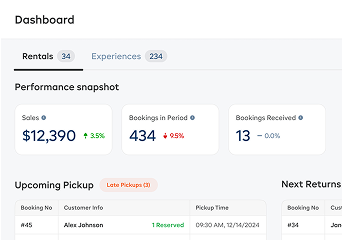
EquipDash was built for operators who do tours and rentals under one roof. The same calendar that schedules your 9am kayak tour tracks which paddleboards are out, which came back, and which need a fin repaired before the next booking. One booking flow, one customer record, one dashboard — instead of stitching a rental spreadsheet onto a tour platform.
The pricing sits between the two models you've just compared, and it's public: annual plans start at $23/mo with a 2% booking fee (Starter), then $55/mo at 1.5% (Growth) and $119/mo at 1% (Pro) — the fee falls as you grow instead of taking a fixed cut of every sale. For an operator doing $300K in online bookings, that's a fraction of a 6% commission, with rental inventory included rather than bolted on.
Be honest about the fit: a pure-tour operator living on Booking.com volume still has good reasons to pick FareHarbor, and a reseller-driven business may never outgrow Rezdy. But if gear is part of the picture, a platform that treats rentals as a first-class feature beats forcing them through software that doesn't.
Still shortlisting? Our best Rezdy alternatives and best FareHarbor alternatives guides score the full field with the same criteria.
FAQ
What's the main difference between Rezdy and FareHarbor?
The pricing model and the distribution style. Rezdy charges a monthly subscription from around $49 plus roughly 1.9% per booking, and is built around reseller and agent distribution. FareHarbor charges no monthly fee but takes roughly a 6% booking fee, usually passed to the customer, and leans on its Booking Holdings ownership for OTA reach.
Is Rezdy or FareHarbor cheaper?
It depends on volume. At low booking volume FareHarbor's no-monthly-fee model is cheaper to start with. As annual online bookings grow, Rezdy's subscription-plus-small-fee model usually wins on total spend, because a flat 6% commission scales with every dollar you sell — at $300,000 a year that's roughly $18,000 in fees versus around $6,300 on Rezdy's model.
Does Rezdy charge a monthly fee?
Yes. Rezdy runs on a monthly subscription starting around $49, paired with a small per-booking fee of roughly 1.9%. FareHarbor takes the opposite approach — no monthly software fee, with its revenue coming from a booking commission of roughly 6% added at checkout.
Which platform has better OTA distribution?
Both are strong in different ways. FareHarbor benefits from Booking Holdings ownership and deep reach through Booking.com and its partners. Rezdy's channel manager connects to Viator, GetYourGuide, Expedia and more, and its agent portal covers hotel concierges and local resellers — a network FareHarbor doesn't serve natively.
Can Rezdy or FareHarbor manage equipment rentals?
Not properly. Both are tour-first platforms: no per-unit tracking, no check-in/check-out workflow, no maintenance scheduling, no deposits tied to a specific item. If you rent bikes, boards or ski gear alongside tours, you'll need a second system — or an all-in-one platform like EquipDash that handles both natively.
Is there an alternative that handles tours and rentals together?
Yes. EquipDash manages guided tours and equipment rentals in one system — one calendar, one customer record, one dashboard. Annual plans start at $23/mo with a booking fee that drops from 2% to 1% as you move up tiers, which usually beats a 6% commission well before the $300K mark.
in one place