Campground & Glamping Gear Rentals: Add-On Revenue for Sites
Campground & Glamping Gear Rentals: Add-On Revenue for Sites
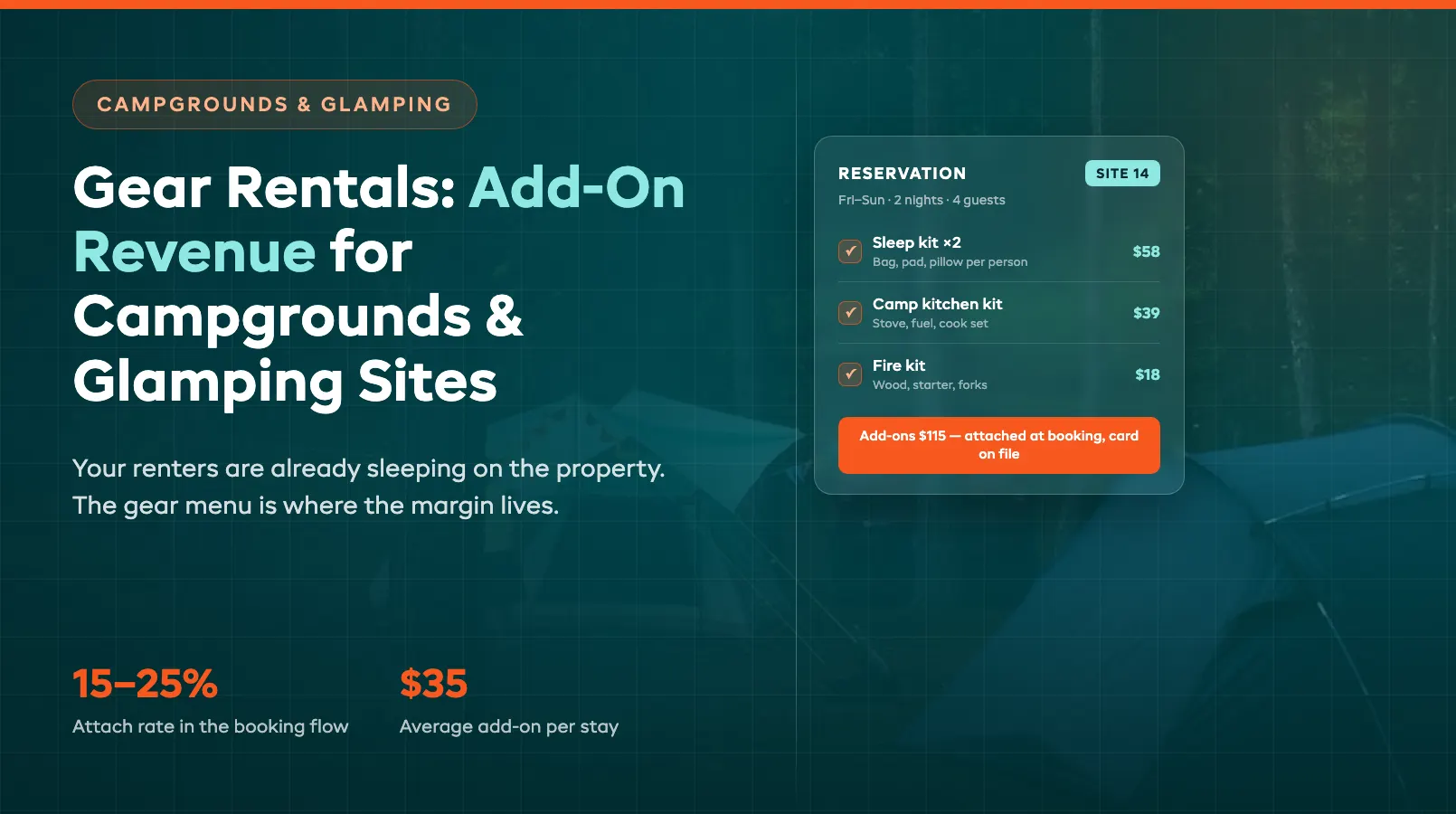
A campground with 40 sites already has the hardest part of a rental business solved: a steady stream of customers who are physically on the property, every night, with a confirmed reservation and a card on file. What most campgrounds and glamping sites don't have is the $25-60 per stay those same guests spend somewhere else — at the big-box store on the drive in, on a cheap tent they'll use twice, on the camp chairs that end up in a landfill by Labor Day.
Gear rental is the ancillary revenue stream that fits a campground better than almost any other. You're not chasing new customers — you're capturing spend from guests you've already booked. The site fee got them in the gate; the gear menu is where the margin lives. Glamping operations figured this out early: the whole model is "arrive with nothing, we provide everything." Traditional campgrounds and RV parks are only now catching up.
This guide covers how to build a gear add-on program that runs alongside your site bookings: what to stock, how to price it per stay instead of per item, how to turn kits around between guests, and how to attach the whole thing to your reservation flow so the revenue books itself. If you'd rather run gear rental as a full standalone business, start with our complete guide to running a camping gear rental business — most of what follows is the campground-shaped version of that playbook.
Why Gear Rentals Fit Campgrounds and Glamping Sites
Run the numbers on your existing occupancy first, because the case usually makes itself. A 40-site campground averaging 60% occupancy through a 20-week season hosts roughly 3,360 site-nights. If 20% of those stays add a gear package averaging $35, that's around $23,500 in add-on revenue — from guests already on the property, with zero additional marketing spend.
Three things make campgrounds structurally better at gear rental than standalone shops:
- The customer is captive. A standalone rental shop fights for every booking. Your renters are sleeping 200 feet from the gear shed. Forgotten sleeping pad, broken pole, cold snap nobody packed for — you're the only option within 30 minutes, and that's a service, not a hard sell.
- The rental period is defined for you. Gear goes out at check-in and comes back at check-out. No open-ended loans, no chasing returns across town. The reservation dates are the rental dates.
- The margin compounds per site-night. Site fees are capped by the market and your permit. Add-on revenue isn't. A $45/night site that adds a $30/stay bedding kit and $15 in extras is suddenly earning like a $60/night site — without touching the posted rate.
Glamping sites push this furthest: the tent, bedding, and kitchen are the product, and the add-on menu extends into fire kits, lantern sets, and guided-experience gear. If you're running canvas tents or pods, gear add-ons aren't a side hustle — they're the difference between a campsite with furniture and a hospitality product.
Build the Add-On Menu: What to Stock
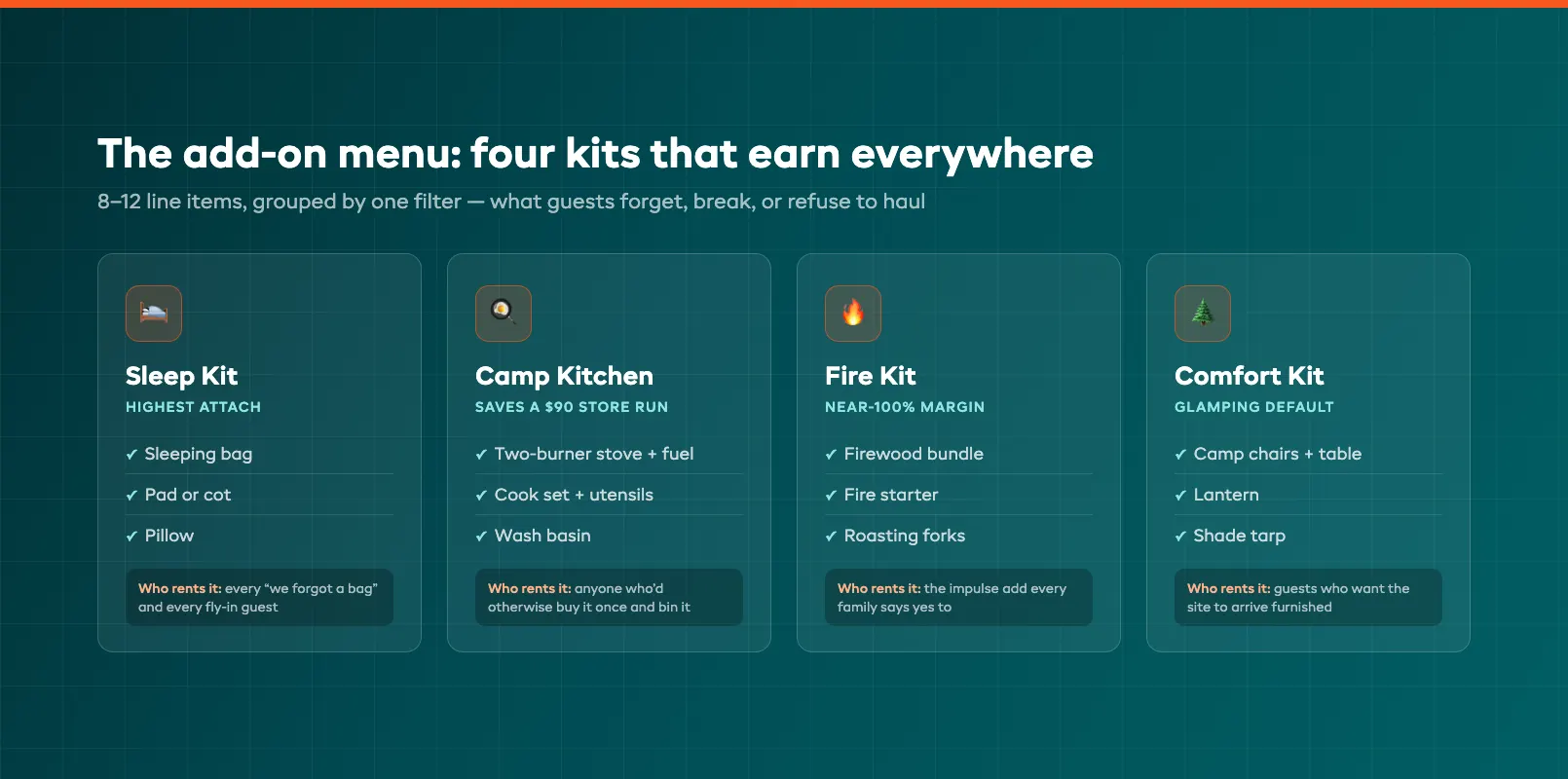
Resist the urge to stock everything. The best campground gear programs run 8-12 line items grouped into 3-4 kits, chosen by one filter: what do guests forget, break, or refuse to haul?
The core kits that earn everywhere:
- Sleep kit — sleeping bag, pad or cot, pillow. The single highest-attach item. Every "we forgot a bag" and every fly-in guest rents one.
- Camp kitchen kit — two-burner stove, fuel, cook set, utensils, wash basin. Second-highest attach, and the one that saves guests a $90 big-box run.
- Fire kit — firewood bundle, starter, roasting forks. Low cost, near-100% margin, and the impulse add every family says yes to.
- Comfort kit — camp chairs, table, lantern, shade tarp. The "make the site feel furnished" bundle that glamping guests expect by default.
Stock rules that keep the program profitable:
- Buy mid-tier, not premium. Your guests are car campers, not alpinists. A $120 sleeping bag survives 60+ rental nights; a $400 bag earns the same $12/night and walks off the property more often.
- Standardize hard. One tent model, one stove model, one bag model. Every unique SKU multiplies your spare-parts problem and your training problem.
- Plan replacement from day one. Soft goods at a campground take more abuse than shop rentals — sap, campfire embers, morning dew. Budget 20-25% annual replacement on soft goods and track the wear honestly. When items start coming back marginal, our gear loss and damage recovery framework covers how to charge for it without torching the review score.
Hygiene is non-negotiable and it's where campground programs get sloppy, because the gear shed sits next to the office and "we'll wash it later" becomes never. Bags and liners get laundered between every guest, pads get wiped and air-dried, cook sets get sanitized — the full standard is in our camping gear hygiene and cleaning guide, and it applies double when your brand is on the campsite, not just the gear.
Price Per Stay, Not Per Night
Standalone rental shops price per item, per night. Campgrounds should price per stay — one flat number attached to the reservation, covering the whole booking window.
Per-stay pricing works because your average stay is short and predictable: 2-3 nights for most campgrounds, 2 nights for most glamping bookings. A sleep kit at "$12/night" reads as math homework; the same kit at "$29/stay" reads as an easy yes. You lose a few dollars on the rare week-long booking and win it back ten times over on attach rate.
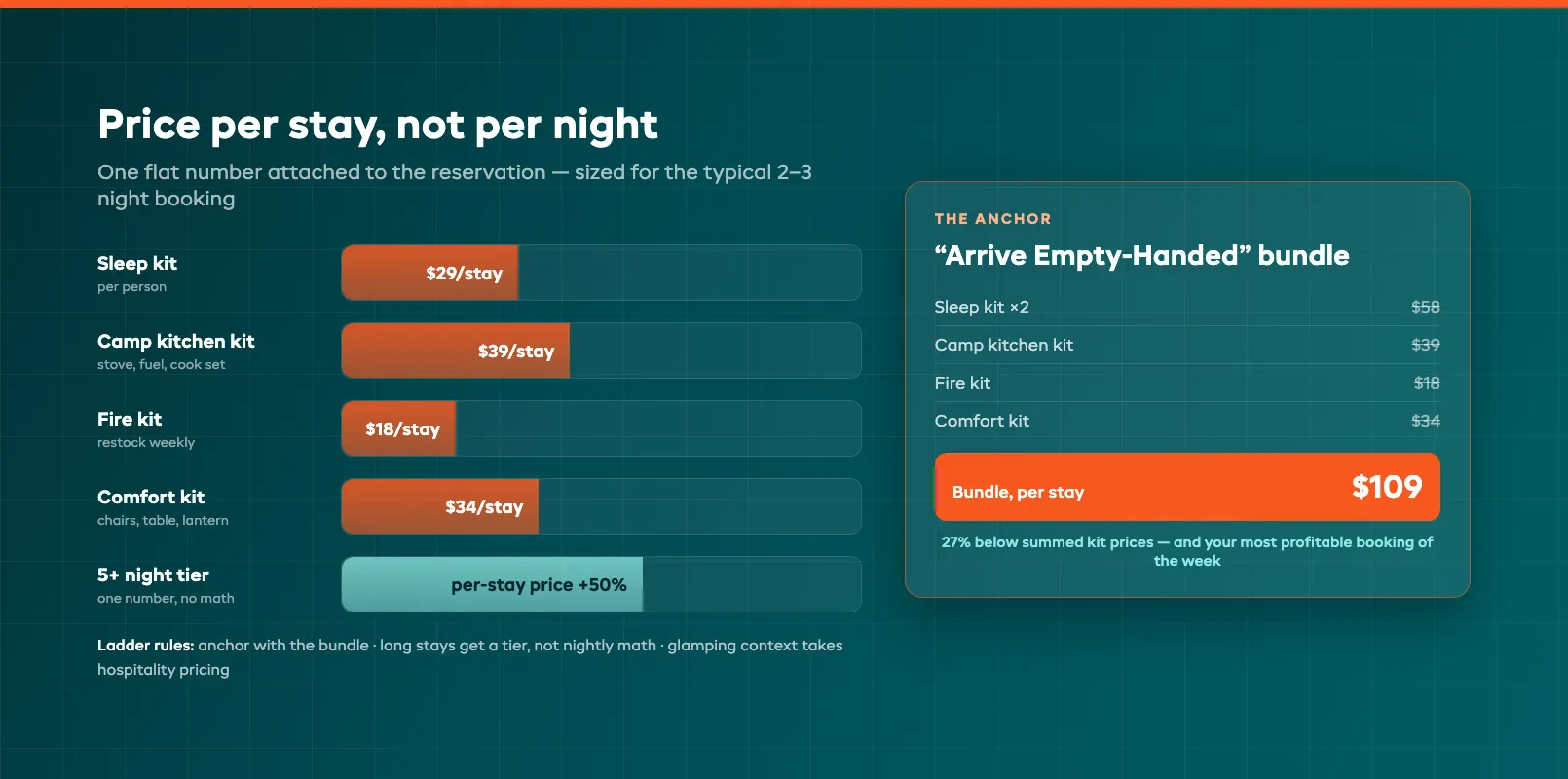
A pricing ladder that works for a typical 2-3 night stay:
| Add-On | Per-Stay Price | Cost Basis | Notes |
|---|---|---|---|
| Sleep kit (per person) | $25-35 | ~$150 kit cost | Pays for itself in 5-6 stays |
| Camp kitchen kit | $30-45 | ~$180 kit cost | Highest perceived value |
| Fire kit | $15-20 | $6-8 per bundle | Near-pure margin, restock weekly |
| Comfort kit | $25-40 | ~$200 kit cost | Default-on for glamping tiers |
| Full "Arrive Empty-Handed" bundle | $89-129 | All of the above | 25-30% below summed prices |
Three ladder rules:
- Anchor with the bundle. The "Arrive Empty-Handed" package at $99 makes the $29 sleep kit look small and makes the guest who takes everything your most profitable booking of the week.
- Add a long-stay tier, not a discount. For 5+ night bookings, add roughly 50% to the per-stay price rather than switching to nightly math. Keep it one number.
- Charge glamping rates for glamping context. The same fire kit supports a $250/night canvas tent and a $45/night pitch. Price to the experience — glamping guests expect to pay hospitality prices and read cheap add-ons as a quality signal, in the wrong direction.
The deeper mechanics — package construction, deposits, late fees, seasonal surcharges — are the same ones standalone operators use, and our guide to camping rental pricing and packages covers them in full.
Turnaround Between Guest Stays
The operational difference between a campground gear program and a rental shop is that your turnarounds are synchronized. Check-out is 11am, check-in is 3pm, and every kit that went out this week comes back in the same four-hour window on Sunday — exactly when your staff is also flipping sites, cleaning bathhouses, and running the office.
If you don't design for that crunch, the program dies by August: kits go back on the shelf unwashed, the next guest gets a bag that smells like campfire, and the one-star review mentions your name, not the gear.
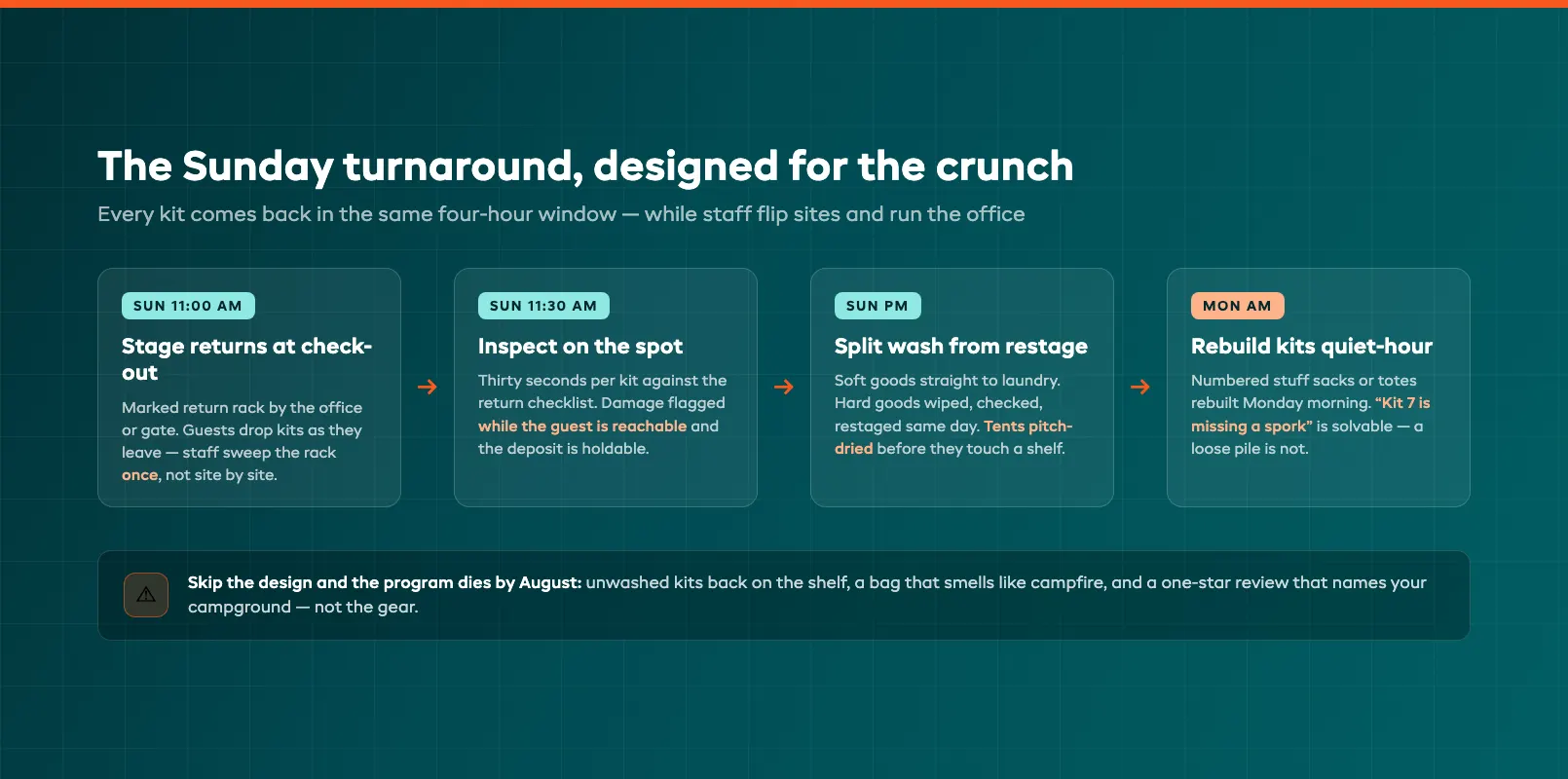
The turnaround workflow that survives a Sunday:
- Stage returns at check-out, not at the shed. A marked return rack by the office or gate. Guests drop kits as they leave; staff sweep the rack once, not site by site.
- Inspect on the spot with a checklist. Thirty seconds per kit against a standard list — our post-rental return check is built for exactly this — so damage gets flagged while the guest is still reachable and the deposit is still holdable.
- Split the wash from the restage. Soft goods go straight to laundry Sunday afternoon; hard goods get wiped, checked, and restaged same day. Kits rebuild Monday morning when the office is quiet.
- Tag every kit as a unit. Numbered stuff sacks or totes. "Kit 7 is missing a spork" is solvable; "somewhere in the pile we're down three sporks" is not.
Tents deserve their own line: a returned tent that gets bagged wet on Sunday is mildew by Wednesday and a write-off by June. Pitch-dry every returned tent before it goes back on the shelf, and run the tent pre-rental inspection before it goes out again — poles, zippers, seams, stakes. It's ten minutes that prevents the worst guest experience your program can produce: a leaking tent at 2am with your logo on the receipt.
Attach Gear at Reservation Time
The single biggest revenue lever isn't the menu or the pricing — it's where the offer appears. Gear sold at the front desk on arrival day attaches at maybe 5% of bookings. The same menu presented inside the reservation flow attaches at 15-25%, because the guest is already in spending mode, already imagining the trip, and already holding a card.
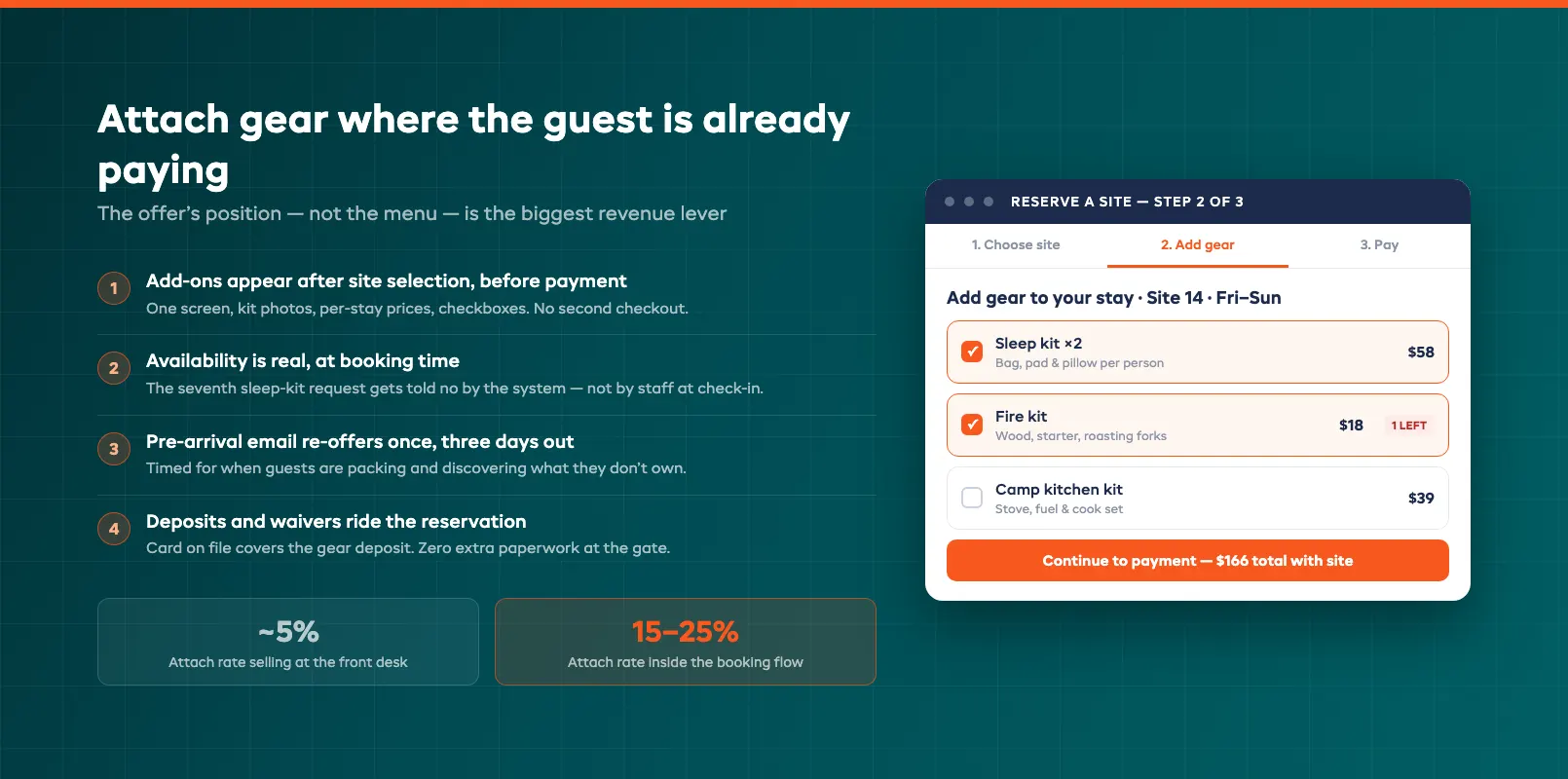
What good attach flow looks like:
- Add-ons appear after site selection, before payment. One screen, kit photos, per-stay prices, checkboxes. No separate cart, no second checkout.
- Availability is real. If you own six sleep kits and five are reserved for the weekend, the sixth books and the seventh request gets told no — by the system, at booking time, not by an embarrassed staffer at check-in. Double-booked gear at a campground is worse than at a shop, because the guest has nowhere else to go.
- The pre-arrival email re-offers once. Three days out — "arriving light? add a kit before you get here" — timed exactly when guests are packing and discovering what they don't own. One automated reminder, not a drip campaign; a pre-trip reminder agent handles the timing without anyone touching a send button.
- Deposits and waivers ride the reservation. Card on file from the site booking covers the gear deposit; any liability language gets signed digitally alongside the site terms. Zero extra paperwork at the gate.
This is the part where spreadsheets genuinely can't keep up, because gear availability has to sync against site reservations in real time. Purpose-built rental software — see the camping and hiking rental platform overview for how EquipDash handles kits, availability, and add-on flows, with plans that fit a campground gear shed as well as a full shop — treats each kit as bookable inventory attached to a reservation window, which is exactly the shape of the problem. (And if any term in the gear world is unfamiliar, the camping rental glossary covers the vocabulary.)
Own the Inventory or Partner With an Outfitter?
Not every site should buy gear. There's a real fork here, and the honest decision framework is volume.
Own the inventory when: you clear roughly 1,500+ site-nights a season, you have dry storage and laundry access on site, and your staff can absorb the Sunday turnaround. Ownership keeps the full margin and the full control of quality — which matters most for glamping operations, where the gear is the brand.
Partner with a local outfitter when: you're under that volume, storage is tight, or you'd rather sell the add-on and let someone else own the depreciation. A typical arrangement: the outfitter stocks and services the gear, you present it in your booking flow, and you keep 15-25% of the rental price for the placement and the customer. The outfitter gets a distribution channel with zero marketing cost; you get an add-on menu with zero inventory risk. The mechanics of these deals — revenue splits, service standards, who eats damage — are covered in our guide to outfitter and guide partnerships.
A hybrid works too, and it's often the right first season: own the fire kits and comfort kits (cheap, simple, high-margin), partner for tents and technical gear (expensive, maintenance-heavy). Review the split after one season of real attach data and buy into whatever category earned the most per dollar of someone else's inventory.
However you structure it, start smaller than feels ambitious: three kits, one season, real numbers. The attach rate will tell you exactly what to buy next — and unlike almost every other revenue idea a campground gets pitched, this one's customers are already asleep on your property.
FAQ
How much revenue can a campground make from gear rentals?
A useful planning number is attach rate times average add-on value times stays. A 40-site campground at 60% occupancy over a 20-week season hosts roughly 1,200-1,400 stays; at a 20% attach rate and a $35 average add-on, that's $8,500-10,000 in first-season add-on revenue, growing as the attach rate climbs toward the 25% that well-placed booking-flow offers reach. Glamping sites run higher — add-ons are expected there, and $50-80 per stay is common.
What gear should a campground rent to guests?
Start with what guests forget, break, or won't haul: sleep kits (bag, pad, pillow), camp kitchen kits (stove, fuel, cook set), fire kits (wood, starter, forks), and comfort kits (chairs, table, lantern). Run 8-12 line items grouped into 3-4 kits, standardized on one model per item. Skip technical gear — backpacks, climbing equipment, backcountry kit — unless you partner with an outfitter who services it.
Should campgrounds price gear rentals per night or per stay?
Per stay. Campground bookings average 2-3 nights, so one flat per-stay price — $29 for a sleep kit, $99 for a full bundle — reads as an easy yes where nightly math reads as homework. Add roughly 50% for stays of five nights or more rather than switching to nightly rates. Bundles priced 25-30% below the summed kit prices anchor the menu and produce your most profitable bookings.
How do glamping sites handle gear between guests?
The same synchronized-turnaround discipline campgrounds need, at a higher standard: soft goods laundered between every guest, hard goods wiped and inspected same day, tents pitch-dried before restaging, and every kit tracked as a numbered unit. Because glamping check-out and check-in fall in the same afternoon window, the wash gets split from the restage — laundry runs Sunday, kits rebuild Monday morning. Damage gets flagged at the return rack while the deposit is still holdable.
Is it better for a campground to buy rental gear or partner with a rental company?
Volume decides. Above roughly 1,500 site-nights a season with on-site storage and laundry, ownership keeps the full margin and full quality control. Below that, a partnership — a local outfitter stocks and services the gear, you sell it in your booking flow for a 15-25% cut — delivers the add-on menu with zero inventory risk. Many sites start hybrid: own the cheap high-margin kits (fire, comfort), partner for tents and technical gear, then buy into whichever category the first season's data says earns most.
in one place