Weekend Pricing for Trailer Hire (and What Overdue Really Costs)
Walk into most trailer yards and the rate card on the wall has one number per trailer type: a daily rate, sometimes a weekly one. That card is doing almost none of the work. The money in trailer hire lands between Friday afternoon and Monday morning, when every box trailer, cage, and car transporter in the yard goes out to someone moving house, clearing a shed, or collecting a purchase. Midweek, half the fleet sits.
So the questions that decide margin are not "what's the daily rate." They are: what is a weekend worth, what is the shortest hire you will accept on a Saturday, what happens at 9:01am Monday when the trailer is still not back, and how much of the deposit stands between you and a bent drawbar. This guide works through each one - duration tiers, the weekend as its own rate, minimum periods, overdue charging that runs itself, deposits, and finally which trailer types earn their keep.
This is the pricing half of running a yard. For the operating side - turnaround, the yard board, handover checks - see the trailer hire software guide. For keeping every unit legal and bookable, see brake tests, lights, and ramps.
Half-Day to Weekly Rates
A trailer rate card needs four or five duration tiers, not one. The customer picking up a 6x4 box trailer to collect a fridge and the customer taking a plant trailer for a week of site work are buying different things, and a single daily rate underprices one while overpricing the other.
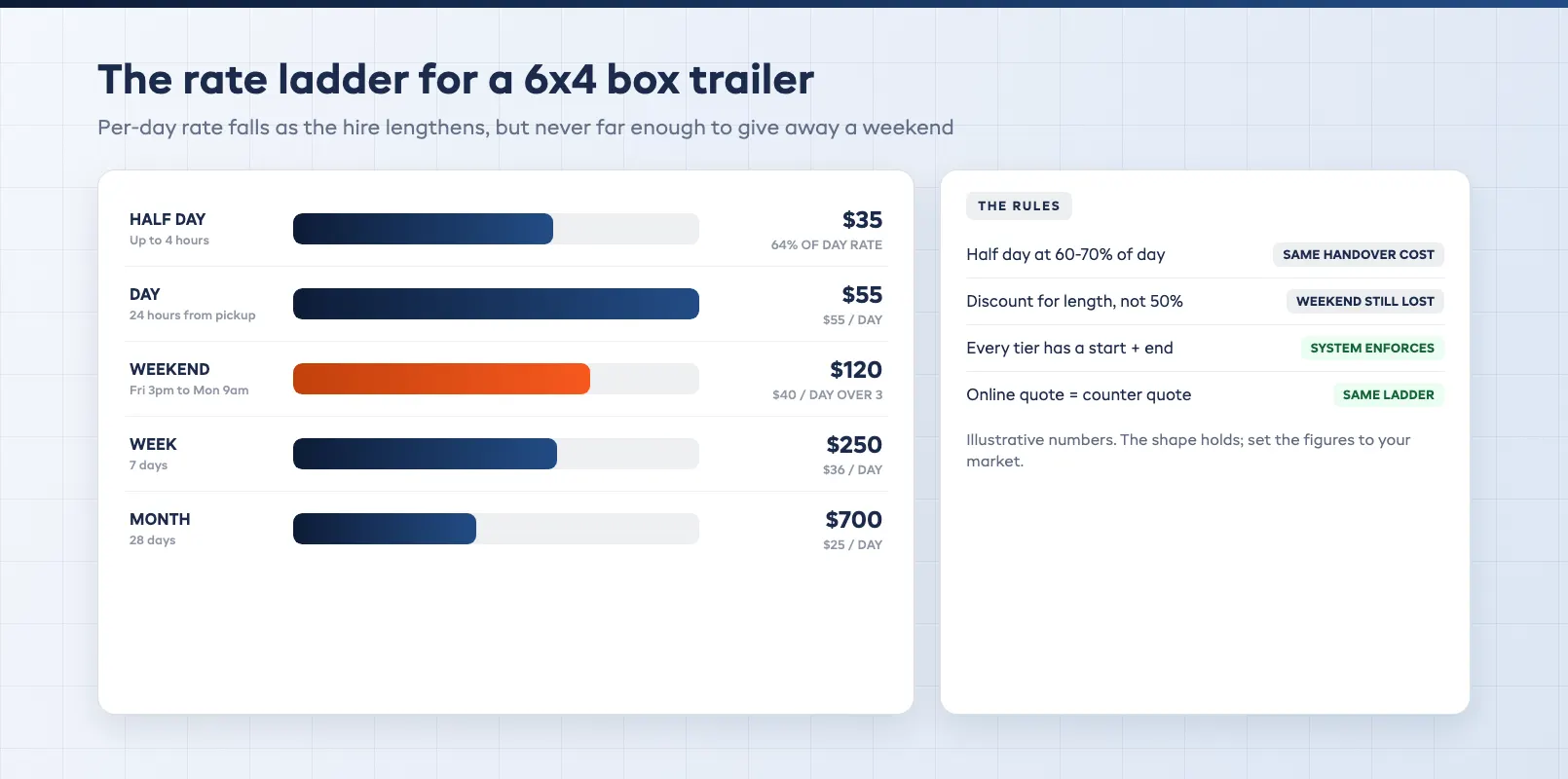
A working ladder for a standard box trailer looks something like this. The numbers are illustrative; yours depend on your market, but the shape holds:
| Tier | Period | Example rate | Per-day equivalent |
|---|---|---|---|
| Half day | Up to 4 hours | $35 | - |
| Day | 24 hours | $55 | $55 |
| Weekend | Fri 3pm to Mon 9am | $120 | $40 (over 3 days) |
| Week | 7 days | $250 | $36 |
| Month | 28 days | $700 | $25 |
Three things to notice about the ladder:
- The half-day rate is deliberately close to the day rate. A half-day hire costs you the same handover, the same check, the same sweep as a full day, and it ties the unit up during the hours everyone else wants it. Price it at 60-70% of the day rate, not 50%. If a customer is going to be gone five hours anyway, the day rate should feel like the obvious choice.
- The per-day rate falls with duration, but not far. Longer hires reduce your handover cost per day, and a trailer out for a week is not being cleaned four times. That is worth a discount. It is not worth a 50% discount, because a week-long hire also removes the unit from the weekend where it would have earned the most.
- Every tier needs a defined start and end. "One day" means 24 hours from pickup, or it means "back by close of business," and the two are not the same trailer. Write the boundary on the rate and let the booking system enforce it; the overdue section below depends on this.
Rate tiers belong in the trailer rental software, not on a laminated sheet, for a simple reason: the system can then quote the right tier automatically when a customer picks a pickup and return time online, and apply the same logic at the counter. A yard that prices by hand gets a different answer depending on who is behind the desk.
Weekend as Its Own Rate
The weekend is not "two days." It is the product most of your customers are actually buying, and it deserves its own line on the rate card with its own boundaries.
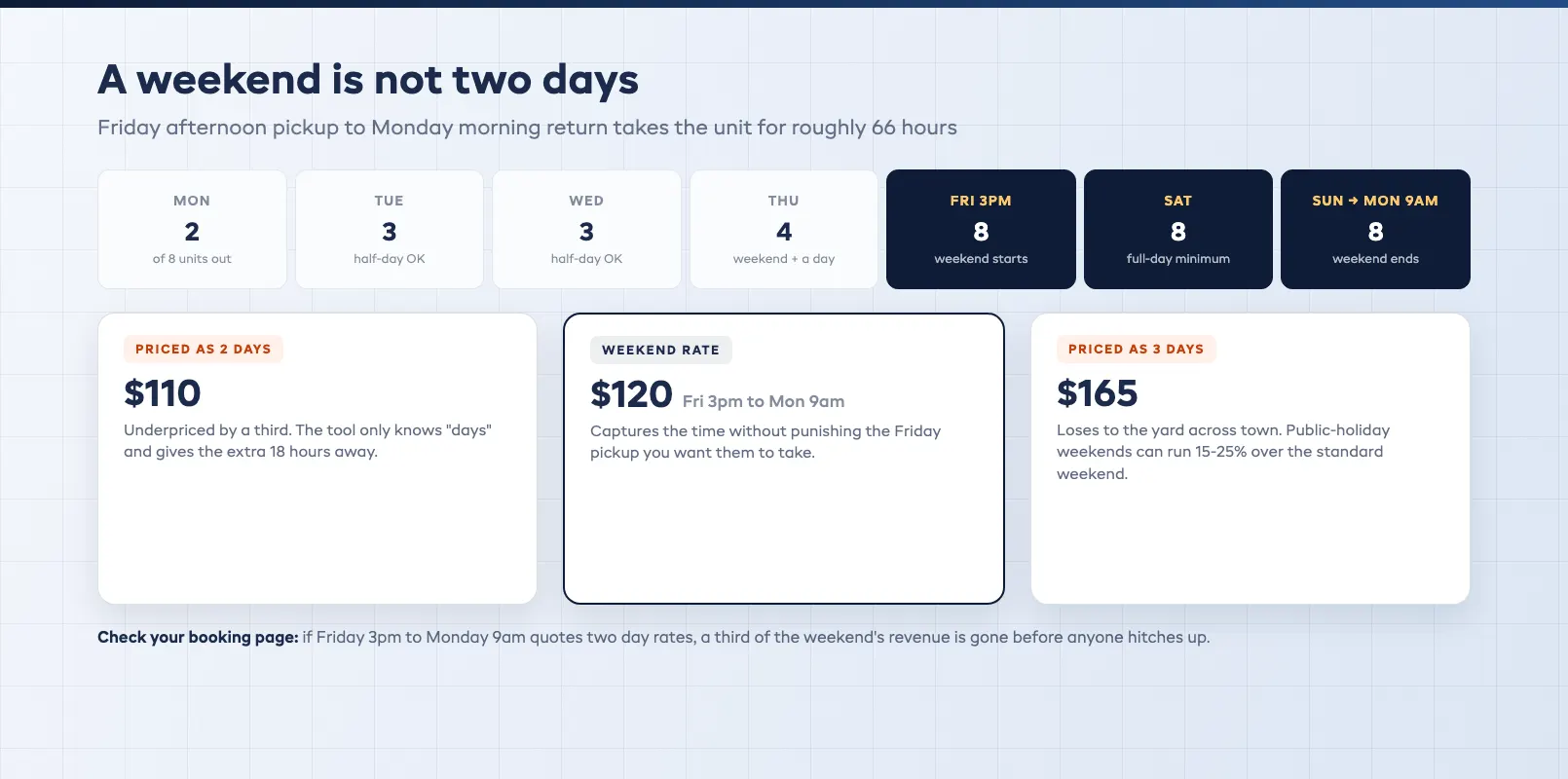
Look at what a weekend hire really covers. Pickup Friday afternoon, use Saturday, maybe Sunday, return before you open Monday. That is roughly 66 hours, or nearly three calendar days, of the unit being unavailable. Priced as two day rates it is underpriced by a third. Priced as three day rates it loses to the yard across town. The answer is a weekend rate set somewhere between the two, which is what the $120 line in the ladder above does: it captures the extra time without penalizing the customer for the Friday-afternoon pickup you want them to take anyway.
Some ways to structure it:
- Fixed window, fixed price. Friday from 3pm to Monday by 9am at one rate. Simple to explain, simple to enforce, and it pushes Friday pickups into the afternoon when the yard is quieter.
- Saturday premium. Some yards leave the ladder alone and add a flat surcharge to any hire that spans Saturday. This works if your midweek utilization is genuinely low and you want the weekend to subsidize it, but it is harder to explain at the counter.
- Seasonal weekend rates. Moving season, spring clean-ups, and long weekends are when demand runs ahead of the fleet. A public-holiday weekend rate 15-25% above the standard weekend is normal, and the customers booking those weekends are rarely price shopping.
The important discipline is that a weekend hire should always be quoted as a weekend hire. If your online booking lets a customer pick Friday 3pm to Monday 9am and quotes them two day rates because the tool only knows "days," you have given away a third of the weekend's revenue before anyone has hitched anything. Check what your booking page actually quotes for that window; it is a common leak.
The weekend rate also changes the conversation about pickups. If a Friday-afternoon pickup is part of the weekend product, the customer who wants the unit from Thursday is now buying a weekend plus a day, and the system should quote it that way.
Minimum Periods
A minimum hire period is a pricing rule, not a customer-service rule, and it does a different job on different days.
On a quiet Tuesday, a two-hour hire is found money. On a Saturday morning, the same two-hour hire blocks a unit that could have gone out for the weekend on Friday. So the minimum period should vary by day, and probably by unit:
- Weekdays: half-day minimum on standard box and cage trailers. Take the short hires; the fleet is sitting anyway.
- Saturdays: full-day minimum on everything, and on car transporters and plant trailers consider a weekend minimum. A transporter that goes out Saturday 8am for four hours and comes back at noon has probably cost you a weekend booking.
- Public holiday weekends: weekend minimum across the fleet. Anyone who wants a unit for Easter Saturday alone is asking you to hold it for the whole weekend on their behalf.
Minimum periods are also where the shape of your fleet shows up. A yard heavy on small box trailers can afford short minimums because the units are cheap and plentiful. A yard with two car transporters cannot, because each one is a large slice of weekend capacity.
Two practical notes. First, the minimum should be enforced by the booking system, not by the person at the counter having an argument. If the online calendar simply does not offer a two-hour slot on a Saturday, nobody has to say no. Second, a minimum that never flexes leaves money on the table. Once a Saturday is clearly not going to fill, opening up half-day slots that afternoon is a sensible way to earn something from a unit that would otherwise sit, and a system with per-day rules makes that a switch rather than a rewrite.
Overdue Charging That's Automatic
Here is what overdue actually costs, and it is more than the extra hours.
A trailer due back Monday 9am is booked out again Monday 10am. The Monday customer arrives, the unit is not there, and you either send them away, substitute a different unit, or give them a discount to wait. Meanwhile the weekend customer rolls in at 11:30 with "sorry, traffic," and unless the overdue fee is already on the card, you are now having a conversation about whether they should pay for it. Most yards, most of the time, wave it. That is the real cost: a lost Monday booking, an annoyed customer, and an overdue fee that was never charged.
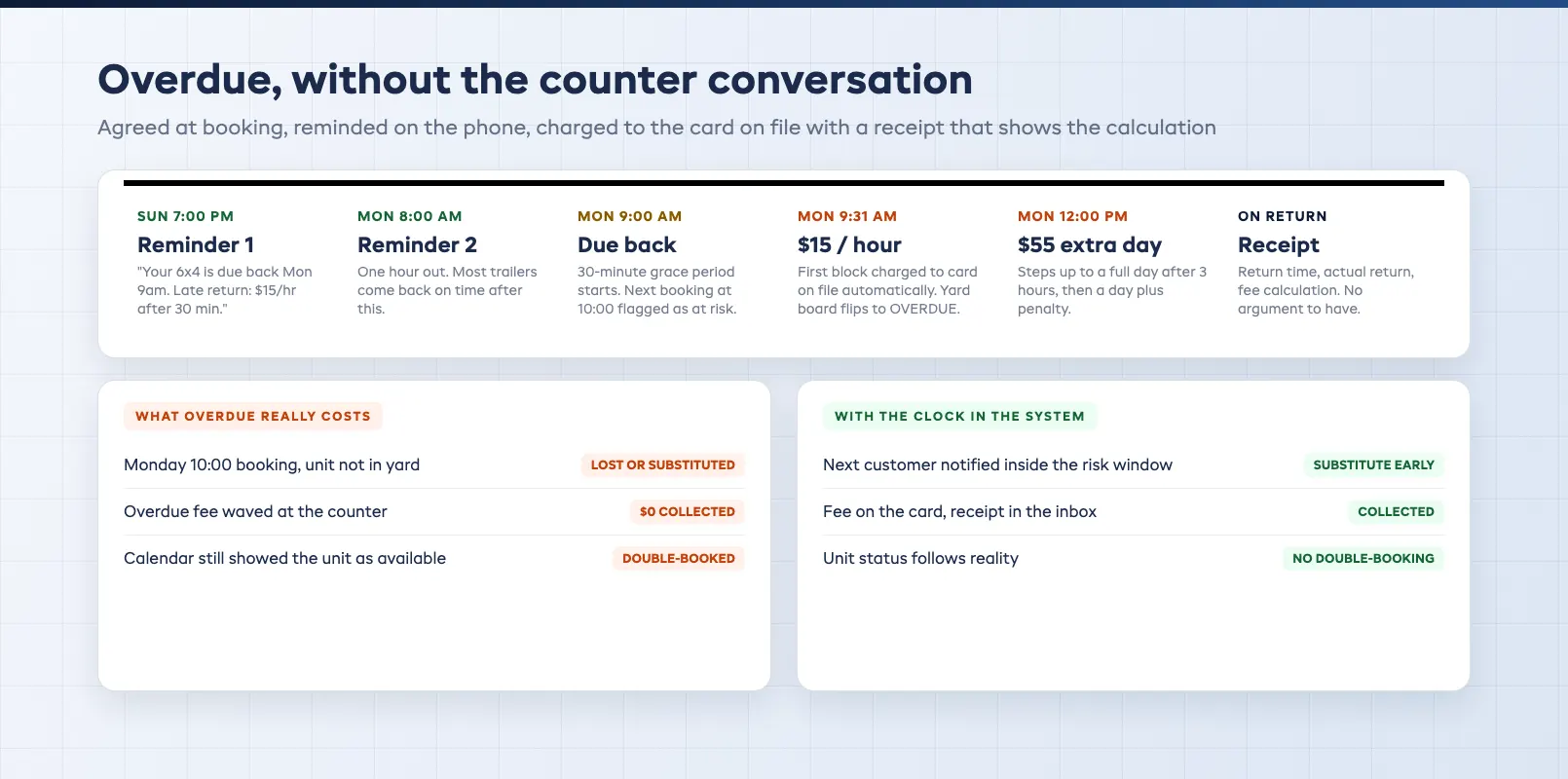
The fix is to make overdue charging automatic, so it never depends on a counter conversation:
- Put the return time on the booking, and on the customer's phone. A reminder the evening before and again an hour before the return time gets most trailers back on time. The customers who forget were never trying to cheat you.
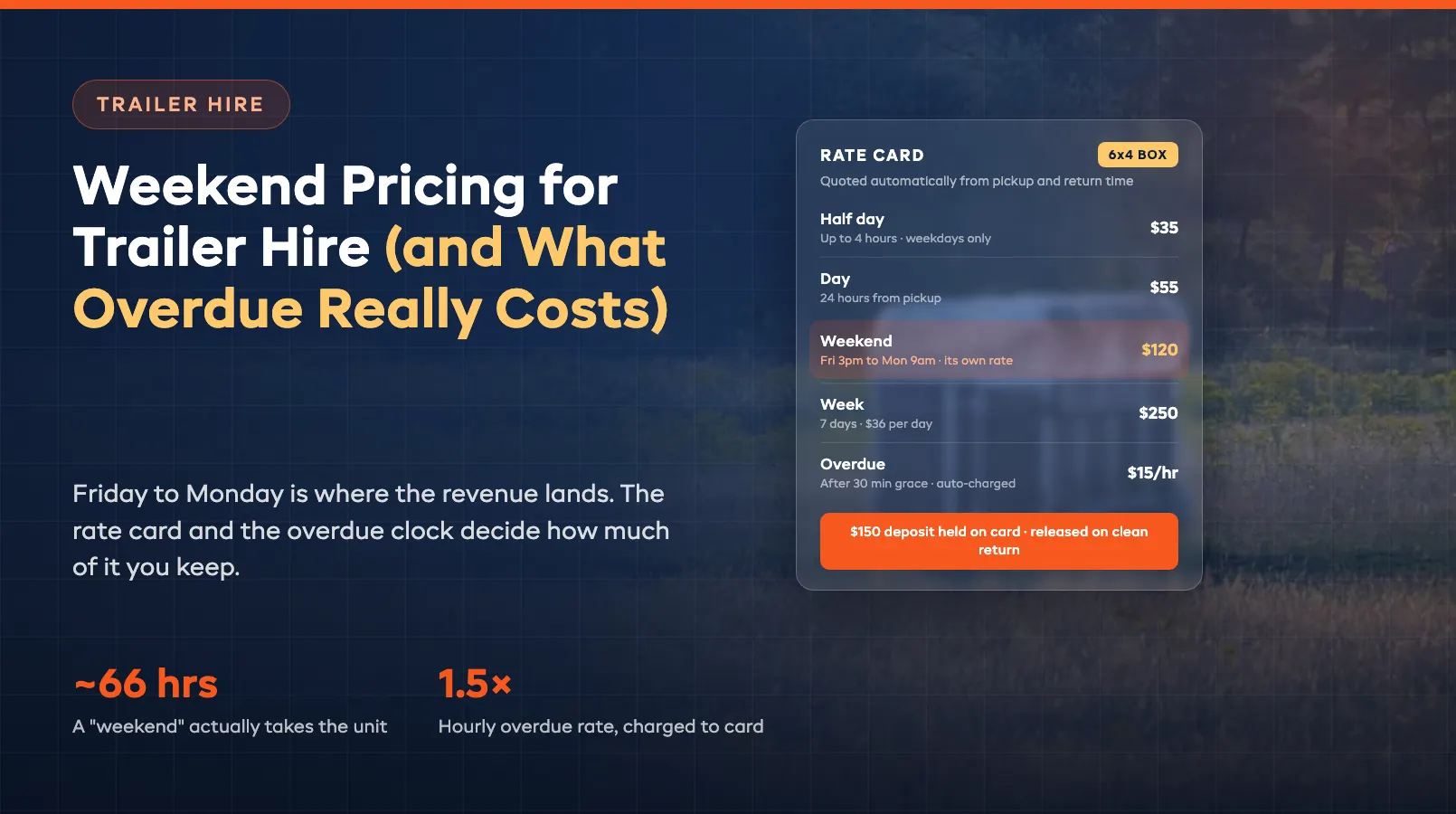
- Set the grace period in writing. Thirty minutes is common. After that, the first overdue charge applies. Make it visible at booking, on the confirmation, and on the reminder.
- Charge in blocks, not by the minute. An hourly overdue rate at 1.5x the hourly equivalent of the day rate is typical for the first few hours. After that, it steps up to a full extra day, then a day plus a penalty. The point is that being late is always more expensive than booking the extra time up front.
- Charge the card on file automatically. The overdue fee goes on the same card the deposit was taken from, without anyone having to ask. The customer gets a receipt that shows the return time, the actual return, and the fee. Arguments drop away because the number was agreed at booking, and the receipt shows exactly how it was calculated.
- Notify the next customer. If a unit is running late and the next booking is inside the risk window, the system should flag it so you can substitute a unit before that customer is standing in the yard.
The overdue rate itself should be written on the rate card as a real line item, not buried in terms. Customers who see "late return: $15 per hour after a 30-minute grace period" bring the trailer back on time. Customers who see nothing assume it is negotiable, and they are usually right.
One more reason to automate this: late returns are the leading source of double-bookings in trailer yards, because a unit that is physically not in the yard still shows as available for the next customer. When the overdue clock runs in the same system that holds the calendar, the unit's status follows reality, and the yard board shows a red "overdue" flag instead of a green "ready" one. The trailer hire software guide covers what the yard board should look like.
Deposits
A deposit does two jobs: it covers you for damage you can prove, and it makes the customer treat the unit as if it costs something. Size it to the unit, not to a single fleet-wide number.
| Trailer type | Typical deposit | What it is covering |
|---|---|---|
| 6x4 or 7x5 box trailer | $100-200 | Light board, mudguard, tailgate latches |
| Cage trailer | $150-250 | Cage panels, gate hinges, floor |
| Enclosed / furniture trailer | $250-500 | Door, panel dents, floor, tie-down rails |
| Car transporter | $500-1,000 | Ramps, winch, deck, wheel straps |
| Plant / machinery trailer | $500-1,500 | Ramps, brakes, drawbar, structural |
The numbers are a guide; the pattern matters more. Deposits track the cost of the most common damage on that unit type, not its replacement value. A $500 deposit on a $2,000 box trailer is not covering a write-off; it is covering the light board and mudguard that get reversed into a wall every other week.
Three rules keep deposits from turning into a Monday-morning argument:
- Pre-authorize, don't charge. A hold on the card, released automatically at a clean return, is what customers expect from a hire. Charging and refunding costs you processing fees both ways and makes every hire feel like a purchase.
- Tie the claim to the handover photos. Damage is only chargeable if you can show the before and the after, timestamped and attached to the booking. The condition-photo routine in the inspection guide is the same routine that makes deposit claims stick.
- Release fast. A hold that sits on a card for a week after a clean return is the single most common complaint in hire reviews. Auto-release on checklist completion, and the customer leaves the yard already knowing the money is coming back.
For commercial customers on account, a deposit can be replaced by a signed damage agreement and a card on file. The trailer that goes out to a tradesman every Monday for six months does not need a fresh $200 hold each time; it needs a standing authorization and a clear per-incident charge.
Which Trailer Types Earn
Every unit on the fleet is competing for the same weekends, so the last question is which types deserve the space. Measure it as revenue per unit per week, net of the maintenance that type generates, and the ranking is usually a surprise.
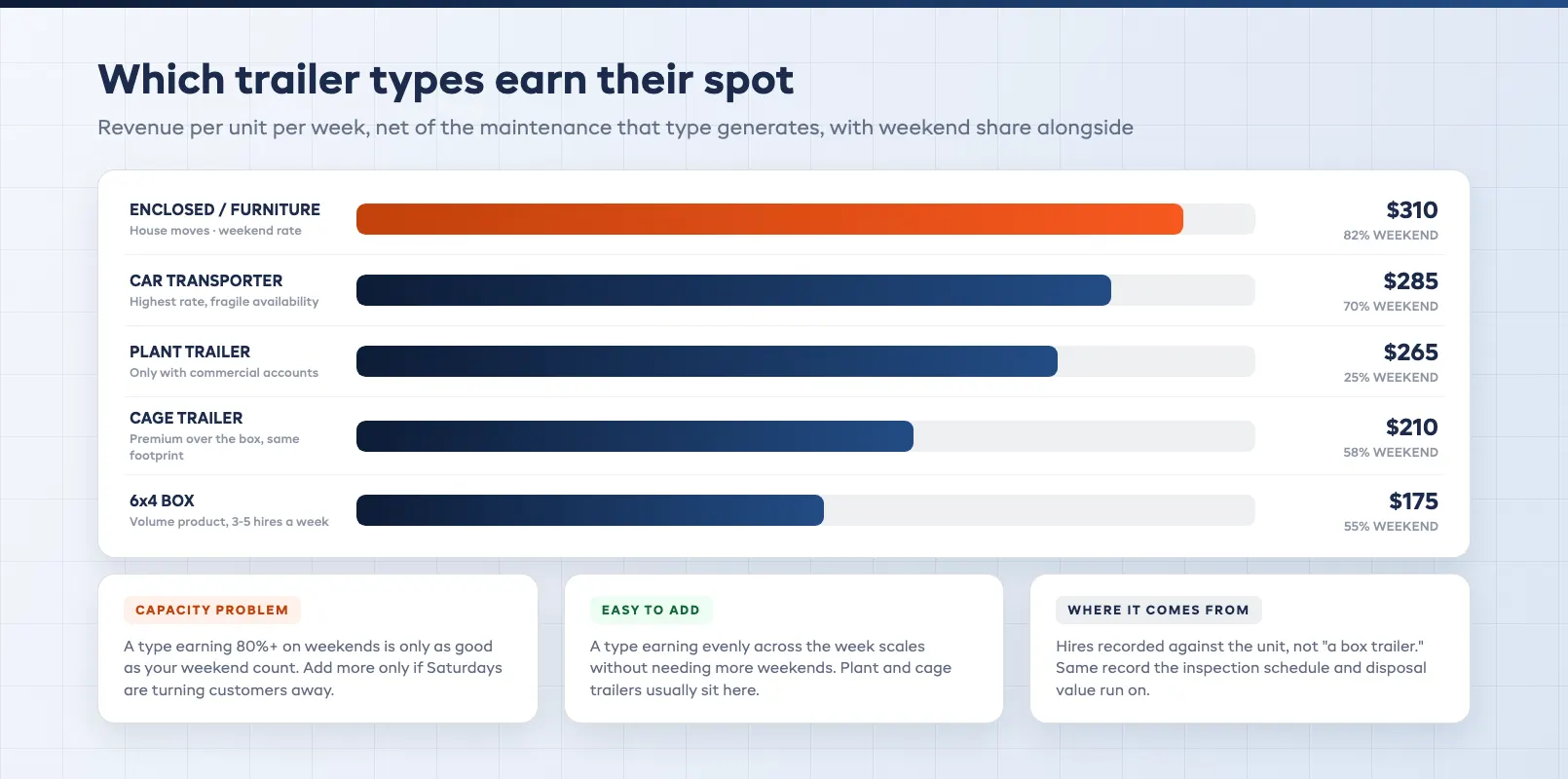
A typical pattern, for a yard with a mixed fleet:
- 6x4 box trailers are the volume product. Cheap to buy, cheap to fix, out three to five times a week, and the first unit every new customer hires. They earn steadily but never spectacularly, and they are the ones that get overbooked on long weekends.
- Cage trailers earn a premium over the plain box for the same footprint, because the customer clearing a garden or a shed will pay for the sides. Maintenance is a little higher (panels bend), but the rate difference more than covers it.
- Enclosed and furniture trailers are the weekend champions. Almost every hire is a house move, almost every house move is a weekend, and customers pay a full weekend rate without blinking because the alternative is a truck. Utilization midweek is low; the weekend rate is what justifies the unit.
- Car transporters are the highest-rate units and the most fragile earners. A weekend rate two to three times a box trailer, but each one is a large share of your weekend capacity, the deposit is high enough to put some customers off, and a bent ramp takes the unit off-fleet for a week. Two well-maintained transporters usually outperform four neglected ones.
- Plant trailers depend entirely on whether you have commercial customers. On account, out for a week at a time, they earn more per unit than anything else in the yard. Without those customers, they sit.
The measure to track is not just revenue but weekend revenue as a share of total. A unit type that earns 80% of its money on weekends is a capacity problem: it is only ever as good as your weekend count. A unit type that earns evenly across the week is easier to add more of. A yard that knows both numbers per type buys the right next trailer instead of the one the supplier had in stock.
Per-unit revenue, weekend share, and maintenance cost per type all come out of the same booking data, provided the system records hires against the unit rather than against "a box trailer." That is the same unit-level record the inspection schedule runs on, and the same one that tells you, at disposal time, exactly what a trailer earned over its life.
Plans that fit a trailer yard start at $23/month on annual billing; see pricing for the current tiers, and the trailer rental software page for the feature rundown, including duration-based rates, automatic overdue fees, and deposit holds.
Set the ladder, price the weekend as its own product, put minimums where the weekend capacity is, let the overdue clock run without a phone call, and size the deposit to the unit. The rate card stops being a number on the wall and starts being the thing that decides whether Friday to Monday makes money.
FAQ
How much should a trailer hire cost per day?
It depends on the unit and the market, but the shape of the rate card matters more than any single number. A standard 6x4 box trailer typically sits in the $45-65 per day range in most markets, with a half-day at 60-70% of that, a weekend rate that covers Friday afternoon to Monday morning at roughly 2.2 day rates, and a weekly rate at around 4.5 day rates. Cage, enclosed, and car transporter units price up from there. Build the ladder first, then set the numbers to your local competition.
Should weekend trailer hire cost more than weekday hire?
Yes, and it should be priced as its own product rather than as two or three day rates. A weekend hire from Friday afternoon to Monday morning takes the unit out of the fleet for close to three days, so two day rates underprice it, while three day rates lose to competitors. A dedicated weekend rate between the two captures the extra time, and a public-holiday weekend rate 15-25% higher covers the periods when demand runs ahead of the fleet.
What is a fair overdue fee for a late trailer return?
A short grace period (usually 30 minutes) followed by an hourly charge at about 1.5 times the hourly equivalent of the day rate for the first few hours, stepping up to a full extra day and then a day plus a penalty. The exact number matters less than three things: it is written on the rate card, it is agreed at booking, and it is charged to the card on file automatically with a receipt that shows the return time, the actual return, and the calculation. Fees that depend on a counter conversation rarely get collected.
How much deposit should I take on a hire trailer?
Size the deposit to the most common damage on that unit type, not to its replacement value. As a guide: $100-200 on a box trailer, $150-250 on a cage, $250-500 on an enclosed trailer, $500-1,000 on a car transporter, and $500-1,500 on a plant trailer. Take it as a pre-authorization hold rather than a charge, release it automatically on a clean return, and only claim against it when the handover and return photos show the damage.
Which type of trailer makes the most money to hire out?
Measured as revenue per unit per week net of maintenance, enclosed and furniture trailers usually win on a weekend-heavy yard because almost every hire is a house move at a full weekend rate. Box trailers earn steadily on volume, cage trailers earn a premium over the box for the same footprint, car transporters have the highest rates but the most fragile availability, and plant trailers only earn if you have commercial customers on account. Track weekend revenue as a share of total per type; a unit that earns 80% on weekends is limited by how many weekends you have.
in one place