End-of-Summer Water Sports: Shoulder-Season Pricing and Fleet Wind-Down
End-of-Summer Water Sports: Shoulder-Season Pricing and Fleet Wind-Down
Peak season runs itself. Every board goes out, every slot fills, and the only decision is how fast you can turn a kayak around. The last six weeks are different. Demand drops in steps, not a straight line, and every week you're making calls that peak season never asked of you: what to charge on a Tuesday in mid-September, whether that eight-year-old tandem is worth another winter in storage, when to let the second dock hand go, and how much next-season cash you can bank before the gate closes.
Most water sports rental businesses handle the wind-down by feel. Rates stay at peak until the lot is empty, the fleet goes into storage as one blob, staff get cut the week after the owner realizes payroll is bigger than revenue, and next season's marketing starts in April. This guide replaces feel with a framework: four decisions, made in order, on a calendar.
Read the demand curve before you touch anything
The shoulder season isn't one thing. It's three overlapping shifts, and each one takes out a different slice of your bookings:
- Schools go back. Family midweek demand disappears almost overnight. Weekends hold for another three to five weeks.
- Water and air temperatures drop. First to go are the walk-up SUP and swim-adjacent hires. Kayak and lesson demand hangs on longer, especially with wetsuits in the mix.
- Daylight shortens. Your last bookable slot moves earlier every week, which quietly removes the after-work hire that filled 4-6pm in July.
Pull last year's bookings by week and by weekday. If you're running a booking system, this is a two-minute report. If you're on a spreadsheet, it's an evening's work that will pay for itself ten times over. What you're looking for is the week your midweek utilization first drops under 40%, and the week your weekend utilization does the same. Those two dates anchor everything below.
If you run more than one site, the curve will differ by location. A lake beach with a local town behind it holds midweek demand far longer than a resort-strip kiosk. The multi-location operations guide covers how to run different closing dates without losing track of the fleet.
Pricing as demand drops: three levers, pulled in order
The instinct is to hold peak rates and accept lower volume. That works for exactly as long as the weekends stay full. Once they don't, you're paying staff to stand next to idle boards. The SUP and kayak pricing guide covers how to set the peak rate card. This is about what to do with that card as the season ends.
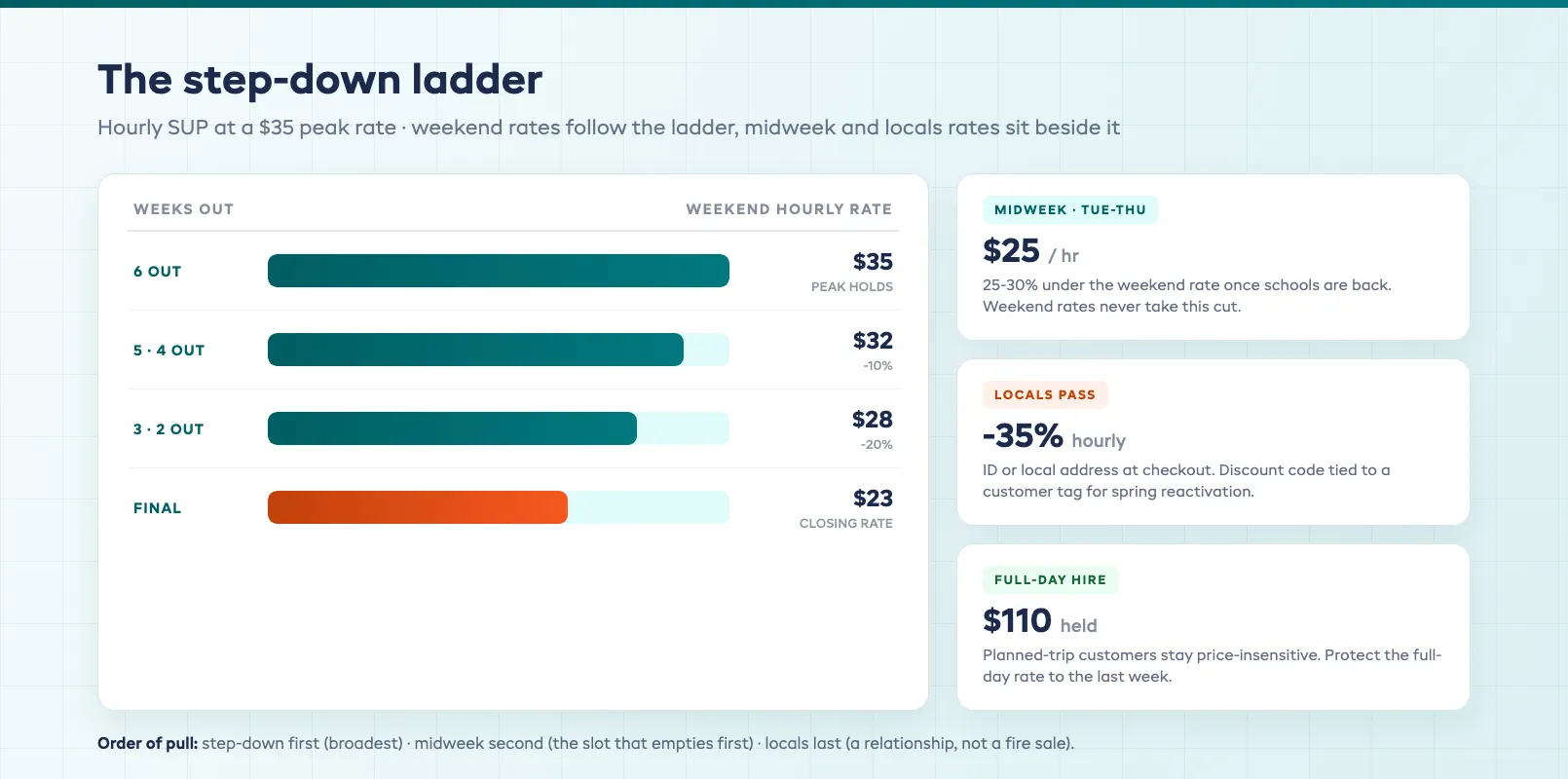
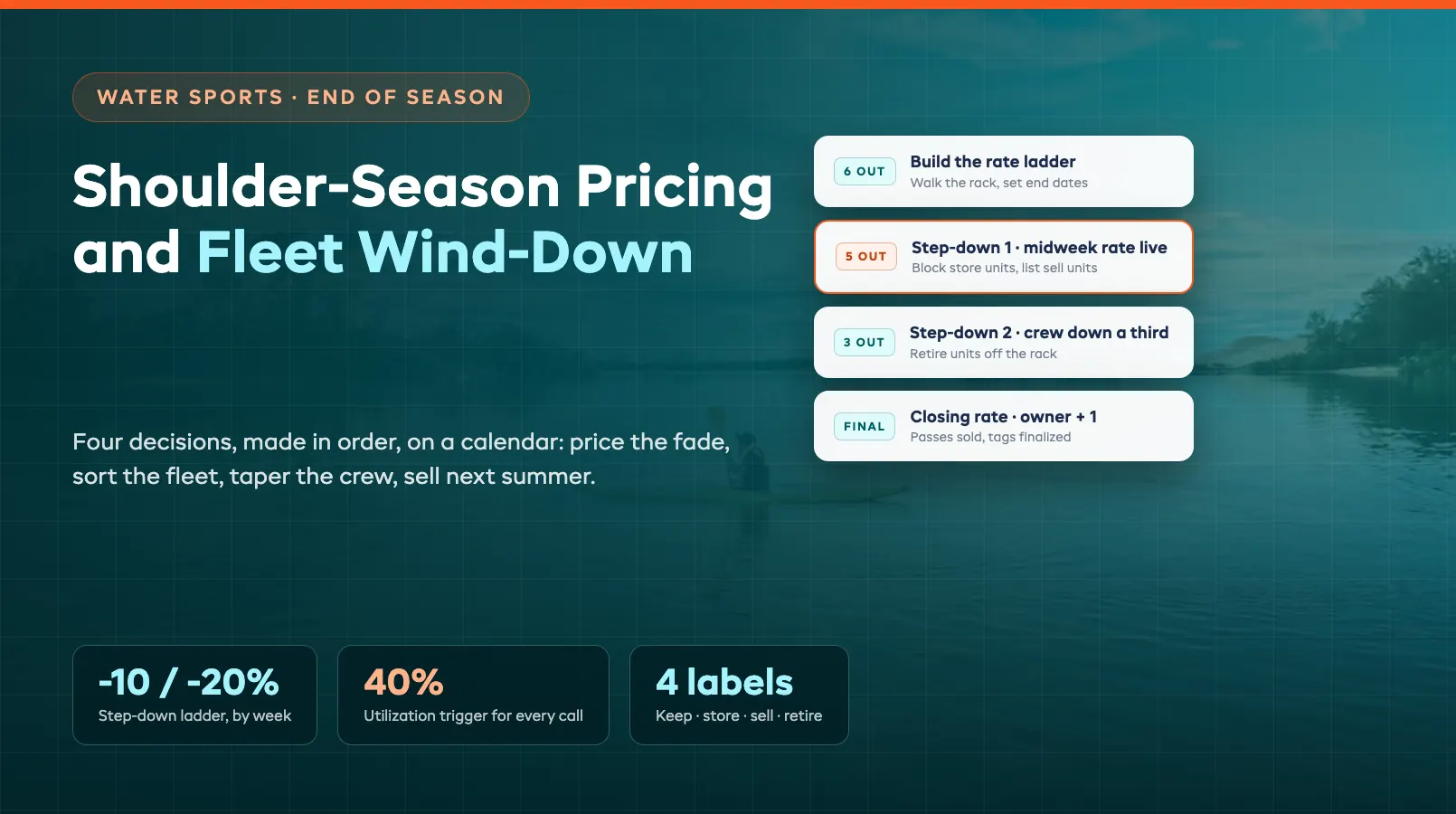
Lever 1: Step-down rates, by week. Don't cut everything at once. Set a ladder: peak rate through the last full-demand weekend, then 10% off for the next two weeks, then 20% off for the following two, then a closing rate for the final week. A $35/hour SUP becomes $32, then $28, then whatever moves boards on the last Saturday. Publish the ladder in your booking system in advance so the price a customer sees on your site changes on the day you decided, not the day you remembered.
Lever 2: Midweek pricing. Once schools are back, Tuesday through Thursday need their own price. A flat midweek rate 25-30% under the weekend rate, or a "second hour free" midweek offer, brings in the retirees, shift workers and remote workers who were priced out or crowded out in August. Keep weekend rates on the step-down ladder only. Discounting Saturdays when Saturdays are still full is money you're handing back.
Lever 3: Locals rate. Tourists leave. Locals don't. A locals pass (show ID or a local address at checkout) with a meaningful discount, say 30-40% off hourly, turns the people who avoided your beach all summer into your September customers. Set it up as a discount code tied to a customer tag so it's trackable, and so the same customers are easy to reach when you run the pre-season reactivation in spring.
The order matters. Step-down first, because it's the broadest. Midweek second, because it targets the slot that empties first. Locals last, because it's a relationship you want to carry into next year, not a fire sale.
What not to do: don't slash the full-day rate. Full-day hires are the ones that still book in the shoulder season, usually by people who planned a trip. They're price-insensitive relative to the hourly walk-up. Protect them.
Keep, store, sell or retire: every unit gets one answer
The fleet doesn't wind down as one thing either. A twelve-month-old inflatable SUP and a six-year-old rotomolded sit-on-top that's done four summers of beach abuse are different assets with different answers. Walk the rack with a tablet and give every unit one of four labels.
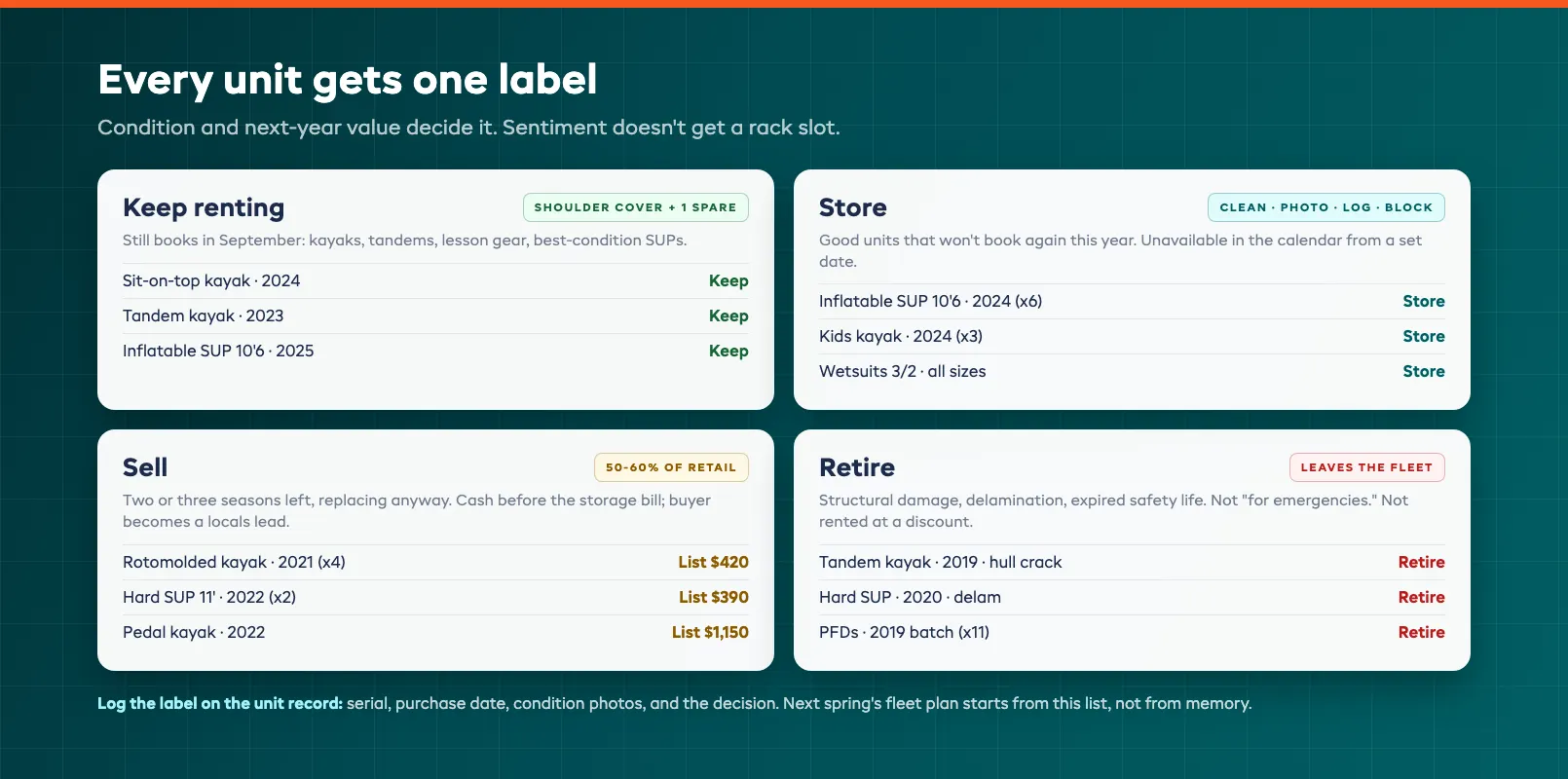
Keep renting. Units that still book in the shoulder: kayaks, tandems, anything used in lessons, and your best-condition SUPs. Keep enough to cover a realistic shoulder-season Saturday plus one spare per type. Everything above that number is idle inventory sitting in salt air.
Store. Good units that won't book again this year. Rinse, dry, log the condition with photos, deflate or rack them, and mark them unavailable in the booking calendar from a set date. The wetsuit and soft-gear guide covers the cleaning and storage detail for suits, PFDs and neoprene; the same "clean, photograph, log, block" sequence applies to hard gear.
Sell. Units with two or three seasons left in them but that you'd replace anyway. End of season is the best time to sell used rental gear, because buyers get a full off-season to shop and you get the cash before the storage bill. Price at 50-60% of retail for units in genuinely good condition, and be honest in the listing. A local paddler who buys a well-described used kayak from you in September is a warm lead for a locals pass next June.
Retire. Cracked hulls, delaminating boards, PFDs past their inspection life, paddles with worn ferrules. Retire means it leaves the fleet. It doesn't go back on the rack "for emergencies" and it doesn't get rented at a discount. The end-of-season retirement review checklist walks through the pass/fail criteria by gear type.
The rule for the matrix: a unit's label depends on condition and next-year value, not on how you feel about it. If you find yourself keeping a board because it was the first one you bought, that's a decision about sentiment, and it costs a rack slot.
Track the four labels in whatever runs your inventory. If each unit already has a record with a serial, a purchase date and a condition log, the matrix takes an afternoon. If it doesn't, this is the moment to build one, because you're touching every unit anyway.
Staff taper: roll the roster down with the calendar
Payroll is the biggest controllable cost in the shoulder season, and it's also where operators wait longest to act. The fix is to decide the taper on the day you set the pricing ladder, and to tell the team.
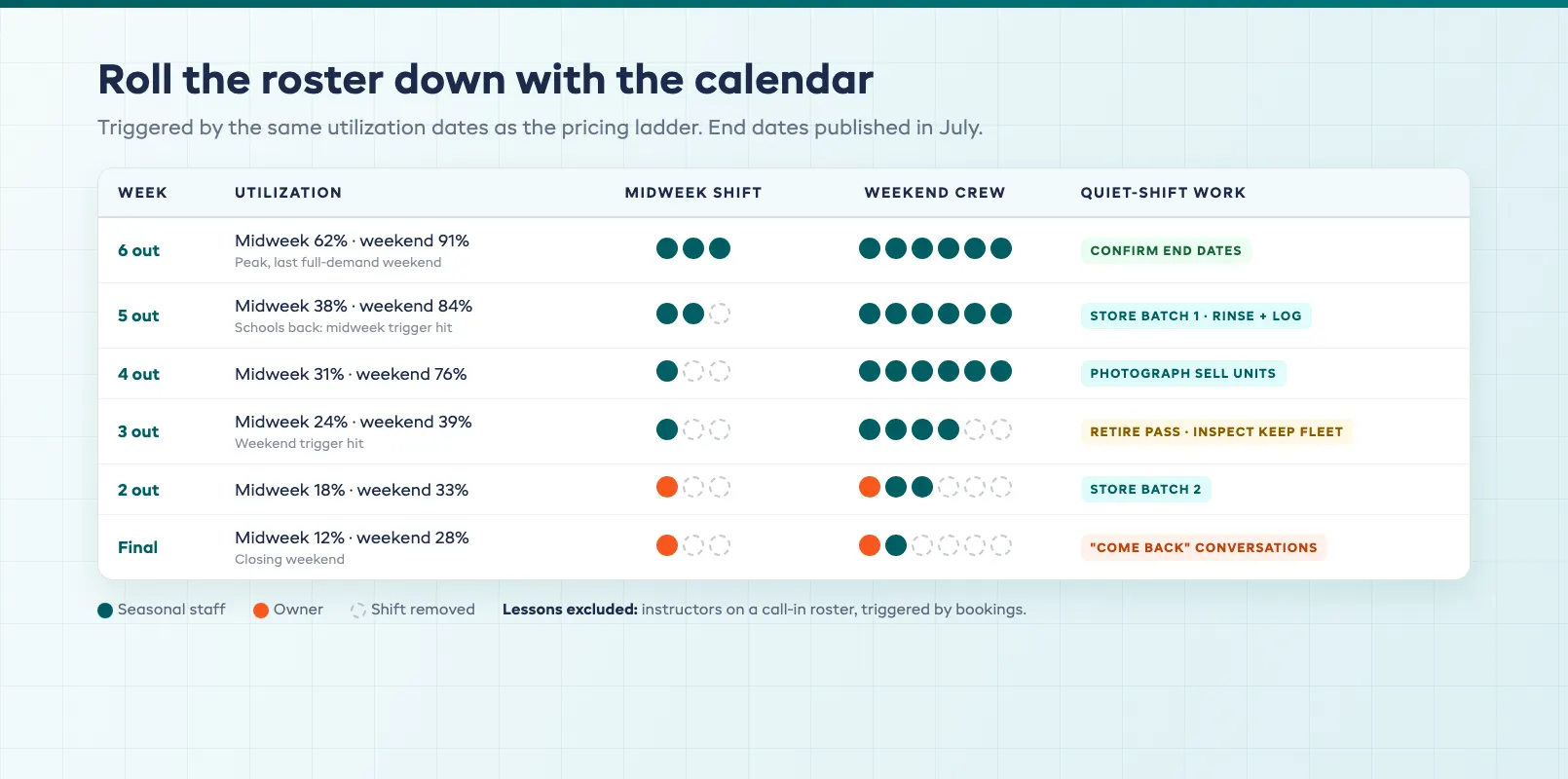
Work backwards from the two utilization dates. The week midweek demand drops under 40%, midweek becomes a one-person shift, or a two-person shift if you still run lessons. The week weekend demand drops under 40%, the weekend crew drops by a third. The final week is the owner plus one, and the one is whoever you want back next year.
Three practices make this go well instead of badly:
- Publish end dates early. Seasonal staff have their own plans for September. Telling someone in July that their last shift is the 20th of September is respectful. Telling them on the 18th is not, and they'll tell next year's applicants.
- Keep your best two on the longest. The taper is your chance to see who runs a quiet dock well. Those are the people you want opening next season, and a short "we'd like you back, here's the date" conversation in the last week is worth more than any spring job ad.
- Use the quiet shifts for close-down work. Idle staff on a dead Wednesday can be rinsing and logging the units you tagged "store," photographing the "sell" units for listings, and doing the inspection pass on the "keep" fleet. Utilization is low, but the hours aren't wasted.
Lessons are the exception to the taper. If you run instruction, the shoulder season is often your best lesson window: warm water, fewer crowds, calmer mornings. Keep qualified instructors on a call-in roster tied to actual bookings rather than a fixed rota, and let the booking system trigger the shift.
Pre-sell next season before you lock the gate
The September customer is the most valuable customer you'll meet all year. They came when it was cooler, quieter and cheaper, which means they came for the activity, not the holiday. They're also standing in front of you with a card in their hand. That's the moment to sell next year.
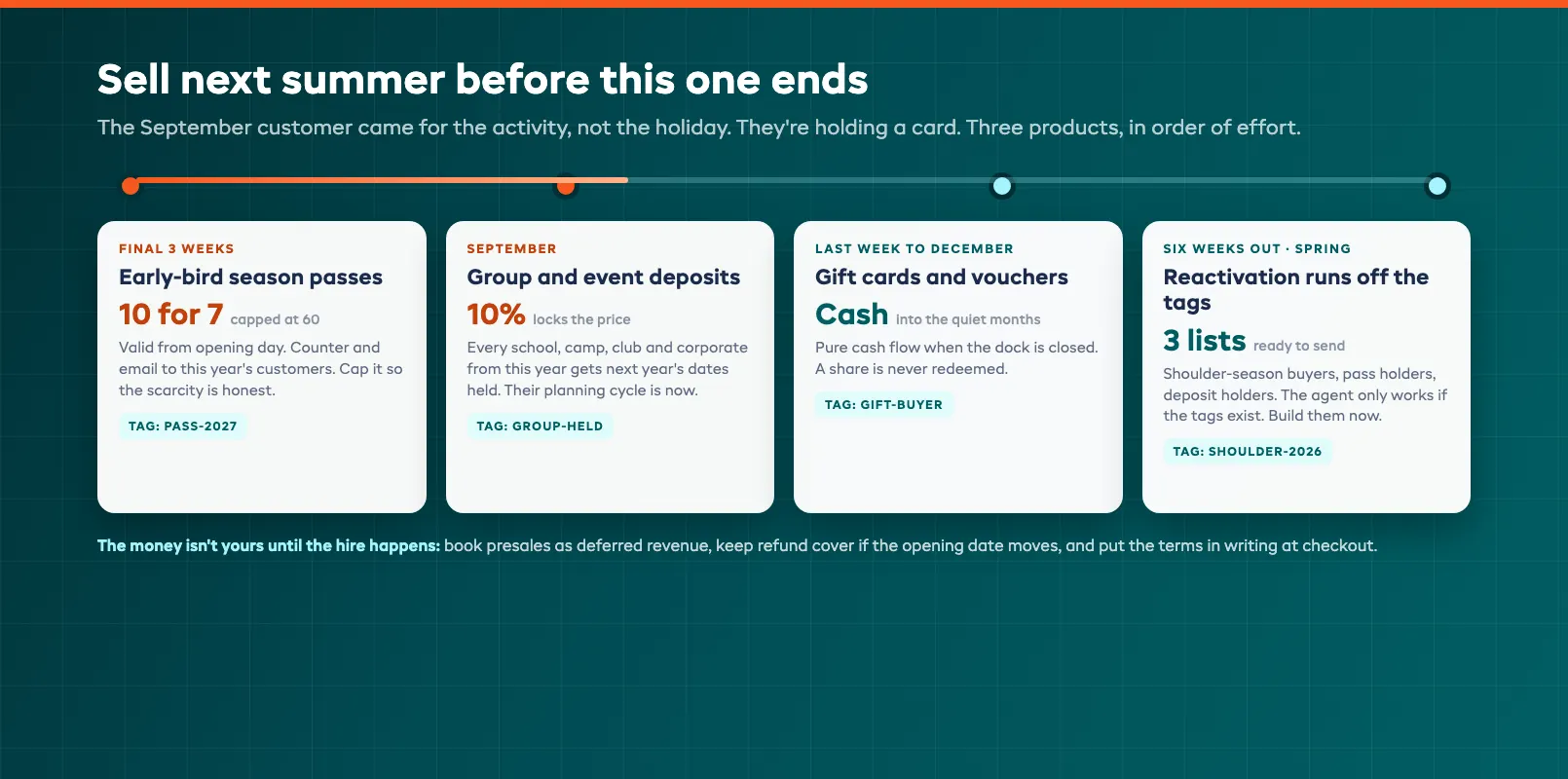
Three products work, in this order of effort:
Early-bird season passes. A fixed number of "10 hires for the price of 7" or "unlimited weekday SUP" passes, sold at a real discount, valid from opening day. Cap them so scarcity is honest. Sold at the counter and by email to this year's customers in the final three weeks.
Group and event deposits. Any school, camp, corporate or club that booked this year gets an email in September with next year's dates held and a 10% deposit locking their price. Most will take it, because their own planning cycle is happening now, and a held date is one fewer thing to organize in spring.
Gift cards and vouchers. Push them from the last week of the season through December. They're pure cash flow into the quietest months, and a proportion will never be redeemed.
Then do the thing most operators skip: tag every customer who bought in the shoulder season, and tag every pass and deposit holder. In spring, those tags are your reactivation list. A pre-season reactivation agent can work that list automatically six weeks before opening, but only if the tags exist. Build them now.
One warning on presales: the money isn't yours until the hire happens. Book it as deferred revenue, keep enough aside to honor refunds if you change your opening date, and put the terms in writing at checkout.
The wind-down calendar
Put the four decisions on one page. This is a realistic six-week shape for a Northern Hemisphere operator closing in early October; shift the dates to your own utilization curve.
| Week | Pricing | Fleet | Staff | Presale |
|---|---|---|---|---|
| 6 out | Peak rates hold; ladder built and scheduled in the booking system | Walk the rack, assign keep/store/sell/retire labels | Confirm end dates with every seasonal | Design passes and set the cap |
| 5 out | Step-down 1 (-10%); midweek rate live | Block "store" units from a set date; list "sell" units | Midweek drops to one or two staff | Email this year's groups with held dates |
| 4 out | Step-down 1 continues; locals rate live | First storage batch cleaned, photographed, racked | Weekend crew unchanged | Passes on sale at counter and by email |
| 3 out | Step-down 2 (-20%) | "Retire" units off the rack, disposal logged | Weekend crew down by a third | Deposits chased; second email |
| 2 out | Step-down 2 continues | Second storage batch; fleet down to shoulder-Saturday cover | Owner plus two | Gift cards pushed |
| Final | Closing rate; last-day offers to locals list | Remaining units in on the last evening | Owner plus one; "come back" conversations | Tags finalized; deferred revenue booked |
The calendar isn't the point. The point is that each column has an owner, a date and a place where the decision is recorded, so nothing depends on remembering. If the booking system holds the pricing schedule, the availability blocks, the customer tags and the shift roster, the wind-down mostly runs from the decisions you made in week six.
Weather will interrupt it. A warm late-September weekend can put you back at peak demand for two days, and an early storm can end the season a week short. The numeric go/no-go thresholds in the weather operations guide don't change in the shoulder season; if anything, they matter more, because a thin crew has less margin for a rescue. Hold the framework, flex the dates.
Everything here runs on the same operating model as the rest of our water sports hub: one record per unit, one record per customer, and pricing that lives in the system rather than on a whiteboard. If any of the terms are unfamiliar, the water sports rental glossary covers them.
FAQ
When should a water sports rental business start shoulder-season pricing?
The week your midweek utilization first drops under about 40% is the trigger, and for most operators that lines up with schools going back. Build the step-down ladder before that week so the price changes on a scheduled date rather than when you notice the lot is empty.
How much should I discount rentals at the end of the season?
A ladder works better than one cut: hold peak rates through the last full weekend, then 10% off for two weeks, 20% off for the next two, and a closing rate in the final week. Add a separate midweek rate 25-30% under weekend pricing, and a locals rate of 30-40% off hourly. Don't discount full-day hires, which stay price-insensitive in the shoulder season.
Should I sell used rental kayaks and paddleboards at the end of summer?
Yes, for units with two or three seasons left that you'd replace anyway. End of season is when buyers have a full off-season to shop and you avoid the storage cost. Price good-condition units at 50-60% of retail, describe them honestly, and treat every buyer as a locals-pass lead for next year.
How do I decide which rental gear to keep, store, sell or retire?
Judge on condition and next-year value, not sentiment. Keep enough to cover a shoulder-season Saturday plus one spare per type; store good units that won't book again this year; sell units you'd replace anyway; retire anything with structural damage, delamination or expired safety life. Log the label against each unit's record.
How do I reduce seasonal staff without hurting next season's hiring?
Set end dates in July and tell people then, not the week before. Taper the roster on the same utilization triggers as your pricing, keep your best two on the longest, and use quiet shifts for storage and inspection work. Have a short "we want you back, here's the opening date" conversation with the people you'd rehire.
What can I pre-sell for next season before closing?
Capped early-bird season passes, held dates with a 10% deposit for this year's groups, and gift cards pushed through December. Tag every buyer so they form your spring reactivation list, and book the money as deferred revenue with refund terms in writing.
in one place