Multi-Day Adventure Operations: Permits, Logistics, Base Camp
A single-day rafting trip is logistics. A five-day wilderness expedition is a supply chain. The difference between a profitable multi-day adventure operation and a cash-burning disaster usually comes down to three things: permits secured months in advance, logistics planned to the hour, and a base camp setup that keeps clients comfortable and guides efficient.
Most operators start with day trips, then graduate to overnights, then attempt multi-day itineraries, and discover that the operational complexity doesn't scale linearly. It multiplies. Every additional night adds food logistics, waste management, shelter setup, emergency evacuation planning, and permit requirements that didn't exist for your day program.
This guide covers the operational systems behind running 3-10 day adventure itineraries profitably. For the full business playbook, see How to Run an Adventure Activity Business. For guide credential requirements that affect your insurance coverage on multi-day trips, see Guide Certifications: What Your Insurance Actually Requires. For checklists, templates, and tools for adventure operators, visit the adventure activity hub and activities glossary.
The Permit Landscape: What You Need Before You Sell a Single Trip
Multi-day trips on public land almost always require permits. The permitting agency varies by jurisdiction: federal (BLM, Forest Service, National Park Service), state parks, or local land managers. Many popular corridors have limited commercial allocation, and those slots are awarded months or years in advance.
Federal permits (US). The National Park Service and Bureau of Land Management issue Commercial Use Authorizations (CUAs) annually. Applications typically open 6-12 months before the season. Grand Canyon river permits, for example, use a weighted lottery system with applications due by February for the following year's season. Glacier National Park backcountry camping permits open March 15 for the full summer season.
Capacity and allocation. Most agencies cap commercial group size (6-16 participants depending on the corridor) and limit total commercial launches per day. If you're running multi-day trips on a popular river or trail, your entire season calendar is constrained by your permit allocation. Losing a permit slot costs you $3,000-$15,000 in lost revenue per trip, so track application deadlines like they're tax deadlines.
International permits. If you operate treks or expeditions outside your home country, expect additional layers: national park fees, local guide requirements (Nepal requires a licensed Nepali trekking guide), and environmental bonds. Budget 3-6 months lead time for international permit applications.
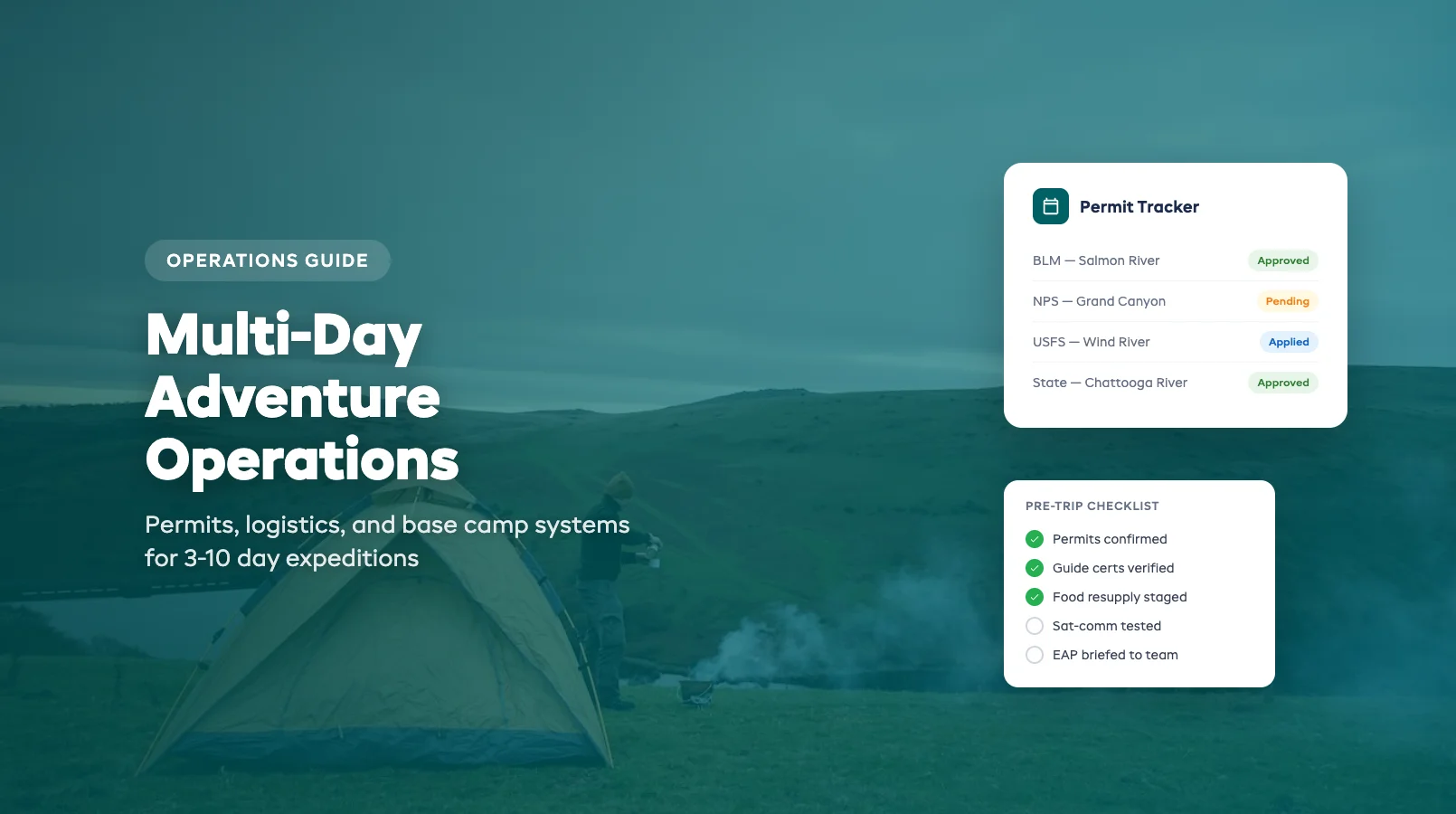
The permit calendar. Build a master calendar showing: application open dates, submission deadlines, lottery results dates, permit fee due dates, and post-trip reporting deadlines. Miss any one of these and you're either forfeiting a slot or operating illegally. Neither is acceptable.
Itinerary Design: Balancing Experience with Operational Reality
A great multi-day itinerary isn't a marketing document. It's an operations plan that happens to create an incredible guest experience. Every decision (camp locations, daily mileage, rest days, activity windows) has operational consequences.
Daily mileage and pacing. For mixed-fitness groups, plan 8-12 miles per day for hiking itineraries, 12-18 miles for river trips. Build in a rest day for trips longer than 4 days. Clients who are exhausted on day three become safety risks on day four.
Camp selection criteria. Your camp spots need: legal access (permitted camping zones), water source proximity, flat ground for tents, wind protection, waste management feasibility, and, critically, helicopter landing zone access within reasonable distance for emergency evacuation. A beautiful camp spot that's inaccessible to SAR helicopters is a liability.
Weather windows and bail-out points. Every day of your itinerary should have an identified bail-out option: a point where you can safely exit the route and transport clients back to civilisation if weather deteriorates, someone is injured, or group dynamics collapse. Multi-day trips without bail-out planning are underinsured regardless of what your policy says.
Buffer days. Build 1-2 buffer days into your operational calendar (not marketed to guests). Weather holds happen. River levels spike. Trail bridges wash out. If your schedule has zero slack, one weather day cascades into missed flights, upset clients, and refund demands.
Base Camp Setup: Comfort That Scales
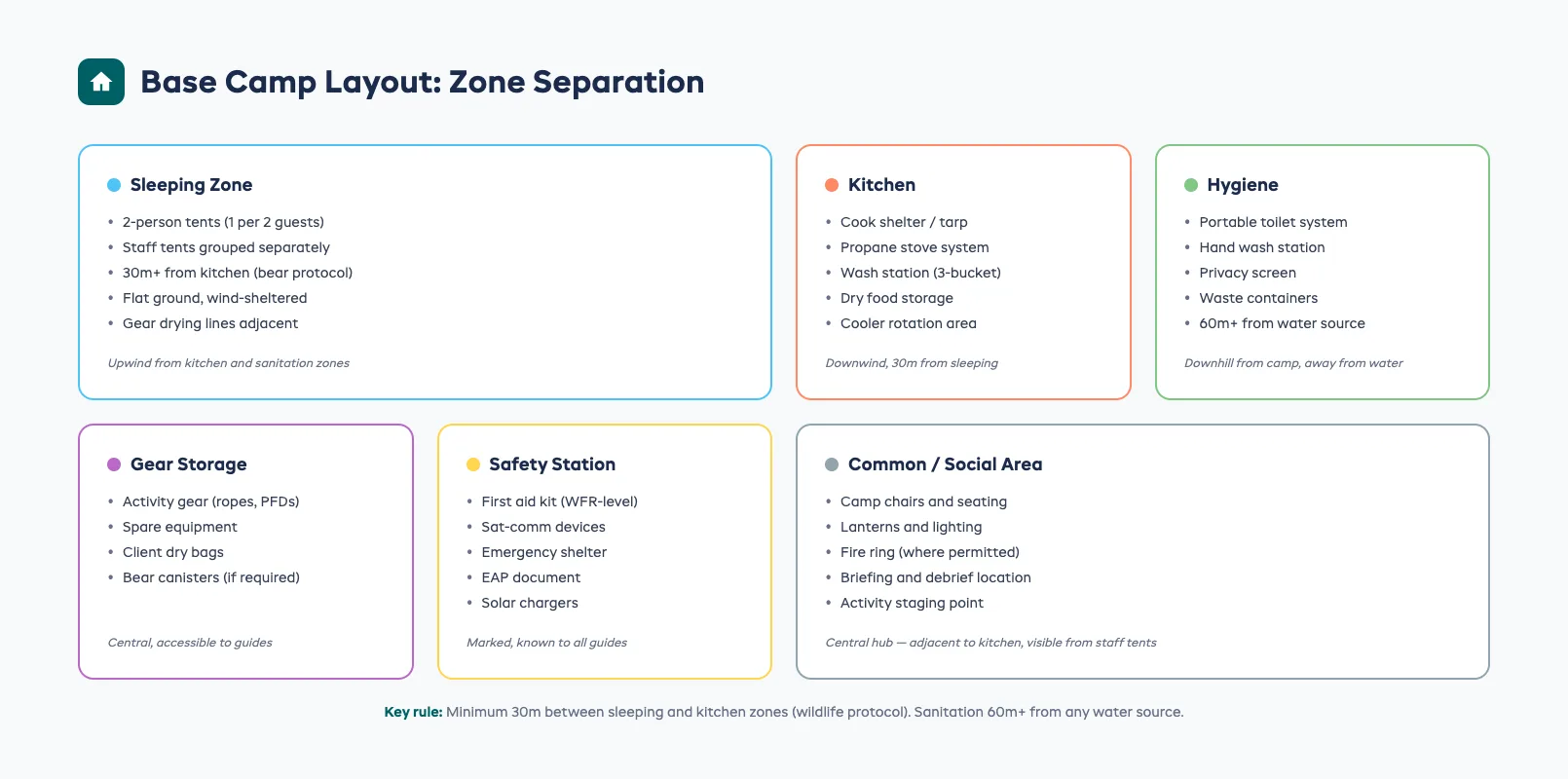
Whether you're running a fixed base camp or leapfrogging mobile camps each night, the fundamentals are the same: separate zones for sleeping, cooking, hygiene, and gear storage. Clients don't need luxury. They need dry, clean, and organized.
Fixed base camp (lodge-style multi-day). If your multi-day trips operate from a single base location, invest in permanent infrastructure: platform tents with cots, a dedicated cook shelter, proper waste management systems, and a charging station for guest electronics. The upfront investment ($15,000-$40,000) pays back in reduced setup time and higher per-trip margins because staff spend less time on logistics.
Mobile camps (river/trail). Everything you carry must justify its weight. Standard mobile camp kit per group of 8-12 clients:
- Tents: 2-person tents (one per two guests) + staff tents
- Kitchen: Propane stove system, wash station, dry box, cooler rotation
- Sanitation: Portable toilet system (required by most permits), hand wash station
- Safety: Satellite communicator, first aid kit (WFR-level), emergency shelter
- Comfort: Camp chairs, lanterns, dry bags for guest gear
The weight budget. For raft-supported trips, weight is less constrained, but pack volume still matters. For pack-supported hiking trips, plan 15-20 lbs of group gear per porter/pack animal in addition to personal kit. If you don't have pack support, your multi-day trip is limited to what guides and clients can carry, which caps your comfort level significantly.
Staff and Guide Ratios: More Than Compliance
Permit conditions usually specify minimum guide-to-client ratios. But the operational minimum and the legal minimum aren't the same number.
Legal minimums. Most CUAs require 1:8 guide-to-client ratio for standard activities, 1:4 for high-risk activities (class IV+ whitewater, technical climbing, canyoning with rappels). Check your specific permit — ratios vary by agency and activity.
Operational reality. For multi-day trips, you need additional staff beyond the guide ratio:
- Trip leader: One designated lead guide responsible for all decisions. Not a shared role.
- Sweep: One guide at the back of every group movement. Non-negotiable in technical terrain.
- Camp manager: On trips of 8+ clients, someone who stays at camp to manage setup, food prep, and guest needs while guides run activities.
The math. A 10-person, 5-day raft trip typically requires: 1 trip leader + 2 raft guides + 1 camp manager/cook = 4 staff. That's a 1:2.5 staff-to-client ratio — well above the legal 1:8 minimum. Your labor cost for that trip is $800-$1,500/day across all four staff. Build that into pricing or you'll lose money on every expedition you run.
Emergency Protocols: Plan for When, Not If
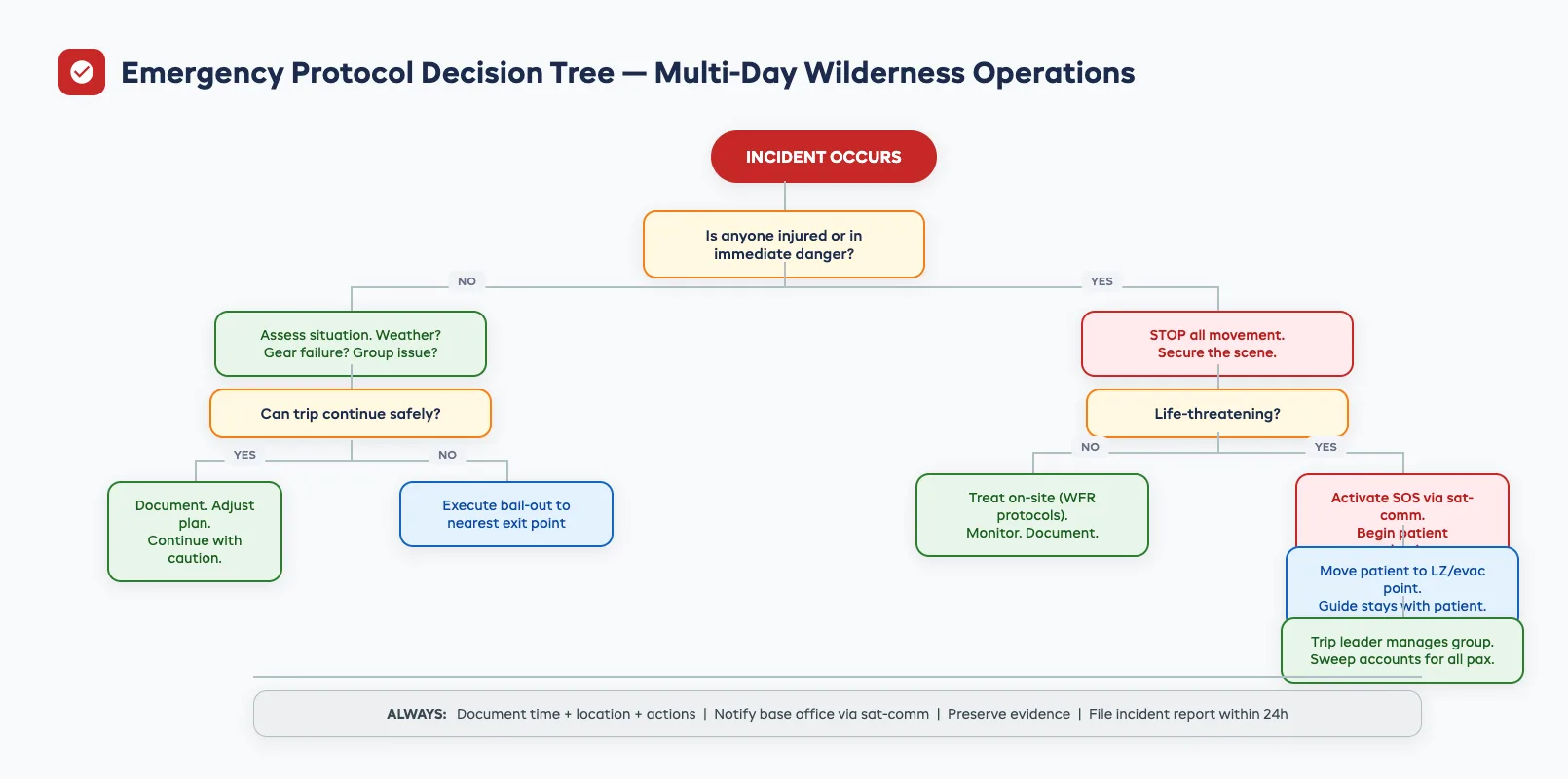
On day trips, "emergency protocol" means calling 911 and driving to the nearest hospital. On multi-day wilderness trips, emergency response is measured in hours, sometimes half a day or more. Your protocols need to account for that gap.
Communication. Satellite communicators (Garmin inReach, Zoleo, SPOT) are mandatory for any multi-day trip beyond cell coverage. Carry two devices on every trip, one primary, one backup. Test both before departure. Program emergency contacts, evacuation coordinates, and nearest hospital GPS into the devices before the trip starts.
Evacuation planning. For every camp and trail section, document:
- Nearest road access point (GPS coordinates)
- Helicopter landing zone (GPS coordinates, clear area 30m x 30m minimum)
- Estimated ground evacuation time to nearest road
- Estimated helicopter response time from nearest SAR base
- Patient packaging requirements for the terrain (litter carry, swift-water evacuation, etc.)
The emergency action plan (EAP). Every trip leader carries a written EAP. Every guide on the trip has read it. It covers: medical emergency protocol, missing person protocol, severe weather protocol, river/flash flood protocol, and equipment failure protocol. This document is what your insurance company will ask for after an incident.
Incident documentation. If anything goes wrong, even minor, document it on the trip. Time, location, what happened, what actions were taken, witness names. This isn't optional. It's what separates a defensible incident from a lawsuit.
Food and Resupply Logistics
Feeding 10-14 people three meals a day for 5-7 days in the backcountry requires the same planning as a catering operation: except you're doing it without refrigeration, running water, or a dishwasher.
Menu planning. Plan menus by day and meal. Account for dietary restrictions (get these during booking, not at the trailhead). Standard multi-day food budget: $25-$40 per person per day depending on quality level and resupply access.
Cold chain management. For raft-supported trips, coolers can maintain cold food for 3-4 days with proper ice management. After day four, you're on shelf-stable food unless you have a resupply point. For hiking trips, all food is shelf-stable from day one.
Resupply points. If your itinerary passes through accessible points, pre-stage resupply caches. This lets you carry less food weight and maintain better variety in later days. Some operators use pack animals, float planes, or pre-positioned vehicles for resupply on longer trips.
Waste management. Pack-in, pack-out applies to all food waste on most permitted routes. That means carrying 5-7 days of food garbage, compostables, and gray water unless your permit includes approved disposal sites. Budget for the weight and container volume.
Technology: What to Bring, What to Leave Behind
Multi-day trips exist in a technology gap. Your clients want to disconnect. Your operations require connection.
Essential tech for multi-day operations:
- Satellite communicator (emergency + daily check-ins with base office)
- GPS device or app with downloaded offline maps
- Weather radio or satellite weather service subscription
- Solar charger for device maintenance (guides only — guests can bring their own)
- Digital waiver and manifest copies (stored offline on a device)
Operational check-ins. Establish a daily check-in protocol with your base office. At the same time each day (usually evening camp), the trip leader sends a brief status update via satellite messenger: group status, location, any issues, tomorrow's plan. If you're managing multiple concurrent expeditions, Dash can track incoming check-in messages and flag overdue reports automatically.
Guest communications. Set expectations before departure. Clients should know: there's no cell service, guides carry emergency communication only, photos will be shared post-trip. Most clients actually prefer the disconnection, but they want to know their emergency contacts can reach them through your base office if needed.
Putting It Together: The Pre-Trip Operations Checklist
Running profitable multi-day operations means nothing gets forgotten. Use the Adventure Pre-Activity Briefing Checklist for day-of-departure protocols, and build a pre-trip operations checklist that covers the 30-day window before departure:
- 30 days out: Confirm permit, verify guide certifications current, send client prep materials
- 14 days out: Finalise menu, order resupply, confirm vehicle/shuttle logistics
- 7 days out: Equipment inspection, test satellite devices, brief all guides on EAP
- 48 hours out: Weather check, confirm client registrations, load client waivers and medical forms
- Day of: Headcount, final weather check, load gear, execute pre-activity briefing
The operators who run this consistently (trip after trip, season after season) are the ones whose multi-day programs actually make money. Everyone else is running expensive camping trips and wondering where the margin went. For guidance on managing the financial side of seasonal operations (cash flow reserves, guide retention between seasons, and off-season revenue) see Seasonal Adventure Business Management. When something goes wrong in the backcountry, your response protocol matters even more than on day trips. See Adventure Incident Response and Reporting for the full playbook.
FAQ
How far in advance should I apply for multi-day commercial permits? Most federal agencies (NPS, BLM, USFS) require applications 6-12 months before the season. High-demand corridors like Grand Canyon or Salmon River use lottery systems with deadlines 12-18 months out. Start tracking application windows the day you decide to offer multi-day trips.
What's the minimum guide-to-client ratio for multi-day adventures? Legal minimums vary by permit and activity, typically 1:8 for standard activities, 1:4 for high-risk. Operationally, multi-day trips need 1:3 or better when you factor in camp management, sweep roles, and trip leadership. Budget for at least one more staff member than the permit requires.
How much should I budget for food per person per day on multi-day trips? Plan $25-$40 per person per day depending on resupply access and quality level. Raft-supported trips can do fresh food for 3-4 days; hiking trips are shelf-stable from day one. Don't forget to budget for waste management weight and containers.
What satellite communicator is best for multi-day commercial trips? Garmin inReach Mini 2 and Zoleo are the most popular for commercial operators. Key requirements: two-way messaging, SOS button, tracking capability, and subscription plans that allow daily check-ins. Always carry two devices, never rely on a single point of failure for emergency communication.
How do I handle medical emergencies on multi-day wilderness trips? Every trip leader carries a written Emergency Action Plan with GPS coordinates for helicopter landing zones, ground evacuation routes, and nearest hospital access for every section of the route. All guides must hold current WFR certification. Satellite communicator triggers SAR. Patient is stabilised, packaged, and moved to nearest evacuation point.
What insurance coverage do I need for multi-day adventure operations? General liability ($1-2M minimum), professional guide liability, and, critically, evacuation and search-and-rescue coverage. Some policies exclude trips beyond a certain duration or distance from road access. Confirm with your underwriter that your specific multi-day itinerary is covered before selling a single seat.
How do I price multi-day trips to maintain margin? Calculate true cost: permits + staff (4-5 staff x daily rate x trip days) + food ($25-40/person/day x pax x days) + transport + gear depreciation + insurance allocation. Add 30-40% margin. Most profitable multi-day operations charge $200-$500 per person per day depending on activity and comfort level. If your margin is below 25%, your staffing or food costs are too high.
in one place