Adventure Incident Response and Reporting: A Playbook for Operators
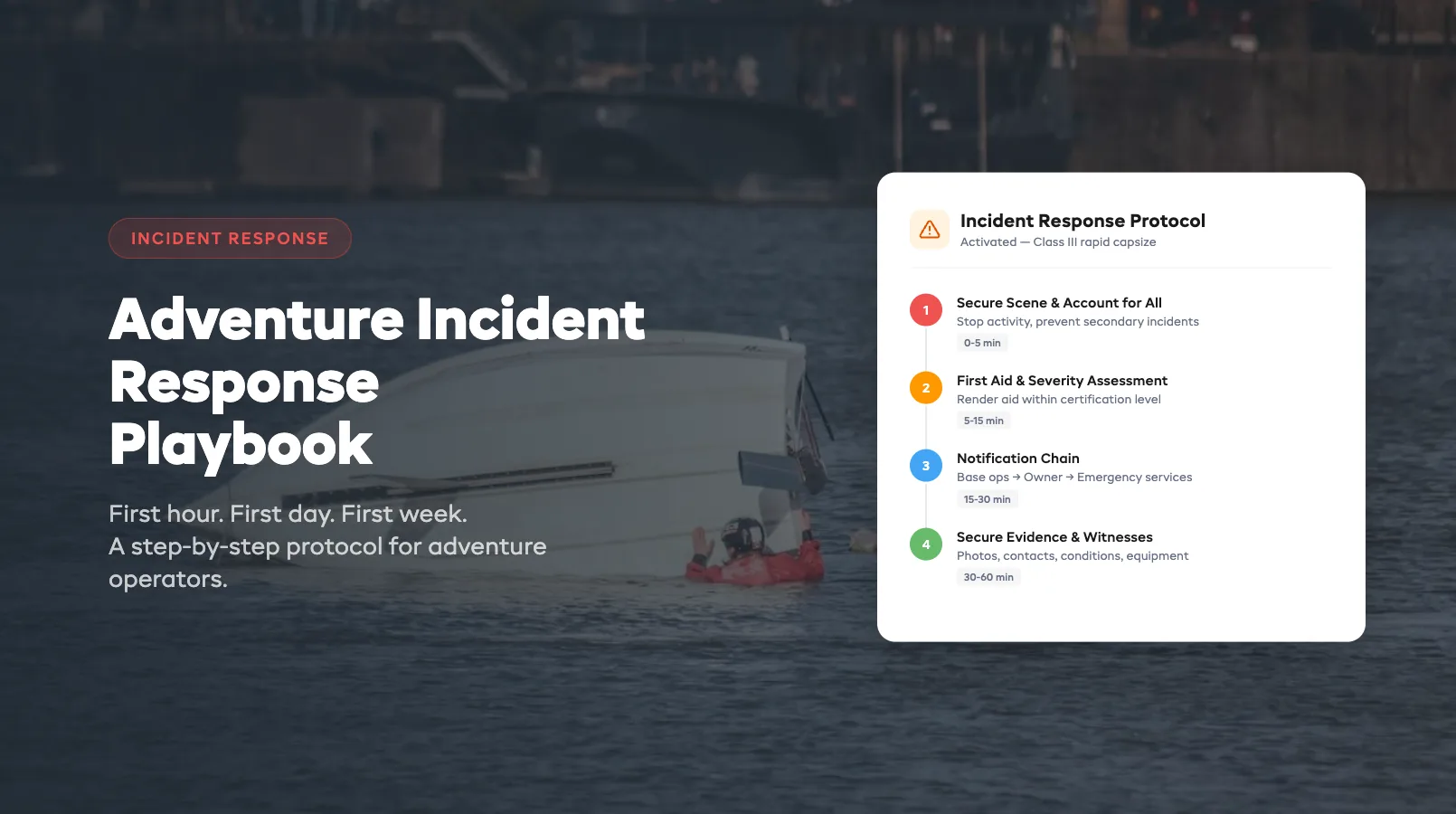
It's 2:15 PM on a Saturday in peak season. A raft flips in Class III rapids. Everyone surfaces, but one participant has a dislocated shoulder. Your guide radios base. The clock starts now.
What you do in the next 60 minutes determines whether this becomes a managed incident or a lawsuit, a lost insurance policy, or a news story. Most adventure operators have safety protocols for prevention. Fewer have a tested playbook for what happens after something goes wrong.
This guide gives you that playbook: minute by minute, hour by hour, week by week. For the full operator's guide, see How to Run an Adventure Activity Business. For the waiver and legal framework that supports your incident response, see Waiver Enforcement for High-Risk Activities. For more adventure operations resources, visit the activities and adventure hub.
First-Hour Protocol
The first 60 minutes after an incident are where most operators either protect themselves or create compounding problems. Speed matters, but sequence matters more.
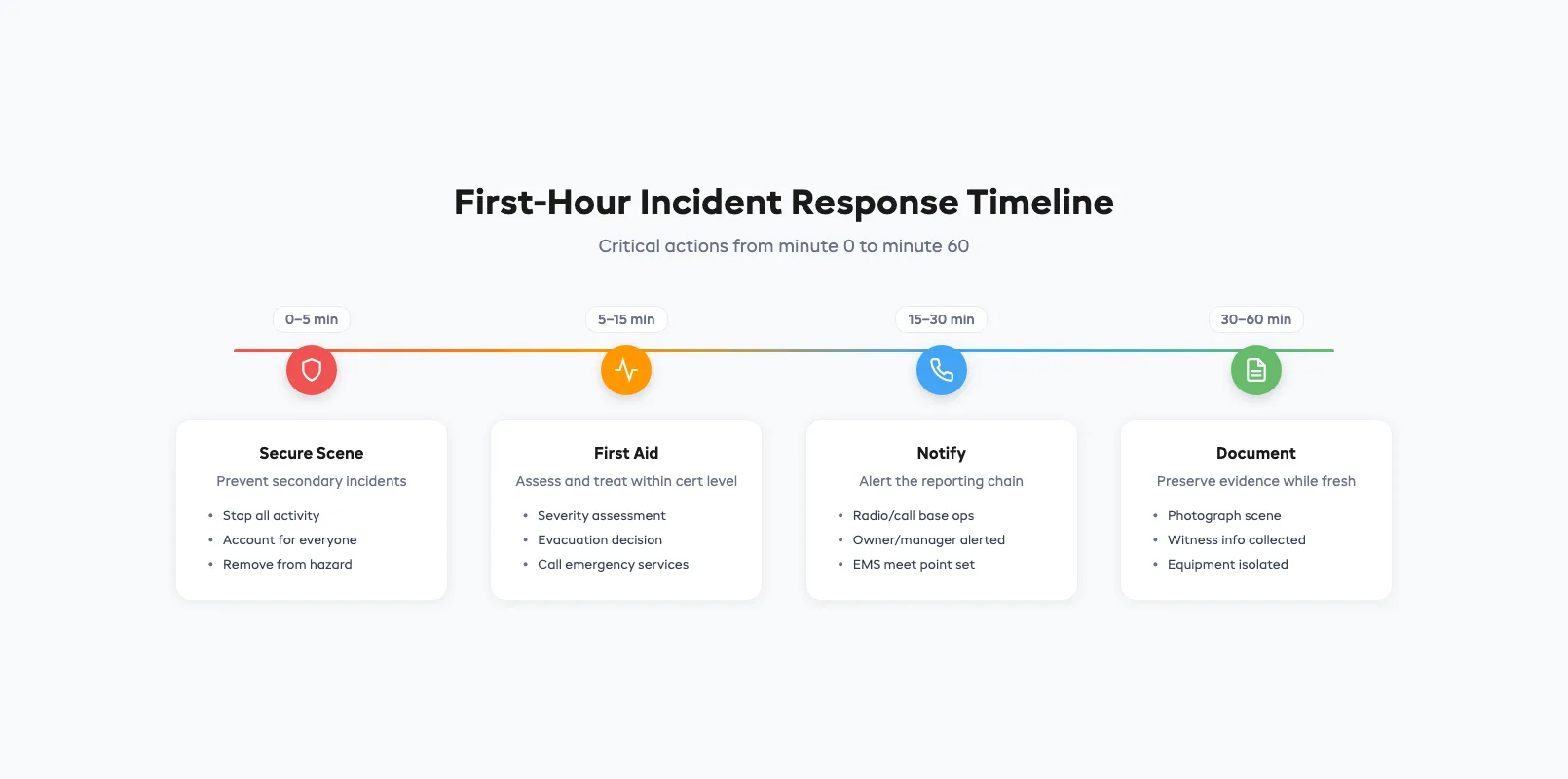
Minutes 0-5: Secure the scene. Stop the activity. Account for all participants. Separate the injured party from ongoing hazards. Your lead guide's first job isn't treatment. It's preventing a second incident. A capsized raft means other rafts need to eddy out, not crowd the scene.
Minutes 5-15: First aid and assessment. Render appropriate first aid within your guide's certification level. Do not exceed your training. Assess severity: does this need evacuation, or can the participant self-evacuate? Call emergency services if there's any doubt. Document the time of the call.
Minutes 15-30: Notification chain. Your lead guide radios or calls base operations. Base contacts the owner/manager. If the injury requires emergency services, someone at base should meet the ambulance or helicopter at the access point. Don't assume dispatch knows where your put-in is.
Minutes 30-60: Secure evidence and information. While the incident is fresh:
- Photograph the scene, equipment, and conditions
- Get names and contact info for all witnesses (participants and staff)
- Note weather, water level, visibility, and any contributing conditions
- Identify and isolate the equipment involved. Do not clean, repair, or return it to service
Do not discuss fault. Not with participants, not with bystanders, not with other staff. "We're taking care of [name] and documenting what happened" is the only statement anyone should make on-scene.
24-Hour Protocol
The first day after an incident separates professional operations from reactive ones. Everything you do in these 24 hours will be reviewed if this incident escalates.
Hour 1-4: Written incident report. Your lead guide completes a detailed incident report while memory is fresh. Use the Adventure Incident Report Procedure template. Include: timeline, participants involved, staff present, equipment in use, conditions, response actions taken, injuries observed, and any participant statements (quoted verbatim where possible).
Hour 2-6: Insurance notification. Most adventure insurance policies require notification within 24-72 hours of any incident involving injury, property damage, or potential claims. Don't wait to see if the participant complains. Notify your broker or carrier the same day. Include the incident report, photos, and the participant's signed waiver.
Hour 4-12: Equipment sequestration. Tag and remove the involved equipment from service. Photograph it from multiple angles. Note its last maintenance date and inspection history. If this goes to litigation 18 months from now, you need to prove the equipment was maintained, inspected, and appropriate for the activity. See Adventure Gear Lifecycle for the documentation standards that support this.
Hour 6-24: Participant follow-up. Contact the injured participant (or their family) to check on their condition. Express concern. Do not apologize, admit fault, or offer compensation. These create legal exposure. "We hope you're recovering well and want to make sure you have everything you need" is appropriate. Document the call.
Within 24 hours: Staff debrief (informal). Gather involved staff separately. Let them recount what happened without leading questions. Take notes. This isn't a blame session. It's evidence preservation. Memories degrade within 48 hours. Get the details captured now.
Reporting Chains
Every incident triggers a reporting chain. Who gets told, in what order, determines your legal exposure and operational response quality.
Tier 1: Immediate (within 1 hour):
- Owner/operations manager
- Emergency services (if injury requires)
- On-site safety officer (if you have one)
Tier 2: Same day (within 8 hours):
- Insurance broker/carrier
- Legal counsel (for serious injuries, potential hospitalisation, or any head/spine/drowning incident)
- Land manager or permitting authority (if operating on public land — many permits require same-day notification for incidents)
Tier 3: Within 48 hours:
- Relevant regulatory body (varies by state/activity — some states require adventure operators to report certain incidents to consumer affairs or tourism boards)
- Equipment manufacturer (if equipment failure is suspected)
- Parent company or franchise (if applicable)
Who does NOT get told: Social media managers, marketing staff, uninvolved customers, or the press, until ownership and legal counsel have aligned on messaging.
Communication Templates
Having pre-written templates prevents panicked, poorly-worded communications that create liability.
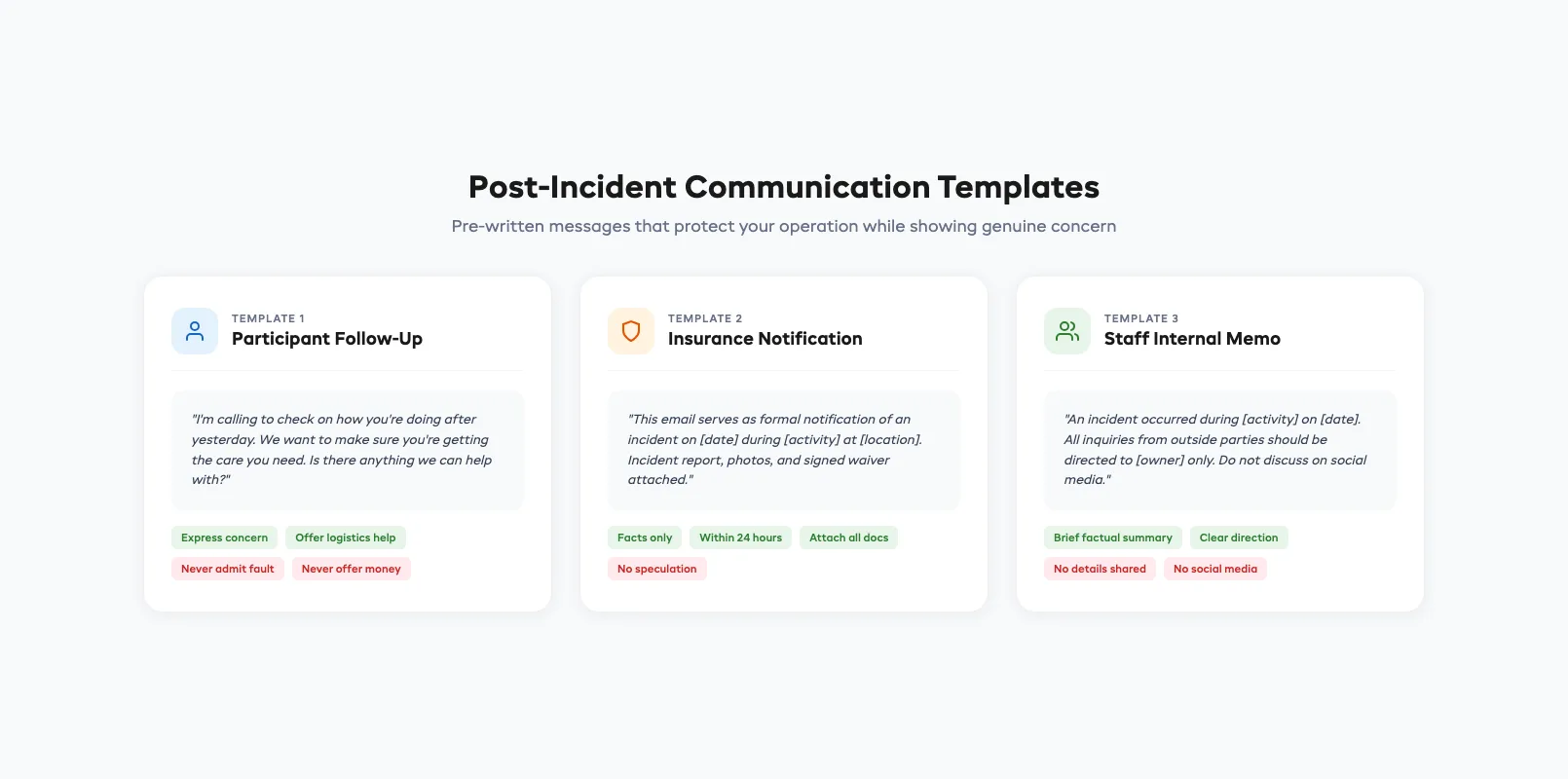
Participant follow-up (phone script): "Hi [name], this is [your name] from [company]. I'm calling to check on how you're doing after [activity] yesterday. We want to make sure you're getting the care you need. Is there anything logistically we can help with — getting your belongings returned, connecting you with our insurance information, or anything else?"
Insurance notification (email): "Subject: Incident Notification — [Date] — [Activity] — [Location]. Dear [broker name], this email serves as formal notification of an incident on [date] during [activity type] at [location]. [Number] participants and [number] staff were involved. One participant sustained [general description — e.g., 'an upper extremity injury requiring transport to hospital']. Incident report, photos, and signed waiver are attached. Please advise on next steps."
Staff internal memo: "Team — an incident occurred during [activity] on [date]. [Brief factual summary]. All inquiries from outside parties — participants, families, media, anyone — should be directed to [owner/manager name] only. Do not discuss details on social media or with other customers. A formal debrief is scheduled for [date/time]."
What you never put in writing: Speculation about cause. Statements about what "should have" happened. Comparisons to other incidents. Anything that reads like an admission of fault.
Insurance and Legal Considerations
Your incident response directly affects your insurance coverage, premiums, and legal position. Handle this wrong and your carrier may deny the claim.
Policy requirements vary. Read your policy's incident reporting section now, before you need it. Common requirements: notify within 24-72 hours, preserve evidence, cooperate with investigation, do not admit liability. Failure to notify on time is a common basis for claim denial.
Document everything, edit nothing. Incident reports should never be rewritten after the fact. If you need to add information, add an addendum with today's date. Altered documents are devastating in litigation — opposing counsel will argue you changed the narrative.
Guide certifications at time of incident. Was your guide's wilderness first responder certification current? Was their activity-specific certification (swiftwater rescue, climbing instructor, etc.) valid? Track these proactively with the Guide Certification Tracking system so you're never scrambling post-incident. See Guide Certifications: What Your Insurance Actually Requires for what certifications your carrier expects.
Waiver retrieval. Within the first hour of an incident, someone at base should locate and copy the participant's signed waiver. Confirm it was signed before the activity, not during a group rush. Confirm it covers the specific activity involved. If you can't locate the waiver, that's a significant legal exposure — flag it to counsel immediately.
Preserve the chain of evidence. Photos, reports, equipment, communications, all of it needs to be preserved in its original form. If this goes to litigation, a discovery request will cover everything. "We couldn't find that" is not a position you want to be in.
Post-Incident Debrief
A formal debrief happens 48-72 hours after the incident — close enough for accurate recall, far enough for emotions to settle. This is where you turn a single incident into operational improvement.
Structure the debrief around facts, not feelings:
- Timeline reconstruction — minute by minute, what happened
- Decision points, where did staff make calls, and what information did they have at each point
- Equipment and environment — what was the state of gear, weather, water, terrain
- Response assessment — what worked in your emergency response, what didn't
- Root cause analysis, not "who's to blame" but "what systemic factor allowed this to occur"
Involve the right people. Lead guide, assisting guides, base operations staff who handled communications, and ownership/management. Do NOT include uninvolved staff or treat this as a company meeting.
Document outcomes. Use the Post-Activity Debrief & Review template. Record: root cause determination, corrective actions decided, timeline for implementation, person responsible for each action. This document proves you learned from the incident — juries look favorably on operators who demonstrably improve after events.
Follow through on corrective actions. A debrief that identifies changes but never implements them is worse than no debrief. It proves you knew about the problem and didn't fix it. Set deadlines. Assign owners. Follow up.
Near-Miss Logging
The incidents that almost happened are more valuable than the ones that did. Near-miss data reveals systemic risks before they produce injuries, lawsuits, and premium increases.
What qualifies as a near-miss:
- A participant nearly fell but caught themselves
- Equipment showed unexpected wear or failure under load
- A weather window closed faster than forecast
- A guide made a judgment call that could have gone wrong
- A participant ignored a safety briefing in a way that almost caused harm
- Communication failed between guides or between field and base
Make reporting frictionless. If your near-miss system requires a 20-minute form, guides won't use it. A 60-second voice memo, a quick note in a shared log, or a 3-field digital form is enough. Capture: what happened, what prevented it from becoming an incident, and what could prevent it from recurring.
Remove blame from near-miss reporting. Guides must feel safe reporting their own mistakes and close calls. If reporting a near-miss triggers discipline, reporting stops. You lose your early-warning system. Frame near-misses as learning, not liability.
Review monthly. Aggregate near-miss reports monthly. Look for patterns: same rapid, same equipment type, same time of day, same guide experience level. Three near-misses with the same root cause is an incident waiting to happen.
Connect near-misses to training. When you see patterns, build them into your pre-season guide training and your Adventure Pre-Activity Briefing content. "Last season we had four near-misses at [location] related to [cause]" is powerful training material.
Incident response isn't something you figure out after something goes wrong. It's a system you build, test, and refine during the quiet months. Run a tabletop exercise in your off-season. Pick a scenario, walk through your protocol, and find the gaps before a real incident exposes them. For building your seasonal operational calendar around these preparations, see Seasonal Adventure Business Management.
Your playbook should live where every guide can access it: laminated at base, in the guide binder, saved offline on field devices. The worst time to learn your incident protocol is when you need it. For operators managing these workflows with Dash, near-miss logs and incident reports integrate directly with your equipment records, guide files, and waiver system — creating the documentation chain that protects you when it matters most.
FAQ
How quickly do I need to notify my insurance company after an adventure incident?
Most adventure activity insurance policies require notification within 24-72 hours of any incident involving injury, property damage, or potential claims. Check your specific policy — some require "immediate" notification for hospitalizations or evacuations. Late notification is a common basis for claim denial.
Should I apologize to a participant after an incident?
Express genuine concern for their wellbeing, but do not apologize or admit fault. "We hope you're recovering well" is appropriate. "We're sorry this happened — we should have done X differently" creates legal exposure. Your legal counsel and insurer will guide specific communications if a claim develops.
What's the difference between an incident report and a near-miss report?
An incident report documents an event where injury, property damage, or significant safety breach actually occurred. A near-miss report captures events where something almost went wrong but didn't result in harm. Both are critical — incidents for legal/insurance purposes, near-misses for preventing future incidents.
Who should conduct the post-incident debrief?
The owner or operations manager should facilitate, with all directly involved staff present: lead guide, assisting guides, and base operations staff who handled communications. Do not include uninvolved staff. Wait 48-72 hours to allow emotions to settle while memories are still fresh.
Can incident reports be used against me in court?
Yes. Incident reports are discoverable in litigation. This is why accuracy matters more than narrative. Report facts only: what happened, when, who was present, what conditions existed. Never include speculation, blame, or statements about what "should have" been done differently. Altered or rewritten reports are far more damaging than honest ones.
How do I get guides to actually report near-misses?
Remove blame from the process entirely. Make reporting take under 60 seconds — a voice memo or 3-field form. Publicly credit near-miss reports as contributions to safety rather than admissions of failure. If reporting ever triggers discipline, your early-warning system dies immediately.
Do I need to report adventure incidents to any government authority?
It depends on your jurisdiction and permit conditions. Operators on public land (national forests, BLM, state parks) typically must notify the land manager within 24 hours for any incident requiring medical transport. Some states require reporting to consumer affairs or tourism boards for commercial recreation incidents involving hospitalisation. Check your operating permits and state regulations.
in one place