Seasonal Adventure Business: Staffing, Cash Flow, Off-Season Revenue
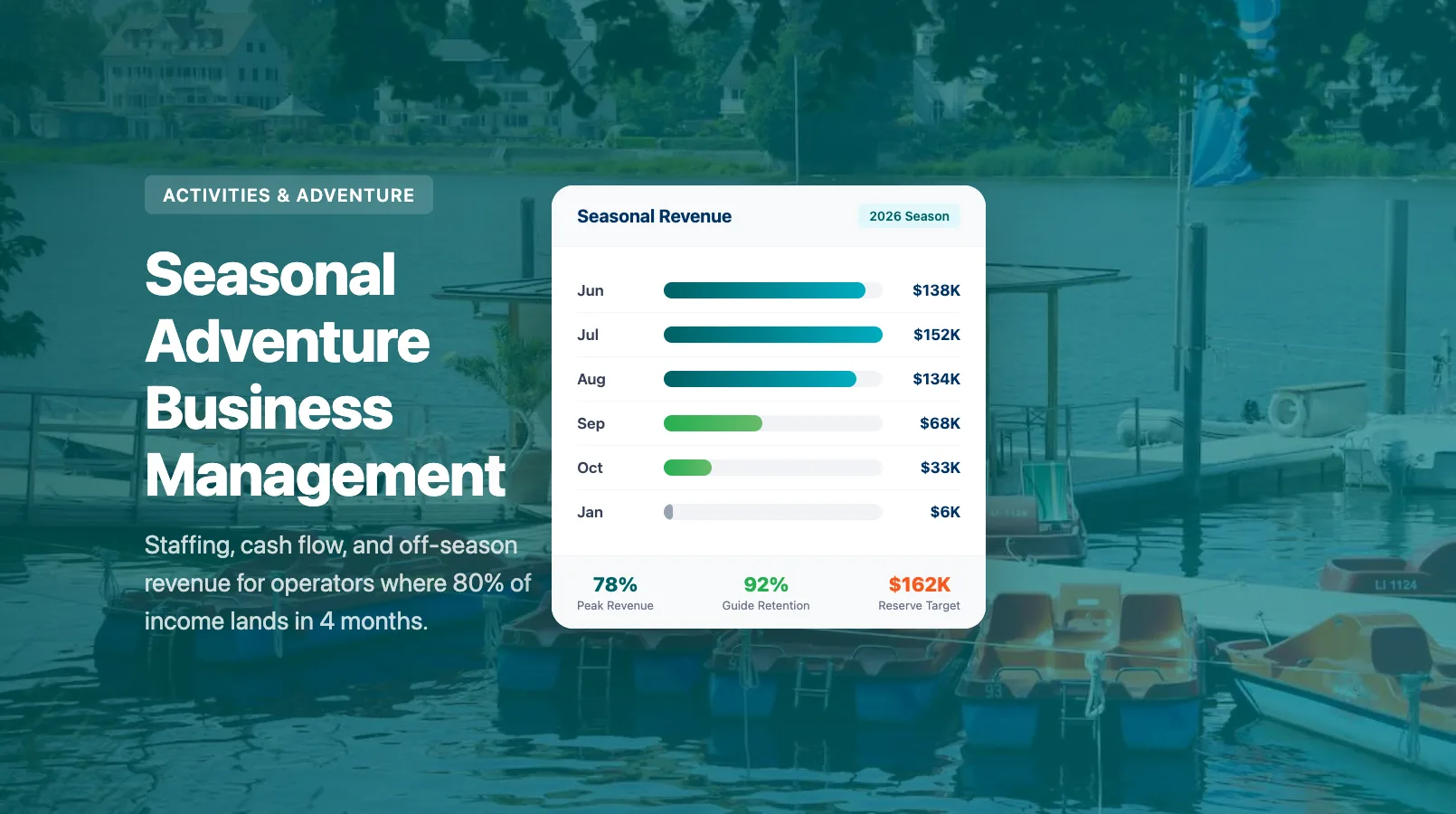
Your best month does $140,000. Your worst month does $6,000. That's not a cash flow problem. That's a business architecture problem. And if you're running an adventure operation in a seasonal market, it's your reality every single year.
Rafting companies, zip-line parks, backcountry guiding outfits, and canyoneering operators all face the same pattern: 70-85% of annual revenue arrives in a 4-5 month window. The other 7-8 months, you're burning through reserves while trying to hold onto the guides who make your peak season possible.
This guide covers the financial and operational playbook for seasonal adventure businesses, from cash flow math to staff retention to off-season revenue. For the full adventure business playbook, see How to Run an Adventure Activity Business. For pricing strategies that maximize peak-season revenue, see Adventure Activity Pricing Models. For more checklists and resources, visit the activities and adventure hub and activities glossary.
Season Cash Flow Math: Know Your Numbers Cold
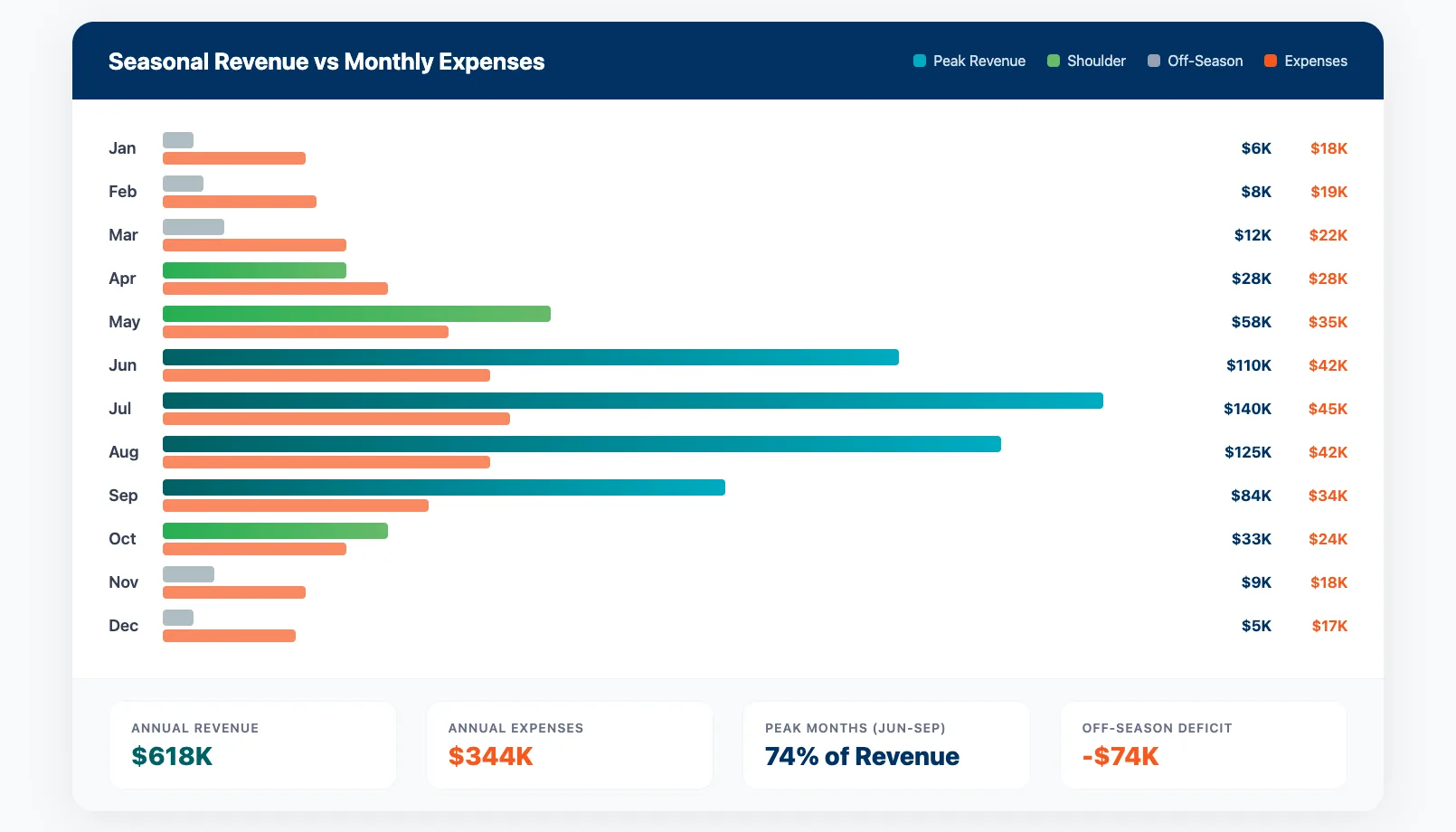
Most seasonal operators know their peak months are profitable. Fewer know exactly how much cash they need to survive the off-season. Get this math wrong and you'll be scrambling for a line of credit in February.
Map your revenue curve month by month. Pull the last 2-3 years of booking data and chart monthly revenue. You'll see the pattern: a ramp-up month (maybe April), 3-4 peak months (June-September for most), a shoulder month (October), and then the trough. Calculate what percentage of annual revenue each month represents. If June through September is 78% of your total, that's your planning baseline.
Calculate your monthly burn rate: off-season versus peak. Off-season burn includes rent/mortgage, insurance premiums, loan payments, utilities, any year-round staff, vehicle payments, and storage costs. Peak-season burn adds guide wages, fuel, food/supplies, increased insurance, marketing spend, and equipment wear. Most operators underestimate off-season burn by 20-30% because they forget about annual renewals, permit fees, and equipment that breaks in storage.
Build your reserve target. Take your average monthly off-season burn and multiply by the number of off-season months, plus two. If your off-season is 7 months at $18,000/month, your reserve target is $162,000 (9 × $18,000). That extra two-month buffer covers the inevitable surprise: a vehicle transmission, a roof leak, or a slow start to the season.
Set aside reserves during peak, not after. The discipline that separates surviving operators from thriving ones: transfer a fixed percentage of every peak-season deposit into a separate reserve account the day it clears. 25-35% of gross revenue is a common target. If you wait until September to "see what's left," there won't be enough.
Staff Retention Through the Off-Season
Losing your best guides every winter means retraining every spring. That cycle costs more than most operators realize: recruiting, background checks, certifications, shadow trips, and the quality dip while new guides find their feet.
Calculate your true cost of turnover. A single guide replacement costs $2,000-4,000 in direct expenses (job postings, interviews, background checks, first aid/CPR training, shadow days) plus the productivity loss of a less-experienced guide running trips for the first 3-4 weeks. If you lose 5 guides and rehire 5 every year, that's $10,000-20,000 in hidden costs, plus the customer experience impact of a rotating roster.
Offer off-season retainer agreements. Pay your top guides a reduced monthly stipend ($500-1,500/month depending on your market) in exchange for a commitment to return for the full peak season. This is dramatically cheaper than replacement costs and gives guides financial stability. Structure it as a monthly payment, not a lump sum, so it functions as ongoing income.
Create off-season work opportunities. Equipment maintenance, marketing content creation, guide training curriculum development, trail maintenance, facility improvements. There's always work. Even 15-20 hours per week at a reduced rate keeps guides connected and your operation improving. Some operators pair this with off-season programming (covered below) to create near-full-time winter roles.
Invest in certification and professional development. Pay for your returning guides to earn advanced certifications during the off-season: Wilderness First Responder upgrades, swift-water rescue, new activity certifications. This increases their value to your operation and gives them a tangible reason to stay. Budget $500-1,000 per guide per off-season for training. For a full breakdown of certification costs, renewal tracking, and insurance requirements, see Guide Certifications: What Your Insurance Actually Requires. For tracking which certifications your team holds, see the Guide Certification Tracking checklist.
Build a tiered retention structure. Not every guide gets the same deal. Your lead guides and trip leaders (the ones customers mention by name in reviews) get the best retainer packages. Mid-level guides get smaller stipends. First-year guides get a return bonus paid after their first month of the next peak season. This rewards loyalty proportionally to value.
Off-Season Revenue Streams
Sitting idle for 7 months isn't a strategy. The operators who build sustainable businesses find ways to generate 15-30% of annual revenue outside their core season.
Corporate team-building packages. Companies book team retreats year-round, and many prefer off-season because pricing is lower and availability is guaranteed. A half-day ropes course, survival skills workshop, or navigation challenge works in shoulder seasons when your core activities (rafting, canyon trips) aren't running. Price these at a premium — corporate budgets are line items, not discretionary spending. The corporate retreat booking guide covers the package, quote, deposit, and invoicing side.
School and youth programs. Outdoor education programs run on academic calendars, which means your quietest months (October-March) align with their programming needs. Partner with local schools, scout troops, and youth organizations to run multi-day outdoor skills programs. Revenue per participant is lower, but group sizes are larger and booking lead times are longer, which makes cash flow more predictable.
Equipment rental to other operators or events. Your fleet of PFDs, helmets, dry suits, harnesses, and vehicles sits idle all winter. Rent it to other operators running winter activities, to event companies, or to film crews. This turns a depreciating asset into a revenue line. Track gear conditions carefully. See Gear Lifecycle for Adventure Operators for retirement and replacement planning.
Training and certification courses. If your lead guides hold instructor-level certifications, run certification courses for aspiring guides during the off-season. Wilderness first aid, swift-water rescue, and activity-specific certifications draw participants from across your region. These carry high margins — your cost is primarily instructor time and facility access.
Facility rentals. If you have a base camp, lodge, or outdoor facility, rent it for events, retreats, or group gatherings during the off-season. Wedding venues, corporate offsites, and photography workshops are common uses. Even modest revenue ($2,000-5,000/month) meaningfully reduces your burn rate.
Marketing Timing: Spend Before the Season, Not During It
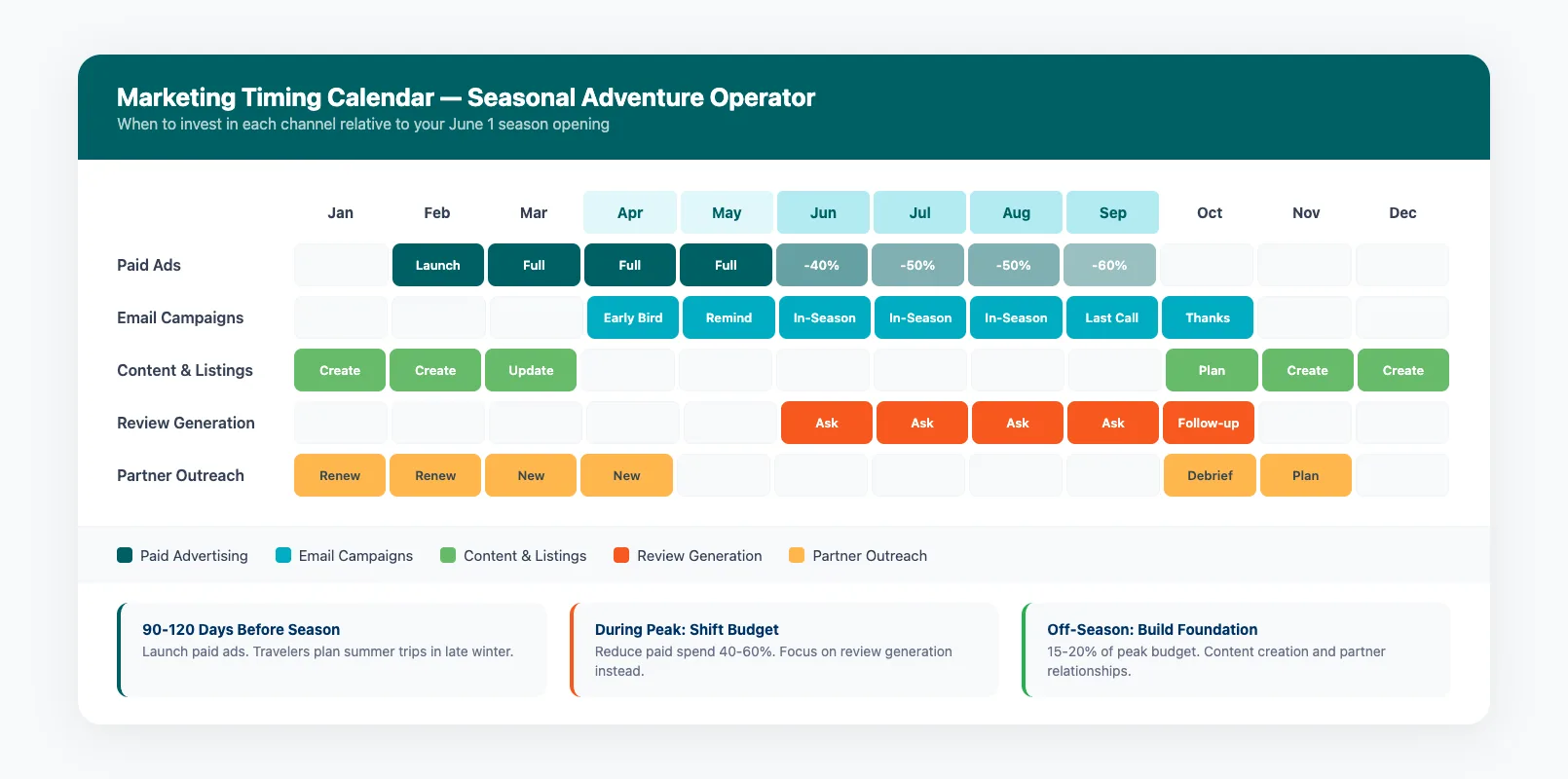
The biggest marketing mistake seasonal operators make: spending ad dollars in July when they're already booked. The bookings you need to influence are the ones being planned 60-120 days before your season opens.
Start paid advertising 90-120 days before your season. If your peak begins June 1, your Google Ads and Meta campaigns should be live by mid-February. Travelers planning summer trips start searching in late winter. If you're not visible then, your competitors are capturing that demand.
Email your past customers 60 days before opening. Your repeat customers are the cheapest bookings you'll ever get. Send a "season opening" email with early-bird pricing or preferred scheduling. A 10% early-bird discount costs less than the Google Ads click that would've acquired the same booking.
Update your content and listings 90 days out. Google Business Profile, TripAdvisor, Yelp, Viator, and your own website all need current season dates, pricing, and photos before the booking window opens. Stale 2025 pricing in March 2026 costs you bookings. Dash can automate booking confirmations and follow-ups so you're not buried in admin when the season ramps, but the content updates need to happen early.
Shift budget from paid to organic during peak. Once your season is running, word-of-mouth, reviews, and organic search carry most of the load. Reduce paid spend by 40-60% during peak months and reallocate to review generation. Every 5-star review posted during July pays dividends in February when next year's planners start searching.
Off-season marketing is maintenance, not acquisition. During the off-season, your marketing budget drops to 15-20% of peak. Focus on content creation (blog posts, videos, social media), review responses, and relationship maintenance with partners and corporate accounts. This isn't where you spend big. It's where you build the foundation for next season's demand.
Equipment Service in the Off-Season
The off-season is when your equipment gets the attention it can't get during peak. Every piece of gear that breaks mid-July is a trip disruption, a refund risk, and a safety concern.
Run a full fleet audit within 2 weeks of season close. Every PFD, helmet, harness, rope, raft, frame, paddle, and vehicle gets inspected and documented. This is also the time to review your waiver processes, incident records, and guide credentials. See Waiver Enforcement for High-Risk Activities for what your documentation trail should look like. Use the Pre-Season Adventure Operations Audit checklist as your baseline, but run it at close, too. Knowing what needs replacement before winter means you can order during manufacturer slow periods (often at 10-20% discount).
Create a maintenance calendar. Spread major maintenance across the off-season rather than cramming everything into the 2 weeks before opening. October: clean and inspect all soft goods. November: vehicle maintenance and repairs. December-January: facility improvements. February: order replacement gear. March: pre-season setup and testing. This prevents the March panic of realizing 15 PFDs need replacement and your supplier has a 6-week lead time.
Retire gear on schedule, not on failure. Every piece of equipment has a useful life measured in trips, hours, or years. Tracking utilization data helps you predict retirement dates and budget for replacements ahead of time rather than reacting to failures. Rafts might last 5 seasons, PFDs 3-4, helmets 3-5 depending on use intensity. For the full retirement framework, see Gear Lifecycle for Adventure Operators.
Store gear properly. Improper winter storage destroys equipment faster than heavy use. Dry all soft goods completely before storage. Deflate rafts to 50% and rotate them monthly. Store PFDs uncompressed in a dry, UV-free space. Hang harnesses — don't coil or stack them. Proper storage extends gear life by 1-2 seasons, which translates directly to thousands in deferred replacement costs.
Financial Planning: Building a Year-Round Business on Seasonal Revenue
The operators who last decades in this industry treat their seasonal business like an annual financial plan, not a summer sprint.
Separate operating, reserve, and tax accounts. Three bank accounts minimum. Operating handles day-to-day expenses. Reserve holds the off-season fund (25-35% of peak revenue, transferred weekly during season). Tax holds quarterly estimated payments (set aside 20-25% of net income). Commingling these guarantees you'll spend your tax money on a new trailer in August.
Negotiate annual terms with vendors and landlords. Your landlord, insurance broker, and major suppliers often prefer annual payment plans over seasonal lump sums. Negotiate 12-month payment terms for annual costs instead of paying everything in one hit. This flattens your cash flow curve and reduces the peak-season cash drain.
Build a 3-year rolling forecast. Year-one operators plan season by season. Experienced operators plan across 3-year cycles that include equipment replacement schedules, facility upgrades, staffing growth, and marketing investments. A raft fleet purchased in Year 1 needs partial replacement in Year 4. If you're not budgeting for that from Day 1, Year 4 hits like a freight train.
Consider revenue-based financing over traditional loans. Seasonal businesses are poorly served by fixed monthly loan payments because January and July have wildly different revenue. Revenue-based financing (where repayment scales with monthly revenue) or seasonal lines of credit (draw in off-season, repay during peak) align better with your cash flow reality. Talk to lenders who specialize in tourism and hospitality.
Track your key seasonal ratios. Peak-to-trough revenue ratio (how extreme your seasonality is). Off-season burn as a percentage of annual revenue. Guide retention rate year over year. Revenue per guide-day during peak. These ratios tell you whether you're getting more stable or more vulnerable each year. For multi-day operations with more complex logistics, see Multi-Day Adventure Operations. Your off-season is also the best time to run tabletop incident response exercises. See Adventure Incident Response and Reporting for the full protocol.
FAQ
How much cash reserve should a seasonal adventure business maintain?
Target your average monthly off-season burn rate multiplied by the number of off-season months plus two. If your off-season is 7 months at $18,000/month, aim for $162,000 (9 x $18,000). The two-month buffer covers unexpected expenses like vehicle repairs, delayed season starts, or permit issues. Transfer 25-35% of gross peak-season revenue into a separate reserve account weekly during your busy months.
What's the best way to retain adventure guides during the off-season?
A tiered retention approach works best. Offer your top guides (trip leaders, those mentioned in reviews by name) monthly retainer stipends of $500-1,500 plus off-season work hours for equipment maintenance, training curriculum, and marketing content. Mid-level guides get smaller stipends. First-year guides get a return bonus paid after their first month of next season. Investing $500-1,000 per guide in advanced certifications (Wilderness First Responder, swift-water rescue) also increases their commitment.
What off-season revenue streams work best for adventure operators?
Corporate team-building packages tend to generate the highest per-event revenue because corporate budgets are line items rather than discretionary spending. School and youth outdoor education programs provide predictable volume during academic months (October-March). Equipment rental to other operators and event companies monetises idle assets. Guide certification courses carry high margins if your lead guides hold instructor-level certifications. Facility rentals for events and retreats can cover $2,000-5,000/month of burn.
When should a seasonal adventure business start marketing for the next season?
Start paid advertising 90-120 days before your season opens. If peak begins June 1, campaigns go live in mid-February. Email past customers with early-bird offers 60 days out. Update all listings (Google Business Profile, TripAdvisor, your website) 90 days before opening with current pricing and season dates. During peak, shift budget from paid acquisition to review generation — reviews posted in July drive bookings the following February.
How do I calculate the true cost of guide turnover?
Each guide replacement typically costs $2,000-4,000 in direct expenses: job postings, interviews, background checks, first aid training, and 3-5 shadow trips before they run independently. Add the indirect cost of lower trip quality during the first 3-4 weeks of a new guide's tenure — potentially impacting reviews and rebooking rates. If you lose and replace 5 guides annually, that's $10,000-20,000 in direct costs plus customer experience impact.
Should I use revenue-based financing or a traditional loan for a seasonal business?
Revenue-based financing (where repayment scales with monthly revenue) or seasonal lines of credit (draw during off-season, repay during peak) align better with seasonal cash flow than fixed monthly loan payments. A $2,000/month loan payment is manageable in July but brutal in January. Look for lenders who specialize in tourism and hospitality. They understand seasonal patterns and structure terms accordingly.
in one place