OTA Distribution for Tour Operators: Viator, GetYourGuide, vs Direct
A new operator lists their walking tour on Viator, gets a booking the first week, and decides the OTAs are a goldmine. Then the payout lands: a $90 tour returned about $65 after commission. The booking was real, the guest was real, and the margin was gone. That is the OTA trade in one transaction. They bring you demand you could not reach on your own, and they charge dearly for it.
The mistake operators make is treating this as a yes-or-no question. OTAs are not good or bad; they are one channel in a portfolio, and the operators who win run them deliberately. This guide covers the OTA landscape, what each channel actually costs, how their ranking algorithms decide who gets seen, and how to balance third-party reach against the direct bookings that keep your business healthy. For the wider operating picture, see How to Run a Tour Operator Business.
The OTA Landscape: Who's Who in Tour Distribution
An OTA, online travel agency, is a marketplace that sells your experience to its own audience and takes a cut of each booking. For tours and activities, a handful of players dominate, and each reaches a different slice of traveler.
Viator is the giant, owned by Tripadvisor. Huge reach, especially with US travelers, and tightly linked to Tripadvisor reviews. If a guest researches "things to do" in your city, Viator listings are everywhere.
GetYourGuide is the strongest competitor, with deep penetration in Europe and a slicker mobile booking flow. It leans hard on quality imagery and instant confirmation, and tends to favor operators who run polished, well-photographed experiences.
Klook dominates Asia-Pacific demand and is the channel to watch if you draw guests from that market.
Airbnb Experiences, Expedia, and GetYourGuide's smaller rivals round out the field, each with a narrower but real audience.
The point is not to be on all of them. It is to know which channels reach the travelers who actually book your kind of experience, and to start there. A small-town kayak operator drawing mostly domestic guests has very different channel priorities from a city walking-tour business living on international tourists.
Commission Rates: What Each Channel Actually Costs
This is the number that decides everything, and it is higher than most new operators expect. OTA commissions on tours and activities typically run 20% to 30% of the booking value, sometimes more for premium placement.
- Viator: commonly around 20–30%, depending on your agreement and tier.
- GetYourGuide: broadly similar, often in the 20–30% range.
- Klook and others: comparable, with regional variation.
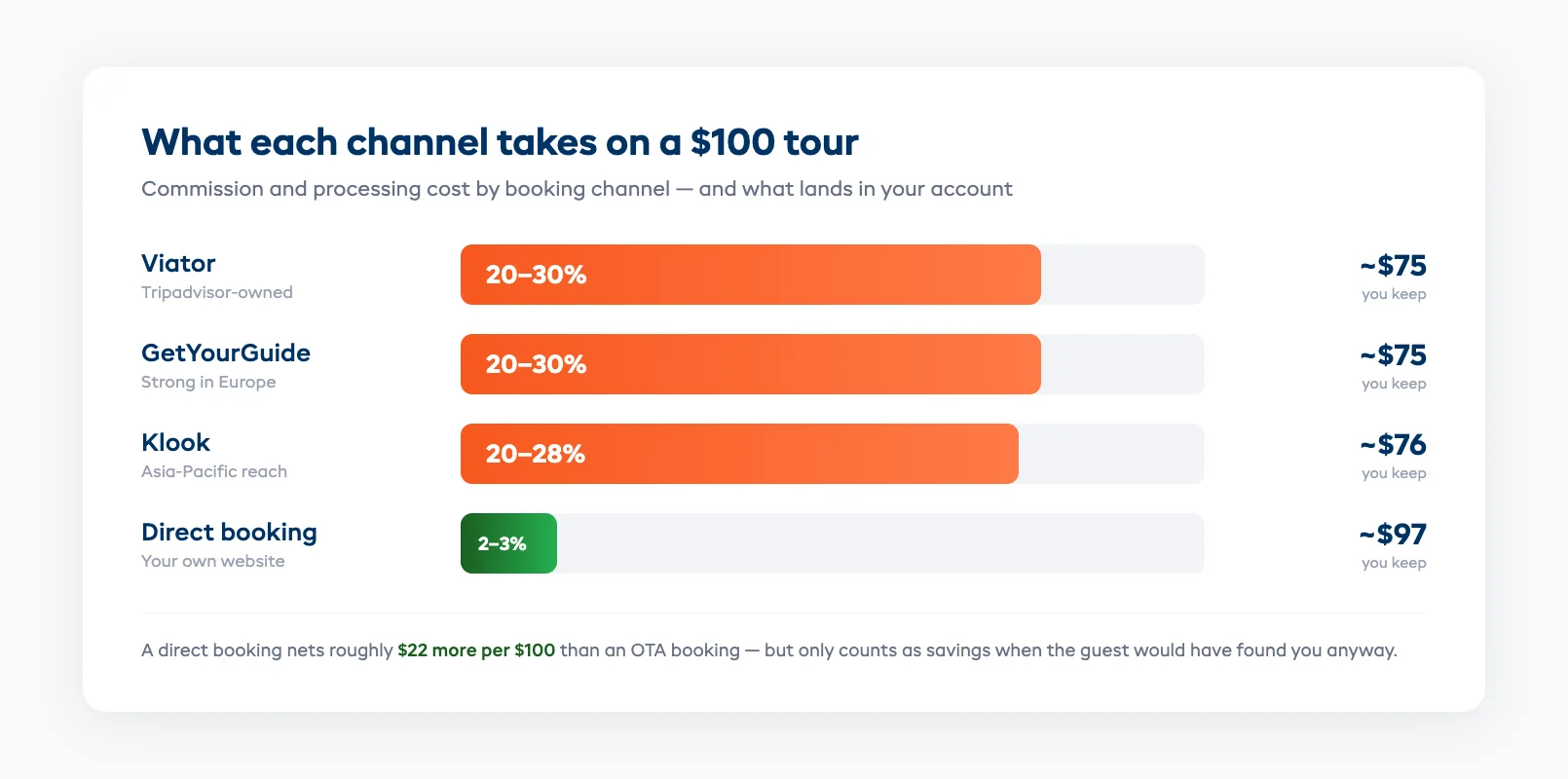
Compare that to a direct booking, where your only hard cost is payment processing, roughly 2–3%. On a $100 tour, an OTA booking might net you $75; a direct booking nets you about $97. That $22 gap is the entire economic case for building direct demand, and it compounds across every departure for the life of your business.
But raw commission is only half the story. A 25% commission on a booking you would never have won is not a 25% loss. It is found revenue. The cost only stings when the OTA takes a cut of a guest who would have booked you directly anyway. Hold that distinction; it is the key to the channel mix decision later.
Ranking Factors: How to Get Found on Viator and GetYourGuide
Being listed is not the same as being seen. Both Viator and GetYourGuide rank thousands of experiences, and the ones near the top capture most of the bookings. The algorithms are not published, but the levers are well understood.
Reviews and rating volume. This is the heaviest factor on both platforms. More reviews and a higher average push you up the results. A systematic review-generation habit is the single biggest ranking lever you control. It also helps everywhere else you sell.
Conversion rate. Platforms favor listings that turn views into bookings, because that earns them commission. Sharp photography, a clear title, honest inclusions, and instant confirmation all lift conversion and, in turn, ranking.
Response time and reliability. Fast replies to questions and a low cancellation rate signal a dependable operator. Canceling on guests is punished hard by the algorithm.
Availability and instant confirmation. Listings with broad, real-time availability and immediate confirmation rank above ones that make guests wait for manual approval. Keeping live availability accurate across channels matters here.
Price competitiveness. You do not have to be cheapest, but a wildly out-of-band price for your category will sink you.
The throughline is that OTAs reward operators who deliver a great booking experience and a great tour. A consistent on-the-ground routine (like a repeatable pre-tour customer briefing that every guide runs the same way) is what produces the reviews and low complaint rates the algorithm rewards. Gaming the algorithm is a losing game; running a tight operation is the algorithm.
Direct Booking Strategy: Owning the Relationship
Every OTA booking gives the platform the guest relationship: the email, the rebooking, the upsell, the review prompt. Direct bookings give all of that to you. Building direct demand is the long game that turns OTA-acquired guests into repeat guests who never cost you commission again.
Capture the guest after the OTA brings them. Where platform rules allow, the in-person experience is yours: a great tour, a business card with a "book direct next time" offer, a post-trip email asking for a review and inviting a return. The OTA paid to find them once; you can earn the second booking for the price of payment processing.
Make direct booking effortless. A clean booking widget on your own site, mobile-friendly, with instant confirmation and the same availability the OTAs see. If your direct channel is clunkier than Viator's, guests will keep using Viator. Your own booking confirmation process should feel as smooth and reassuring as any marketplace.
Invest in the assets you own. Your website, your email list, your Google Business Profile, your social proof. These keep working without taking a cut. Pricing your direct channel well matters too. See Tour Pricing Strategy for how to structure rates that hold up across channels.
Commission vs Cost of Acquisition: The Real Math
Here is the comparison operators get wrong. They look at a 25% OTA commission, recoil, and assume direct is always cheaper. But direct bookings are not free. You pay for them with marketing: ads, SEO, content, your own time. The honest question is not "commission versus zero," it is OTA commission versus your true cost of acquiring a direct booking.
Work it out. If acquiring a direct guest costs you, say, 10–15% of the booking value once you tally ad spend and effort, then direct still wins, but the margin is thinner than the raw commission gap suggests. And for reaching a brand-new international traveler who has never heard of you, the OTA's 25% may genuinely be cheaper than what you would spend trying to reach them cold.
This reframes the OTAs from "expensive middlemen" to "a paid acquisition channel with a known, fixed cost and zero upfront spend." For top-of-funnel discovery, travelers who will never find your website, that can be a fair deal. The trap is paying OTA commission on guests who would have come to you anyway. Your job is to use OTAs for the former and steadily convert as many as possible to the latter.
Channel Mix Optimization: Building Your Distribution Portfolio
The answer is never "all OTA" or "all direct." It is a deliberate mix, and the right ratio shifts as your business matures.
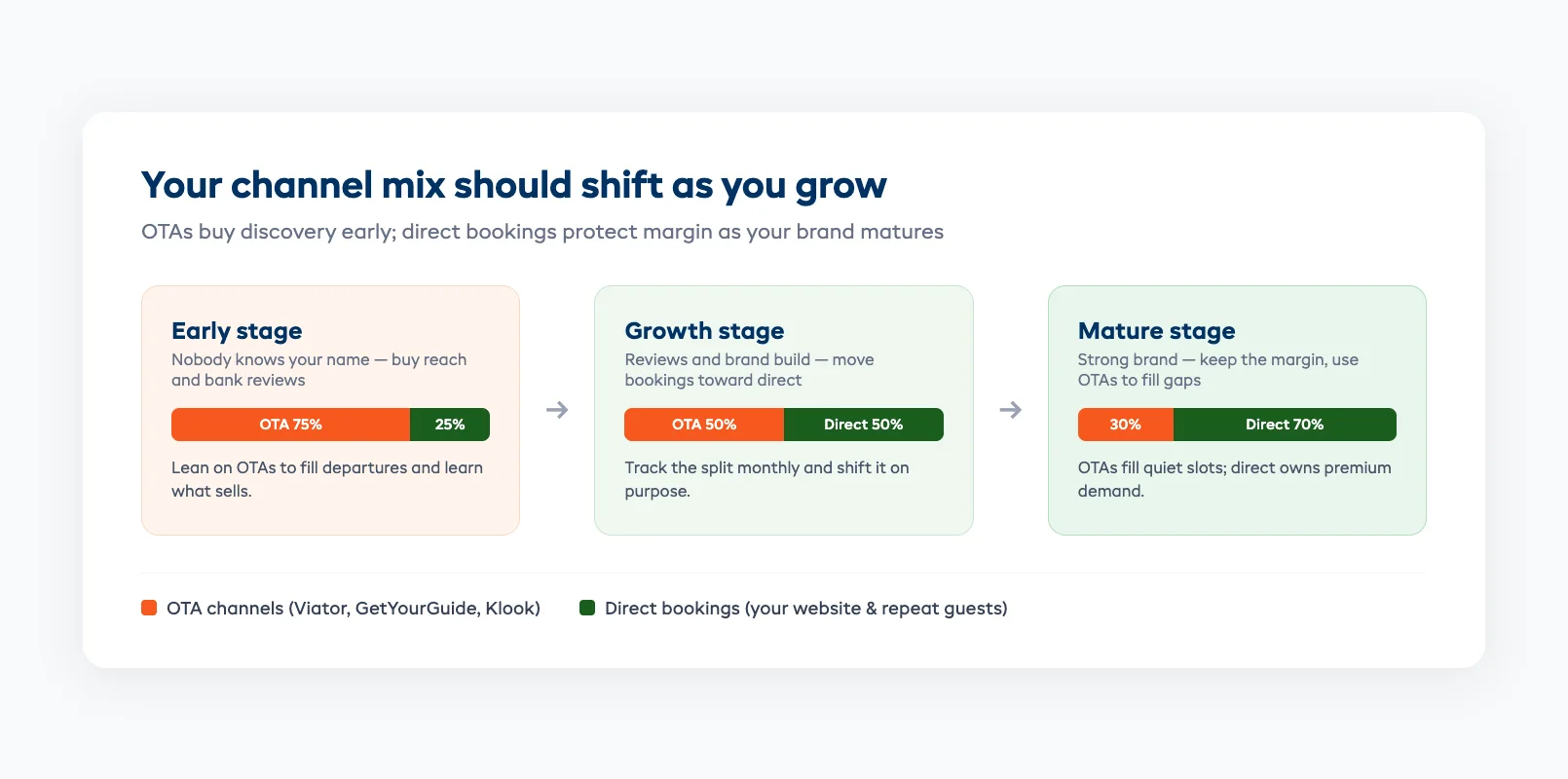
Early stage: lean on OTAs. When nobody knows your name, OTA reach is worth the commission. Use it to fill departures, bank reviews, and learn what sells. Most new operators rightly start with a high OTA share.
Growth stage: shift the ratio. As your reviews, brand, and website mature, deliberately move bookings toward direct. Track the split every month. A healthy maturing operator often moves from mostly-OTA toward a more balanced or direct-leaning mix over a couple of seasons.
Use OTAs for what they are uniquely good at. Filling otherwise-empty low-season departures, reaching international markets, and capturing pure discovery demand. Protect your premium, high-demand slots for direct guests where you keep the full margin.
Keep availability synced. The fastest way to lose money and ranking is double-booking a slot across two channels. Real-time availability across every channel is non-negotiable as you scale, and it gets harder the more guides and departures you run. Running Multi-Guide Tour Operations covers keeping that coordination tight at volume.
Watch the cancellation math. OTA bookings follow the platform's cancellation terms, not yours, which changes your no-show exposure by channel — something to factor into your no-show and cancellation strategy.
OTAs are a tool, not a master. Used deliberately (for discovery, for reach, for filling quiet slots) they grow your business. Used by default, they quietly become your most expensive habit. Build the portfolio on purpose, sync your availability, and keep converting OTA guests into direct ones. To manage availability, bookings, and channel sync from one system, start a free trial, and if you are weighing your options, it is worth comparing the alternatives to Rezdy before you commit. For more operational guides, explore the tours hub and the tour operator glossary.
FAQ
What is OTA distribution for tour operators?
OTA distribution means selling your tours and activities through online travel agencies (marketplaces like Viator, GetYourGuide, and Klook) that reach their own large audiences and take a commission on each booking. It is one channel in a wider distribution mix that also includes direct bookings on your own website. Operators use OTAs to reach travelers they could not find on their own, then work to convert those guests into lower-cost direct bookings over time.
How much commission do Viator and GetYourGuide charge?
Both Viator and GetYourGuide typically charge tour and activity operators commissions in the range of 20% to 30% of the booking value, with the exact rate depending on your agreement, tier, and any premium placement. By comparison, a direct booking on your own site usually costs only 2–3% in payment processing. That gap is the core economic reason to build direct demand alongside your OTA listings rather than relying on them entirely.
How do I rank higher on Viator and GetYourGuide?
The heaviest ranking levers are review volume and rating, conversion rate, response time, low cancellation rates, and broad real-time availability with instant confirmation. Generate reviews systematically, use sharp photography and honest listings to lift conversion, reply to questions fast, and never cancel on guests. Both platforms reward operators who deliver a reliable, high-quality booking experience, so running a tight operation is the most durable way to climb the rankings.
Are direct bookings always cheaper than OTA bookings?
Not always. Direct bookings avoid the 20–30% OTA commission but are not free. You pay for them with marketing: ads, SEO, content, and your own time. The honest comparison is OTA commission versus your true cost of acquiring a direct guest. Direct usually wins for guests already aware of your brand, but for reaching a cold, brand-new international traveler, the OTA's commission can genuinely be the cheaper way to acquire that booking.
What is a healthy OTA-to-direct booking ratio?
There is no single correct ratio. It shifts as your business matures. New operators rightly lean heavily on OTAs because they need the reach and the reviews. As your brand, website, and review base grow, you should deliberately move the mix toward direct bookings to protect margin, often shifting from mostly-OTA toward a balanced or direct-leaning split over a couple of seasons. The key is tracking the split monthly and moving it on purpose.
Can booking software help manage OTA and direct channels together?
Yes. Booking software can sync real-time availability across OTAs and your own website so you never double-book a slot, push the same instant confirmation through every channel, and centralise bookings from all sources in one calendar. That coordination is what makes a multi-channel distribution strategy workable as you add guides and departures, and it removes the manual cross-checking that otherwise causes overbookings and lost rankings.
in one place