Tour No-Show Recovery and Cancellation Policies That Retain Revenue
A guest books a six-person sunset kayak tour for Saturday. Friday night it rains a little. Two of them text "we'll just come another time" and the other four never show. Your guide is paid, your boats sat idle, and the slot that could have sold to a waitlist is gone. Multiply that across a season and no-shows quietly become one of the largest leaks in a tour business.
Most operators react by either refunding everything to avoid bad reviews or clamping down with a harsh no-refund rule that scares off bookings. Both are mistakes. The operators who keep the most revenue treat a cancellation as the start of a recovery conversation, not the end of a sale. This guide covers the policy architecture, recovery cadence, and the credit-versus-refund math that turns lost departures back into bookings.
For the full operating playbook, see How to Run a Tour Operator Business. For how cancellation terms interact with your rate card, see Tour Pricing Strategy.
Cancellation Policy Architecture: Tiers, Not a Single Rule
A one-line policy ("no refunds within 48 hours") is too blunt to protect revenue. It punishes the guest who cancels for a genuine reason and gives you nothing back from the one who simply forgot. Build your policy in tiers tied to how much notice the guest gives, because the further out the cancellation, the easier the slot is to resell.
A workable default structure:
- More than 7 days out: full refund or free reschedule. The slot has plenty of time to resell, so there is no reason to fight the guest.
- 2–7 days out: free reschedule or store credit; refund minus a small admin fee. You can still fill the spot, but it costs you marketing effort.
- 24–48 hours out: reschedule or credit only, no cash refund. This window is hard to resell.
- Under 24 hours or no-show: charge in full, but offer a one-time goodwill reschedule at your discretion.
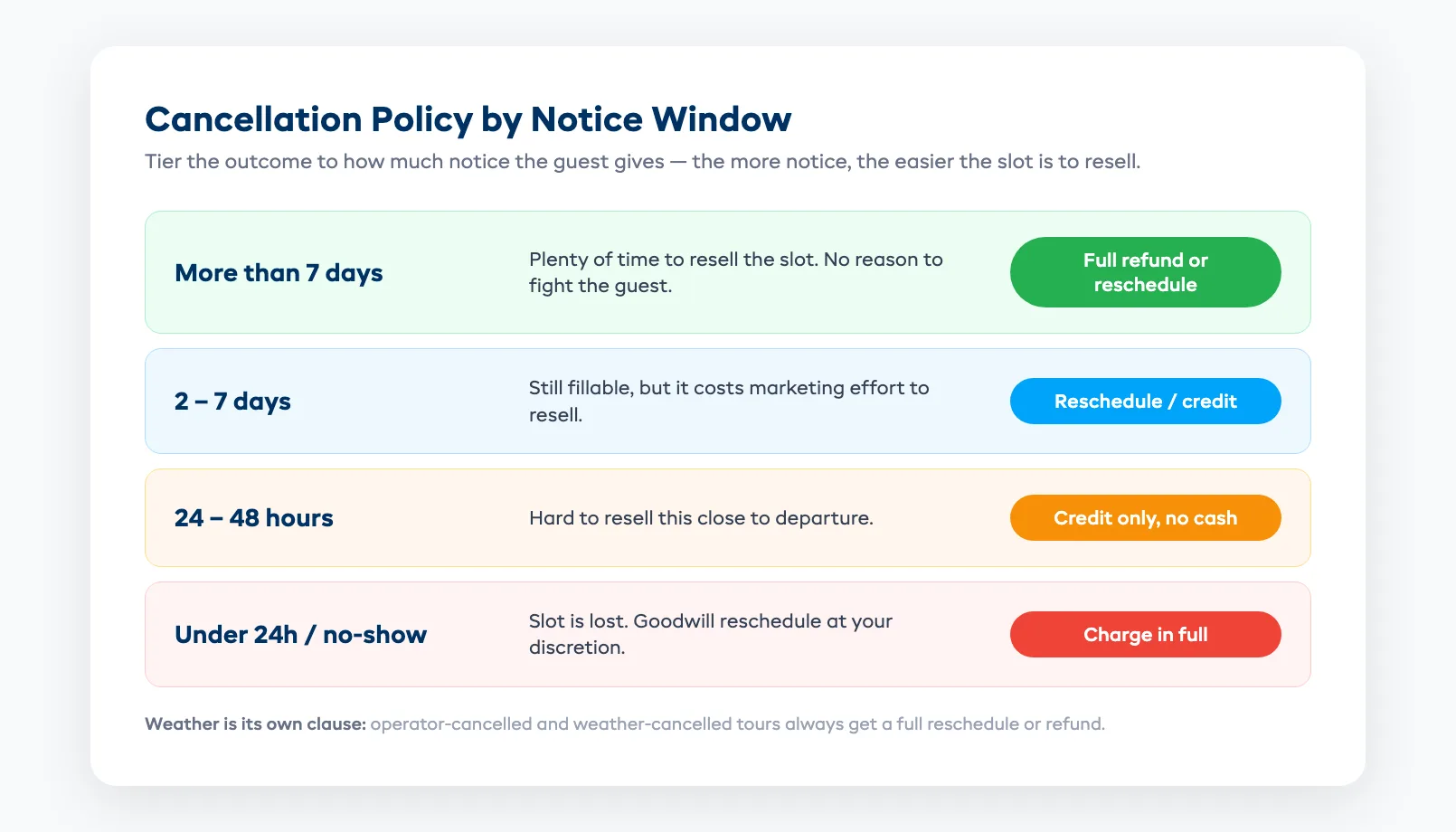
Make weather its own clause. Weather is the single biggest cancellation driver for outdoor tours, and guests treat a rained-out kayak trip very differently from a change of plans. Spell out exactly who decides (you, not the guest), what counts as an operator cancellation, and that operator-canceled tours always get a full reschedule or refund. A clear weather clause prevents the Friday-night "it might rain" cancellations from becoming refund demands.
Publish it where guests actually see it: at checkout, in the confirmation email, and in the reminder. A policy buried in your terms page is unenforceable in practice because the guest can honestly say they never saw it.
No-Show Recovery: A Cadence, Not a Shrug
A no-show is not a dead loss. The guest already wanted your experience enough to book it. Something got in the way. A simple recovery cadence wins a meaningful share of them back instead of writing them off.
Hour 0: the day-of follow-up. Within a few hours of the missed departure, send a warm, non-accusatory message: "Sorry we missed you today — life happens. Here's a link to rebook any open date." No guilt, no lecture. The goal is to keep the door open while the intent is still fresh.
Day 2: the reschedule nudge. If they have not rebooked, follow up with a specific offer: a credit valid for 6–12 months, or a discounted reschedule into a low-demand slot you are trying to fill anyway. Pairing recovery with yield management means the win-back also fills your quiet Tuesdays.
Day 7: the last touch. A final short message with the credit expiry and a single click to book. After this, stop. More than three touches reads as desperation and risks the review you were trying to protect.
The operators who recover the most no-shows are not the ones with the harshest penalties. They are the ones who follow up fast and make rebooking effortless.
Reschedule-First Messaging: Frame the Save, Not the Penalty
How you word the conversation decides whether a cancellation ends in a refund or a reschedule. The same policy can read as punitive or generous depending on the framing, and framing is free.
Lead with the reschedule, mention the refund last. When a guest clicks "cancel," your first screen should offer "Move to another date — no charge" as the prominent button, with the refund path as a smaller secondary option. Most guests genuinely just want to come another time; give them that path first and a large share take it.
Default to credit over cash. A store credit keeps the money in your business and the guest in your funnel. Frame it as a benefit: "Keep your spot's value as credit — use it any time in the next 12 months, transferable to friends." Transferability matters because it turns a credit the guest might not use into one their friend will.
Train your team on the script. When a cancellation comes by phone or message, staff should reflexively offer reschedule, then credit, then refund, in that order, every time. One inconsistent refund-on-demand habit undoes the whole policy.
Credit vs Refund Math: Why the Default Matters
The financial gap between a refunded booking and a rescheduled one is larger than most operators realize, because a refund loses the sale and the cost of acquiring that customer.
Take a $90-per-seat tour with a four-person booking — $360 at stake. A cash refund returns the full $360 to the guest and you also eat the payment-processing fee and whatever you spent on marketing to win them. A reschedule keeps the $360 and costs only an empty slot you would not have sold anyway. A store credit keeps the $360 on your books today, and a portion of credits are never redeemed, which improves the economics further.
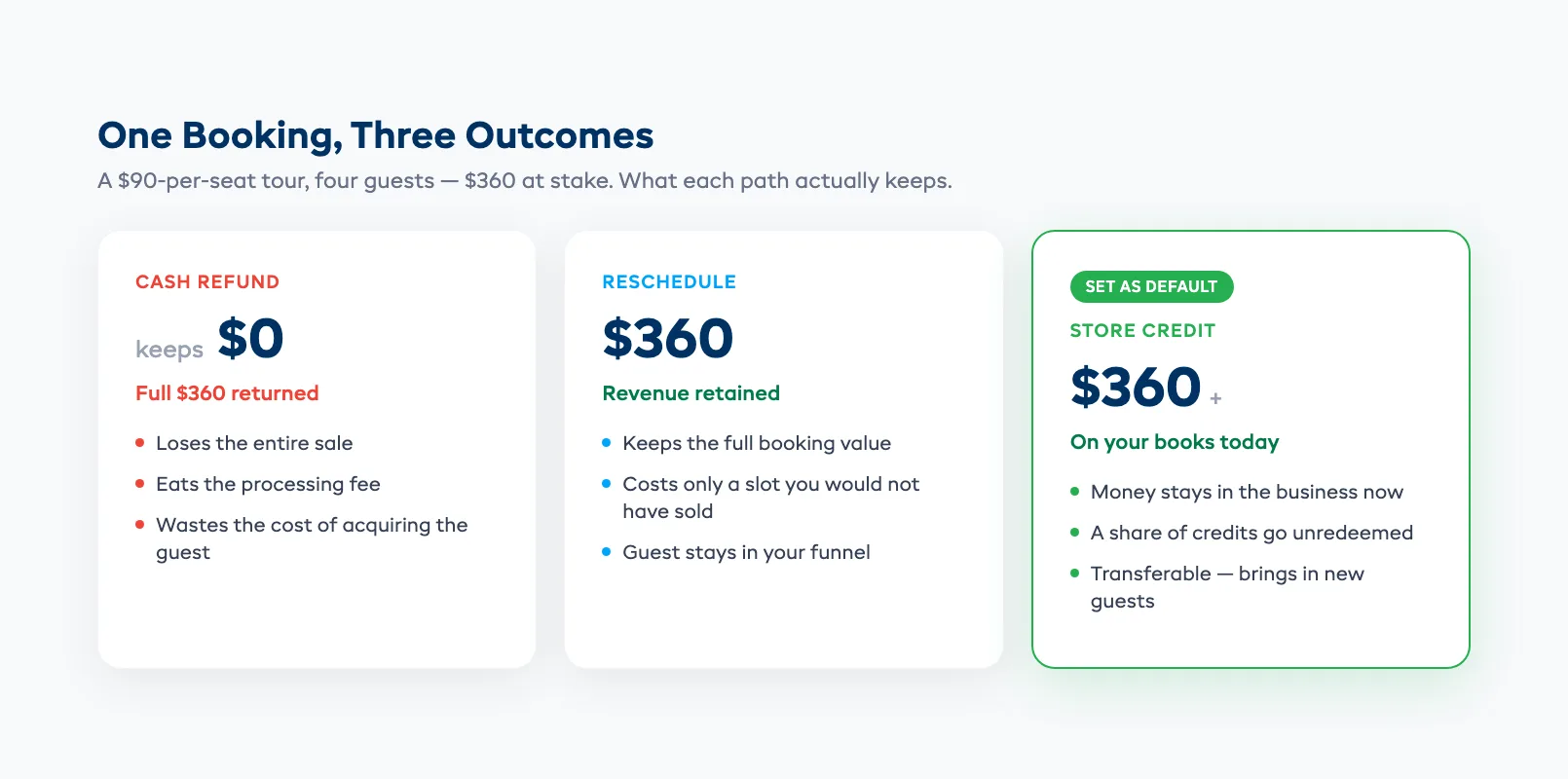
The lesson is simple: every cancellation you convert from refund to reschedule or credit is worth close to the full booking value, not a marginal saving. If reschedule-first messaging moves even one in three cancellations off the refund path, the revenue retained across a season dwarfs the handful of guests who insist on cash. Set credit as the default, cash as the exception, and the math compounds in your favor all year.
Automation: Let the System Run the Cadence
The recovery cadence above only works if it runs every time, automatically. No operator manually tracks who no-showed on a busy Saturday and remembers to follow up on Monday, which is exactly why most no-shows go un-recovered.
Automate the triggers. Booking software should detect a no-show, fire the hour-0 message, queue the day-2 and day-7 follow-ups, and stop the sequence the moment the guest rebooks. Cancellation requests should route automatically into the reschedule-first flow with credit pre-selected.
Reduce no-shows before they happen. Reminders at 48 hours and 2 hours before departure cut no-show rates sharply on their own. A reminder that lets the guest reschedule with one tap is better than one that only says "see you soon," because it surfaces the cancellation early enough to resell the slot.
Dash AI can handle the judgment calls in between: drafting the recovery messages in your voice, picking which low-demand slot to offer a rescheduling guest, and flagging the chronic repeat-canceller who needs a deposit next time. The system runs the cadence so you can run the tours. Wire the win-back sequence to the Tour No-Show Follow-Up Agent so it fires automatically the moment a guest is marked absent, and surface your terms up front with the Tour Booking Confirmation Process so "I never saw the policy" stops being an argument.
Edge Cases: The Situations That Break Simple Policies
Most cancellations fit the tiers above. A handful do not, and how you handle them protects both your revenue and your reputation.
Group and private bookings. A 12-person private tour canceling is a different financial event from one couple dropping off a shared departure. Use a stricter tier for large bookings, a non-refundable deposit of 25–50%, because you turned away other business to hold the date.
Chronic repeat cancellers. A small number of guests book and cancel repeatedly. Flag them and require a deposit or full prepayment on their next booking. Most are not malicious, but your slots are not a free option to hold.
Genuine emergencies. Illness, bereavement, a flight cancellation. Always have discretion to waive the policy entirely for these. A generous exception in a real crisis buys more loyalty and word-of-mouth than the booking was ever worth, and it is the difference between a fair policy and a cold one.
OTA bookings. Reservations from third-party channels follow that channel's cancellation terms, not yours. Know each platform's rules so your team does not promise a guest something the OTA will not honour.
A cancellation policy is not about punishing guests. It is about protecting the revenue you have already earned while keeping the door open for the guest to come back. Build the tiers, run the recovery cadence, default to credit, and automate the whole thing so it happens without you. As you scale across more guides and departures, Running Multi-Guide Tour Operations covers keeping these systems consistent at volume. For more operational guides, explore the tours hub and the tour operator glossary. To run cancellations, reschedules, and automated reminders from one system, start a free trial.
FAQ
What is a fair tour cancellation policy?
A fair policy is tiered by notice rather than a single flat rule. Offer a full refund or free reschedule more than 7 days out, reschedule or credit (refund minus a small fee) 2–7 days out, reschedule or credit only inside 24–48 hours, and full charge for no-shows, with operator-canceled or weather-canceled tours always fully refundable or reschedulable. Tiers feel fair to guests because they reward giving you notice.
How do I reduce tour no-shows?
The biggest levers are reminders and easy rescheduling. Send confirmations and reminders at booking, 48 hours out, and 2 hours out, and make every reminder a one-tap reschedule rather than just a notification. Require deposits for large or private bookings, and put repeat cancellers on prepayment. Automated reminders alone typically cut no-show rates meaningfully.
Should I offer refunds or store credit for cancellations?
Default to store credit and treat cash refunds as the exception. Credit keeps the booking value in your business, keeps the guest in your funnel, and a share of credits go unredeemed. Make credit attractive — long expiry (6–12 months) and transferable to friends — so guests accept it willingly instead of demanding cash.
How do I recover a guest who no-showed?
Run a short three-touch cadence. Within hours, send a warm, non-accusatory rebook link. On day two, offer a credit or a discounted low-demand slot. On day seven, send a final reminder with the credit expiry and one-click booking, then stop. Fast, guilt-free follow-up recovers a meaningful share of no-shows that a single penalty never would.
How should I handle weather cancellations for outdoor tours?
Make weather a separate clause and keep the decision yours, not the guest's. Define clearly what counts as an operator weather cancellation, and always offer a full reschedule or refund when you make that call. A clear weather clause stops guests from pre-emptively canceling at the first forecast of rain and demanding cash back.
Can booking software automate no-show recovery?
Yes. Booking software can detect a no-show, send the recovery sequence automatically, stop the moment a guest rebooks, and route cancellation requests into a reschedule-first flow with credit pre-selected. It can also fire pre-trip reminders that cut no-shows before they happen, so the entire policy runs without manual tracking.
in one place