Wedding Rental Software: Managing One Date Booked Eighteen Months Out
Wedding Rental Software: Managing One Date Booked Eighteen Months Out
Most rental orders last a weekend. A wedding order lasts a year and a half. The couple inquires in June for a Saturday in October of the following year, signs in July, adds twenty guests in the new year, swaps ivory linens for sage in March, asks about lanterns in April and sends final numbers ten days before the day. The date itself never moves. Everything around it does.
That changes what a wedding rental company needs from its system. Checking stock for next weekend is the easy part. The hard part is keeping one order accurate across nine or ten changes, making sure the chairs promised to that couple are never promised to another, and collecting money in stages from people you last spoke to eight months ago. This guide covers how operators handle each piece: holding dates years ahead, orders that survive revisions, staged payments, per-head styling packages, contracts and cancellation, and a checklist that runs from first inquiry to count-back.
Holding Dates Years Ahead
Wedding inquiries arrive earlier than anything else you rent. Twelve to eighteen months is normal for peak Saturdays in May, June, September and October, and some couples lock the venue two years out and start calling suppliers the same week. If your availability only looks one season forward, you can't answer the first question they ask.
So the first requirement is availability that works for any date, not just the current season. When a couple asks about Saturday 9 October 2027, the answer has to account for every order already committed to that Saturday, including orders taken last month by someone else on your team. If you own 300 cross-back chairs and the two weddings already booked that day have 260 of them, the answer is 40.
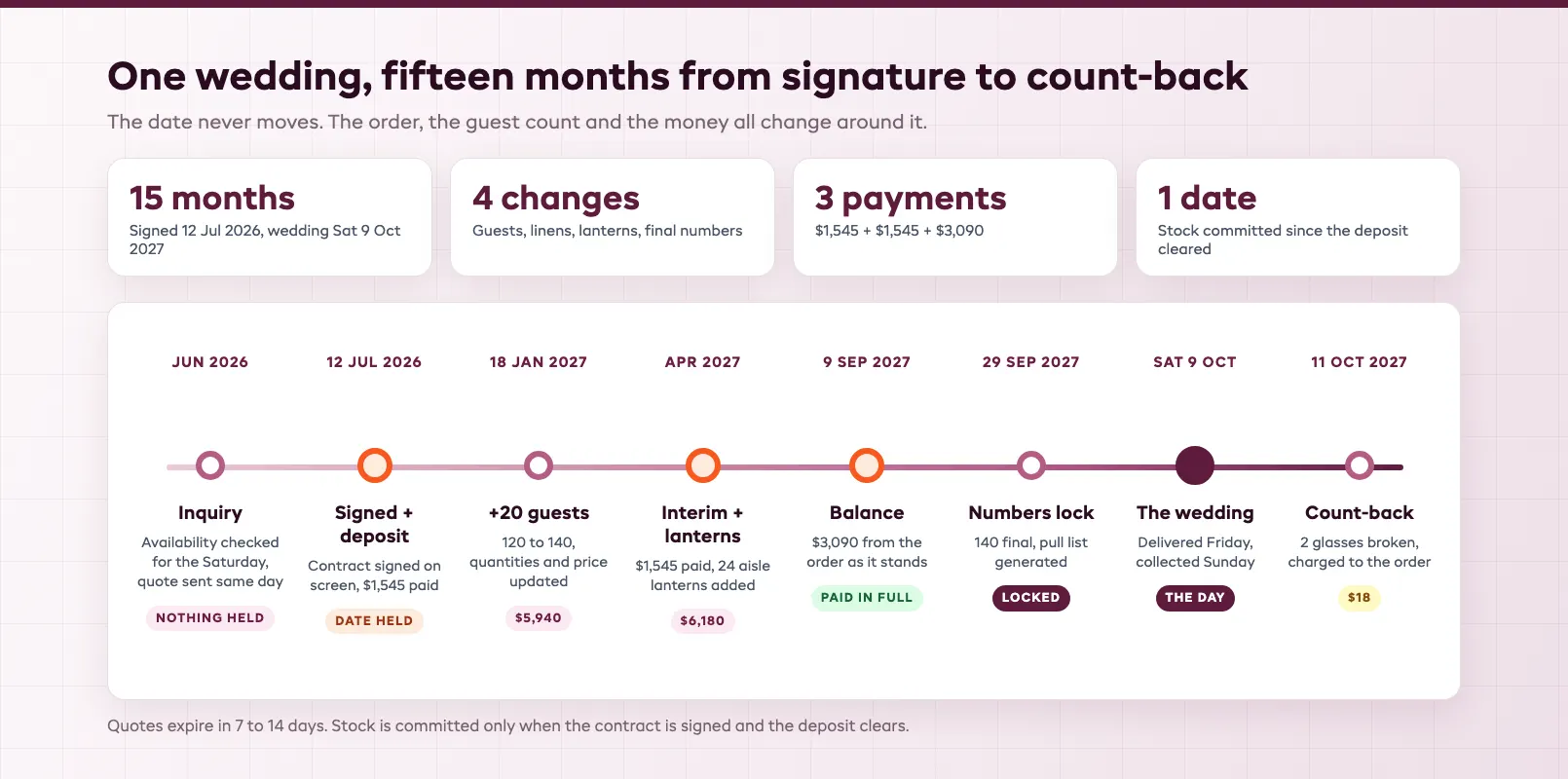
The second requirement is a clear rule for when stock is committed. Three states cover it:
- Inquiry. The couple has asked. Nothing is held. You can tell them what is free, and you should tell them it is not reserved.
- Quote sent. The stock is shown against the date as quoted but not committed. Other quotes for the same Saturday can still go out, and the quote screen should flag when open quotes add up to more than you own.
- Signed and deposit paid. The stock is committed. The next couple who asks about that Saturday sees the lower number.
Holding stock on an unsigned quote for a year is how operators end up with a calendar full of dates they turned people away from and never got paid for. Give quotes an expiry of 7 to 14 days, and commit the stock only when the contract is signed and the deposit clears.
Some items need a stricter rule. You probably own one arbor, two sweetheart tables and a single set of gold chargers for 150. These are the lines that get double-promised, because two people take two calls about two June Saturdays and neither checks. Treat single-unit and limited items as hard holds: once one wedding has them for a date, they don't appear on any other quote for that date, and nobody can override that without a manager.
On EquipDash's wedding rental software, availability can be checked and committed for dates well beyond the current season, and a signed quote holds the stock so the same chairs, arbor or chargers can't be sold to another couple for that date.
Orders That Survive Revisions
The average wedding order changes several times before the day. Guest count goes up after the save-the-dates, down after the RSVPs, and up again when a table of cousins confirms late. Colors change when the florist sends a mock-up. Items get added because the couple saw lanterns at a friend's wedding. Every one of those changes has a price attached, and most operators lose money on at least one of them.
The failure is always the same. The order lives in an email thread. The original quote is a PDF, the first change is a reply, the second is a phone call written on a sticky note, and the third is a message to whoever answered the Instagram DM. On the Thursday before the wedding, the warehouse pulls from the last email somebody printed, and the twenty extra chairs agreed on the phone in February are not on it and were never invoiced.
The fix is one order that changes in place, with the history kept:
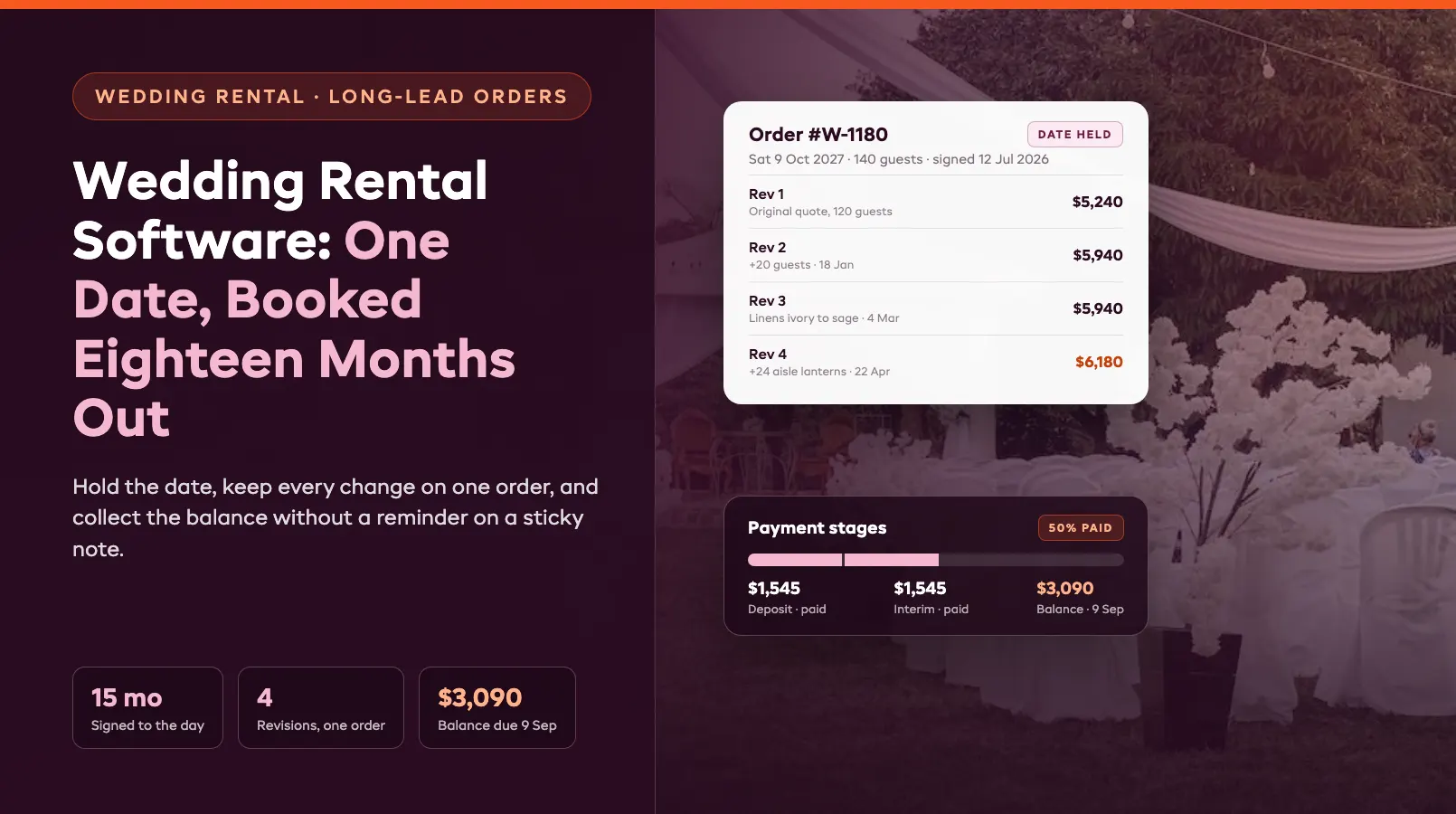
| Revision | Date | Change | Order value |
|---|---|---|---|
| Rev 1 | 12 Jul 2026 | Original quote, 120 guests | $5,240 |
| Rev 2 | 18 Jan 2027 | +20 guests: 20 chairs, 2 tables, linens, place settings | $5,940 |
| Rev 3 | 4 Mar 2027 | Linens changed ivory to sage | $5,940 |
| Rev 4 | 22 Apr 2027 | +24 aisle lanterns | $6,180 |
| Final | 29 Sep 2027 | Numbers locked at 140 | $6,180 |
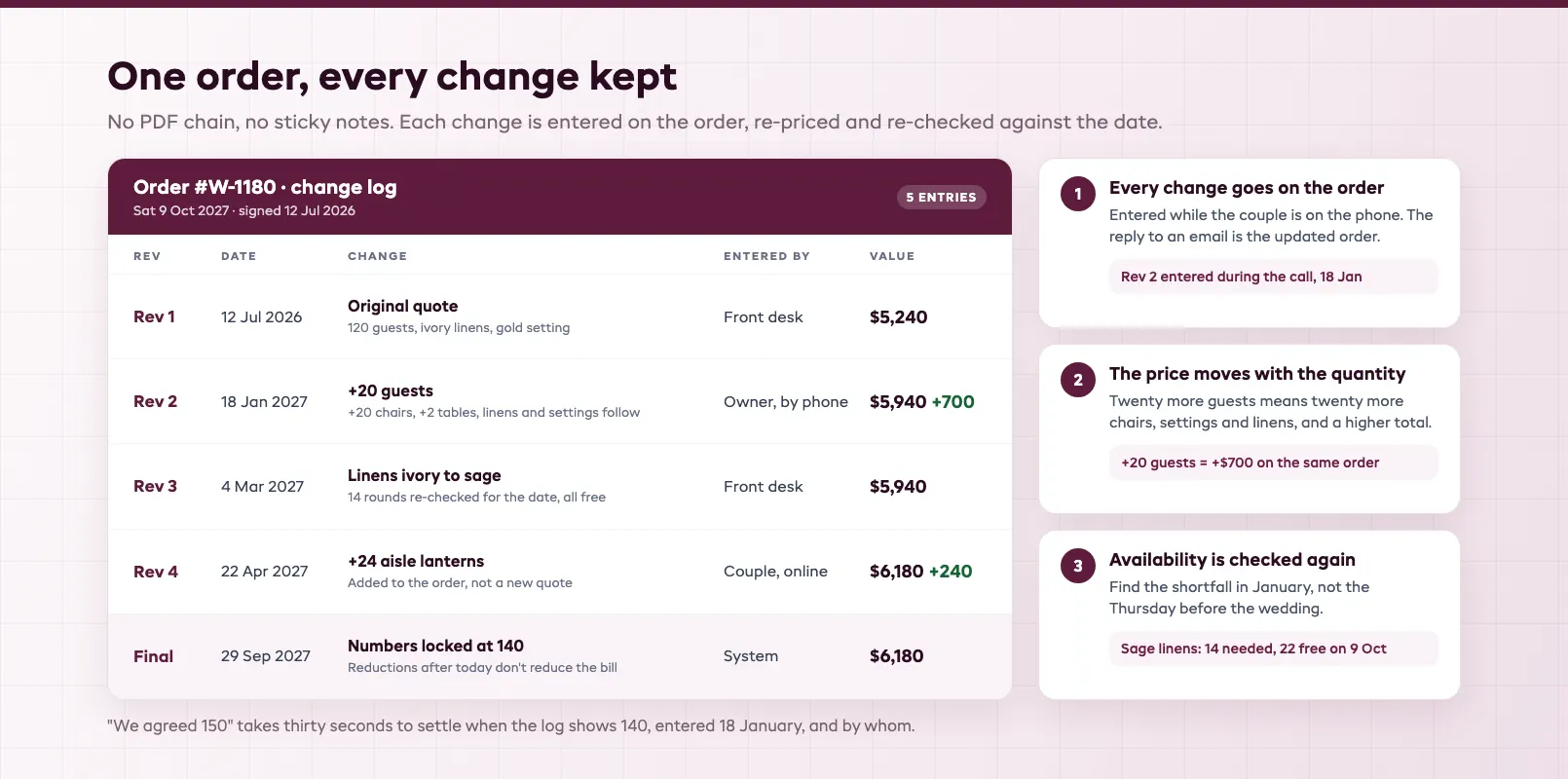
Three rules make this work in practice:
- Every change goes on the order, not in a message. If a couple calls with a change, it gets entered while they are on the phone and they get the updated order by email. If they email a change, the reply is the updated order, not "noted."
- The price moves with the quantity. Add twenty guests and the chairs, tables, linens and place settings go up with it, and so does the total. A change that doesn't re-price is a discount you didn't mean to give.
- Changes check availability again. Twenty more chairs on a Saturday that already has two weddings might not exist. Find that out in January, when you can sub-rent or suggest a different chair, not the Thursday before.
The history matters as much as the current version. When a couple says "we agreed 150," you can open the order and show that the change was to 140, entered on 18 January, and by whom. That conversation takes thirty seconds instead of ruining a relationship you need for their reviews.
Lock final numbers at a fixed point, usually 10 to 14 days before the wedding. After that, additions are accepted only if the stock is free, and reductions don't reduce the bill. Put that date in the contract so it's not a surprise.
Staged Payments
A booking taken eighteen months out is a balance somebody has to remember for eighteen months. Most operators take a deposit, file the contract, and then find out in the week of the wedding that nobody sent the invoice for the rest. Chasing $3,000 from a couple four days before their wedding is a bad conversation for everyone.
Staged payments solve both problems: you get paid across the run instead of all at the end, and the couple budgets for it in pieces. A common schedule for a $6,180 order:
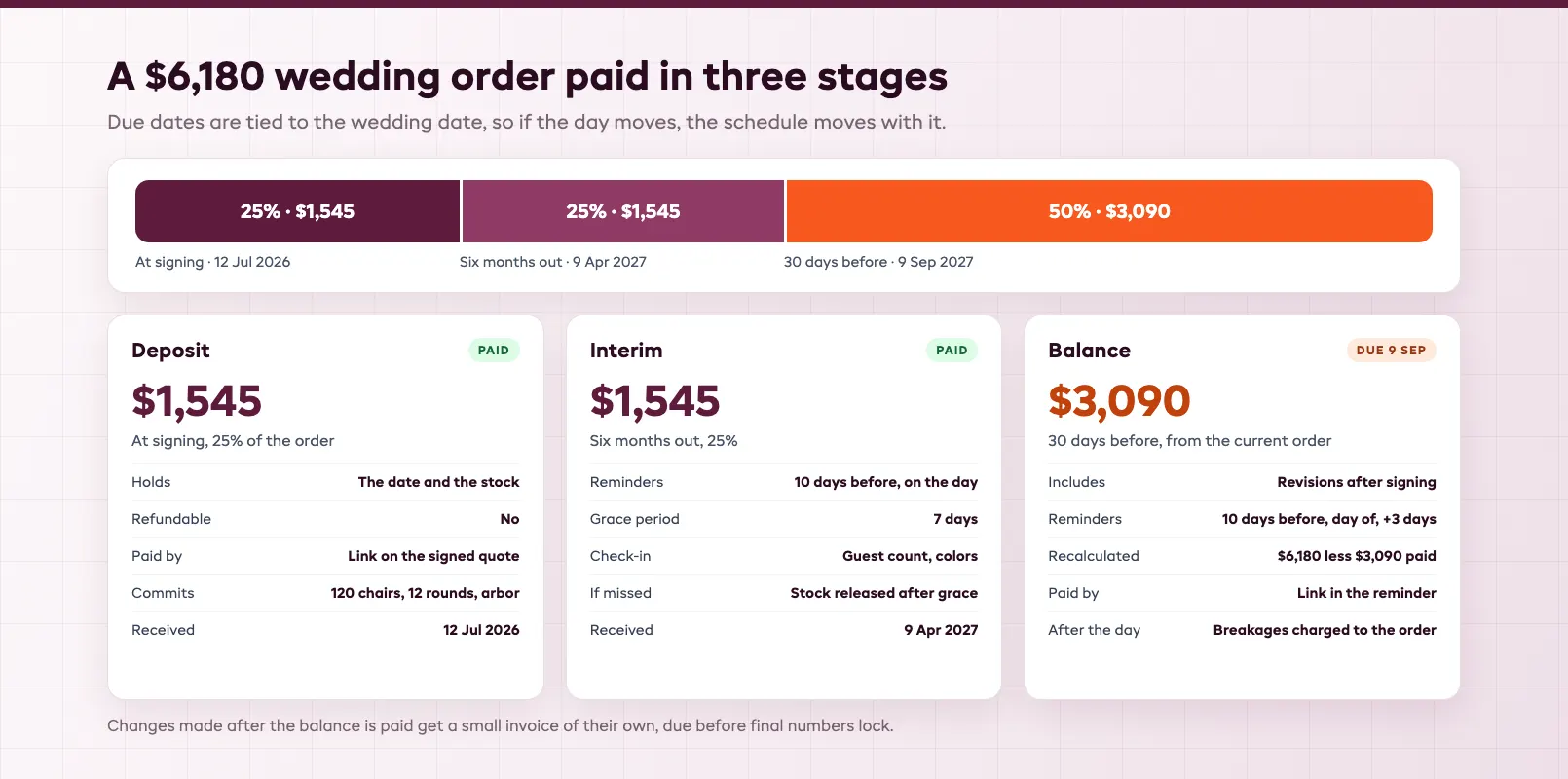
- Deposit at signing, 25%: $1,545. Commits the date and the stock. Usually non-refundable, because it covers the Saturday you turned other couples away from.
- Interim at six months out, 25%: $1,545. Keeps the booking live and gives you a check-in point where guest count and colors usually firm up.
- Balance 30 days before the wedding, 50%: $3,090. Recalculated from the order as it stands, so revisions made after signing are included without a separate invoice.
The schedule needs to be set when the order is confirmed, with due dates tied to the wedding date, not to the day someone remembers. If the wedding moves from 9 October to 16 October (it happens when a venue double-books), the due dates should move with it.
Reminders should go out on their own. A reminder ten days before each due date, another on the due date, and a follow-up three days after is enough for most couples. Every reminder should include a payment link, so the couple can pay from their phone instead of calling with a card number. On EquipDash, a Balance Reminder agent chases staged payments weekly as the wedding approaches, which matters most for the bookings you took a year ago and haven't thought about since.
Two decisions to make up front:
- What happens when a payment is missed. Pick a grace period (seven days is common) and write it into the contract, along with what happens after it: the stock is released, the deposit is kept, or both.
- How late changes are paid. Revisions after the balance is paid get their own small invoice, due before the final numbers lock. Don't let them roll into a "we'll sort it out after" conversation.
The same order also carries the damage deposit or card on file. Breakages and missing items are counted back after the wedding and charged against that order, not raised as a separate bill weeks later that the couple is back from their honeymoon to argue about.
Per-Head Styling Packages
Couples buy a table setting. A styled wedding at 140 guests on rounds of ten might mean 140 chargers, 140 dinner plates, 140 side plates, 420 pieces of glassware, 140 napkins, 14 table runners, 42 candlesticks and 14 centerpiece bases, which is more than a thousand pieces. The couple wants one line on the quote that says "Garden Gold setting, 140 guests." The warehouse needs every piece underneath.
A per-head package does both. You sell a named setting at a per-guest price, and the system tracks each component behind it:
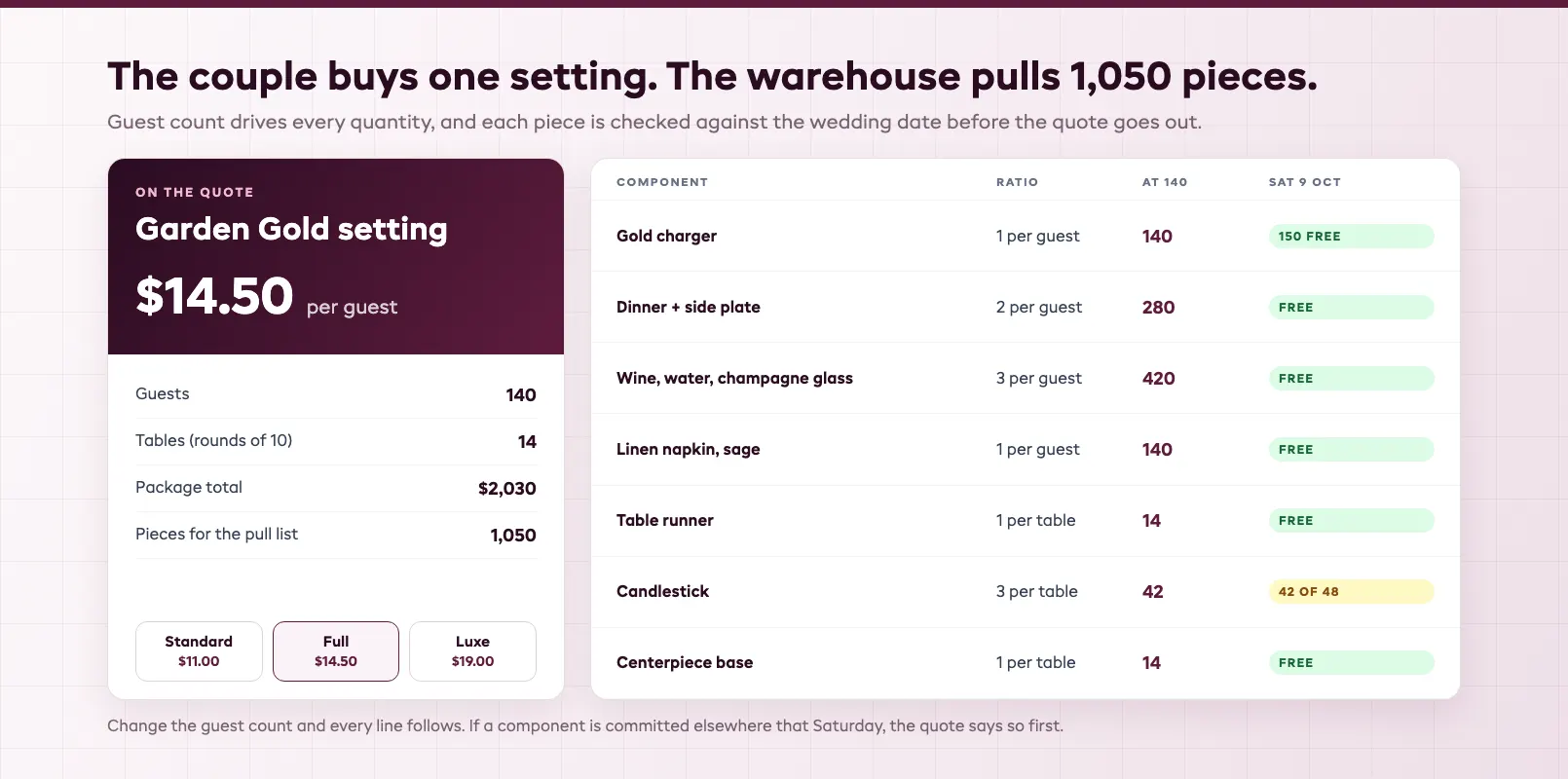
| Component | Per guest | At 140 guests |
|---|---|---|
| Gold charger | 1 | 140 |
| Dinner plate + side plate | 2 | 280 |
| Wine, water and champagne glass | 3 | 420 |
| Linen napkin, sage | 1 | 140 |
| Runner (1 per table of 10) | 0.1 | 14 |
| Candlestick (3 per table of 10) | 0.3 | 42 |
| Centerpiece base (1 per table of 10) | 0.1 | 14 |
| Package price | $14.50 per guest | $2,030 |
Three things make packages work for a wedding business:
- Guest count drives the quantity. When the count goes from 120 to 140, every component follows. Nobody recalculates glassware by hand.
- Components are checked against the date. If the gold chargers are already on another wedding that Saturday, the package can't be sold for that date as built. You find out at quote time, and you can offer the silver version or sub-rent 40 chargers.
- The pull list comes from the package. The styling team loads the truck from a list generated from the order, not from the mood board. Missing napkins get noticed in the warehouse, not at the venue.
Price the package on what the couple is buying, not on the sum of the parts. A $14.50 setting might contain $11 of component rental value, and the difference covers styling time, the extra wash and the breakage rate on glassware, which is the highest of anything you rent. Build three tiers of the same setting (standard, full and luxe), so the upgrade is one click on the order instead of a rebuilt quote.
If you also rent to parties and corporate events, the same packages usually sell there at a lower tier. A simpler version of this setup is covered on the party rental software page.
Contracts and Cancellation
A wedding contract has a harder job than a weekend rental agreement. It has to hold for a year or more, cover changes nobody has thought of yet, and still make sense to a couple reading it the week their venue falls through. Most wedding rental disputes come down to cancellation, postponement or final numbers, and all three are decided by what the contract said at signing.
The contract should cover, at minimum:
- The date, the venue and the delivery and collection windows. Including access times at the venue, because a 6pm collection at a venue that closes at 5pm is your problem, not the venue's.
- What the deposit covers and when it becomes non-refundable. Usually at signing.
- The payment schedule. Each stage, its due date and the grace period for late payment.
- The final numbers date. After which reductions don't reduce the bill.
- Cancellation terms by notice period. A sliding scale is easier to defend than a single cut-off. For example: more than 12 months out, keep the deposit; 6 to 12 months, keep 50% of the order; under 6 months, keep 100%.
- Postponement. Whether a date change is treated as a cancellation or a move, whether there is a fee, and what happens if the new date is not available.
- Damage and loss. Per-item replacement prices for glassware, chargers and linens, plus cleaning fees for wax and red wine, charged against the order after the day.
- Force majeure. What happens when the wedding is canceled for reasons nobody controls. Get this reviewed by a lawyer in your state. This guide is not legal advice.
Sign it digitally and store it against the order. When a couple calls in March about postponing, the terms they agreed to should be one tap away, not in a filing cabinet or a PDF in somebody's inbox. Couples who sign on a screen also sign faster, which matters because the stock isn't committed until they do.
Chase unsigned contracts like unpaid invoices. A couple who paid a deposit but never signed has a date and no terms, which is the worst position to be in if something goes wrong. On EquipDash, an Unsigned Contracts agent reminds couples whose date is approaching without a signature.
Postponements need one more rule. Keep the deposit and move it to the new date, but check availability for the new Saturday before agreeing. If the new date is a peak Saturday that is already two-thirds committed, say so before the couple tells their guests.
Checklist
Use this for every wedding order, from the first message to the count-back. Plans for wedding rental businesses start at $23/month on annual billing, with staged payments, digital contracts and date-based availability on every tier; see pricing for the current tiers.
At inquiry (12 to 18 months out)
- Check availability for the exact date, including single-unit items like the arbor and sweetheart table
- Send a quote the same day with a 7 to 14 day expiry
- Flag any line where open quotes for that Saturday exceed stock
At signing
- Contract signed digitally and stored on the order
- Deposit paid, stock committed to the date
- Payment schedule set with due dates tied to the wedding date
- Final numbers date agreed and written into the contract
Through the run (6 to 12 months out)
- Every change entered on the order, re-priced and re-checked for availability
- Updated order sent to the couple after each change
- Interim payment collected, reminders running
Final stretch (30 days out)
- Balance collected, recalculated from the current order
- Final numbers locked 10 to 14 days out
- Pull list generated from the order and packages
- Delivery, set-up and collection crew scheduled against the wedding
After the day
- Count-back against the order within 48 hours
- Breakages and missing items charged against the order
- Linens and glassware blocked while in the wash so they aren't sold for the next weekend
- Review request sent within a week
For the rest of the setup, from online inquiries to crew scheduling and cleaning turnaround, see the wedding rental software page.
FAQ
What is wedding rental software?
It is the system a wedding rental company runs on: which dates are committed, what is on each order, what has been paid and what is still due. It differs from general event rental software because a wedding is booked a long way out, changes several times before the day and cannot move. The order history, the payment schedule and the contract matter as much as the stock count.
How far ahead should a wedding rental company take bookings?
As far ahead as couples book venues, which for peak Saturdays is often 12 to 18 months and sometimes two years. Your availability needs to answer for any future date, not just the current season. Commit stock only when the contract is signed and the deposit is paid, and give unsigned quotes an expiry of 7 to 14 days so they don't block dates indefinitely.
How do you handle guest count changes on a wedding order?
Keep one order and change it in place, with the history kept. When the guest count changes, the chairs, tables, linens and place settings should update with it, the price should move with the quantity, and availability should be checked again for the date. Lock final numbers 10 to 14 days before the wedding, and write that date into the contract so reductions after it don't reduce the bill.
What payment schedule works for wedding rentals?
A common schedule is 25% at signing to hold the date, 25% at six months out and the balance 30 days before the wedding, recalculated from the order as it stands. Tie due dates to the wedding date, send reminders with a payment link before and on each due date, and write a grace period for late payments into the contract.
How should wedding styling packages be priced?
Per guest, on the value of the finished setting rather than the sum of its parts. The package price should cover the component rental, styling time, the extra wash and glassware breakage. Track every component behind the package so guest count drives the quantities, components are checked against the date, and the pull list for the styling team comes straight from the order.
What cancellation terms should a wedding rental contract include?
A sliding scale by notice period is easier to defend than a single cut-off, for example keeping the deposit more than 12 months out, 50% of the order at 6 to 12 months and 100% under 6 months. Also cover postponement, missed payments, the final numbers date, damage and loss prices, and force majeure. Have the contract reviewed by a lawyer in your state; this is not legal advice.
in one place