Boat Winterization and Storage: Making the Off-Season a Revenue Line
Boat Winterization and Storage: Making the Off-Season a Revenue Line
The last rental of the season goes out on a Sunday in October. The boat comes back, gets hosed down, and sits on the trailer. Somewhere in the next three weeks somebody drains the block, fogs the cylinders, pulls the batteries and throws a cover on. Then nothing happens for five months. No revenue, a storage bill you pay to someone else, and a spring that starts with the same scramble as last year.
That five-month gap is the part of the year most boat rental operators write off, and it does not need to be written off. The same crew, the same yard and the same skills that keep a rental fleet running can bill four things between October and April: the haul-out, the winterization, the storage, and the spring recommission. Some operators bill them to their own fleet as a cost center they now understand. The better ones bill them to customers who own boats and have nowhere to put them.
This guide is the fall half of the seasonal pair. The spring half, engine recommissioning, the safety gear audit and the soft launch, lives in our pre-season boat launch guide. This one covers what happens before the covers go on: scheduling the haul-out week, pricing winterization as a service menu, running storage as a monthly revenue line, taking in customer boats, and selling the spring launch in October while the customer is standing in your yard.
The Haul-Out Week Is a Schedule, Not an Afterthought
The haul-out is the first place off-season money leaks. A fleet of 12 boats pulled "when we get to it" over four weeks means four weeks of a crane, a ramp or a trailer crew on standby, four weeks of boats sitting in the water past their last rental, and at least one boat that gets hauled after the first hard frost with water still in the block.
Run it as one scheduled week instead. The last rental date is on the calendar, so the haul-out date is on the calendar the moment the season closes. What that looks like for a 12-boat pontoon and runabout fleet:
- Monday and Tuesday: the water side. Every boat gets its last hour-meter reading logged, fuel topped and stabilized, and a final run at the dock so the stabilizer reaches the carburetor or injectors. Boats come out in the order they are stored, last in first out, so the ones going to the back of the yard come out first.
- Wednesday and Thursday: the yard side. Pressure wash, hull inspection while the bottom is still wet (it shows the blisters and the prop damage), drain and fog engines, pull batteries to the charging shelf, note everything found on the per-boat record.
- Friday: covers, blocking and the spring list. Shrink-wrap or fitted covers, trailer tires off the ground or on boards, and every open item from the week written into the spring recommission list for that boat.
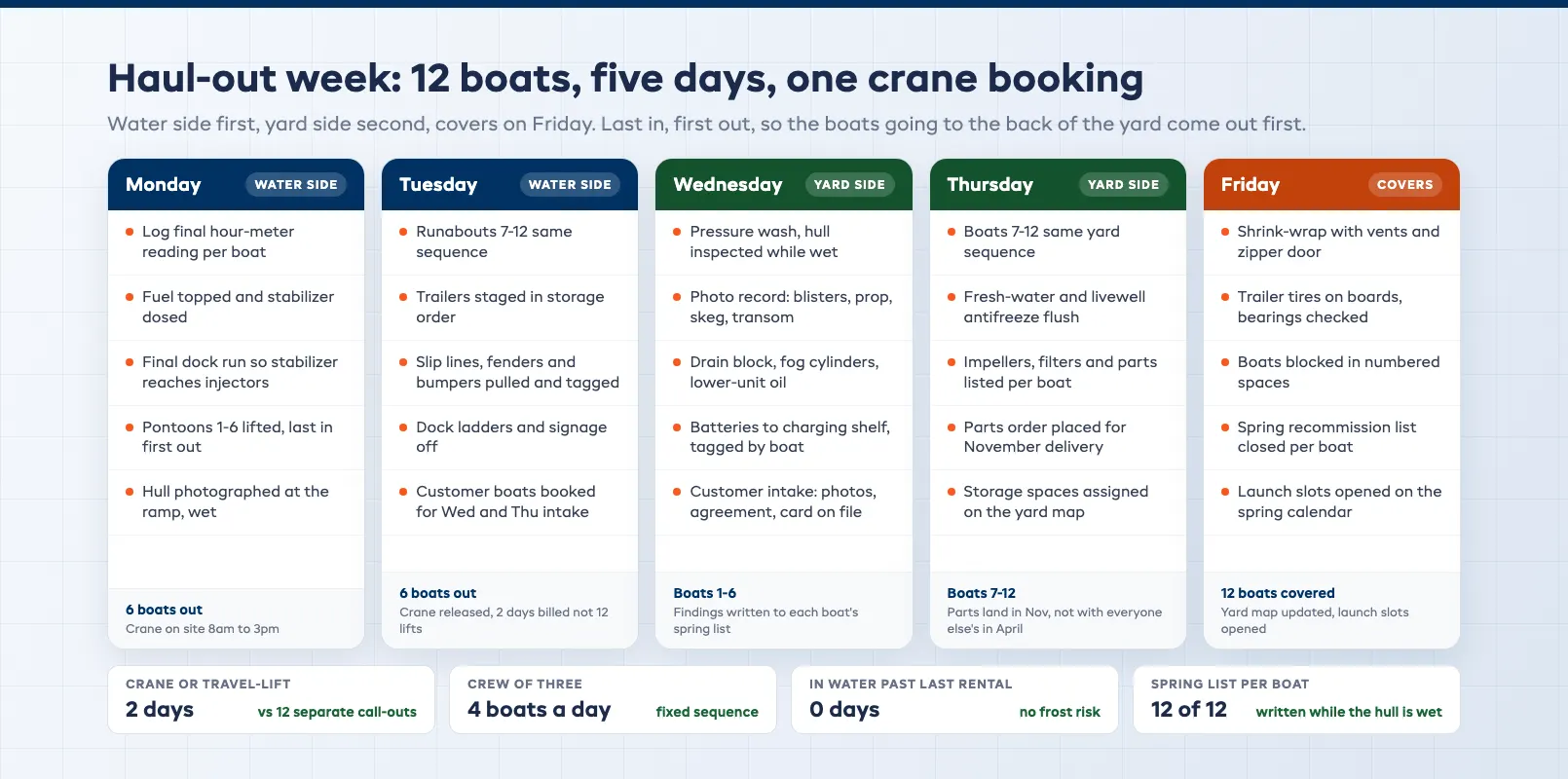
The reason to compress it is cost, not neatness. A crane or travel-lift contractor charges by the day or the lift; a week of lifts booked together is cheaper than 12 separate call-outs. A yard crew of three can process four boats a day when the sequence is fixed; the same crew doing one boat between other jobs takes an hour longer per boat. And the inspection notes taken while the hull is wet on Wednesday become the parts order that ships in November instead of the parts order that ships in April when everyone else's does too.
Log every reading and finding per boat, the same way the season's maintenance logs were kept. The end-of-season hour reading, the compression numbers if you take them, the lower-unit oil condition and the hull findings are the baseline the spring guide works from, and they are the record an insurer wants when a lay-up credit is claimed.
Pricing Winterization as a Service Menu
Winterizing your own fleet is a cost. Winterizing a customer's boat at the same bench, the same week, with the same materials on hand, is a service with a margin, and it is one the marine trade already charges for at $300 to $900 per boat depending on engine type and size. A rental operator with a trained dock crew and a yard is already set up to sell it; most just never put a price on it.
Build the menu the way a mechanic does: a base per engine type, then add-ons. A working rate card for outboard and sterndrive work:
| Service | Outboard, single | Sterndrive or inboard | Add-on |
|---|---|---|---|
| Engine winterization (drain, fog, fuel stabilize, lower-unit oil) | $225 | $375 | Second engine +$150 |
| Batteries pulled, tested, stored on a maintainer | $45 | $45 | Replacement battery at cost +20% |
| Fresh-water and head systems (antifreeze flush) | $85 | $110 | Livewell or washdown pump +$35 |
| Shrink-wrap, with vents and zipper door | $16 to $22 per foot | $18 to $24 per foot | Fitted cover fit and store +$60 |
| Trailer service (bearings, tires off the ground, lights) | $95 | $95 | Bearing repack +$120 |
| Hull inspection with photo record and spring list | $60 | $60 | Included in the storage package |
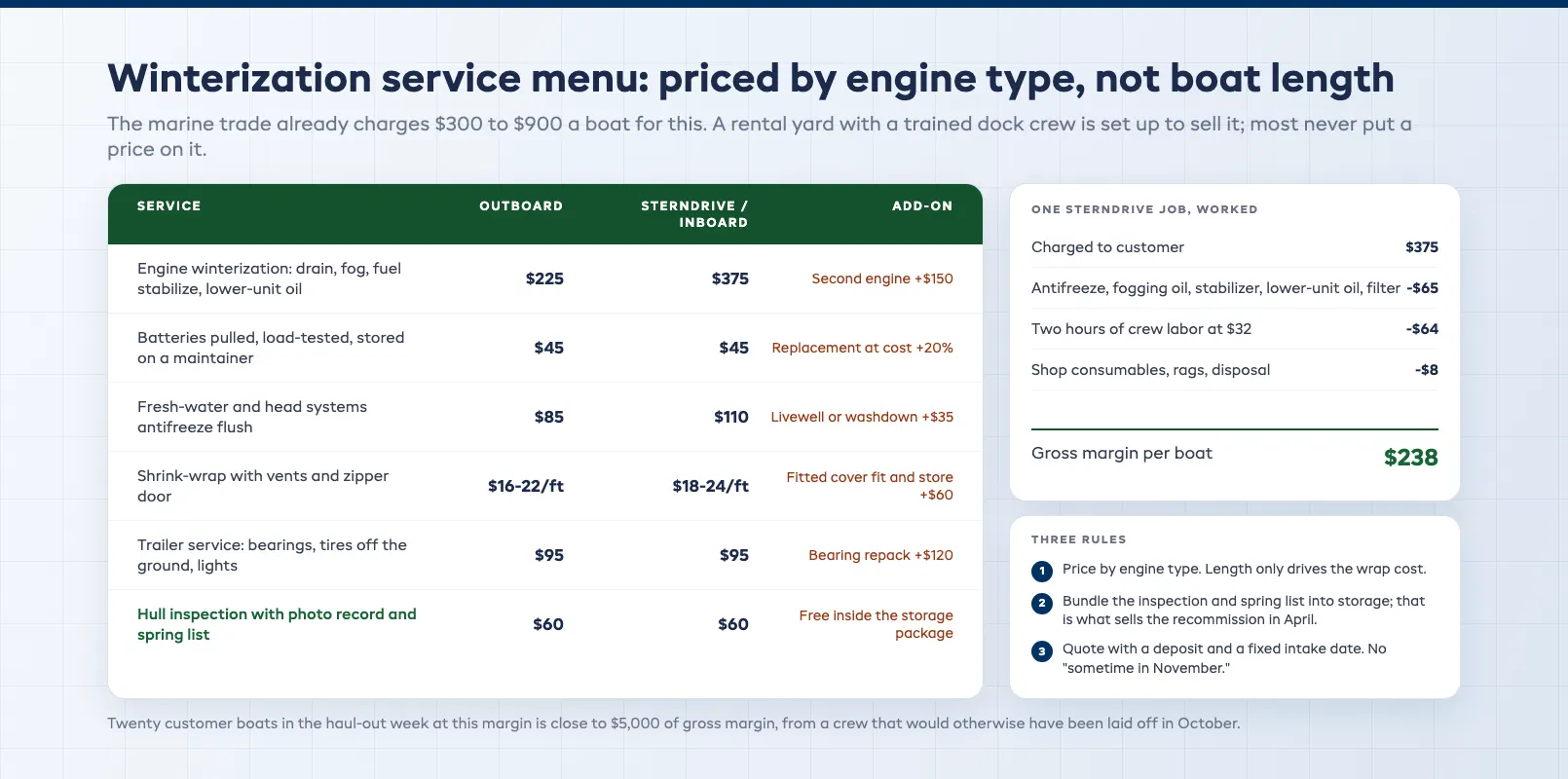
Three rules make the menu profitable rather than just busy:
- Price by engine type, not by boat length. Length drives the shrink-wrap cost and nothing else. A 22-foot pontoon with a 90hp outboard is a 45-minute engine job; a 22-foot bowrider with a sterndrive is two hours plus antifreeze and the risk of a cracked manifold if it is done wrong. The rate card has to reflect the labor.
- Bundle the work you would do anyway. The hull inspection and the spring list are free inside the storage package because they are what you need to sell the recommission in April. On their own they are a $60 line for the customer who is only buying winterization.
- Quote it with a deposit, and take the boat in on a fixed date. The same rule that governs a rental booking governs a winterization job: the slot is held when the deposit is paid, and a customer who wants to "drop it off sometime in November" gets the next open slot on the haul-out calendar, not a promise.
The materials cost is small: a gallon of marine antifreeze, fogging oil, a fuel stabilizer dose, lower-unit oil and a filter run $40 to $70 per boat. The labor is the crew you would otherwise have laid off in October, at their normal hourly rate. On a $375 sterndrive winterization with $65 in materials and two hours of labor at $32, the margin is roughly $238. Twenty customer boats in the haul-out week is close to $5,000 in gross margin from work that also keeps the crew on payroll into November.
Storage as a Monthly Revenue Line
Winterization is a one-time invoice. Storage is a monthly one, and it is the part of the off-season that behaves most like the rental business you already run: a fixed number of spaces, a price per space per month, and occupancy to manage.
Most rental operators already pay for the space. A yard lease, a fenced lot behind the shop, or a leased corner of a marina's dry-stack is a cost that exists whether it holds 12 boats or 30. If the fleet takes 12 spaces and the lot holds 30, the other 18 are storage inventory, and the only question is what they rent for.
The going rates, which vary by region and by whether the space is covered:
- Outdoor, on the owner's trailer, uncovered: $60 to $120 per month, or $300 to $600 for a six-month season paid up front.
- Outdoor, shrink-wrapped and blocked: $90 to $160 per month. The wrap is a separate line on the winterization invoice.
- Covered or dry-stack rack: $150 to $350 per month depending on length. Rack storage needs a forklift and an operator; do not sell it if you do not own one.
- Indoor, heated: $10 to $18 per foot per month. Rare for rental operators to have, and a premium product if you do.
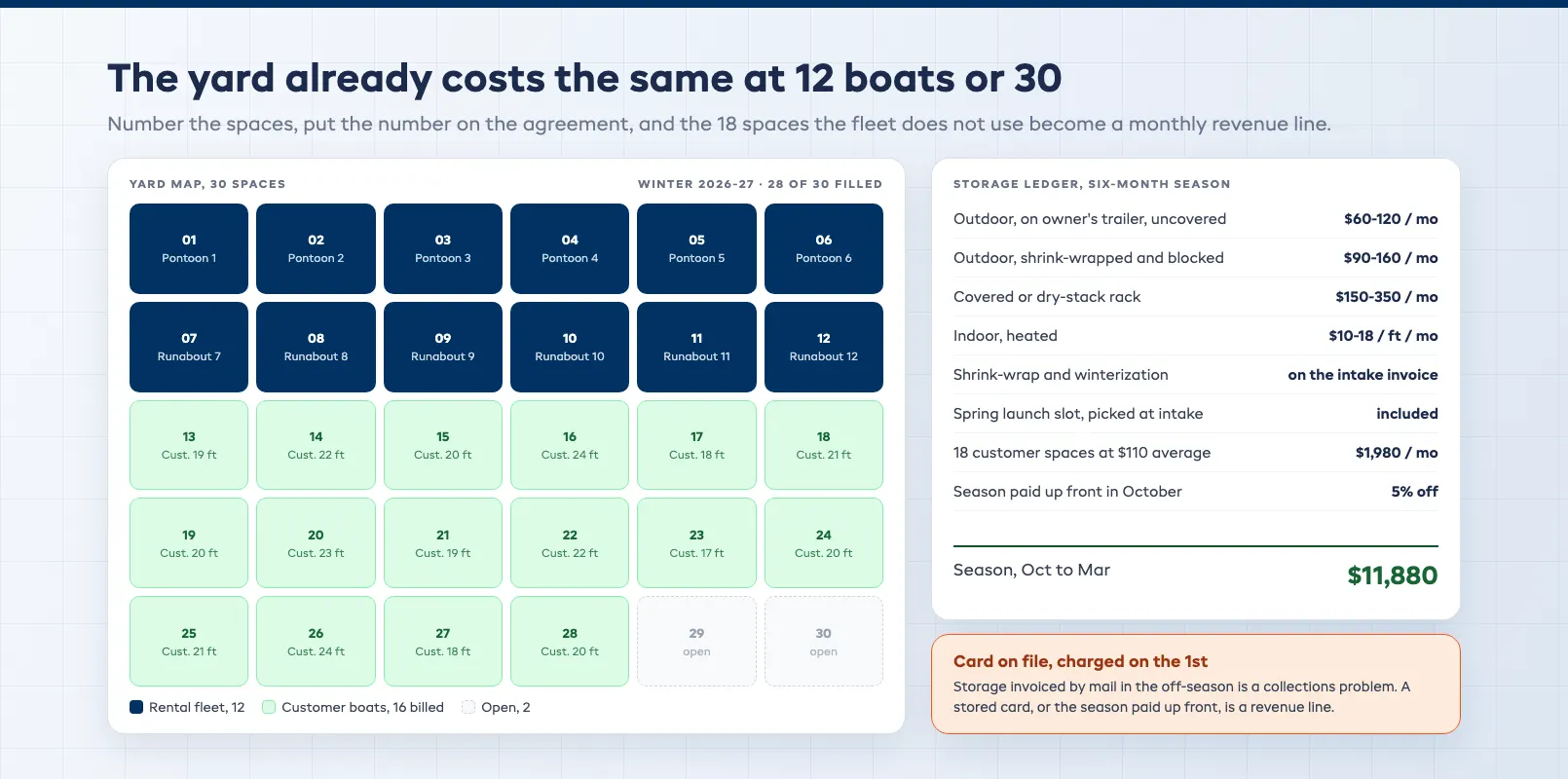
The ledger for an 18-space customer storage line at an average $110 per month, six months, is $11,880 for the season, against a yard cost that was already on the books. It is also money that arrives in October and November, the two months with the least cash coming in from anywhere else.
Some points from operators who run storage well:
- Bill the season up front, or bill monthly on an automatic charge. A card on file that charges on the first of the month is the difference between a storage line and a collections problem. Do not invoice by mail in the off-season and hope.
- Map the spaces. Number them, put the number on the storage agreement, and put the boat where the agreement says. The customer who wants access in January to check a cover needs to be walked to space 14 in two minutes, not found by a crew member reading hull numbers in the snow.
- Sell the spring pull-out date at intake. A storage agreement that says "launch by appointment in April" turns 18 phone calls in March into 18 slots already on the calendar. The customer who wants the first weekend in May books it in October and pays for it in the storage package.
- Set the access rules in the agreement. Days and hours, whether the customer can work on the boat in your yard, who is responsible for the cover, what happens if the account goes unpaid by March. A storage agreement with no lien clause is a boat you cannot move or sell if the owner disappears.
The other side of the ledger is what storage does to your own fleet costs. The captained versus bareboat math and the fleet sizing numbers in the boat rental business guide both treat winter storage as pure overhead. If the yard is earning $11,880 a season from customer boats, the effective storage cost of the rental fleet is close to zero, and that changes the number a new pontoon has to earn in its first season to justify itself.
Taking In Customer Boats
The customer for winterization and storage is already on your list. Anyone who rented a boat this summer and mentioned they own one, anyone who asked whether you sell used boats, every slip holder at the marina you operate out of, and every trailer boat owner within 20 miles who has been paying a marina $200 a month to store a 19-foot bowrider on a rack.
Intake is the part that separates a storage business from a boat graveyard, and it takes 20 minutes per boat:
- Photograph everything. Hull on all four sides, the transom, the prop, the helm, the upholstery, and any existing damage, with the date. This is the same discipline as the rental check-in in the damage deposit process, for the same reason: the boat you hand back in April has to be the boat you took in, and the photos are the proof.
- Record the boat. Make, length, engine, hull number, trailer plate, the owner's insurance carrier and policy number. Your storage agreement should require the owner to carry hull insurance; your yard policy covers your negligence, not their uninsured boat.
- Log the fuel level and the battery state. A customer who drops off a boat with a quarter tank of untreated fuel and a five-year-old battery is a customer who will blame the yard in April. Note it, and sell the stabilizer dose and the battery test on the spot.
- Sign the agreement and take payment before the boat leaves the trailer. Storage term, monthly rate or season total, access rules, lien clause, spring launch date, and the winterization work order attached. Card on file for the monthly charge.
The intake record does one more job. Every item noted at intake, from a worn impeller to a cracked bimini strut, is a line on the spring work order, which is the next section.
Selling the Spring Recommission in October
The most profitable conversation of the off-season happens at intake, with the owner standing next to the boat, and it is a short one: "We will winterize it this week, store it until April, and have it recommissioned and in the water for you on the launch date you pick. Here is the package price."
The spring recommission is the same work the pre-season launch guide describes for your own fleet: batteries back in and load-tested, impeller replaced, fuel filters, oil and lower-unit service, a systems check and a test run. On a customer boat it is a $250 to $600 invoice depending on engine type, and the parts get ordered in November from the intake notes instead of in April from a phone call.
Sell it as one package rather than four separate invoices, for three reasons. The customer sees one number for the whole off-season, which is easier to say yes to than a winterization bill in October and an unexpected recommission bill in April. You collect the storage and winterization portion now, with the recommission portion charged on the launch date. And the spring launch calendar fills in October, so April is a schedule rather than a scramble.
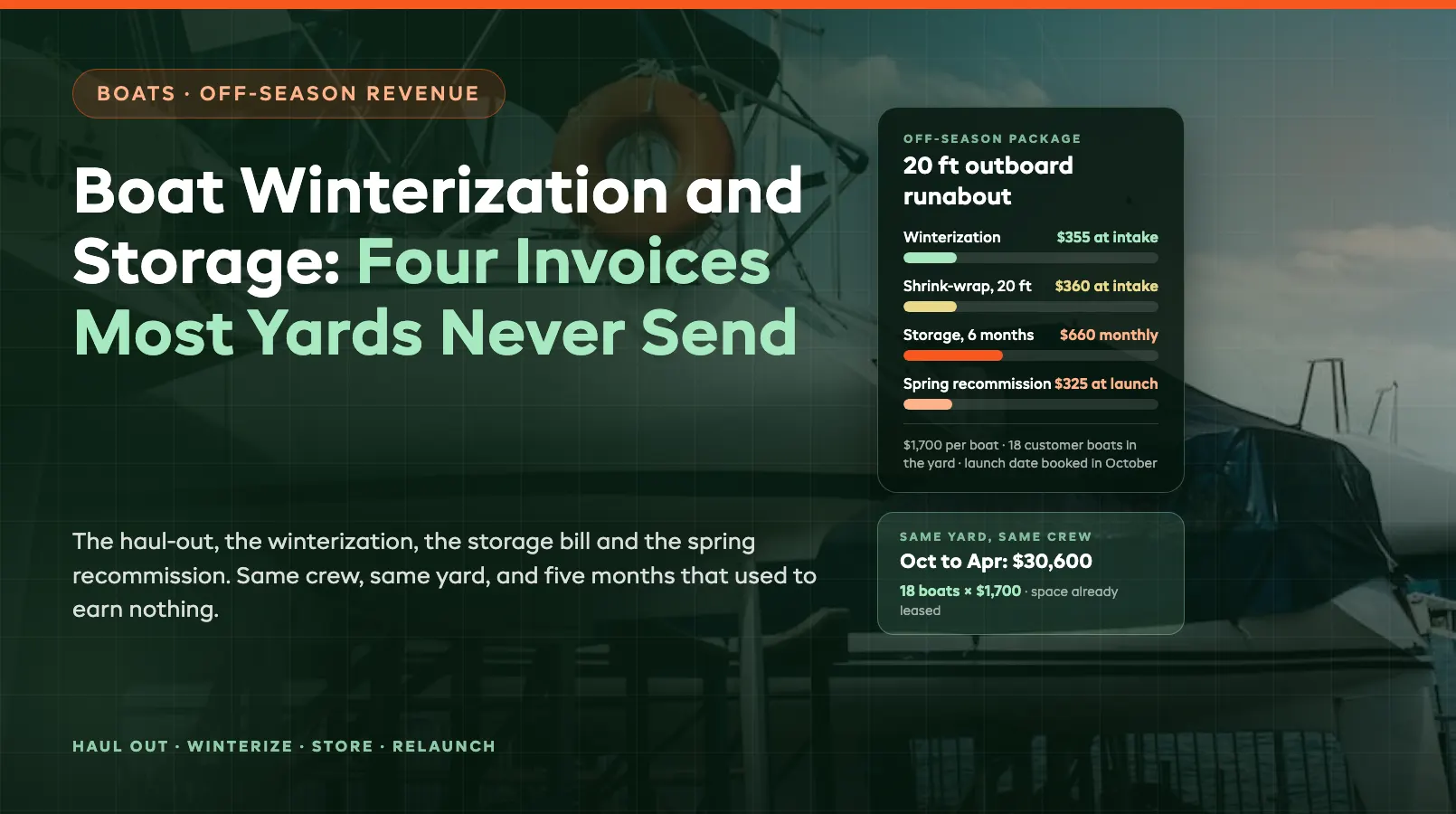
A worked package for a 20-foot outboard runabout on a customer trailer:
| Line | Charged | Amount |
|---|---|---|
| Winterization, single outboard, batteries, fresh-water flush | At intake | $355 |
| Shrink-wrap, 20 feet at $18 | At intake | $360 |
| Outdoor storage, six months at $110 | Monthly, card on file | $660 |
| Spring recommission, single outboard, impeller and filters included | On launch date | $325 |
| Season package | $1,700 |
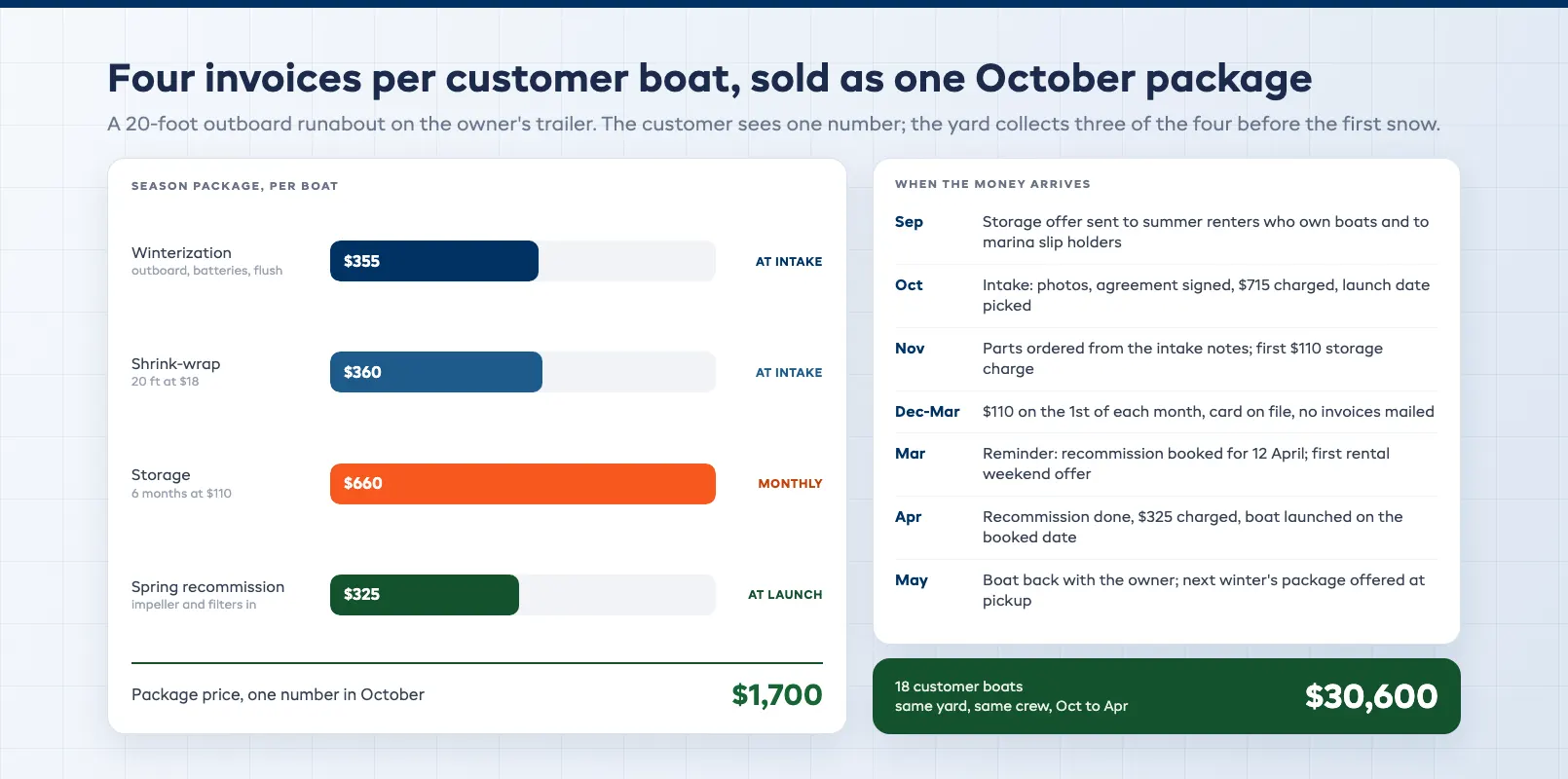
Eighteen customer boats on a package like that is close to $30,000 of off-season revenue for a yard and a crew that used to go quiet in October. Not all of it is margin; the shrink-wrap film, the antifreeze and the parts are real costs. But the labor is the crew you keep, the space is the space you already lease, and the customers are people who already know your dock.
Two operational notes on the package. First, put the launch date in the same booking calendar the rental fleet uses, blocked as a service slot, so the ramp and the crew are not double-committed on the first warm Saturday in April. Second, when a customer's recommission turns up a problem that was not on the intake list, a cracked block from a poor winterization somewhere else or a fuel system full of varnish, quote it before doing it. The package price is the package; the surprise is a separate approval.
Running the Off-Season in the Same System
None of this needs a second software product. The rental fleet's booking calendar holds the haul-out week and the spring launch slots. The customer record that holds a renter's waiver and card on file holds a storage customer's agreement and monthly charge. The per-boat maintenance log that tracked engine hours all summer holds the winterization work order and the spring list for the boat in space 14.
That matters in October because it is the month with the least spare attention. The crew is shrinking, the owner is doing the year-end books, and a storage operation run on a clipboard and a wall calendar is the one where the March phone calls start with "did we ever winterize the Hendersons' boat?" A system that sends the monthly storage charge, holds the launch date, and reminds the customer in March that their recommission is booked for 12 April does the follow-up nobody has time for.
The seasonal templates in this cluster cover the two ends of the job: the end-of-season boat winterization checklist for the haul-out week and the pre-season launch checklist for the spring work order. For the customer side, the pre-season boat customer reactivation agent reaches the storage list in March with their launch date and an offer on the first rental weekend, and the boat maintenance due alert agent flags any boat whose recommission tasks are still open a week before its launch slot.
For the rest of the boat rental operating model, the boats hub and the boat rental glossary cover the terms, and EquipDash plans for boat rental operators start at $23/month on annual billing; see pricing for current tiers.
FAQ
How much should a boat rental operator charge for winterization?
Price by engine type, not boat length. A single outboard winterization (drain, fog, fuel stabilize, lower-unit oil) runs $200 to $275; a sterndrive or inboard $350 to $450 because of the antifreeze flush and the manifold risk. Add-ons are batteries pulled and stored ($45), fresh-water and head systems ($85 to $110), shrink-wrap ($16 to $24 per foot), and trailer service ($95). Materials are $40 to $70 per boat, so the margin on a $375 sterndrive job with two hours of labor is roughly $238.
Is boat storage profitable for a rental business?
Usually, because the space is already a cost. If the yard holds 30 boats and the rental fleet uses 12, the other 18 spaces are inventory. At an average $110 per month for six months, 18 customer boats bring in about $11,880 a season, arriving in October and November when nothing else does. Bill the season up front or charge a card on file monthly, number the spaces, and put a lien clause and access rules in the storage agreement.
Should I store customer boats alongside my rental fleet?
Yes, if you have the space and you run intake properly. Photograph the hull, transom, prop, helm and any existing damage at drop-off, record the hull number, trailer plate and the owner's insurance policy, log fuel level and battery state, and sign the storage agreement with payment before the boat leaves the trailer. Require the owner to carry hull insurance; your yard policy covers your negligence, not their uninsured boat. Map the spaces so any boat can be found in two minutes.
When should I sell the spring recommission?
At intake in October, while the owner is standing next to the boat. Offer one season package: winterization and shrink-wrap charged at intake, storage charged monthly on a card on file, and the recommission charged on a launch date the customer picks now. A 20-foot outboard runabout comes to about $1,700 for the season. Selling it in October fills the April launch calendar and lets you order parts in November from the intake notes.
How is this different from the pre-season launch guide?
This guide covers the fall half of the seasonal pair: the haul-out week, winterization as a paid service, storage as a monthly revenue line, customer boat intake, and selling the spring work up front. The pre-season boat launch guide covers the spring half for your own fleet: the six-week recommissioning timeline, engine work, the safety gear audit, insurance renewal and the soft launch. Read them together; the intake notes from this one become the work order for that one.
What should a boat storage agreement include?
Storage term and space number, the monthly rate or season total and how it is charged, access days and hours, whether the owner may work on the boat in your yard, who is responsible for the cover, the owner's insurance requirement, a lien clause for unpaid accounts, and the agreed spring launch date. Attach the winterization work order and the intake photos. Without a lien clause, an abandoned boat is one you cannot move or sell.
in one place