Quoting Event Hire: Speed, Deposits and Holding the Date
Quoting Event Hire: Speed, Deposits and Holding the Date
An event inquiry is never sent to one supplier. The bride's mother, the corporate events coordinator, the school fundraiser committee: they open the first page of search results, send the same message to three or four companies, and wait. Then they take the first quote that looks competent. Not the cheapest. The first one that arrives with real numbers, real availability for the date, and a way to lock it in.
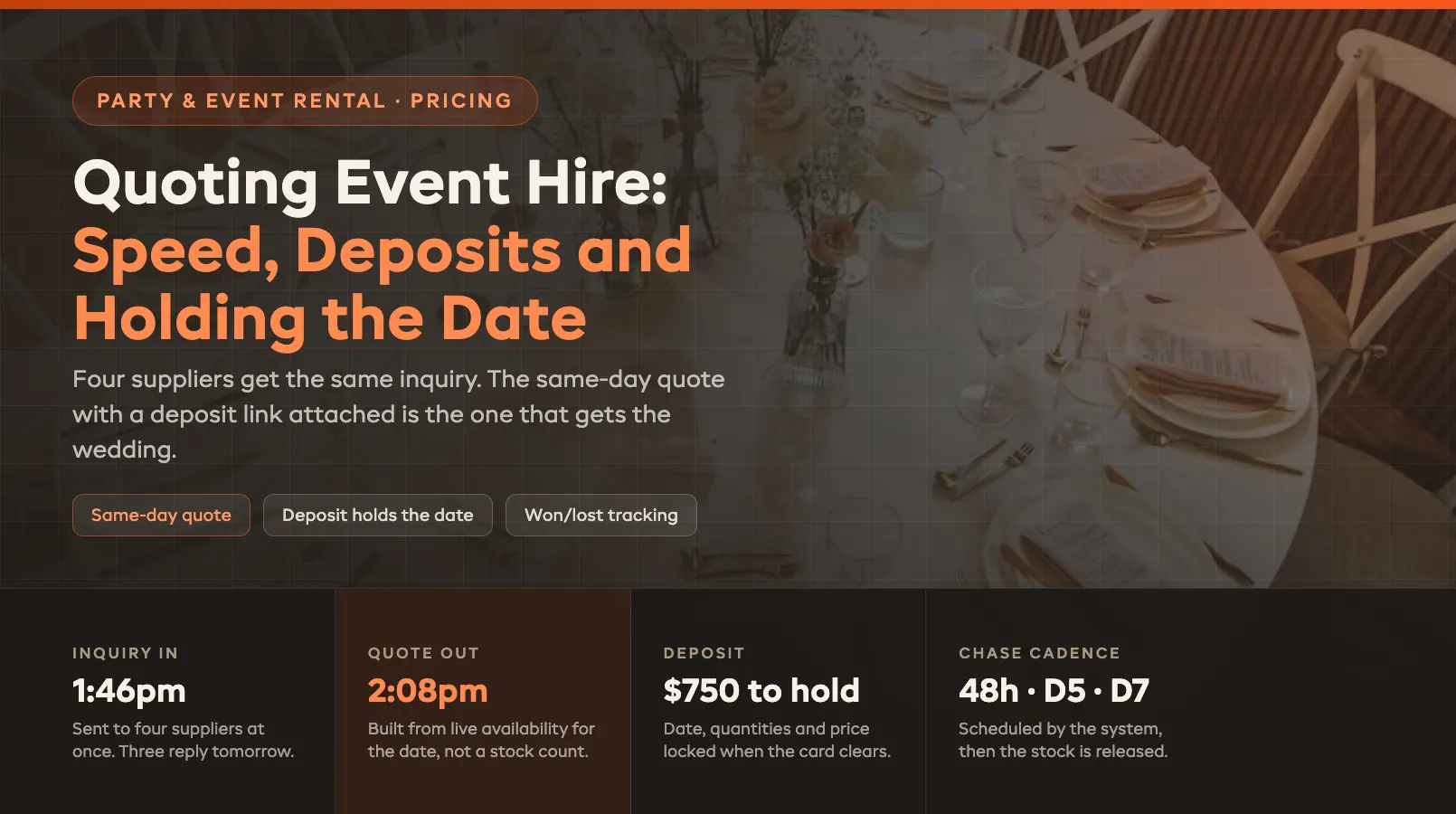
That is the whole competitive picture in event and party rental, and it makes quoting a speed problem before it is a pricing problem. A quote that goes out at 2:08pm for an inquiry that arrived at 1:46pm wins against a better-priced quote that goes out tomorrow morning, because by tomorrow morning the client has already paid a deposit to somebody. This guide is the quoting layer of our event rental software guide: how to quote from live availability, what a deposit should actually hold, converting the quote into a booking without anyone re-keying a line, chasing the quotes that go quiet, sub-hiring when a date sells out, and tracking won and lost quotes so next season's rate card is built on evidence.
Quoting From Live Availability
The quote can only be fast if the availability check is instant. An operator who has to walk the warehouse, open three spreadsheets, and call back tomorrow has already lost to the one who built the quote while the client was still on the phone. So the first requirement is not a quoting feature at all. It is that every line on the quote is checked against the event date, inside the quote screen, as the line is added.
That check has to answer the event rental question, not the inventory question. Owning 400 banquet chairs says nothing about 23 August. What matters is 400 minus everything committed to that Saturday, minus what is still out from the Friday before, minus what came back Sunday but is still in the cleaning block. If the client wants 240 chairs and 216 are free on the date, the quote should say 216 before it leaves the building, so the operator can offer 216 plus a sub-hire line rather than promising 240 and finding out on Thursday.
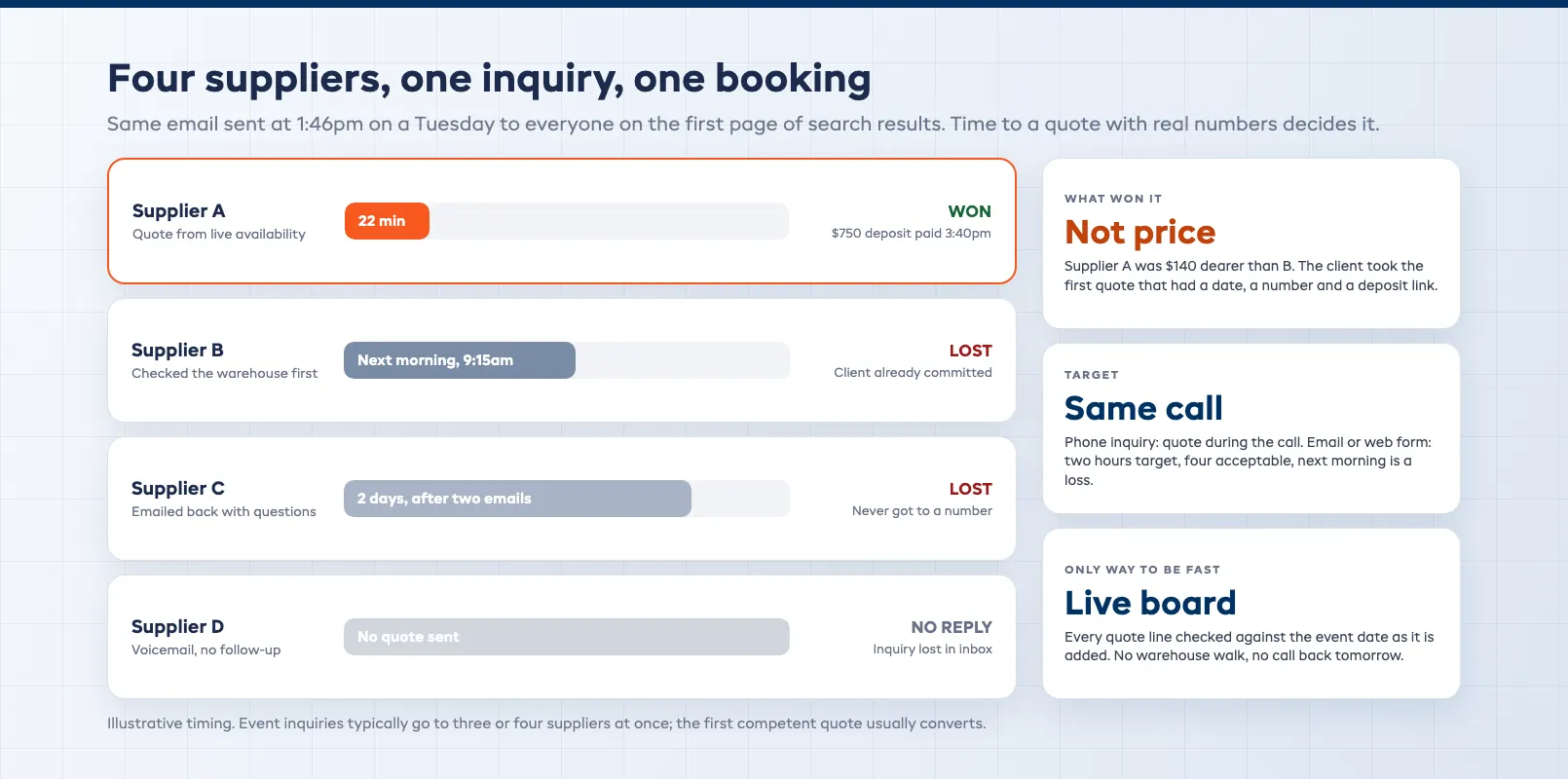
The speed target is the same day, and for a phone inquiry it is the same call. What that looks like in practice:
- Phone inquiry. Build the quote on the call. Guest count, date, venue, delivery window, then lines. The client hears "240 chairs, 24 rounds, ivory linens, that is $2,504 with delivery, and I can send that now with a $750 deposit link to hold the date." The quote is in their inbox before they hang up.
- Email or web form inquiry. Two hours is the target, four hours is acceptable, next morning is a loss. The form should ask for date, guest count, and venue up front so the first reply is a quote, not a question.
- Weekend inquiries. Saturday afternoon inquiries are usually people at someone else's event who liked the set-up. Reply Saturday evening, even briefly, with availability for their date. The full quote can follow Monday if the date is held.
One rule that keeps the quote honest: never quote from a number that is not on the board. If the system shows 216, quote 216. The operator who quotes 240 from memory because "some come back Wednesday" is the operator who sub-hires at the competitor's price on Friday.
What a Deposit Should Hold
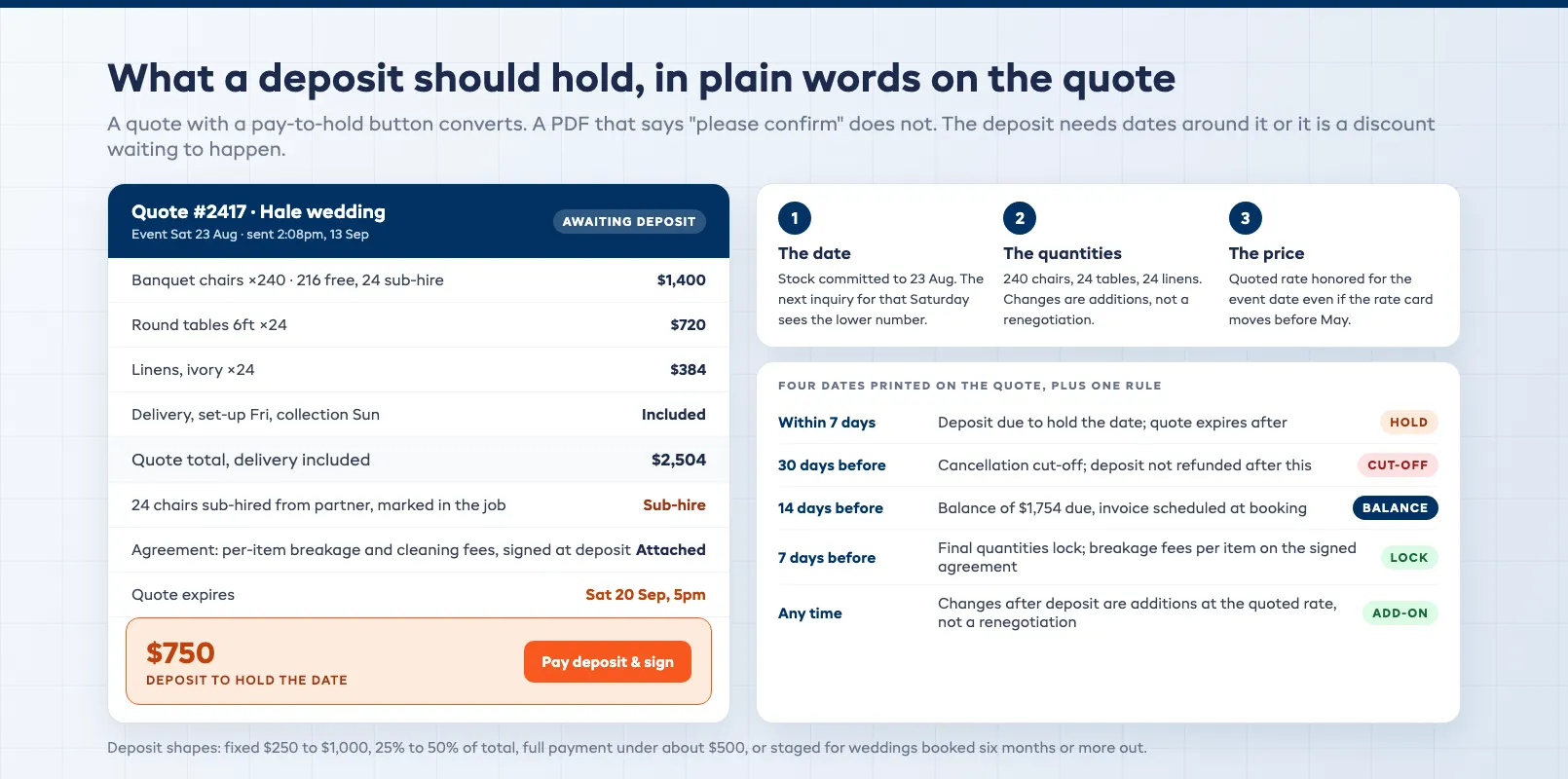
A quote with a "pay $750 to hold the date" button converts. A PDF that says "please confirm at your earliest convenience" does not. The deposit is the moment an inquiry becomes a commitment, and it needs to be defined precisely enough that both sides know what has been bought.
A deposit should hold three things, and the quote should say so in plain words:
- The date. The stock on the quote is committed to that date. The next inquiry for 23 August sees the lower number. If the client cancels inside the notice period, the deposit covers the dates you turned other people away from.
- The stock, at the quoted quantities. Not "around 240 chairs." Two hundred and forty chairs, 24 round tables, 24 ivory linens. Changes are welcome and usually add revenue, but the deposit secures what was quoted.
- The price. The quote is honored for the event date at the quoted rate, even if the rate card changes before then. A client who put money down in September should not be re-quoted in May.
How much to take is a business decision, but the common shapes are:
| Deposit type | Typical amount | Works best for |
|---|---|---|
| Fixed amount | $250 to $1,000 depending on order size | Smaller parties, fast decisions, phone bookings |
| Percentage | 25% to 50% of the quote total | Weddings and corporate events with larger totals |
| Full payment | 100% at booking | Orders under about $500, short-notice bookings |
| Staged | 25% to hold, 50% at 60 days, balance at 14 days | Weddings booked more than six months out |
Whatever the shape, put four dates on the quote: when the deposit is due to hold the date (usually 48 hours to seven days), when the balance is due (usually 14 days before the event), when the final quantities lock (usually seven days before), and the cancellation cut-off after which the deposit is not refunded. A deposit with no dates around it is a discount waiting to happen.
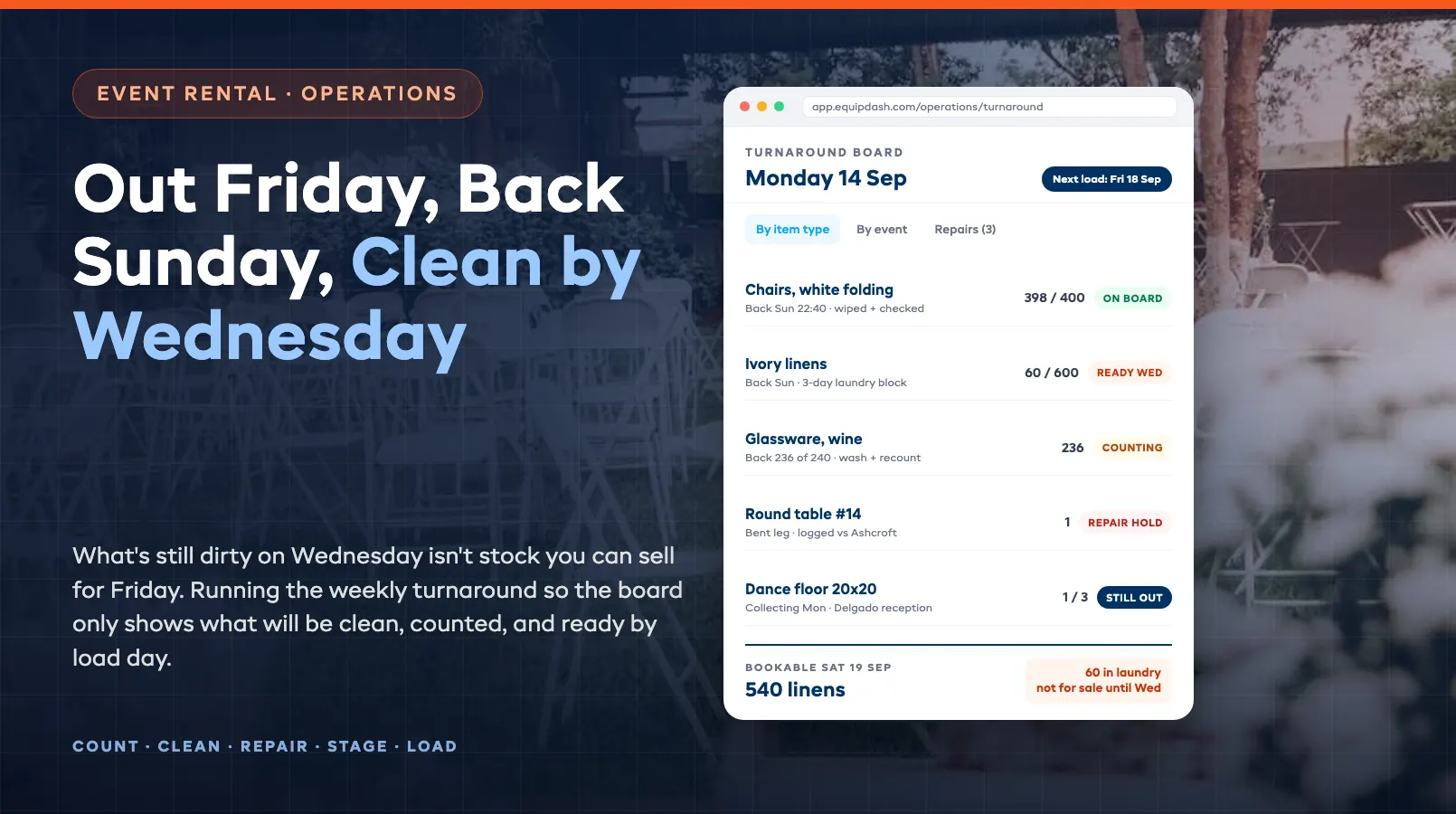
The deposit is also what the breakage and loss charges are deducted from after the event, which is why the rental agreement the client signs at acceptance should carry the per-item replacement and cleaning fees. The count-back on Monday raises those charges against the deposit, as covered in Out Friday, Back Sunday, Clean by Wednesday. Take the deposit and the signature in the same step, or the charges will be argued.
Converting Quote to Booking
The accepted quote should become the booking without anyone re-keying a line. This sounds obvious and is where most quoting workflows leak. The quote lives in a PDF or an email; the booking lives in a calendar or a spreadsheet; a person copies one into the other, and 240 becomes 204, or the ivory linens become white, or the delivery time is lost between the two.
The conversion has to do four things at once, in the moment the deposit clears:
- Commit the stock to the date. Every line moves from "quoted" to "booked" on the availability board, and every other open quote for that date now sees the lower number.
- Create the job. Delivery window, venue address, set-up and collection times, the pull list for the warehouse, and the crew slots, all from the quote lines.
- Record the money. Deposit received, balance due date, and the terms the client accepted. The invoice for the balance is scheduled, not remembered.
- Send the confirmation. One message to the client with what is booked, what has been paid, what is due when, and the agreement they signed attached.
Quoted stock and booked stock are different states, and the board should treat them differently. A quote does not commit stock; it would be impossible to run a business where every unaccepted quote blocked the calendar. But when two open quotes for the same Saturday between them exceed what is free, the operator needs to know before both are accepted. A quote screen that shows "216 free, 180 on other open quotes for this date" tells the operator to chase the older quote or line up sub-hire now.
Signed acceptance matters as much as the deposit. Between the deposit clearing and the event, the client will change the order two or three times. The agreement is what says the changes are additions to a committed order, not a renegotiation of it. On EquipDash's party rental software page the flow is the one described here: a quote built from live stock, sent the same day, committed with a signature and a deposit, and converted to the booking that holds the stock.
Chasing Unaccepted Quotes
Most quotes that are not accepted inside 48 hours are not lost. They are sitting in an inbox while the client compares, or waiting for a partner, a parent, or a finance manager to approve. The operator who follows up recovers a meaningful share of them; the one who waits to be called back does not.
The follow-up has to be scheduled by the system, not remembered by a person. A quoting workflow that depends on the owner remembering on Thursday to chase Tuesday's quotes is a workflow that chases nothing in peak season. A cadence that works:
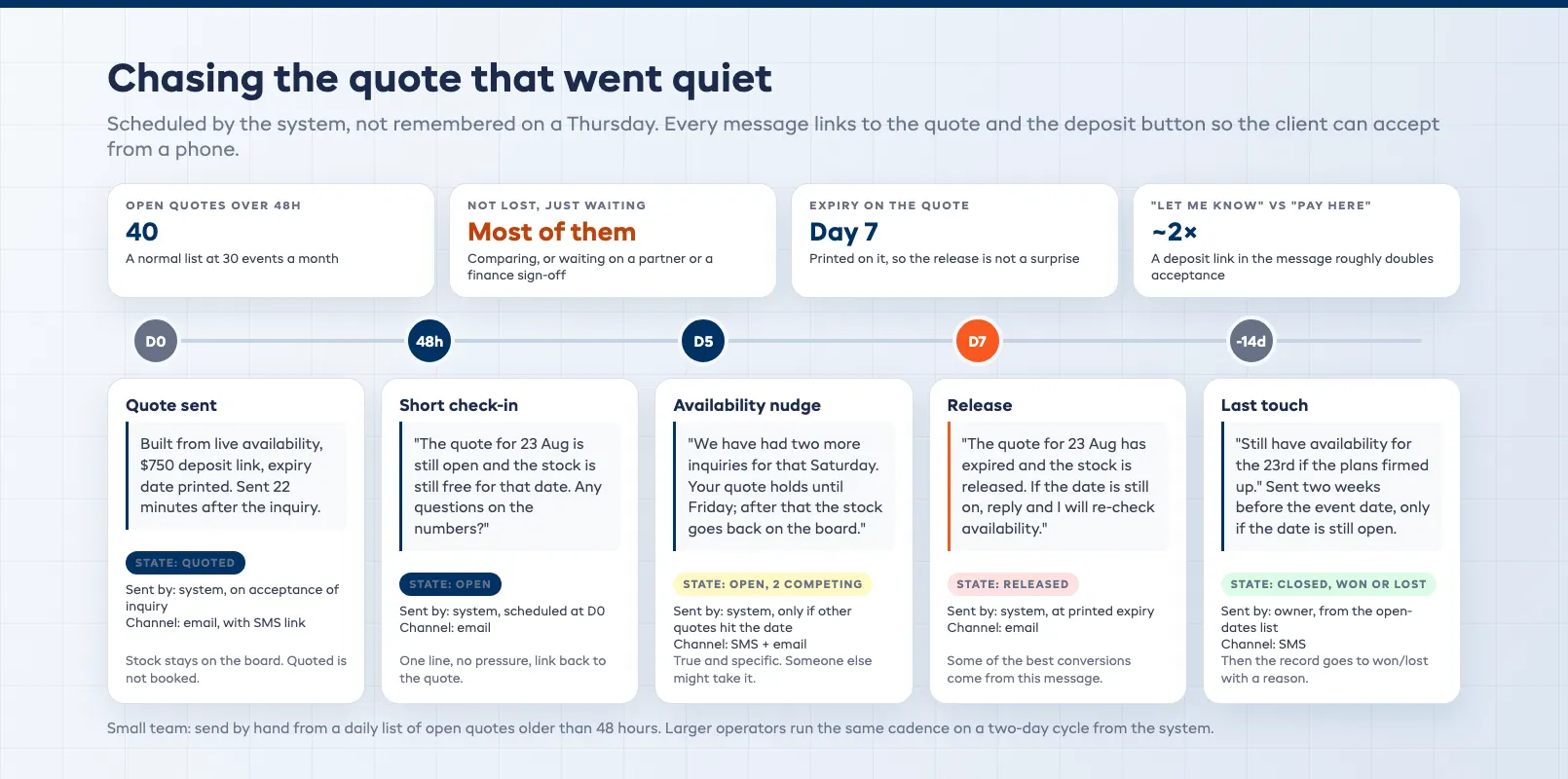
- 48 hours: a short check-in. "The quote for 23 August is still open and the stock is still free for that date. Any questions on the numbers?" One line, no pressure, a link back to the quote and the deposit button.
- Day five: the availability nudge. "We have had two more inquiries for that Saturday. Your quote holds until Friday; after that the stock goes back on the board." True, specific, and the reason the client has been avoiding: someone else might take it.
- Day seven: the release. "The quote for 23 August has expired and the stock is released. If the date is still on, reply and I will re-check availability." Some of the best conversions come from the release message, because the date suddenly feels scarce.
- After release: one more touch two weeks out from the event date, if the date is still open. "Still have availability for the 23rd if the plans firmed up."
Two things that make the cadence work. First, the quote has an expiry date printed on it, so the release message is not a surprise. Second, every message links to the quote and the deposit button, so the client can accept from their phone in the time it takes to read the message. A follow-up that says "let me know" has half the conversion of one that says "pay the deposit here."
Where the messages come from matters less than that they go. An operator with a small team can send them by hand from a daily list of open quotes older than 48 hours. At 30 events a month that list is 40 quotes long, and a Dash Agent that chases sent-but-unaccepted quotes on a two-day cycle does the job without a person watching the list.
Sub-Hire When a Date Sells Out
Every operator has a Saturday that sells out a line. The second Saturday in June needs 720 linens and you own 600. A corporate client wants 300 chairs and 260 are free. The question is not whether to sub-hire, but when the decision gets made, and the answer has to be at quote time, not at 6am on the day.
Sub-hire at quote time is a margin decision. You know the shortfall (120 linens), you know what a sub-hire partner charges (say $2.20 each, $264), and you know what the client is paying ($16 each, $1,920 for the line). The line still makes money. Quote it, mark the 120 as sub-hired in the job so the warehouse does not go looking for them, and place the order with the partner the same day the deposit clears.
Sub-hire on the day is a cost decision made under pressure. The competitor across town knows you are stuck, and the price is whatever they name. Worse, if the partner has nothing, the client gets 600 linens for a 720-guest wedding, and the review says so.
Three things keep sub-hire in the first category:
- The quote screen flags the shortfall. "240 requested, 216 free on the date" appears when the line is added, not after the quote is accepted. The operator decides on the spot: quote 216, or quote 240 with a sub-hire note against the line.
- A warning fires when a date gets close to selling out a line, across all committed bookings, so the operator can arrange sub-hire for the dates that are filling before the last quote is accepted.
- Two sub-hire partners, with rate cards on file. Not one. The weekend you need 120 linens is the weekend your one partner also needs 120 linens.
There is a longer-term version of the same decision. If you sub-hire 120 linens on two Saturdays a year, that is $528 a year, and buying 120 linens costs $1,700 to $2,600 plus the storage and the laundry turns. Sub-hire wins. If you are sub-hiring linens twelve weekends a year, the calculation flips, and the won/lost record below is what tells you which of those two operators you are.
Won/Lost Tracking
Every quote ends one of two ways, and both are data. A quote that converted tells you which packages, which dates, which lead times, and which price points the market accepts. A quote that did not tells you what it rejected. Most operators record the first and throw away the second, and then set next season's rate card by feel.
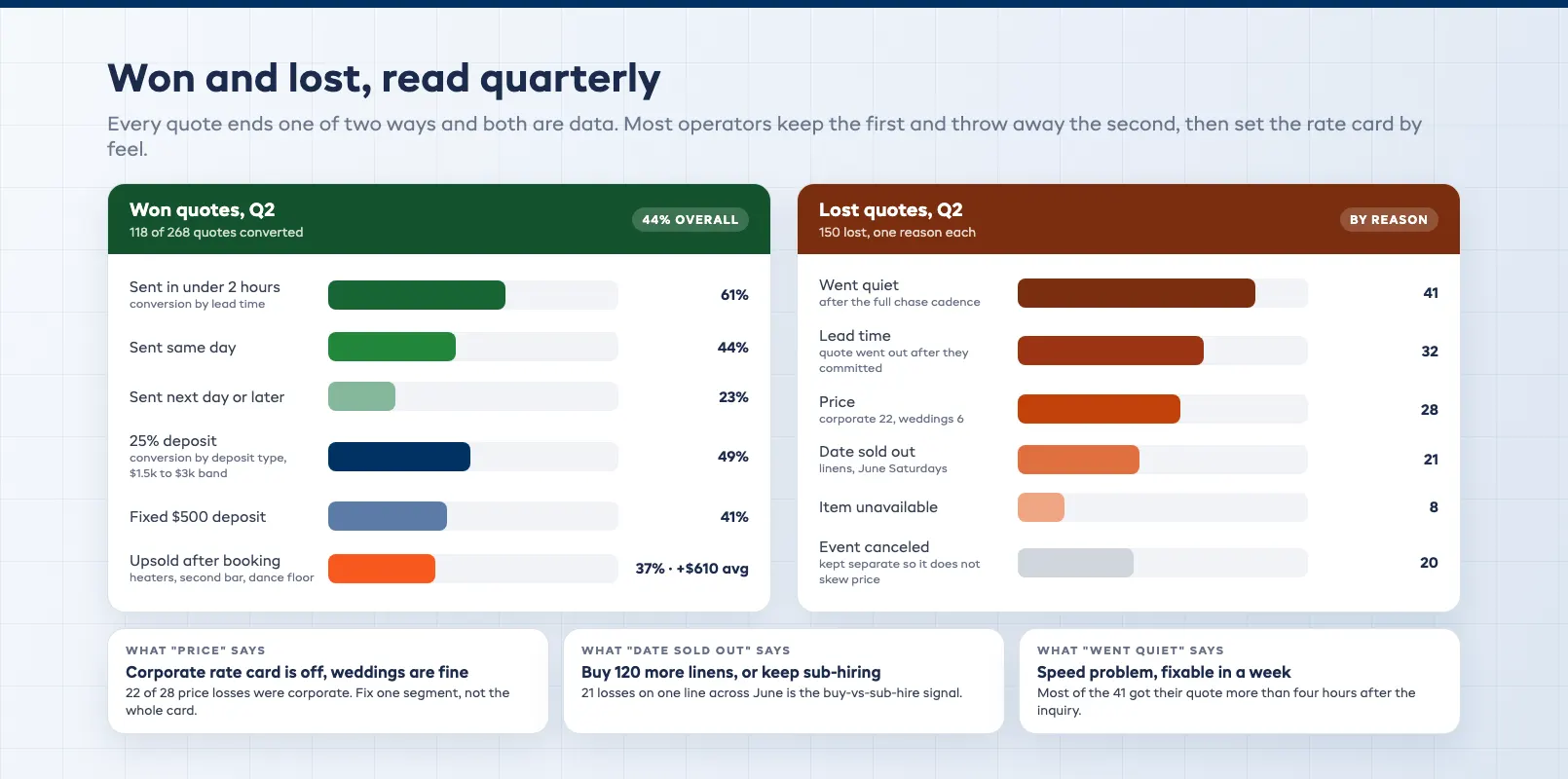
The record does not need to be elaborate. For every quote: event date, quote date (which gives lead time), total, deposit type, item categories, and the outcome. For lost quotes, one reason from a short list:
- Price. The client said so, or booked a cheaper competitor.
- Date sold out. You could not fill the order for the date, or the client took the first supplier who could.
- Lead time. The quote went out too late; they had already committed.
- Went quiet. No reply after the full chase cadence.
- Item unavailable. A specific item the client wanted that you do not carry.
- Event canceled. Not a loss against you, and worth separating out so it does not skew the price figures.
Read quarterly, the reasons tell you different things. A run of "price" losses in the corporate segment and none in weddings says the corporate rate card is off, not the whole rate card. A run of "date sold out" for a specific line across June is the buy-versus-sub-hire signal from the section above. A run of "went quiet" where the quote went out more than four hours after the inquiry is the speed problem this guide opened with, and it is fixable inside a week.
Won quotes carry information too. Conversion rate by lead time (quotes sent in under two hours versus next day) is the number that justifies putting a phone in the warehouse. Conversion rate by deposit type tells you whether a 25% deposit converts better than a fixed $500 for orders in the $1,500 to $3,000 band. Average order value for won quotes that were later upsold (heaters, a second bar, a dance floor) tells you which packages to build the upgrade path into.
Plans for event rental businesses start at $23/month on annual billing, with quotes, deposits, and follow-up on every tier; see pricing for the current tiers. For the rest of the operating model, from date-based availability to packages and crew scheduling, go back to the event rental software guide.
FAQ
How fast should an event rental quote go out?
Same day, and for a phone inquiry, during the call. Event inquiries go to three or four suppliers at once and the first competent quote usually wins, so the quote has to be built against live availability for the event date, carry a deposit link that holds the date, and convert to a booking the moment the deposit clears. For email and web form inquiries, two hours is the target and next morning is usually a loss.
How much deposit should a party rental company take?
Common shapes are a fixed amount ($250 to $1,000 depending on order size), a percentage (25% to 50% of the quote total, typical for weddings and corporate events), full payment for orders under about $500, or staged payments for weddings booked more than six months out. Whichever you use, print four dates on the quote: when the deposit is due to hold the date, when the balance is due, when final quantities lock, and the cancellation cut-off after which the deposit is not refunded.
What does a deposit hold in event hire?
Three things, and the quote should state them: the date, so the stock is committed to it and the next inquiry sees the lower number; the stock at the quoted quantities, so changes are additions rather than a renegotiation; and the price, so a client who paid in September is not re-quoted in May. The deposit is also what breakage and loss charges are deducted from after the event, so take the signed agreement carrying those fees in the same step.
Should an unaccepted quote block stock on the calendar?
No. Blocking stock for every open quote would make the business impossible to run. Quoted and booked are different states. What the operator needs is visibility: when two open quotes for the same Saturday between them exceed what is free, the quote screen should say so, so the older quote gets chased or sub-hire gets arranged before both are accepted. Stock is committed when the deposit clears and the agreement is signed.
How do you follow up on a quote that has not been accepted?
On a scheduled cadence, not from memory: a short check-in at 48 hours, an availability nudge at day five noting that other inquiries have come in for the date, a release message at day seven when the quote expires and the stock goes back on the board, and one more touch two weeks before the event date if it is still open. Every message links to the quote and the deposit button so the client can accept from their phone. Print the expiry date on the quote so the release is not a surprise.
When should an event rental company sub-hire instead of buying more stock?
Decide at quote time, not on the day. If a line sells out two or three Saturdays a year, sub-hiring the shortfall is far cheaper than owning stock that sits idle 45 weekends. If the won/lost record shows "date sold out" losses for that line across a whole season, or you are sub-hiring it twelve weekends a year, the calculation flips and buying wins. Keep two sub-hire partners with rate cards on file, and mark sub-hired quantities in the job so the warehouse does not go looking for them.
in one place