Gear Lifecycle for Adventure Operators: Retirement, Replacement, Budgeting
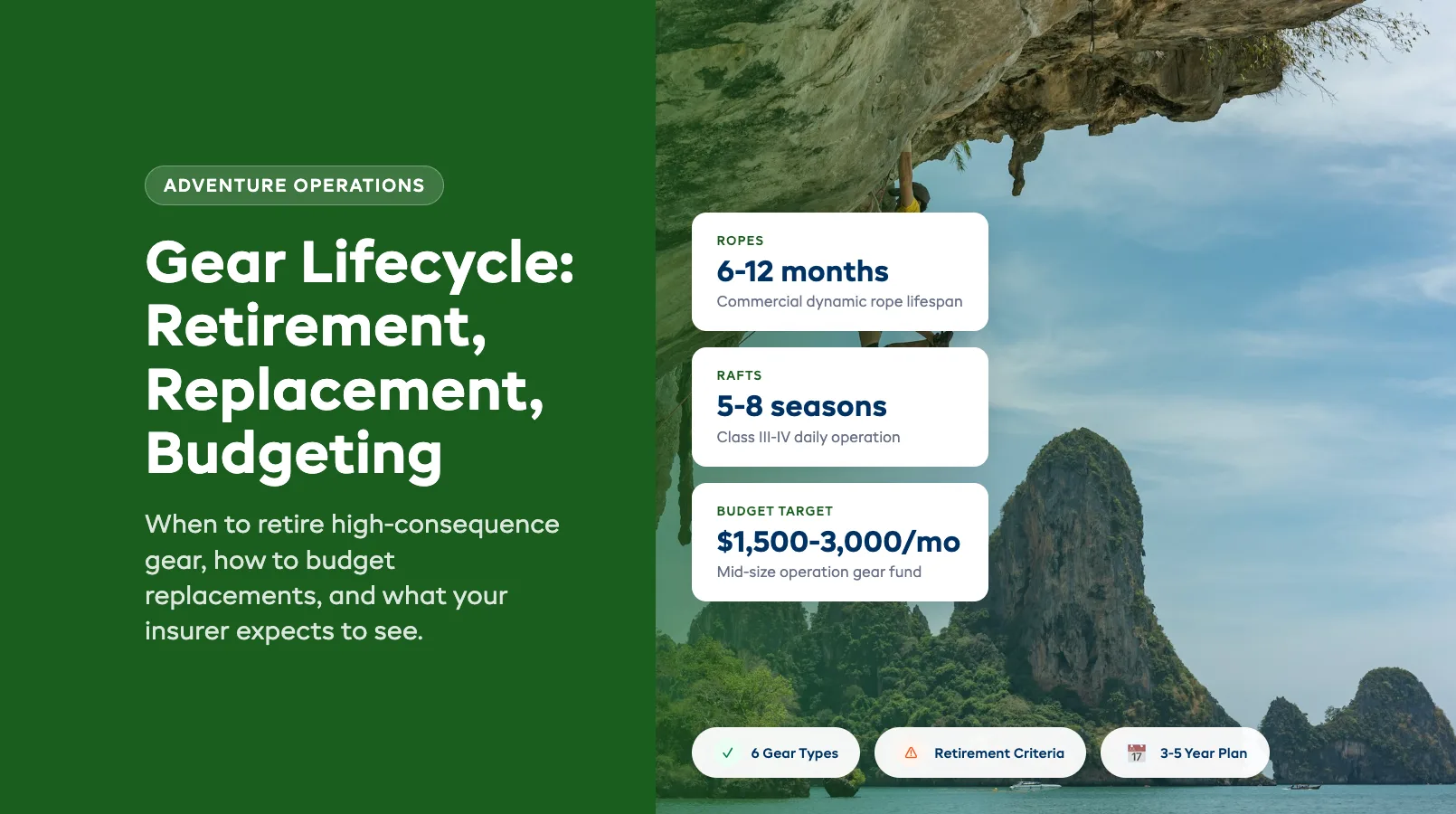
A climbing rope doesn't tell you when it's done. Neither does a raft floor, a harness, or a helmet that took a hit three seasons ago. But every piece of adventure gear has a finite life: measured in calendar years, use cycles, UV exposure, and incident history. Miss the retirement window and you're running clients on equipment that your insurer won't cover and your manufacturer won't stand behind.
Most adventure operators buy gear reactively. Something fails an inspection, looks visibly worn, or a guide flags it mid-trip. By then you're scrambling for replacements at peak-season prices, pulling trips offline, and hoping nothing happens between now and when the new gear arrives.
This guide covers how to manage gear lifecycles proactively, from lifespan benchmarks to retirement criteria to budget planning that keeps your fleet current without surprise capital outlays. For the full business playbook, see How to Run an Adventure Activity Business. For guide credential requirements that tie directly into your gear inspection authority, see Guide Certifications: What Your Insurance Actually Requires. For multi-day trip logistics where gear reliability is critical, see Multi-Day Adventure Operations. For checklists and templates, visit the adventure activity hub and activities glossary.
Lifespans by Gear Type: What the Manufacturers Say vs What Actually Happens
Manufacturer lifespan ratings are a starting point, not a retirement date. They assume controlled storage, moderate use, and no incidents. Commercial adventure operations don't work that way. Your gear lives in trailers, gets UV-blasted on raft frames, and sees 3-5x the use cycles of recreational equipment.
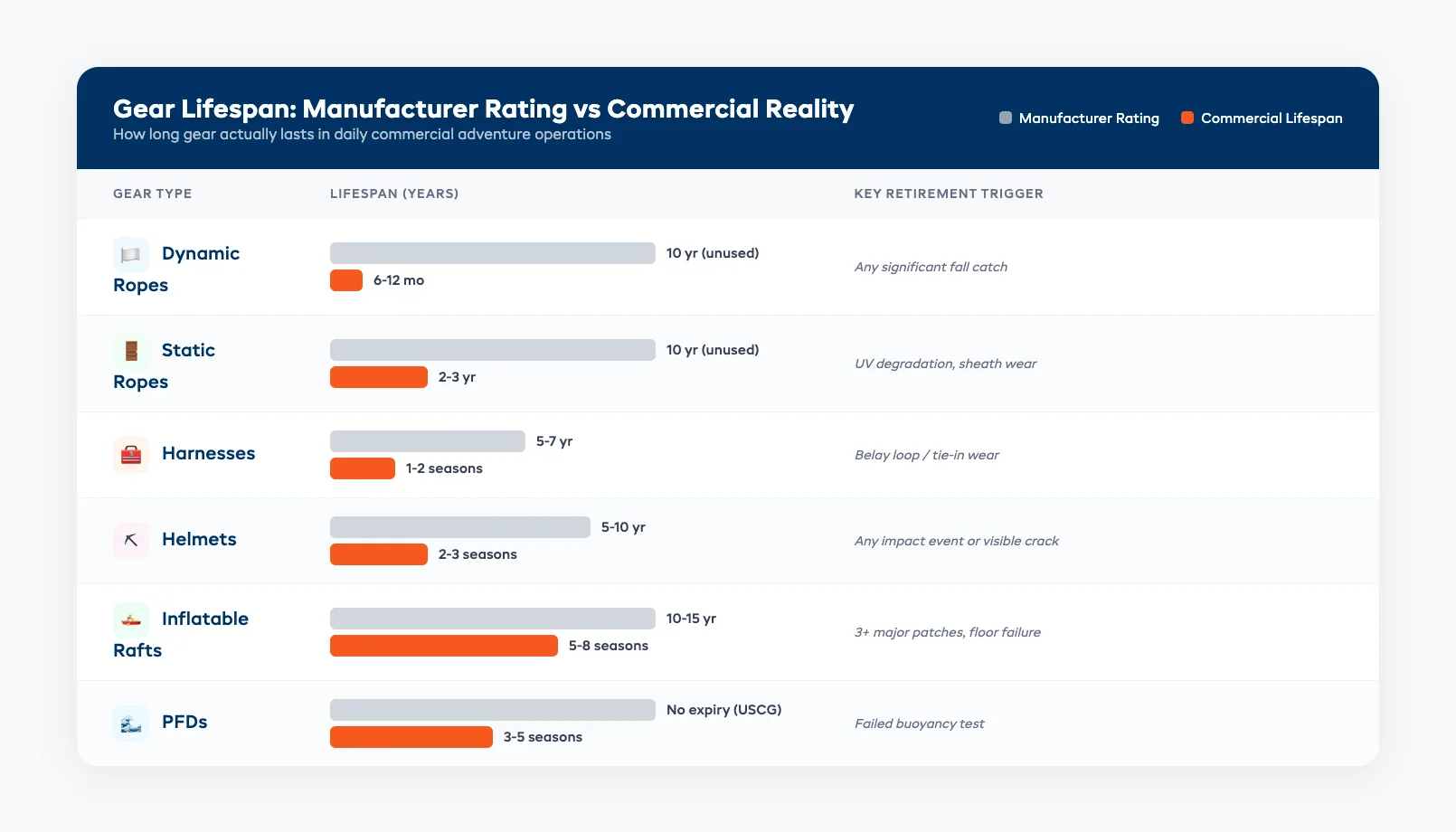
Dynamic ropes. Manufacturer max: 10 years (unused). Commercial reality: 6-12 months with daily use. Retire after any significant fall, regardless of visible condition.
Static ropes. Longer life since they don't absorb falls. Expect 2-3 years in commercial use. UV exposure is the primary degrader — ropes left rigged on canyon walls age faster than stored ropes.
Harnesses. Manufacturer max: 5-7 years. Commercial: 1-2 seasons with daily use. Belay loops and tie-in points show wear first. Retire immediately after any significant fall.
Helmets. Manufacturer max: 5-10 years. Commercial: 2-3 seasons. Any crack, dent, or known impact = immediate retirement. No exceptions.
Inflatable rafts. Commercial use on Class III-IV: 5-8 seasons with maintenance. Once a raft has 3-4+ significant patches, replacement is usually cheaper than continued repair.
PFDs. No formal expiration, but commercial use degrades foam buoyancy. Rotate every 3-5 seasons. Annual buoyancy testing, not calendar age, is the real retirement trigger.
Retirement Criteria: When "It Still Looks Fine" Isn't Good Enough
Visual inspection catches maybe 60% of gear that should be retired. The other 40% requires documented criteria that remove judgment calls from the equation.
Hard retirement triggers — retire immediately:
- Fall-rated gear involved in a significant fall or impact
- Structural damage: core shots, cracked shells, torn webbing
- Chemical contamination (acid, solvents, fuel, bleach)
- Heat exposure above 150F/65C for extended periods
- Manufacturer recall
Soft retirement triggers — inspect closely, retire if any doubt:
- Approaching manufacturer's calendar age limit
- UV degradation: faded colors, stiff webbing, chalky rubber
- Use-cycle threshold exceeded
- Failed inspection more than once in the same season
The gray zone rule. If two qualified inspectors disagree, retire it. A $200 harness is always cheaper than one incident on gear that "probably" had more life.
For daily gear checks that feed into these retirement decisions, use the Daily Adventure Gear Inspection checklist.
Inspection Cadence: How Often and Who Does It
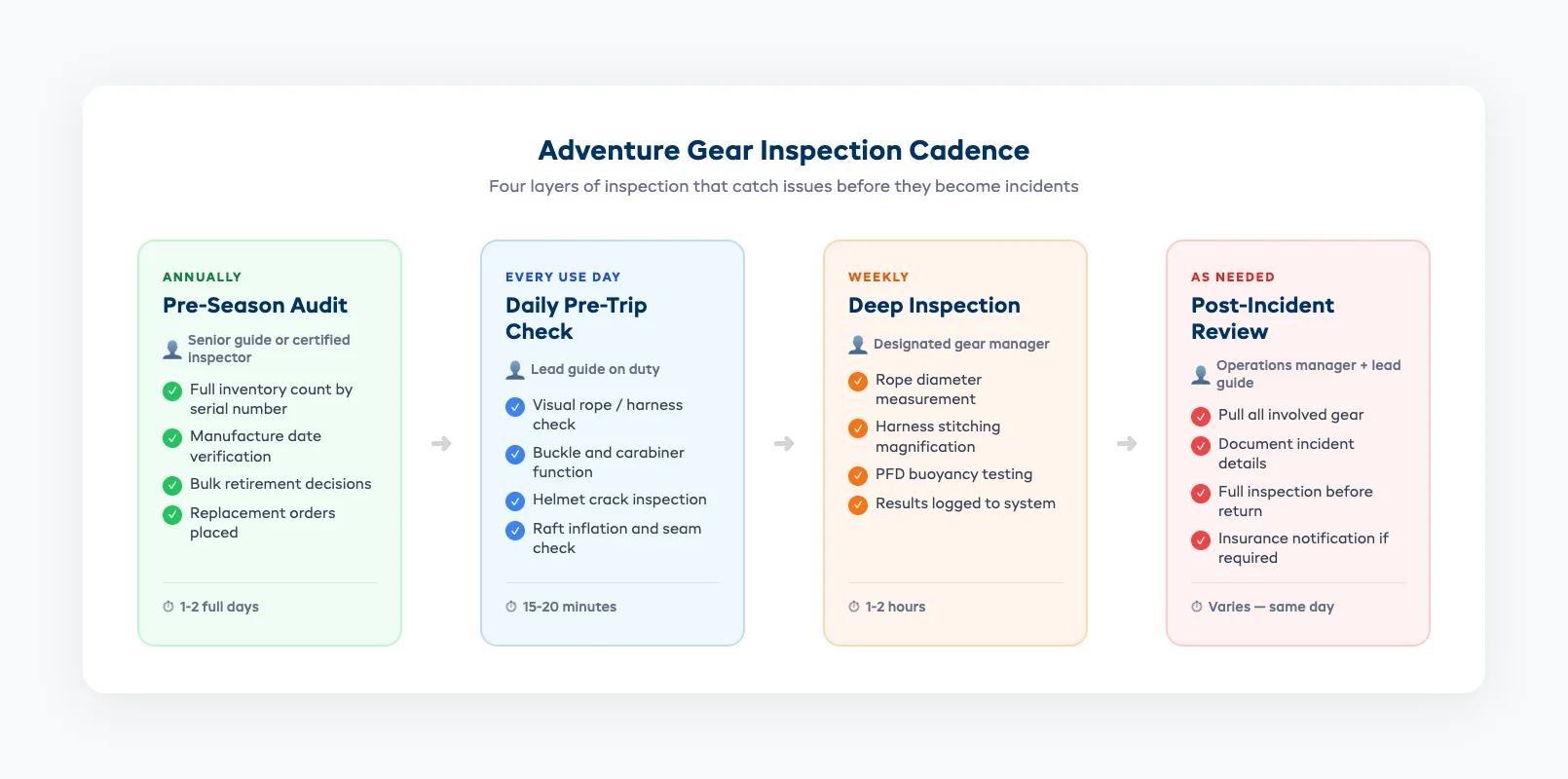
Inspection isn't a single event. It's a layered system with different checks at different frequencies, performed by different people.
Pre-season audit (annually). Every piece of safety-critical gear gets a full inspection before the first trip. This is when you make bulk retirement and replacement decisions. Use the Pre-Season Adventure Operations Audit to structure the process.
Daily pre-trip check. Lead guide inspects all gear being deployed that day: buckles, visible rope damage, helmet cracks, raft inflation. Takes 15-20 minutes. Failed gear gets tagged and pulled immediately.
Weekly deep inspection. One team member does a thorough weekly review: rope diameter checks for core damage, harness stitching under magnification, PFD buoyancy tests, raft seam inspections. Results logged in your gear system.
Post-incident. Any gear involved in an incident gets pulled and inspected before returning to service. Document what happened, what was involved, and the return-to-service decision.
Who inspects? Your insurance policy likely specifies. Most require certified staff for safety-critical gear inspections. See Guide Certifications: What Your Insurance Actually Requires for credential details.
Budgeting for Gear Replacement: The 3-5 Year Capital Plan
Gear replacement isn't an annual expense. It's a rolling capital obligation. Operators who budget for it annually get caught by clumpy replacement cycles: everything you bought in year one expires in year three, and suddenly you need $30,000 in new gear during your busiest revenue month.
Step 1: Build your inventory with purchase dates. Every safety-critical item needs: type, manufacturer, model, serial number, date of manufacture, first use date, and expected retirement date.
Step 2: Map replacement costs to retirement dates. Lay it on a timeline. You'll immediately see the clumps: years where $5,000 needs replacing, and years where $25,000 does.
Step 3: Smooth the spend. Stagger purchases so costs distribute evenly. Buy half your rope inventory this year, half next year. Replace rafts on rotation — two per year instead of all six at once.
Step 4: Set aside monthly. Divide your 5-year total by 60 months. A mid-size adventure operation should budget $1,500-$3,000 per month for gear replacement, covering the $18,000-$36,000 annual cycle without any single month being painful. This gear budget fits into the broader seasonal financial plan. See Seasonal Adventure Business Management for cash flow reserves, off-season timing, and the full financial playbook.
Procurement Timing: When to Buy for Maximum Value
Gear pricing follows predictable seasonal patterns. Buy at the right time and you'll save 15-30% on the same equipment.
Off-season orders (October-February for summer ops). NRS, AIRE, Petzl, and Black Diamond all offer 10-20% pre-season discounts for orders placed 3-6 months before peak. You also get first pick of inventory before popular sizes sell out.
End-of-model-year clearance. Previous-year models get discounted 20-40% when new versions release. A 2025 raft performs identically to a 2026 model — cosmetic updates don't affect commercial performance.
Bulk purchasing. Buying 10+ ropes or 20+ harnesses? Call your distributor directly. Bulk pricing is 10-25% below retail, often with net-30 or net-60 terms for established commercial accounts.
Lead times. Custom raft orders: 8-12 weeks. Specialty ropes: 4-6 weeks. Standard gear: 3-5 days. Build lead times into your procurement calendar so you're not paying overnight shipping premiums in June because you didn't order in February.
Documentation for Insurance: What Your Underwriter Wants to See
Your insurance underwriter doesn't just want to know that you inspect gear. They want to see the paper trail that proves it. In the event of a claim, your gear documentation is the difference between coverage and denial.
What to document for every piece of safety-critical gear:
- Item description, manufacturer, model, serial number
- Date of manufacture (from manufacturer tag, not your purchase date)
- Date of first commercial use
- Inspection history: date, inspector name, pass/fail, notes
- Incident history: any falls, impacts, or near-misses involving this item
- Retirement date, reason, and disposal method
Retirement entries that work. "Retired — exceeded 3-year commercial use threshold, no incidents, cut and disposed" is what your insurer wants. "Threw it away because it looked old" is not.
Annual summary for your broker. At renewal, provide: total inventory count by category, items retired and replaced during the policy period, incident reports involving gear, and inspection cadence documentation. Operators who share this proactively negotiate better renewal terms.
Dash can track gear serial numbers, log inspection results, and flag items approaching retirement dates automatically. For certification tracking tied to gear inspection authority, see the Guide Certification Tracking template. When gear is involved in an incident, your maintenance records become legal evidence. See Adventure Incident Response and Reporting for the equipment sequestration protocol.
FAQ
How often should climbing ropes be retired in commercial operations?
Most commercial operators retire dynamic climbing ropes after 6-12 months of active use (4-6 days per week). Any rope that has caught a significant lead fall should be retired immediately, regardless of age or appearance. Static ropes used for rappelling or fixed lines typically last 2-3 years in commercial settings.
What's the difference between manufacturer lifespan ratings and commercial lifespan?
Manufacturer ratings assume controlled storage, moderate recreational use, and no incidents. Commercial adventure operations use gear 3-5x more intensely: daily deployment, UV exposure, transport wear, and multi-client handling. Expect commercial lifespans to be 30-50% of manufacturer ratings.
Do I need to document gear retirement for insurance?
Yes. Your insurance underwriter wants a paper trail showing what gear was retired, when, why, and how it was disposed of. In the event of a claim, incomplete gear documentation can be grounds for coverage denial. Document the retirement reason, date, and disposal method for every piece of safety-critical gear.
How much should an adventure operator budget for annual gear replacement?
A mid-size operation (30-50 clients per day, mixed activities) should budget $18,000-$36,000 annually, or $1,500-$3,000 per month set aside into a dedicated gear replacement fund. The exact amount depends on your activity mix — high-wear activities like whitewater rafting have higher gear costs than hiking or zip line operations.
Can I buy used gear from other adventure operators?
Hard goods like rafts, helmets, and PFDs can be sourced used, but only with documented inspection history and known manufacture dates. Never buy used ropes, harnesses, or any fall-rated soft goods from unknown sources. The risk-to-savings ratio isn't worth it.
What triggers an immediate gear retirement vs further inspection?
Immediate retirement: any fall or impact on fall-rated gear, visible structural damage (core shots, cracks, torn webbing), chemical contamination, heat exposure, or manufacturer recall. Further inspection: approaching calendar age limits, UV degradation signs, or use-cycle thresholds exceeded.
Published: 26 May 2026
in one place