Waiver Enforcement for High-Risk Activities: Legal Defensibility at Scale
You have 40 guests arriving for a whitewater rafting trip at 8 AM. Half of them haven't signed waivers. Your guides are rigging boats. The parking lot is filling up. Someone hands a clipboard to the group and says "sign at the bottom." Every signature collected that way is a liability time bomb.
A waiver that gets thrown out in court is worse than no waiver at all. It gives you false confidence. You skip the operational steps (briefings, documented consent, proper witness procedures) that actually protect you when something goes wrong. And in adventure operations, something eventually goes wrong.
This guide covers what makes adventure waivers legally defensible: language, process, minor handling, jurisdictional differences, and the documentation trail that connects your waiver to a specific incident. For the full operator playbook, see How to Run an Adventure Activity Business. For the certification and insurance requirements that your waiver process should reference, see Guide Certifications: What Your Insurance Actually Requires. For digital waiver collection workflows, see the Digital Waiver Collection Process checklist. For more adventure operations resources, visit the activities and adventure hub.
What Makes a Waiver Enforceable
Not every waiver holds up in court. The ones that do share a handful of structural requirements that vary by jurisdiction but follow a common pattern. Miss any single element and you've got a piece of paper, not a legal shield.
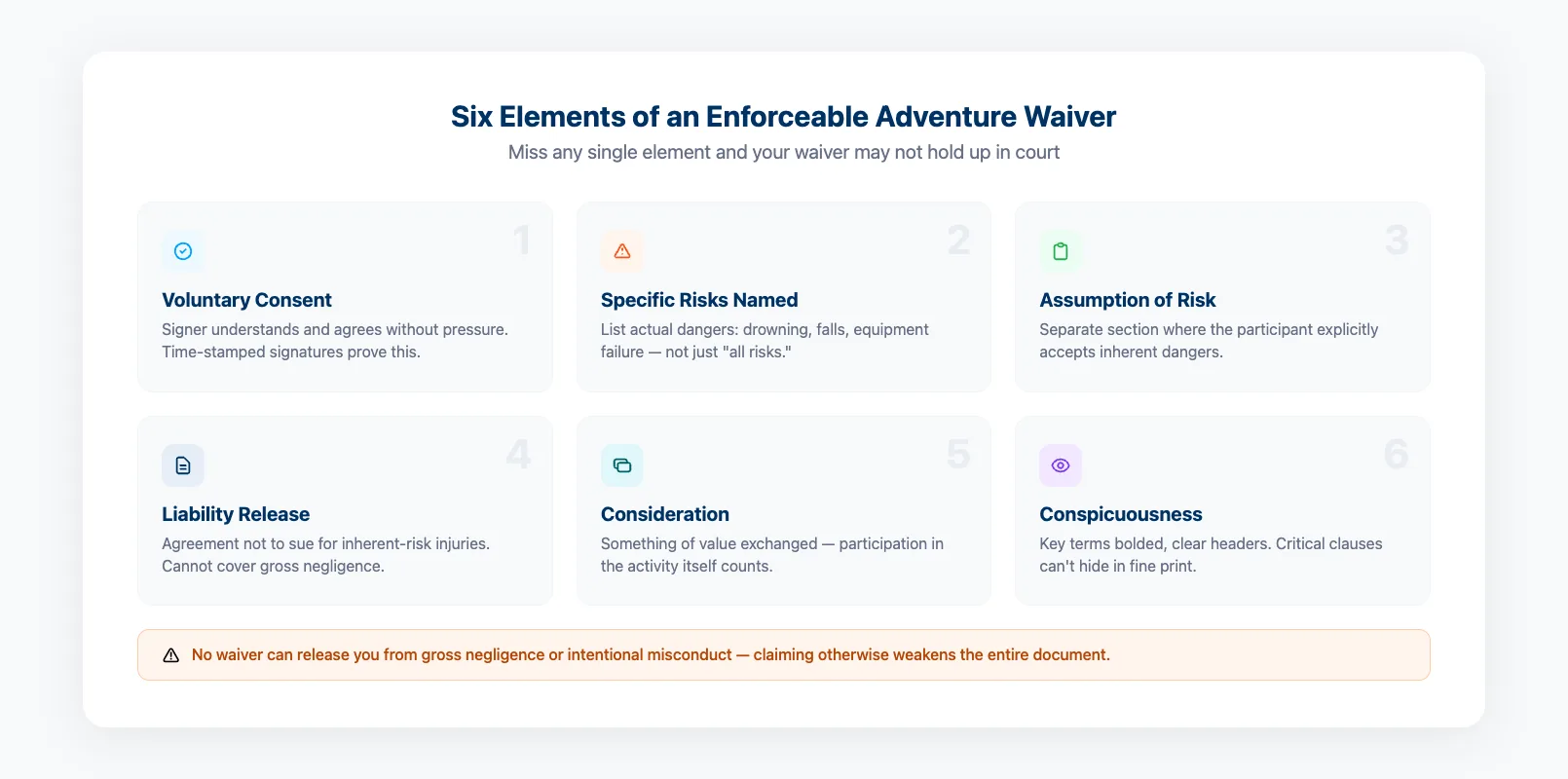
Voluntary and informed consent. The signer must understand what they're agreeing to. Waivers signed under pressure ("sign this or you can't go, the bus is leaving") are easier to challenge. Give participants time to read. Time-stamped digital signatures that track how long the waiver was open before signing help prove this.
Specific risk identification. Courts consistently reject waivers that say "all risks." You need to name the actual risks: drowning, falls, equipment failure, animal encounters, weather-related hazards, collision with other participants. The more specific your risk list, the harder it is to argue the signer didn't know what they were accepting.
Clear assumption of risk language. Separate from the liability release. The participant explicitly acknowledges that the activity is inherently dangerous and accepts those dangers voluntarily. Many jurisdictions require this as a distinct section, not buried in boilerplate.
Liability release. The participant agrees not to sue for injuries resulting from the inherent risks of the activity. This does NOT cover gross negligence or intentional misconduct — no waiver can release you from that, and claiming otherwise weakens your entire document.
Consideration. Something of value must be exchanged. For adventure operations, this is simple: participation in the activity is the consideration. But the waiver must state it explicitly.
Conspicuousness. Key terms can't be hidden in fine print. Bold the assumption of risk. Bold the liability release. Use headers that a reasonable person would notice. Courts have thrown out waivers where critical language was buried in paragraph 14 of a 20-paragraph document.
Language and Readability: Write for Participants, Not Lawyers
The most common reason waivers fail in court isn't missing clauses. It's that the participant couldn't reasonably understand what they signed. A 12-page document written at a law-school reading level is a liability, not a protection.
Target a Grade 8 reading level. Use the Hemingway Editor or similar tool. If your waiver scores above Grade 10, rewrite it. Courts have specifically cited reading level as a factor in waiver enforceability.
Use plain language for risk descriptions. "Fluvial hydraulic hazards" means nothing to your guests. "River currents that can trap and hold you underwater" does. Be direct. Be vivid. Your goal is genuine understanding, not legal-sounding intimidation.
Keep it to 2-3 pages maximum. Longer waivers get skimmed. Every clause you add dilutes the ones that matter. Your attorney will want to add everything. Push back. A focused waiver that gets read beats a comprehensive one that doesn't.
Structure matters. Use clear section headers: "Risks of This Activity," "Your Assumption of Those Risks," "Release of Liability," "Medical Disclosure," "Emergency Contact." Participants should be able to find any section in under 10 seconds.
Separate the waiver from other paperwork. Don't embed your liability release inside a booking confirmation or medical form. Courts have invalidated waivers that were part of a larger document where participants didn't realize they were signing away legal rights.
Activity-specific language. A rafting waiver and a climbing waiver should list different risks. Template waivers that try to cover all activities are weaker than activity-specific versions. If you run three different activities, you should have three different waivers.
The Signing Process: Where Most Operators Lose Defensibility
Your waiver language can be perfect and still fail if your signing process is sloppy. Process is where legal defensibility lives or dies.
Advance signing, not day-of. Send waivers 48-72 hours before the activity. Participants who sign at home, at their own pace, with time to consult someone, are demonstrably informed signers. Day-of signing in a rush undermines the "voluntary and informed" requirement. Dash can automate waiver delivery as part of your booking confirmation workflow — the Adventure Waiver Chaser agent follows up with anyone who hasn't signed by your cutoff.
Digital signatures with metadata. Paper waivers prove who signed. Digital waivers prove who signed, when, from what device, how long the document was open, and whether it was scrolled to the end. That metadata is gold in litigation.
Identity verification. The signer must be the participant. For digital waivers, capture name, email, and date of birth at minimum. For high-risk activities, consider requiring a photo ID upload. A waiver signed by "Mickey Mouse" has zero legal value.
Witness requirements. Some jurisdictions require witness signatures, especially for waivers involving minors. Even where not required, having a staff witness adds a layer of defensibility. Your lead guide should verify that every participant on the manifest has a signed waiver before departure. Use the Adventure Pre-Activity Briefing Checklist to formalize this step.
No "sign or leave" pressure. If a participant has concerns, answer them. If they refuse to sign, they don't participate. But never create a situation where signing feels coerced. "The trip leaves in two minutes, sign now" is the opposite of informed consent.
Minor Waivers: The Highest-Risk Area
Minors cannot legally waive their own rights. This is universal across the US and most common-law jurisdictions. Every adventure operator running family-friendly activities needs a minor-specific waiver process.
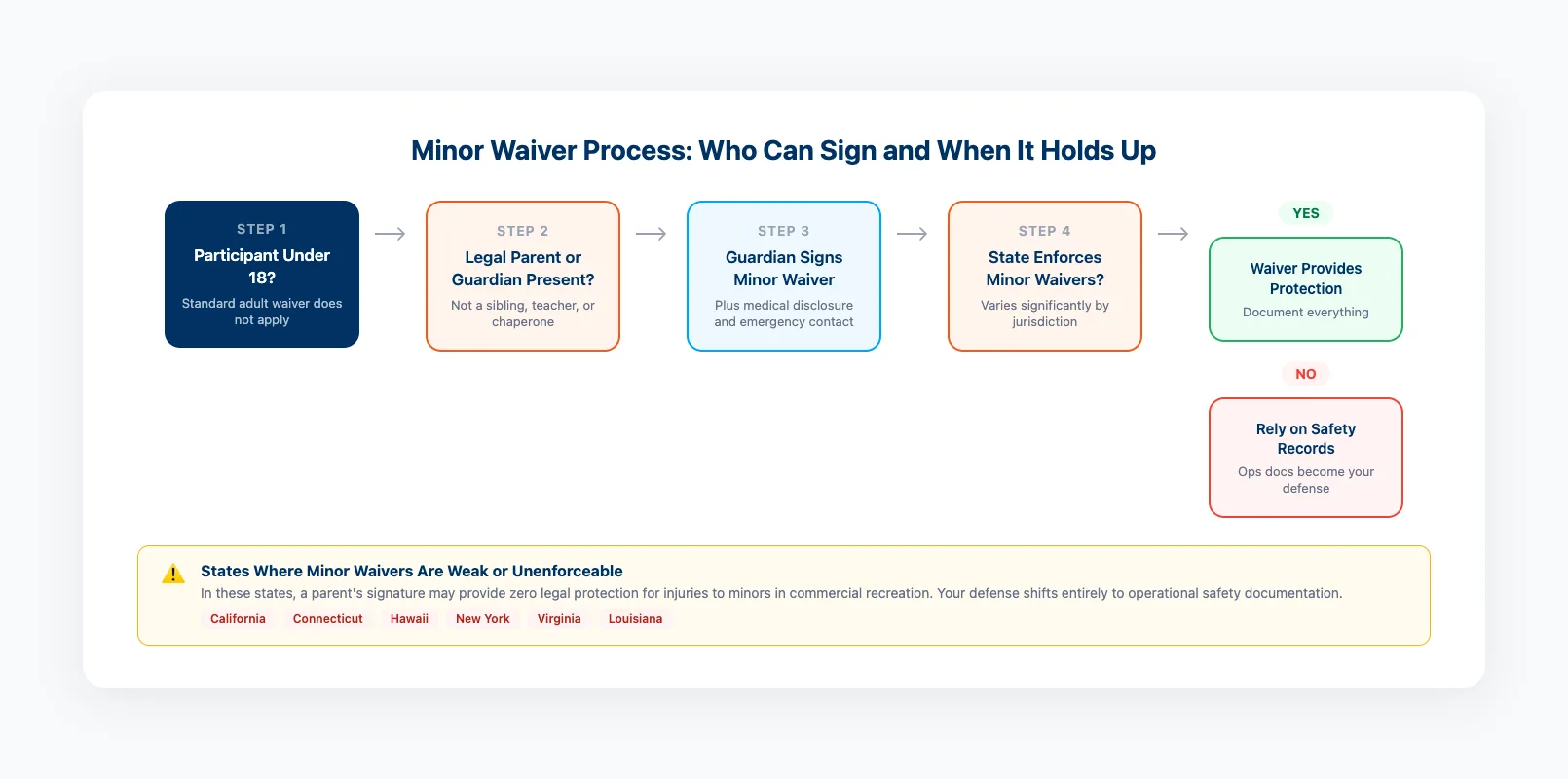
Parent or legal guardian must sign. Not an older sibling. Not a teacher. Not a camp counselor. The legal parent or guardian. If a group of kids arrives with a chaperone who isn't the legal guardian, those kids cannot participate unless you have pre-signed waivers from their parents.
State-specific enforceability varies wildly. In most US states, a parent can sign a waiver on behalf of their minor child for commercial recreation. But several states (California, Connecticut, Hawaii, and others) have case law limiting or eliminating a parent's ability to waive a minor's future claims. In these states, your waiver may provide zero protection for injuries to minors, regardless of what the parent signed.
What this means operationally. In states where minor waivers are weak or unenforceable, your defense shifts from the waiver to your operational safety record. Documented safety procedures, guide certifications, equipment inspection logs, and incident records become your primary protection. See Adventure Gear Lifecycle for the equipment documentation side.
Age-appropriate briefings. Courts have examined whether minor participants were actually briefed on risks in language they could understand. A pre-trip safety briefing delivered at adult level doesn't satisfy this for a 10-year-old. Document your minor-specific briefing with the Adventure Pre-Activity Briefing Checklist.
Medical disclosure for minors. Parents should disclose relevant medical conditions, medications, and allergies on the waiver. This isn't just a legal requirement. It's an operational one. A guide needs to know about a participant's asthma before they're mid-rapid.
State and Country Differences: One Waiver Doesn't Fit All
If you operate in one state and your customers come from 30, which law governs your waiver? The answer determines everything.
Choice-of-law clauses. Your waiver should specify that the laws of your operating state govern. Courts generally respect this for commercial recreation, but it's not automatic. A California resident injured in Colorado may attempt to litigate under California law, which is less waiver-friendly.
US state landscape. States fall roughly into three categories:
- Strong waiver enforcement: Colorado, Florida, Idaho, Montana, Texas, and most western states with outdoor recreation economies. Courts in these states generally uphold well-drafted waivers.
- Moderate enforcement: Most other states. Waivers hold up if the language is clear, the process was proper, and there's no gross negligence.
- Weak or hostile enforcement: Virginia, Louisiana, Montana (for certain claims), and several states with strong consumer-protection statutes. In these states, invest more in operational safety documentation and less in waiver language.
International operations. If you run trips internationally or serve international clients, know this: most civil-law countries (continental Europe, Latin America, much of Asia) do not enforce pre-injury liability waivers the way common-law countries do. In France, Germany, and similar jurisdictions, your waiver is informational, not legally binding. Your protection comes from compliance with local safety regulations and insurance.
Multi-state operators. If you run operations in more than one state, you need state-specific waivers. A waiver drafted for Colorado law may not meet Virginia requirements. Your attorney should review each version. The cost of 3-4 state-specific waiver templates is trivial compared to one undefended lawsuit.
Incident-Related Records: The Documentation That Actually Saves You
When an incident occurs, your waiver is the first document your insurer and your attorney will ask for. But it's not the only one. The documentation ecosystem around the incident determines whether your waiver holds.
Connect the waiver to the incident. Your records should create a clear chain: this person signed this waiver, for this activity, on this date, led by this guide, using this equipment. If you can't connect the waiver to the specific trip and incident, its value drops significantly.
Incident reports filed within 24 hours. Memory degrades fast. Your lead guide should complete an incident report the same day, covering what happened, who was involved, what equipment was in use, weather conditions, and what response actions were taken. Use the Adventure Incident Report Procedure template to standardize this.
Equipment records tied to the event. Which raft was the participant in? When was it last inspected? What's its maintenance history? If the incident involves equipment, your gear records either support your defense or undermine it. See Adventure Gear Lifecycle for building these records.
Guide credentials at time of incident. Was the lead guide's certification current on the date of the incident? Was their first aid cert valid? Your Guide Certification Tracking system should make this a 30-second lookup, not a scramble through filing cabinets.
Weather and conditions documentation. If you made a go/no-go decision, document it. If conditions changed mid-trip, document that too. The Weather Go/No-Go Decision Checklist creates the paper trail that shows you made a reasonable judgment call.
Participant communications. Did you send a pre-trip briefing email? Did the participant acknowledge the risks in writing? Did they disclose a medical condition? Every pre-trip communication that touches on safety is potentially relevant.
Retention period. Keep waivers and incident records for the statute of limitations in your operating state, plus a buffer. For most states that's 2-3 years for adults, but for minors it often extends until they turn 18, plus the limitation period. A 10-year-old's parents could bring a claim 10+ years after the incident. Store digitally, back up redundantly, and never purge minor records early.
Waivers aren't a checkbox. They're an operational system: language, process, documentation, and jurisdiction-specific compliance working together. Get one piece wrong and the rest unravels when you need it most.
Start with the waiver language. Then build the signing process around it. Then connect it to your incident documentation, gear records, and guide credentials. The operators who do this aren't just legally protected. They're running tighter operations overall. When an incident occurs, your first action is locating that participant's signed waiver — the Adventure Incident Response Playbook covers the full first-hour through post-incident debrief protocol. Your off-season is the best time to audit and update these processes. See Seasonal Adventure Business Management for timing your operational reviews around the seasonal calendar.
If you're still collecting signatures on clipboards in the parking lot, it's time to move to a system that captures metadata, automates follow-ups, and stores everything where you can find it. Start your free trial and see how digital waivers connect to your booking, briefing, and incident workflows in one place.
FAQ
How long should I keep signed waivers on file?
Keep waivers for at least the statute of limitations in your operating state, typically 2-3 years for adults. For minors, retain records until the participant turns 18 plus the limitation period, which can mean 10+ years. Digital storage with redundant backups is essential.
Can a waiver protect me from gross negligence claims?
No. No waiver in any US jurisdiction can release you from liability for gross negligence or intentional misconduct. Waivers protect against claims arising from the inherent risks of the activity when your operation met reasonable safety standards.
Are digital waivers as legally valid as paper waivers?
Yes, and often stronger. Digital waivers capture metadata (timestamp, device, how long the document was open, scroll depth) that demonstrates the signer had time to read and understand the document. This evidence is harder to produce with paper.
Do I need a separate waiver for each activity I offer?
Strongly recommended. Activity-specific waivers with tailored risk descriptions are more defensible than generic catch-all waivers. A rafting waiver should list drowning, rapid hydraulics, and cold-water shock. A climbing waiver should list falls, rockfall, and equipment failure.
What happens if a participant refuses to sign the waiver?
They don't participate. This should be stated clearly in your booking terms. Never pressure or coerce someone into signing — a coerced signature actually weakens your legal position more than a missing one.
Can a parent waive their minor child's right to sue in every state?
No. Several US states (including California, Connecticut, and Hawaii) limit or eliminate a parent's ability to waive a minor's future claims for commercial recreation. In those states, your operational safety record and documentation become your primary defense.
Should I have my waiver reviewed by an attorney?
Absolutely. State laws vary significantly, and a waiver that works in Colorado may be unenforceable in Virginia. Have an attorney licensed in each state where you operate review your waivers. The cost is trivial compared to one undefended claim.
in one place