Rental Fleet Management: A Practical Guide
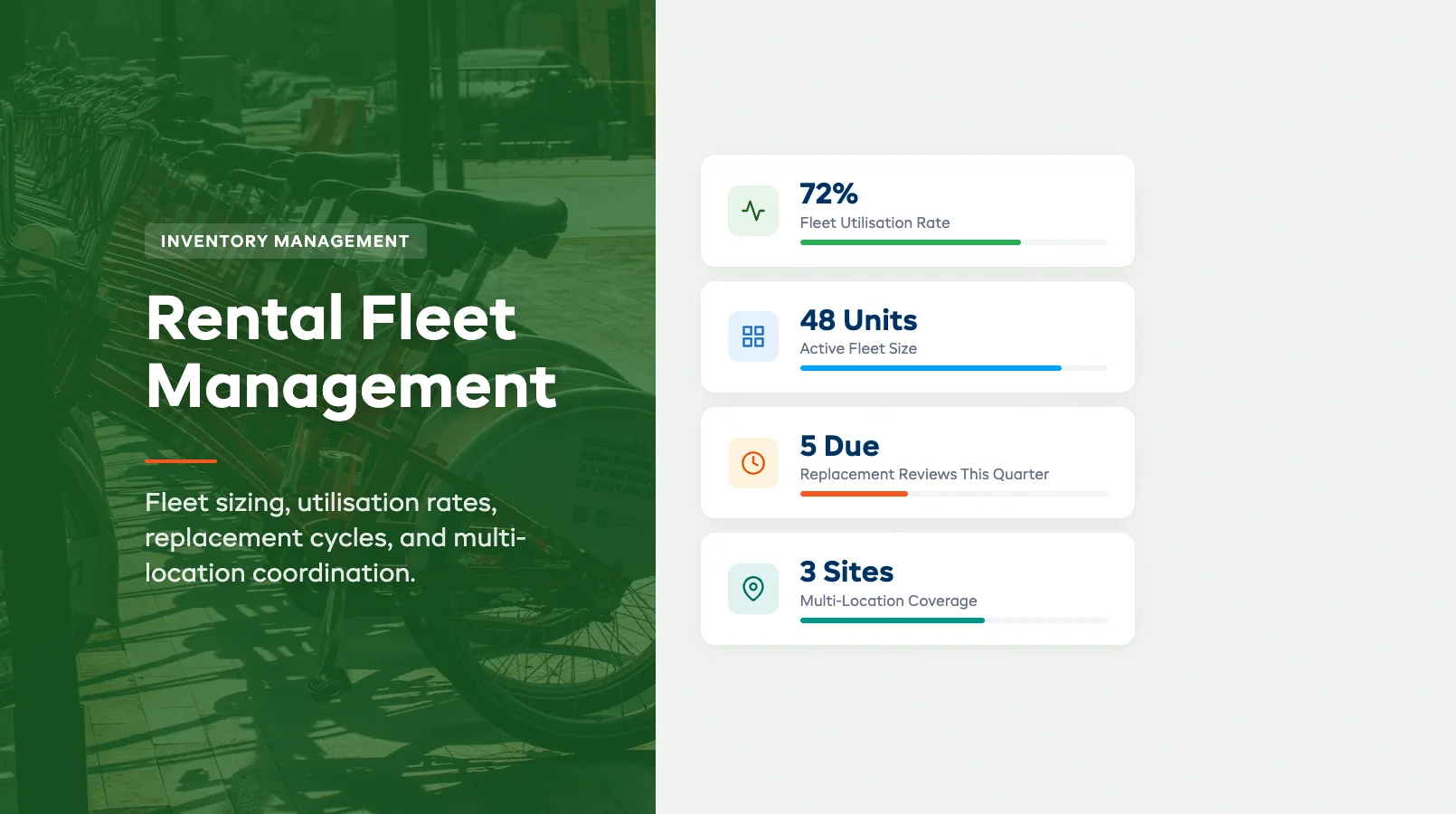
You own 40 kayaks. Twelve of them haven't left the rack in three weeks. Six are overdue for hull repairs. And your best-performing tandem model has a two-day waitlist every weekend.
That's not an inventory problem. That's a fleet management problem.
Fleet management is what separates a rental shop that owns equipment from one that profits from it. It's the layer above tracking individual items: the decisions about how many units to own, when to retire them, and how to keep every asset earning revenue instead of gathering dust. This guide covers the five fundamentals every operator needs to get right.
What Fleet Management Means for Rental Businesses
Inventory management tracks what you have. Fleet management decides what you should have.
Think of it this way: your inventory system tells you that unit #37 is checked out until Thursday. Fleet management asks whether you need unit #37 at all, or whether the money tied up in that kayak would earn more as a second tandem SUP.
For operators renting higher-value items (boats, e-bikes, specialty outdoor gear) fleet decisions carry real financial weight. A pontoon boat sitting idle costs $200-$400/month in slip fees, insurance, and depreciation whether it's booked or not. Getting fleet composition wrong doesn't just waste space. It bleeds cash.
Fleet management comes down to four questions:
- How many units do I need? (right-sizing)
- Are they earning enough? (utilization)
- When do I replace them? (lifecycle)
- Where should they be? (allocation)
The rest of this guide tackles each one.
Right-Sizing Your Fleet
The most expensive fleet mistake is owning too much. The second most expensive is owning too little.
Too many units means capital locked in depreciating assets, higher maintenance costs, and storage overhead for gear that rarely books. Too few means turning away customers during peak periods and sending revenue to your competitors.
Here's how to find the right number:
Start with peak-day demand. Look at your busiest 10 days from last season. How many units were booked? That's your ceiling. You don't need to own enough to cover your absolute peak. You need enough to cover 80-85% of peak demand. Beyond that, you're buying gear for five days a year.
Factor in downtime. At any given moment, 10-15% of your fleet will be in maintenance, transit, or cleaning. If you need 30 units available on a peak Saturday, you need 34-35 in your total fleet.
Track booking denials. Every time a customer asks for something you don't have, log it. After a month, you'll see exactly which categories are undersized. If you're losing three bookings a week on tandem kayaks, that's a clear signal to add units, not more singles that already sit idle midweek.
Review quarterly. Fleet sizing isn't a one-time decision. Demand shifts seasonally, customer preferences change, and new product categories emerge. Set a calendar reminder to review your fleet composition every quarter against actual booking data.
Utilization Rates: The Number That Matters Most
Utilization rate is the single best measure of fleet health. It answers one question: what percentage of the time is each unit actually earning revenue?
The formula is straightforward:
Utilization Rate = (Days Rented ÷ Days Available) × 100
A kayak available 30 days in a month that was rented 18 of those days has a 60% utilization rate. A boat available 30 days that booked 9 has 30%.
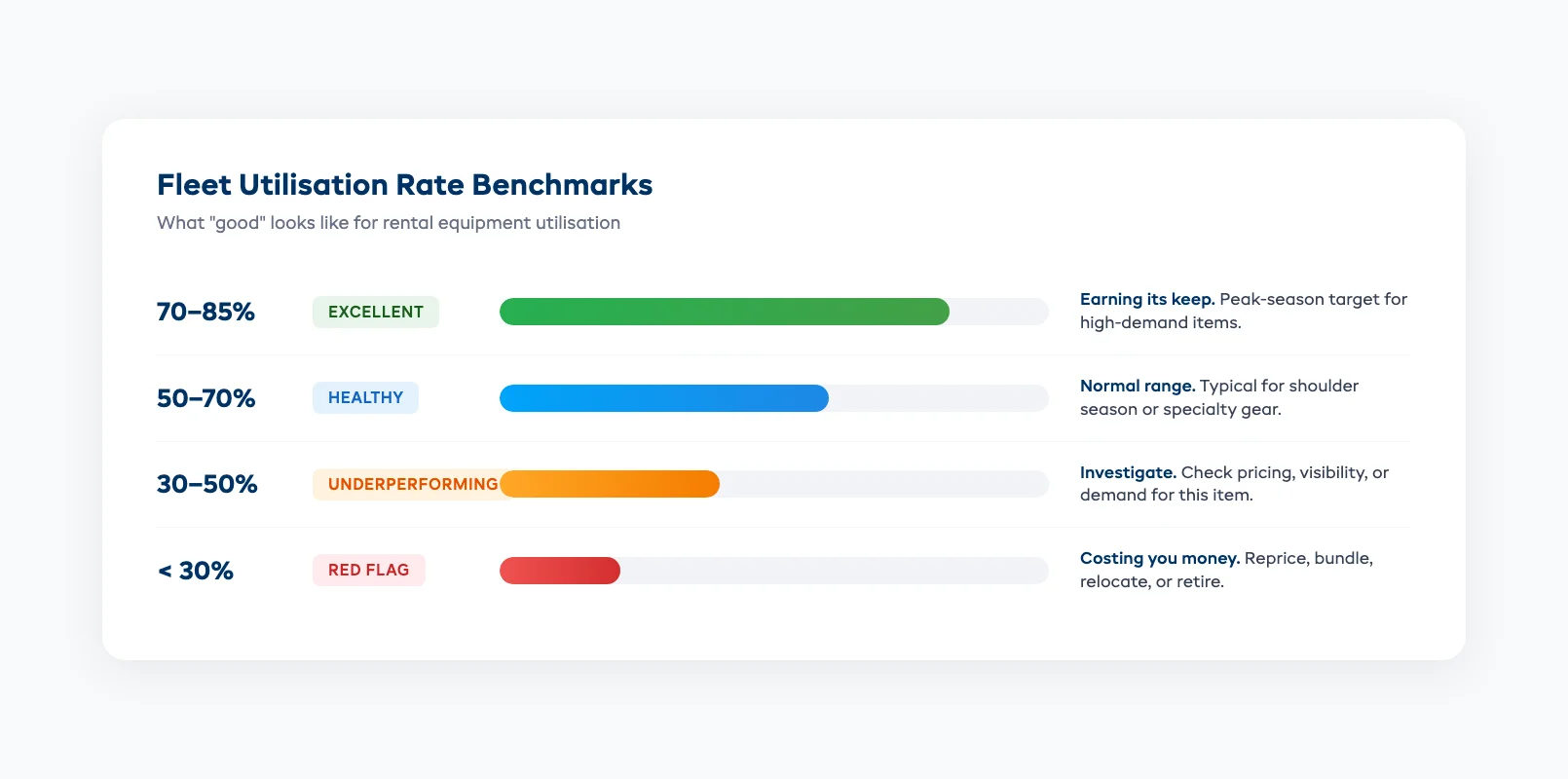
What "good" looks like depends on your item type and season. General benchmarks:
- 70-85%: Excellent. This unit is earning its keep.
- 50-70%: Healthy. Normal for shoulder season or specialty items.
- 30-50%: Underperforming. Investigate pricing, visibility, or demand.
- Below 30%: Red flag. This unit is costing you money.
When you spot underperformers, you have three levers before retirement:
- Reprice. Drop the rate on slow days. A kayak rented at $30 beats a kayak sitting on the rack at $50.
- Bundle. Package underperforming items with popular ones. "Book a tandem SUP, add a single kayak for $15."
- Relocate. A bike that sits idle at your downtown shop might book every day at the beachfront location.
If none of those move the needle after 60 days, it's time to consider retirement.
Replacement Cycles and Retirement Decisions
Every piece of rental equipment has a lifecycle. The question is whether you manage it proactively or wait until gear fails during a rental.
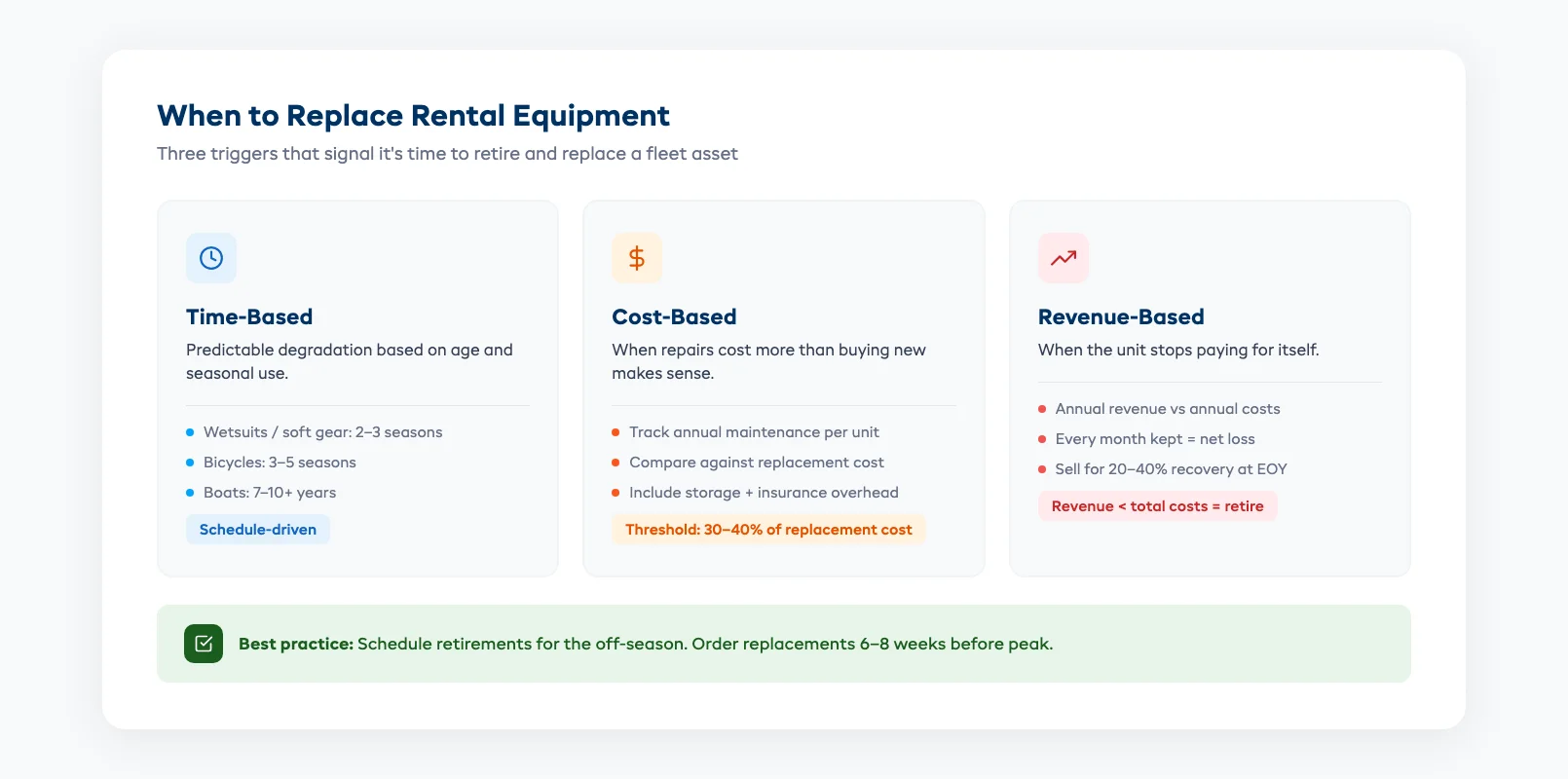
Time-based triggers work for items with predictable degradation. Wetsuits and soft gear typically last 2-3 seasons. Bicycles, 3-5 seasons depending on use. Boats, 7-10+ years with proper maintenance.
Cost-based triggers are more precise. Track the total maintenance cost per unit over the last 12 months. When annual maintenance exceeds 30-40% of replacement cost, the math favors buying new. A kayak that costs $800 new and needed $350 in repairs last year is telling you something.
Revenue-based triggers close the loop. If a unit's annual rental revenue no longer covers its annual costs (maintenance + storage + insurance + depreciation), it's past retirement age. Every month you keep it is a net loss.
The same asset list drives what you can claim after a theft or a fire, so keep the values current and check whether your fleet is insured for replacement cost rather than depreciated value. A four-year-old bike paid out at actual cash value does not replace itself in March.
The retirement process:
- Flag units approaching thresholds in your tracking system
- Schedule retirement for the off-season, not mid-July when you need every unit
- Sell retired gear at end-of-season sales (operators typically recover 20-40% of original cost)
- Order replacements 6-8 weeks before peak season
Multi-Location Fleet Coordination
Running gear across two or more locations introduces a new challenge: allocation. The same fleet can perform very differently depending on where each unit sits.
Track utilization by location, not just by unit. A paddleboard with 45% utilization might be at 70% at your lakeside shop and 20% at the urban location. The problem isn't the board. It's where you put it.
Build transfer protocols. Moving gear between locations should be a planned operation, not a scramble. Set a weekly review: which items are underbooked at Location A and waitlisted at Location B? Move them before the weekend, not during it.
Prevent double-booking across sites. When customers book online and you manage multiple locations, real-time availability sync is non-negotiable. An item transferred from Site A to Site B needs its availability updated at both locations instantly. One shared calendar, one source of truth.
Standardize maintenance across locations. A bike serviced to one standard at your main shop and a different standard at the satellite creates liability risk and inconsistent customer experience. Use the same checklists, the same service intervals, and the same condition grading at every site.
Multi-location fleet management is where spreadsheets break down fastest. If you're running more than one site, software that syncs inventory and bookings across locations isn't a luxury. It's the minimum viable setup.
Frequently Asked Questions
What's a good utilization rate for rental equipment? Most rental operators target 50-70% utilization across their full fleet. Individual high-demand items should hit 70-85% during peak season. Anything below 30% consistently is a candidate for repricing, relocation, or retirement.
How do I know when to add more units to my fleet? Track booking denials — every time you turn away a customer because a category is sold out. If you're consistently denying 3+ bookings per week in a category, the revenue you're losing likely exceeds the cost of adding units.
When should I retire a piece of rental equipment? When annual maintenance costs exceed 30-40% of replacement cost, or when the unit's annual revenue no longer covers its total annual costs (maintenance, storage, insurance, depreciation). Schedule retirements for the off-season.
How do I manage fleet across multiple locations? Track utilization by location, not just by unit. Set weekly transfer reviews to move underbooked gear to high-demand sites. Use a single booking system with real-time availability sync to prevent double-bookings across locations.
What's the difference between fleet management and inventory management? Inventory management tracks what you have, where each item is, who has it, what condition it's in. Fleet management is the strategic layer: deciding how many units to own, which categories to invest in, when to retire assets, and where to allocate them.
How often should I review my fleet composition? Quarterly. Review utilization rates, booking denial data, and maintenance costs against the previous quarter. Adjust fleet size and composition before each peak season, not during it.
Fleet management is one piece of the rental operations puzzle. For the complete picture of tracking, organizing, and optimizing your rental inventory, start with our Rental Inventory Management guide. And if you need a simple way to log every item going out the door, grab our free equipment sign-out sheet template.
in one place