FareHarbor vs Bokun: Which Is Better? (2026)
FareHarbor vs Bokun: Which Is Better? (2026)
FareHarbor and Bokun are the two booking platforms owned by travel giants: FareHarbor by Booking Holdings, Bokun by Tripadvisor. Picking between them is really picking which ecosystem you want your business wired into - Booking.com's OTA network and a famously high-converting checkout on one side, the Viator marketplace and a B2B reseller network on the other. They also charge you in opposite ways: FareHarbor takes a roughly 6% booking fee that's usually passed to your customer, while Bokun runs a subscription with fees that shift by sales channel, plus a free tier for Viator-only sellers. This guide breaks down the features, the real cost math at your volume, and who should pick which - plus a third option if equipment rental is part of your revenue.
Weighing one of these against an all-in-one platform? See the direct head-to-heads in our EquipDash vs FareHarbor comparison and EquipDash vs Bokun comparison - or score the whole field in the best FareHarbor alternatives and best Bokun alternatives guides.
Quick Comparison Table
Here's the head-to-head at a glance. FareHarbor keeps its exact rate behind a sales call, so its column reflects what operators consistently report; Bokun publishes a free Viator-only tier and a paid plan with channel-based fees.
| FareHarbor | Bokun | |
|---|---|---|
| Owned by | Booking Holdings (Booking.com) | Tripadvisor (Viator) |
| Best for | Website- and OTA-driven operators | Viator-first operators |
| Pricing model | ~6% booking fee, typically paid by customer | Subscription + fees that vary by channel |
| Monthly software fee | None | Free Viator-only tier, paid plan above it |
| OTA connections | Booking.com network + partners | Viator native + other channels |
| B2B / reseller tools | No equivalent | Bokun Marketplace - operators resell each other |
| Booking widget | Excellent, built for you free | Capable, more configuration on you |
| Ease of setup | Fast - their team does the build | Steep - setup commonly takes weeks |
| Equipment rentals | Minimal | None |
| Support | 24/7 phone | Help center + business hours |
Both are proven for pure tours and activities. Neither was built to track rental inventory - hold that thought if bikes, kayaks or ski gear share your counter.
Features Comparison
Day to day - departure schedules, capacity caps, cutoffs, manifests, payments - FareHarbor and Bokun are closer than either sales team admits. The real differences live in which giant's network feeds your calendar and how much work each platform takes to stand up.
Distribution. Both platforms inherit their owner's reach, and the ecosystems barely overlap. FareHarbor plugs you into Booking Holdings: deep OTA distribution through Booking.com and its partner brands, which is hard to beat if that marketplace drives your region. Bokun wires you into Tripadvisor: the Viator connection is native, listings flow into the review ecosystem with minimal friction, and the Bokun Marketplace adds something FareHarbor has no answer to - a B2B network where operators contract with each other and resellers to sell each other's products.
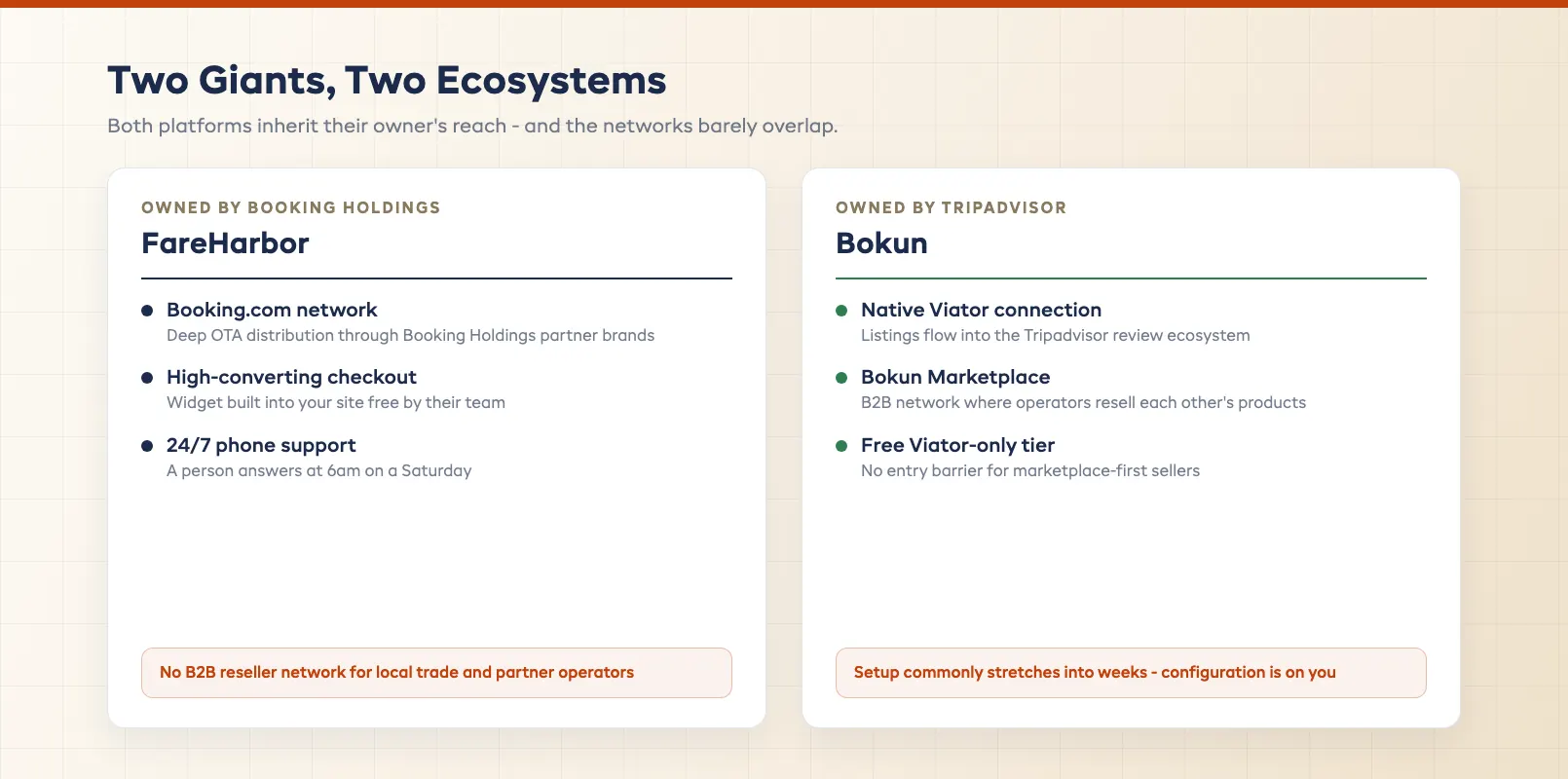
The dependency question. It cuts both ways here, because whichever you pick, a travel giant sits between you and your bookings. FareHarbor's commission scales with every sale its network helps you make. Bokun's free tier deepens your reliance on Viator with every listing, review and ranking you build there - and leaving means rebuilding that presence from scratch. Neither is neutral ground; the honest question is which ecosystem already drives your calendar.
Booking widget and checkout. FareHarbor wins here, and it isn't close. Its widget is fast, high-converting, and its team builds it into your site for free - the onboarding is famously hands-on. Bokun's checkout is capable but takes real configuration: products, pricing rules, availability and channel connections all need setting up, and operators consistently report initial setup stretching into weeks.
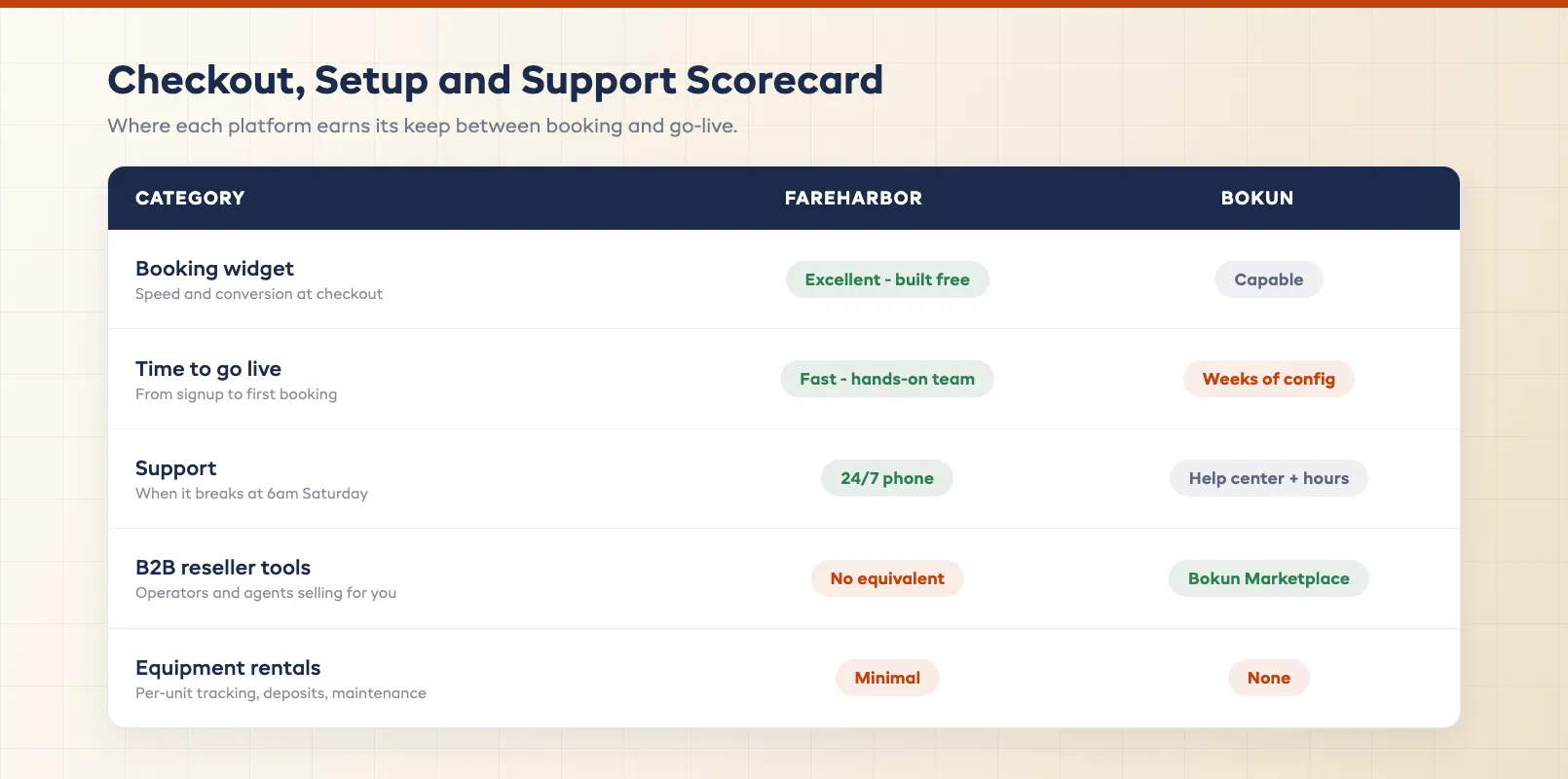
Support. FareHarbor runs 24/7 phone support, which earns its keep the first time a booking bug hits at 6am on a Saturday. Bokun leans on a help center and business-hours responses - workable most days, thinner in a peak-season emergency.
Where both fall short. Physical gear. Neither platform tracks per-unit inventory, check-in and check-out, damage deposits against a specific item, or maintenance windows. A "rental" in tour-first software is just another time slot - which collapses the moment two bookings want the same ten kayaks on overlapping windows. And neither offers an AI assistant or autonomous agents, so reporting, waiver chasing and follow-ups stay manual as you grow.
Pricing Comparison
The two models behave very differently as you grow, and neither is as simple as its headline.
FareHarbor charges no monthly software fee at all. Instead it takes roughly a 6% booking fee, typically added to the customer's total at checkout rather than coming out of your margin. Your software bill reads zero - but your customers see inflated prices, which can dent conversion on price-sensitive trips, and the platform's take scales with every dollar you sell.
Bokun is the spreadsheet one. Its fees vary by sales channel - direct bookings carry one rate, OTA bookings another, marketplace bookings yet another - stacked on top of the commission the OTA itself takes. The free Viator-only tier removes the entry barrier, but a Viator sale already surrenders a marketplace commission before Bokun's cut enters the math. Predicting your monthly cost accurately requires modeling your actual channel mix.
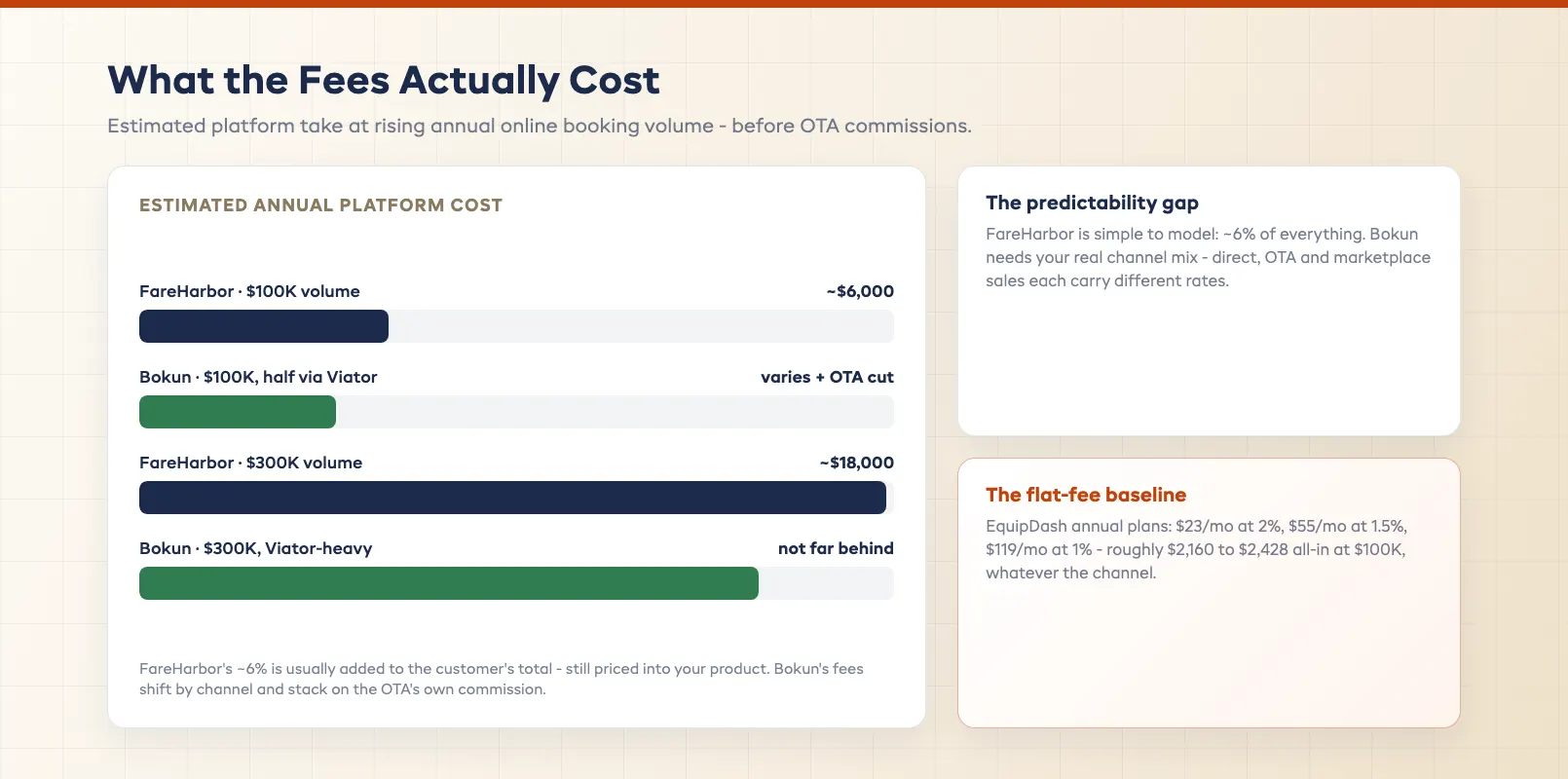
Run the math at real volumes. At $100,000 in annual online bookings, FareHarbor's model moves about $6,000 through fees - nominally paid by your customers, but priced into your product either way. On Bokun, the same volume sold direct can cost far less; shift half of it to Viator and the effective cost per booking multiplies once marketplace commission stacks on platform fees. At $300,000, FareHarbor's take approaches $18,000, and a Viator-heavy Bokun mix isn't far behind.
Whichever you pick, get your rates in writing per channel, and run last season's actual channel mix through them before you sign - not the mix you're hoping for.
Best For: When to Choose Each
Neither platform is simply "better." They're tuned for different ways of selling.
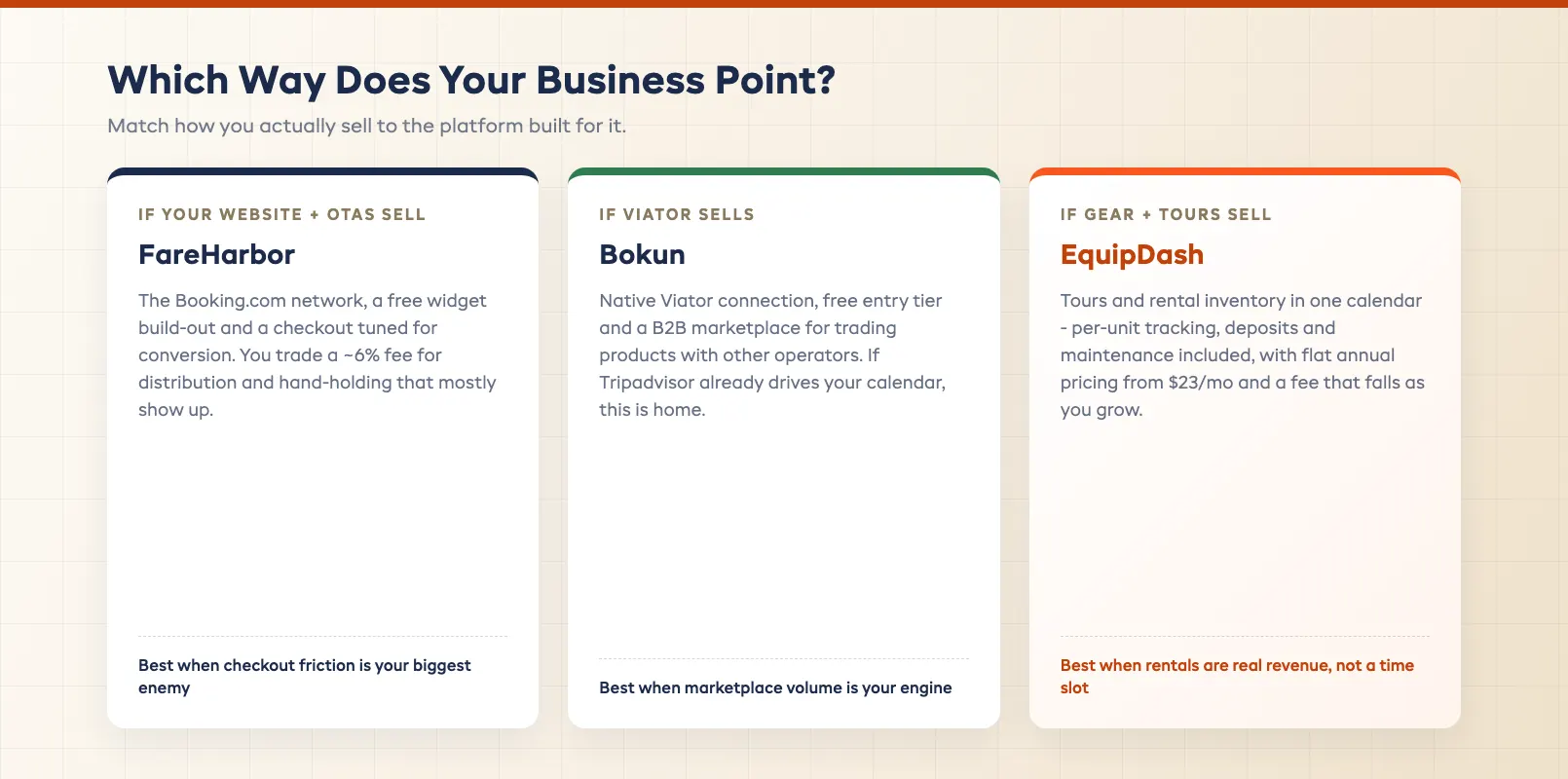
Choose FareHarbor if your own website and the Booking.com network drive your growth. The free widget build-out, the high-converting checkout and 24/7 phone support make it the safe default for operators who can't afford checkout friction - or downtime at dawn. The commission stings as you scale, but you're paying for distribution and conversion that mostly show up.
Choose Bokun if Viator and Tripadvisor drive your bookings. The native connection, the free entry tier and the B2B Marketplace make it the obvious home for operators who live on marketplace volume and want to trade products with other operators. If most of your calendar already comes from Viator, you're fighting gravity anywhere else.
Choose neither if equipment rental is a real slice of your revenue. That's no knock on either platform; they were never built to track physical inventory. Forcing gear through tour software means a second system, double data entry, and a standing risk of double bookings.
A Third Option: Rentals + Tours
If your business sells both - guided experiences and equipment rental - FareHarbor and Bokun both leave you running two systems. That's the gap an all-in-one platform closes.
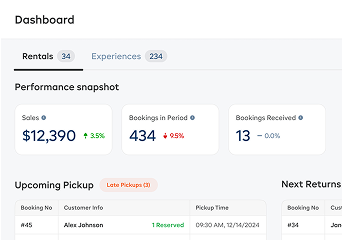
EquipDash was built for operators who do tours and rentals under one roof. The same calendar that schedules your 9am kayak tour tracks which paddleboards are out, which came back, and which need a fin repaired before the next booking. One booking flow, one customer record, one dashboard - instead of stitching a rental spreadsheet onto a tour platform. Dash AI adds the automation layer both platforms lack: ask it for a revenue report, let its agents chase unsigned waivers and late returns.
The pricing is public and flat, which already separates it from a 6% commission or a channel-based fee stack: annual plans start at $23/mo with a 2% platform fee (Starter), then $55/mo at 1.5% (Growth) and $119/mo at 1% (Pro) - the fee falls as you grow instead of scaling with every sale. At $100,000 in annual bookings that's roughly $2,160 to $2,428 all-in, one rate regardless of where the booking came from. See the full breakdown on the pricing page.
Be honest about the fit: a pure-tour operator living on Booking.com volume still has good reasons to pick FareHarbor, and a Viator-first operator may never outgrow Bokun. But if gear is part of the picture, a platform that treats rentals as a first-class feature beats forcing them through software that doesn't. Already decided to move? The FareHarbor migration guide and Bokun migration guide walk through the switch step by step.
FAQ
What's the main difference between FareHarbor and Bokun?
The pricing model and the ecosystem. FareHarbor, owned by Booking Holdings, charges no monthly fee but takes roughly a 6% booking fee (usually passed to the customer) and leans on Booking.com for OTA reach. Bokun, owned by Tripadvisor, runs a subscription with fees that vary by sales channel, a free Viator-only tier, and a B2B marketplace where operators resell each other's products.
Is FareHarbor or Bokun cheaper?
It depends on your channel mix and volume. FareHarbor's no-monthly-fee model is painless to start, but a flat ~6% fee scales with every dollar - about $6,000 moved through fees at $100,000 of annual bookings. Bokun can cost much less for direct-heavy sellers, while Viator-heavy operators stack marketplace commission on top of platform fees. Run last season's actual mix through both before deciding.
Does Bokun have a free plan?
Yes - for operators who sell exclusively through Viator. It removes the entry barrier, but every sale on that tier already carries Viator's marketplace commission, and it deepens your dependence on the Tripadvisor ecosystem. FareHarbor has no free tier as such; it has no monthly fee at all, earning instead from its ~6% booking fee.
Which platform is easier to set up?
FareHarbor. Its team builds the booking widget into your site for free and the onboarding is hands-on, so time-to-first-booking is short. Bokun's interface is powerful but complex - products, pricing rules, availability and channel connections take significant configuration, and operators commonly report setup stretching into weeks.
Can FareHarbor or Bokun manage equipment rentals?
Not properly. Both are tour-and-activity platforms: no per-unit tracking, no check-in/check-out workflow, no maintenance scheduling, no deposits tied to a specific item. If you rent bikes, boards or ski gear alongside experiences, you'll need a second system - or an all-in-one platform like EquipDash that handles both natively.
Is there an alternative that handles tours and rentals together?
Yes. EquipDash manages guided experiences and equipment rentals in one system - one calendar, one customer record, one dashboard. Annual plans start at $23/mo with a platform fee that drops from 2% to 1% as you move up tiers, and the fee is the same whichever channel the booking came from.
in one place