Trailer Hire Software: Running a Yard That Turns Over Fast
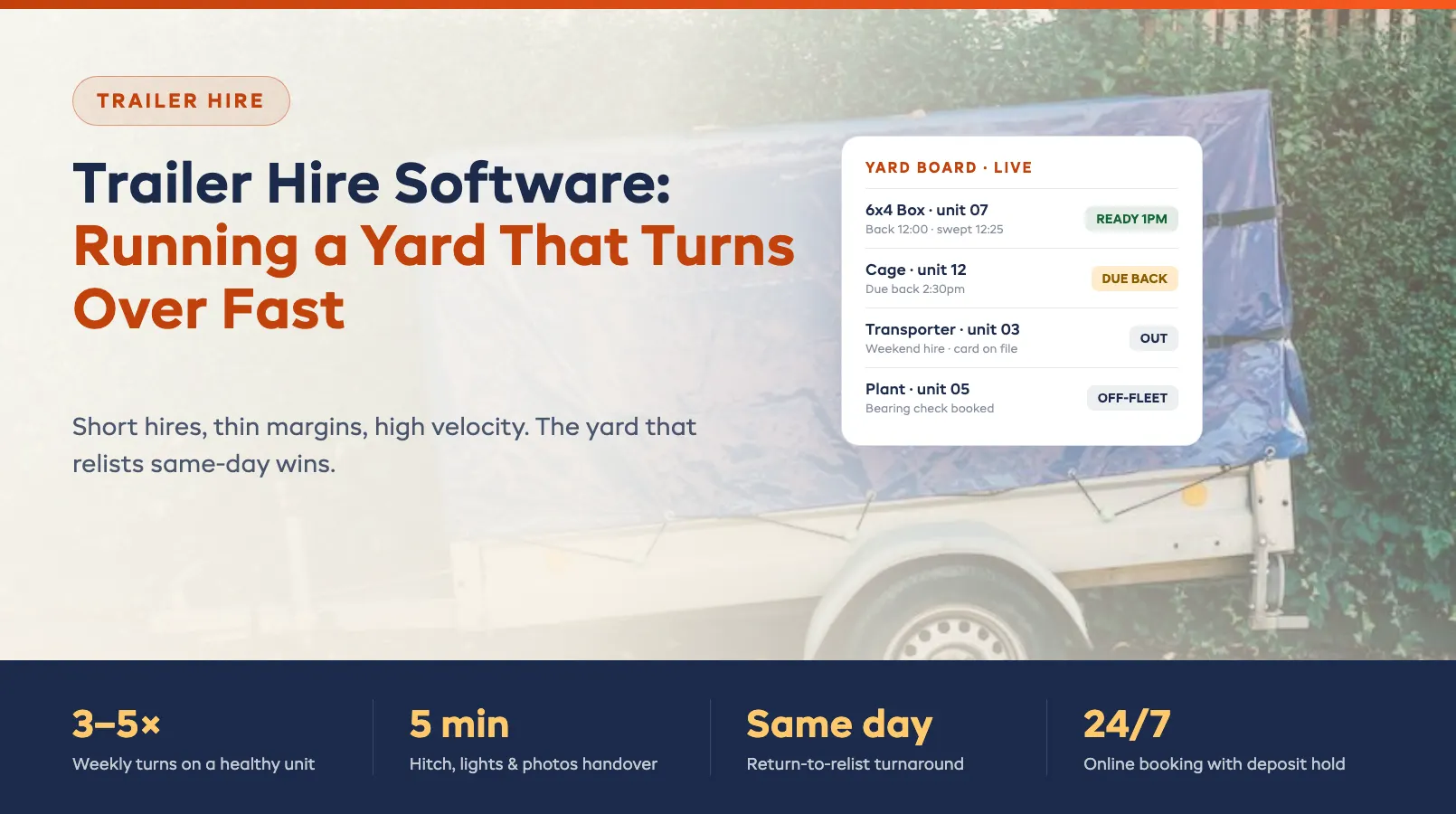
A trailer yard doesn't make its money the way a boat fleet or a campervan operation does. The average hire is hours or days, not weeks; the revenue per booking is $40-150, not $1,500; and the profit lives in velocity: how many times each trailer goes out per week, and how little time it spends sitting between hires. A box trailer that turns over five times a week at $60 a hire out-earns one that goes out twice at $90, every time. That changes what the software has to do: half-day precision on availability, bookings that come in without a phone call, a handover that takes five minutes including the hitch check, and turnaround so tight the next customer can collect an hour after the last one returns. This guide works through each piece.
For the feature-by-feature breakdown of what to look for in a platform, see our trailer rental software page. This guide is about running the yard on top of it.
Trailer Hire Is a Velocity Business
Run the math on a typical mixed yard. A 6x4 box trailer hires at $45 a day. If it goes out 3 times a week, that's $7,000 a year; at 5 times a week it's $11,700: same trailer, same parking space, same insurance. Across a 30-unit yard, the gap between a 3x and a 5x weekly turn is the difference between a yard that pays a wage and one that pays for expansion.
Three things set the turn rate, and all three are operational rather than marketing problems:
- Booking friction. Every hire that needs a phone call during business hours is a hire that goes to the yard with online booking. Trailer customers decide fast. They're moving house Saturday, the decision is today.
- Turnaround time. The gap between one hire returning and the unit being bookable again. Yards that inspect, sweep, and re-list within the hour turn units the same day; yards that "get to it tomorrow" lose a full hire cycle on every return.
- Dead stock. Units that sit because nobody knows they're free, they're blocked by an unrecorded repair, or the booking calendar says they're out when they're parked in row three.
Software doesn't swing the trailer coupling for you, but it decides all three of those numbers.
Sell Half-Day and Daily Blocks Online
The booking setup that fits trailer hire is short fixed blocks with real-time availability:
- Half-day (4-hour) and full-day blocks as the standard products, with a weekly rate for the tradesman and house-move market. Half-day blocks matter more than most yards think — the tip-run customer who needs a trailer from 8 to 12 frees the unit for a second hire the same afternoon, which is exactly the velocity the yard is chasing.
- Real-time availability by trailer type, not by individual unit. The customer books "6x4 box trailer, Saturday morning," and the system assigns a specific unit from the pool. Pooling is what keeps utilization high — assigning specific registrations at booking time strands capacity every time a unit goes into repair.
- 24/7 self-service booking with payment and deposit pre-authorization taken online. A large share of trailer bookings land at night for next-morning collection; if that customer can't book at 9pm, the 7am queue at the counter does the job slower and worse.
- Hard buffer times between hires (30-60 minutes per unit for the inspection-and-sweep routine) built into availability so back-to-back bookings never collide at the gate.
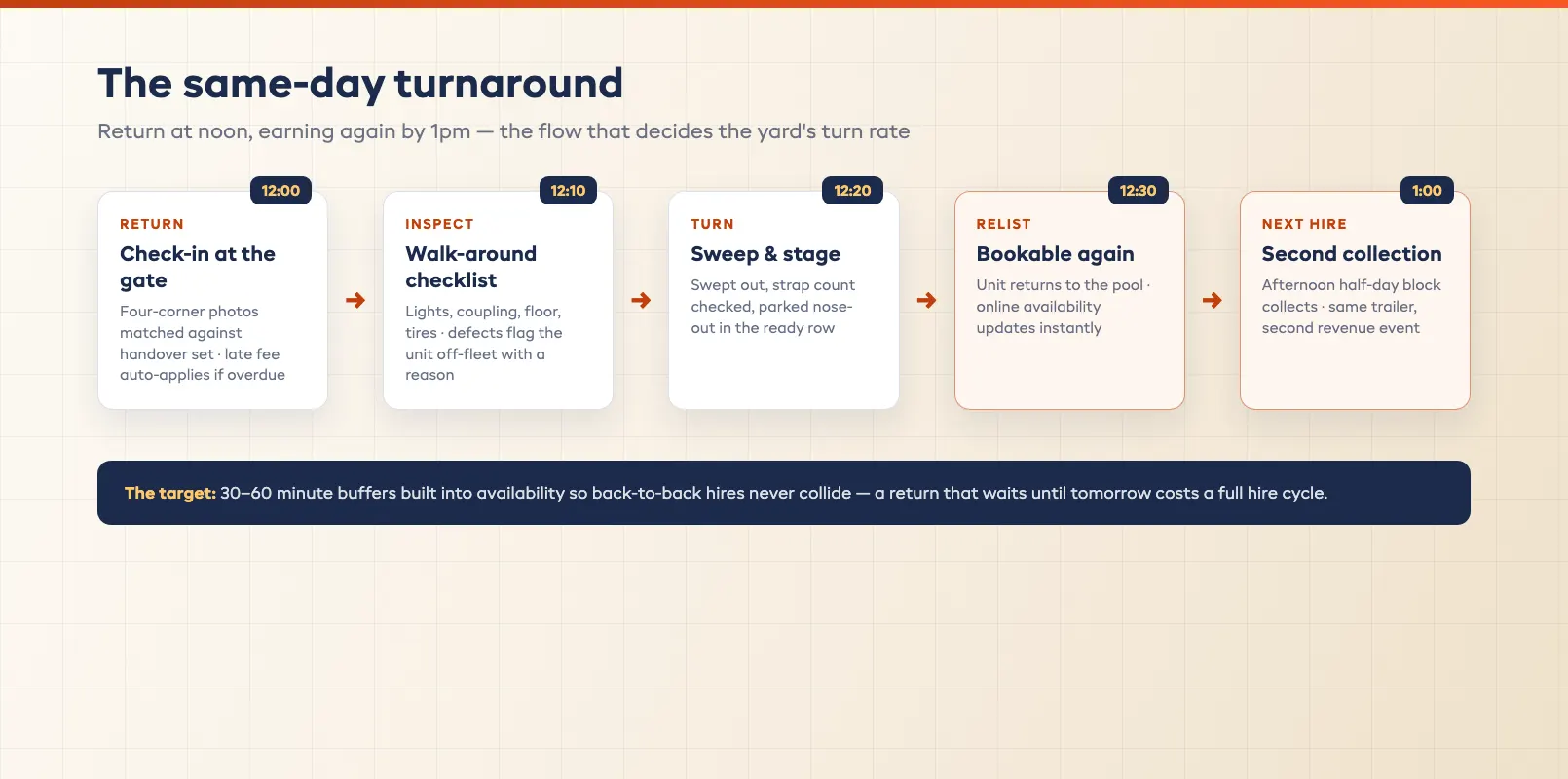
The turnaround target is the same-day relist: return at 12, inspected and swept by 12:30, bookable for 1pm. That only works when the return triggers a checklist rather than a memory, which is the yard board's job.
Run the Yard From One Board
The single view a trailer yard needs is a live board answering three questions: what's out, what's due back, and what's on the lot ready to go.
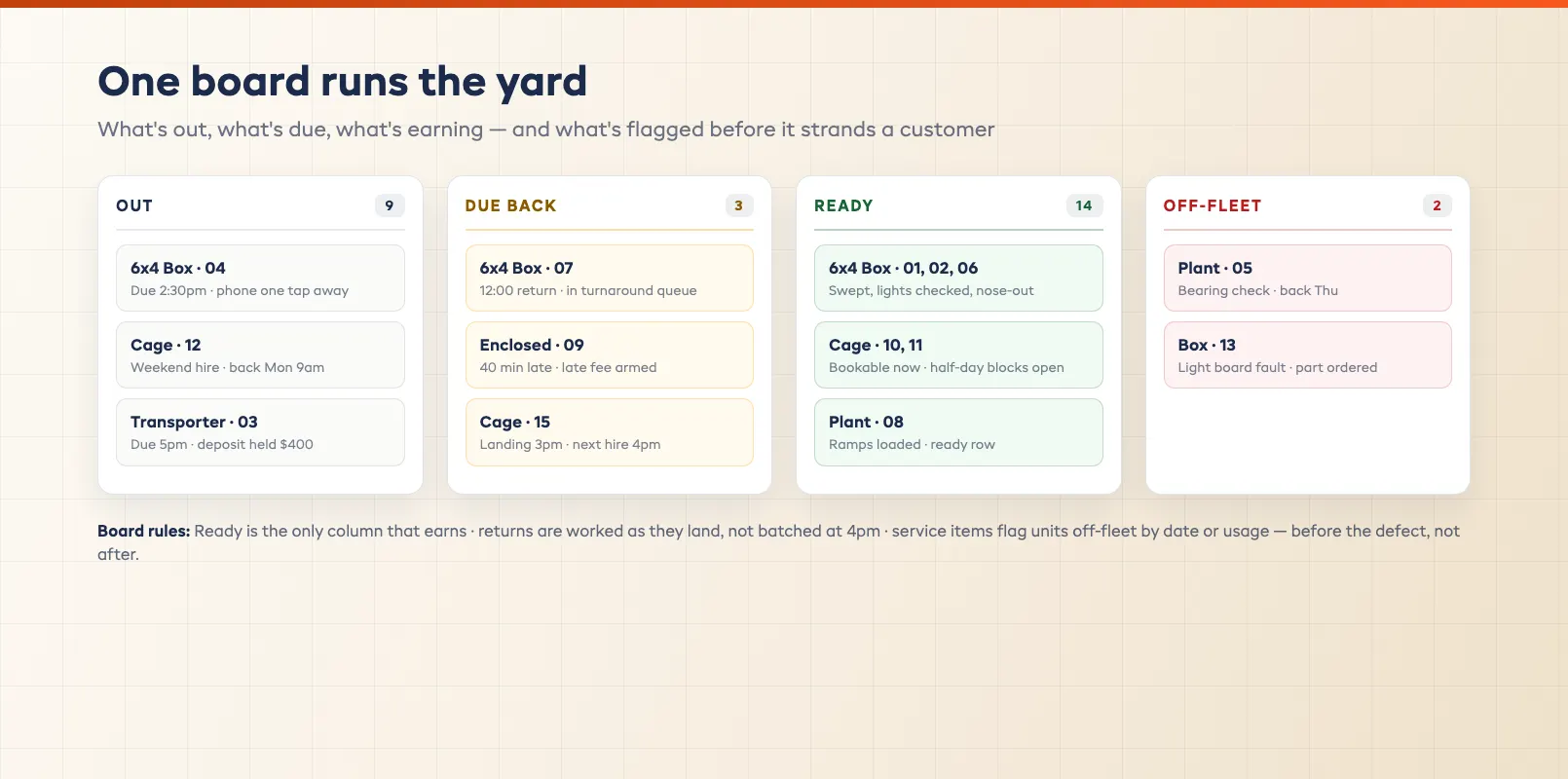
- Out: on hire, with the due-back time and the customer's phone number one tap away for the 30-minutes-late call.
- Due back today: the turnaround queue, in arrival order, so whoever is on the yard works returns as they land instead of batching them at 4pm.
- Ready: inspected, swept, lights checked, bookable. This is the only column that earns money.
- Off-fleet: flagged for repair with a reason and a date. A trailer with a blown bearing that's "sort of known about" but still showing available is how double-bookings and Saturday-morning arguments happen.
Registration renewals and service items (bearings, brake checks, tire wear, light boards) belong on the same board as date- or usage-triggered flags, so a unit rolls off-fleet before the defect strands a customer on the highway rather than after. The full inspection structure (what to check at what interval, and how a lapsed test blocks the booking on its own) is covered in keeping trailers legal and hireable.
Make the Handover a Five-Minute Routine
Trailer handovers carry more liability per minute than almost any rental category: the customer tows your asset on a public road, attached to their vehicle, at highway speed. The handover routine has to cover that in about five minutes, because at 9am on a Saturday there are four customers in the queue.
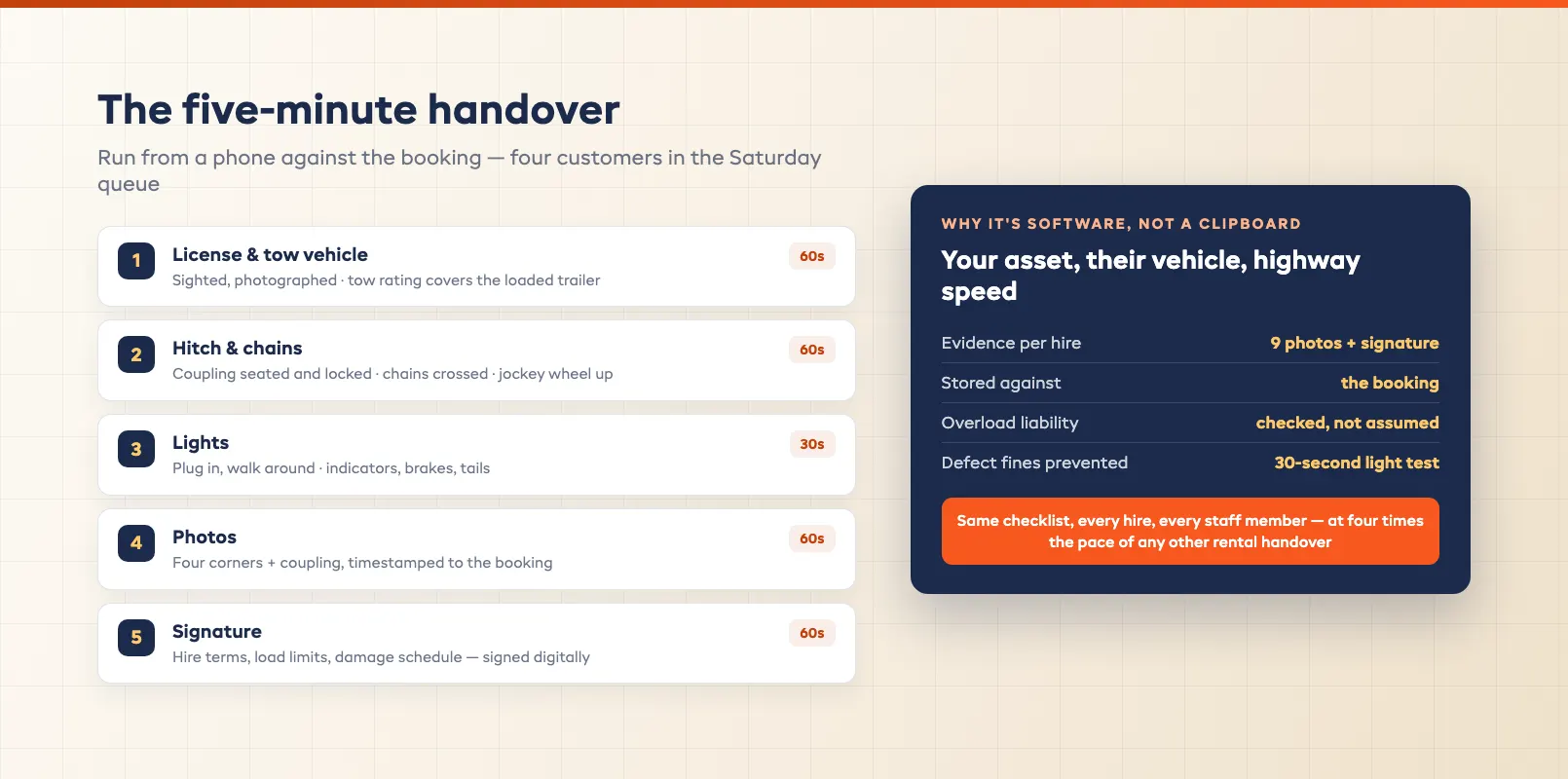
The routine that fits in five minutes, run from a phone or tablet against the booking:
- License and tow vehicle check: sighted, photographed, matched to the booking. Confirm the tow vehicle's rating covers the trailer's loaded weight; an overloaded coupling is your insurance claim, not the customer's.
- Hitch and chains: coupling seated and locked, safety chains crossed and shackled, jockey wheel up. Done by the yard, watched by the customer.
- Lights: plug in, walk around, indicators-brakes-tails. Thirty seconds that prevents the most common defect fine.
- Photos: four corners plus the coupling, timestamped against the booking. The same set at return closes out the hire.
- Signature: hire terms, load limits, and damage liability signed digitally on the spot, stored with the booking.
The identical logic applies at handover for any towed or driven asset (our car rental handover guide covers the evidence side in more depth) but the trailer version has to run at four times the pace, which is why the checklist lives in software rather than on a clipboard.
Deposits, Damage, and the Evidence Trail
Trailer damage disputes are small, frequent, and winnable, if the evidence exists. The structure that works:
- Deposit as a card pre-authorization, tiered by unit: $100-200 on box and cage trailers, $300-500 on car transporters, plant trailers, and enclosed units. Taken automatically at booking or collection, released automatically at a clean return. Nobody handles cash, nobody forgets a release.
- Photo pairs: the four-corner set at handover matched against the same set at return. Bent tailgates, scraped guards, and cut floors get settled by comparison, not argument.
- A published damage schedule — flat prices for the common items: light board, jockey wheel, spare, winch strap, tailgate hinge. Charging from a schedule the customer signed beats improvising a number at the counter.
- Late fees that defend the next booking. In a same-day-turn yard, a trailer back two hours late kills a paid hire. A published late fee per half-hour, charged to the card on file, converts most chronic late returns into on-time ones within a month.
Review Per-Trailer Revenue Monthly
The yard's buying decisions should come from a per-unit ledger, reviewed monthly:
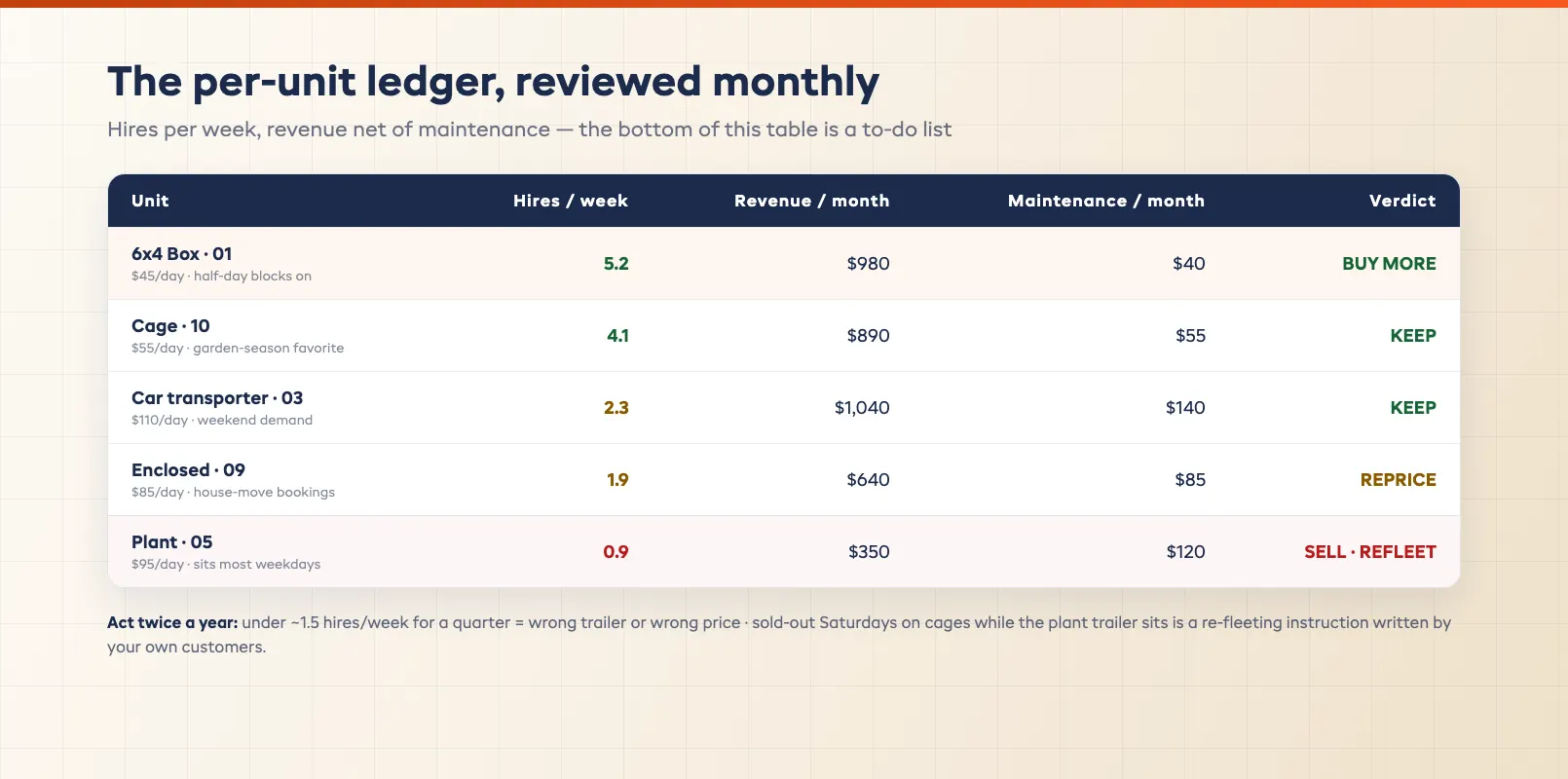
- Hires per week per unit: the velocity number. A healthy general-purpose unit turns 3-5 times a week in season; anything under 1.5 for a quarter is the wrong trailer or the wrong price.
- Revenue per unit per month, netted against its maintenance spend. Tandems and transporters earn more per hire but cost more per year in bearings, brakes, and tires — the ledger shows whether the premium units actually out-earn a second box trailer in the same parking space.
- Type-level demand: the booking system's search and sell-out data tells you what customers wanted and couldn't get. Sold-out Saturdays on cage trailers while the plant trailer sits is a re-fleeting instruction, written by your own customers.
Twice a year, act on the bottom of the ledger: reprice it, or sell it and put the capital into whatever sells out. A trailer yard's fleet should be the most responsive in the rental industry — units are cheap, liquid, and quick to source, so there's no excuse for carrying passengers.
Plans that fit a trailer yard start at $23/month on annual billing. See pricing for the current tiers, and the trailer rental software page for the full feature rundown. For the rate card itself (duration tiers, the weekend as its own rate, and overdue fees that charge themselves) see weekend pricing for trailer hire.
FAQ
What does trailer hire software actually need to do?
Five things: take bookings online 24/7 in half-day and daily blocks with real-time availability by trailer type; run the yard from a live board showing what's out, due back, ready, and off-fleet; put the handover (license, hitch, lights, photos, signature) on a phone in five minutes; handle deposits as automatic card pre-authorizations with photo evidence for damage claims; and report hires per week and revenue per unit so fleet decisions come from data. Anything beyond that is nice to have; anything less and the yard is running on a whiteboard and memory.
Should trailers be booked by unit or by type?
By type, always. The customer books a "6x4 box trailer" and the system assigns a specific unit from the pool at collection time. Pooling keeps utilization high because any ready unit can fill any booking of its type. When a specific trailer goes off-fleet for a bearing or a light board, the booking simply draws from the rest of the pool. Assigning registrations at booking time strands capacity every time a unit needs repair, and in a high-turnover yard something always needs repair.
Are half-day trailer hires worth offering?
Yes. They're the core of a high-velocity yard. The tip-run and pickup-collection customer needs a trailer for three or four hours, and a 4-hour block priced at 60-70% of the day rate gets that unit back on the lot for a second hire the same afternoon. Two half-day hires out-earn one full-day hire on the same trailer, and the half-day product wins the customers who would otherwise borrow a mate's trailer rather than pay a full day for a morning's work. Build the buffer time in so back-to-back blocks never collide.
How much deposit should a trailer rental take?
Tier it by unit value: $100-200 on standard box and cage trailers, $300-500 on car transporters, plant trailers, and enclosed units. Take it as a card pre-authorization at booking or collection, not cash, and release it automatically on a clean return. Pair the deposit with timestamped four-corner photos at handover and return, plus a published damage schedule with flat prices for the common items (light board, jockey wheel, spare, tailgate hardware), so disputes settle by comparison against a signed schedule instead of by argument at the counter.
How many times a week should a hire trailer go out?
A healthy general-purpose unit (box, cage, or single-axle) turns 3-5 times a week in season. Specialty units like transporters and plant trailers turn less but earn more per hire, so judge them on monthly revenue net of maintenance rather than raw turns. The number to act on is the floor: any unit under about 1.5 hires a week for a full quarter is the wrong trailer for your market or the wrong price, and trailers are cheap and liquid enough that repricing or replacing the bottom of the fleet twice a year should be routine.
What should a trailer handover include?
Five steps in about five minutes: sight and photograph the license and confirm the tow vehicle's rating covers the loaded trailer; seat and lock the coupling with safety chains crossed; test the lights on a full walk-around; take timestamped photos of all four corners plus the coupling; and capture a digital signature on the hire terms and damage schedule. Run it as a checklist on a phone against the booking so every hire produces the same evidence trail — the routine protects the yard on the road-liability side and wins the small damage disputes that trailer hire generates constantly.
in one place