Charter Add-On Revenue: Catering, Photography, and Equipment Upsells
Charter Add-On Revenue: Catering, Photography, and Equipment Upsells
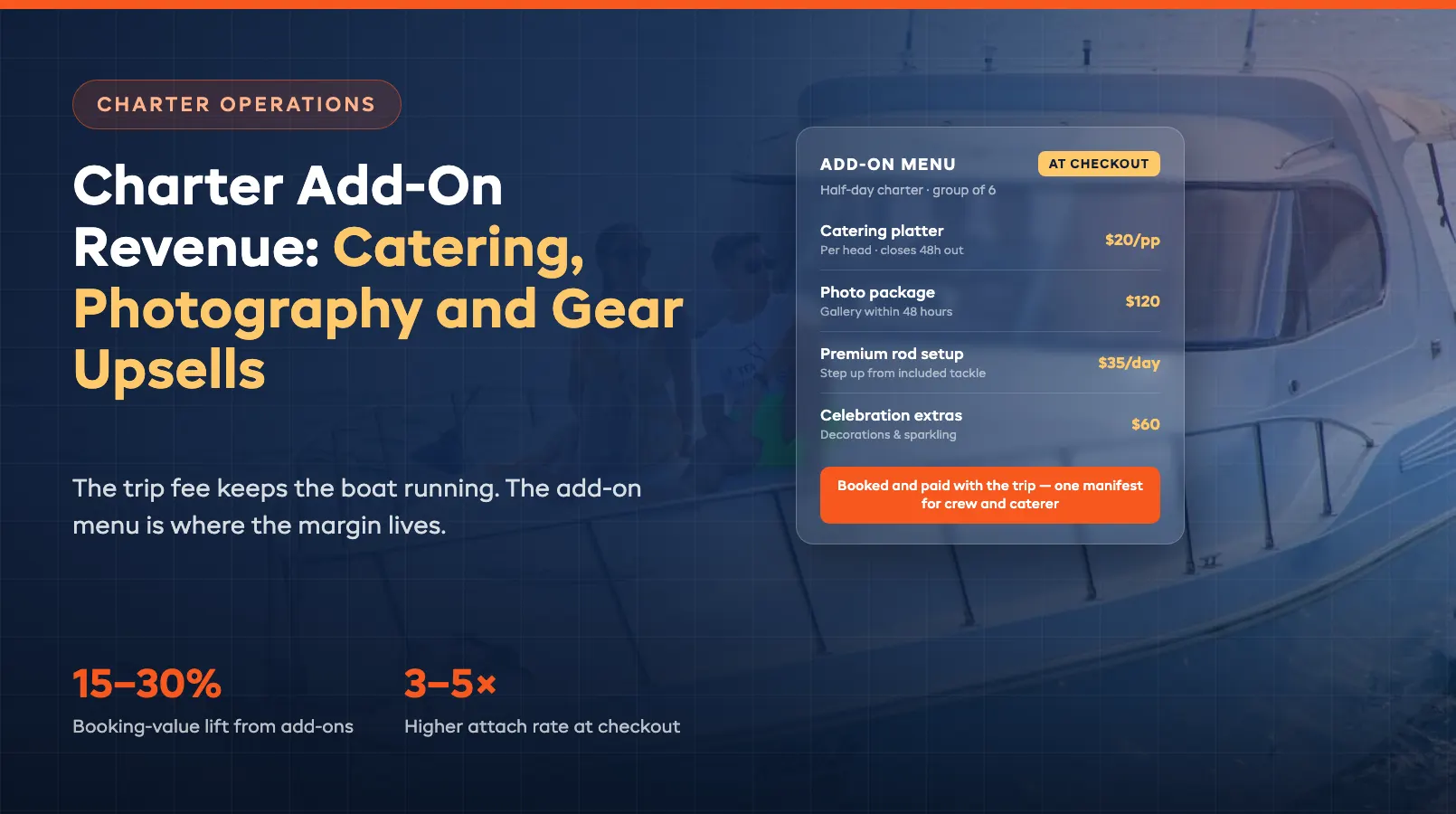
Most charter operators price the trip carefully and treat everything else as an afterthought. That's backwards on margin. The trip fee has fuel, crew, insurance, and maintenance baked into it; a catering platter, a photo package, or a rented rod-and-reel setup carries almost none of that cost. Operators who run a real add-on program routinely lift booking value 15-30%, and the extra revenue lands at margins the charter itself can't touch. The catch is that add-ons only sell when they're offered at the right moment, priced as named products, and fulfilled without slowing down your dock. This guide works through the menu, the pricing, the timing, and the numbers.
It builds on our guide to charter pricing strategy — get the base trip price right first, then layer add-ons on top of it. If you're still setting up the operation itself, start with how to run a charter business.
Why Add-Ons Beat Raising the Trip Price
Raising the headline trip price is the obvious move, and it's also the one guests comparison-shop hardest. A $700 half-day that becomes $800 loses bookings to the $700 boat next door. The same guest who balked at $800 will happily book the $700 trip and add a $60 catering platter, a $95 photo package, and $40 of gear — because each add-on is a choice, priced against what it delivers, not against the competing boat.
The margin story is even better than the revenue story:
- The trip carries fuel, crew wages, dock fees, insurance, and engine hours. A well-run charter nets 25-35% on the trip fee.
- Catering bought from a local caterer at $8-12 a head sells at $18-25 a head. Margin: 50-60%, and the caterer does the work.
- Photography costs you a waterproof camera, a crew habit, and 20 minutes of editing time. A $95-150 package is nearly all margin after the first season.
- Equipment — premium rods, snorkel sets, SUPs towed along — is gear you already own, renting at $15-40 a day per item against a purchase cost it repays in weeks.
The operators who skip this aren't leaving a few dollars on the table. On a boat running 200 trips a season, a $75 average add-on take per trip is $15,000 of high-margin revenue — often the difference between a season that covers the refit and one that doesn't.
Building the Add-On Menu
The menu works when it's short, named, and priced flat. Guests scanning a checkout page don't want fifteen options with sliding scales; they want four to six clear products they can add in one tap.
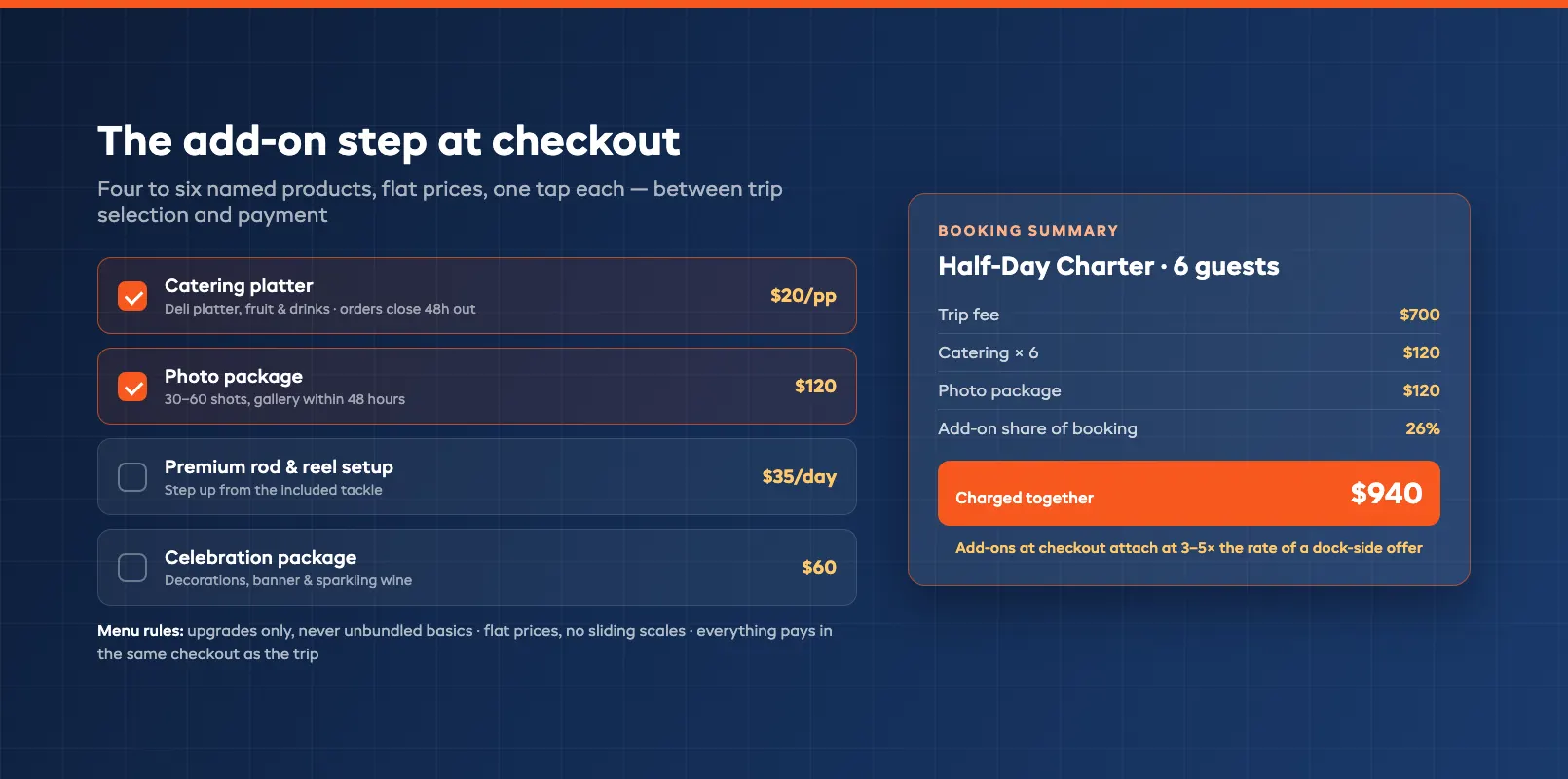
A proven starter menu for a six-pack or day-charter operation:
- Catering platter (per group or per head) — deli platter, fruit, drinks package. One supplier, one standing order format.
- Premium provisioning — the upgrade tier: breakfast spread for early departures, or a celebration package with cake and sparkling wine for birthdays and proposals.
- Photo package — crew-shot photos through the trip, delivered as an online gallery within 48 hours.
- Premium gear — the step up from included equipment: premium rod-and-reel setups, full snorkel kits, a SUP or inflatable towed along.
- Occasion extras — decorations, a banner, flowers. Low volume, but these guests are the least price-sensitive on your calendar.
Keep included items included. If life jackets, basic tackle, or water were part of the trip last season, charging for them now reads as a fee grab and poisons the rest of the menu. Add-ons are upgrades, never unbundled basics.
Pricing Each Category for Margin
Each category has its own cost structure, so price them separately instead of applying one markup rule.
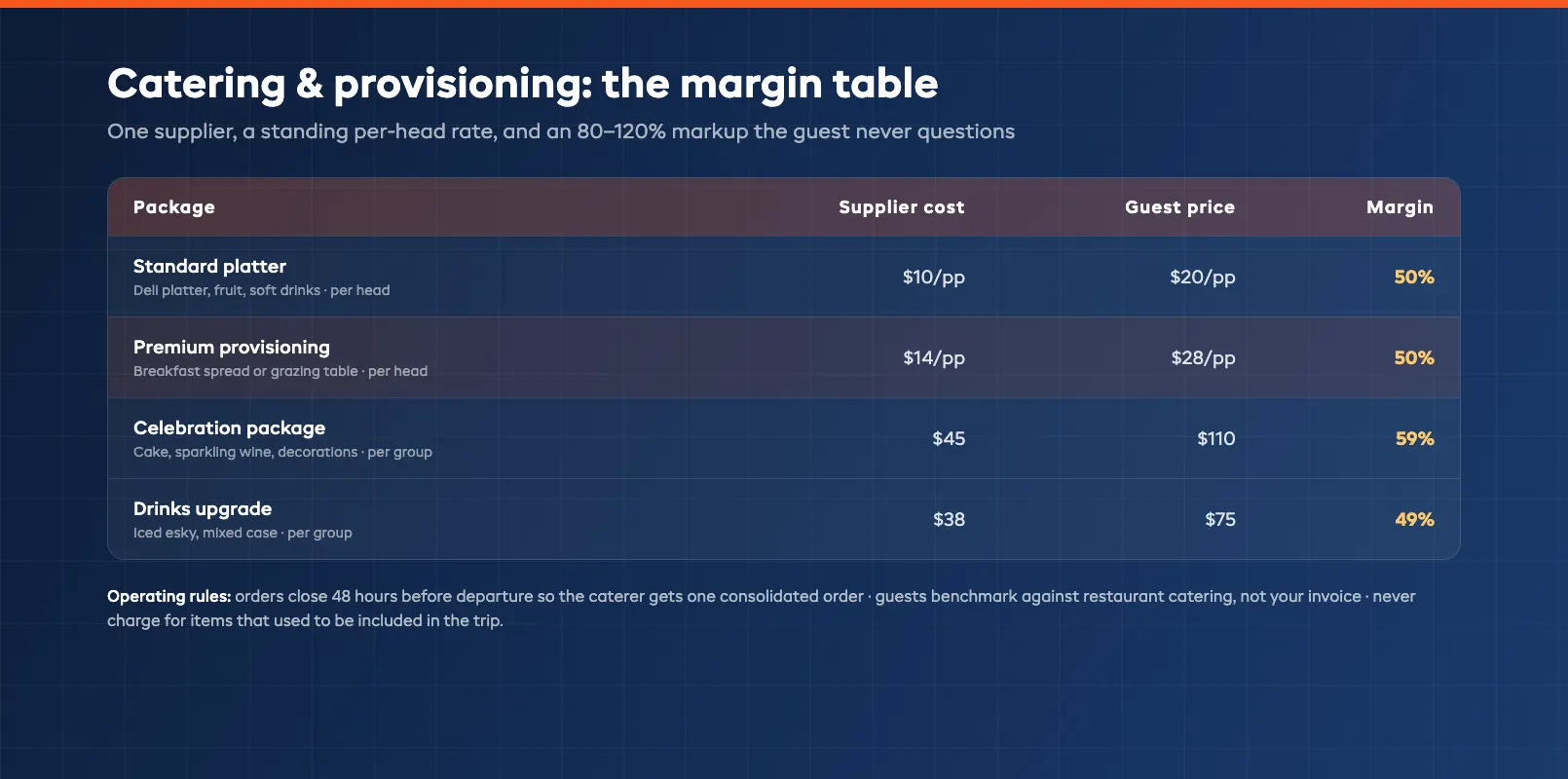
Catering and provisioning. Negotiate a standing per-head rate with one local caterer — consistency beats variety here — and mark it up 80-120%. A platter costing you $10 a head sells at $20 a head without pushback, because guests price it against restaurant catering, not against your invoice. Require add-on catering orders to close 48 hours before departure so the caterer gets one consolidated order and you never eat a no-show platter.
Photography. Price the package, not the photos: $95-150 for a gallery of 30-60 shots delivered within 48 hours. The crew shoots through the trip on a dedicated waterproof camera — never a personal phone — and the same three or four moments sell every time: departure, the first catch or first swim, the group shot at the landmark, golden hour on the way home. Offer it at booking, then re-offer it once on board to the groups who declined; seeing the crew shooting other moments converts a surprising share of them.
Equipment. Tier it against what's included. The trip includes basic tackle; the add-on is the premium setup at $25-40 a day. The trip includes masks; the add-on is the full snorkel kit with fins and a wetsuit top at $15-20. Track add-on gear as inventory with sizes and condition, exactly as a rental shop would — a sold add-on you can't fulfill at the dock is worse than one never offered.
Occasion extras. Price these highest of all relative to cost. A $60 decoration package costs $15 in materials and ten minutes of crew time, and the guest booking a proposal charter is not comparison-shopping the banner.
Sell at Checkout, Not at the Dock
Timing decides attach rate more than pricing does. The same add-on menu converts at wildly different rates depending on when it's offered.
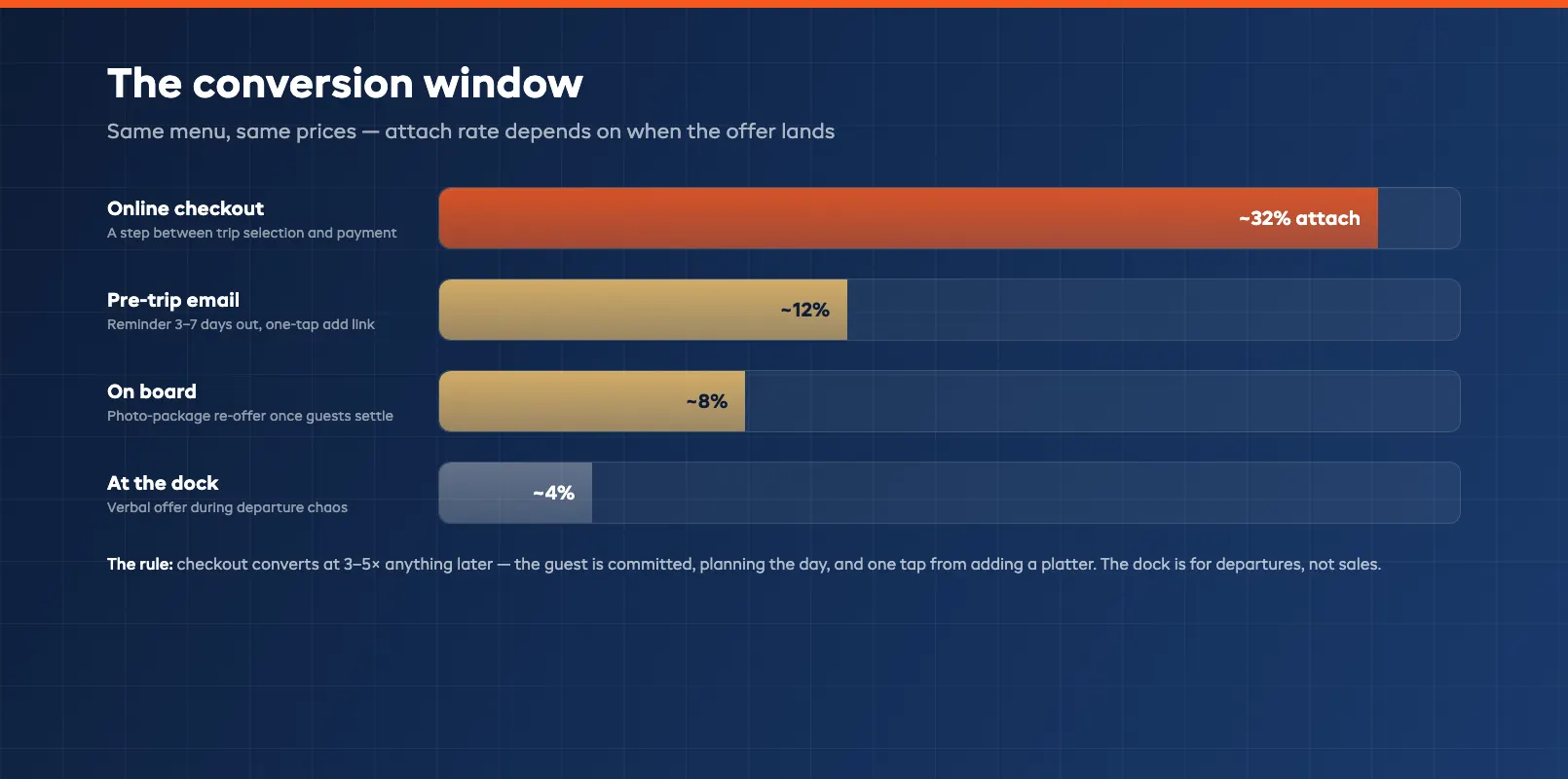
- At online checkout is the window that matters. The guest is already committed, card in hand, planning the day in their head. Add-ons offered as a step between trip selection and payment attach at 3-5x the rate of anything offered later. This is where booking software earns its keep: the add-on step, the flat prices, and the cut-off rules all run without anyone touching them.
- In the pre-trip email is the second chance. A confirmation or reminder email 3-7 days out, with a one-tap link back to add catering or photos, catches the guests who rushed checkout. It also enforces your catering cut-off naturally.
- At the dock is the worst window. The group is managing bags, kids, and parking; the crew is managing departure. Verbal upsells here convert poorly and slow the turnaround. The only dock-side offer that works is the photo package re-offer once guests are aboard and relaxed.
One rule ties this together: every add-on must be bookable and payable in the same system as the trip. A catering order living in a text thread and a photo package settled in cash at the dock are how add-on programs die — unfulfilled orders, untracked revenue, and no attach-rate data to manage against. Confirmations should list the add-ons alongside the trip so guests, crew, and the caterer are reading the same manifest — the same discipline covered in charter manifests and waivers.
Fulfillment That Doesn't Slow the Dock
An add-on program lives or dies on the morning routine. The structure that scales:
- One consolidated caterer order per day, generated from the booking system at the 48-hour cut-off, delivered to the dock an hour before first departure. Crew checks it against the manifest, not against memory.
- A gear pull list per trip: which premium setups, which sizes, which boat. Pulled the night before, staged by trip, checked back in at return like any rental.
- A photo workflow the crew can run on autopilot: same camera, same shot list, same upload folder. Editing is batch-processed once a day; the gallery link goes out through the booking system within 48 hours.
- Weather integration. When a trip moves or cancels under your weather policy, the add-ons must move or refund with it automatically — a rebooked trip with a lost catering order generates the worst kind of review.
None of this needs a bigger crew. It needs the add-ons to exist as line items in the same system as the bookings, so the morning's work is printed, not remembered.
Track Attach Rate or You're Guessing
Two numbers tell you whether the program works, per add-on, per month:
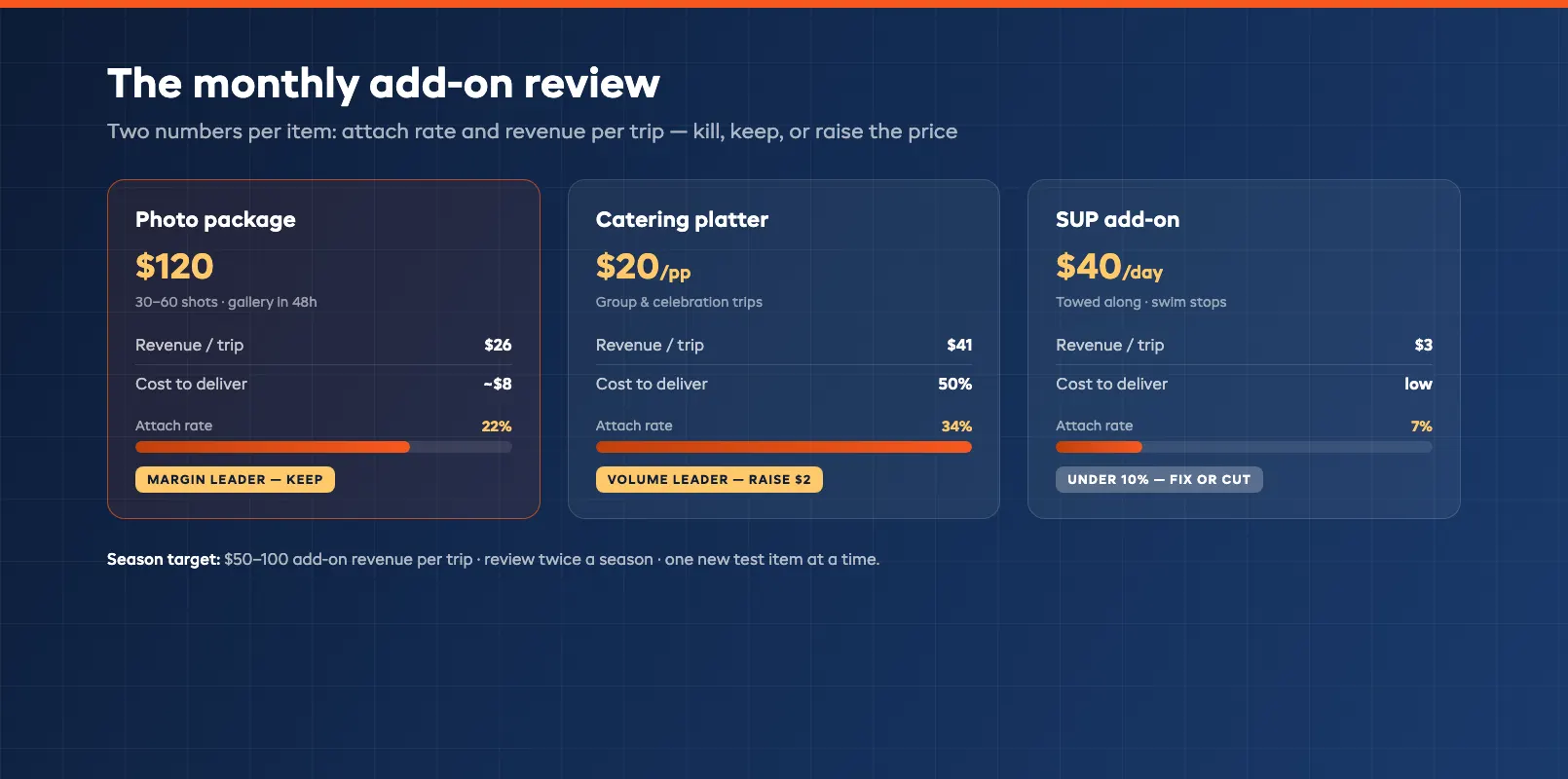
- Attach rate — the share of bookings that include the add-on. Healthy benchmarks: catering 25-40% on group and celebration trips, photography 15-30%, premium gear 10-20% on fishing charters. An add-on stuck under 10% for a season has a pricing problem, a placement problem, or shouldn't exist.
- Add-on revenue per trip — total add-on revenue divided by trips run. This is the number to grow season over season; $50-100 per trip is a realistic target for a day-charter operation with a working menu.
Review the menu twice a season. Kill the item nobody buys, raise the price on the one everyone buys, and test one new item at a time. The charter booking confirmation checklist keeps add-ons visible at confirmation, and the no-show follow-up agent protects the revenue when a guest with a paid catering order doesn't appear.
For the wider operation — scheduling, crew, compliance, pricing — the charter operations hub collects every guide in this series, and the charter operator glossary covers the terms.
FAQ
What add-ons sell best on a charter?
Catering is the volume leader — 25-40% of group and celebration bookings add it when it's offered at checkout as a flat-priced platter or package. Photography is the margin leader: a $95-150 gallery package costs almost nothing to deliver once the crew routine exists. Premium equipment (rod-and-reel upgrades, full snorkel kits, towed SUPs) attaches at 10-20% on the right trip types. Occasion extras — decorations, flowers, celebration packages — are low volume but carry the highest markups on the menu.
How much should a charter mark up catering?
80-120% over your supplier cost is the working range. A platter that costs $10 a head from your caterer sells at $18-25 a head, because guests benchmark against restaurant and event catering rather than your invoice. Negotiate a standing per-head rate with one caterer, close catering orders 48 hours before departure so the order consolidates cleanly, and never unbundle items that used to be included in the trip — add-ons are upgrades, not fee grabs.
When should add-ons be offered to charter guests?
At online checkout, as a step between choosing the trip and paying. Add-ons offered there attach at 3-5x the rate of anything offered later — the guest is committed, planning the day, and one tap from adding a platter. The pre-trip reminder email 3-7 days out is the second window and catches the rushed bookers. The dock is the worst window: the group is distracted, the crew is busy, and the only offer that works there is a photo-package re-offer once guests are settled aboard.
Are photography packages worth it for a small charter operation?
Yes — they're usually the highest-margin item a charter can sell. The setup cost is a waterproof camera and a repeatable crew shot list (departure, first catch or first swim, the landmark group shot, golden hour). Price the package at $95-150 for a 30-60 shot gallery delivered within 48 hours, offer it at booking, and re-offer once on board. After the first season the package is nearly all margin, and the galleries double as your best marketing material when guests share them.
What attach rate should charter add-ons hit?
Per category: catering 25-40% on group trips, photography 15-30%, premium gear 10-20% on fishing and snorkel charters. Roll it up into add-on revenue per trip — total add-on revenue divided by trips run — and grow that number season over season; $50-100 per trip is a realistic target for a working day-charter menu. Any item stuck under a 10% attach rate for a full season has a pricing, placement, or existence problem: fix the price, move it to checkout, or cut it.
Do add-ons need to be in the booking system?
Yes, without exception. Every add-on should be bookable and payable in the same checkout as the trip, listed on the same confirmation, and visible on the same manifest the crew and caterer work from. Add-ons managed through text threads and dock-side cash are how programs fail — orders get missed, revenue goes untracked, and there's no attach-rate data to manage the menu with. It also means when a trip reschedules under your weather policy, the add-ons move or refund automatically with it.
in one place