Brake Tests, Lights and Ramps: Keeping Trailers Legal and Hireable
Every trailer yard has a version of the same story. A tandem-axle transporter goes out on a Saturday morning, the customer gets pulled over or has a near miss, and someone checks the file on Monday to find the brake service was due six weeks ago. Nobody skipped it on purpose. The date was on a wall planner behind the counter, the planner said October, and October got busy.
The failure is not discipline. Counter staff on a Saturday with a queue of tow vehicles are never going to cross-reference a wall chart. The failure is structural: the test date lived on a planner instead of on the unit, so nothing stood between an out-of-test trailer and a paying customer. This guide is about closing that gap - what to inspect and how often, how to schedule against the unit, how to make a lapsed test block the booking automatically, and the condition records that hold up when an insurer or an auditor asks to see them.
This is the operations half of the story. For the software side - what a platform needs to do for a hire yard overall - see the trailer hire software guide or the trailer rental software feature breakdown. For the pricing side - rate tiers, weekend rates, and overdue fees - see weekend pricing for trailer hire.
What to Inspect and How Often
A hire trailer works harder than a private one. It gets loaded by people who have never balanced a load, reversed by people who have never reversed, and hitched by whoever is standing closest. Intervals that would be fine for a farm trailer are too long for a hire fleet.
A working inspection structure has three tiers:
Every hire (the handover and return check). Coupling and safety chains, full lights test, tire condition and pressure by eye, breakaway cable or battery where fitted, ramps and tailgate latches, winch strap condition on transporters. This is minutes, not an inspection - but it is the tier that catches the light board a customer reversed into a wall last week.
Monthly or usage-based (the yard service). Wheel bearings checked for play and heat, brake actuation and adjustment, tire tread measured and logged, jockey wheel and coupling wear, floor and ramp structural check, wiring plugs cleaned. On high-turn units, run this on hire count rather than the calendar - a box trailer doing five hires a week needs the bearing check long before a unit that went out twice.
Annual or regulatory (the formal test). Registration renewal, the state safety inspection where one applies, a full brake test on braked units, and a documented structural inspection on ramps, drawbars, and welds. For units hired to commercial operators, this is also where DOT-adjacent expectations land - a business customer's insurer may ask for the trailer's inspection history after an incident, and "we look at them regularly" is not an answer.
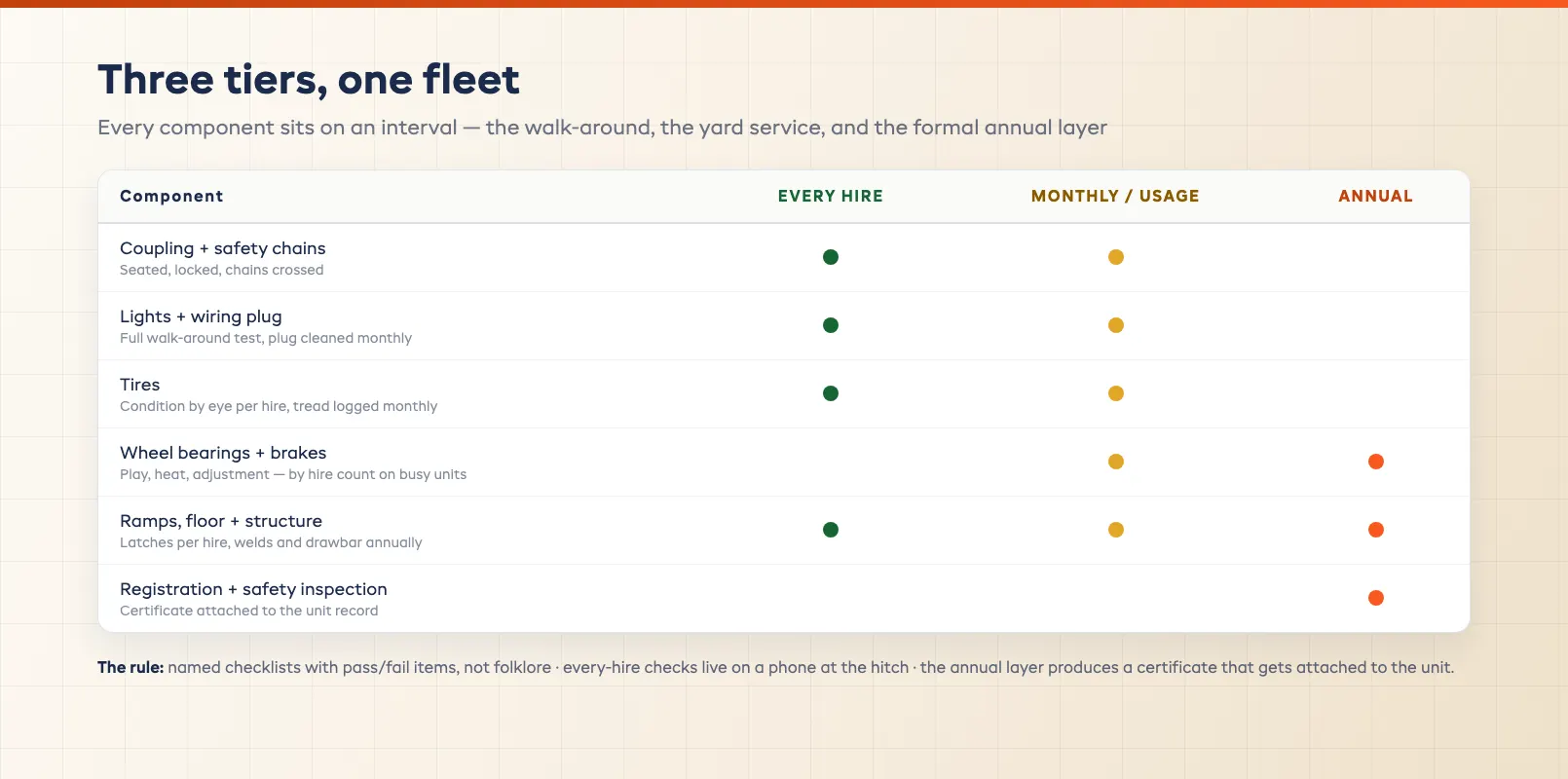
Write the three tiers down as named checklists with pass/fail items, not as folklore. The every-hire check belongs on a phone at the hitch; the monthly service belongs in the workshop with a signature on it; the annual test produces a certificate that gets attached to the unit record, which is the subject of the next section.
Scheduling Against the Unit, Not the Wall Planner
The wall planner fails for one reason: it separates the date from the trailer. The planner knows October; the trailer on row three knows nothing. Whoever hands it over on a Saturday would have to walk to the office, find the right row on the chart, and read it correctly under pressure - so in practice, nobody checks at all.
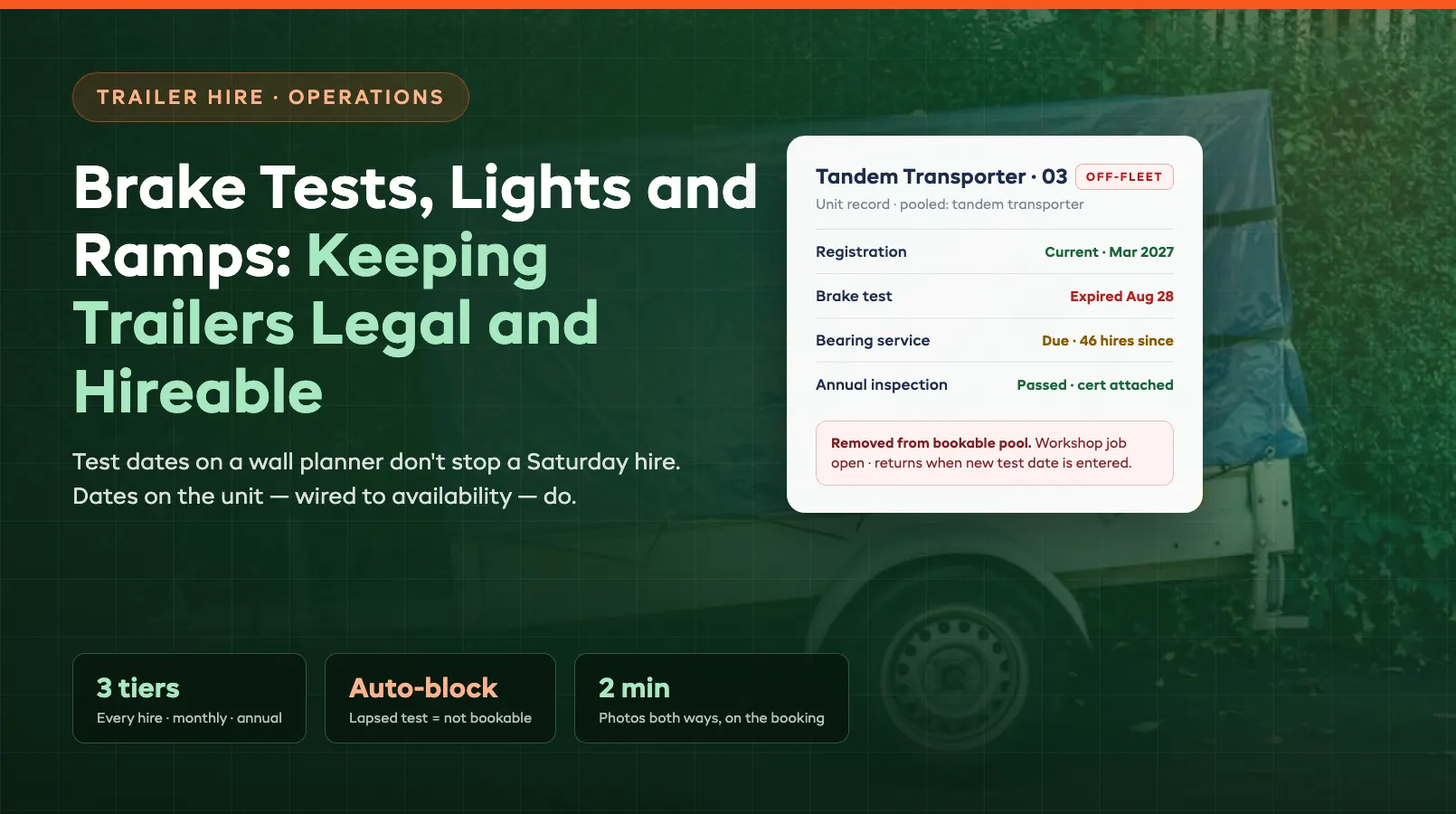
Unit-level tracking inverts that. Every trailer has a record - registration, brake test date, last bearing service, hire count since service, annual inspection certificate - and the schedule is generated from the unit outward. The questions the yard actually asks become one-tap answers: what is due on this unit, and what is due across the fleet this month?
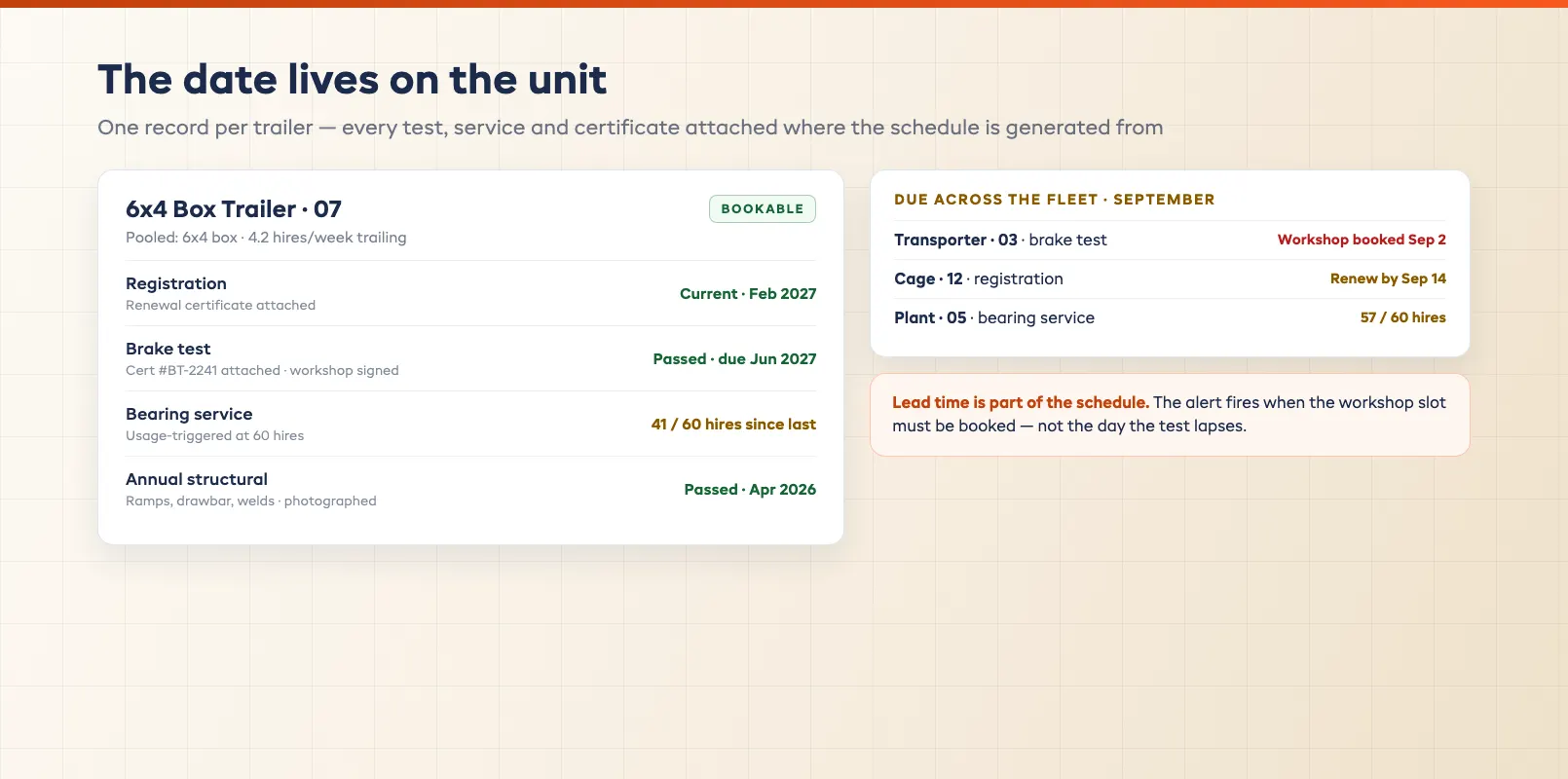
Three rules make unit-level scheduling work in practice:
- Every date lives on the unit record, with the evidence attached. The brake test entry carries the certificate scan; the bearing service carries who did it and when. If it is not on the unit record, it did not happen.
- Usage-based items count hires, not weeks. Maintenance checklists that trigger on hire count fire early on the busy units and stay quiet on the slow ones, which is exactly the shape of real wear.
- Lead time is part of the schedule. A brake test that expires on the 15th needs the workshop slot booked by the 1st. Set the alert at the lead time, not at the expiry - an alert that fires the day a test lapses is an obituary, not a warning.
Squads of one can run this too. A five-trailer operation does not need less structure than a fifty-trailer one - it needs the same structure with smaller numbers, because the owner-operator is also the counter staff, the workshop, and the person the claim lands on.
Blocking Availability Automatically
Alerts are the halfway house. An alert tells someone a test has lapsed; it still relies on that someone to act before Saturday. The full fix is a hard link between the unit's test status and its availability: when the brake test date passes without a new entry, the trailer drops out of the bookable pool on its own.
This is where booking by type earns its keep a second time. Because customers book "tandem transporter, Saturday" rather than a specific registration, one unit going off-fleet for a lapsed test does not cancel anyone's booking - the pool absorbs it, and the yard sees a flagged unit instead of a fielded complaint. The out-of-test trailer sits in the off-fleet column of the yard board with a reason on it, and it cannot be assigned to a hire until the new test date is entered.
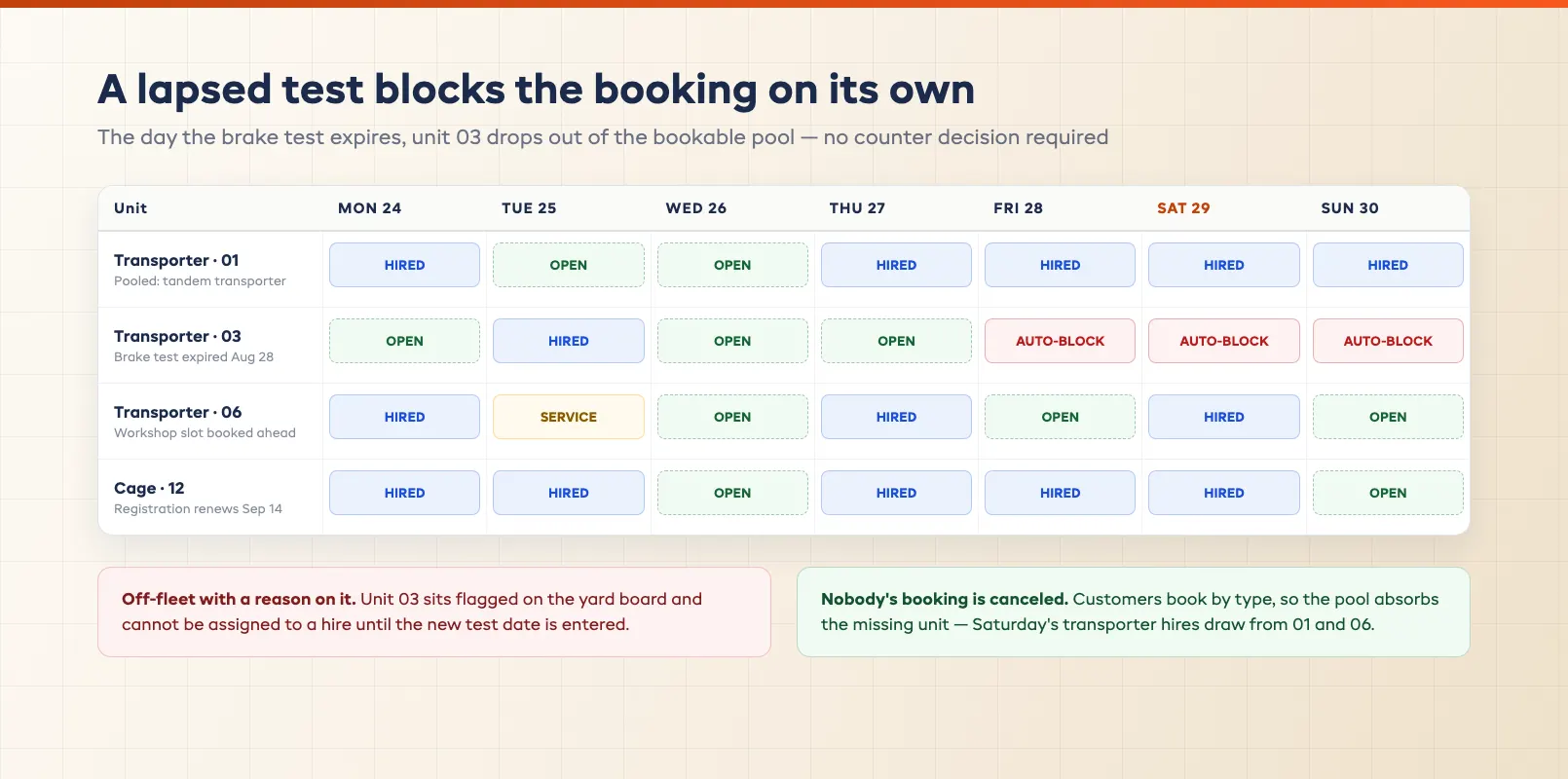
The same mechanism covers planned work. Book the workshop slot against the unit and the block appears in the calendar weeks ahead, so the pool's capacity for that Saturday is honest in advance instead of surprised on the day. Yards that run this way stop having the Saturday conversation entirely: the counter never has to decide whether a trailer is legal, because an illegal trailer is not on the list.
One automation note worth the setup time: have the system chase the paperwork as well as the date. When a new brake test certificate is uploaded, the next due date sets itself; when nothing is uploaded by the lead-time alert, the reminder escalates instead of repeating. Dash Agents can run that loop - watch the dates, open the workshop task, nag until the certificate lands - without anyone owning it as a job.
Condition Photos Both Ways
Test dates keep the trailer legal. Condition evidence keeps it hireable - because the second-fastest way to lose a unit for a week is a damage dispute with no photos.
The routine is symmetrical and takes under two minutes each way:
- At handover: timestamped photos of all four corners, the coupling, the light board, and the deck or interior, taken on a phone against the booking record. Not to the camera roll - against the booking, where they are findable in ninety days.
- At return: the same angles again, plus anything the return inspection flags. The pair of photo sets, sixty seconds apart in viewing time, settles almost every dispute by comparison instead of argument.
The every-hire inspection and the return photos are the same walk-around. Fold them into one checklist so the person at the hitch does one loop of the trailer, not two - tires, lights, chains, corners, coupling, done. A checklist that doubles the yard walk gets skipped by February; one that matches the walk people already do gets completed.
Photograph the customer-facing items too: the signed hire terms and the damage schedule with published prices for the common items - a light board, a jockey wheel, a ramp latch. When the return photo shows a bent latch, the conversation is a line item, not a negotiation.
Damage Into the Workshop, Not Onto a Note
A return inspection that finds damage has to put that damage somewhere. In most yards, "somewhere" is a verbal handoff or a sticky note, and the trailer goes back into the pool with a cracked light lens because the note fell off the board.
The route that works is the same unit-record spine used for testing:
- The return check fails an item. The checklist entry captures the photo and the fault in one step - this is why the return inspection lives on a phone, not a clipboard.
- A workshop job opens against the unit automatically. The fault, the photo, and the booking it came from travel together, so the workshop knows what happened and the deposit claim has its evidence without anyone re-typing anything.
- The unit's availability follows the job status. Minor cosmetic damage can leave the trailer bookable with a note; a brake, light, or structural fault holds it in the off-fleet column until the job closes.
- The repair closes back onto the unit record. Parts, cost, and who signed it off - which is what makes the per-unit maintenance cost real when fleet decisions get made.
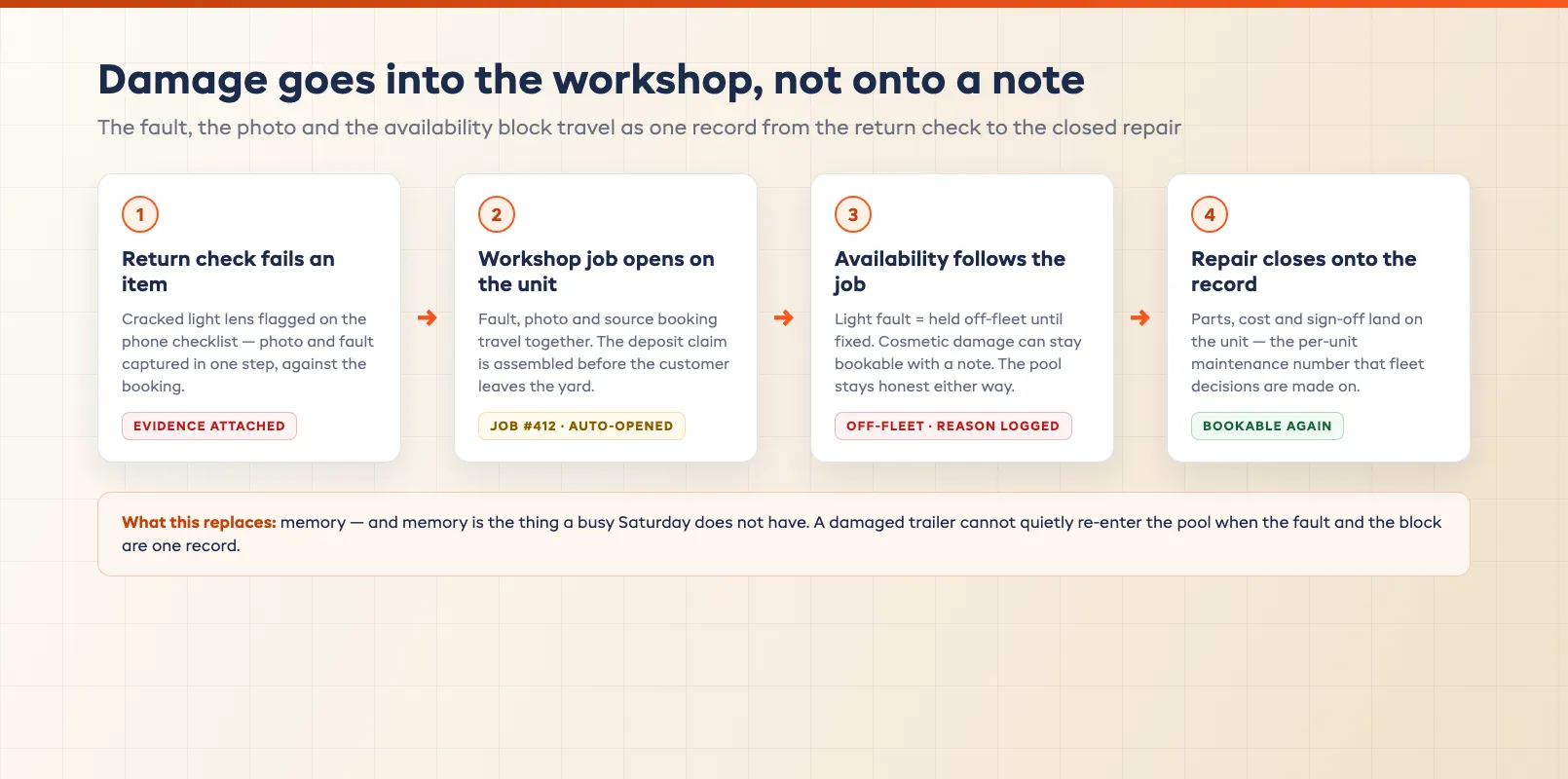
The discipline this replaces is memory, and memory is the thing a busy Saturday does not have. When the fault, the evidence, and the availability block are one record, a damaged trailer cannot quietly re-enter the pool - and the deposit claim is assembled before the customer has left the yard.
Records That Survive an Audit
The last test of the whole system is external. Three audiences will eventually read a trailer's records, and each has a standard:
- The insurer, after an incident. They want the inspection history for the specific unit, the brake test certificate current on the hire date, and the handover evidence showing condition and the customer's signature. A unit record with dated entries and attachments answers in minutes. A wall planner and a box of receipts answers in weeks, if at all - and an insurer who cannot see a maintenance trail prices the next premium as if there is none.
- The regulator or registration authority. State inspection and registration status per unit, produced on request. This is the easiest audience to satisfy and the most expensive to fail.
- The buyer, when a unit is sold. A hire trailer with a complete service history sells at the top of its range for the same reason a serviced car does. The records are worth real money at disposal time - a side effect, but not a small one.
The common thread: records survive when they are created as a by-product of doing the work - the checklist completion is the record, the certificate upload is the record - and they decay when they are a separate admin job for later. Later is the wall planner again, wearing a different hat.
Run the three tiers, keep every date and document on the unit, let the booking calendar enforce what the paperwork says, and photograph both directions of every hire. That is the entire system. None of it is glamorous, and all of it is cheaper than one Saturday with an out-of-test trailer on the highway.
FAQ
How often should hire trailers be inspected?
Three tiers: a walk-around at every handover and return (coupling, chains, lights, tires, ramps), a monthly or usage-based yard service (bearings, brake adjustment, tread depth, structural check), and an annual formal layer (registration, state safety inspection where required, documented brake test on braked units). High-turn units should have the middle tier triggered by hire count rather than the calendar, so a trailer doing five hires a week is serviced sooner than one doing two.
What does a trailer brake test involve?
A documented check that the braking system actuates correctly and performs to standard: coupling-head or electric actuation, brake adjustment at each wheel, breakaway function where fitted, and a stopping-performance check. For hire fleets the test result should be recorded against the unit with the date and the person or workshop that performed it, and the next due date set at the same time. The certificate or record is what an insurer asks for after an incident, so treat it as an attachment to the unit record, not a piece of paper in a drawer.
Why track inspections against the unit instead of a wall planner?
Because the planner separates the date from the trailer. On a busy Saturday, nobody walks to the office to cross-reference a wall chart before a hire, so a lapsed test does not stop the hire. When dates live on the unit record, the system knows a specific trailer is out of test and can pull it from the bookable pool automatically - the counter never has to make the call, because the illegal unit is simply not on the list.
Can software stop an out-of-test trailer from being hired?
Yes, and this is the strongest argument for unit-level tracking. Link each unit's test and inspection dates to its availability: when a date passes without a new entry, the unit drops to off-fleet status and cannot be assigned to a booking. Because customers book by trailer type rather than registration, the pool absorbs the missing unit and no existing booking is canceled. Reminders at lead time - not at expiry - give the workshop time to get the test done before the block ever triggers.
What trailer condition records do insurers actually ask for?
After an incident, expect three requests: the inspection and maintenance history for that specific unit, proof the relevant test (brake test, safety inspection, registration) was current on the hire date, and the handover evidence - timestamped condition photos and the customer's signed hire terms. Yards that keep these as attachments on the unit record answer in minutes. Yards that keep a planner and a receipts box can fail a claim on a trailer that was actually well maintained, because they cannot prove it.
in one place