Nine Changes Before the Day: Managing Wedding Orders Without an Email Thread
Nine Changes Before the Day: Managing Wedding Orders Without an Email Thread
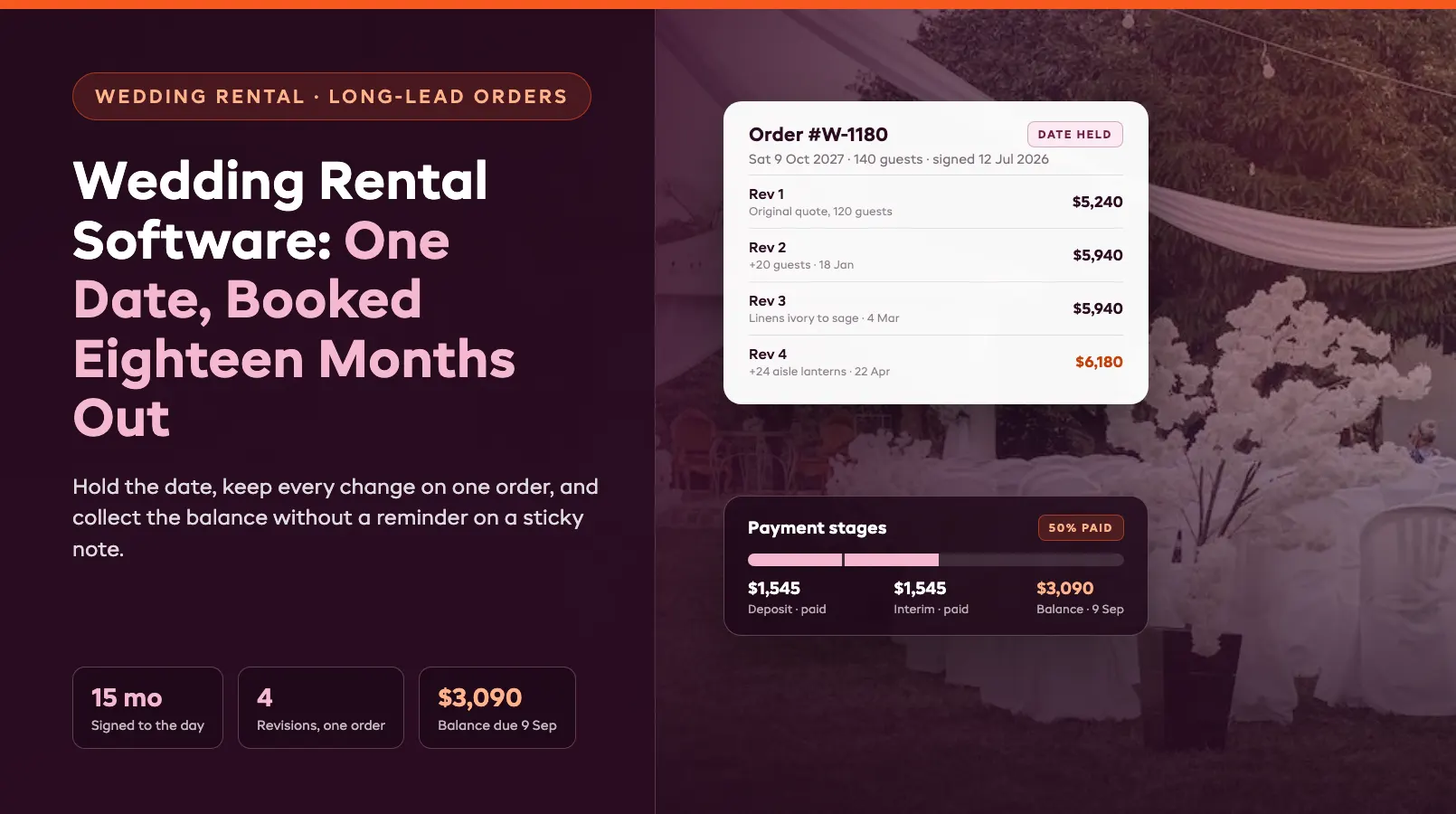
A couple signs in July for a 120-guest wedding the following October. In January they add twenty guests. In March the linens go from ivory to sage. In April they want aisle lanterns, in May they want nicer chairs, and in June they ask for a sweetheart table. In July the planner adds ceremony seating on the lawn. In August the RSVPs come back short. On the day final numbers are due, four more guests confirm. Five days before the wedding, the couple asks to take six guests off the bill.
That is nine changes on one order. None of them is unusual, and each one has a price, a quantity and an availability check attached. If the order lives in an email thread, the final count is whichever message you scrolled to last, and the warehouse loads the truck from a printout that is three changes out of date.
This guide covers how to run a wedding order so it survives all nine: one order with every revision on it, guest count driving the quantities, re-pricing each change, locking final details on a fixed date, telling the couple and the crew what changed, and a checklist for the run-up. If you are setting up a wedding rental business from scratch, start with the wedding rental software guide, which covers holding dates, staged payments and contracts.
One Order, Every Revision
The email thread fails in a predictable way. The original quote is a PDF. The first change is a reply. The second is a phone call written on a pad by whoever answered. The third comes through the planner, the fourth through an Instagram message, and the fifth is agreed at a venue walk-through and never written down at all. By September nobody can say with confidence what the couple ordered, and the one person who might know is on leave the week of the wedding.
The fix is a single order that changes in place, with a log of every change. Here is the order from the opening, change by change:
| Change | Date | What changed | Order total |
|---|---|---|---|
| Signed | Jul 12, 2026 | 120 guests, cross-back chairs, ivory linens, gold setting | $5,240 |
| 1 | Jan 18, 2027 | +20 guests (140) | $5,740 |
| 2 | Mar 4, 2027 | Linens ivory to sage | $5,740 |
| 3 | Apr 22, 2027 | +24 aisle lanterns | $5,980 |
| 4 | May 18, 2027 | Cross-back to Chiavari chairs | $6,260 |
| 5 | Jun 9, 2027 | +Sweetheart table | $6,355 |
| 6 | Jul 14, 2027 | +60 ceremony chairs on the lawn | $6,625 |
| 7 | Aug 20, 2027 | -12 guests after RSVPs (128) | $6,309 |
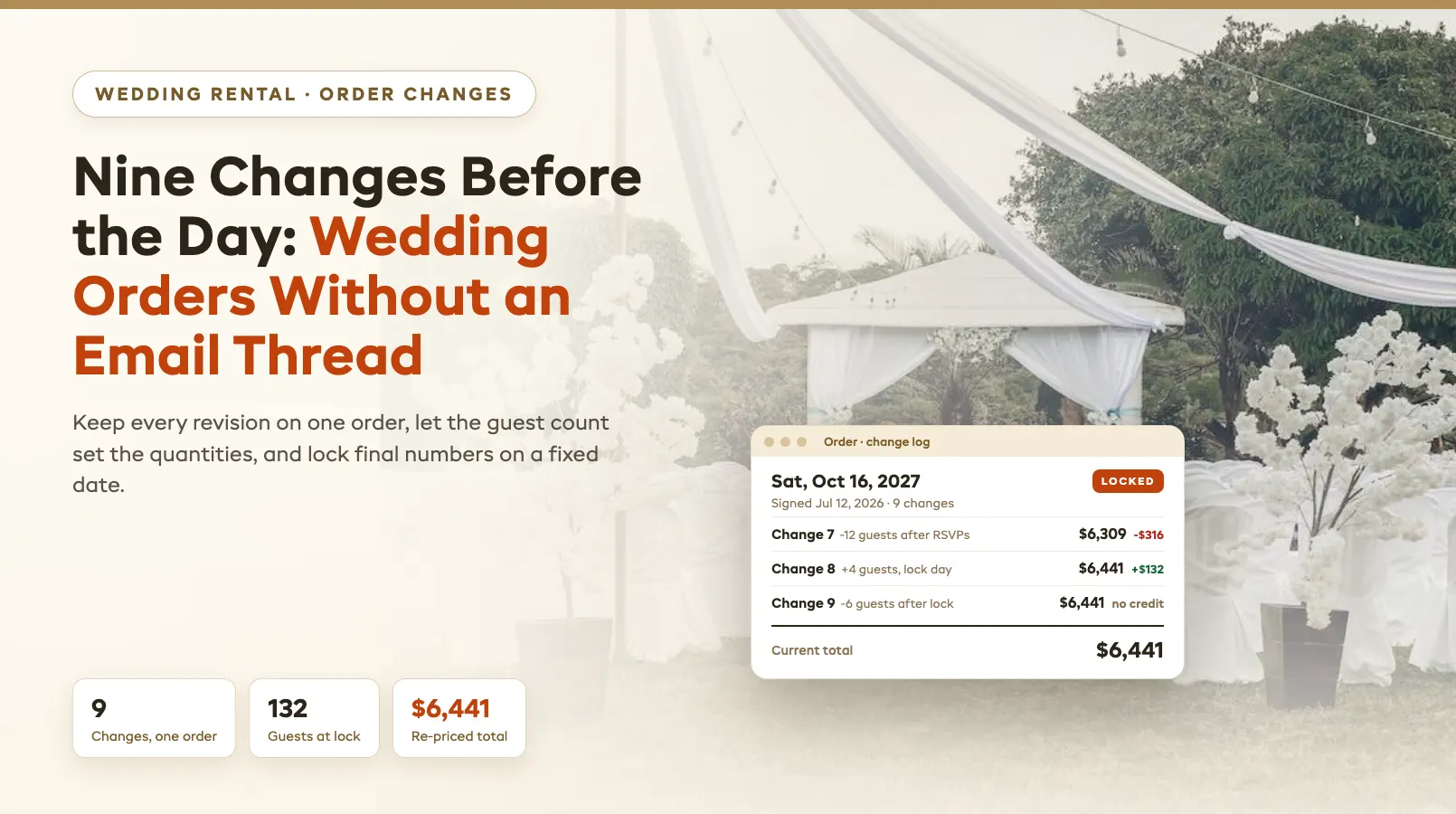
| 8 | Oct 2, 2027 | +4 guests on final numbers day (132) | $6,441 |
| 9 | Oct 11, 2027 | -6 guests requested after lock | $6,441 |
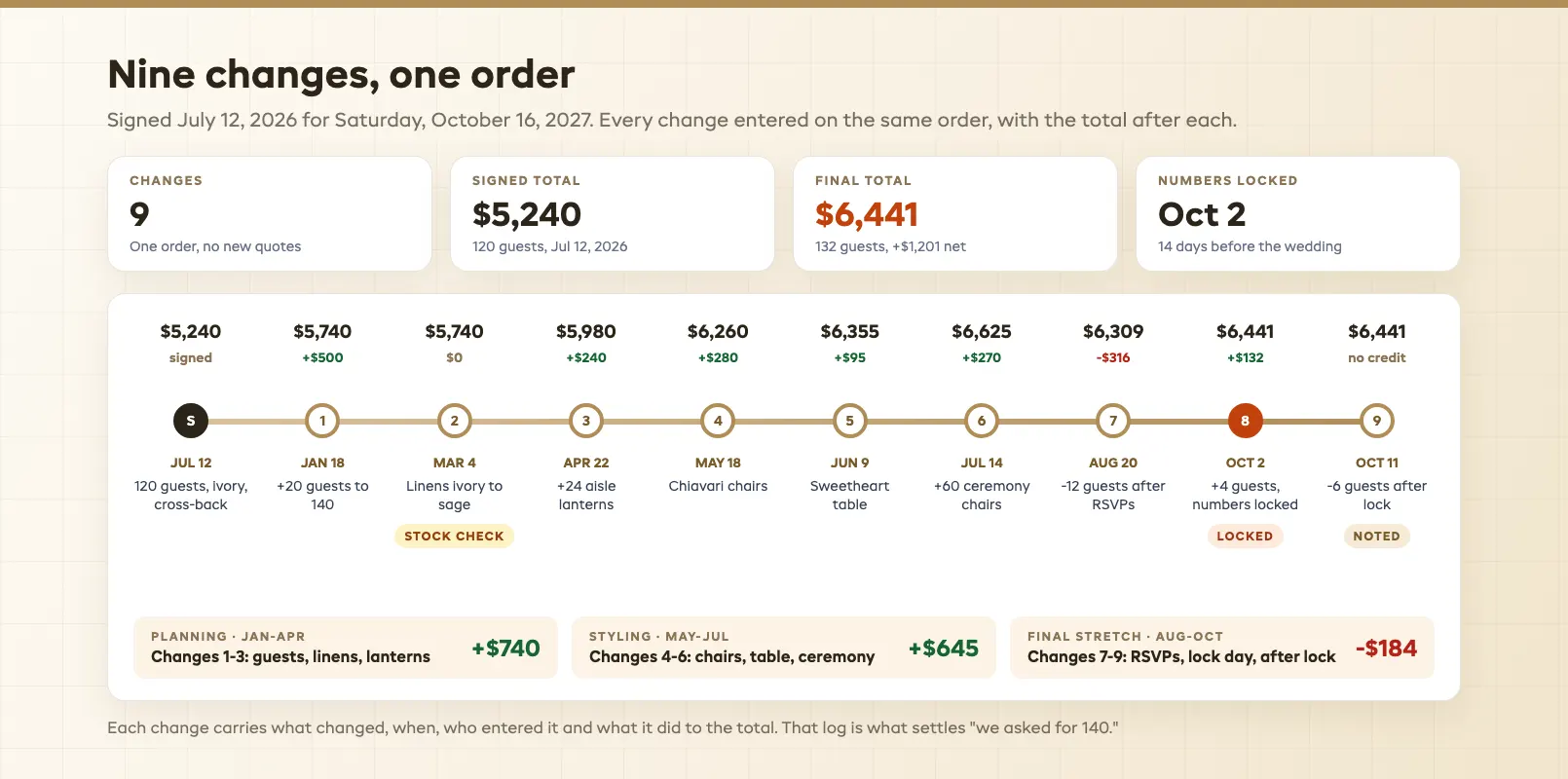
Every row carries four things: what changed, when, who entered it, and what it did to the total. That log is what settles disputes. When the couple says in September that they asked for 140 chairs, you can show that the count went to 128 on August 20, entered by the front desk after a call with the bride, and that the updated order was emailed the same afternoon.
A few rules keep the log honest:
- Whoever takes the change enters it. Not "I'll pass it on." If the owner takes a call at a venue, the change goes in from a phone before the call ends.
- One order per wedding, forever. Never start a new quote for a change. A second quote for the same couple is how two versions of the truth end up in the warehouse.
- Agree at signing who can change the order. Usually the couple and a named planner. A mother of the bride asking for more chairs is a question for the couple, not a change.
- Notes go on the order, not in your head. "Venue gate closes at 11pm" and "bride wants the lanterns lit before guests arrive" belong on the order the crew reads.
On EquipDash's wedding rental software, changes update the same order instead of starting a new quote, and the history shows what changed, when, and what it did to the price.
Guest Count Driving Quantities
Most changes to a wedding order are really one change: the guest count. Twenty more guests means twenty more chairs, two more tables, two more tablecloths, twenty more place settings, sixty more glasses and twenty more napkins. Calculating that by hand on every call is where mistakes come from. Somebody adds the chairs and forgets the glassware, and the styling team finds out at the venue.
Set the ratios once, per item, and let the count drive everything else:
| Item | Ratio | 120 guests | 128 guests | 140 guests |
|---|---|---|---|---|
| Chairs | 1 per guest | 120 | 128 | 140 |
| 60-inch rounds (10 seats) | 1 per 10, rounded up | 12 | 13 | 14 |
| Tablecloths | 1 per table | 12 | 13 | 14 |
| Place setting package | 1 per guest | 120 | 128 | 140 |
| Glassware (wine, water, champagne) | 3 per guest | 360 | 384 | 420 |
| Napkins | 1 per guest | 120 | 128 | 140 |
| Dance floor, bar, arbor | Fixed | 1 | 1 | 1 |
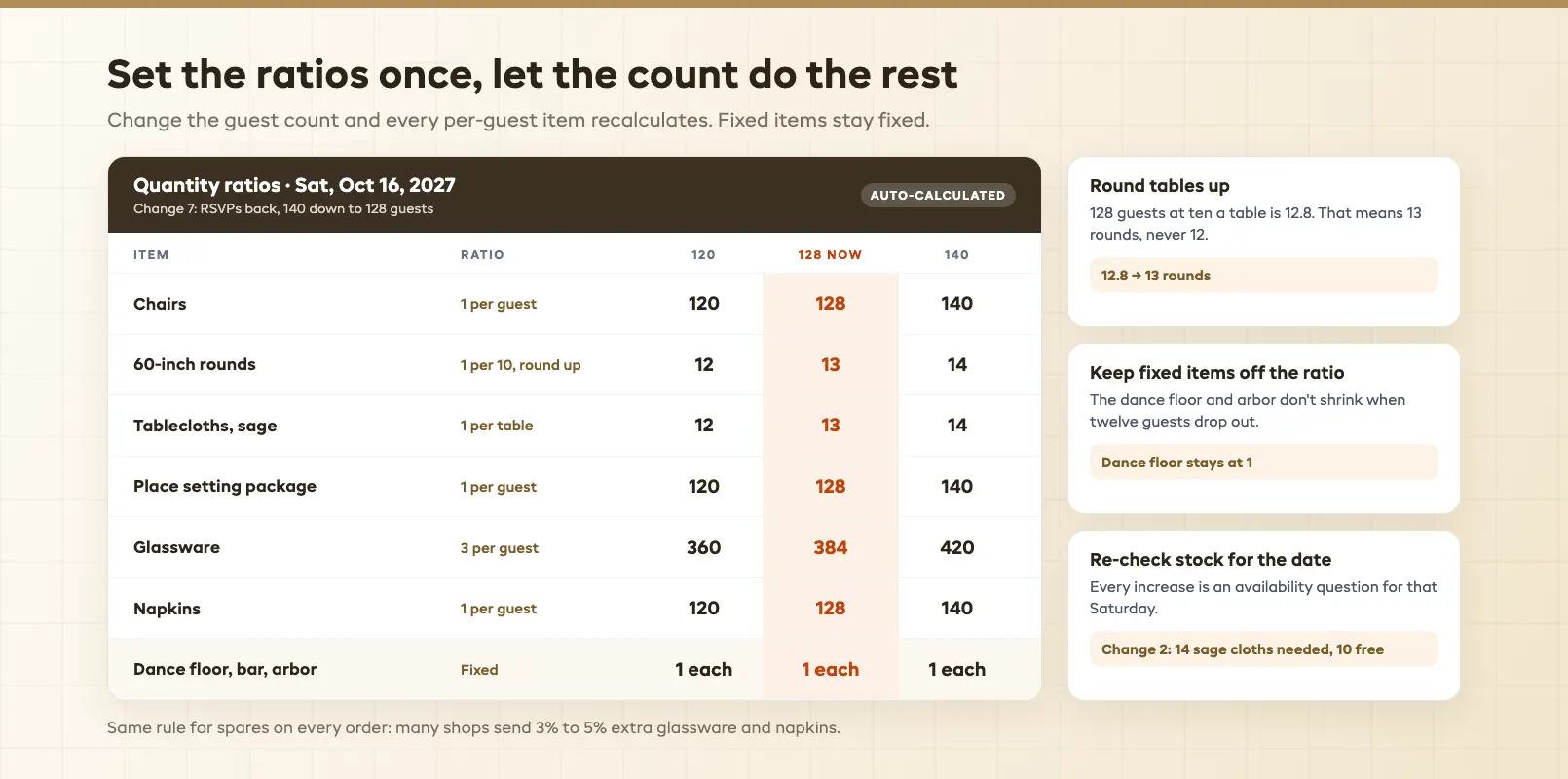
Three details trip people up:
- Round up tables, never down. 128 guests at ten a table is 12.8 tables, which means 13. A table of eight is fine. A guest with no seat is not.
- Keep the fixed items fixed. The dance floor, the bar, the arbor and the sweetheart table don't change with the count. If they are on a per-guest ratio by mistake, a drop of twelve guests quietly removes a tenth of a dance floor from the invoice.
- Decide your spares policy and write it down. Many operators send 3% to 5% extra glassware and napkins because something always breaks or goes missing in setup. Whether the couple pays for spares is your call, but it should be the same on every order.
Every change to the count is also an availability question. On the Saturday in October, you might own 300 Chiavari chairs, with 160 already committed to another wedding. The couple's move from 120 to 140 in January is fine. The same move in September, after a third wedding booked that day, might not be. Checking at the moment of the change gives you months to sub-rent or offer a different chair. Checking the week before gives you a phone call nobody wants to make.
Linen and color changes are the ones people forget to check. Change 2 above cost nothing, but the order now needs 14 sage tablecloths on a Saturday when another wedding already has 10 of your 20. That is a shortfall found in March, when it can still be fixed.
Re-Pricing Automatically
Every change that doesn't re-price is money handed back to the couple without anyone deciding to. It happens most often with small changes taken by phone: "Sure, we can add a few chairs." The chairs go on the truck and never make it onto the invoice.
When the price moves with the quantity, every change carries its own number. From the order above:
- Change 1, +20 guests: +$500. 20 chairs at $6.50, 2 rounds with tablecloths at $40, 20 place settings at $14.50.
- Change 4, Chiavari chairs: +$280. 140 chairs moving from $6.50 to $8.50.
- Change 7, -12 guests: -$316. 12 chairs at $8.50, 1 round with its tablecloth at $40, 12 place settings at $14.50.
- Change 8, +4 guests: +$132. 4 chairs, 1 table back on, 4 place settings.
Two things to get right when the price moves:
The balance follows the order. If the payment schedule is 25% at signing, 25% six months out and the balance 30 days before the wedding, the deposit and interim were fixed at $1,310 each on the original $5,240. The balance is not a fixed number from July 2026. It is whatever the order says 30 days out, minus what has been paid. On September 16, 2027 the order stood at $6,309, so the balance was $3,689.
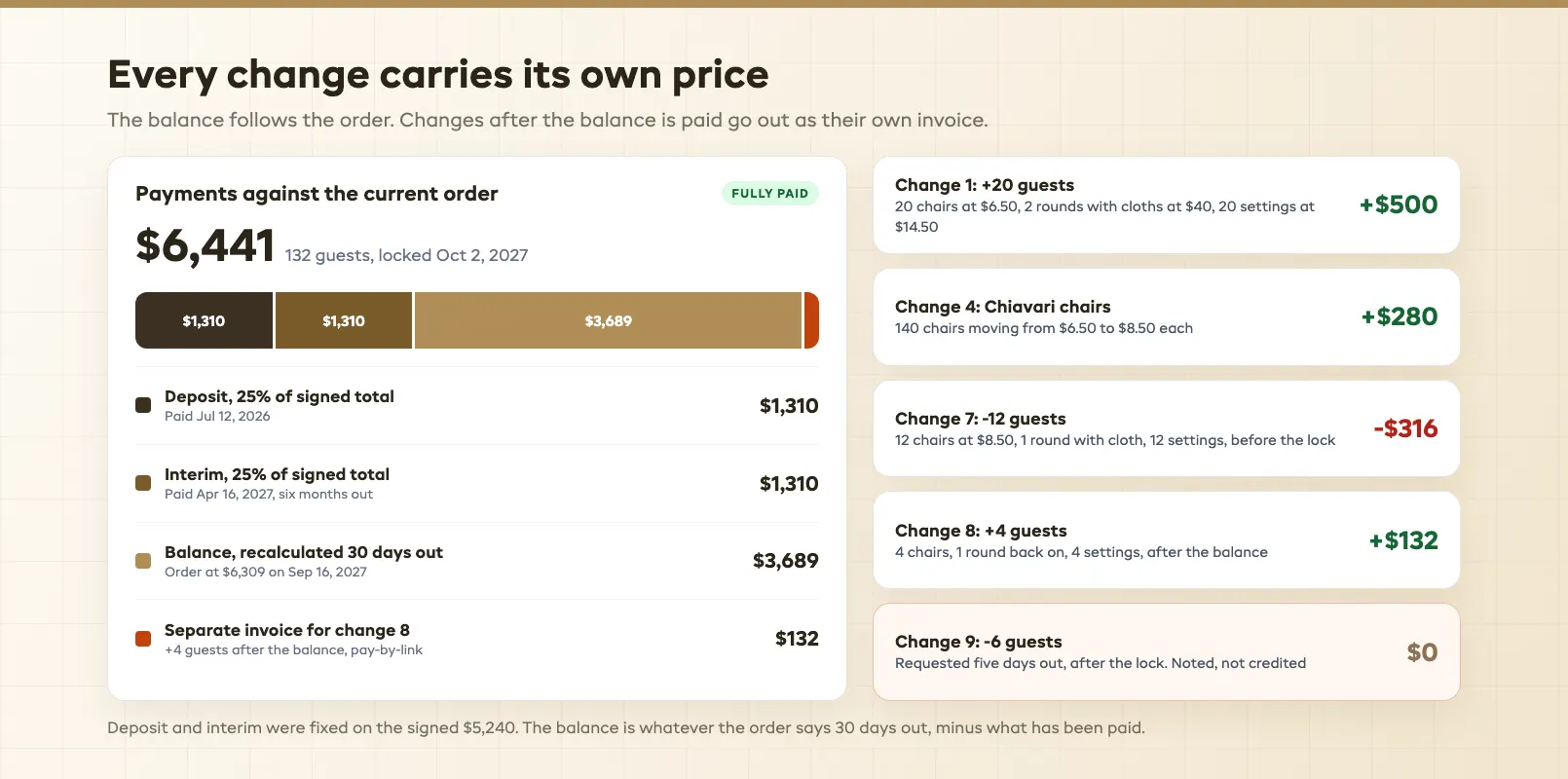
Changes after the balance get their own invoice. Change 8 landed after the balance was paid, so the extra $132 went out as a small invoice with a payment link, due before the wedding. It did not wait for a "we'll sort it out after" conversation, which is where small additions go to be forgotten.
Reductions need a rule too. Most wedding contracts let the couple reduce numbers up to the final numbers date and credit the difference. After that date, reductions don't reduce the bill, because the stock has been pulled, the crew has been booked and the Saturday is gone. That is why change 9 above, six guests off five days before the wedding, left the total at $6,441. The couple had signed that term 15 months earlier, and the log showed it.
Locking Final Details
Every wedding order needs a point after which it stops changing. Without one, the order is still moving on Thursday afternoon while the truck is being loaded, and whoever answers the phone that day decides what goes to the venue.
Set the final numbers date at signing, usually 10 to 14 days before the wedding, and write it into the contract. The order from this guide locked on Saturday, October 2, 2027, exactly two weeks out.
What locks on that date:
- Guest count and table plan. The number of rounds and how many seats at each.
- Every item and quantity. Chairs, linens, settings, lanterns, extras.
- Colors and styles. No more linen swaps once the linens are pulled for washing and pressing.
- Delivery and collection windows. Including venue access times and any gate or noise curfew.
- Contacts on the day. Who the crew calls if the venue is locked, usually the planner and not the couple.
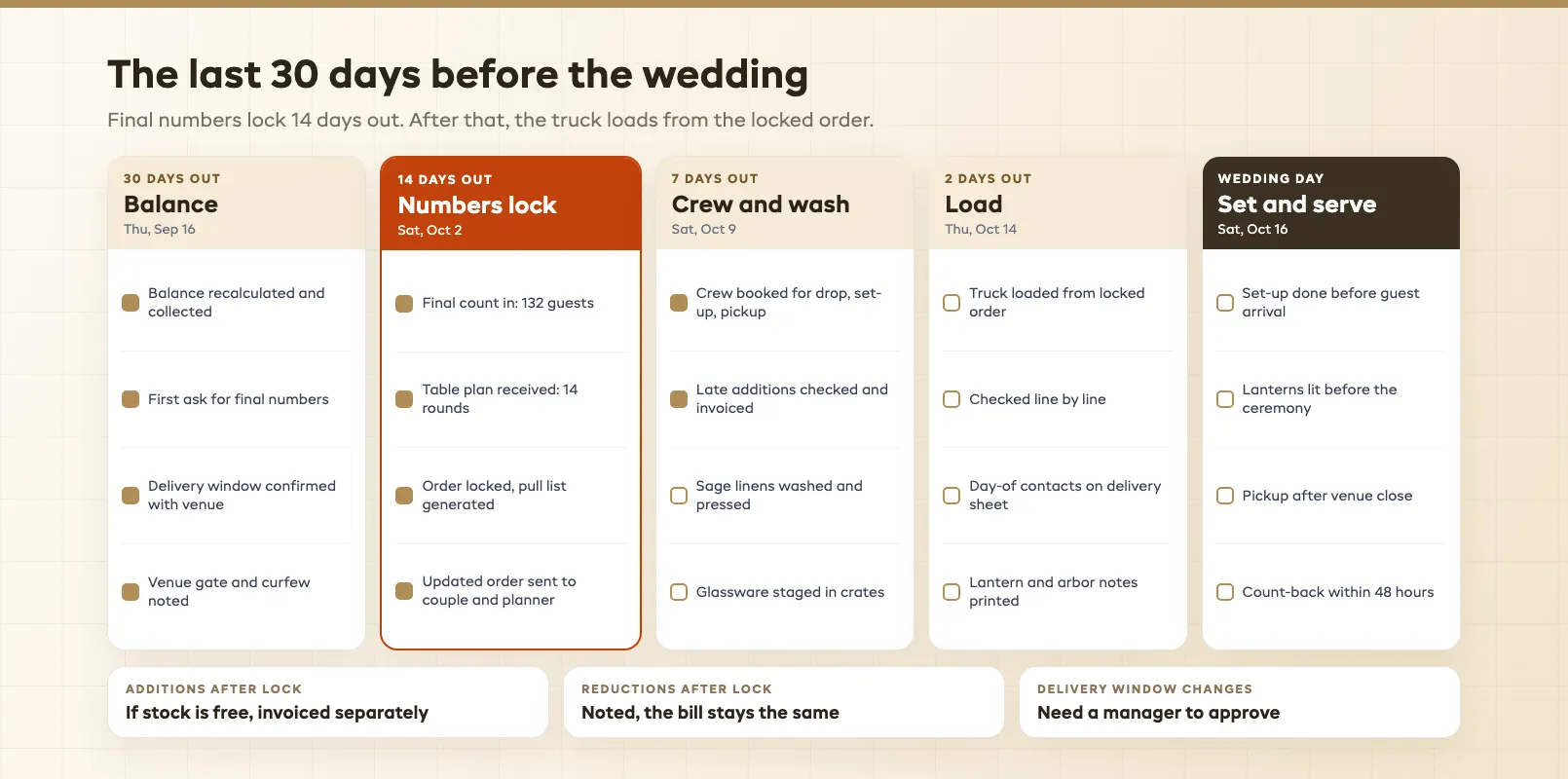
After the lock, the rule is simple. Additions are accepted if the stock is free and the crew can handle it, and they are invoiced separately. Reductions are noted but don't reduce the bill. Changes to delivery windows need a manager.
The hard part is getting final numbers on time. Couples are busy in the last month, and RSVPs come in late. Start asking a month out, again two weeks before the lock, and again three days before. On EquipDash, a Final Details Chase agent requests final guest numbers from couples in the run-up so the order can be locked on schedule.
Once locked, the order produces the pull list. The warehouse loads from the locked order, not from a printout of the last email, and the styling team knows exactly how many sage napkins and gold chargers are coming off the shelf.
Communicating Changes
A change is finished once the couple has seen it in writing and the people doing the work know about it.
To the couple: send the updated order every time. Not "noted, thanks." The reply to any change is the updated order with the change called out and the new total. For example:
Hi Sam and Jordan, your order is updated. Chairs are now Chiavari with ivory pads (140). New total: $6,260, up $280. Nothing else has changed. Reply if anything looks wrong.
It takes a minute, and it ends most disputes before they start. A couple who received and read an order that said 128 guests will not argue in October that they asked for 140.
To the planner: copy them if they are named on the order. Planners often relay changes from the couple and then assume the couple confirmed them. Sending the updated order to both closes that gap.
To the crew: the order is the brief. The warehouse, the styling team and the delivery driver should all work from the same locked order, with notes attached. If the pull list, the setup plan and the delivery sheet come from three different documents, one of them will be wrong. Book set-up and collection crews against the wedding itself, so a change to the delivery window moves the crew's shift with it.
Inside the business: one channel. Changes that arrive by text, voicemail or a message to someone's personal phone get entered on the order by whoever received them, the same day. If your team discusses a change in a group chat, the decision still ends up on the order, or it didn't happen.
A last habit worth building: after each change, read the order top to bottom once. Most mistakes sit in the line next to the change, the one that should have moved and didn't.
The Run-Up Checklist
Use this from the day the order is signed to the count-back. Wedding rental plans start at $23/month on annual billing; see pricing for the current tiers, and the bookings features for how orders and availability work.
At signing
- Final numbers date agreed and written into the contract
- Authorized contacts named on the order (couple, planner)
- Quantity ratios set for every per-guest item
- Spares policy applied the same way as every other order
Every change, all year
- Entered on the order by whoever took it, the same day
- Quantities recalculated from the guest count
- Availability re-checked for the date, including linens and colors
- Price updated and the updated order sent to the couple (and planner)
30 days out
- Balance recalculated from the current order and collected
- First request for final numbers sent
- Delivery and collection windows confirmed with the venue
14 days out (final numbers date)
- Final guest count and table plan received
- Order locked, pull list generated from it
- Any change after today invoiced separately or noted as non-refundable
7 days out
- Crew booked against the wedding for delivery, set-up and collection
- Any late additions checked for stock and invoiced with a payment link
- Linens and glassware pulled, washed and staged
2 days out
- Truck loaded from the locked order, checked line by line
- Day-of contacts and venue notes printed with the delivery sheet
After the day
- Count-back against the locked order within 48 hours
- Breakages and missing items charged against the same order
- Change log reviewed: which changes came late, and should the final numbers date move earlier next season?
For the rest of the setup, from holding dates to staged payments and styling packages, see the wedding rental software page.
FAQ
How do you manage changes to a wedding rental order?
Keep one order for the wedding and change it in place, with a log of what changed, when, who entered it and what it did to the total. Whoever takes the change enters it the same day, the quantities and price update with it, availability is checked again for the date, and the couple gets the updated order in writing. Never start a new quote for a change.
How should guest count changes affect a wedding rental order?
Set a ratio for every per-guest item once: one chair per guest, one round per ten guests rounded up, one tablecloth per table, three glasses per guest. When the count changes, every item recalculates from it. Keep fixed items such as the dance floor, bar and arbor off the ratios, and check availability for the date each time the count goes up.
When should a wedding rental company lock final numbers?
Usually 10 to 14 days before the wedding, on a date agreed at signing and written into the contract. After that date, additions are accepted only if the stock is free and are invoiced separately, and reductions don't reduce the bill. Start asking for final numbers a month out so the lock happens on time.
What happens to the balance when a wedding order changes?
The balance should be recalculated from the order as it stands when it falls due, usually 30 days before the wedding, minus the deposit and any interim payments. Changes made after the balance is paid go out as their own small invoice with a payment link, due before the wedding, so they are not forgotten.
Should a couple get a refund if guest numbers drop after the final numbers date?
Most wedding rental contracts say no. By then the stock is pulled, the crew is booked and the date is committed, so reductions after the final numbers date are noted but don't reduce the bill. Put the rule in the contract at signing so it is not a surprise. This is not legal advice; have your terms reviewed by a lawyer in your state.
Who should be allowed to change a wedding order?
Agree it at signing and name them on the order, usually the couple and one planner. Requests from anyone else, such as a parent or the venue, go back to the couple for confirmation before they are entered. Send every updated order to the couple and, if one is named, the planner, so nobody assumes a change was confirmed when it wasn't.
in one place