Reducing Chargebacks and Payment Disputes for Rental Operators
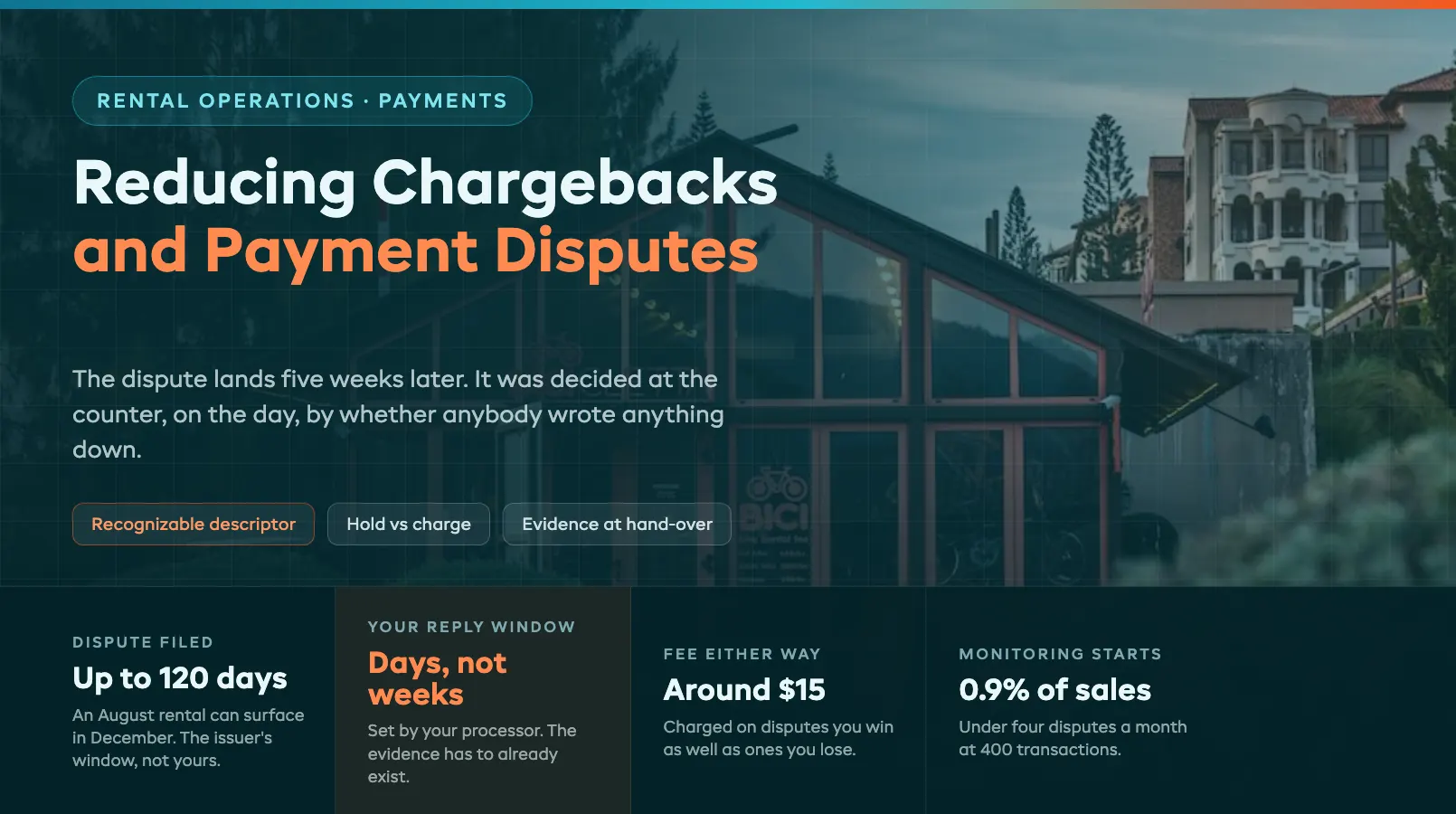
Reducing Chargebacks and Payment Disputes for Rental Operators
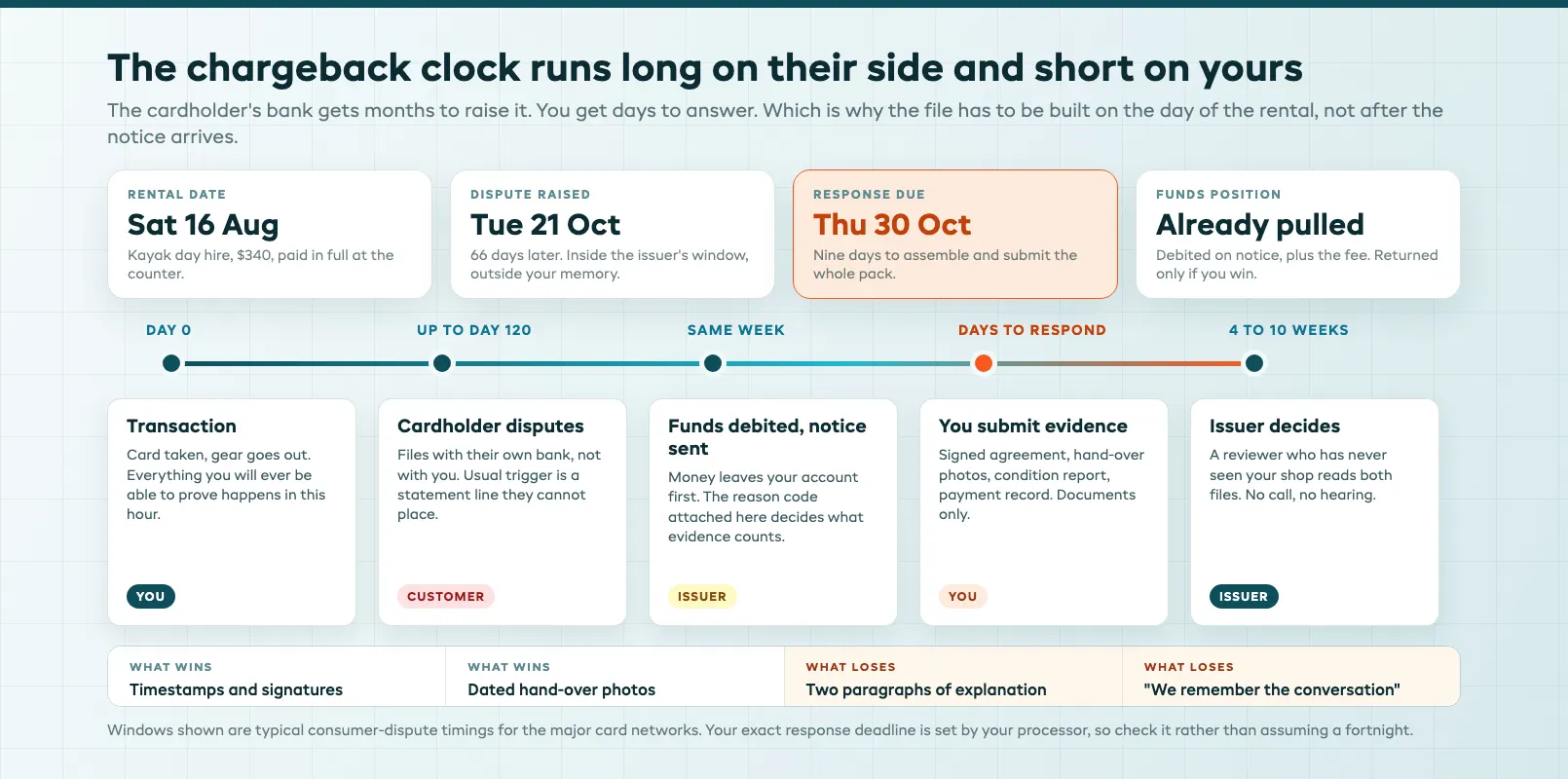
The email arrives on a Tuesday in October. A customer is disputing a $340 charge from the middle of August. Your processor has already pulled the money out of your account and added a fee on top, and you have nine days to send evidence.
You go looking. The booking is in the system. The name matches. But the kayaks went out on a Saturday, the staff member who ran the counter that day finished up three weeks ago, and nobody photographed anything. You know the customer brought one paddle back cracked, because you remember the conversation. There is no record of it. You reply with two paragraphs explaining what happened and you lose, because two paragraphs of explanation is not evidence.
That is the shape of almost every rental chargeback. The dispute is not decided in October. It was decided in August, at the counter, when nothing got written down. The good news is that the fixes are cheap, mostly one-off, and three of them have nothing to do with fighting disputes at all - they stop the dispute being raised.
What a Chargeback Actually Is
A chargeback is not a refund and it is not a complaint. The customer goes to their bank rather than to you. The bank takes the money back out of your account first, tells you afterwards, and charges you a fee for the privilege whether or not you eventually win.
Three details matter for how you run your shop.
The window is long on their side and short on yours. Card networks generally give the cardholder's bank up to 120 days from the transaction or the expected service date to raise a consumer dispute, which is why an August rental can surface in December. Your response window is usually days, not weeks, and it is set by your processor rather than by you.
The decision is made on documents by someone who has never seen your shop. Nobody calls you. Nobody calls the customer back. A reviewer at the issuing bank reads what each side submitted and decides. Tone, fairness and how long you have been in business count for nothing. Timestamps, signatures and photos count for everything.
The fee is charged either way. Most processors charge a per-dispute fee in the region of $15, and you pay it even on disputes you win. So a dispute you win is not a free outcome, it is a small loss plus an hour of your time. That matters later when you decide which ones to fight.
Where Rental Disputes Actually Come From
Ask an operator why they get chargebacks and they will usually say fraud. Look at the actual reason codes on a year of disputes at a rental or tour business and fraud is rarely the biggest bucket. Four causes account for most of them, and each has a different fix.
The customer does not recognize the charge. Your business trades as Harbor Paddle Co and the line on the statement reads something else entirely, or the charge landed three weeks after the booking because you took the balance later. The cardholder sees an amount they cannot place and files it as fraud. They are not lying. They genuinely do not know what it is.
Deposit confusion. You told the customer you were taking a $500 deposit. They believed nothing would leave their account. Then $500 actually moved, or the hold sat on their card for a week and their balance looked wrong, and they disputed it as an unauthorized charge. This one is almost always a wording problem rather than a money problem.
A damage or cleaning charge with nothing behind it. You charged $180 for a cracked paddle or a filthy interior. The customer says it was already like that. Without a dated photo from hand-over you have an opinion and they have an opinion, and the issuer sides with the person whose bank they work for.
A cancellation or no-show charge the customer says they never agreed to. Your policy is fair. It is on the website. But what matters is whether this specific customer accepted it at the time, in a way you can produce on demand.
Notice that only the first of those is really about payments. The rest are about records. That is the theme of everything below.
Fix One: Make the Charge Recognizable
This is the cheapest win available to any operator and most have never touched it.
The line that appears on a card statement is called the statement descriptor, and your payment processor lets you set it. If it currently shows a legal entity name, an old trading name, or a payment platform's name instead of yours, change it today. The customer needs to read that line five weeks later and think "that is the kayak place" without any effort.
Three things to get right.
Use the name on your shop front and your website, not the name on your incorporation papers. If they differ, the descriptor loses and the dispute starts.
Add something locating if you have the characters. Descriptors are short, but "HARBORPADDLE MONTEREY" places the charge in a way that "HPC LLC" never will.
Set a separate descriptor suffix for deposits and damage charges if your processor supports it, so a later charge does not look like a duplicate of the rental.
Then finish the job at the point of sale. Tell the customer what the charge will look like, and put it in the confirmation email: the descriptor in capitals, the amount, and the date it will appear. It takes one line of template copy. On EquipDash, payments run through Stripe with the descriptor set once in your account, and the confirmation that goes out on booking is the natural place to repeat it.
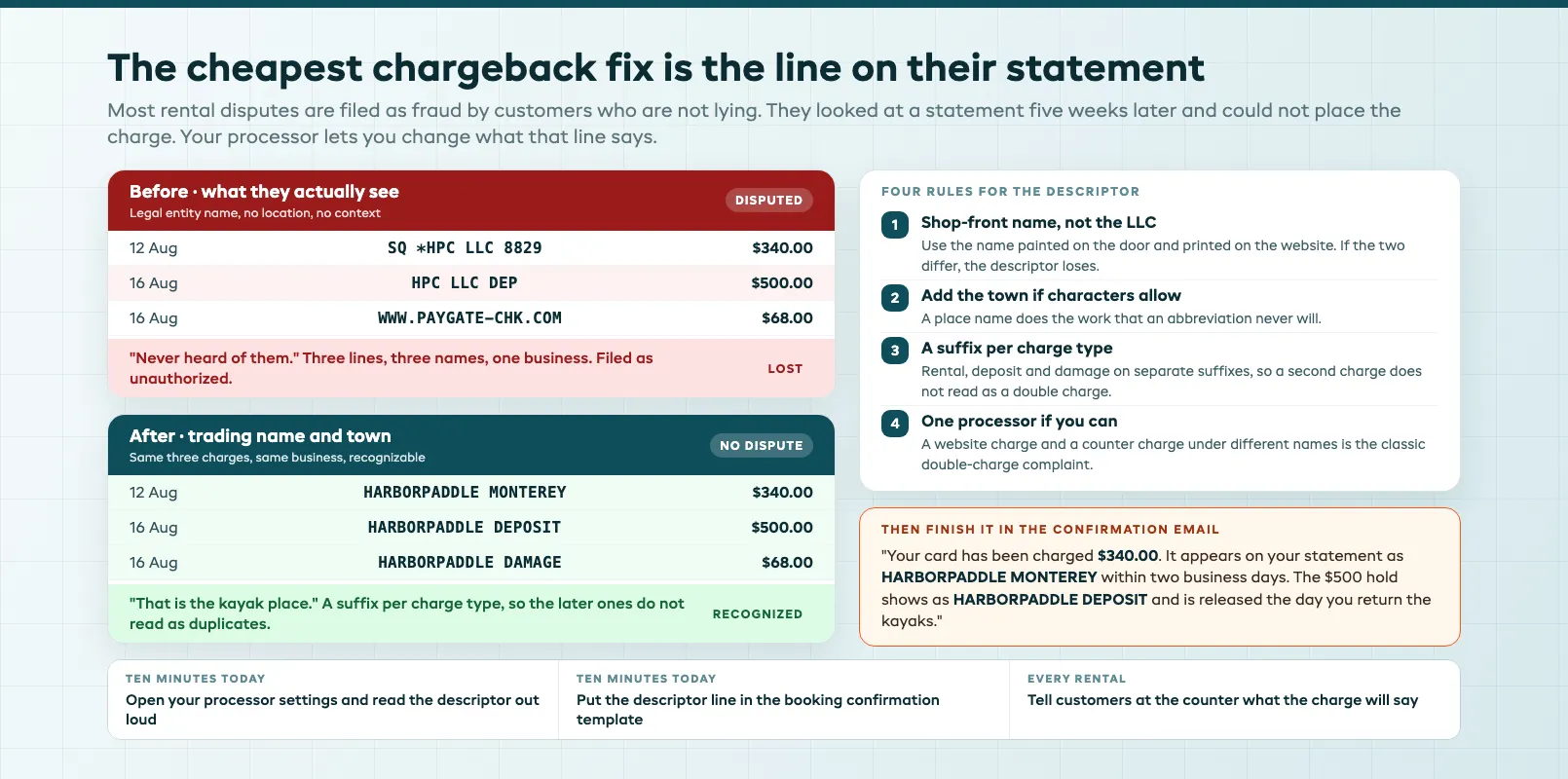
There is a version of this that catches operators who take a deposit online and the balance on arrival. Two charges from the same business on different days, different amounts, one of them from a card machine and one from a website, look to a suspicious customer like a double charge. Either take both through the same processor so the descriptor matches, or say plainly in the confirmation that they will see two lines and what each one is for.
Fix Two: Get Deposit Language Right
A deposit means three different things in a rental shop, and the word is used for all three.
An authorization hold puts a temporary block on part of the customer's available credit. No money moves. Depending on the card and processor the hold typically stays valid for up to about seven days before it has to be captured or released, and even after you release it the customer's bank can take a few more days to show the balance back. Nothing was charged, but their available balance was lower for a week, and that is what they will remember.
A captured charge actually takes the money, with a refund later if the gear comes back fine. Money left their account. This is a charge, not a hold, and calling it a hold when you have captured it is the single most reliable way to generate a dispute.
A non-refundable booking deposit is part of the price, taken up front to secure the date. It is neither of the above and should never be described with the same word as the other two.
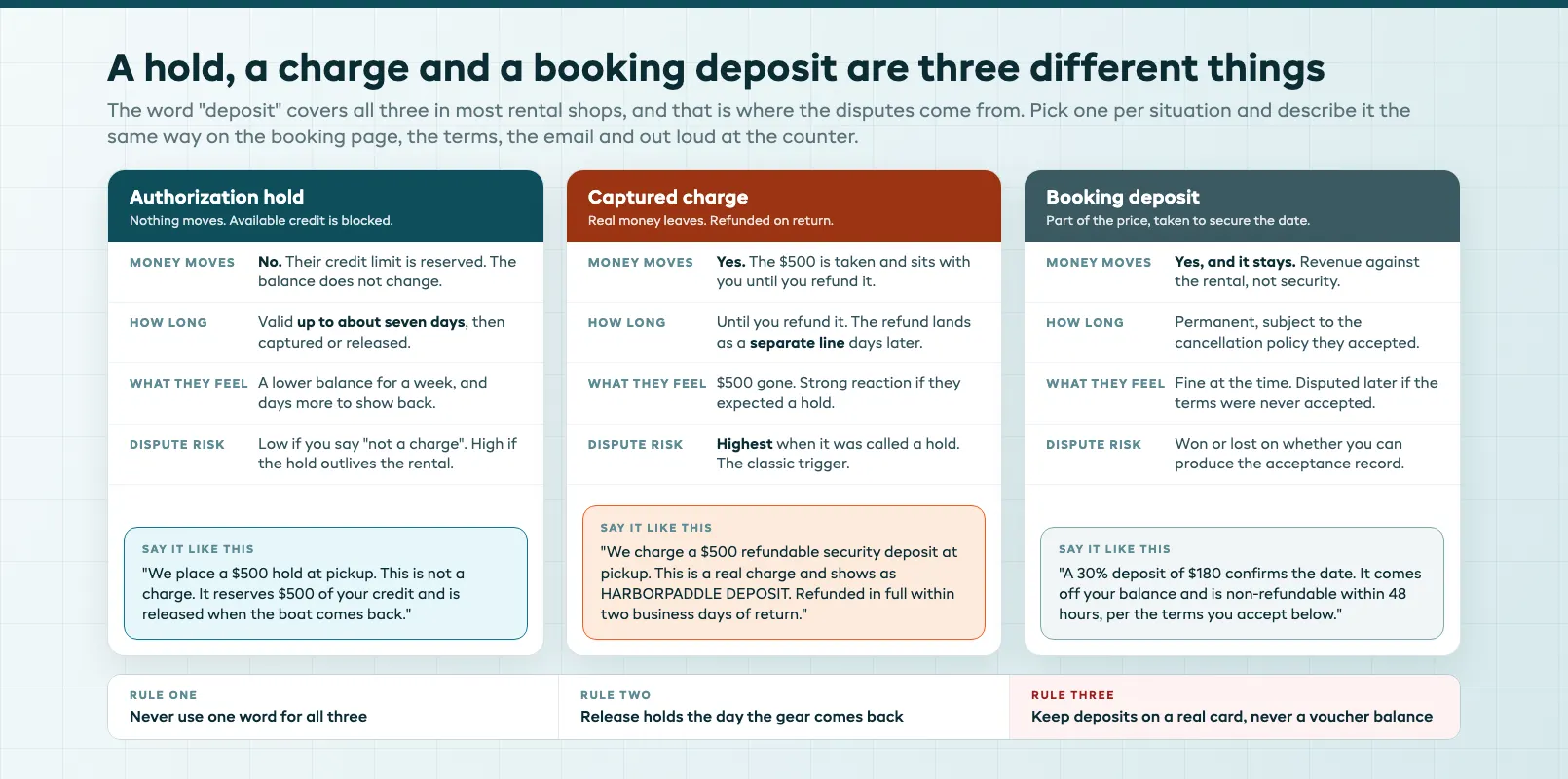
Pick one mechanism per situation, then write it the same way everywhere: the booking page, the terms, the confirmation email, and the sentence your counter staff say out loud. The wording that holds up looks like this.
"We place a $500 hold on your card at pickup. This is not a charge. It reserves $500 of your available credit and is released when the boat comes back as it went out. Your bank may take three to five business days to show the released amount."
Or, if you are actually capturing it:
"We charge a $500 refundable security deposit at pickup. This is a real charge and will show on your statement as HARBORPADDLE MONTEREY. It is refunded in full within two business days of return if there is no damage."
Two more rules earn their keep. Release holds the day the gear comes back, not at the end of the week, because a hold that lingers past the promised date generates the phone call that turns into the dispute. And keep deposits on a real payment card rather than letting them ride on a gift card or voucher balance, which is the same rule that applies when you run a gift card program: mixing the two means a cancellation turns into an argument about which pot the money came from.
Fix Three: Build the Evidence Trail Before You Need It
Everything up to here reduces how many disputes get filed. This is the part that decides the ones that do.
You cannot build evidence in October for a rental that happened in August. It has to be captured at the time, by staff, in under a minute, or it will not happen at all. Four artifacts do the work.
An accepted rental agreement with a timestamp. Not a policy page on your website. A record that this customer, on this date, at this time, accepted these terms, including the cancellation policy and the damage and cleaning fee schedule. A digital waiver or agreement signed on the customer's phone before they arrive produces exactly that, with the signature, the time it was signed and the booking it belongs to all stored together. If you are still collecting signatures on paper at the counter, moving waivers online is the single change that does most for your dispute file. Paper in a folder in the back office is better than nothing and worse than everything else, because nobody will find the right sheet in nine days.
Hand-over photos. Four or five shots of the item as it leaves, dated automatically. This is the one operators skip and the one that wins damage disputes outright. The whole argument is "was it already broken," and a timestamped photo ends it.
A return condition report. Logged when the gear comes back, with the damage flagged and photographed and the staff member's name on it. In EquipDash this is a condition report against the item itself, which means the trail shows who had the equipment and what state it came back in, and the same record can push a damaged unit into the workshop so it stops appearing as bookable. The same maintenance and condition history that keeps your fleet honest is also your dispute file.
Proof the customer was actually there. The signed agreement, the waiver, the check-in time, a photo with the customer in frame if you take group shots anyway. For any dispute filed as fraud, evidence that the cardholder personally showed up and used the service is the strongest thing you can send.
The practical test for all four: if a dispute for any rental in the last 90 days landed tomorrow, could someone who was not working that day assemble the file in ten minutes? If the answer depends on a specific person's memory, the trail does not exist yet. Getting this into the normal flow of a booking rather than bolted on afterwards is most of what people mean by running the shop on software instead of on habits.
Fix Four: Write Policies That Can Be Enforced
A fair policy that nobody accepted is worth nothing in a dispute. A clear policy that every customer accepted at booking wins.
Three tests for each policy you have.
Is it specific? "Cancellations within 48 hours incur a 25% fee" survives review. "Cancellations may incur a fee" does not.
Is it accepted, not just published? The customer has to have ticked, signed or clicked through it, and you have to be able to produce the record. A policy in a footer link is not acceptance.
Is it applied consistently? If you waive the fee for half your customers, the half you charge have a real argument. Inconsistent enforcement reads badly in a dispute file and it reads worse in reviews.
The mechanical part of this is worth automating. Set the refund windows, the cancellation percentages and the partial refund rules once, and let the system apply them so the amount is calculated the same way for every booking regardless of who is on the counter. Refund and cancellation rules in EquipDash work this way, and the byproduct is a clean record of which policy applied to which booking. It is the same logic as any other workflow you take off the whiteboard: consistency is what makes it defensible.
One more thing that reduces disputes and has nothing to do with policy: ask for the balance at a sensible time. A charge that lands the week of the rental gets recognized. A charge that lands six weeks after someone booked, with no reminder in between, gets disputed. If you take a deposit at booking and the balance later, send an email before you take the balance, not after. This is one of the quieter arguments for taking money through an online booking system rather than a card machine and a notebook: the reminder goes out on its own.
The Dispute Response Playbook
When one does arrive, work it as a process. Rambling costs you.
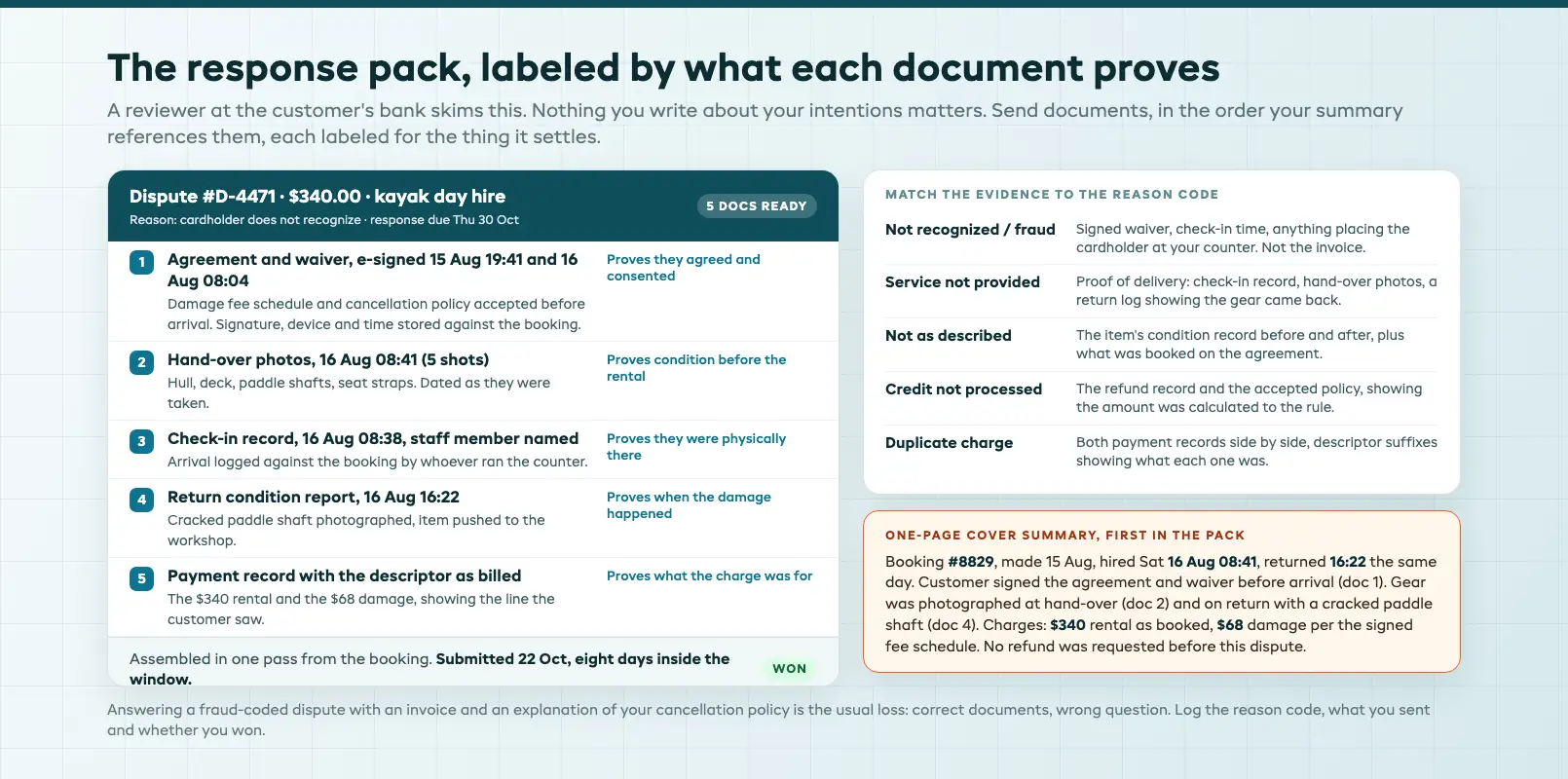
Step one: read the reason code, not the customer's story. The reason code tells you what the issuer will actually assess. A "services not provided" dispute is won with proof of delivery. A "not as described" dispute is won with the item's condition record. A fraud-coded dispute is won with proof the cardholder was present and consented. Sending the wrong kind of evidence for the code is the most common way to lose a winnable case.
Step two: pull the file in one pass. The booking record, the signed agreement or waiver with its timestamp, the hand-over and return photos, the condition report, the payment record with the descriptor, and any messages with the customer. All of it, from the booking, without hunting through folders.
Step three: write a one-page cover summary. Dates, amounts, what was booked, what was delivered, which policy applied and when the customer accepted it. Plain sentences, no emotion, no history of your business. The reviewer is skimming. Make the timeline obvious.
Step four: attach the documents in the order the summary references them. Label each file for what it proves: "signed rental agreement, accepted 14 Aug 09:12", "kayak hull at hand-over, 16 Aug 08:41". A reviewer should not have to work out why a photo is in the pack.
Step five: submit inside the window and record the outcome. Log which reason code it was, what you sent and whether you won. After a dozen disputes that log tells you where your process leaks, which is worth more than any individual case.
When to Fight and When to Refund
Not every dispute is worth contesting, and the math is unsentimental.
Add up what a fight costs: the dispute fee you pay regardless, plus an hour or two of your time assembling and writing. If the disputed amount is $60 and your evidence is thin, contesting it costs more than conceding it. Refund it, note why, and move on.
Fight when the amount is material and the evidence is strong. A $600 damage charge with hand-over photos and a signed agreement is worth the hour, and winning it is close to certain.
There is a second reason to fight even a small one, though. A customer who wins a chargeback learns that it works. If you are seeing repeat disputes from the same names, or the same pattern across different customers, conceding is training the behavior. That is the case for contesting a $90 dispute you would otherwise write off.
The better move in a lot of these cases is to intervene before the dispute exists. When a customer emails you angry about a damage charge, that email is your last cheap exit. Answer it within a day, attach the photo, and offer a partial refund if there is any doubt. A partial refund costs you part of one charge. A chargeback costs you the whole charge, the fee, your time, and a mark against your dispute rate.
Keeping Your Dispute Rate Down
Card networks track disputes as a percentage of your transactions, monthly, and they start taking an interest well before you think you have a problem. Visa's monitoring program kicks in around 0.9% of transactions with a dispute count threshold alongside it, and Mastercard's sits higher, with early-warning tiers below both. Landing in a monitoring program means fees, remediation plans and, at the far end, losing the ability to take cards at all.
For a shop doing 400 transactions a month, 0.9% is under four disputes. That is closer than most operators assume, and a single bad month with a confusing new deposit process can get you there.
Two habits keep you clear. Watch the rate monthly rather than reacting to individual disputes, because the count is what the networks see. And when the number moves, look for the process cause rather than the customer cause: a new descriptor, a new staff member skipping photos, a policy change that went out without an acceptance step. Disputes cluster around process changes far more than around bad customers.
None of this needs a compliance department. It needs the descriptor set correctly once, deposit wording that says the same thing in four places, photos at hand-over as a habit, and policies the customer actively accepted. Do those four and the dispute that arrives in October is one you can win in ten minutes, on paper, without remembering a thing about August.
If your records currently live in a mix of paper, a shared drive and one person's memory, that is the thing to fix first, and it is the same fix that solves half a dozen other problems at the counter. Pricing for EquipDash starts at $23 a month on annual billing, and payments, agreements, condition records and refund rules sit in the same system as the bookings they belong to.
FAQ
What is a chargeback and how is it different from a refund?
A refund is you returning money to a customer. A chargeback is the customer going to their bank instead, and the bank reversing the payment out of your account. You find out after the money has gone, you pay a per-dispute fee whether you win or lose, and the decision is made by a reviewer at the customer's bank based on the documents each side submits. A refund you control. A chargeback you defend.
How long does a customer have to dispute a rental charge?
Longer than most operators expect. Card networks generally allow the cardholder's bank up to 120 days from the transaction or the expected service date to raise a consumer dispute, and some categories run longer. That is why an August rental can produce a dispute notice in December. Your window to respond is far shorter, usually a matter of days set by your processor, which is the reason the evidence has to already exist rather than be assembled after the notice arrives.
Why do customers dispute charges they recognize as legitimate?
Usually they do not recognize them. The most common cause of a rental chargeback is a statement descriptor that does not match the name on your shop front, or a balance charge that lands weeks after the booking with no warning. The customer sees an amount they cannot place and reports it as fraud in good faith. Setting the descriptor to your trading name, adding your town if there is room, and telling customers in the confirmation email exactly what the line will say removes a large share of disputes with a single afternoon of work.
Should I take a security deposit as a hold or a charge?
Either works as long as you describe accurately what you are doing. An authorization hold blocks part of the customer's available credit without moving money and typically stays valid for up to about a week before it must be captured or released. A captured charge actually takes the money and is refunded on return. The disputes come from calling a charge a hold, or from a hold that sits on the card days after the gear came back. Pick one per situation, use the same wording on the booking page, the terms, the confirmation email and at the counter, and release holds the day the item is returned.
What evidence wins a damage chargeback?
Timestamped photos of the item at hand-over, a signed rental agreement showing the customer accepted the damage and cleaning fee schedule, and a return condition report naming the staff member who logged the damage. The dispute is always some version of "it was already like that," and dated photos from before the rental settle it. Photos taken only on return prove damage exists but not when it happened, which is usually not enough. Written explanations without documents almost never win.
Is it worth contesting a small chargeback?
Compare the disputed amount against the dispute fee plus an hour or two of your time. Under about $100 with thin evidence, conceding is usually cheaper than fighting. Two things override that math: a dispute where your evidence is strong is quick to win and worth doing at almost any amount, and a repeat pattern from the same customer or the same scenario is worth contesting regardless of size, because conceding teaches the behavior. Also watch the count, not just the cost, since the networks measure disputes as a percentage of transactions.
What dispute rate do card networks consider too high?
Visa's monitoring program begins around 0.9% of monthly transactions with a minimum dispute count alongside it, Mastercard's threshold sits higher, and both have early-warning tiers below those numbers. For a business doing 400 transactions a month, 0.9% is fewer than four disputes, so the margin is thinner than it sounds. Track the percentage monthly rather than reacting case by case, and when it moves, look for a process change first: a new descriptor, a staff member skipping hand-over photos, or a policy that went out without an acceptance step.
Can software actually reduce chargebacks?
It reduces them by removing the gaps that cause them. One system holding the booking, the signed agreement with its timestamp, the hand-over and return photos, the condition report and the payment record means the evidence pack for any rental in the last few months can be assembled in minutes rather than reconstructed from memory. It also enforces the same refund and cancellation rules on every booking, so the policy you point to in a dispute was demonstrably applied consistently. The software does not argue the case for you. It makes the case arguable.
in one place