Tour Review Velocity: How Top Operators Get 3× More Reviews
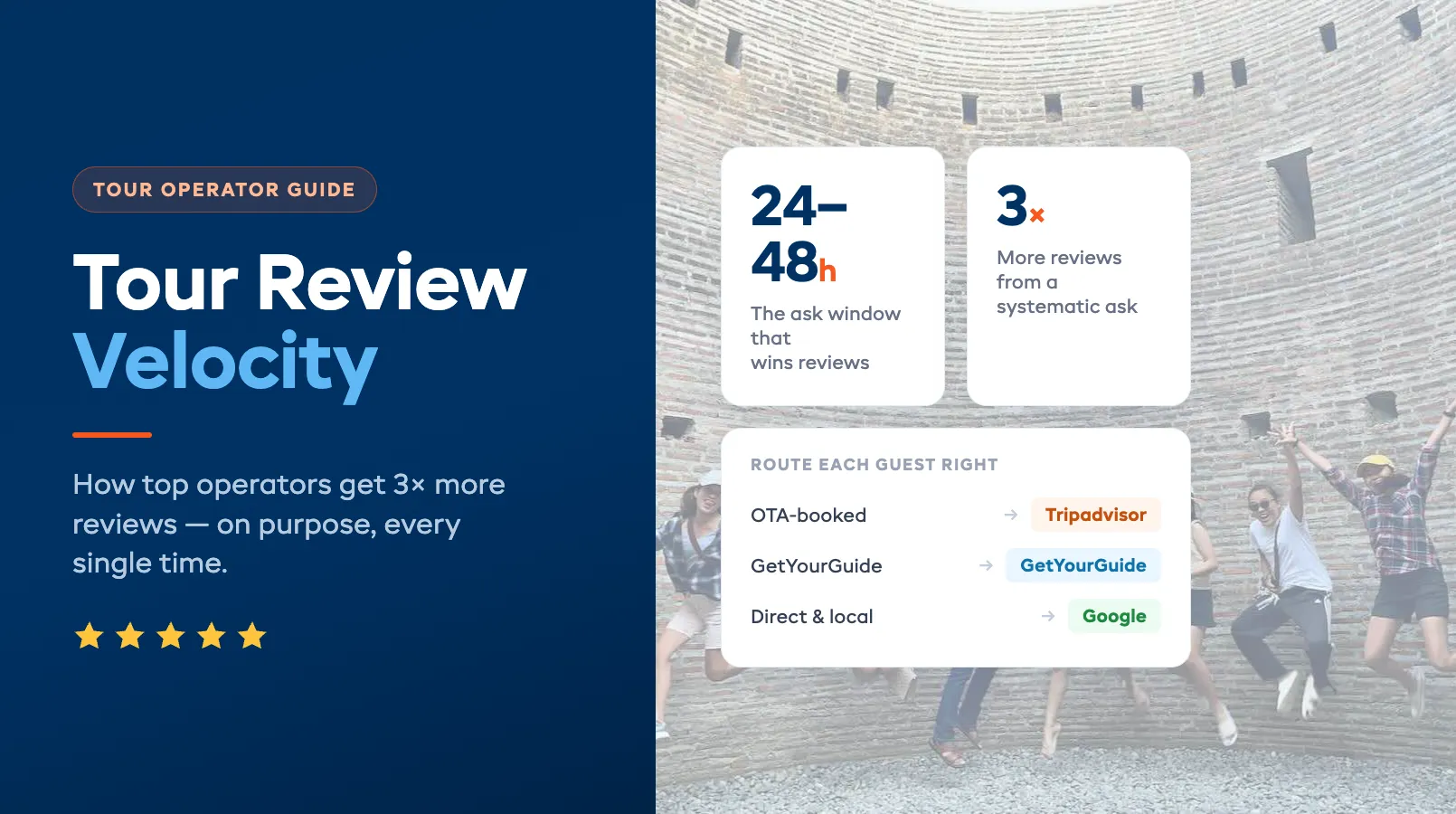
Two tour operators run the same city walking tour, charge the same price, and deliver the same experience. One has 1,400 reviews and a 4.9 rating. The other has 90 reviews after three years in business. The gap isn't tour quality, both are excellent. The gap is that one operator asks for reviews on purpose, at the right moment, through the right channel, every single time. The other hopes happy guests remember to leave one.
Reviews are the single most valuable asset a tour business builds, and almost nobody treats them like one. They drive your ranking on Viator and GetYourGuide, they decide whether a stranger trusts you over the operator next door, and they compound: every review makes the next booking easier to win. The good news is that review velocity (the steady rate at which new reviews come in) is almost entirely within your control. This guide covers why velocity matters more than raw count, exactly when to ask, how to route guests to the right platform, the templates that get a response, and how to turn a bad review into proof you can be trusted. For the wider operating picture, see How to Run a Tour Operator Business.
Why Review Velocity Matters More Than Total Count
Most operators fixate on their total review number. The platforms care more about velocity: how many fresh reviews you've collected recently, and how consistently they arrive.
A listing with 600 reviews and three new ones this month looks alive. A listing with 600 reviews and nothing in six months looks like a business that's coasting or closing. Ranking algorithms on the major platforms weight recency heavily, because a recent review is better evidence that you're still delivering today. Travelers read the same signal: most people sort by "most recent" and judge you on the last handful, not the lifetime total.
Velocity also protects you from the occasional bad review. If you collect twelve reviews a month, one disappointed guest barely moves your average and gets buried within days. If you collect one review a quarter, that same complaint sits at the top of your listing for weeks, visible to every prospect. Volume is a buffer, and steady velocity is how you build it.
The operators getting 3× more reviews aren't lucky. They've turned the ask into a fixed step of every tour, as automatic as collecting payment or briefing guests. That's the whole secret: it's a system, not a personality trait. The systematic side of customer communication is covered more broadly in AI for Tour Operators, but the principle is simple — what you don't systematise, you forget.
Ask Timing: The 24–48 Hour Window
When you ask matters as much as whether you ask. There's a clear sweet spot, and most operators miss it on both sides.
Ask too early (at the van before guests have even left) and the experience isn't complete in their minds. They're polite but vague, and the review, if it comes, is thin. Ask too late, a week or two out, and the glow has faded. The tour is now a pleasant memory competing with their flight home, their inbox, and everything else. Response rates fall off a cliff after a few days.
The window that works is 24 to 48 hours after the tour ends. By then the guest has slept on it, told a friend about the highlight, and settled the experience into a story. They're still warm, the details are fresh, and they have a quiet moment (often back at the hotel or in transit) to tap out a few sentences. Asking inside that window is the single biggest lever on your response rate.
Two refinements make it work even better. First, send the ask when guests are likely to be on their phones and relaxed — early evening tends to beat mid-morning. Second, make the timing automatic. If you're triggering review requests by hand, you'll nail the window for some guests and forget others entirely, and the ones you forget are pure lost reviews. Tie the request to the booking's completion so it fires on its own, every time — a Post-Tour Review Request agent can send it at the right moment without anyone remembering to. The same discipline applies to the rest of your post-trip routine, which a post-trip debrief step keeps consistent across guides.
Platform Routing: Send Each Guest to the Right Place
A scattershot "please review us somewhere" gets you reviews scattered thinly across five platforms, none of which looks strong. The operators who win route each guest to the one platform that matters most for them, and they decide that on purpose.
Start by knowing where reviews actually move your business:
- Tripadvisor and Viator carry enormous weight for tours and activities, especially with international and US travelers researching "things to do."
- GetYourGuide reviews lift your ranking on that platform directly, which matters if it's a meaningful booking channel for you.
- Google reviews drive local discovery and the map pack — vital if walk-up and "tours near me" traffic is part of your mix.
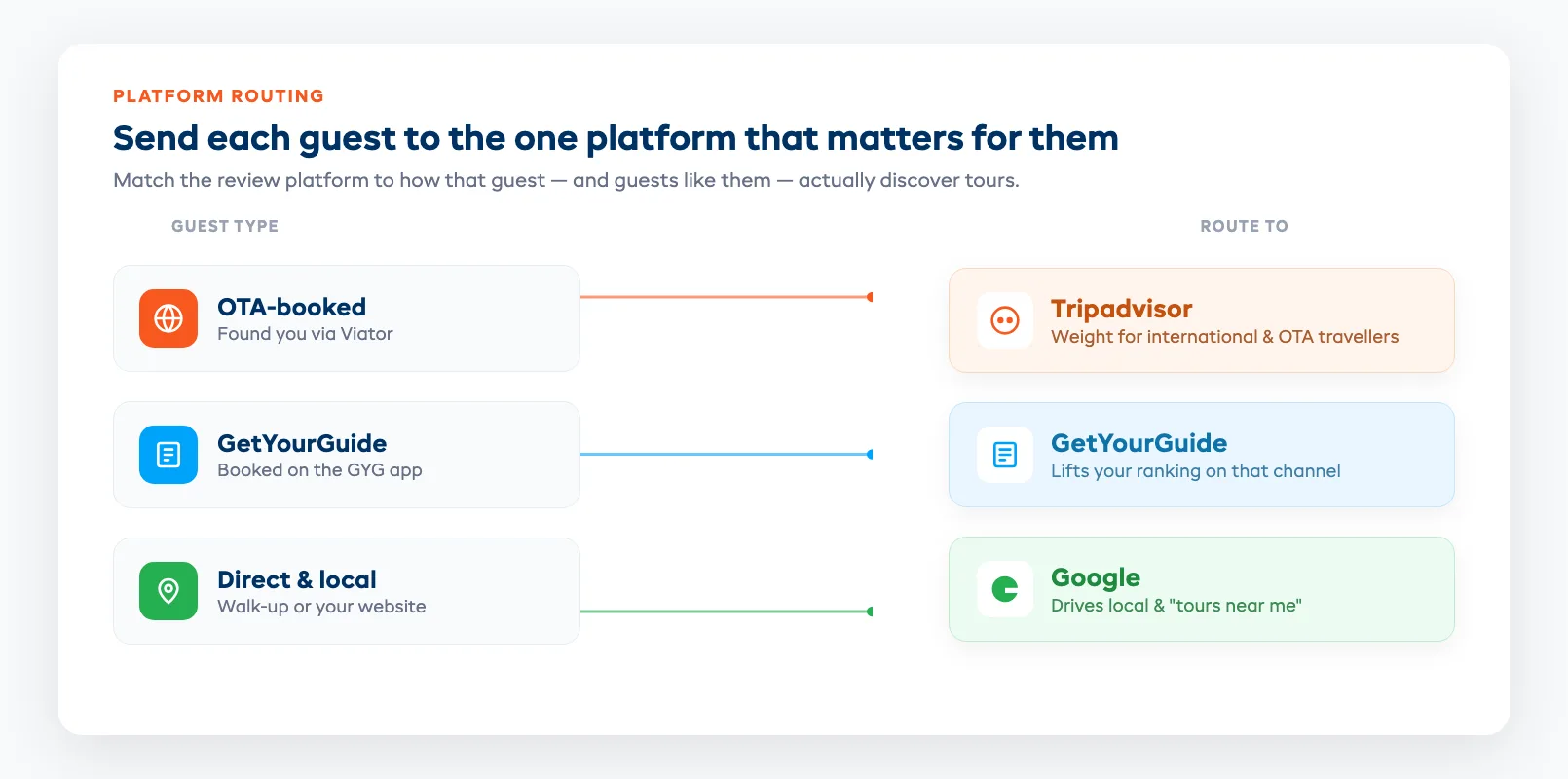
Routing by market is the refinement that separates good from great. If a guest booked through Viator, send them to Tripadvisor. That's where their review compounds your reach. If they found you on Google and booked direct, point them at your Google listing. A domestic guest who'll recommend you to local friends is most valuable on Google; an international guest who books through OTAs is most valuable on Tripadvisor. Match the platform to how that guest, and guests like them, actually discover tours.
One caution: don't ask the same guest to post the identical review in four places, and never offer a discount or freebie in exchange for a review. The major platforms detect and penalise incentivised reviews hard, and a clean, organic review history is worth far more than a padded one. Knowing the platform landscape is part of a wider OTA distribution strategy, where reviews are also a top ranking factor.
Email and SMS Templates That Actually Get a Response
The ask itself should be short, warm, specific, and frictionless. Long, formal requests get ignored. Here's the shape that works, and why.
Email suits guests who booked online and gave you a real address. Keep it to a few lines:
Subject: How was your [tour name]?
Hi [first name],
It was a pleasure having you on the [tour name] yesterday — we hope [specific highlight, e.g. "the sunrise from the lookout"] stuck with you.
If you have two minutes, a quick review helps other travelers find us and means a lot to our small team. You can leave one here: [direct link].
Thanks so much, [Guide / operator name]
SMS works when you have a mobile number and want speed — texts get opened almost immediately and convert well for quick reviews:
Hi [first name], thanks for joining the [tour name] yesterday! If you enjoyed it, a quick review would mean the world: [direct link]. — [name]
Four things make either version work. Personalise it: a real name and a specific moment from the tour proves it isn't a blast and lifts response sharply. Link straight to the review form, not a homepage; every extra tap loses people. Keep the ask small: "two minutes," "a quick review", because friction, not unwillingness, is what kills most reviews. And send it in the window: yesterday's tour, today's gentle nudge. One well-timed follow-up a few days later is fine if there's no response; a third is nagging.
Handling Negative Reviews: Response as Reputation
You will get bad reviews. Every operator with real volume does, and how you respond is read far more closely than the complaint itself. A thoughtful public reply turns a one-star into evidence that you're a business worth trusting.
Respond promptly and publicly — within a day or two. Future guests are watching how you handle pressure, not just what went wrong. Lead with genuine acknowledgment, not defensiveness: thank them for the feedback, name the specific issue, and own whatever was legitimately yours to own. Then state briefly what you've changed or offer to make it right offline. Never argue the facts in public, never get sarcastic, and never out a guest's personal details.
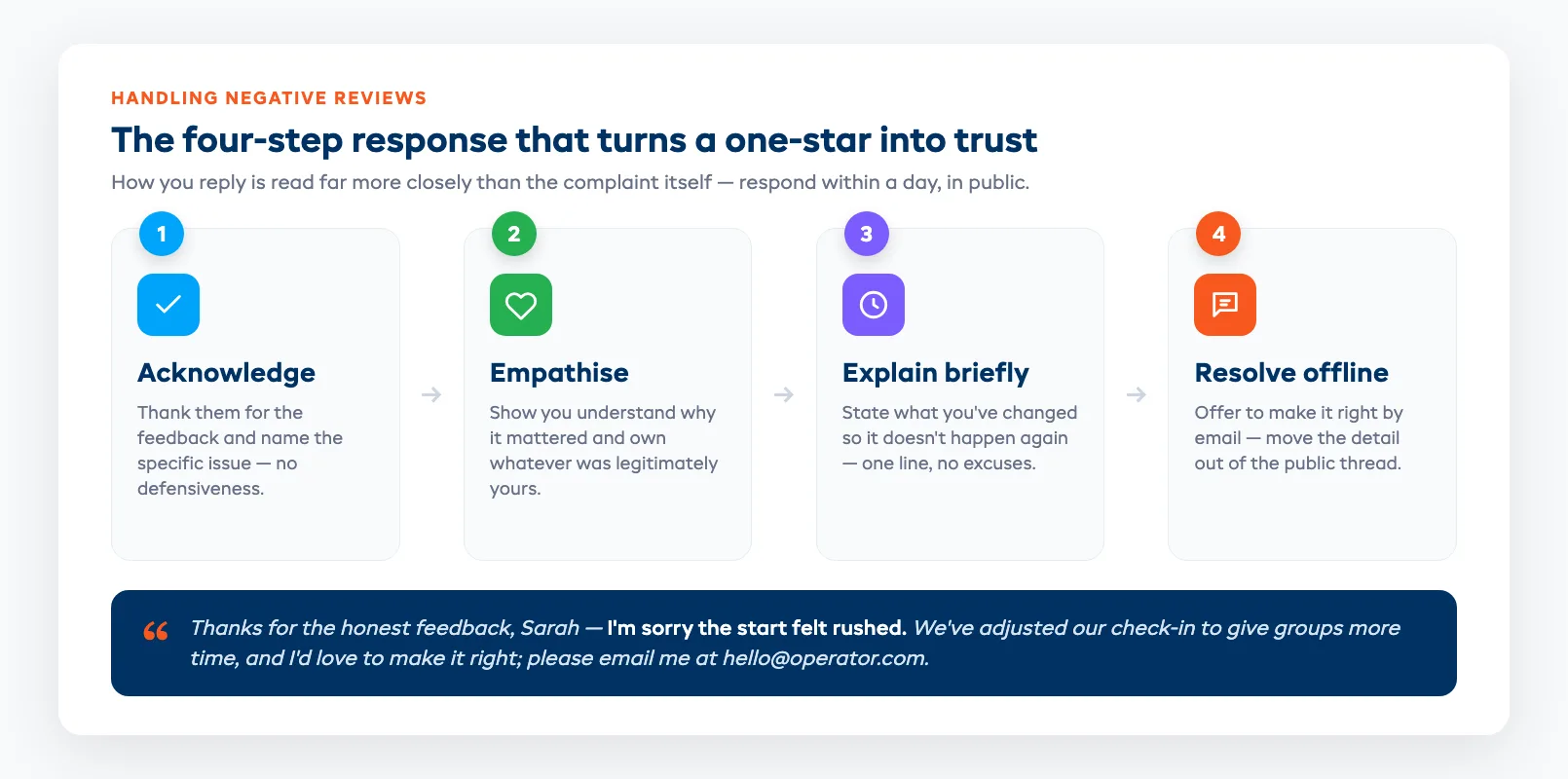
The formula that consistently works: acknowledge, empathise, explain briefly, resolve offline. "Thanks for the honest feedback, [name] — I'm sorry the start felt rushed. We've adjusted our check-in to give groups more time, and I'd love to make it right; please email me at [address]." A prospect reading that sees an operator who listens and fixes things. That's more persuasive than a wall of flawless five-stars, which many travelers quietly distrust.
For the genuinely unfair or fake review, most platforms have a flagging process for content that breaks their guidelines. Use it, but sparingly, and keep responding professionally while you wait. A consistent, calm handling routine (the kind a customer complaint handling checklist keeps standard across your team) means every negative review gets the same composed response, no matter who's covering the inbox that day.
Building Long-Term Reputation: Compounding the Asset
Review velocity isn't a campaign you run once; it's a habit that compounds for the life of your business. The operators with thousands of reviews didn't get a lucky viral month. They collected steadily for years, and the asset grew on itself.
Make the ask a permanent fixture. Bake it into your operating rhythm so it survives busy seasons, staff turnover, and the day-to-day chaos that makes one-off efforts evaporate. Track velocity as a number you actually watch (reviews per month, by platform) the same way you watch bookings, so a slowdown is something you notice and fix rather than discover six months late. And keep your pricing and experience worth reviewing in the first place; no script saves a tour that isn't good, and a strong one (see tour pricing strategy for getting the experience and rate right) gives guests something genuine to rave about.
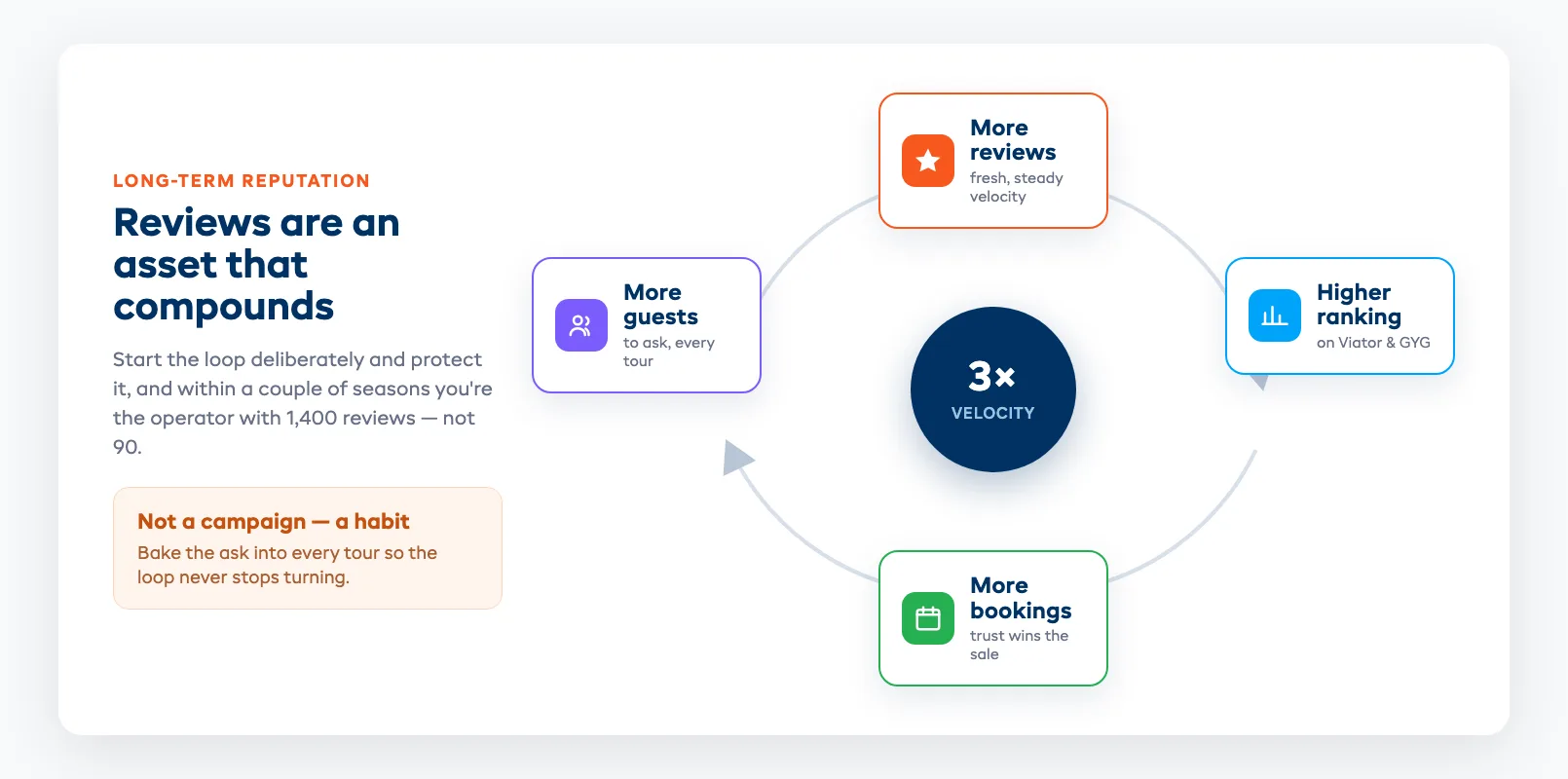
The compounding is real. More reviews lift your ranking, ranking brings more bookings, more bookings create more guests to ask, and more reviews follow. Start the loop deliberately and protect it, and within a couple of seasons you're the operator with 1,400 reviews instead of 90, not because your tour got better, but because you stopped leaving reviews to chance. To trigger review requests automatically, sync them to each completed booking, and manage guest communication from one place, start a free trial. For more operational guides, explore the tours hub and the tour operator glossary.
FAQ
What is review velocity for tour operators?
Review velocity is the rate at which your business collects new reviews over time (for example, reviews per month) rather than your lifetime total. It matters because ranking algorithms on platforms like Viator, GetYourGuide, and Google weight recent reviews heavily, and travelers tend to judge you on your most recent handful rather than your all-time count. A steady stream of fresh reviews signals an active, reliable operator and gives you a buffer that softens the impact of any single negative review.
When is the best time to ask for a tour review?
The sweet spot is 24 to 48 hours after the tour ends. Asking at the van or immediately afterwards is too early (the experience isn't fully settled in the guest's mind) while waiting a week or more lets the glow fade and response rates collapse. Inside the 24–48 hour window, guests have processed the experience, the details are still fresh, and they usually have a quiet moment to write a few sentences. Sending the request in the early evening, when people are relaxed and on their phones, tends to lift response further.
Which review platform should I send tour guests to?
Route each guest to the platform that matters most for how guests like them discover tours. Tripadvisor and Viator carry the most weight for international and OTA-booked travelers, GetYourGuide reviews lift your ranking on that channel directly, and Google reviews drive local and "tours near me" discovery. A practical rule: send OTA-booked guests to Tripadvisor, and direct or local guests to Google. Avoid asking the same guest to post identical reviews across multiple platforms, as that can read as spam.
How do I get more tour reviews without offering discounts?
Never offer discounts or freebies for reviews: the major platforms detect and penalise incentivised reviews, and a clean review history is worth far more. Instead, lift volume by making the ask systematic: trigger a personalised request 24–48 hours after every tour, link straight to the review form, keep the message short, and route guests to the right platform. The single biggest lever is consistency (asking every guest, every time, automatically) rather than relying on staff to remember after a busy day.
How should I respond to a negative tour review?
Respond promptly and publicly within a day or two, because future guests judge you on how you handle problems, not just on your perfect reviews. Acknowledge the feedback genuinely, name the specific issue, own whatever was legitimately yours, briefly explain what you've changed, and offer to resolve it offline. Never argue the facts in public, get sarcastic, or expose the guest's details. A calm, fix-it response often persuades prospects more than an unbroken wall of five-star reviews, which some travelers quietly distrust.
Can software automate tour review requests?
Yes. Booking and operations software can trigger a review request automatically when a booking is marked complete, so the message fires inside the ideal 24–48 hour window for every guest without anyone remembering to send it. It can personalise the request with the guest's name and tour, route them to the right platform, and send a single timed follow-up if there's no response. Automating the ask is what turns review collection from an occasional effort into the steady velocity that builds ranking and trust over time.
in one place