Adventure Pricing: Per-Person, Private Group, and Corporate Tiers
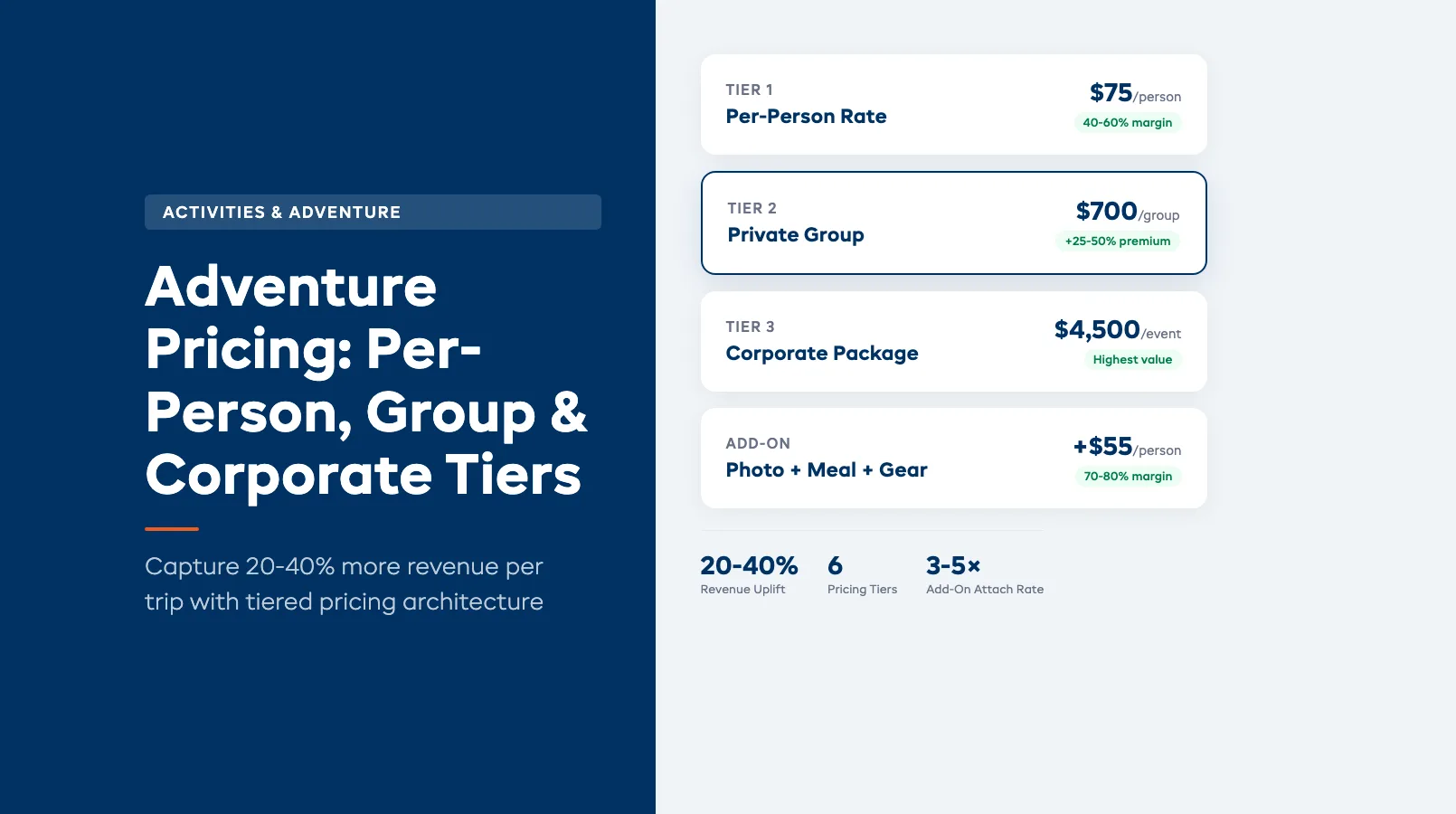
You're running a rafting company with one price: $75 per person. A couple pays $150. A birthday group of 12 pays $900. A corporate team of 30 pays $2,250. Same river. Same guides. Same gear. But the corporate group is willing to pay $4,000+ and the birthday group would've paid $1,200 for a private departure. You're leaving $1,050 on the table in a single morning.
Flat per-person pricing is the default because it's simple. But simple doesn't mean optimal. Adventure operators who build tiered pricing (per-person base rates, private group premiums, corporate packages, and smart add-ons) capture 20-40% more revenue per trip without adding capacity.
This guide covers how to structure adventure activity pricing across every customer segment. For the full business playbook, see How to Run an Adventure Activity Business. For managing the gear costs that feed into your pricing, see Gear Lifecycle for Adventure Operators. For the waiver and legal infrastructure behind premium experiences, see Waiver Enforcement for High-Risk Activities. For more resources and checklists, visit the activities and adventure hub and activities glossary.
Per-Person Base Rate: Your Pricing Foundation
Your per-person rate is the anchor every other tier builds on. Get it wrong and everything downstream (group pricing, corporate tiers, add-ons) is built on a shaky foundation.
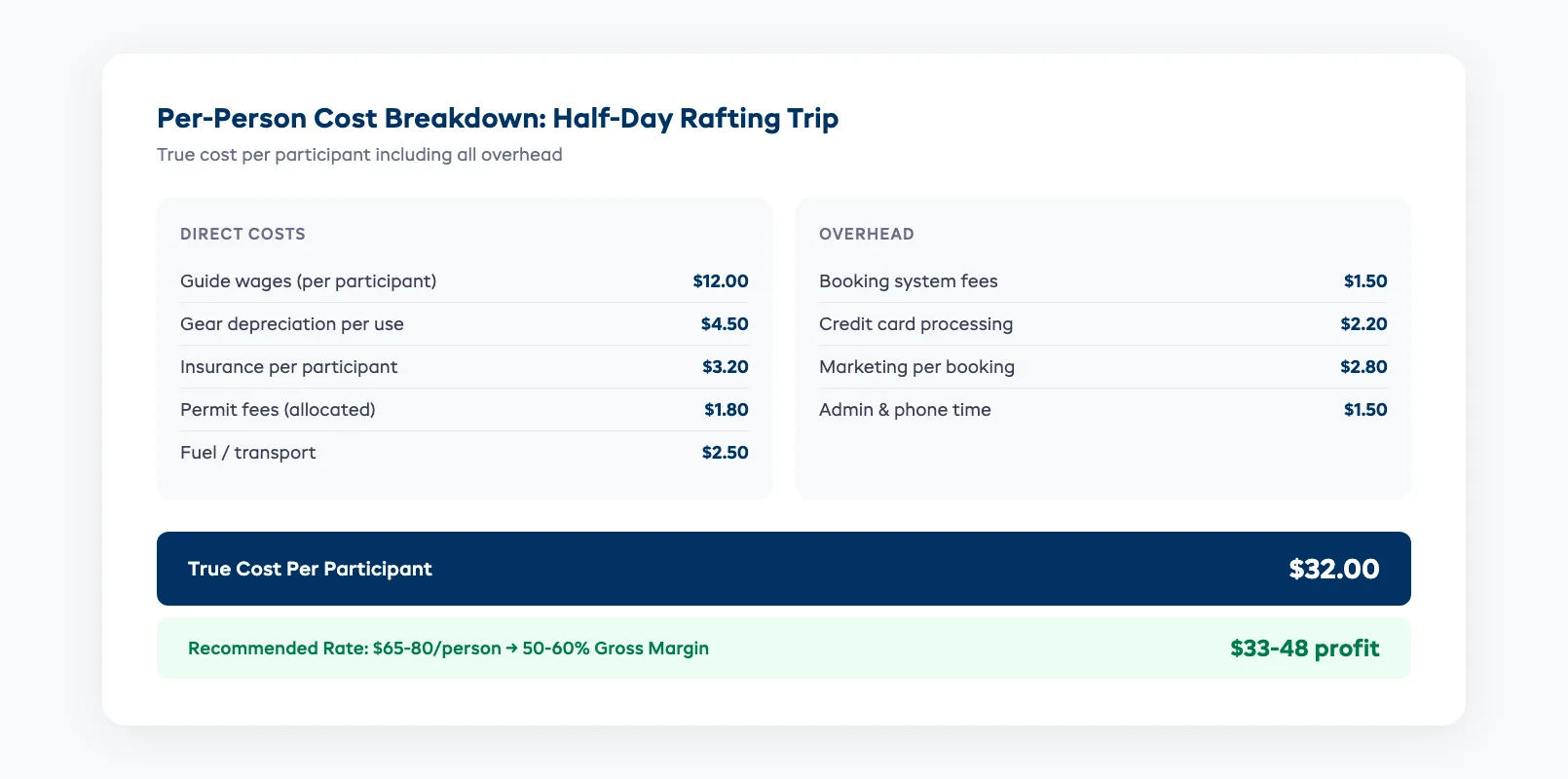
Start with your true cost per participant. Add up guide wages (allocated per participant), gear depreciation per use cycle, insurance cost per participant, permit fees divided by annual volume, fuel/transport, and admin overhead. Most operators undercount overhead by 15-25%. Include booking system fees, credit card processing, marketing spend per booking, and the time you spend answering phones.
Benchmark against your market. Pull pricing from every competitor within your operating radius. Don't just look at the headline rate. Check what's included. A $65 rafting trip that includes lunch, photos, and transport is priced differently than a $55 trip that charges for each of those separately. You need apples-to-apples comparisons.
Margin target: 40-60% gross margin on your base rate. Below 40% and you don't have enough room for discounts, commissions, or bad-weather cancellations. Above 60% and you're probably underinvesting in guide quality or equipment. A half-day rafting trip costing $32 per participant to run should price at $65-80 per person, not $45.
Minimum group size matters. If your trip economics require 6 participants to break even and you regularly run with 4, your base rate needs to cover the shortfall. Some operators set a minimum of 4 and price assuming that minimum. Others set individual rates high enough that 3 participants still cover costs. Either works, but you need to know your breakeven participant count cold.
Time-based tiers within per-person pricing. A 2-hour kayak tour and a full-day expedition use different rate structures. Shorter experiences command higher per-hour rates because setup, briefing, and gear time are fixed costs regardless of duration. A 2-hour trip at $75 ($37.50/hr) and a 6-hour trip at $150 ($25/hr) is normal. Don't scale linearly.
Private Group Pricing: Capturing the Premium
Private departures are your highest-margin product. Families, friend groups, and social clubs will pay 25-50% more for an exclusive experience. The operational cost difference is minimal. You're running the same trip with the same guide.
Price the departure, not the person. A private rafting trip for up to 8 people at $700 captures more than 8 × $75 = $600 at individual rates. The group perceives value because they get exclusivity. You get a guaranteed minimum regardless of final headcount.
Set a base group rate with per-person adds. The most effective structure: $500 base rate for up to 6 people, plus $60 per additional person up to 12. This guarantees your minimum revenue while scaling smoothly for larger groups. The per-person add-on is deliberately lower than your individual rate. It encourages groups to bring more people.
Private departure windows. Offer private groups preferred time slots (early morning, sunset, or mid-week) that don't conflict with your peak public departures. This fills capacity that would otherwise sit idle. Wednesday at 7 AM has zero demand for individual bookings but genuine demand for corporate team outings and bachelor parties.
Upsell the private experience. Private groups are predisposed to spend more. Photography packages, custom itineraries, catered lunch additions, and post-trip videos have 3-5x higher attachment rates on private bookings versus individual ones. Build your add-on menu (covered below) with private groups in mind.
For managing private group waivers efficiently at scale, see the Digital Waiver Collection Process checklist.
Corporate Tiers: The $3,000+ Booking
Corporate bookings are adventure's highest-value segment. Team-building budgets at mid-size companies run $100-200 per person, and the decision-maker cares more about logistics and liability coverage than price.
Build packages, not price lists. Corporate buyers don't want to pick from a menu. They want a proposal that says: "Your 25-person team gets exclusive use of the river from 9 AM to 2 PM, including lunch, professional photography, a debrief facilitator, and full liability coverage. $4,500." One number. One decision.
Include what corporate buyers actually need. Invoicing (they can't expense a Venmo payment). W-9 documentation. Certificate of insurance naming their company. Dietary accommodation forms. A single point of contact who answers emails within 4 hours. These details close corporate deals more than price does.
Tiered corporate pricing. Structure by group size:
- 10-20 people: $150/person (includes lunch, photos, facilitator)
- 21-40 people: $130/person (volume discount, same inclusions)
- 41-60 people: $115/person (multi-guide, custom agenda, dedicated coordinator)
Each tier should be profitable at the bottom of the range. A 10-person booking at $150/head should still hit your margin target.
Repeat corporate pricing. Companies that book annually get a 10% loyalty rate — locked for 12 months. This turns a $4,500 one-time booking into a recurring $4,050 annual event. The 10% discount costs you $450 but eliminates the acquisition cost of finding a new $4,500 booking.
Lead time advantage. Corporate bookings come 4-8 weeks in advance. That's 4-8 weeks of guaranteed revenue you can plan around: staffing, equipment allocation, and capacity management become predictable. Price this certainty into your corporate discount.
Add-Ons: Revenue Without Adding Capacity
Add-ons are pure margin. The trip is running. The guide is paid. The gear is out. Every add-on dollar goes almost entirely to your bottom line.
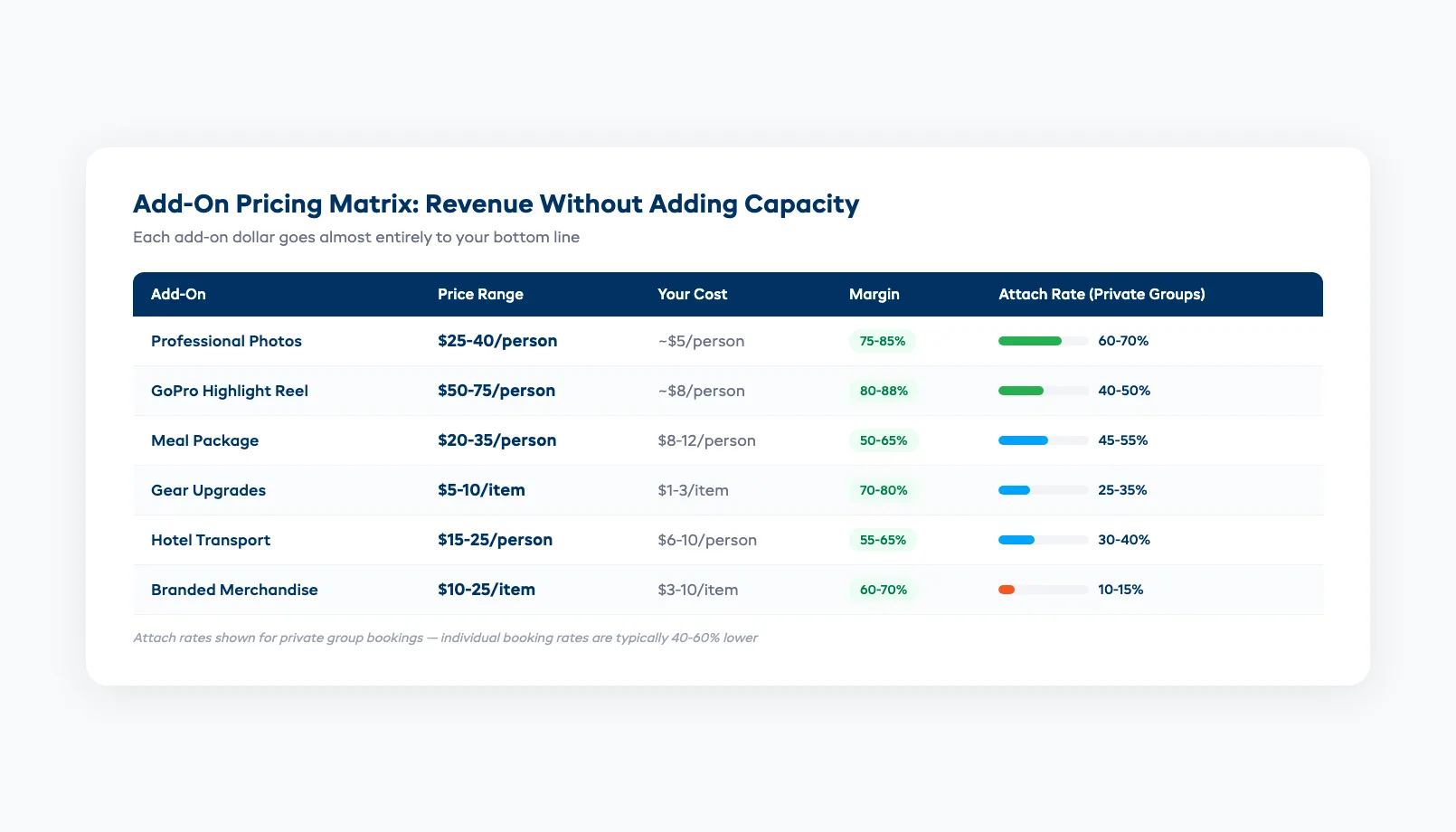
Photography and video. The highest-margin, highest-attachment add-on across adventure verticals. Professional action photos: $25-40 per person or $150 for the whole group. GoPro footage edited into a highlight reel: $50-75 per person. Cost: a waterproof camera and 20 minutes of editing time per trip.
Meal packages. Riverside lunch on a full-day trip: $20-35 per person. Cost: $8-12 per person through a local caterer. Margins of 50-65%. For multi-day operations, meal packages should be standard inclusions priced into the base rate. See Multi-Day Adventure Operations for logistics.
Gear upgrades. Premium wetsuit ($10 add-on), upgraded paddle ($5), splash-proof phone case ($8). Low-cost items with 70-80% margins that improve the customer experience. Stock them at your check-in area where the buying decision is impulsive.
Transportation. Hotel pickup and drop-off: $15-25 per person. Especially valuable in resort destinations where your put-in is 30+ minutes from town. Some operators include transport in their base rate and price accordingly. This simplifies the booking decision but hides a potential profit center.
Merchandise. Trip-branded t-shirts, stickers, and caps at your takeout point. $5-15 margin per item. Don't push it — just make it available. A branded shirt rack next to the changing area converts at 10-15% without a single sales pitch.
Seasonal and Weekend Pricing: Matching Price to Demand
If your Saturday in July costs the same as your Tuesday in April, you're subsidizing low-demand days with money you should be making on high-demand ones.
Weekend surcharge: 10-20%. Saturday and Sunday demand is 2-3x weekday demand for most adventure operations. A 15% weekend surcharge on a $75 base rate is $86.25 — small enough that it doesn't deter bookings, large enough that it adds $11.25 per person across your highest-volume days.
Peak season pricing. Define your peak clearly, usually 8-12 weeks. During peak, raise base rates 15-25%. A $75 off-peak trip at $90-94 in July is standard and expected. Customers booking peak season trips expect to pay more. They're already paying peak rates for flights and hotels.
Shoulder season discounts. Early and late season: 10-15% below base rate. This isn't about margins. It's about filling trips that would otherwise run at 40% capacity. A discounted trip at 8 participants beats a full-price trip with 3. Set your Dash booking system to apply shoulder pricing automatically within your defined date ranges.
Holiday pricing. Memorial Day, Fourth of July, Labor Day: treat these as super-peak. Price 20-30% above your standard peak rate. These days sell out regardless. The question isn't whether people will book. It's how much margin you'll capture.
Dynamic pricing caution. Some operators experiment with algorithmic pricing that adjusts based on remaining capacity. This works for airlines and hotels. It's risky for adventure operations because your product has a physical safety dimension — customers get nervous when prices fluctuate dramatically, and it complicates guide compensation if you pay per-participant bonuses. For the broader seasonal financial picture (including cash flow reserves and off-season revenue streams that reduce your dependence on peak pricing) see Seasonal Adventure Business Management.
Discount Strategy: When to Cut Price and When to Hold
Discounting without a strategy is just giving away margin. Every discount should have a clear purpose: fill a specific gap, acquire a specific customer type, or generate a specific downstream behavior.
Early-bird discounts (10-15%). Bookings made 30+ days in advance get a modest discount. The value to you: cash flow certainty, staffing predictability, and reduced day-of no-show risk. Early bookers also have higher add-on attachment rates because they're planners.
Last-minute fills (15-20%). Two spots left on tomorrow's 10 AM trip? Drop the price through a last-minute channel: your own email list, a local hotel concierge partnership, or a social media flash post. Never discount on your main booking page. The discount lives on a separate channel so full-price buyers don't see it.
Repeat customer pricing. A returning customer costs $0 to acquire. Give them 10% off their second booking, then lock them into a "locals' rate", 15% below standard, for ongoing bookings. Track repeat rates by customer in your booking system. The Guide Daily Briefing Checklist helps your team identify returning guests before they arrive.
Referral credits over cash discounts. Instead of $10 off, offer a $15 credit toward their next booking when they refer someone who books. This costs more on paper but generates two future bookings instead of discounting one current booking.
Group minimums over group discounts. Rather than "10% off for groups of 8+," try "groups of 8+ get a free photo package" (cost to you: $20 in editing time). The perceived value is higher, your margin hit is lower, and you're promoting your highest-margin add-on.
What NOT to discount. Private departures — the customer has already decided they want exclusivity. Corporate bookings — the buyer cares about quality, not price. Peak Saturday mornings. They'll sell out regardless. Discounting high-demand products trains customers to wait for sales.
For guide certification costs that factor into your pricing, see Guide Certifications: What Your Insurance Actually Requires.
Pricing isn't a number you set once and forget. It's a system: base rates, group tiers, corporate packages, add-ons, and seasonal adjustments that work together to match your price to each customer's willingness to pay. Start with your true costs, build tiers that capture different segments, and review every season. The operators who treat pricing as a living system consistently outperform those charging the same flat rate to everyone. And when incidents happen, every adventure business faces them eventually, your response protocol protects both your participants and your revenue; see Adventure Incident Response and Reporting.
FAQ
How often should I review my adventure pricing?
Twice a year minimum — once before peak season (March/April for summer operators) and once after peak (September/October). Review your actual cost-per-participant against your rates, check competitor pricing, and adjust. Major cost changes (insurance renewal, permit fee increases, guide wage hikes) should trigger an immediate review.
Should I show all my pricing tiers on my website?
Show per-person and private group pricing publicly. Keep corporate pricing as "contact us" or "request a proposal." Corporate buyers expect custom quotes, and showing a per-person rate for corporate bookings anchors them too low. Your public pricing should make it easy for individual and group bookings to convert without a phone call.
How do I handle pricing for activities with different difficulty levels?
Price by resource intensity, not difficulty label. A Class IV rafting trip that requires more experienced guides, specialized gear, and higher insurance coverage should cost more than a Class II float trip. Customers understand that harder trips cost more. Frame it as "advanced trip" versus "introductory trip" rather than just slapping different prices on the same listing.
What's the best way to handle pricing for kids?
Most operators offer a child rate (typically ages 6-12) at 60-75% of the adult rate. Kids under 6 are usually free if sitting with a parent on calm activities. Don't make child pricing too generous — a family of 4 with 2 kids at 50% off means 25% less revenue for the same operational cost. The gear is the same size, the guide ratio is the same, and the liability is actually higher.
Should I offer package deals combining multiple activities?
Yes. If you run multiple activities. A "full-day adventure pass" (morning raft + afternoon climb) at 15-20% below the combined individual price drives higher per-customer revenue even at a discount. The key: packages should sell activities that have different demand profiles. Bundle your high-demand trip with your underbooked one.
How do I compete with operators who undercut my pricing?
Don't race to the bottom. Operators who undercut on price are either cutting corners (fewer guides, older gear, less insurance) or running unsustainable margins. Compete on experience quality, safety reputation, guide expertise, and convenience. Make your value visible: list what's included, show guide certifications, display safety records. Customers booking adventure activities are buying trust, not the cheapest option.
in one place