How to Run an ATV and Off-Road Tour Business
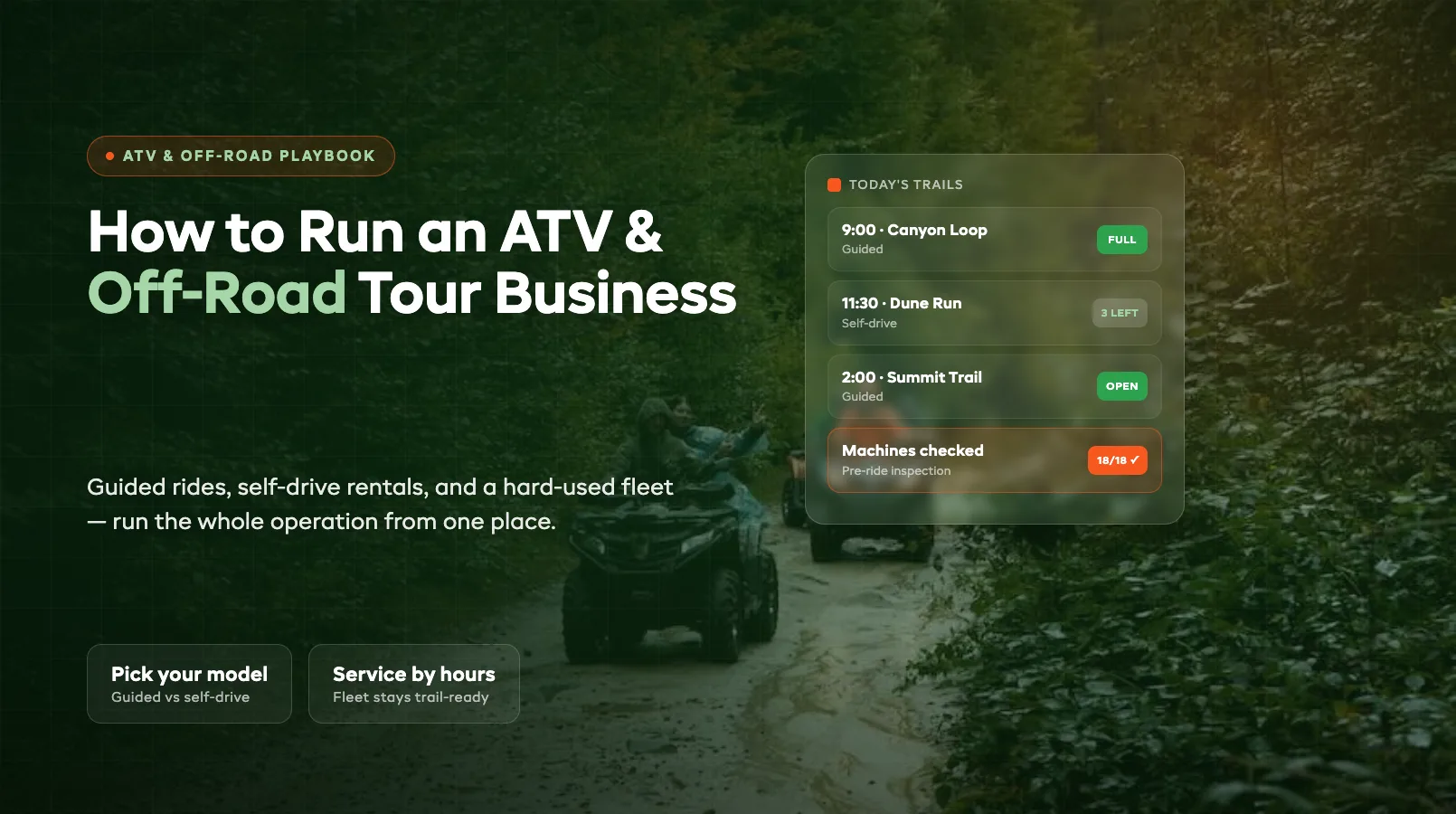
An ATV and off-road tour business looks simple from the outside: buy some quads, find a trail, sell seats. Anyone who has actually run one knows the reality is a fleet of hard-used machines, a stack of waivers, weather that can cancel your whole day, and the constant question of how many riders one guide can safely keep alive on a rocky descent. The machines are the easy part. Running the operation around them is where most new operators come unstuck.
The two decisions that shape everything else are the ones people tend to make by accident. First, whether you run guided tours, self-drive rentals, or a blend of both — that choice sets your machines, your staffing, your insurance, and your margins. Second, how disciplined you are about keeping a fleet of engines that live at full throttle, in dust and mud, ready to ride on your busiest morning. This guide walks through the whole business end to end: your model, your fleet, land access, guide ratios, safety briefings, maintenance, pricing, and the booking system that keeps the office running while you are out on the trail. If a term is new to you, the ATV and off-road glossary covers the vocabulary. For the wider picture of running an experience business, the ATV and off-road operator hub pulls the pieces together.
Guided tours vs self-drive rentals: pick your model
Before you buy a single machine, decide what you are actually selling. A guided ride is an experience: the guest pays for the route, the scenery, the story, and a lead guide who keeps them safe and picks the line through the tricky bits. A machine rental is access: the guest pays to take a quad or side-by-side and ride, with far less hand-holding. The two models pull your business in different directions, and trying to run both without noticing the difference is how operators end up with the wrong fleet and the wrong insurance.
Guided tours earn more per seat and give you tight control. A guide is with the group the whole time, so your machines stay on the routes you know, at the pace you set, and nobody wanders onto a closed trail. The trade-off is labor: you pay a guide for every group, and there is a hard limit on how many riders one guide can lead safely. Self-drive rentals flip that maths. Without a guide per group, rentals scale better and your margin per machine can be higher — but you carry more damage and liability risk, you need a bigger deposit hold, and they only work where guests can ride without getting lost or hurt.
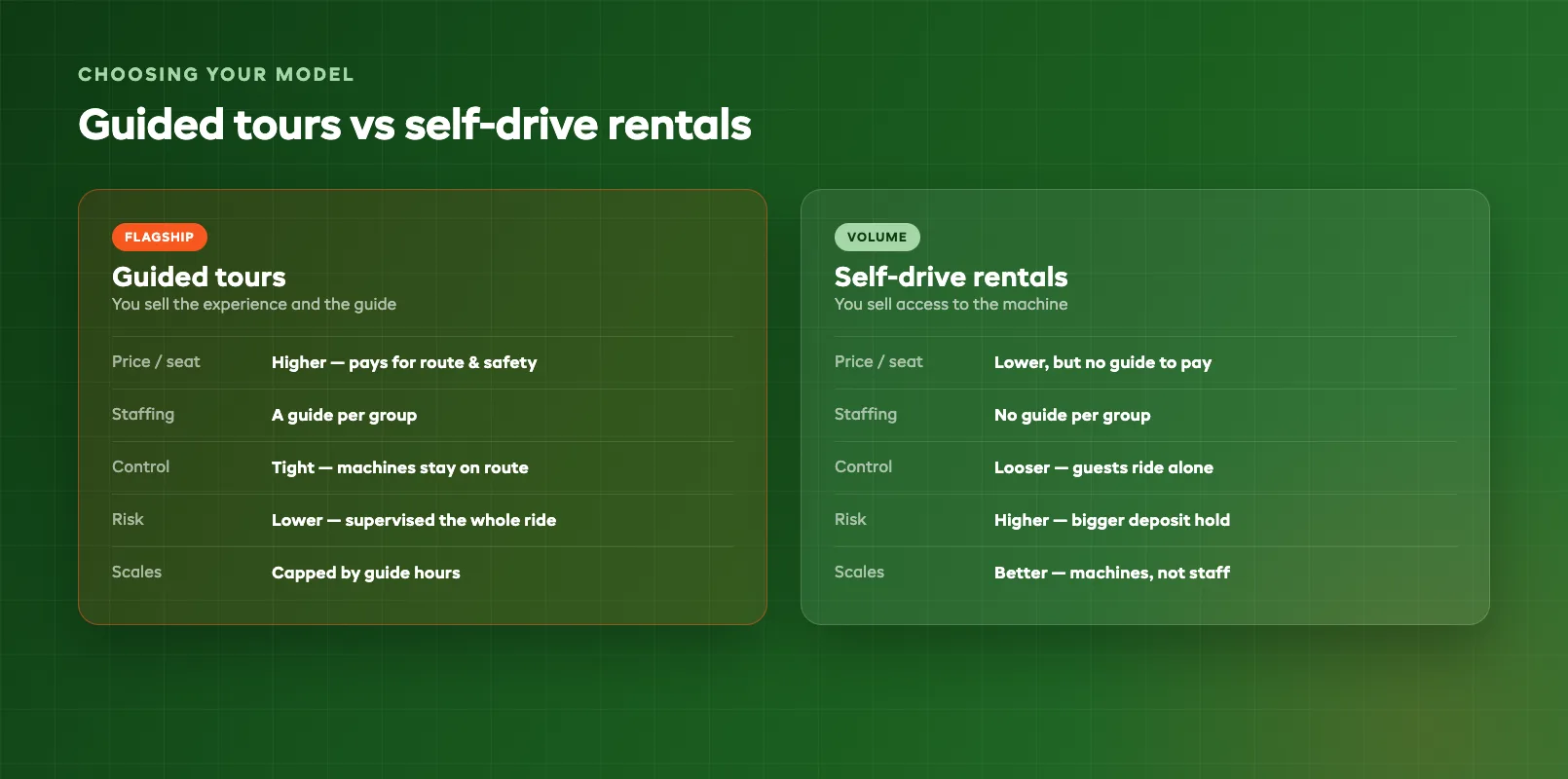
Most operators end up running both. Guided rides become the flagship product — the thing people book, review, and remember — while self-drive rentals fill capacity where the terrain and the customer allow it. What matters is that you make the choice on purpose. Your land, your insurance policy, and your appetite for letting guests ride unsupervised should decide the balance, not whatever machine happened to be for sale when you started.
Building your machine fleet
Your fleet is your biggest asset and your biggest headache. The instinct for a new operator is to buy the exciting machines — the fast sport quads, the big-bore side-by-sides. That is almost always the wrong first move. The vast majority of your guests have never ridden before, and the machine that makes them money is the one that is forgiving, automatic, and hard to get into trouble on.
A sensible starting fleet is built around mid-size, automatic single-rider quads and a handful of side-by-sides. The side-by-sides are quietly the most important machines you own: they let couples, families, and nervous first-timers join a ride without operating anything themselves, which widens your market far more than another sport quad ever will. Someone who would never straddle a quad will happily climb into a side-by-side next to a confident friend. Buy one or two models and stick to them, so spare parts, staff training, and servicing all stay simple. A mixed bag of ten different machines is ten different maintenance manuals and ten different sets of parts.

Size the fleet to the terrain you actually run and the demand you can actually fill, not to the most extreme trail you can picture. Machines that sit idle still cost you insurance, storage, and depreciation, and a quad that only suits expert riders will sit idle most of the season. When you do add sport machines, add them because you have proven demand and the experienced guests to match — not because they look good in the brochure.
Land access, permits, and where you can legally ride
This is the part that can stop your business before it starts, so handle it first. You cannot run tours on land you do not have the right to use, and "nobody has said anything yet" is not a right. Your options are usually private land you own, private land you lease from a landowner, or a permit to operate on public OHV (off-highway-vehicle) land managed by a public agency.
Each route has its own conditions. A lease gives you control but costs you rent and depends on a relationship you have to maintain. A permit on public OHV or public-agency land often requires a commercial-use application, proof of insurance, and sometimes a cap on how many riders or operators are allowed — and those permits can be competitive. Whatever the arrangement, get it in writing, understand exactly which trails and staging areas you are cleared to use, and know the rules on group size, noise, hours, and seasonal closures that come attached.
Land access also shapes your product. If your permit limits you to marked trails, self-drive rentals with a GPS route may be fine; if the terrain is technical or the land manager requires supervision, you are running guided rides whether you planned to or not. Nail down access before you buy machines, because the land you can legally ride decides what kind of business you can actually run.
Guide ratios, group sizes, and trail roles
On a guided ride, your guides are the product and the safety system rolled into one. Get the ratio wrong and you either bleed money on over-staffing or, far worse, put riders on a trail with no one close enough to help. There is no single legal number that applies everywhere, but there is a working standard that experienced operators converge on.
Run a lead guide at the front and a sweep rider at the back for any guided group. The lead sets the pace, picks the line, and makes the calls; the sweep stays behind the last guest so no rider is ever behind a staff member or alone on the trail. For groups up to roughly six to eight machines, a lead and a sweep is a sensible baseline. Beyond that, add another guide. Tighten the ratio — and slow the pace — whenever the trail gets technical, the riders are first-timers, or there are children in the group.
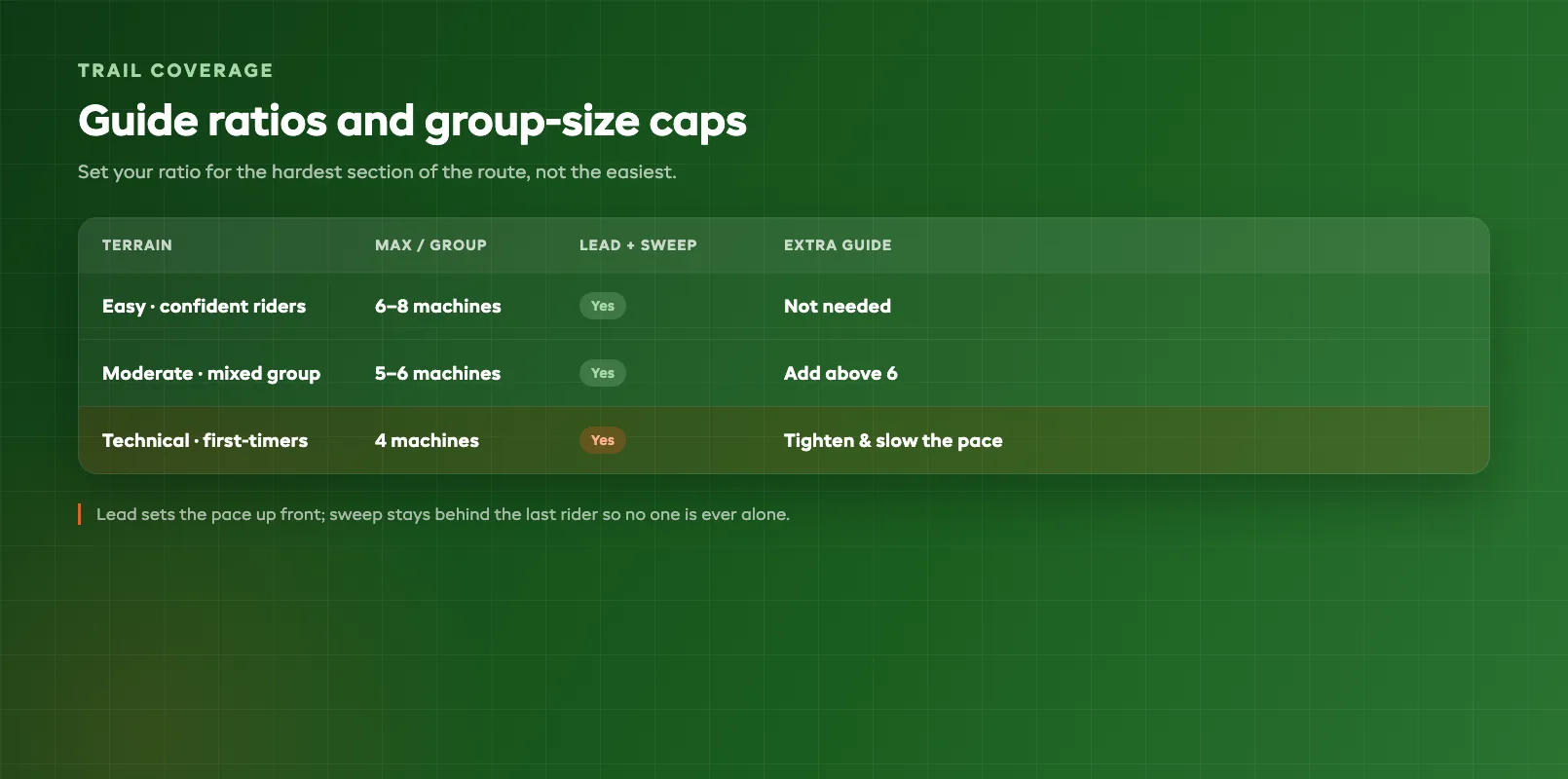
The principle behind the ratio is simple enough to explain to any new guide: every rider stays within sight of a guide, and nobody is ever left alone. Set your ratio for the hardest section of the route, not the easiest, because the group is only as safe as its worst moment. Good guides also do the quiet work that keeps you out of trouble — reading the group, spotting the rider who is getting tired or overconfident, and using clear hand signals when engine noise makes talking useless.
Safety briefings and waivers that hold up
Every guided ride and every rental starts the same way: a consistent safety briefing and a signed waiver. Skip or rush either and you are exposed, both to the guest getting hurt and to the fallout afterward. The briefing is not a legal formality you race through — it is the single biggest thing standing between a nervous first-timer and a crash.
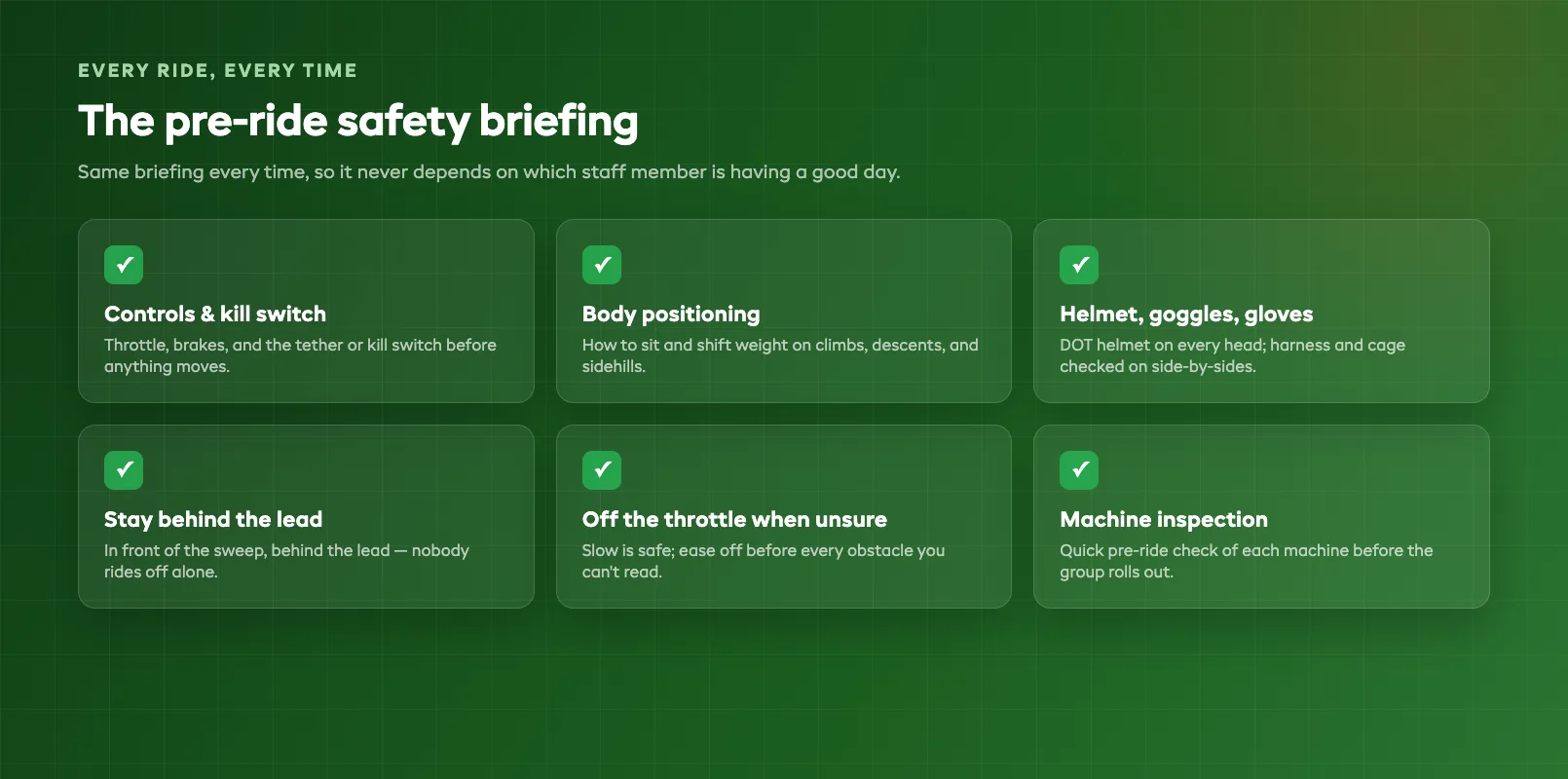
A good briefing is the same every time, so it does not depend on which guide is having a good day. Cover the controls — throttle, brakes, the kill switch or tether — how to sit and position the body, how the machine behaves on climbs, descents, and sidehills, and the golden rules: stay behind the lead, in front of the sweep, and off the throttle when unsure. Fit and check the gear before anyone rides: a DOT helmet on every head, goggles, gloves, and for side-by-sides the harness and roll cage. Do a quick pre-ride inspection of each machine while you are at it.
The waiver is the paper half of the same job. Every rider signs one that names the real risks of off-road riding, states they accept those risks, and releases your business — and it has to be signed by the right person. Minors cannot waive anything, so a parent or legal guardian signs on their behalf, and your booking flow should capture that consent in advance rather than at the trailhead. Collect waivers digitally when the booking is made, keep every signed form linked to its ride, and you can produce the exact document someone agreed to in seconds if you ever need it.
Fleet maintenance and engine-hour servicing
Off-road machines live a brutal life. They run at full throttle through dust, mud, and water crossings, get bounced off rocks, and come back caked in grit that eats into every moving part. A fleet that is not maintained on a schedule will fail you on exactly the day you can least afford it — a sold-out summer Saturday with three groups waiting at the staging area. The fix is not heroics; it is a boring, disciplined service program.
The key is to service by engine hours, not by the calendar. A tour machine can pack a season's worth of wear into a few peak months, so a date-based schedule either services too late (and you get failures) or too early (and you waste money). Track the hours on every machine, set fixed service intervals — oil and filters, air filter, chain or belt, brakes, and a full inspection at set hour marks — and pull each machine off the trail the moment it hits its number.
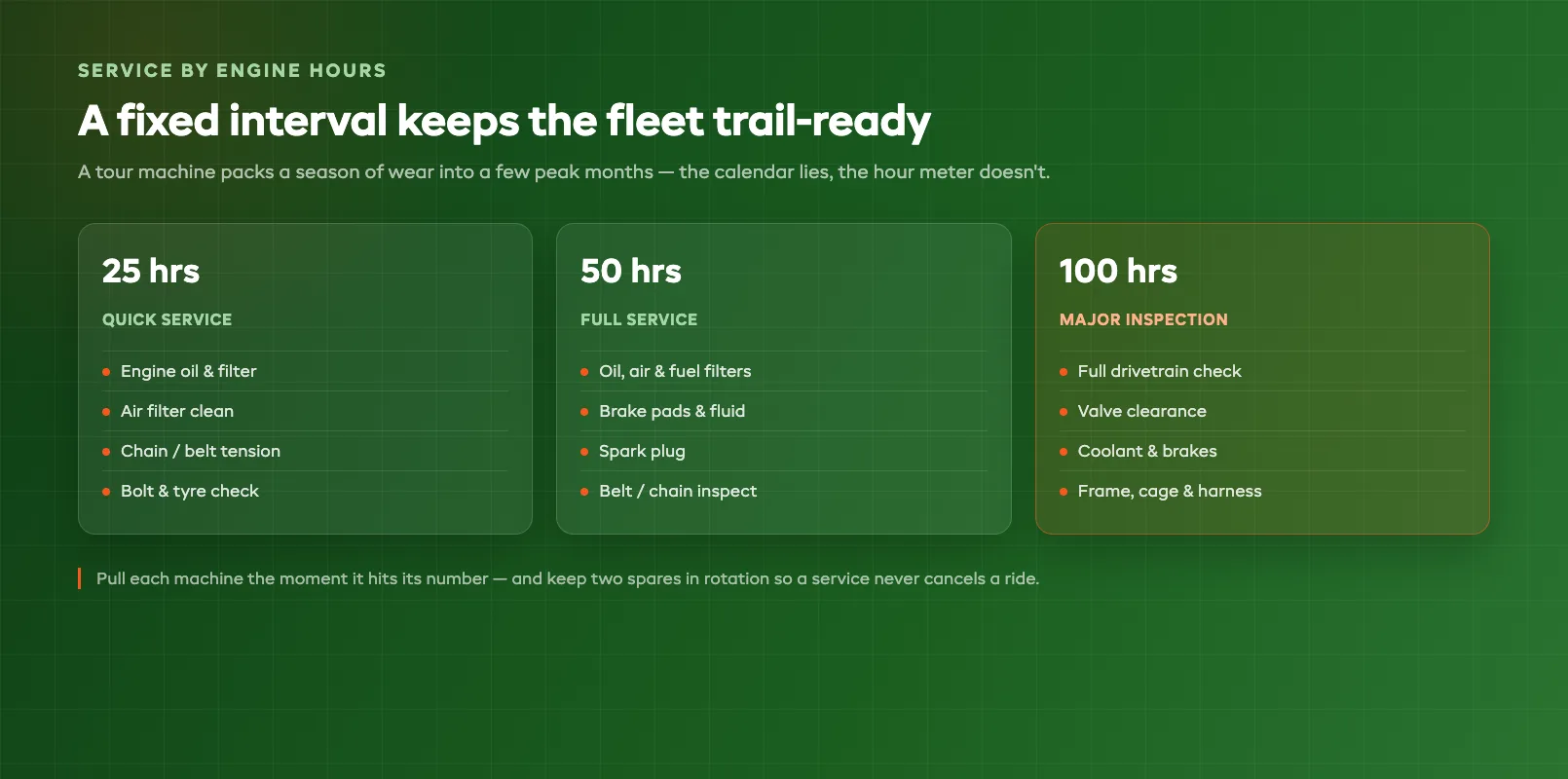
Build the daily habits around it too: a pre-ride inspection before the first group and a return inspection after the last, so damage gets caught the day it happens instead of the morning it strands a guest. Keep a couple of spare machines in the rotation so you can pull one for service without canceling a ride. The operators who stay reliable through peak season are not the ones with the newest machines — they are the ones who never let a machine go out overdue.
Pricing guided rides, rentals, and add-on gear
Price has to cover four things: the machine, the guide, the land, and the risk. New operators routinely price off the machine alone and wonder why the money never adds up. A guided ride carries the cost of a guide's time and a share of every machine's depreciation, fuel, insurance, and land access — plus the fact that you can only run so many rides a day. Price it as an experience, because that is what the guest is buying, and anchor it against the value of the trip rather than the hourly cost of a quad.
Self-drive rentals price differently. Without a guide per group your labor cost drops, but your risk and admin rise, so build the deposit hold and the damage exposure into the number. Length matters: an hourly rate, a half-day rate, and a full-day rate that rewards longer bookings all pull different customers. Then layer on the add-on gear that carries a healthy margin — helmet and goggle rental, a chase-vehicle photo package, fuel, or premium machines — because those extras are often where a thin ride margin turns into a real one.
Deposits deserve their own thought. A clear, disclosed deposit hold protects your machines and sets expectations, and it should be tied to a published damage schedule so a genuine charge is defensible and a clean return gets refunded fast. Guests accept fair, evidenced charges; they resent surprises. Charge for peak demand when the season is hot, and do not be shy about it — a handful of peak months usually carries the whole year.
Seasonality, weather, and trail closures
Almost every off-road operation is seasonal, and pretending otherwise is how businesses run out of cash in the quiet months. In most regions the riding season is set by weather, daylight, and trail condition, so the bulk of your revenue lands in a handful of peak months. Build your entire budget around those months and treat the rest of the year as something you actively work to fill, not something you passively wait out.
Weather and closures add a second layer of unpredictability on top of the season. A day can be called off for rain, heat, fire risk, or a land manager closing the trail, and it will happen with little notice. You need a clear cancellation and reschedule policy — written down, communicated at booking, and applied consistently — that protects your revenue without burning goodwill. Offering a reschedule or credit before a refund keeps the money in the business while still treating the guest fairly.
The operators who make the quiet season pay do three things. They use the off-season for the deep fleet maintenance and staff training there is never time for at peak. They add shoulder-season products where the climate allows — winter rides, night tours, guided expeditions for experienced riders. And they lock in group bookings and corporate days that fill mid-week gaps. Seasonality is a fact of the business; whether it sinks you or just shapes you is a planning decision.
The booking and operations system that ties it together
Every piece above — trip times, machine availability, guide rosters, waivers, deposits, cancellations — has to live somewhere, and a shoebox of paper and a phone that rings during a ride is not it. As soon as you are running more than a handful of trips a week, the admin becomes the job, and the office cannot run itself while you are out on the trail unless you put a real system behind it.
One booking and operations platform should hold the whole operation: the day's trip schedule, which machines are booked and which are free, the waiver signed against each rider, the deposit taken and released, and the automatic reminders that cut no-shows. When a booking comes in, the machine is reserved, the waiver goes out, and the deposit is flagged — without you touching a spreadsheet. That is the difference between a business that depends on you standing in the office and one that keeps selling while you are leading a group up a canyon. EquipDash is built for exactly this kind of operation, tying bookings, fleet, waivers, and deposits into one place so the trail work and the office work stop fighting each other.
Putting it together
An ATV and off-road tour business is not built on the machines — it is built on the decisions around them. Choose your model on purpose, buy a fleet that suits your guests rather than your ego, and never take a booking on land you cannot legally ride. Run guided groups with a lead and a sweep, brief every rider the same way, and collect a signed waiver before anyone touches a throttle. Service by engine hours so the fleet is ready when the season is hot, price to cover the machine, the guide, the land, and the risk, and plan your whole year around the peak months.
Do those things well and the parts start to reinforce each other: a reliable fleet earns better reviews, better reviews fill peak days, and a full peak season funds the machines and staff that let you grow. Get the fundamentals right, put one system behind the operation, and you can spend your time where it belongs — on the trail, not buried in the office.
FAQ
Do you need a license or permit to run ATV tours?
It depends entirely on where you operate, and this is the first thing to nail down before you spend money on machines. In most places you do not need a special operator's license to run guided rides, but you almost always need the legal right to ride the land you use — which means owning it, leasing it, or holding a permit on public off-highway-vehicle land. Many public OHV areas require a commercial-use permit and proof of insurance, and some cap how many operators they allow. On top of land access you will need business registration, liability insurance that specifically covers ATV and off-road activity, and, in some regions, a minimum-age and rider-license check for guests. Treat land access and insurance as the two things that can stop your business dead, and confirm both in writing before you take a booking.
Are guided tours or self-drive rentals more profitable?
Neither wins on paper alone. Guided tours earn a higher price per seat because the guest is paying for the experience, the route, and the safety of a lead guide, and you keep tighter control of your machines because a guide is with them the whole time. The catch is the labor cost of the guide and a hard cap on how many riders one guide can safely lead. Self-drive rentals scale better because you are not paying a guide per group, but they carry more damage and liability risk, need a bigger deposit hold, and only work where guests can safely ride without one. Most established operators run both: guided rides as the flagship product and self-drive rentals where the terrain and the customer allow it. The right mix depends on your land, your insurance, and how comfortable you are letting guests loose without a guide.
What machines should a new ATV tour operator buy first?
Start with machines that are forgiving for beginners rather than the fastest or most powerful, because most of your guests will have never ridden before. A core fleet of mid-size, automatic single-rider quads and a few side-by-sides covers the widest range of guests: the side-by-sides let families, couples, and nervous riders join without operating a machine themselves, which massively widens your market. Buy the same one or two models rather than a mixed bag, so parts, training, and servicing stay simple. Leave the high-performance sport quads until you have a clear demand for them and the experienced riders to match. Size the whole fleet to the terrain you actually run, not to the most extreme trail you could imagine.
What guide-to-rider ratio is safe for off-road tours?
There is no single legal number, but the working standard most operators land on is a lead guide plus a sweep rider for groups up to around six to eight machines, and an extra guide once you go beyond that. The lead guide sets the pace at the front and picks the line, and the sweep rider stays at the back so nobody is ever behind the last staff member. On easier terrain with confident riders you can push group sizes up; on technical trails, with first-timers, or with children in the group you should tighten the ratio and slow the pace. The point of the ratio is simple: every rider is always within sight of a guide, and no one is ever left alone on the trail. Set your ratio for the hardest section of the route, not the easiest.
How do you handle ATV damage and deposits fairly?
The fairest system is the one both sides can see coming, so photograph or inspect every machine before it goes out and again when it comes back, and hold a clear, disclosed deposit against each rental. Tell the guest up front what a deposit covers and what normal trail wear looks like versus chargeable damage, because most disputes come from surprise, not from the money itself. When something is genuinely damaged, charge against a published schedule tied to real repair costs rather than a number you invent on the spot. Return the deposit fast when a machine comes back clean. Guests accept fair charges backed by before-and-after evidence far more readily than a vague hold with no explanation, and a clear policy protects you as much as it reassures them.
How seasonal is an ATV tour business?
Most ATV and off-road operations are strongly seasonal, and how you handle the quiet months decides whether the business is viable year-round. In a lot of regions the riding season is tied to weather, daylight, and trail conditions, so you earn the bulk of your revenue in a handful of peak months and go quiet in the off-season. The operators who thrive plan for it: they charge peak pricing when demand is high, run the off-season for deep fleet maintenance and staff training, and where the climate allows they add shoulder-season products like winter or night rides to fill the gap. Trail closures for weather, fire risk, or land-manager rules add another layer, so you need a clear cancellation and reschedule policy that keeps revenue and goodwill when a day is called off. Build your budget around the peak months and treat everything else as a bonus you actively work for.
in one place