Deposits, Interim, Balance: Payment Schedules for Long-Lead Weddings
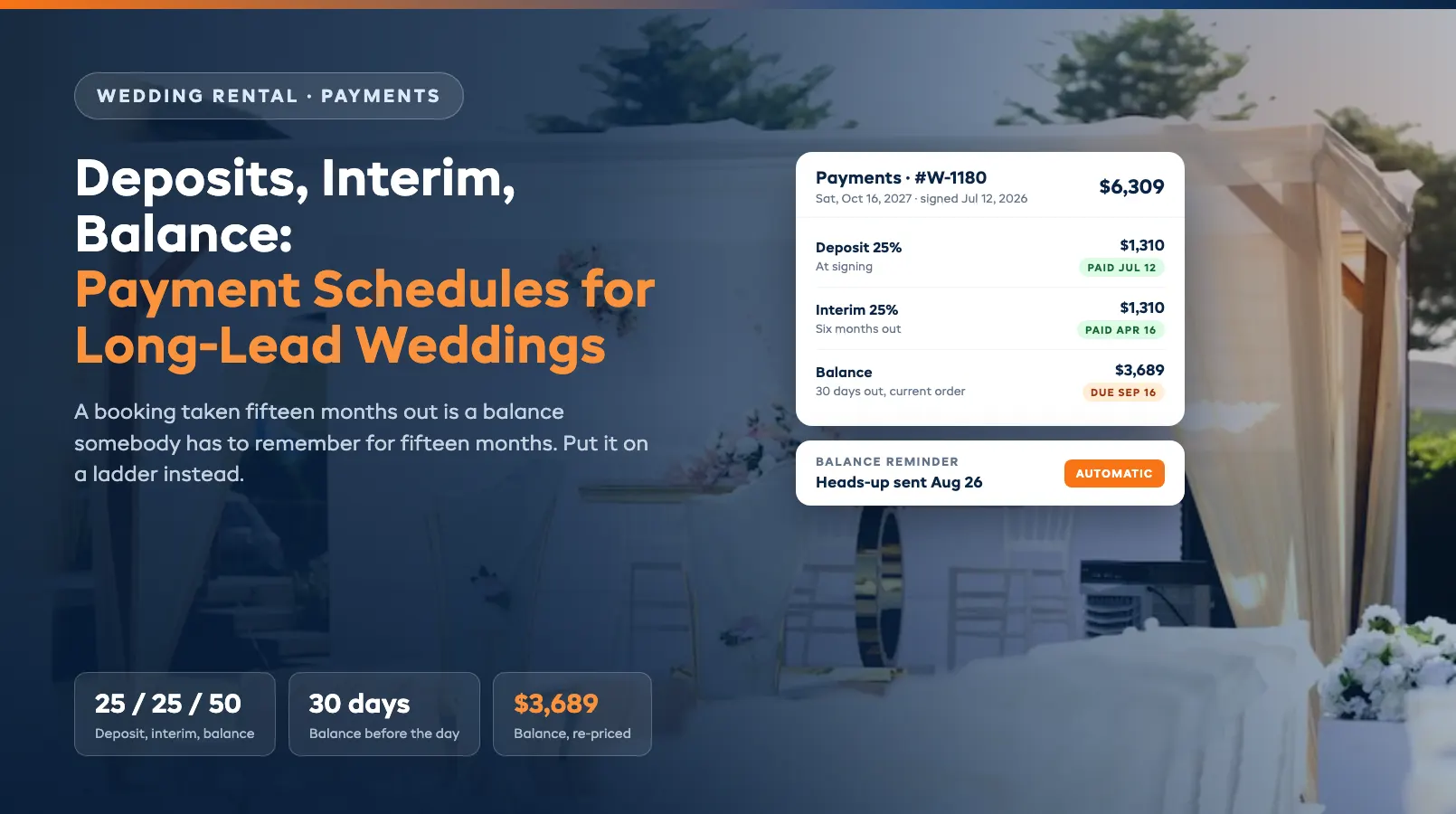
Deposits, Interim, Balance: Payment Schedules for Long-Lead Weddings
A couple signs on July 12, 2026 for a wedding on Saturday, October 16, 2027. They pay a deposit that week, and then nothing happens for fifteen months. The next money is due in April 2027. The money after that is due in September. Between those dates the order changes eight or nine times, two of your staff leave, and the spreadsheet that held the reminder gets replaced by a different spreadsheet.
That is the whole problem with wedding rental. Fifteen months is long enough for a balance to be forgotten by everyone involved, including the couple, who genuinely believe they paid in full because the last invoice they remember was a year ago.
This guide covers structuring the stages, deciding what a deposit actually covers, automating the chase, writing cancellation terms that hold, charging breakages after the day, and reading what all of it does to cash flow across a season. If you are setting the business up from scratch, start with the wedding rental software guide, which covers holding dates, contracts and packages. For keeping the order itself accurate between signing and the day, see managing wedding order revisions.
Structuring the Stages
A single deposit and a single balance works fine for a party booked six weeks out. It does not work for a wedding booked fifteen months out, because it leaves one payment date with nothing in front of it and a very large number attached to it. Couples who have paid 25% and then nothing for a year get a surprise in the last month, at the point they are least able to absorb one.
Three shapes cover almost every wedding order:
| Lead time | Stages | Typical split | Why |
|---|---|---|---|
| Under 3 months | Deposit, balance | 50% / 50% | Short gap, no drift, balance 14 to 30 days out |
| 3 to 9 months | Deposit, balance | 25% / 75% | One reminder cycle is enough |
| 9 months or more | Deposit, interim, balance | 25% / 25% / 50% | Spreads the load and gives you a check-in halfway |
The interim payment is the one operators skip and later wish they had not. It does two jobs beyond the money. It forces a conversation at the halfway point, when there is still time to fix a problem, and it tells you early whether a couple is going to struggle. A couple who cannot pay 25% nine months out is not going to find 50% thirty days out, and knowing that in April is worth far more than knowing it in September.
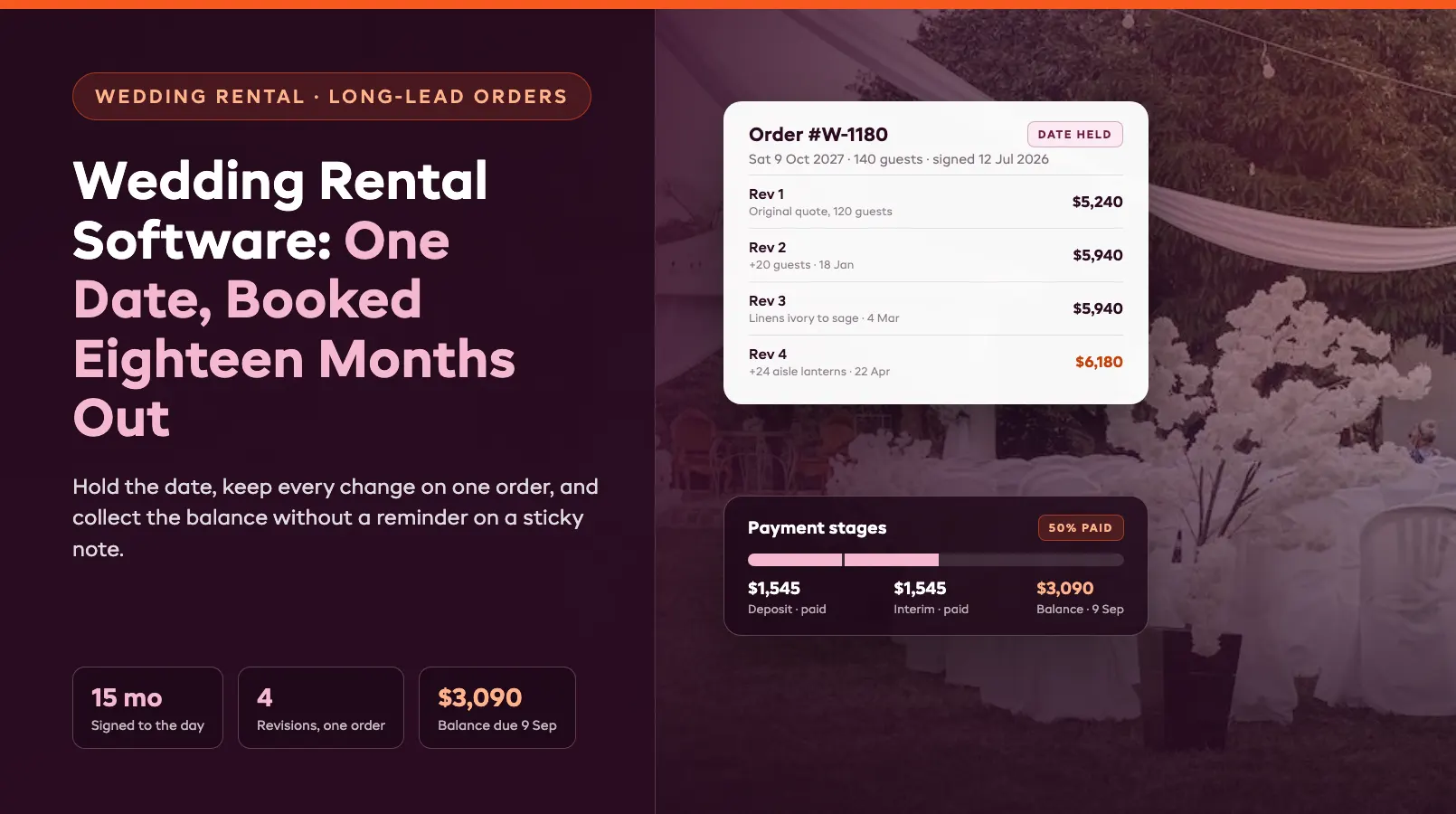
Here is the order from this cluster, a 120-guest wedding signed at $5,240:
| Stage | Due | Amount | Basis |
|---|---|---|---|
| Deposit 25% | At signing, Jul 12, 2026 | $1,310 | 25% of the signed order |
| Interim 25% | Apr 16, 2027, six months out | $1,310 | Fixed at signing, not recalculated |
| Balance | Sep 16, 2027, 30 days out | $3,689 | Current order less what has been paid |
| Late additions | On request, before the day | Invoiced separately | Anything added after the balance |
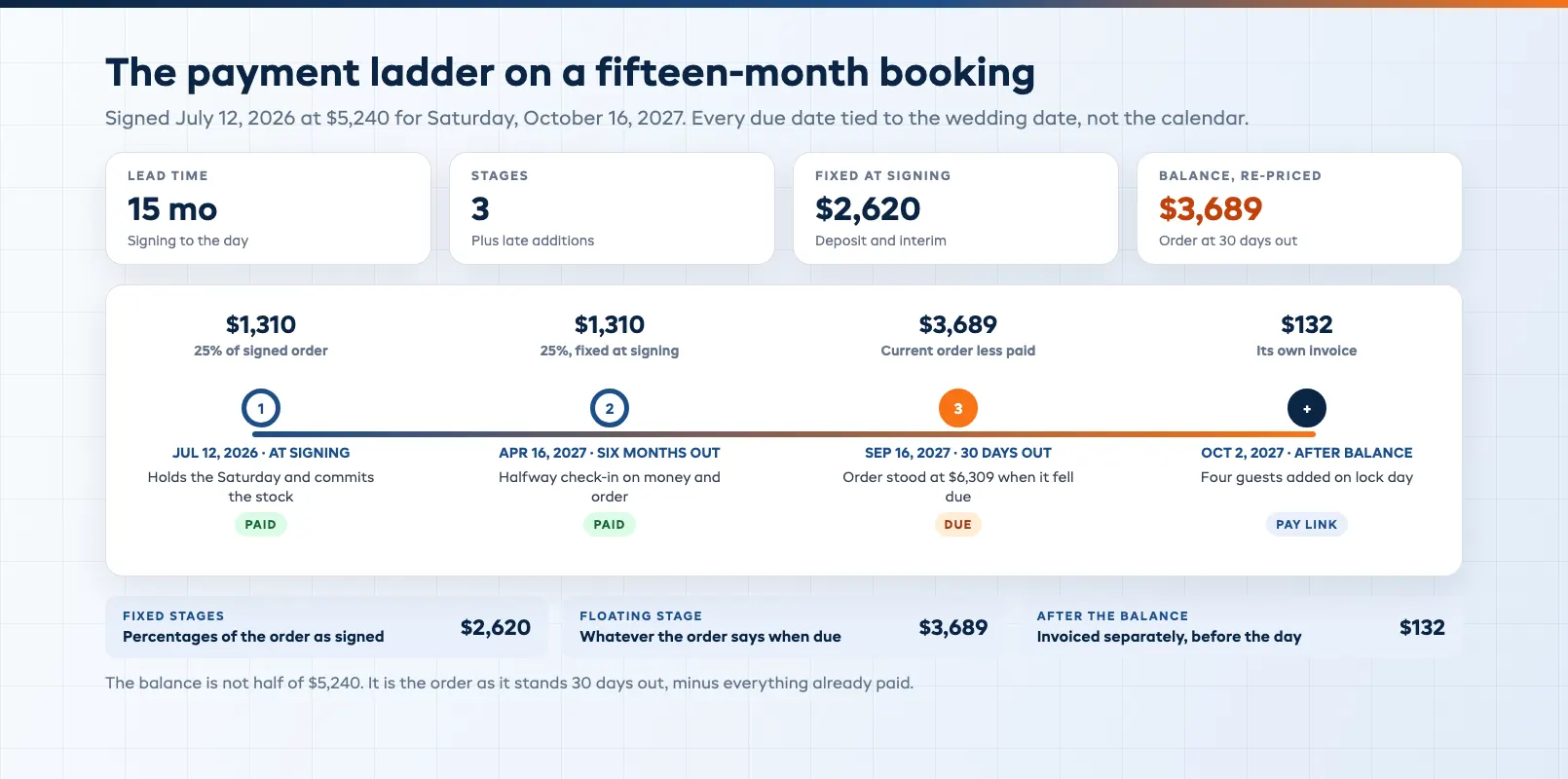
Four rules make the ladder work:
- Tie every due date to the wedding date, not to the calendar. "Six months out" and "30 days out" move automatically if a wedding is postponed. A hard-coded April 16 does not, and you will chase money for a wedding that no longer happens on that timeline.
- Fix the early stages, float the last one. The deposit and interim are percentages of the order as signed. The balance is whatever the order says when it falls due, minus what has been paid. That is why the balance above is $3,689 and not 50% of $5,240.
- Print all four dates on the quote. Deposit, interim, balance and the final numbers date. A couple who saw those dates before they signed will not argue about them in September.
- Never let the balance land inside the final week. Thirty days out, not seven. If the payment fails or the couple disputes a line, you want weeks to sort it out, not the two days before you load a truck.
For weddings booked more than 18 months ahead, some operators add a second interim rather than making one payment larger. Four smaller stages are easier for a couple to plan for than three bigger ones, and every extra stage is another point where you find out early that something is wrong.
What a Deposit Should Cover
Ask ten operators why they take 25% and most will say "because that's what everyone takes." A deposit sized by habit is either leaving money on the table or making you look expensive next to the company down the road. Size it against what you actually commit when the contract is signed.
The moment a wedding order is signed, four things happen, and each has a cost:
| What signing commits | Cost on a $5,240 order | Recovered by the deposit? |
|---|---|---|
| The Saturday itself, taken off the market | The highest-value slot in your year | Yes, this is the main one |
| Specific stock held for 15 months | 140 chairs, 12 rounds, 360 glasses unavailable to sell that date | Yes |
| Admin and quoting time to date | 3 to 5 hours at signing, more across the year | Partly |
| Bought-in items ordered for this wedding | Custom linens, hired-in specialty pieces | Should be 100%, on top |
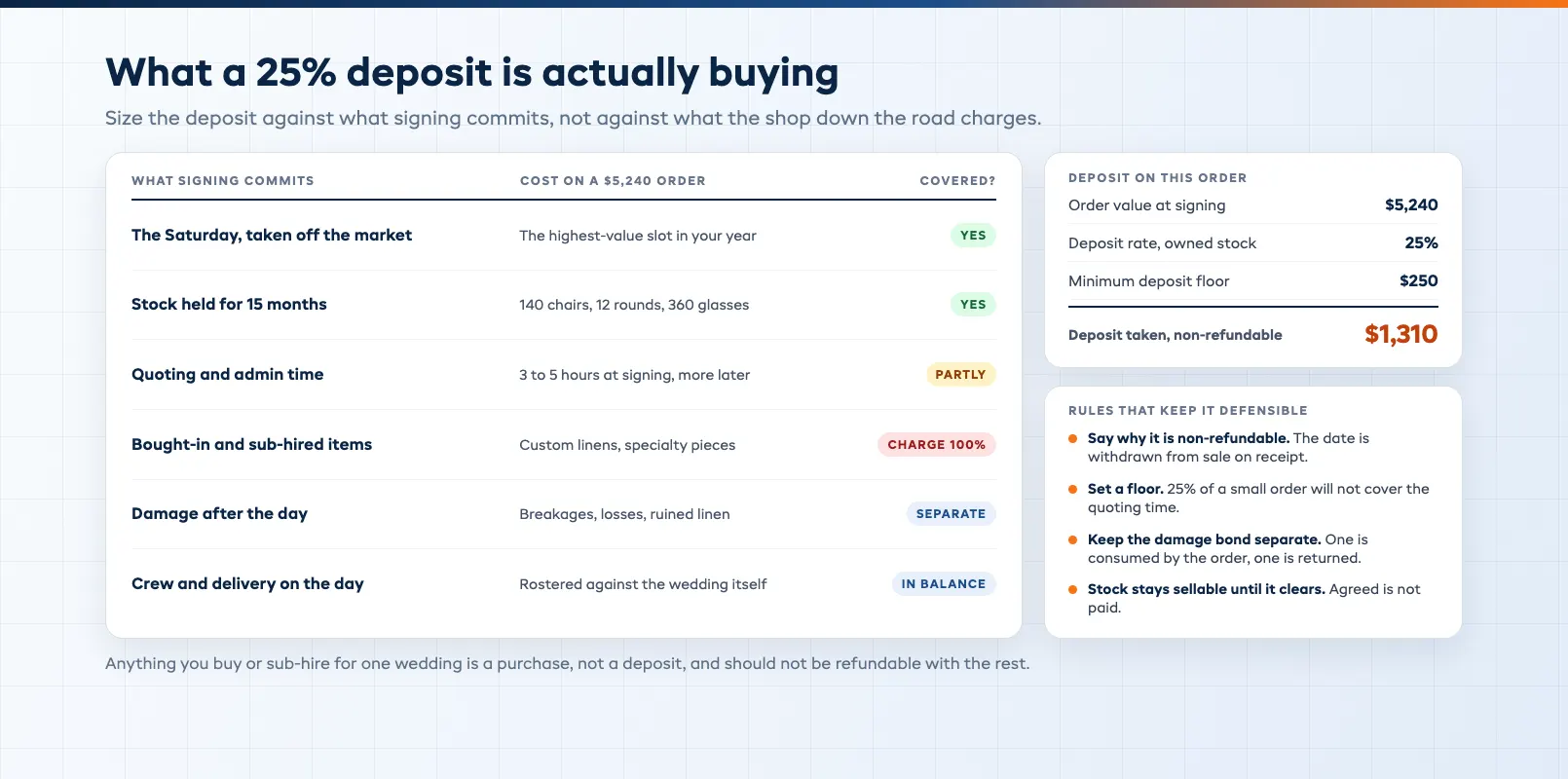
That table gives you a defensible answer rather than a habit. A few working rules:
- 25% is a sound default for stock you already own. You are covering the date and the holding, not buying anything new.
- Anything bought or sub-hired specifically for this wedding gets charged at 100%, separately, at the point you commit to it. If a couple wants a color of linen you do not stock, you are buying it for them. That is not a deposit, it is a purchase, and it should not be refundable with the rest.
- Set a floor. A small order at 25% can be $90, which does not cover the time spent quoting it. Many operators use a minimum deposit of $250 to $500, whichever is higher than the percentage.
- The deposit is non-refundable and the contract says so in plain words. "Non-refundable deposit" on its own is weaker than "the deposit is not refundable because the date is withdrawn from sale on receipt." One is a label, the other is a reason.
- Do not confuse the deposit with a damage bond. They are different amounts doing different jobs. The deposit is part of the order value and is consumed by it. A damage bond, if you take one, sits outside the order and is returned. Mixing them is how a couple ends up believing a quarter of the wedding bill is coming back.
A deposit only holds the date when it is paid, not when it is agreed. Until the contract is signed and the money has cleared, the stock should stay available to sell. Unsigned quotes want an expiry of 7 to 14 days, or your best Saturdays quietly block themselves.
Automating the Chase
Nobody forgets the deposit. It gets taken on the call, while the couple is excited and has a card in their hand. Everything after that is a memory problem, and memory is the wrong tool for a fifteen-month gap.
A cadence that works, tied to each due date:
| When | What goes out | Who acts |
|---|---|---|
| 21 days before due | Heads-up: amount, due date, payment link | Nobody, informational |
| 7 days before due | Reminder with the same link | Nobody |
| On the due date | "Due today" with the link | Nobody |
| 3 days after due | Reminder, cc the planner if named | Nobody |
| 7 days after due | Phone call from a person | Owner or manager |
| 14 days after due | Contract grace period expires, written notice | Owner |
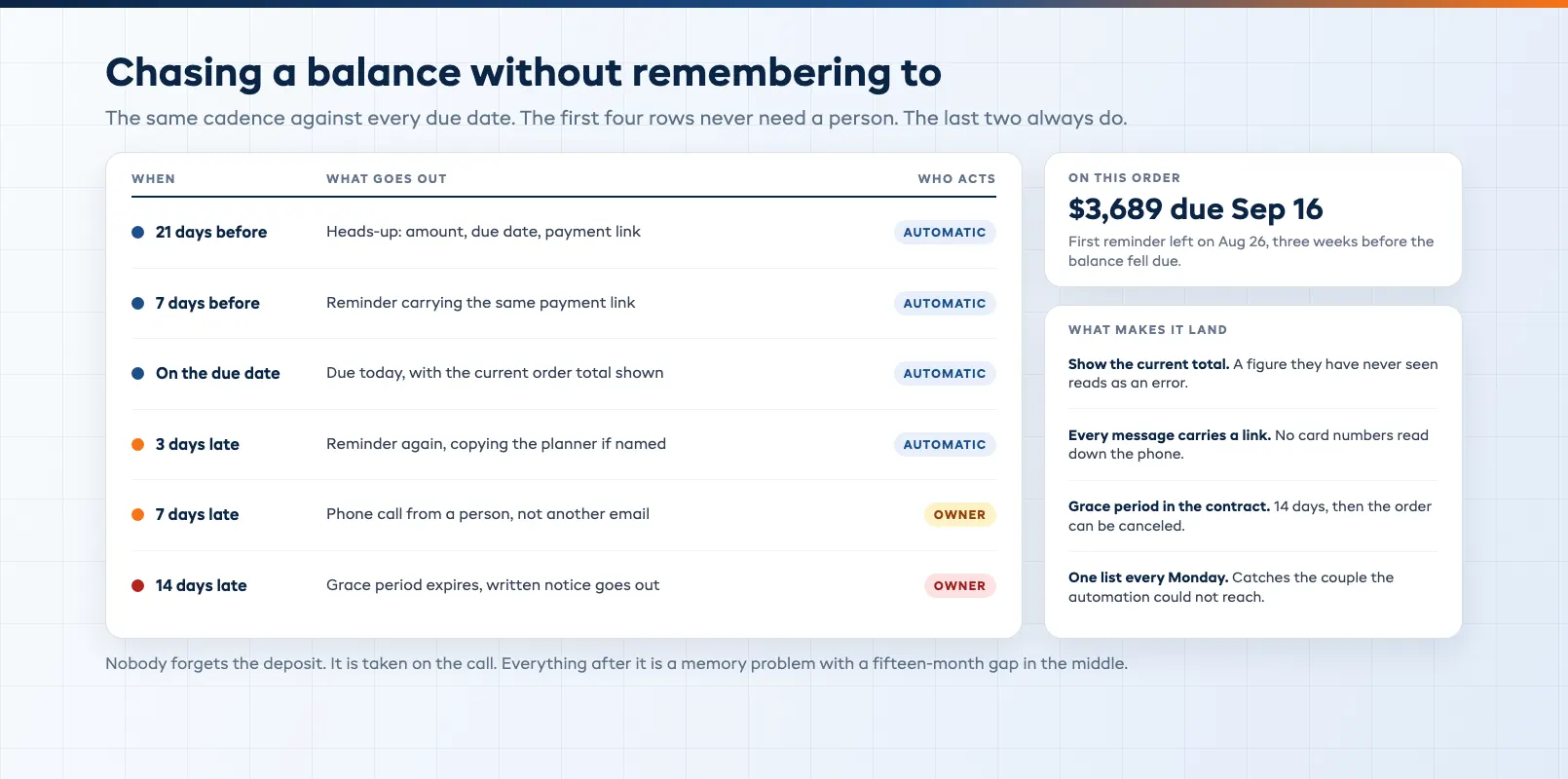
The first four rows should never require a person. On EquipDash, a Balance Reminder agent chases staged payments as the wedding date approaches, and every message carries a payment link so the couple settles online instead of reading a card number down the phone.
The last two rows should always require a person. An automated message does not fix a couple who has run out of money, and it is not what you want doing the talking when the conversation is about whether the wedding happens.
Three things matter more than the cadence itself:
- Every reminder shows the current order total, not the one from signing. A balance request for $3,689 against an order the couple last saw at $5,240 reads like a mistake and buys you a phone call.
- The link takes card payment, and the card is not stored on a notepad. Payments run through the platform, so the record of what was paid and when sits on the order rather than in somebody's inbox. See secure payments for how that works.
- Write the grace period into the contract. Usually 14 days, after which the order can be canceled and the money already paid retained. Having it in writing means the escalation is a process rather than an argument.
One more habit: run a single list every Monday of every wedding with money outstanding, sorted by wedding date. It takes two minutes and it catches the one couple the automation could not reach because the email address on file has a typo in it.
Cancellation Terms That Hold
Weddings get canceled. Not many, but enough that the terms need to be written before you need them, not after. The terms that hold up are the ones a couple can see the logic in.
A single cut-off is hard to defend. "No refunds after signing" reads as punitive on a wedding canceled fourteen months out, when you have every chance of reselling the date. A sliding scale by notice period reads as fair, because it tracks your actual ability to fill the Saturday:
| Notice before the wedding | Retained | The reasoning |
|---|---|---|
| More than 12 months | Deposit only | Plenty of time to resell a peak date |
| 6 to 12 months | 50% of the order value | Inquiries for that Saturday have already been turned away |
| 3 to 6 months | 75% of the order value | Realistically the date is not being resold |
| Under 3 months | 100% of the order value | Stock committed, crew rostered, season locked |
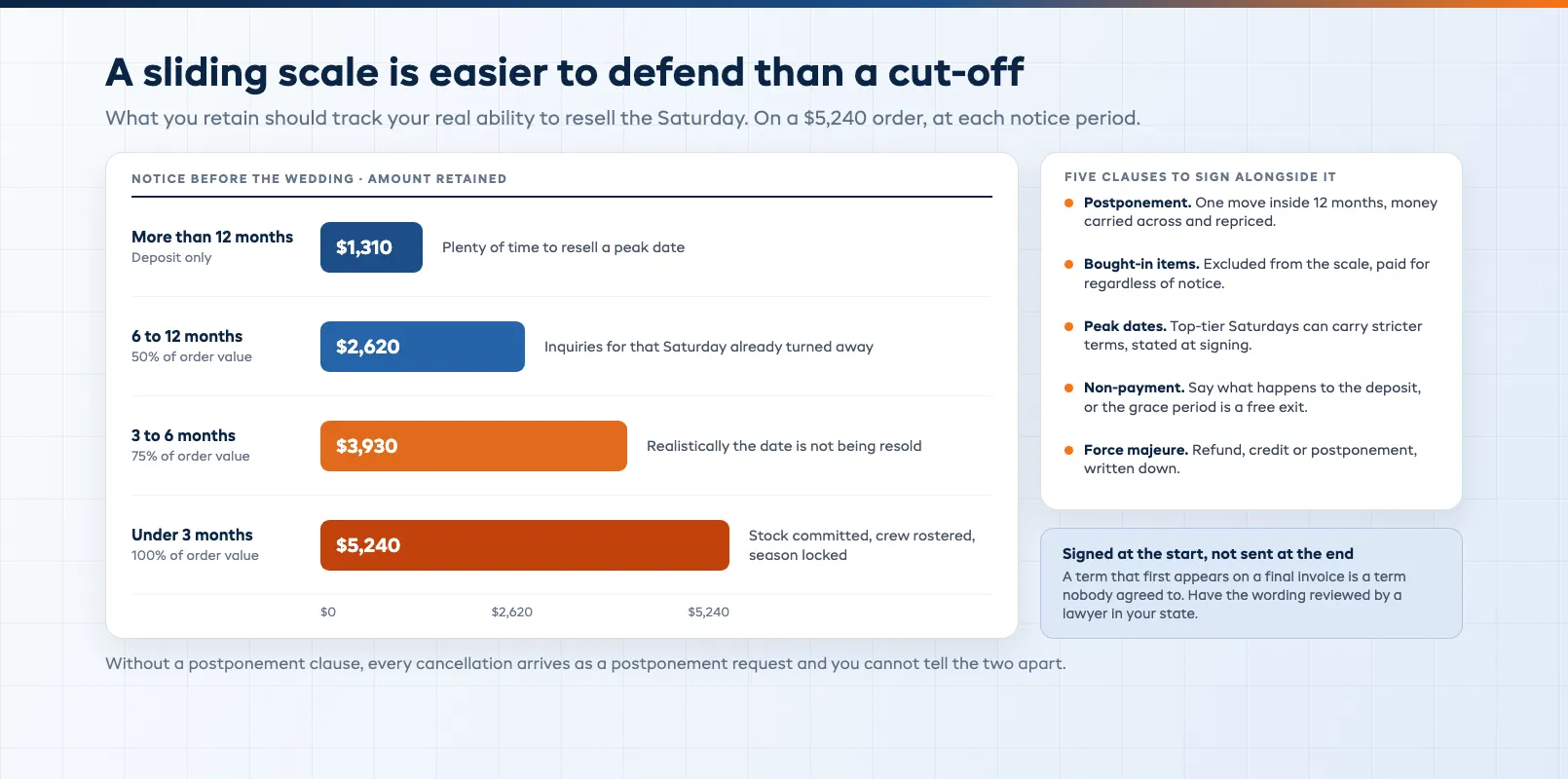
Alongside the scale, five clauses are worth having:
- Postponement is not cancellation, and it has its own rule. The common approach is one move permitted to a date within 12 months, subject to availability, with the money already paid carried across and repriced to the new date. Without that clause, every cancellation becomes a postponement request, and you cannot tell the difference.
- Bought-in items are excluded from the scale. If the custom linen was bought, it is paid for regardless of notice.
- Peak dates can carry their own terms. A Saturday in June is not the same asset as a Wednesday in February, and nothing stops the scale being stricter for your top-tier dates, as long as it is clear at signing.
- Say what happens to the deposit on a cancellation for non-payment. Otherwise a couple can stop paying and treat the grace period as a free exit.
- Force majeure needs its own paragraph. Write what happens if the venue is unusable or an event is prohibited, and whether that is a refund, a credit or a postponement. The years since 2020 made this clause non-optional.
Have the terms reviewed by a lawyer in your state. Cancellation and deposit rules vary, and none of this is legal advice. What is universal is that the terms must be on the contract the couple signs at the start, not on an invoice sent at the end. A term nobody signed is a term nobody is bound by.
Charging Breakages After the Day
The last money in a wedding order usually arrives after the wedding, and it is the money most often left uncollected. The crew brings back a crate, someone notes "a few glasses short," and the order gets marked complete on Monday because the next weekend is already loading.
Getting it collected comes down to four things:
Price the list before the season, not after the breakage. A per-item replacement price list attached to the contract turns an argument into an invoice. Glassware at $6, chargers at $12, a Chiavari chair at $95, a linen stained beyond recovery at $38. The couple signed the list in July 2026, so the October 2027 conversation is short.
Count back against the locked order within 48 hours. Not against the delivery note, and not from memory. The order says 132 place settings went out. The count-back says 129 came back. Three at $14.50 is $43.50, recorded on the same order rather than on a sticky note.
Photograph anything that is damaged rather than missing. A burn on a linen and a cracked charger are both disputable in a way a headcount is not. Condition notes with photos attached to the order are the difference between a charge that sticks and one that gets refunded to keep the peace.
Charge inside a week, against the same order. On EquipDash, breakages are charged against the order after the day, so the payment record and the count-back live in the same place. Three weeks later the couple is on honeymoon and the goodwill is gone.
One judgment call worth making deliberately: set a threshold below which you write it off. Many operators absorb anything under $25 rather than send an invoice for two glasses, because the invoice costs more in goodwill than the glasses cost to replace. That is a legitimate policy. What is not legitimate is absorbing $300 of missing chargers because nobody wanted to make the call.
Cash Flow Across a Season
Staged payments change what your bank balance means. On a single-payment model, the money arrives near the event, and what is in the account is roughly what you have earned. On staged payments, a large part of the balance is money for weddings that have not happened, against stock you still have to deliver, crew you still have to pay and breakages you have not yet had.
For a wedding rental company running 40 weddings a year, the pattern looks like this:
| Month | Deposits in | Interims in | Balances in | What is happening |
|---|---|---|---|---|
| Jan to Mar | Heavy | Light | Light | Engagement season, bookings for next year |
| Apr to May | Moderate | Heavy | Building | Interims on the summer, balances starting |
| Jun to Sep | Light | Moderate | Heavy | Peak weddings, most delivery cost |
| Oct to Dec | Moderate | Light | Light | Fall weddings, then the quiet |
Three consequences follow from that shape:
- January cash is mostly other people's weddings. A strong engagement season fills the account with deposits for dates 12 to 18 months away. Buying stock with it is fine if the stock is for those weddings. Covering a shortfall with it means next summer's deliveries are funded by next winter's deposits, which is a treadmill that only speeds up.
- Your worst cash month is not your worst trading month. Peak season is when crew, laundry, fuel and replacement stock all cost the most, while much of the revenue for those weddings arrived months earlier. Look at the delivery calendar against the payment calendar before you assume a busy August pays for itself.
- A canceled wedding takes cash twice. You may owe a refund on a scale, and you lose a Saturday that is now too late to resell. The sliding scale exists to keep that from being a double hit.
Two habits keep the picture honest. Track deferred revenue separately from cash, so you know how much of the account is money already spoken for. And run a monthly report of outstanding balances against wedding dates, which tells you what is genuinely still to come in before peak season starts.
Wedding rental plans start at $23/month on annual billing. See pricing for the current tiers, and the wedding rental software page for how staged payments, reminders and contracts fit together.
FAQ
How much deposit should a wedding rental company take?
25% of the order value is a sound default for stock you already own, because the deposit covers taking the Saturday off the market and holding the items for the life of the booking. Set a floor of $250 to $500 so small orders still cover the quoting time, and charge anything bought or sub-hired specifically for that wedding at 100% on top, separately. Make the deposit non-refundable in the contract and say why: the date is withdrawn from sale on receipt.
What payment schedule works for a wedding booked more than a year out?
Three stages: 25% deposit at signing, 25% interim around six months before the wedding, and the balance 30 days out. The deposit and interim are fixed percentages of the order as signed; the balance is whatever the order says when it falls due, minus what has been paid. Tie every due date to the wedding date rather than a fixed calendar date, so a postponement moves the whole schedule with it.
Why add an interim payment instead of just a deposit and a balance?
The interim does two jobs beyond the money. It forces a check-in at the halfway point, while there is still time to fix a problem with the order or the date, and it shows you early whether a couple is going to struggle to pay. A couple who cannot find 25% nine months out will not find 50% thirty days out, and knowing that in spring is far more useful than finding out the week the truck loads.
How do you chase a wedding balance without chasing it by hand?
Set a cadence against each due date: a heads-up 21 days before, a reminder at 7 days, a notice on the due date and another 3 days after, all automatic and all carrying a payment link. Escalate to a phone call from a person at 7 days late and written notice at 14, when the contract grace period expires. Every reminder should show the current order total, because a figure the couple has never seen reads as a mistake.
What cancellation terms hold up for wedding rentals?
A sliding scale by notice period is easier to defend than a single cut-off, because it tracks your real ability to resell the date: deposit only above 12 months, 50% at 6 to 12 months, 75% at 3 to 6 months and 100% under 3 months. Add clauses for postponement, bought-in items, non-payment and force majeure, and put all of it on the contract signed at the start. Have the terms reviewed by a lawyer in your state; this is not legal advice.
How should breakages and missing items be charged after a wedding?
Attach a per-item replacement price list to the contract at signing, count back against the locked order within 48 hours of collection, photograph anything damaged rather than merely missing, and charge against the same order inside a week. A signed price list turns the conversation into an invoice. Set a threshold, often around $25, below which you write it off rather than spend the goodwill.
What do staged payments do to cash flow across a season?
They move money away from the month the work happens. Deposits cluster in engagement season, interims land in spring and balances arrive just before peak, while crew, laundry, fuel and replacement stock all cost the most during peak itself. Track deferred revenue separately from cash so you know how much of the account is already spoken for, and run a monthly report of outstanding balances by wedding date before the season starts.
in one place