RV Rental Cancellations and No-Shows: Policy and Recovery
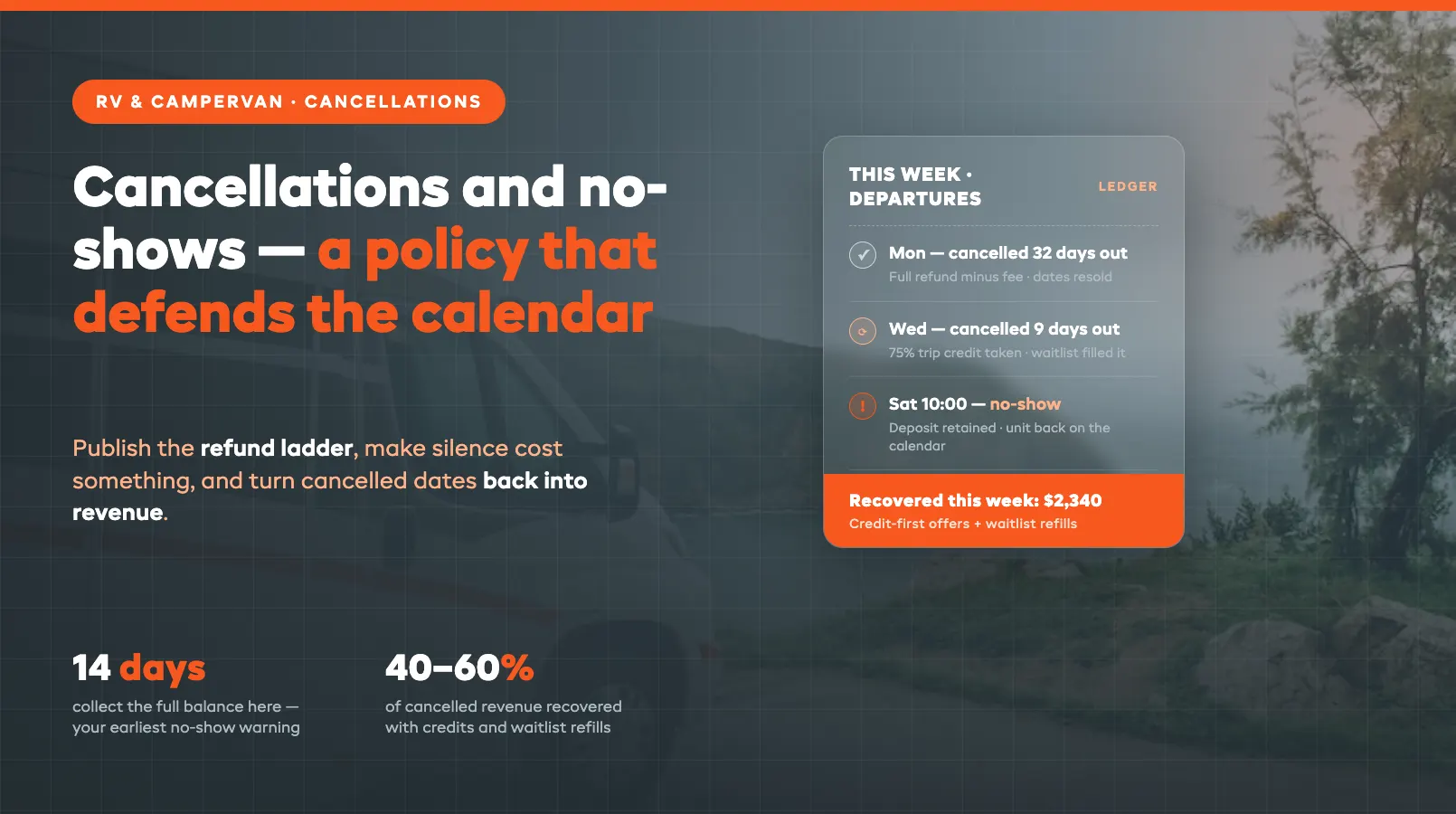
A family cancels their 10-night motorhome trip six days before pickup. That's not one lost booking. It's a quarter of the month's revenue for that vehicle, gone in a phone call, with almost no runway to resell the dates. RV rentals sit at the painful end of the cancellation spectrum: bookings are long, made months ahead, and worth thousands each. One empty departure hurts more than a week of empty kayaks.
The fix isn't a stricter attitude. It's three systems working together: a published cancellation policy with clear refund tiers, a booking flow that makes no-shows financially pointless, and a recovery routine that turns canceled dates back into money. This guide walks through all three.
Why Cancellations Hit RV Rentals Harder
Most rental businesses absorb a cancellation by renting the gear to the next walk-in. You can't do that with a Class C motorhome booked for ten nights.
- The booking window is long. Guests book RV trips 2–6 months out. A cancellation 30 days before pickup still leaves you reselling dates that most travelers planned long ago.
- Each booking is a big share of the calendar. A six-vehicle fleet running 10-night trips has maybe 18 bookings a month in peak season. Losing one is 5% of monthly revenue — losing a peak-week booking can be double that.
- Trips are weather- and life-exposed. Long trips get canceled for reasons short ones don't: a sick kid, a changed work schedule, a storm forecast ten days out.
None of this means you should punish guests. It means your policy has to be explicit about who carries the risk in each time window, because by default, it's all on you. If you're still building the wider operation, start with the full playbook in how to run an RV rental business and come back to this piece for the cancellation layer.
Build the Refund Ladder: Tiers by Notice Window
A good cancellation policy is a ladder, not a wall. Full refunds far out, partial refunds mid-range, no cash refund close in. Guests accept tiers they can see at booking; they fight blanket "no refunds" lines every time.
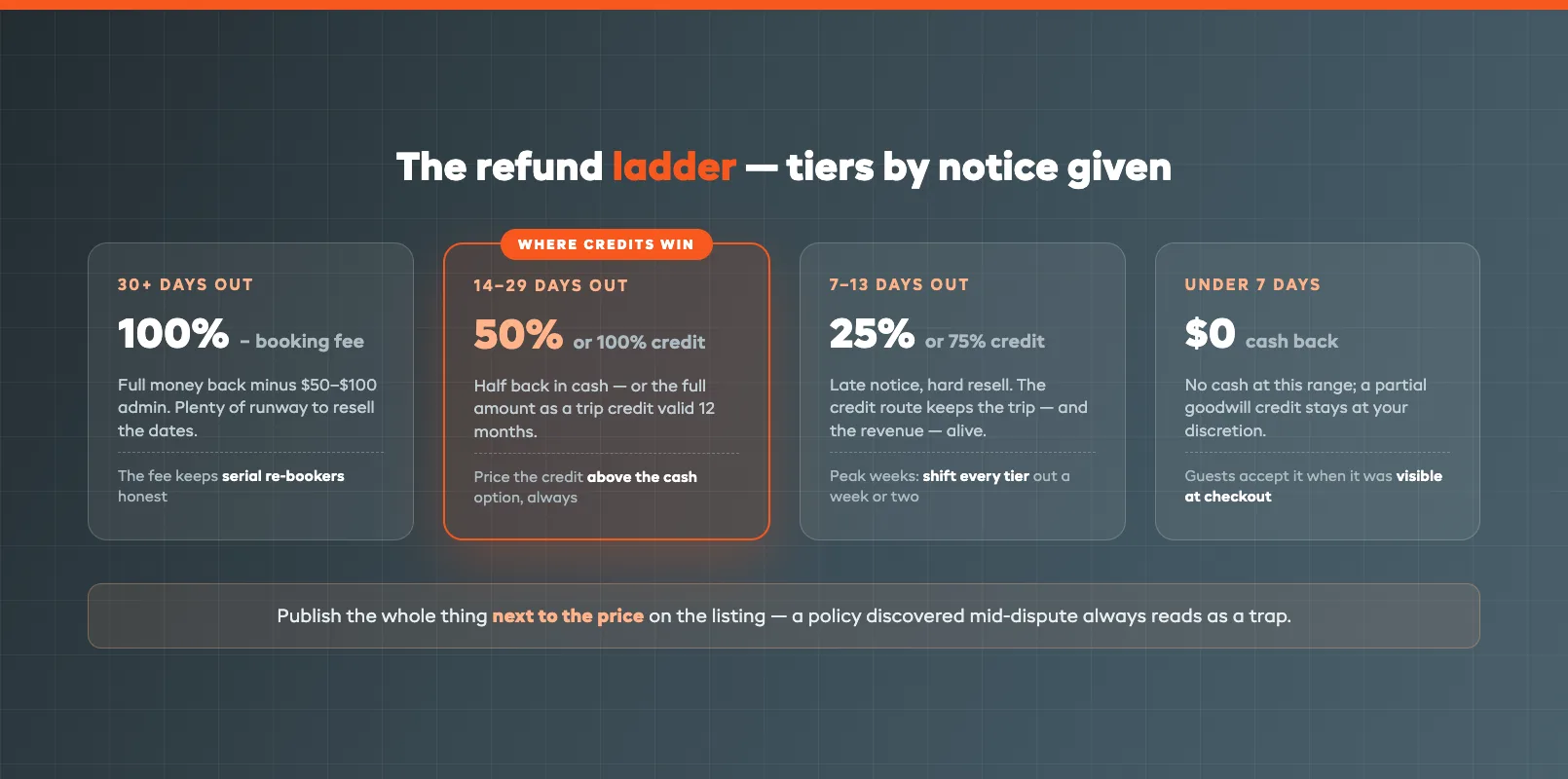
A workable structure for most RV fleets:
- 30+ days before pickup: full refund, minus a small booking fee ($50–$100) that covers your admin and keeps serial re-bookers honest.
- 14–29 days: 50% refund, or 100% as a trip credit valid for 12 months.
- 7–13 days: 25% refund, or 75% as a trip credit.
- Under 7 days: no cash refund; offer a partial credit at your discretion.
Two rules make the ladder work. First, publish it on the booking page — next to the price, not buried in terms. A guest who saw the tiers before paying rarely disputes them; a guest who discovers them mid-cancellation always does. Second, always price the credit option above the cash option. Credits keep revenue in the business and most get spent on bigger trips later. This is the same logic that runs through your RV rental pricing strategy: every number a guest meets should feel planned, not improvised.
Peak-season dates deserve a stricter ladder. Move each tier out by a week or two, because a canceled school-holiday week is nearly impossible to resell late. Say so on the listing.
Deposits and Prepayments That Make No-Shows Pointless
A no-show is just a cancellation that skipped the phone call, and it happens when the guest has nothing at stake. The prevention is financial, not motivational.
Take a real booking deposit at the moment of reservation: 20–30% of the trip total is standard, non-refundable inside your final tier. Collect the balance 14 days before pickup, not at the counter. A guest who has paid in full two weeks out either shows up or tells you they won't — silence stops being free. Handled this way, no-show revenue loss mostly disappears before you ever need to chase anyone.
Note the distinction: this booking deposit is not the security bond you hold against damage. That's a separate pre-authorization with its own rules, covered in managing RV security deposits. Keep the two visibly separate on the checkout page or guests will think you're charging twice.
The Reminder Cadence That Stops Silent Drop-Offs
Most no-shows aren't deliberate. They're a forgotten balance payment, a missed pickup time, a guest who thought the trip started Saturday when the booking says Friday. A short automated sequence removes almost all of them.
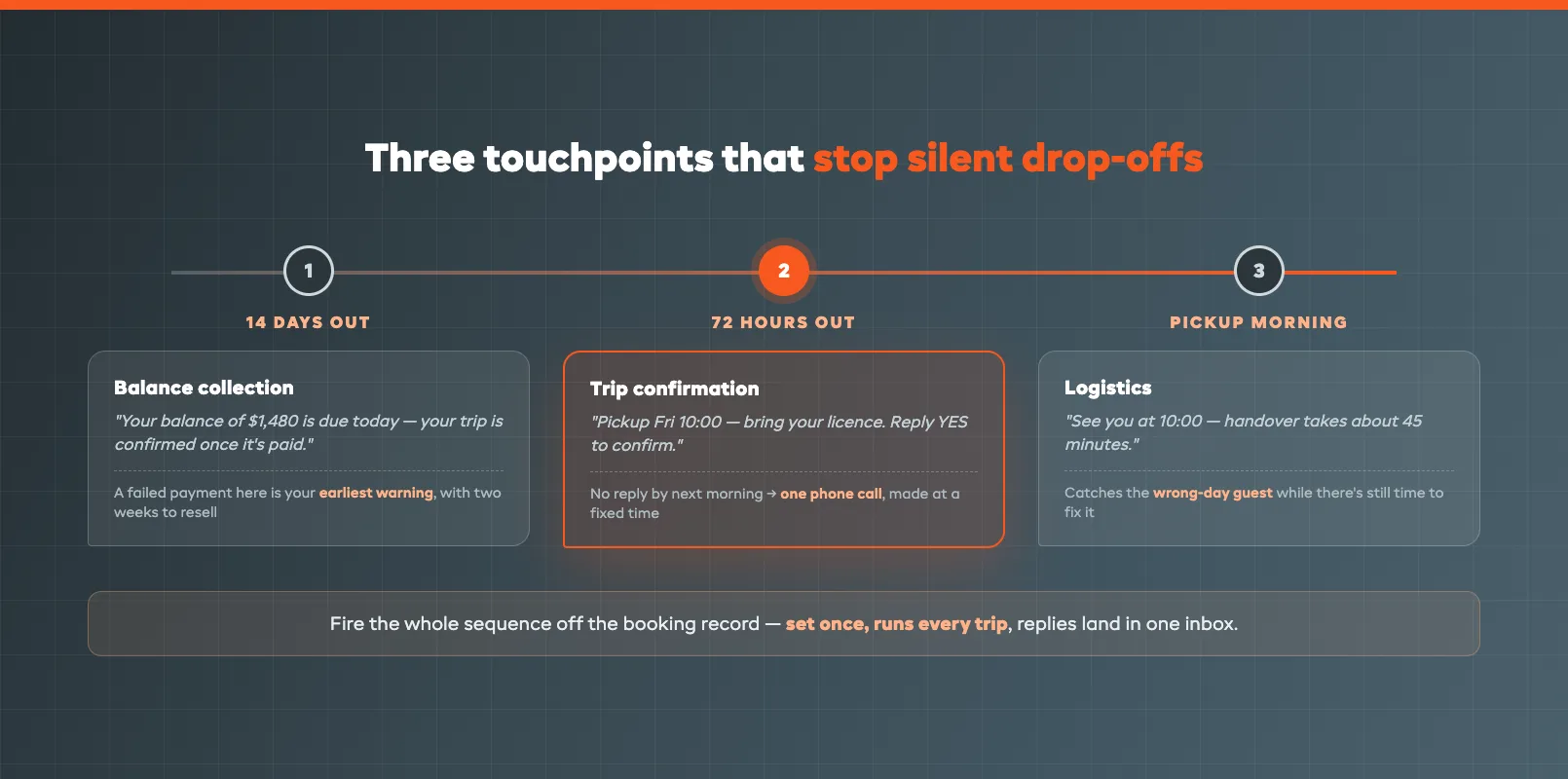
Three touchpoints do the work:
- 14 days out: balance collection. "Your balance of $1,480 is due today; your trip is confirmed once it's paid." A failed payment here is your earliest no-show warning, with two full weeks to resell the dates.
- 72 hours out: trip confirmation. Pickup time, address, license and documents to bring, and a reply-to-confirm prompt. Anyone who doesn't confirm gets a phone call the next day: one call, made once, at a fixed time.
- Pickup morning: logistics. "See you at 10:00. Handover takes about 45 minutes." This is the message that catches the wrong-day guest while there's still time to fix it.
This is a set-and-forget job for RV rental booking software: the sequence fires off the booking record, and the replies land in one inbox. Running it manually off a wall calendar is how touchpoints get skipped in your busiest week, which is exactly when a no-show costs the most.
Pickup Day: A Fixed Decision Flow for the Guest Who Isn't There
It's 10:20 and the 10:00 pickup hasn't arrived. What happens next should be a procedure, not a judgment call made by whoever is on the desk.
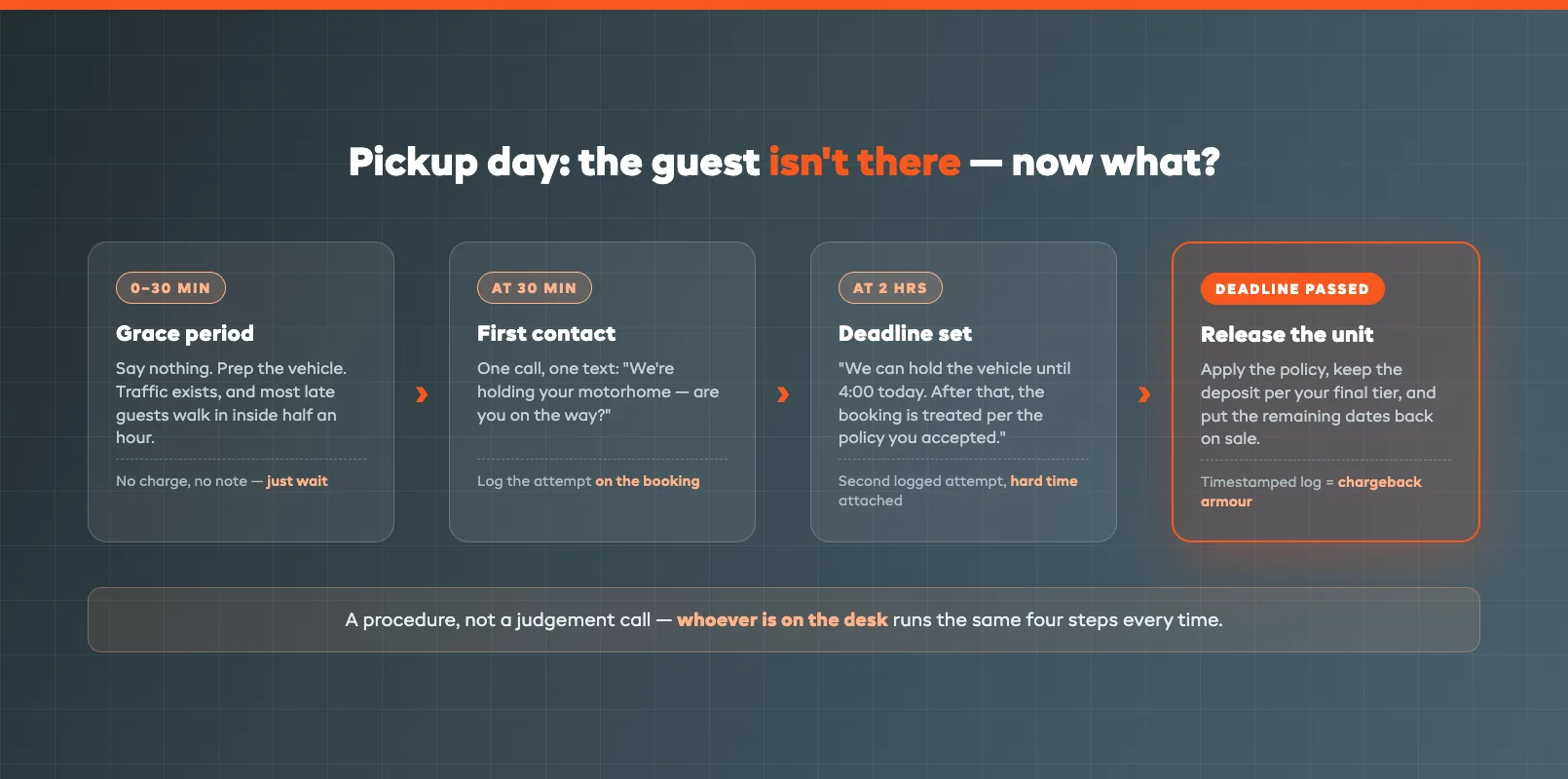
- 0–30 minutes: grace period. Say nothing, prep the vehicle. Traffic exists.
- 30 minutes: contact attempt. One call, one text: "We're holding your motorhome — are you on the way?" Log the attempt on the booking.
- 2 hours: second contact, with a deadline. "We can hold the vehicle until 4:00 today. After that the booking is treated as a no-show under the policy you accepted."
- Deadline passed: release the unit. Mark the booking a no-show, apply the policy (the deposit is forfeited, the balance is retained per your final tier) and put the vehicle back on the calendar for the remaining dates.
The log matters as much as the flow. When a no-show guest disputes the charge with their card issuer weeks later, timestamped contact attempts plus the policy they accepted at checkout is what wins it. Terms like pre-authorization and chargeback trip up new staff — the RV rental glossary keeps the whole team using the same language.
Recovery: Credits First, Then Refill the Dates
Policy protects you from the loss; recovery shrinks it. Two moves, in order.
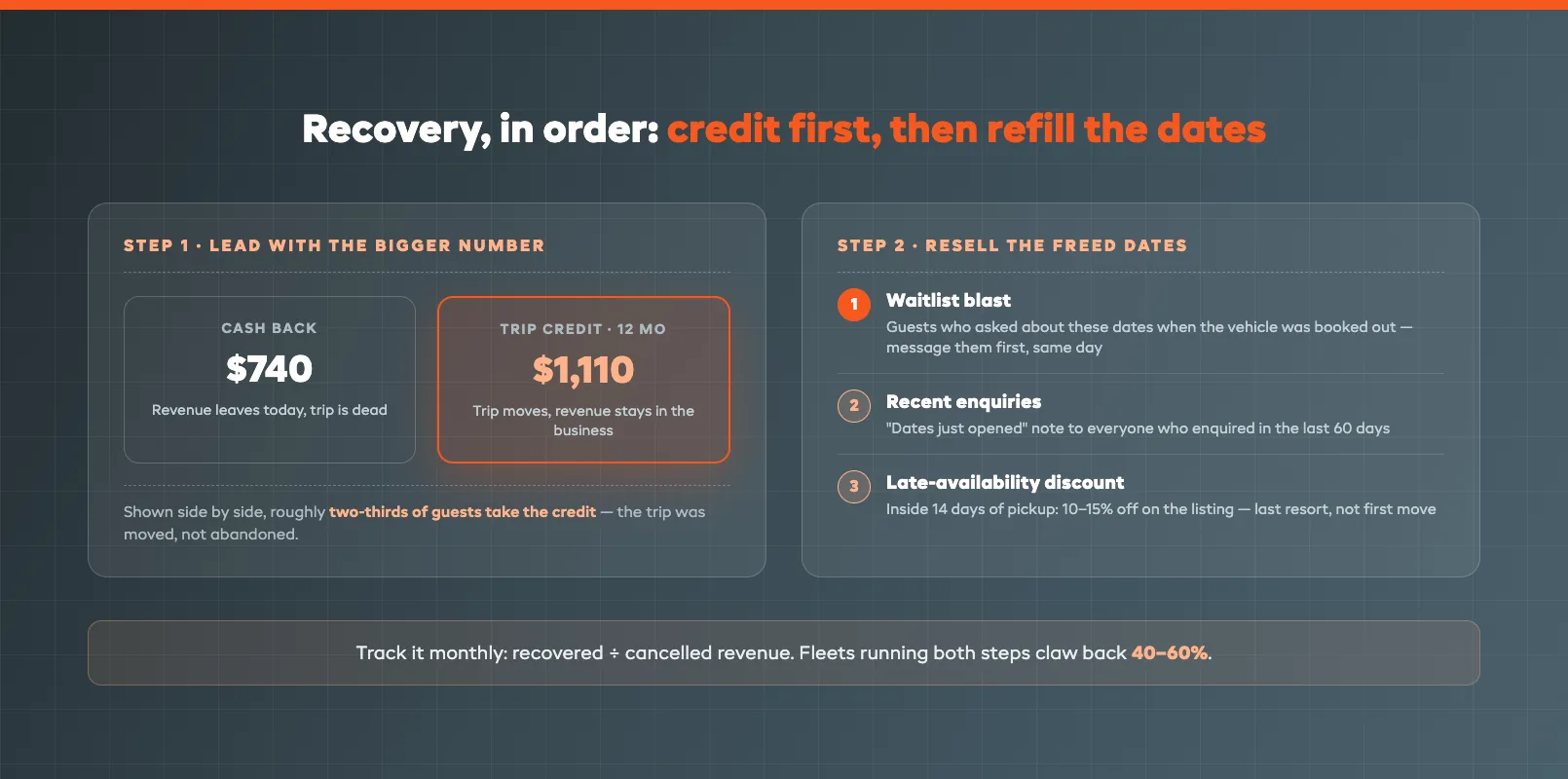
Offer the credit before the cash refund. When a guest calls to cancel in a partial-refund tier, lead with the better-value credit: "You'd get $740 back in cash, or $1,110 as a credit valid for 12 months." Around two-thirds of guests take the credit when it's clearly the bigger number — the trip usually wasn't abandoned, just moved. A credit costs you a future discount; a cash refund costs you the revenue today.
Then resell the freed dates. The moment a cancellation lands, three channels in sequence: a waitlist blast to guests who asked about those dates when the vehicle was booked out; a "dates just opened" note to your recent-enquiry list; and, inside 14 days of pickup, a late-availability discount of 10–15% on the listing. A vehicle sitting on your RV and campervan hub listing at full price for dates nobody can plan a trip around isn't holding value. It's holding air.
Track one number monthly: recovered revenue as a share of canceled revenue. Fleets doing all of the above typically claw back 40–60%. Fleets doing none of it recover close to zero.
Putting It Together
Cancellations and no-shows stop being emergencies when the whole path is decided in advance. Publish a tiered refund ladder next to the price and make the credit option the obviously better deal. Take a real deposit at booking and the balance 14 days out, so silence is never free. Let an automated three-touch reminder cadence catch the forgetful before pickup day. Work a fixed decision flow when someone doesn't arrive, and log every contact attempt. Then recover: credit first, waitlist second, late discount last. On EquipDash, the tiers, the payment schedule, and the reminder sequence all hang off the booking record, but whatever system you run, the principle holds: the policy does the arguing, so you don't have to.
FAQ
What is a fair cancellation policy for RV rentals?
A tiered ladder: full refund minus a small booking fee at 30+ days before pickup, 50% at 14–29 days, 25% at 7–13 days, and no cash refund under 7 days, with a trip credit offered as the better-value alternative at every tier. Publish it on the booking page next to the price.
Should RV rental deposits be non-refundable?
The booking deposit, typically 20–30% of the trip total, should become non-refundable once the guest is inside your final cancellation tier. Outside that window, refund it per your ladder. Keep it separate from the security bond, which is a pre-authorization held against damage and released after a clean return.
How do I stop no-shows at my RV rental business?
Collect the full balance 14 days before pickup and run an automated reminder sequence: a balance-due message at 14 days, a confirm-your-trip message at 72 hours, and a logistics message on pickup morning. A guest who has paid in full and confirmed almost never fails to appear.
How long should I wait before treating a booking as a no-show?
Give a 30-minute grace period, make a logged contact attempt at 30 minutes, set a hard deadline at the second contact around 2 hours, and release the vehicle once it passes. The exact times matter less than having them written down and applied the same way every time.
Can I resell dates from a canceled RV booking?
Yes. And you should, even when you kept part of the payment under your policy. Blast your waitlist first, then recent enquiries, then apply a late-availability discount inside 14 days of pickup. Most operators who work all three channels recover 40–60% of canceled revenue.
Are trip credits better than refunds for cancellations?
For the operator, almost always. A credit keeps the revenue in the business and most credits get spent on equal or bigger trips later. Make the credit worth more than the cash option, for example 75% credit versus 50% cash, and roughly two-thirds of guests will choose it.
in one place