RV Rental Booking Software: Fleet Calendar, Deposits, and Handover

An RV rental booking is not a kayak booking with a bigger number on it. Every reservation blocks a vehicle for days, not hours. Every changeover needs cleaning, tank dumps, and an inspection before the next guest arrives. Every trip carries a security deposit that can run past $1,500, and every handover puts a guest behind the wheel of a $90,000 asset. Booking software built for hourly gear rentals falls over on all four counts, and the failure shows up as double-booked motorhomes, deposits chased by text message, and a Saturday morning with two families in the yard and one clean vehicle.
This guide covers what RV rental booking software actually has to do: the fleet calendar, the deposit engine, the booking flow that verifies drivers before they pay, and the handover scheduling that keeps departure day calm. It is the operational layer under everything in the complete guide to running an RV rental business, and if any vocabulary here is new, the RV rental glossary covers it.
The Fleet Calendar: One View of Every Vehicle
The core of any RV rental booking system is a calendar that shows every unit, every day, in one grid. Not a shared spreadsheet, not three platform dashboards side by side: one view where a booking, a maintenance hold, and a turnaround block all look different and none of them can overlap.
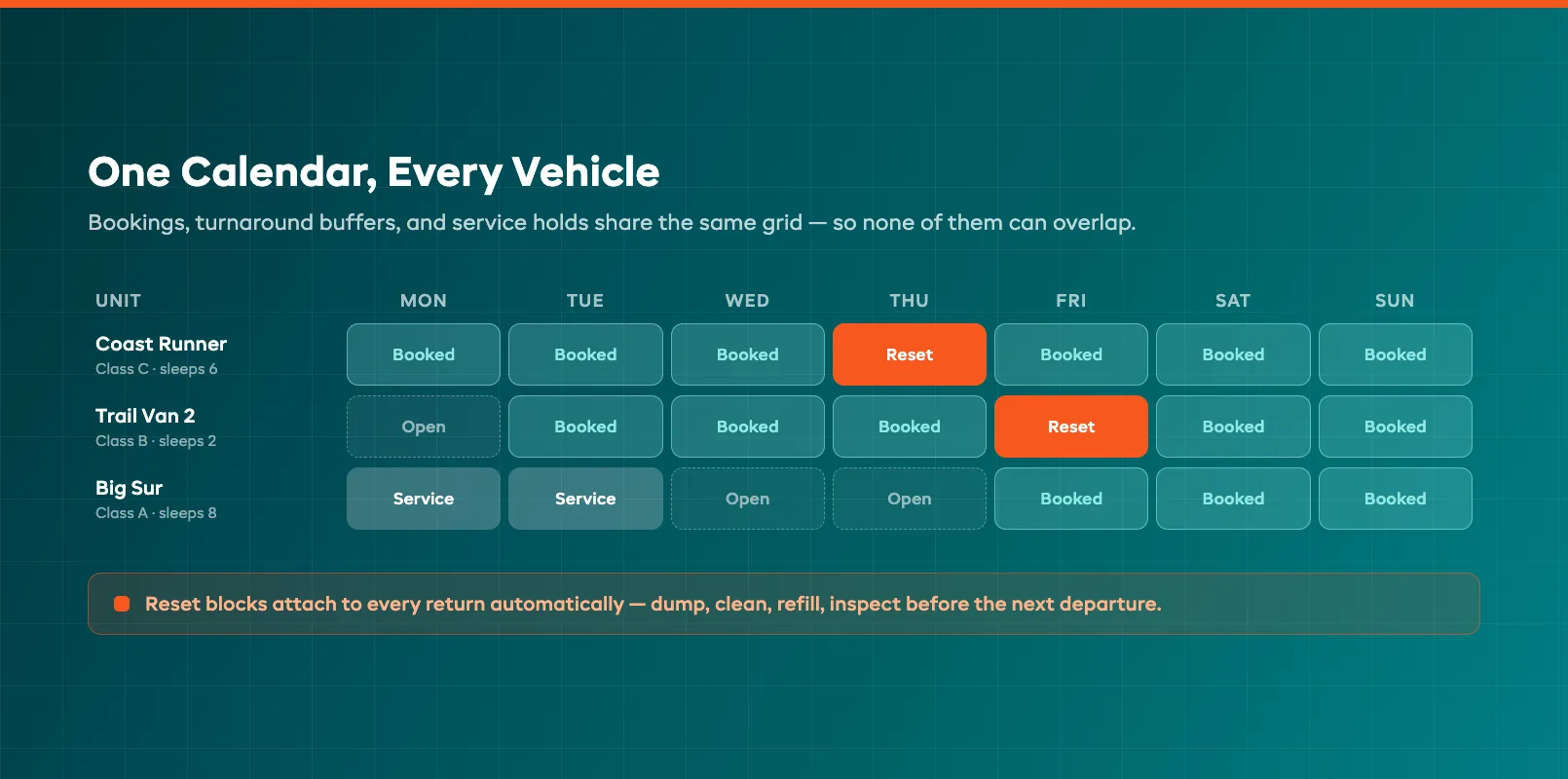
The feature that separates RV-grade software from generic reservation tools is the turnaround buffer. A motorhome that comes back at 10 a.m. is not rentable at 10:05. It needs a dump station visit, a full interior clean, a fresh-water refill, propane check, and a walkaround inspection — realistically four to six hours for a Class C, longer if the last guest was rough on it. Good software attaches that buffer to every return automatically, so the next booking physically cannot start inside the reset window. If you are blocking turnarounds by hand, one busy weekend is all it takes to promise a vehicle that is still full of someone else's holiday.
The calendar also needs proper maintenance holds. RVs live on service schedules: engine servicing by mileage, habitation checks by season, warrant and registration by date. A unit due for its service should be blockable in two clicks, and that block should push back against bookings the same way a reservation does. The winter version of this matters just as much: when half the fleet is winterized in storage, those months should be marked unavailable once, not defended against enquiries all season. What actually happens inside those service blocks and reset windows is covered in the RV fleet maintenance and turnaround guide.
Finally, if you list on peer-to-peer platforms while taking direct bookings, the hybrid model most operators land on, the calendar must sync availability both ways. A platform booking should block the direct calendar within minutes, and vice versa. A double-booked campervan is not an inconvenience; with a guest who planned a two-week trip around it, it is a refund, a review, and sometimes a small legal problem.
Deposits and Pre-Authorization Holds
The deposit is where RV rentals diverge hardest from the rest of the rental industry. A paddleboard shop can hold $150 and shrug. An RV operator is protecting against awning damage, roof strikes, misfuelling, and interiors that come back needing professional cleaning, which is why security deposits of $1,000–$2,500 are normal, sized by vehicle class.
Booking software should run the whole deposit lifecycle without a human touching it:
- At booking, collect the reservation payment, commonly 25–30% of the trip total, and state the deposit terms in plain language on the confirmation.
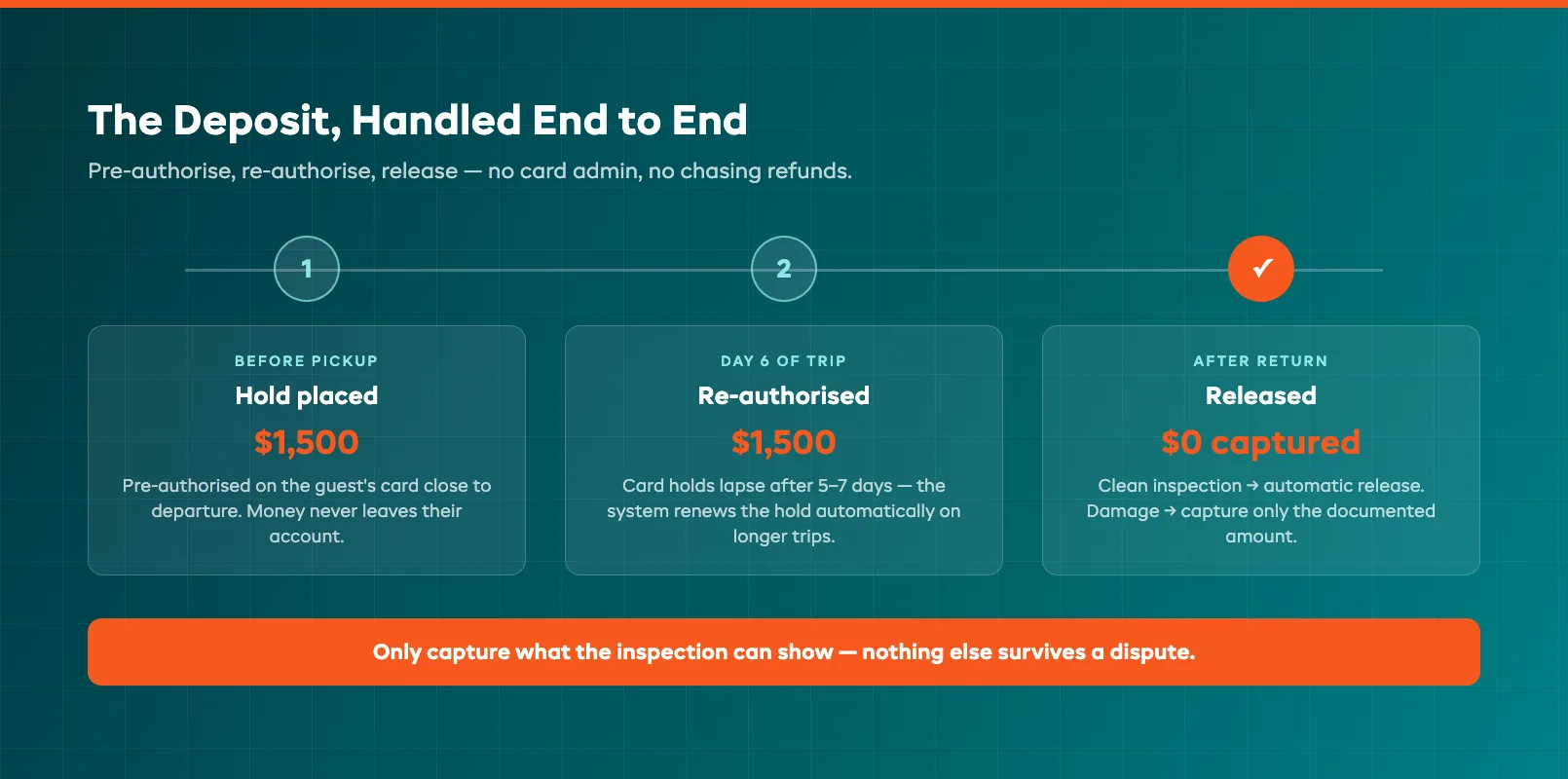
- Before departure, place a pre-authorization hold on the guest's card rather than charging cash. The money never leaves their account, no refund transfer is needed later, and the psychology is better on both sides. The software must handle the fine print for you: card pre-auths expire after roughly 5–7 days, so the system has to place the hold close to pickup and re-authorize automatically on longer trips.
- After return, release the hold once the inspection clears, or capture only the documented amount if something comes back damaged. Release should be automatic on a clean inspection — the operators who make guests chase their own deposit money for a week are the ones collecting one-star reviews.
The test to run on any platform demo: ask to see a deposit re-authorized mid-trip and a partial capture after return. If either step is manual, you will be doing card admin every week of peak season.
The Booking Flow: From Search to Confirmed Without a Phone Call
Most RV trips are planned at night, weeks or months out. If a guest cannot see live availability, pick dates, and pay a booking amount at 9 p.m. on a Tuesday, some percentage of them books with an operator who lets them. The booking flow should run end to end without you: real-time availability from the fleet calendar, total pricing shown up front (nightly rate, mileage terms, cleaning fee, extras) and a payment step that takes the reservation amount and schedules the balance.
Two steps in that flow are RV-specific and non-negotiable:
Driver verification. Before a booking confirms, the system should collect the driver's license details, age confirmation (most insurers set minimums of 25, some 21 with surcharges), and any additional drivers. Your commercial insurance almost certainly requires every driver to be declared and verified: software that captures this at booking, rather than in the yard at handover, is the difference between a two-minute check and an insurance breach discovered after the vehicle is gone.
Add-ons at checkout. Bedding kits, camp chairs, generators, unlimited-mileage upgrades, campground-delivery packages — RV renters buy extras at booking time at a rate walk-in customers never match. The booking flow should offer them before payment, priced per item or per night, and attach them to the reservation so the yard crew stages the right kit for each departure.
Handover Scheduling: The Hour That Decides the Whole Rental
The handover is the most operationally expensive hour in RV rental. A proper walkthrough (water systems, waste tanks, propane, awning, hookups, driving briefing) takes 45–60 minutes per departure, and it cannot be compressed without paying for it later in callouts and damage. Booking software should treat handover as scheduled work, not something that happens whenever guests wander in. What actually happens inside that hour (the photo protocol, systems training, and return standards) is covered in the handover and return inspection guide.
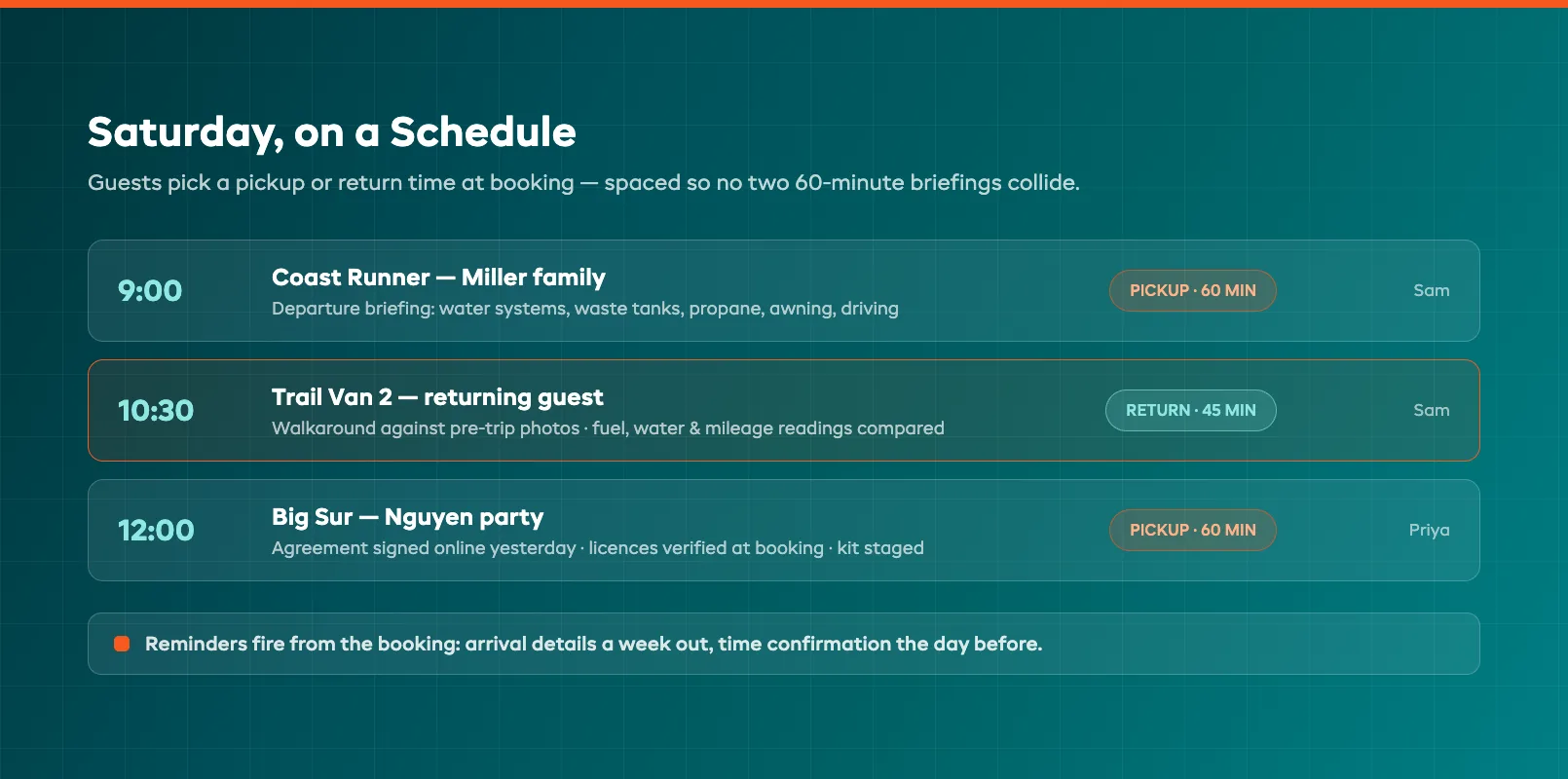
That means pickup and return time slots, chosen by the guest at booking, spaced so your crew is never running two walkthroughs at once. Three departures at 10 a.m. with one staff member is a rushed briefing for all three families and a black-tank phone call by Wednesday. Slot scheduling turns Saturday from a scrum into a queue.
It also means the paperwork rides along with the booking. The rental agreement should be signed digitally before arrival, the pre-trip condition photos should attach to the reservation record, and the fuel, water, and mileage readings logged at departure should be waiting there for the return inspection. When the vehicle comes back, the person doing the walkaround compares against the same record (same photos, same readings) and any charge that follows is documented rather than argued. Reminder messages should fire from the booking too: a week-out email with arrival details and what to bring, and a day-before message confirming the slot. Every reminder the system sends is a no-show or a late arrival you did not have to absorb.
What to Look For: A Buying Checklist
Feature lists blur together on pricing pages. These are the capabilities that actually separate RV-ready platforms from generic booking tools, in the order they will hurt you if missing:
- Fleet calendar with automatic turnaround buffers: bookings cannot touch inside the reset window.
- Pre-authorization deposit handling: holds placed, re-authorized, and released or partially captured without manual card work.
- Driver verification at booking: license, age, and additional drivers captured before confirmation.
- Pickup and return slot scheduling: walkthroughs spaced to your staffing, not left to chance.
- Balance and payment scheduling: reservation amount now, balance collected automatically before departure.
- Digital agreements and condition records: signatures, photos, and readings attached to each booking.
- Channel sync: platform and direct availability reconciled in near real time for hybrid fleets.
- Maintenance and storage holds: service blocks and winterization handled in the same calendar as bookings.
An all-in-one operations platform like EquipDash covers this list in one system (calendar, deposits, agreements, and messaging on a single booking record) which matters more in RV rental than almost any other vertical, because the cost of a gap between tools is measured in double-booked vehicles and undocumented damage.
Putting It Together
RV rental booking software earns its keep in four places: a fleet calendar that makes double-booking impossible and turnaround automatic, a deposit engine that places and releases holds without card admin, a booking flow that verifies drivers and sells extras while you sleep, and handover slots that turn departure day into a schedule instead of a scramble. Get those four right and the software fades into the background, which is exactly what it is for. The vehicles, the walkthroughs, and the guests coming back next summer are covered in the rest of the RV rental playbook, and the broader operating picture for the vertical lives on the RV and campervan rental hub.
FAQ
What does RV rental booking software do that a generic booking tool doesn't?
Four things: turnaround buffers that keep bookings from touching between rentals, pre-authorization deposit handling sized for four-figure holds, driver verification collected before a booking confirms, and pickup/return slot scheduling for hour-long handovers. Generic tools built for hourly gear or appointments handle none of these well, and each gap turns into manual work or a dispute.
How big should an RV security deposit be?
Most operators hold $1,000–$2,500 depending on vehicle class — towards the lower end for small campervans, the upper end for Class A motorhomes and premium conversions. The deposit should be a pre-authorization hold on a card rather than a cash charge, placed shortly before pickup and released automatically once the return inspection clears.
What is a pre-authorization hold and why use it instead of charging the deposit?
A pre-authorization reserves the amount on the guest's card without taking the money. Nothing needs refunding after a clean return, the hold simply lapses, and if there is damage, you capture only the documented amount. The catch is that holds expire after roughly 5–7 days, so on longer trips the software needs to re-authorize automatically mid-rental.
How long should the turnaround buffer be between RV rentals?
Four to six hours is a realistic minimum for a Class C motorhome: dump station, interior clean, fresh-water refill, propane check, and a walkaround inspection. Campervans can be faster; a unit that came back late or dirty is slower. The buffer should attach to every return automatically in the calendar so the next booking cannot start inside it.
Can booking software handle both peer-to-peer platform listings and direct bookings?
The good ones can. Hybrid operators (listing on platforms like Outdoorsy or RVshare while taking direct bookings on their own site) need availability synced both ways within minutes, so a platform booking blocks the direct calendar and vice versa. Without sync, hybrid fleets eventually double-book, and an RV double-booking costs a full trip, not an hour.
When should an RV rental business move off spreadsheets?
Before the second vehicle. One unit with occasional bookings survives on a spreadsheet and a card terminal. The moment two vehicles share a calendar (with turnarounds, deposits, and handover slots to coordinate) manual tracking starts producing the expensive mistakes: overlapping bookings, forgotten holds, and undocumented damage. The software cost is a rounding error against one lost multi-day booking.
in one place