Walking Tour Operations: Routing, Group Size, and Guide Scripts
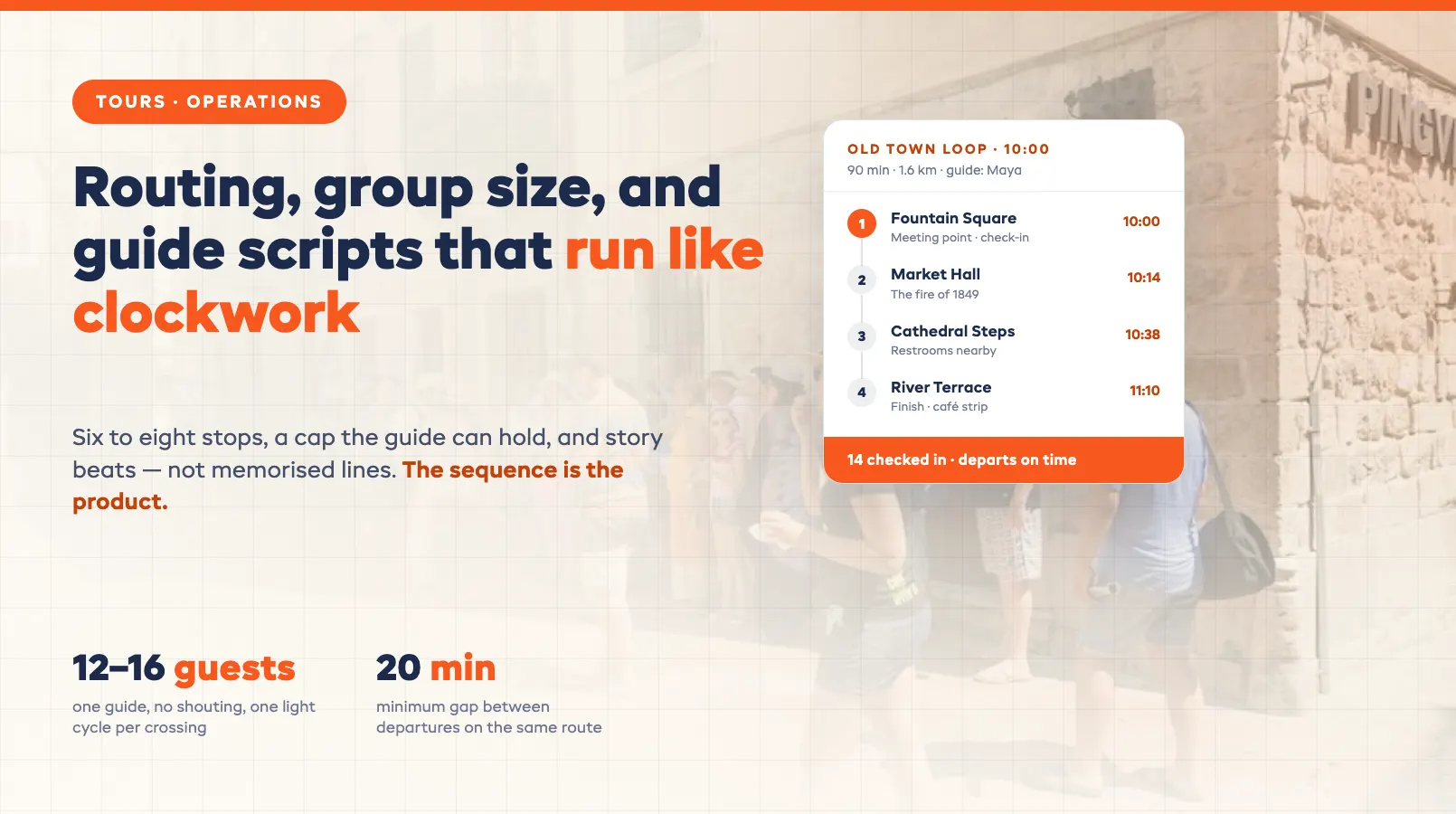
A walking tour has no vehicle, no fuel bill, and almost no equipment. That's exactly why the operations get underestimated. When the product is ninety minutes of a person talking while a crowd follows them through public streets, everything rides on three decisions: where the route goes, how many people walk it at once, and what the guide actually says at each stop. Get those right and the same tour runs clean at 10:00, 12:00, and 2:00 every day. Get them wrong and you'll hear about it, in reviews, in guests drifting off mid-tour, and in guides quietly rewriting your product on the street.
This guide covers the operational core of a walking tour business: route design, group size caps, script structure, staggered departures, and the meeting-point check-in that decides whether the day starts on time. It sits alongside our full guide to running a tour operator business, which covers licensing, pricing, and marketing for tour operations of every kind.
Route Design: The Stop Sequence Is the Product
A walking tour route isn't a list of famous landmarks. It's a sequence, and the sequence is doing more work than any single stop. Guests judge the tour by how it flows: whether the walk between stops feels purposeful, whether the story builds, and whether they end somewhere that makes the finish feel earned.
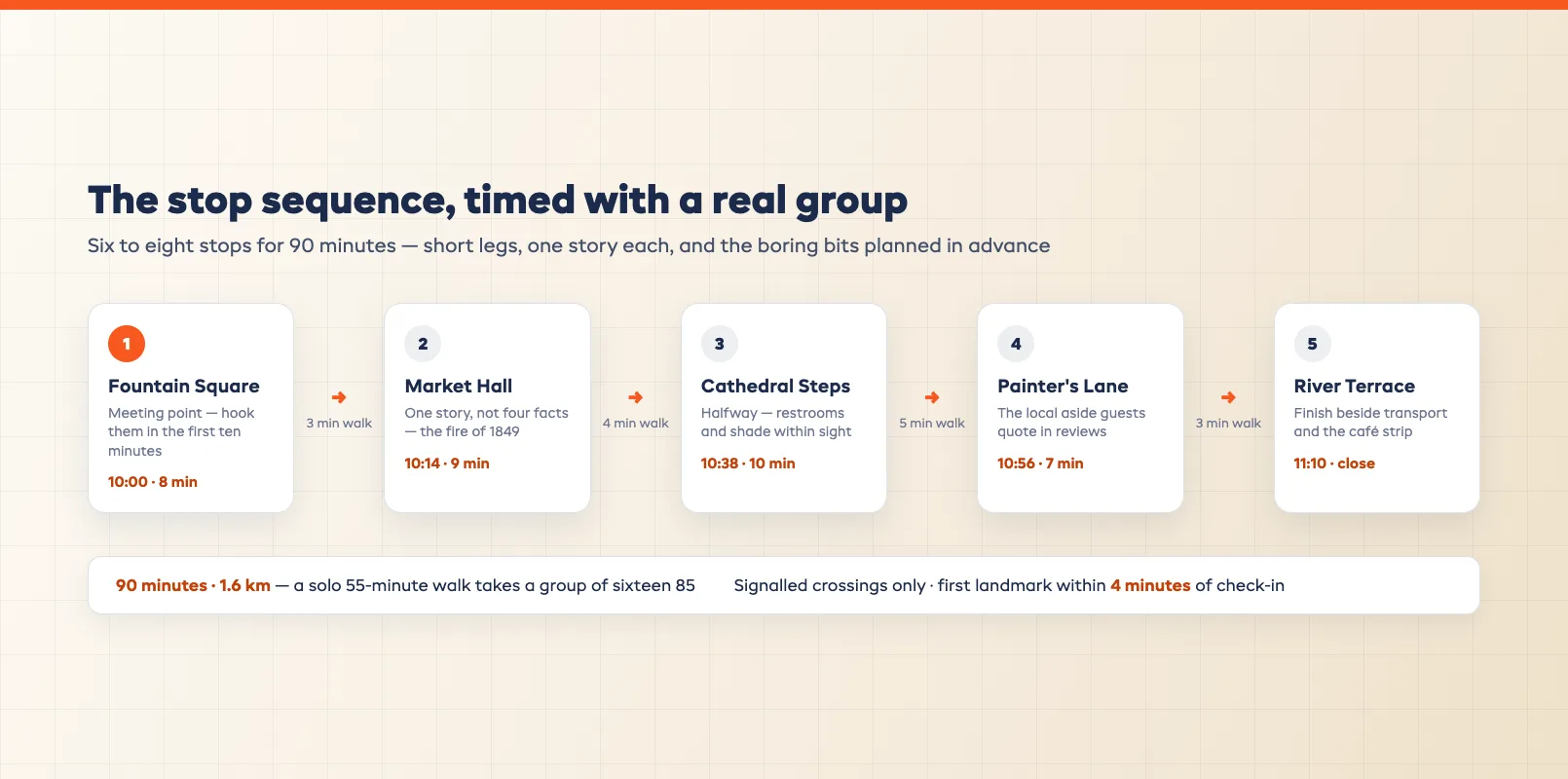
Time everything, then walk it again slower. A route you can walk alone in 55 minutes takes a group of sixteen about 85: every corner, crossing, and photo pause compounds. Practical rules that hold up:
- Six to eight stops for a 90-minute tour. More than that and each story gets squeezed under five minutes; fewer and the walking legs drag.
- First stop within four minutes of the meeting point. Guests decide in the first ten minutes whether they trust the guide. Don't spend those minutes in transit.
- Walking legs of two to five minutes. Anything over seven minutes of silent walking and the group unspools into a long line of strangers checking phones.
- Plan the boring bits. Restrooms at roughly the halfway mark, shade in summer, awnings for sudden rain, and crossings with signals rather than gaps in traffic. One bad intersection with a big group erases three great stories.
- End near transport, cafés, or your next sale. A tour that finishes in a dead-end alley wastes the best conversion moment you have, the goodbye.
Then protect the route legally. Many cities require permits for commercial groups above a certain size in parks, cathedrals, or market halls, and some cap amplified audio outright. Confirm the rules for every stop before printing a single flyer — the fastest way to lose a route is to have a ranger or verger tell your guide to move along in front of twenty guests.
Group Size: Where a Walking Tour Breaks
Every walking tour has a number beyond which the product quietly fails. Guests at the back can't hear, the guide starts shouting, crossings take two light cycles, and shopkeepers start glaring. The number is lower than most operators want it to be.
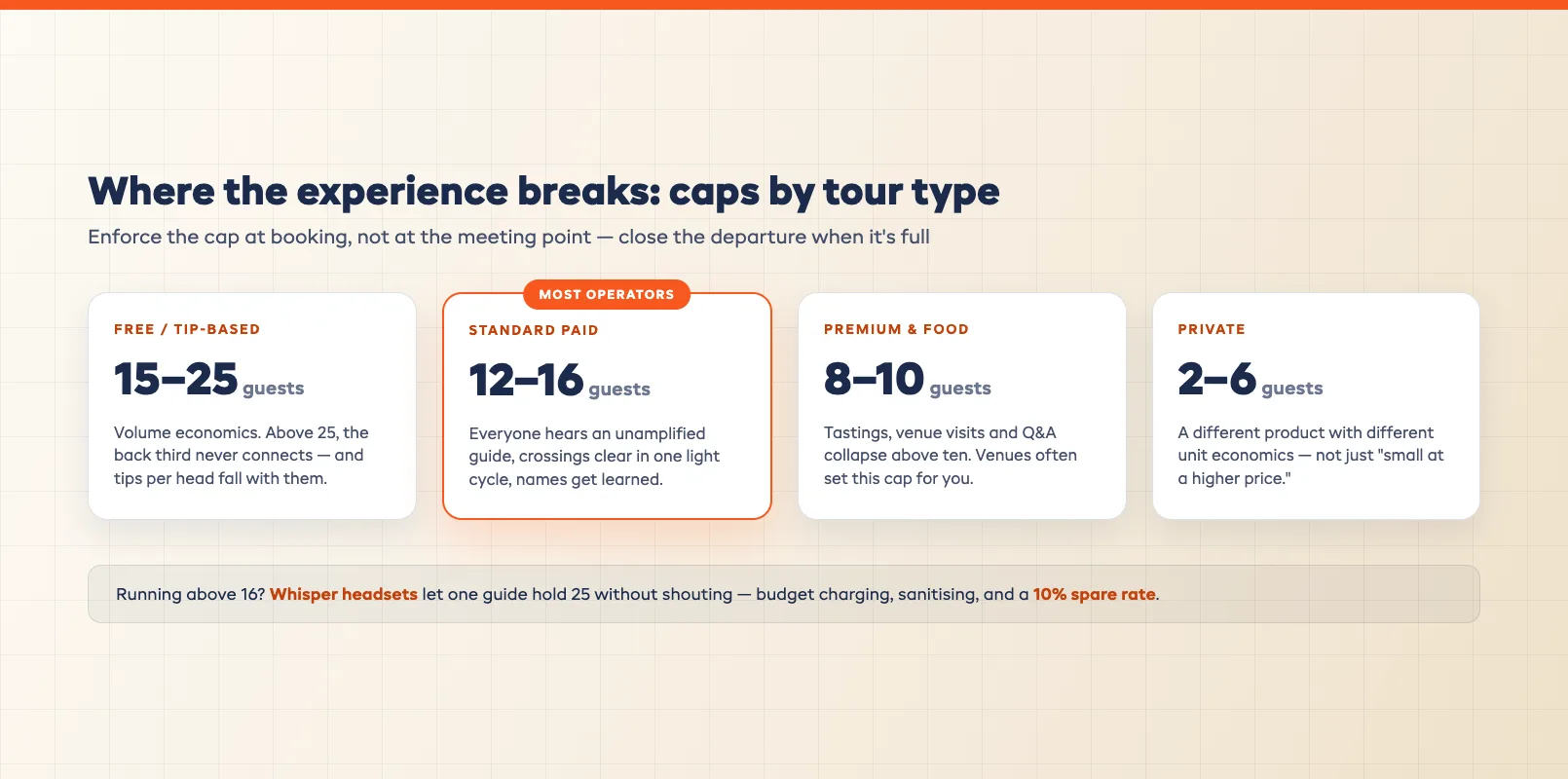
Working bands that match how the market actually prices:
- Free / tip-based tours: 15–25. The economics demand volume, and guests self-select for tolerance. Above 25, tips per head fall — the back third never connected with the guide.
- Standard paid tours: 12–16. The sweet spot for most operators. Everyone hears an unamplified guide, crossings happen in one go, and the guide can learn a few names.
- Premium and food tours: 8–10. Tastings, venue visits, and Q&A-heavy formats collapse above ten. Venues often set this cap for you.
- Private tours: 2–6. A different product with different economics. See our breakdown of private versus group tour economics before assuming private is just "small group at a higher price."
Two operational notes. First, if you regularly run above 16, headsets change the math: a whisper-audio system lets one guide hold 25 without shouting, but budget for charging, sanitising, and a spare rate of about 10%. Second, enforce the cap at booking, not at the meeting point. Your booking system should close the departure when it's full and open a waitlist, turning away a walk-up is awkward; turning away someone with a confirmation is a refund and a one-star review.
Guide Scripts That Don't Sound Scripted
The worst walking tours are memorised essays. The best ones feel improvised but never miss a beat, because the guide is working from a structure, not a transcript. Give guides story beats per stop and let the wording stay theirs.
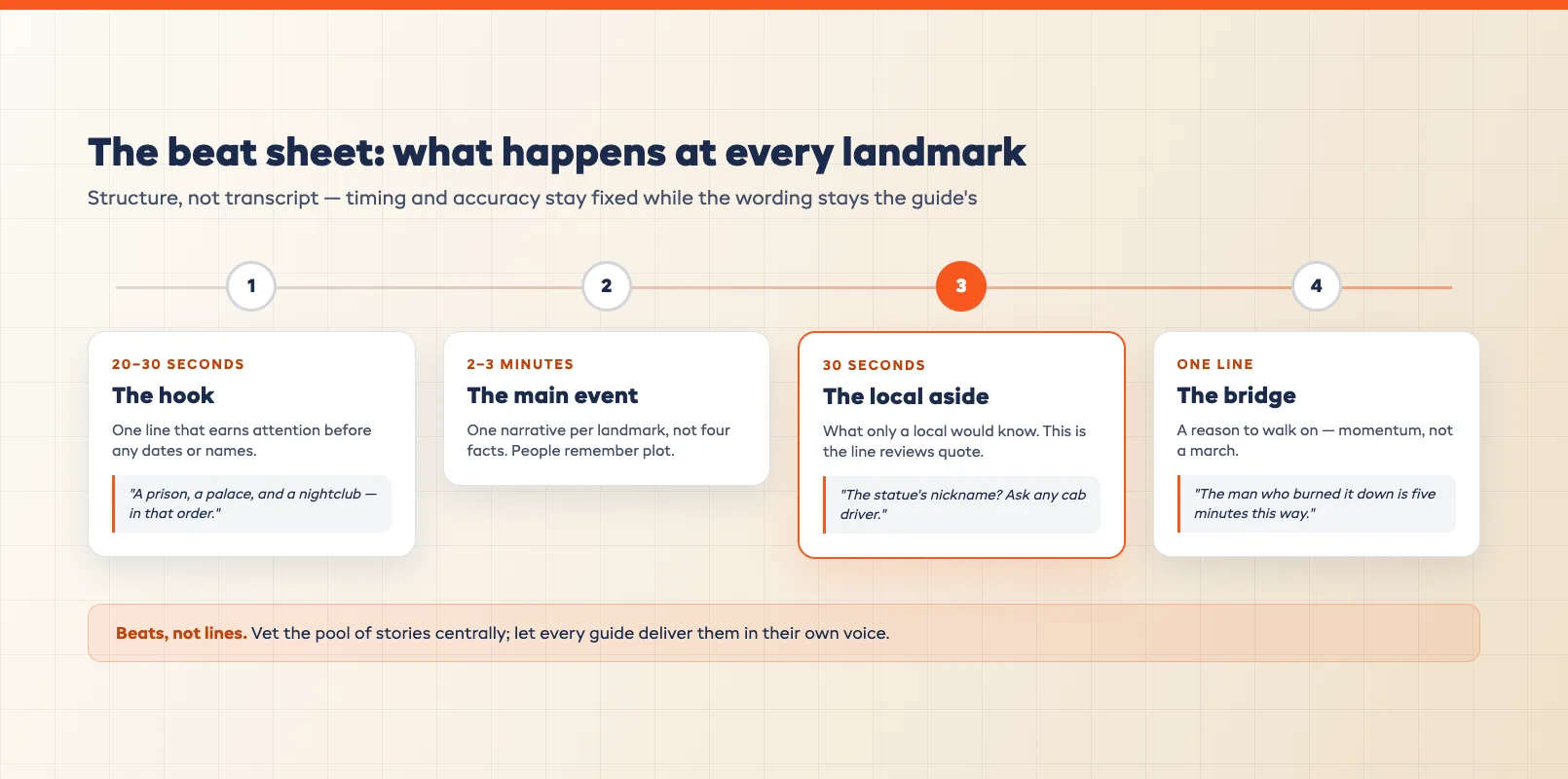
A beat sheet for each stop looks like this:
- The hook (20–30 seconds). One sentence that earns attention before any dates or names. "The building behind me was a prison, a palace, and a nightclub — in that order."
- The main story (2–3 minutes). One story per stop, not four facts. Guests remember narrative, not chronology.
- The local aside (30 seconds). The thing only a local would know, where the guide drinks coffee, what the statue's nickname is. This is what reviews quote.
- The bridge (one line). A reason to walk: "Which brings us to the man who burned it down — he's five minutes this way."
Codify the beats in a shared document, then let guides swap stories in and out of a vetted pool. You get consistency where it matters (timing, accuracy, the tour's arc) without six guides delivering identical monologues. This is the same consistency problem every multi-guide operation faces: standardize the skeleton, not the voice. And because reviews mention guides by name, script quality feeds directly into your review velocity — the local aside is usually the line that shows up on Tripadvisor.
Brief the beats every morning. A two-minute rundown per departure (today's closures, a VIP in the group, the stop that's scaffolded this month) is cheap insurance. Operators on EquipDash automate the rundown with the guide morning briefing agent, which sends each guide their departures, group sizes, and route notes before they leave the house.
Staggering Departures and Sharing the Street
The moment you run more than one departure a day, or more than one guide at once, you inherit a scheduling problem: two of your own groups arriving at the same narrow viewpoint, competing for the same acoustic space.
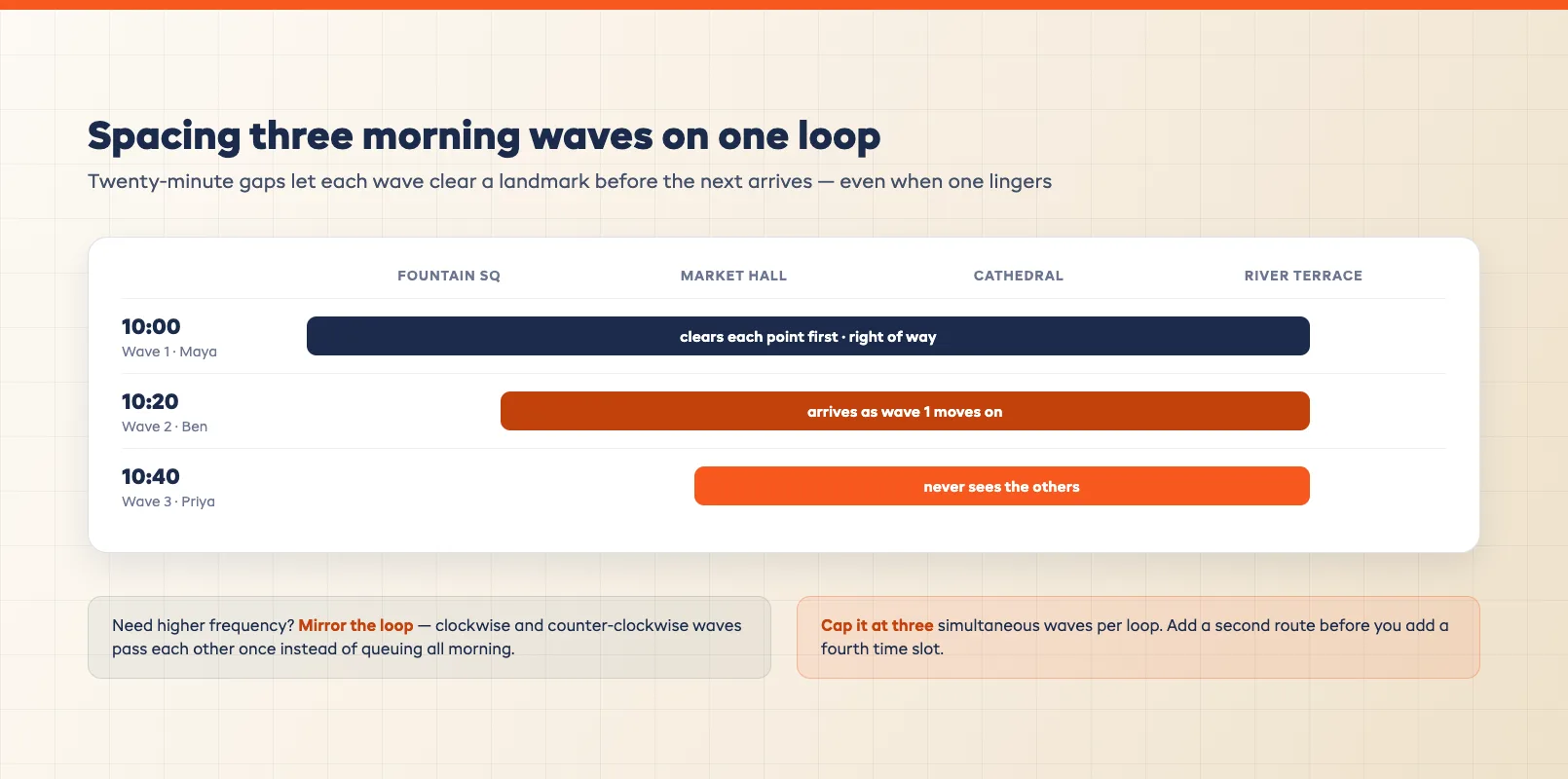
The fix is boring and absolute: minimum 20-minute gaps between departures on the same route. At a 20-minute stagger, a group that lingers still clears each stop before the next arrives. If demand justifies departures every 10 minutes, don't compress the gap. Run a mirrored variant of the route (clockwise and counter-clockwise) so groups pass each other once instead of queuing behind each other all morning.
Three more rules for shared streets:
- Give guides a "yield order." When two of your groups do collide, the earlier departure has right of way at the stop; the later guide uses a nearby overflow point. Decide this in the office, not on the pavement.
- Coordinate with competitors informally. Most cities have three operators hitting the same cathedral steps at :00 past the hour. Departing at :15 costs you nothing and upgrades every tour you run.
- Cap simultaneous groups per route. Even perfectly staggered, more than three of your own groups on one loop degrades all of them. Add a second route before you add a fourth departure.
Meeting Points, Check-In, and No-Shows
Walking tours don't have a shopfront, which means the meeting point is your front desk. Pick somewhere guests can name to a taxi driver, that has shelter, and that isn't shared with three other tour companies' identical red umbrellas. Then over-communicate it: a photo of the exact spot in the confirmation email, a pin, and the guide's first name.
Run check-in against a manifest, not a headcount. The guide (or a second phone) marks arrivals off the booking list, which is what tells you at 10:03 that two guests are missing, and whether they're no-shows or just lost. A reminder message the evening before with the meeting-point photo cuts no-shows sharply; a "we depart in 15 minutes, here's the pin again" message on the morning catches the rest. Hold departure a maximum of five minutes: the sixteen people who arrived on time are the ones writing reviews.
Standardize what the guide checks before walking off: manifest closed, waivers where required, headsets counted, first stop confirmed open. That's a fixed list, and it belongs on a pre-departure checklist rather than in anyone's memory.
Weather Calls and Route Variants
Rain rarely cancels a walking tour, but it re-routes one. Build two variants in advance: the full fair-weather route, and a wet version that swaps exposed stops for arcades, covered markets, and church porches — same stories where possible, same duration, decided by the guide before departure rather than improvised at the first downpour. Heat needs the same treatment in summer: shade at every stop after noon, a water reminder in the confirmation email, and a shorter loop for the 2:00 departure in heatwave weeks.
Make the go/no-go call once, centrally, by 7:30 for morning departures. Thunderstorms and ice are the genuine cancellation triggers; for everything else, the wet route runs. If you do cancel, reschedule-first messaging protects the revenue — a credit and two alternative dates in the same message, refund only on request.
Putting It Together
Route, cap, script, stagger, check-in. A walking tour operation is five decisions made once and then defended daily: a stop sequence you've timed with a real group, a group size the guide can hold without shouting, story beats that survive being retold by six different voices, departures spaced so your own groups never meet, and a meeting point that starts the day on time. Operators who write these down run the same great tour hundreds of times; operators who don't run a different tour every departure and call it variety. For the vocabulary that comes with the trade (manifests, dynamic caps, whisper systems) the tour operator glossary covers it, and the tours hub collects the rest of our operator guides.
FAQ
How long should a walking tour be?
Ninety minutes to two hours is the standard for city walking tours. Under an hour feels thin at typical price points; past two and a half hours, energy and attention drop regardless of how good the guide is. Food tours run longer, up to three hours, because tastings act as built-in rest.
What is the ideal group size for a paid walking tour?
Twelve to sixteen guests for a standard paid tour with an unamplified guide. Everyone can hear, street crossings happen in one movement, and the guide can still take questions. Free tip-based tours stretch to 25 because their economics demand volume; premium and food tours should cap at eight to ten.
Should walking tour guides memorise a script?
No. They should work from story beats: a hook, one main story, a local aside, and a bridge line for each landmark. The structure keeps timing and accuracy consistent across guides while each keeps their own voice. Word-for-word memorisation produces flat delivery and falls apart the first time a guest asks a question.
Do walking tours need permits?
Often, yes. Many cities require commercial-use permits for guided activity in parks, religious sites, and markets, and some license guides individually or cap amplified audio. Check every stop on your route with the local authority before selling the tour — rules vary block by block in historic centers.
How far apart should walking tour departures be?
A minimum of 20 minutes on the same route. That gap lets each group clear a stop before the next arrives, even when one lingers. If you need higher frequency, run the loop in both directions so groups pass each other once rather than stacking up at every viewpoint.
How do I reduce no-shows on walking tours?
Send a reminder the evening before with a photo of the exact meeting point, and a second message on the morning with the pin and departure time. Check guests in against the booking manifest so you know who's missing by name, hold departure no more than five minutes, and apply a reschedule-first policy to late cancellations.
in one place