Managing RV Security Deposits and Damage Claims
A cracked shower skylight. A tow-bar scrape nobody mentions. A gray tank returned full and fouled. When you rent out a $90,000 motorhome, the question isn't whether damage will happen. It's whether you'll be covered when it does. That's the job of the RV security deposit: a refundable amount you hold during the rental so that small damage gets paid for without a fight, and big damage gets escalated with evidence behind it.
Most deposit disputes aren't about the money. They're about surprise. A guest who signed for a $1,500 hold, saw a published repair price list, and got 40 timestamped photos at handover rarely argues with a $180 deduction. A guest who finds a mystery charge on their card three weeks later always does. This guide covers how to size deposits by vehicle class, how to run the card hold properly, and how to settle damage claims fast enough that your reviews survive them.
Why RV Deposits Are Different
A paddleboard deposit covers a $900 board. An RV deposit sits in front of a vehicle worth $40,000 to $150,000, with plumbing, gas, electrical, awnings, and interiors that all break independently of the engine.
Three things follow from that:
- The deposit never covers the worst case. A $1,500 hold won't rebuild a rolled Class A. It exists to cover the frequent case (awning tears, bumper scrapes, interior damage, cleaning and dumping failures) below your insurance excess. Anything bigger goes through your commercial policy, which is why your rental agreement and insurance stack has to be sorted before your deposit policy means anything.
- Damage is often invisible at return. A ding on a kayak is obvious in ten seconds. A soft spot in an RV floor from a slow tank leak isn't. Your inspection process, not the deposit amount, is what protects you.
- The amounts are big enough to kill bookings. Ask for $5,000 held on a card and watch families walk. Sizing is a pricing decision, not just a risk decision.
Sizing the Deposit by Vehicle Class
There's no single right number, but there are workable bands. Set the deposit roughly at your insurance excess for that class, then sanity-check it against what your guests' cards can actually carry.
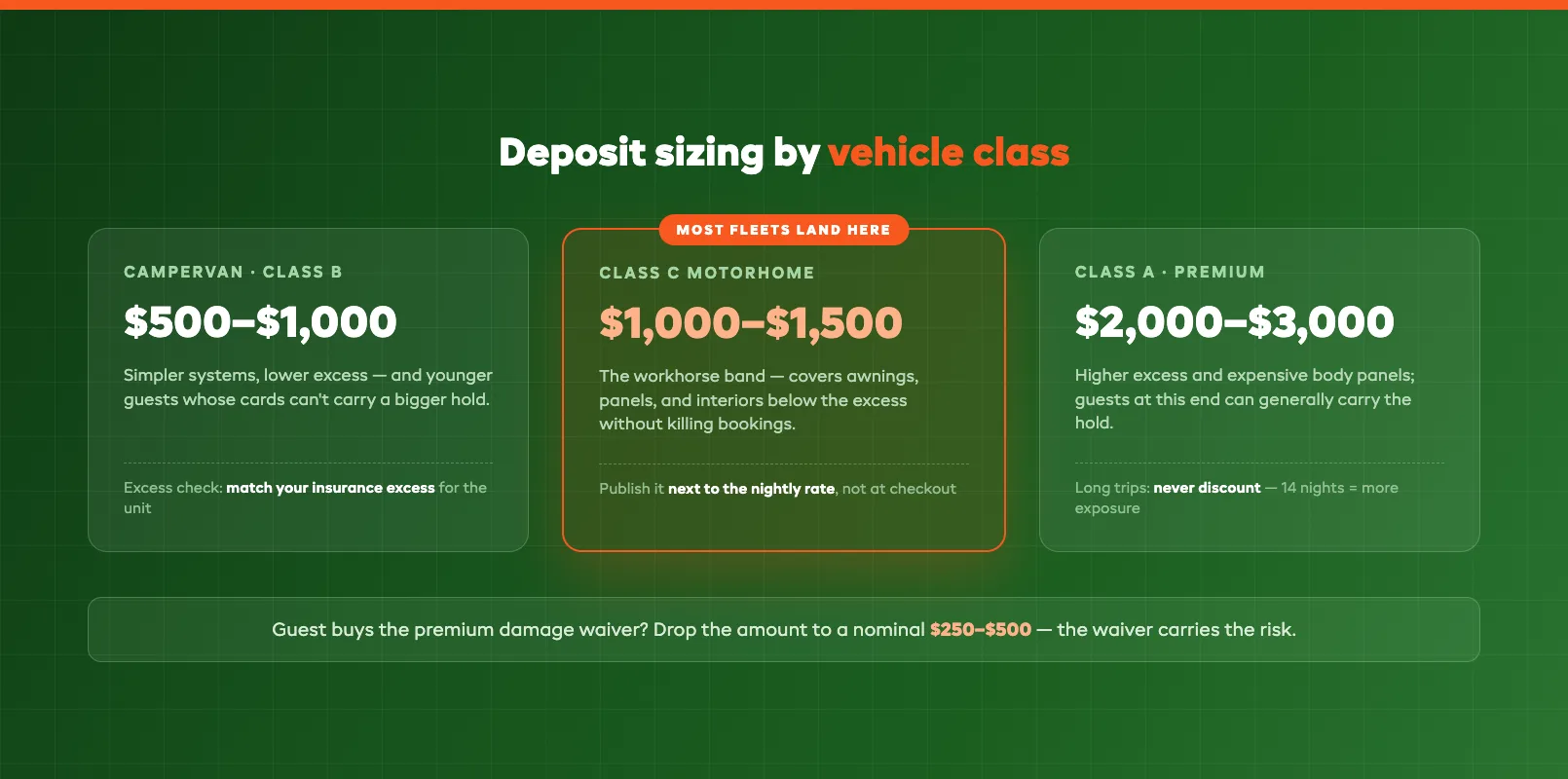
- Campervans and small Class B: $500–$1,000. Lower excess, simpler systems, younger guests with lower card limits.
- Class C motorhomes: $1,000–$1,500. The workhorse tier. This is where most fleets should land.
- Class A coaches and premium units: $2,000–$3,000. Higher excess, expensive body panels, and guests who can generally carry the hold.
Two adjustments worth building in. First, match the deposit to the damage-waiver tier the guest picks: if they buy your premium waiver, drop the deposit, $250–$500 is common, because the waiver is doing the work. Second, don't discount the deposit for long trips. A 14-night booking has more exposure, not less.
Publish the number on the booking page next to the nightly rate. A deposit that first appears at checkout reads like a hidden fee, and hidden fees are where pricing trust goes to die.
Card Pre-Authorization, Not a Charge
Never take the deposit as a cash payment you'll refund later. Refunds are slow, they clog your bookkeeping, and guests hate watching $1,500 leave their account. The standard is a pre-authorization hold: the amount is reserved on the guest's card but never captured unless you file a claim.
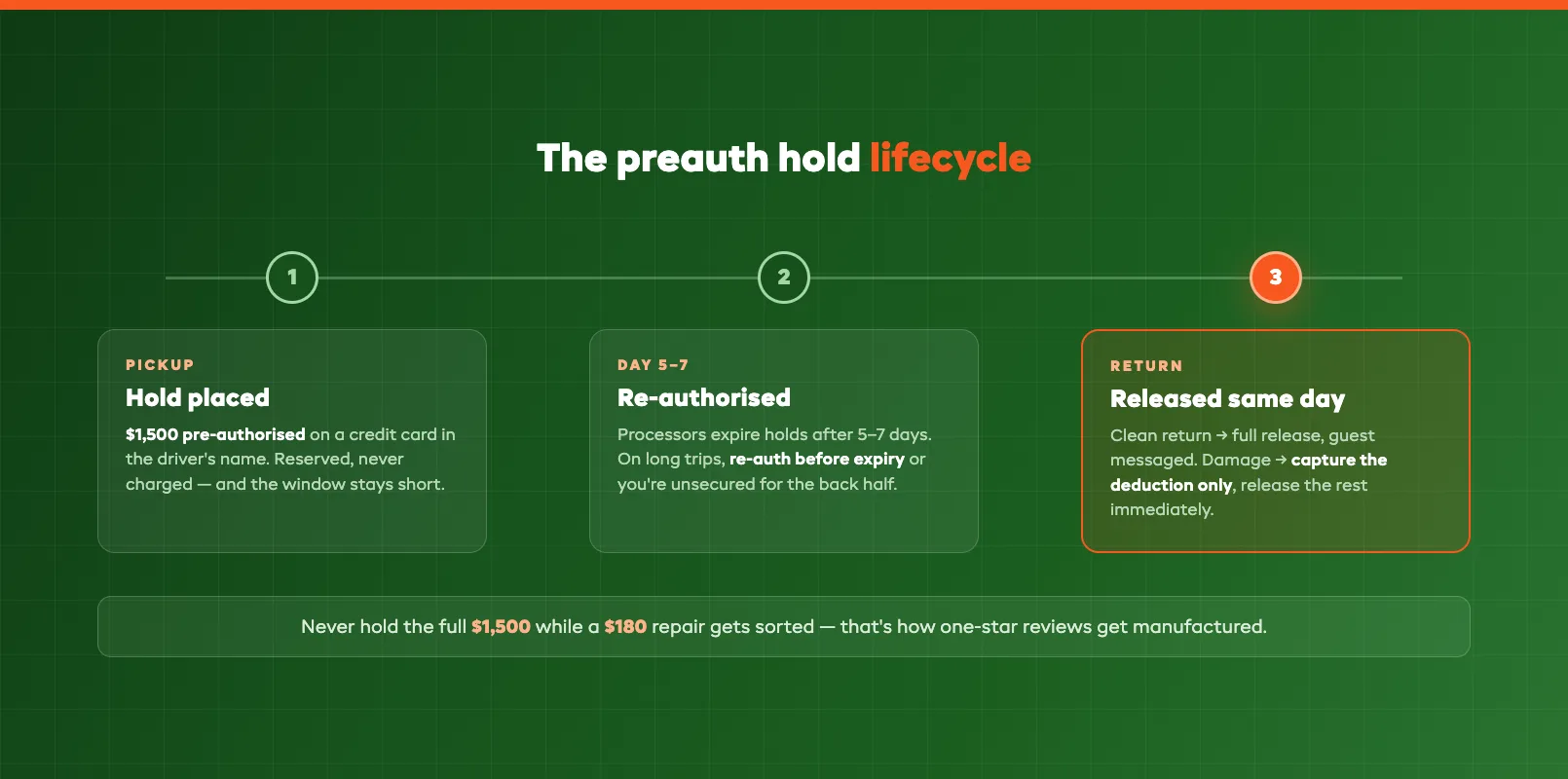
The lifecycle has three moments you need to manage:
- Placement. Put the hold through at pickup, on a credit card in the driver's name, not a debit card if you can avoid it, because holds on debit cards freeze real money and generate angry calls. Placing it at pickup rather than booking keeps the hold window short.
- Extension. Most processors expire holds after 5–7 days. On longer rentals, your system needs to re-authorize before expiry, or you're unsecured for the back half of the trip. This is exactly the kind of silent deadline good RV booking software tracks for you; a wall calendar does not.
- Release. If the return inspection is clean, release the hold the same day and tell the guest you did. "Your $1,500 hold was released this afternoon" is a five-second message that shows up in reviews.
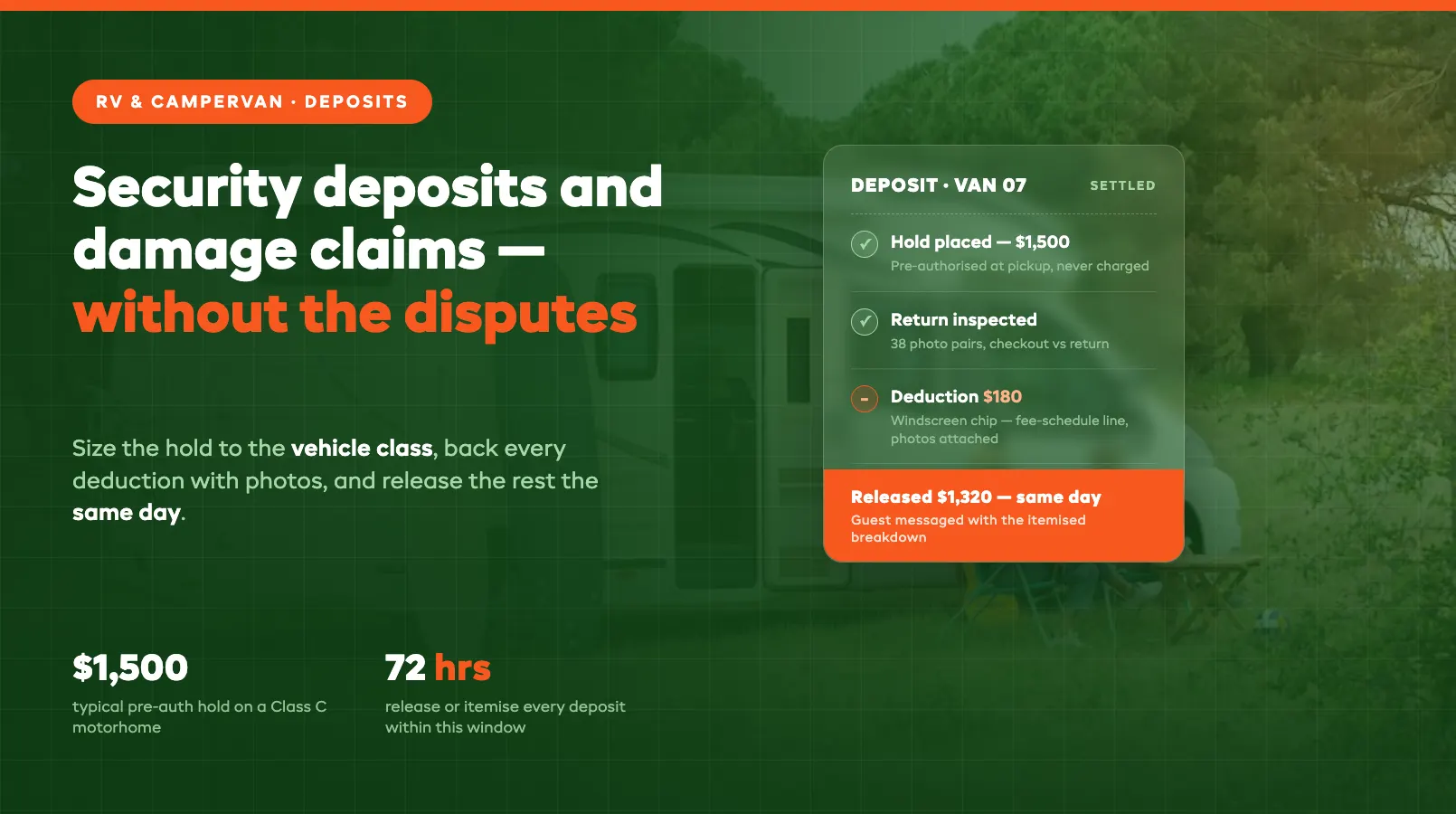
If there is damage, capture only the deduction ($180 of a $1,500 hold) and release the rest immediately. Holding the full amount while a $180 repair gets sorted is how operators manufacture their own one-star reviews.
Evidence: The Handover Photos Do the Heavy Lifting
A damage claim without before-and-after photos is an opinion. With them, it's an invoice.
The foundation is laid before the guest drives away: a full walkaround with 30–40 timestamped photos — every panel, every corner, the roof, the awning rolled out, the interior, fuel and propane gauges, odometer. Both parties acknowledge the record. If you're not doing this systematically yet, fix that first; the full shot list lives in our handover and return inspection guide.
At return, you re-shoot the same angles and compare side by side. New scrape on the rear quarter panel that isn't in the checkout set? That's a claim. Mark it, photograph it close-up with something for scale, and note it on the return report while the guest is standing there. Claims raised at the counter get accepted. Claims raised by email two days later get disputed.
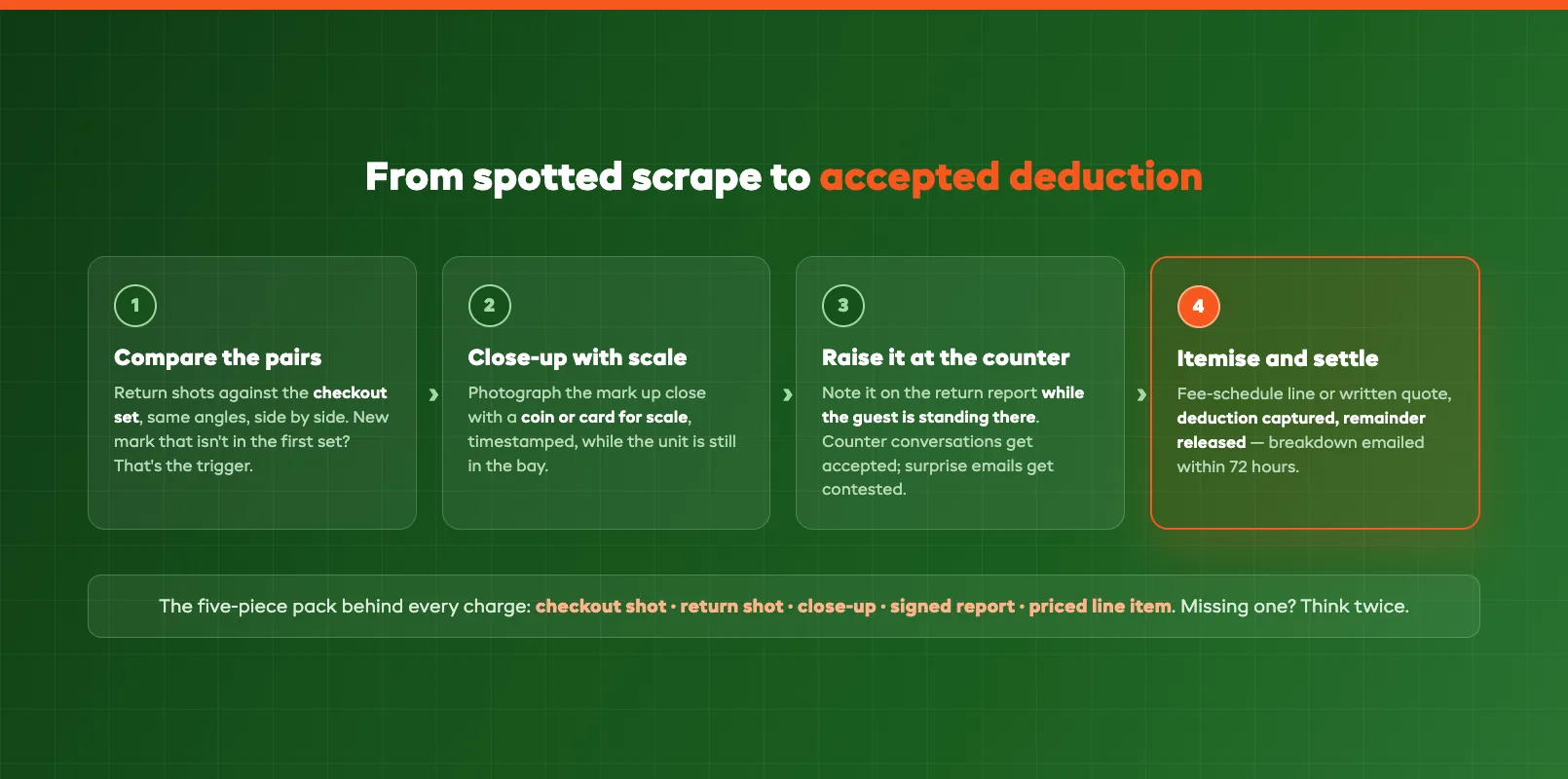
The full evidence pack for any deduction: checkout photo, return photo, close-up, the signed return report, and the repair quote or fee-schedule line item. Five things. If you can't produce all five, think hard before you charge.
Charging Fairly: The Published Fee Schedule
The fastest way to settle small claims is to price them before they happen. Publish a repair fee schedule in your rental agreement — real numbers for the incidents that make up 90% of claims:
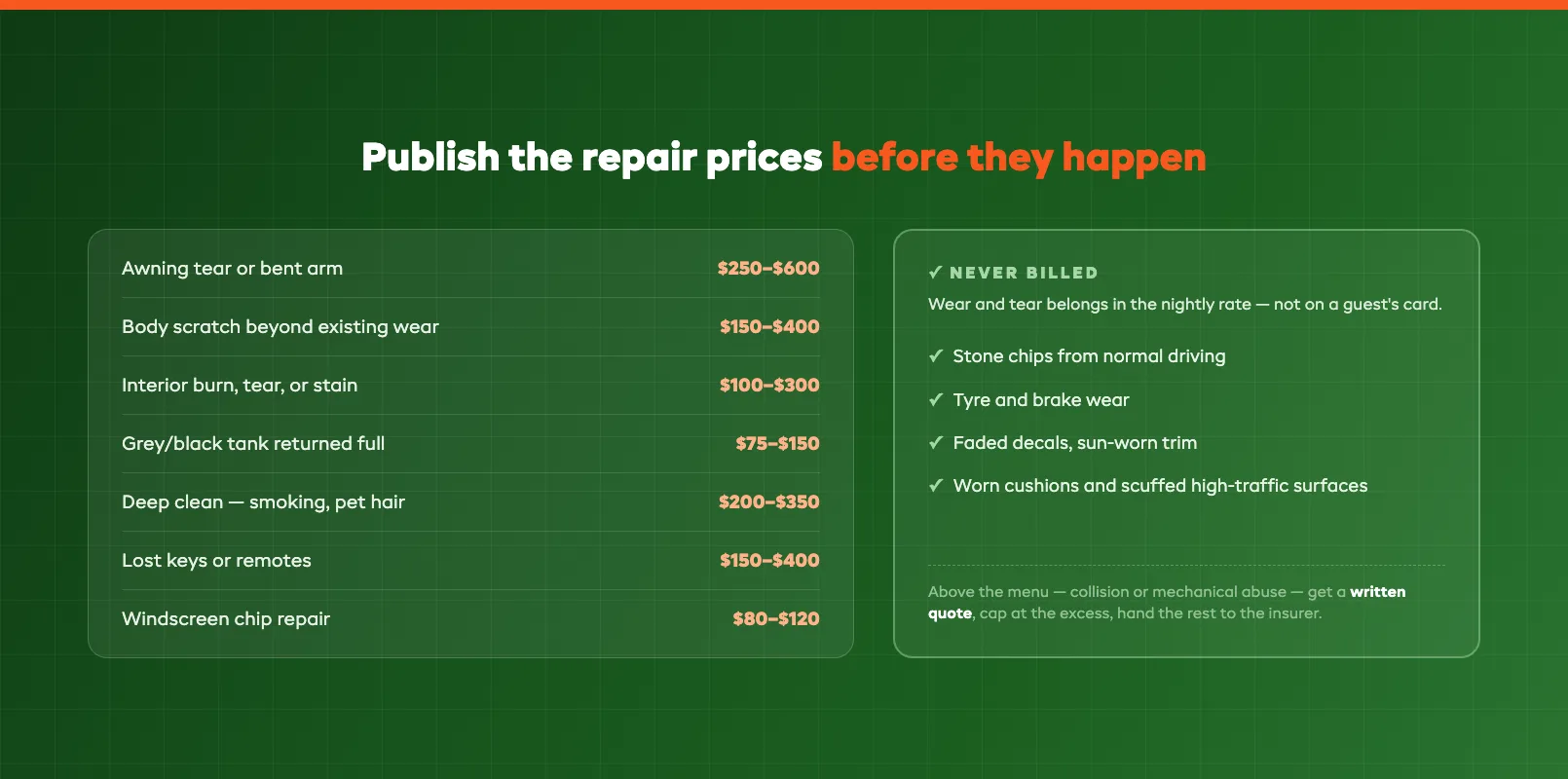
- Awning tear or bent arm: $250–$600
- Body scratch beyond a panel's existing wear: $150–$400
- Interior burn, tear, or stain requiring replacement: $100–$300
- Gray/black tank returned full: $75–$150 dump-and-flush fee
- Deep clean (smoking, pet hair on a no-pet unit): $200–$350
- Lost keys or remotes: $150–$400
- Windscreen chip repair: $80–$120
Just as important is the list of what you never charge for: stone chips from normal driving, tire wear, worn upholstery, faded decals, small scuffs on high-traffic surfaces. That's wear and tear (the cost of being in the rental business) and it belongs in your nightly rate, not on a guest's card. Operators who bill wear and tear as damage win the $90 and lose the repeat booking. Anything genuinely worn out gets handled through your maintenance and turnaround process, not a claim.
For anything above the fee schedule (collision damage, mechanical abuse) get a written repair quote before charging, cap the deduction at the deposit/excess, and hand the rest to your insurer.
Settling Fast: The 72-Hour Rule
Set yourself a deadline: every deposit is either released or itemised within 72 hours of return. In practice that means:
- Clean return: hold released same day, confirmation message sent.
- Minor damage: deduction captured against the fee schedule, remainder released, evidence pack emailed with the itemised breakdown, all within a day or two.
- Major damage: guest told at return what happens next, deposit captured up to the excess, insurer engaged, and a written summary sent within 72 hours.
The message matters as much as the maths. Lead with the number they get back, not the number you kept: "We've released $1,320 of your $1,500 deposit. The $180 deduction covers the windscreen chip repair — photos and the fee-schedule line are attached." Factual, documented, done. Guests can disagree with a judgment; it's much harder to disagree with a photo pair and a published price.
Putting It Together
A deposit policy that works is boring by design: a published amount sized to the vehicle class, a preauth hold placed at pickup and released the day of a clean return, 40 photos on each end of the rental, a fee schedule that prices the common incidents, and a hard 72-hour settlement deadline. Every piece removes a surprise, and surprises, not deductions, are what guests punish in reviews.
Running it manually across a growing fleet is where it breaks: holds expire mid-trip, photo sets live on three different phones, and deductions drift into "whatever seems fair today." This is the part worth systematising — EquipDash handles the hold lifecycle, stores handover and return photo sets against each booking, and keeps your fee schedule attached to the agreement the guest signed. If you're building the wider operation around it, start with the complete RV rental business guide, browse the RV & campervan hub for tools and templates, and keep the RV rental glossary handy for the contract terms.
FAQ
How much should an RV security deposit be?
Size it to the vehicle class and your insurance excess: $500–$1,000 for campervans and Class B vans, $1,000–$1,500 for Class C motorhomes, and $2,000–$3,000 for Class A coaches and premium units. If the guest buys your premium damage waiver, drop the deposit to a nominal $250–$500 — the waiver is carrying the risk instead.
Should I take the deposit as a charge or a pre-authorization hold?
Always a pre-authorization hold on a credit card. A hold reserves the funds without capturing them, so a clean return needs a release, not a refund — faster for the guest and cleaner for your books. If you do file a claim, capture only the deduction amount and release the remainder immediately.
What happens if the card hold expires during a long rental?
Most processors expire holds after 5–7 days, so on longer trips you must re-authorize before expiry or you're holding nothing for the rest of the rental. Track the expiry date against each booking. This is one of the strongest arguments for running deposits through booking software rather than a standalone card terminal.
What counts as damage versus normal wear and tear?
Damage is a specific incident: an awning tear, a new scrape that isn't in the checkout photos, a burn in the upholstery, a tank returned full. Wear and tear is gradual and expected: stone chips from normal driving, tire wear, faded decals, worn cushions. Charge for the first, absorb the second in your nightly rate, and publish the distinction in your agreement so guests see it before they book.
How do I charge for damage a guest disputes?
Produce the five-piece evidence pack: the checkout photo, the return photo, a close-up, the signed return report, and the repair quote or published fee-schedule line. Raise the issue at the counter during return whenever possible — face-to-face claims backed by photo pairs are usually accepted on the spot, while surprise charges raised days later by email are the ones that turn into chargebacks.
How quickly should I release a security deposit after return?
Same day for a clean return, and within 72 hours for anything involving a deduction. Message the guest either way, leading with the amount released. Slow, silent releases are one of the most common complaints in RV rental reviews, and one of the cheapest to eliminate.
in one place