Snowmobile Tour Pricing: Half-Day, Full-Day, and Backcountry
Snowmobile Tour Pricing: Half-Day, Full-Day, and Backcountry
Snowmobile touring is an expensive product to deliver. Every seat you sell carries a share of a $12,000–$18,000 machine, a guide's wages, fuel that a hard-ridden sled drinks by the liter, insurance priced for a motorsport, and a season that might be 14 weeks long in a good year. Price like a bike rental and the season ends before the sleds are paid for.
This guide covers the pricing half of the business: building your cost floor, structuring the classic three-tier menu — half-day, full-day, backcountry — pricing single versus double riders, and lifting rates when demand does the selling for you. It sits alongside guide ratios and group scheduling, which drives much of the cost side, and the complete guide to running a snowmobile business for the full operational picture.
Start with the cost floor, not the competitor's website
Before any tier gets a price, you need one number: what one seat on one departure actually costs you to deliver. Not roughly — actually. Most operators who do this exercise for the first time discover their "profitable" half-day tour was clearing less than a coffee per rider.
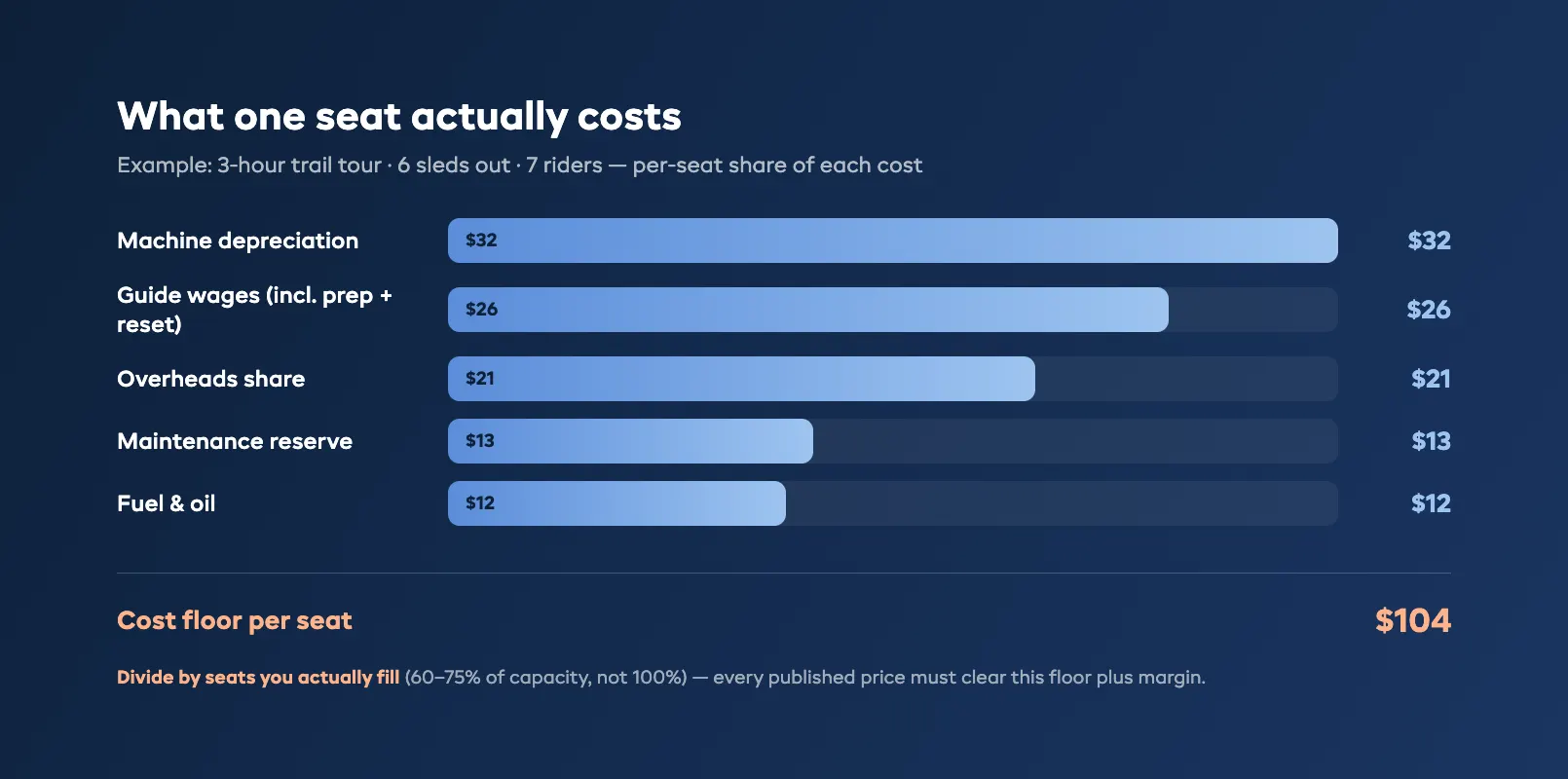
Build it per departure, then divide by realistic average occupancy — not maximum capacity:
- Machine cost — depreciation per engine hour. A $15,000 sled ridden 1,200 hours over its rental life costs roughly $12.50 per hour before it turns a wheel. A four-hour tour is $50 of machine, per sled.
- Guide wages — lead guide, plus sweep on larger groups, for tour time and prep, briefing, and reset time. A "four-hour" tour is closer to six paid hours.
- Fuel and oil — trail sleds burn hard under renters. Track it per tour length, not as a season-end surprise.
- Maintenance reserve — carbides, belts, hyfax, and the repair bills that follow rental use. Your fleet maintenance logs tell you the real per-hour figure; without them you are guessing.
- Overheads — insurance, permits and land-use fees, base rent, booking costs, marketing — divided across your realistic season departure count.
Sum it, divide by the seats you actually fill on an average departure (for most operators that is 60–75% of capacity, not 100%), and that is your floor. Every tier price is that floor plus the margin that funds new sleds and a living. If the market will not pay floor-plus-margin for a tier, the answer is to fix the cost side or cut the tier — not to sell below it and make it up on volume. Volume below cost is just faster losses.
The three-tier menu: half-day, full-day, backcountry
Three tiers is the standard menu for a reason: it matches how guests self-select, and it gives you a clean good-better-best ladder where each step up carries visibly more value — and meaningfully more margin.
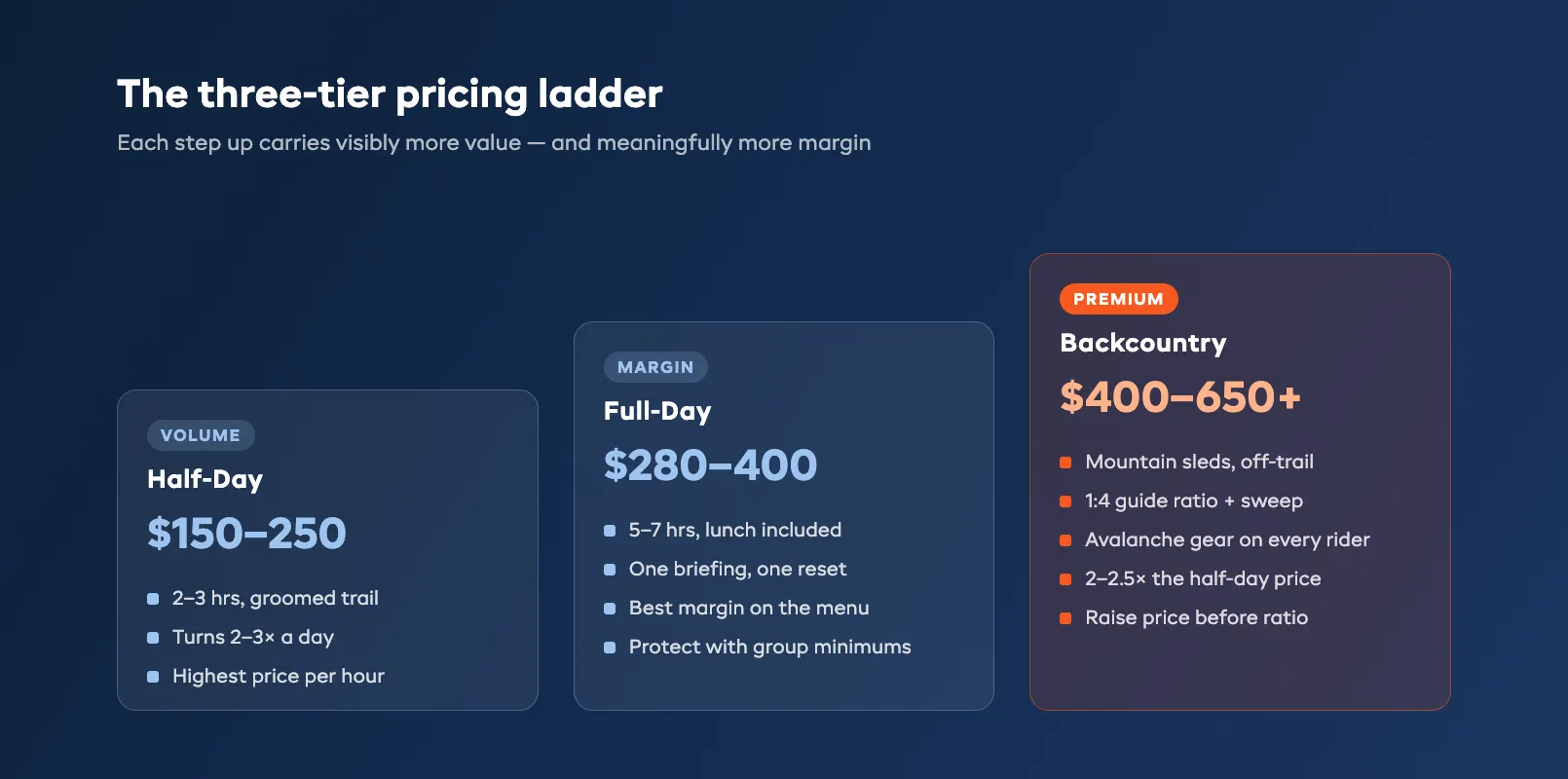
As a reference point, groomed-trail half-day tours across North American snowbelt markets commonly sit in the $150–$250 per driver range, full-day tours $280–$400, and guided backcountry runs $400–$650+. Your numbers come from your cost floor — but if you are far below these bands, you are probably underpriced, not competitive.
Half-day: the volume product
The two-to-three-hour trail tour is the door most guests walk through: first-timers, families, cruise-ship and resort traffic. It runs on groomed trails, modest guide ratios, and — critically — can turn twice or even three times a day off the same fleet.
Price it as your accessible tier, but not a cheap one. The half-day carries the same briefing, gear-up, and reset overhead as the full-day in nearly the same staff time, so its per-hour price should be your highest. A $189 half-day and a $329 full-day is a coherent ladder; a $99 half-day under a $329 full-day tells guests the short tour is the budget option and drags your average booking value down with it. Anchor pricing works: listing the full-day and backcountry tiers first makes the half-day read as the sensible entry point rather than the cheap one.
Full-day: the margin workhorse
The five-to-seven-hour tour adds range, a lunch stop, and more varied terrain. Its costs do not double relative to the half-day — one briefing, one gear-up, one reset — but its price roughly does, which is why full-day tours are usually the best-margin product on the menu. The trade-off is fleet time: a full-day sled turns once.
Two rules keep the tier honest. First, include the lunch and price it in — a $20 cost supporting a $70 price step is the easiest money on the menu. Second, protect it with a minimum booking count per departure, because a full-day tour that rolls out with two riders and two guides is a loss dressed up as service. Set the minimum from your cost floor and hold it, offering the half-day or a reschedule when a departure does not fill.
Backcountry: the premium tier
Backcountry and off-trail tours are a different product wearing the same brand: mountain sleds that cost more and wear faster, tighter guide ratios — often 1:4 rather than 1:8 — avalanche transceivers, probes, and airbags on every rider, guides holding avalanche qualifications, and terrain that demands real judgment.
Price it like the premium product it is: typically 2–2.5× your half-day, with a hard floor well above the full-day. Guests booking backcountry are buying scarcity and expertise, not trail miles, and they are the least price-sensitive segment you serve. The classic mistake is pricing backcountry $50 above the full-day "to fill seats" — you fill them with underprepared riders while the tier subsidises its own safety overhead. Small groups, high price, strict prerequisites. If demand outruns capacity, raise the price before you loosen the ratio.
Single riders, double-ups, and the add-on board
A snowmobile seat is not one product. How you price the driver-versus-passenger split and the extras around the tour moves 15–25% of revenue on exactly the same departures.
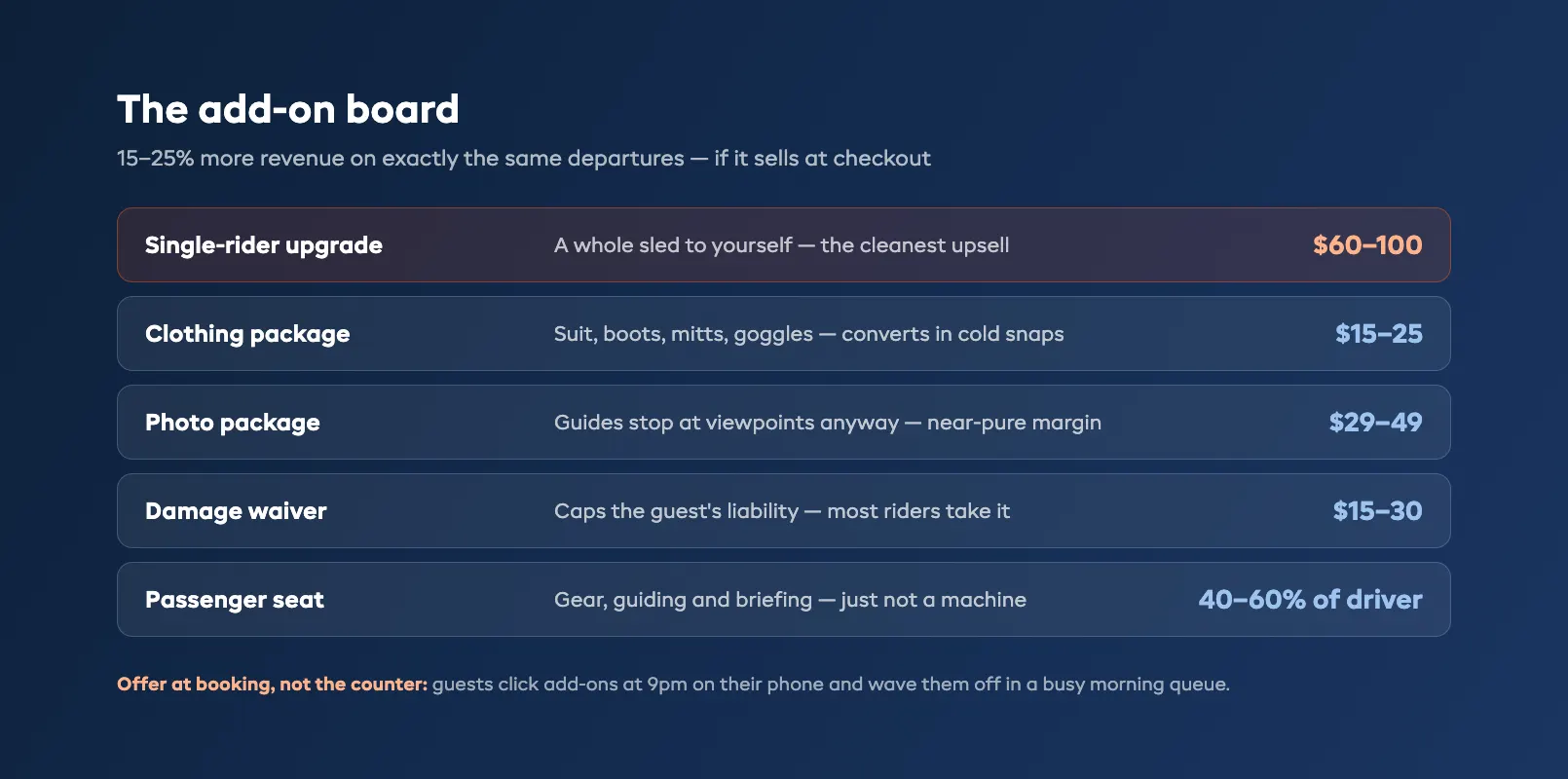
- Driver vs passenger — price the passenger at 40–60% of the driver rate. The passenger consumes gear, guiding, insurance, and a briefing slot, just not a machine.
- Single-rider upgrade — the guest who wants their own sled instead of doubling up is your cleanest upsell. Charge a meaningful supplement (commonly $60–$100 on a half-day) because they consume a whole machine.
- Gear packages — helmets are included everywhere; suits, boots, mitts, and goggles can be bundled or listed as a package add-on. One-piece suits at $15–$25 per rider convert well in cold snaps.
- Photo and media packages — guides are stopping at viewpoints anyway. A $29–$49 photo package is near-pure margin.
- Damage waiver — a per-rider fee (commonly $15–$30) that caps the guest's damage liability. Most guests take it, and it smooths the deposit and damage conversation before it starts.
The operational catch: add-ons only sell if they are offered at booking, not at the counter. A guest clicks "own sled + suit + photos" at 9pm on their phone; the same guest waves it off in a busy morning queue. Your booking software should present the add-on board at checkout and put the revenue on the same invoice.
Peak weeks: let the calendar do the pricing
A snowmobile season is not 14 equal weeks. Christmas–New Year, February half-terms, and bluebird Saturdays after a storm sell out at almost any price; early-December and March midweeks need help. Flat pricing across that curve gives your best inventory away cheap and discounts nothing when it would actually matter.
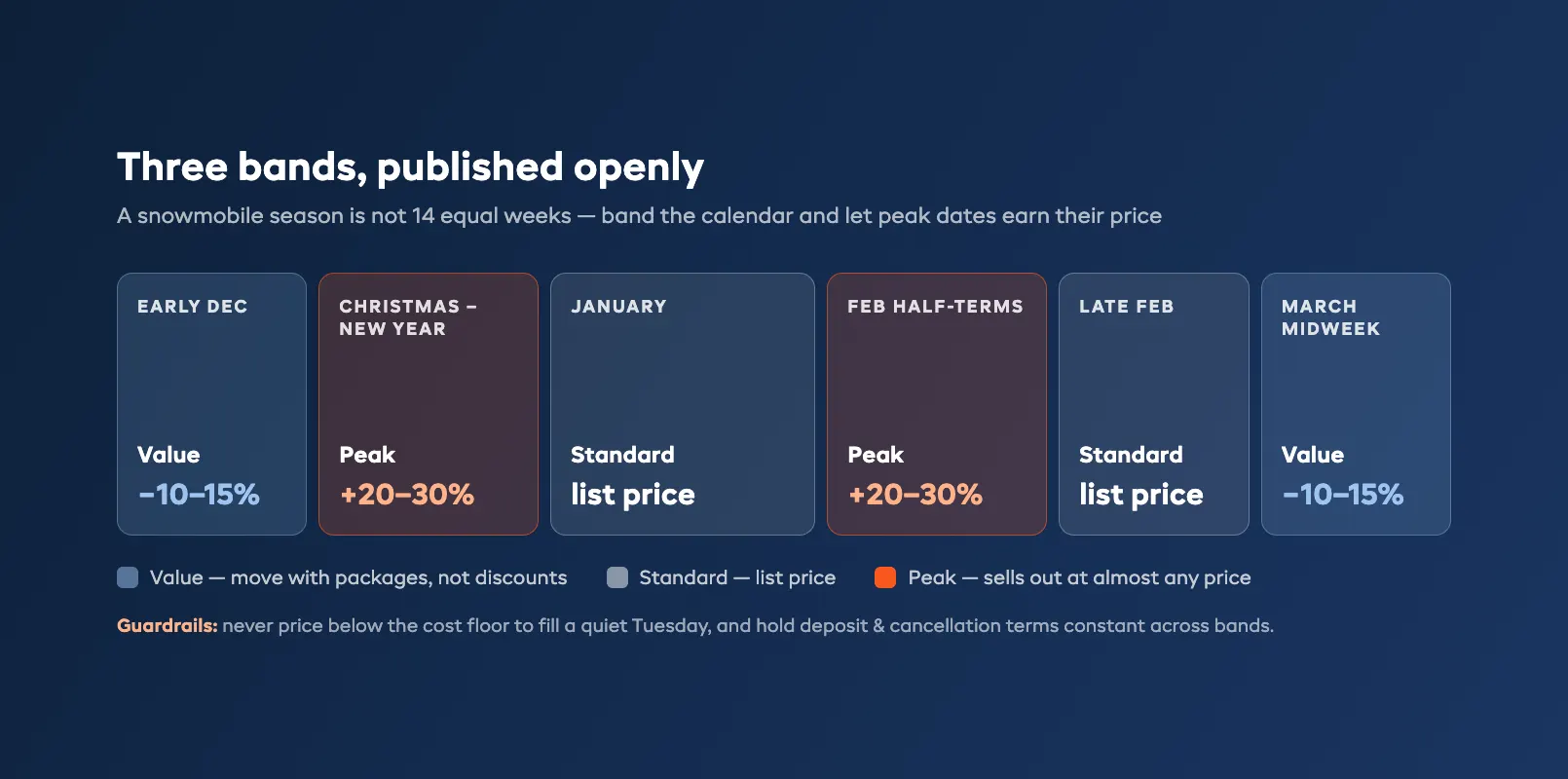
Keep it to three published bands — value, standard, and peak — with peak sitting 20–30% above standard and value 10–15% below. Publish the calendar openly: guests accept holiday pricing everywhere else in travel, and a visible band system reads as normal rather than opportunistic. Move midweek shoulder dates with packages (tour plus lunch, family bundles) rather than headline discounts, so the list price never erodes. Dash AI can watch pace and flag departures that are filling faster than the band predicts, so you can nudge peak dates up while there is still inventory to sell.
Two guardrails. Never drop below your cost floor to fill a quiet Tuesday — cancel or consolidate departures instead, which your group scheduling already gives you the mechanics for. And hold deposits and cancellation terms constant across bands; pricing flexes, policy does not.
Put the pricing where guests can buy it
None of this works as a laminated sheet at the counter. Tiers, driver/passenger rates, single-rider supplements, add-ons, and seasonal bands need to live in your online checkout, price themselves correctly at 11pm, and land on one invoice — which is the job of your snowmobile booking software, covered in its own guide. From there, review the numbers once a month in season: occupancy by tier, average booking value, and add-on attach rate tell you which tier is mispriced long before the P&L does.
The rest of the operation this pricing sits on — fleet, guides, waivers, weather calls — is in the complete guide to running a snowmobile business, with the surrounding tools and terms on the snowmobile hub and in the snowmobile glossary.
FAQ
How much should a half-day snowmobile tour cost?
Across North American snowbelt markets, guided half-day trail tours commonly run $150–$250 per driver, with passengers at 40–60% of the driver rate. Your exact number should come from your per-seat cost floor plus margin, not from matching the shop down the road — but if you are well under $150 on a guided product, you are almost certainly underpriced rather than competitive.
Why are backcountry snowmobile tours so much more expensive?
Because everything about them costs more: mountain sleds that are pricier and wear faster, guide ratios of roughly 1:4 instead of 1:8, avalanche transceivers, probes, and airbags for every rider, guides with avalanche training, and small group caps that spread costs over fewer seats. Priced honestly, backcountry lands at 2–2.5× the half-day rate. Pricing it barely above the full-day fills seats with underprepared riders and leaves the tier unable to fund its own safety overhead.
Should passengers pay the same as drivers on a snowmobile tour?
No. A passenger consumes gear, guiding capacity, insurance, and a briefing slot, but not a machine — the single biggest cost per seat. Pricing passengers at 40–60% of the driver rate reflects that fairly, keeps double-up bookings attractive for couples and families, and leaves room to sell the single-rider upgrade to guests who want their own sled.
How do you calculate the cost of running a snowmobile tour?
Per departure: machine depreciation per engine hour, guide wages including prep and reset time, fuel and oil, a maintenance reserve based on your actual per-hour service costs, and a share of overheads — insurance, permits, rent, booking and marketing costs — spread across your realistic season departure count. Divide the total by average seats filled (typically 60–75% of capacity, not 100%) to get your cost per seat. Every published price needs to clear that floor plus margin.
Should snowmobile tour prices change by season or date?
Yes, within reason. Publish three bands — value, standard, and peak — with peak holiday weeks 20–30% above standard and quiet shoulder dates 10–15% below. Guests accept calendar pricing everywhere else in travel. Use packages rather than headline discounts to move slow midweek dates so your list price never erodes, and never price below your cost floor to fill a departure — consolidate or cancel instead.
What add-ons make the most money on snowmobile tours?
The single-rider upgrade is the cleanest — $60–$100 for a guest who would otherwise share a sled. After that: clothing packages ($15–$25 per rider for suits, boots, and mitts), photo packages ($29–$49, near-pure margin since guides stop at viewpoints anyway), and a per-rider damage waiver ($15–$30) that most guests take. The rule that makes all of them work: offer add-ons in the online checkout at booking time, not verbally at a busy counter.
in one place