Motorcycle Rental Software: Checking the Rider, Not Just the Bike
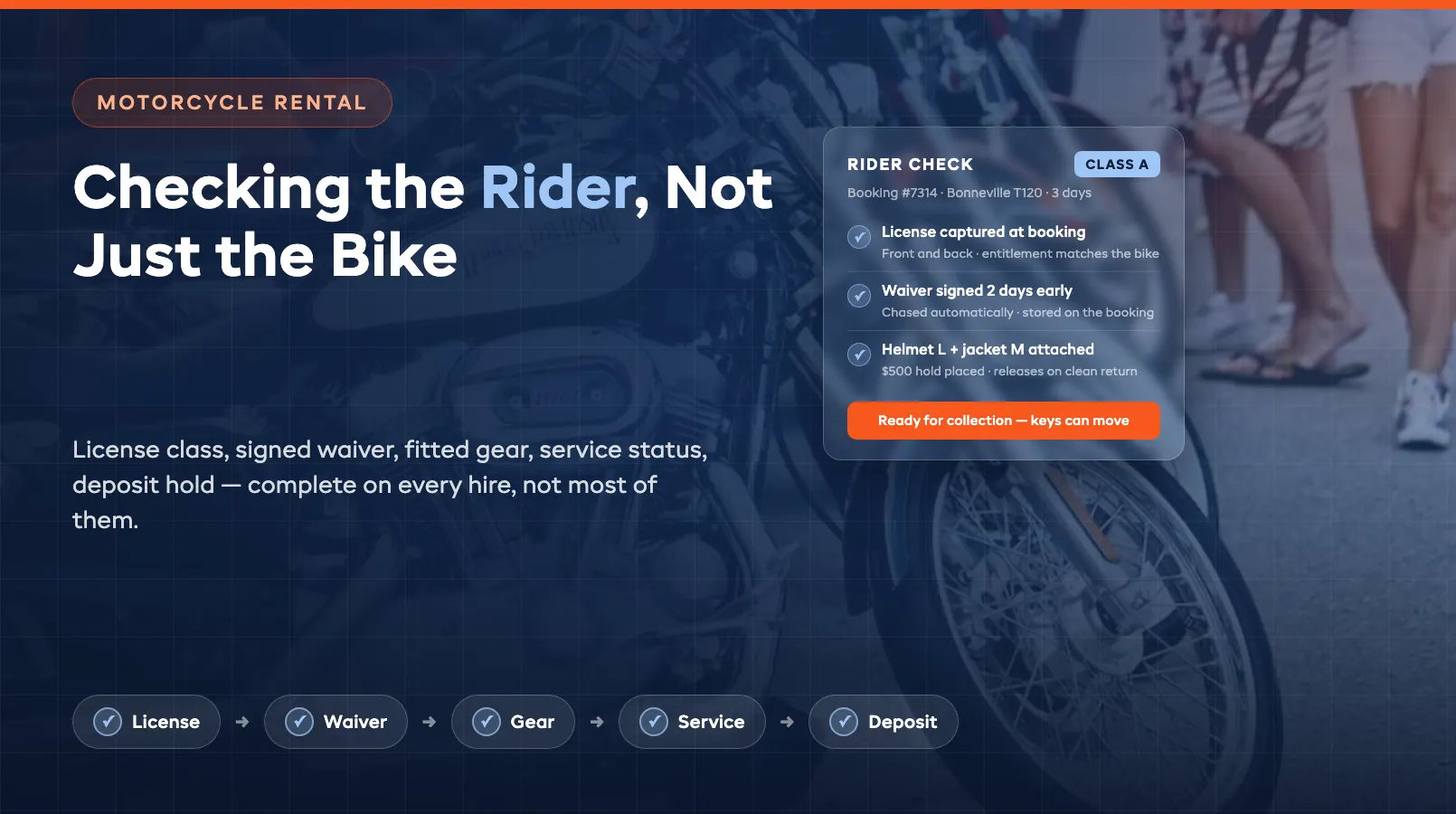
A car rental operator worries about the vehicle coming back damaged. A motorcycle rental operator worries about the rider not coming back at all. That is the difference the software has to be built around. Motorcycle hire carries exposure car hire does not — an unlicensed rider on a 1,200cc machine is not a paperwork gap, it is an uninsured incident waiting to attach itself to your business — and the checks that prevent it are exactly the ones that get skipped when the counter is busy and the customer is standing there in riding boots.
The job of purpose-built motorcycle rental software is not to make those checks possible. A clipboard makes them possible. The job is to make them complete on every hire, by refusing to move the booking forward until each one is done: license and entitlement captured and matched to the bike, waiver signed before the customer arrives, helmet and gear on the same booking, the bike itself in service and inside its maintenance window, and a deposit hold sized to what a dropped motorcycle actually costs. This guide walks through the five, plus a checklist to run in any demo.
License and Entitlement Capture
The single most important field in a motorcycle hire booking is not the dates. It is whether this person is legally entitled to ride this machine. Car hire checks that a license exists. Motorcycle hire has to check what the license covers, because motorcycle entitlements are tiered nearly everywhere you operate: an M endorsement on top of a standard license in most US states, the A2/A class split by power output across Europe, learner-approved capacity limits in Australia. A rider with a car license and enthusiasm is not a customer. He is a claim your insurer will decline.
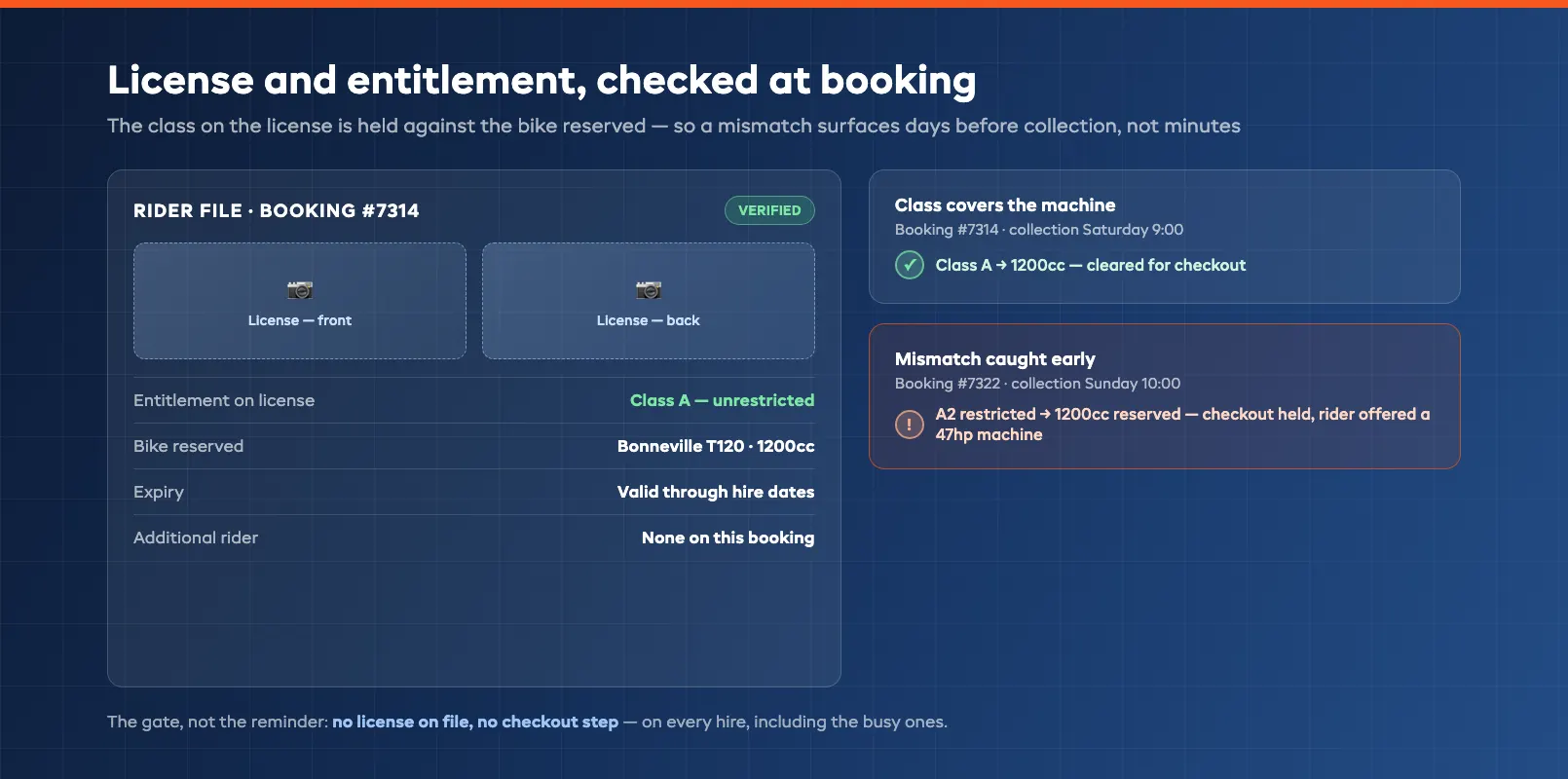
Software built for this asks for the license at booking, not at the counter. The customer photographs the front and back from their phone during checkout, the images store against the booking, and (this is the part that separates purpose-built from generic) the booking records the entitlement class alongside the bike reserved, so a mismatch surfaces two days before collection instead of two minutes before. Staff see a simple state on the day: license captured, class verified, matches the machine. Anyone picking up a second bike on the same booking goes through the same steps, because the passenger who "might take a turn riding" is the gap every operator learns about the hard way.
The test in a demo: try to move a booking to checked-out without a license on file. If the system lets you (if the check is a reminder rather than a gate) then on a busy Saturday it will be skipped, and the one hire where it mattered will be the one where it was.
Digital Waivers Before Collection
A motorcycle waiver signed at the counter is better than no waiver. A waiver signed three days before collection, on the customer's own phone, read at their own pace, is better than both, and it is also faster for you, because the handover on the day becomes keys and a walkaround instead of paperwork. The waiver is where the customer acknowledges the risks of riding, confirms their experience level, and accepts the damage and deposit terms in writing. If a claim ever turns adversarial, the signed record (who signed, when, from where, against which booking) is what makes your position defensible rather than arguable.
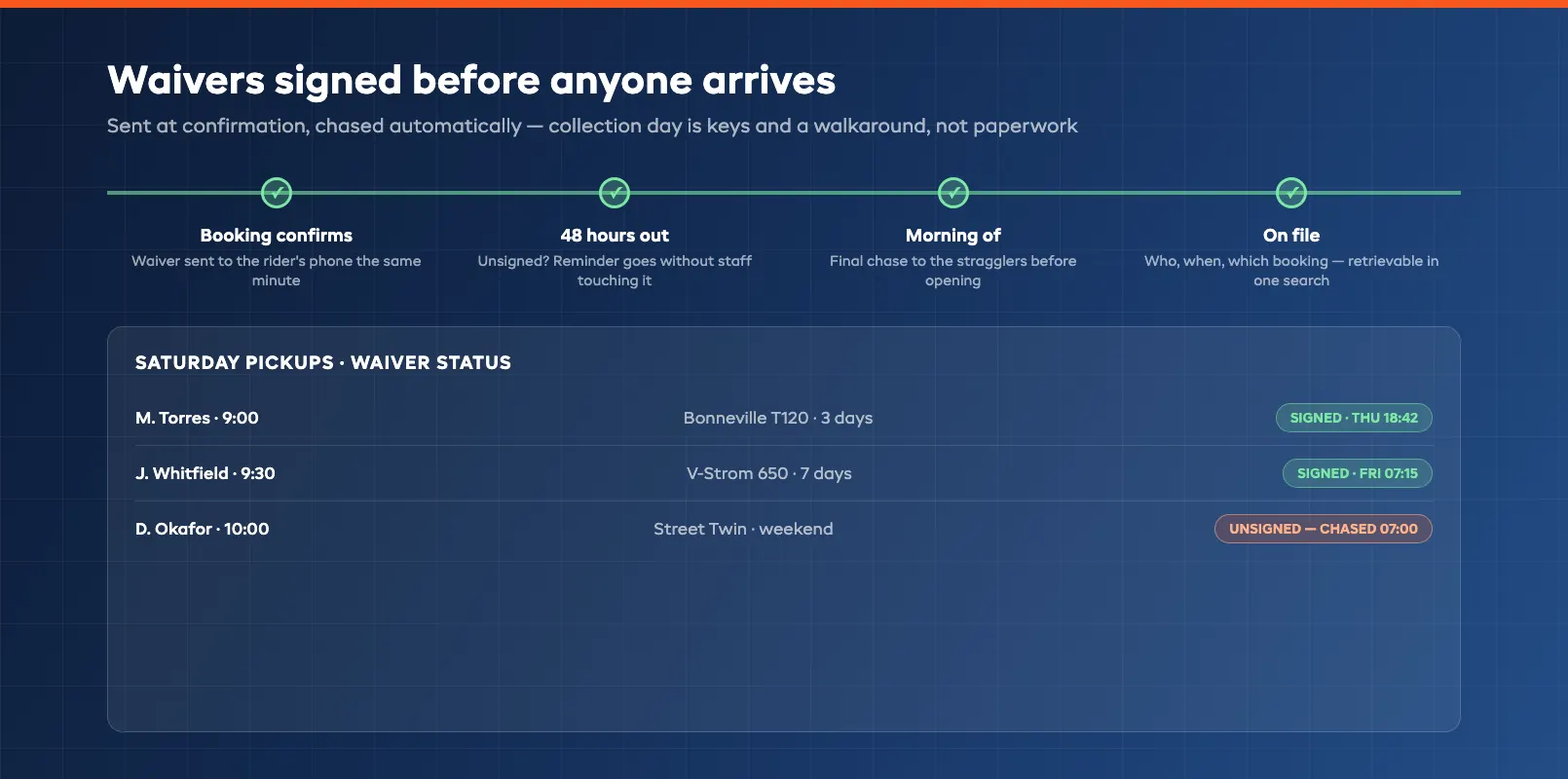
The workflow worth paying for sends the waiver automatically the moment the booking confirms, tracks its status against the booking, and chases the unsigned on its own — a reminder at 48 hours, another the morning of collection. Staff open the day's pickups and see at a glance which riders are ready and which still owe a signature. The signed document stores with the license images and the booking record, retrievable in one search years later, which is precisely when you will need it: insurers and courts are unimpressed by "we always get them signed" and very impressed by a timestamped file.
One structural point: the waiver and the license check belong on the same booking record, not in separate tools. The moment rider paperwork lives in one system and bookings in another, reconciliation becomes a manual job, and manual jobs get skipped in season. For the full working process (the capture list, the chase schedule, and the experience questions worth asking) see the guide to rider checks and waivers.
Gear on the Same Booking
Most motorcycle hires are not just a motorcycle. They are a bike, a helmet, sometimes a second helmet, a jacket, gloves, and every one of those items has a size, a stock level, and a cost when it walks away. Operators who handle gear informally ("grab a helmet from the rack") lose in three ways: no revenue from riders who would happily pay for a quality lid, no record of who took what, and a scramble on the day when the only remaining helmet is a small and the rider is not.
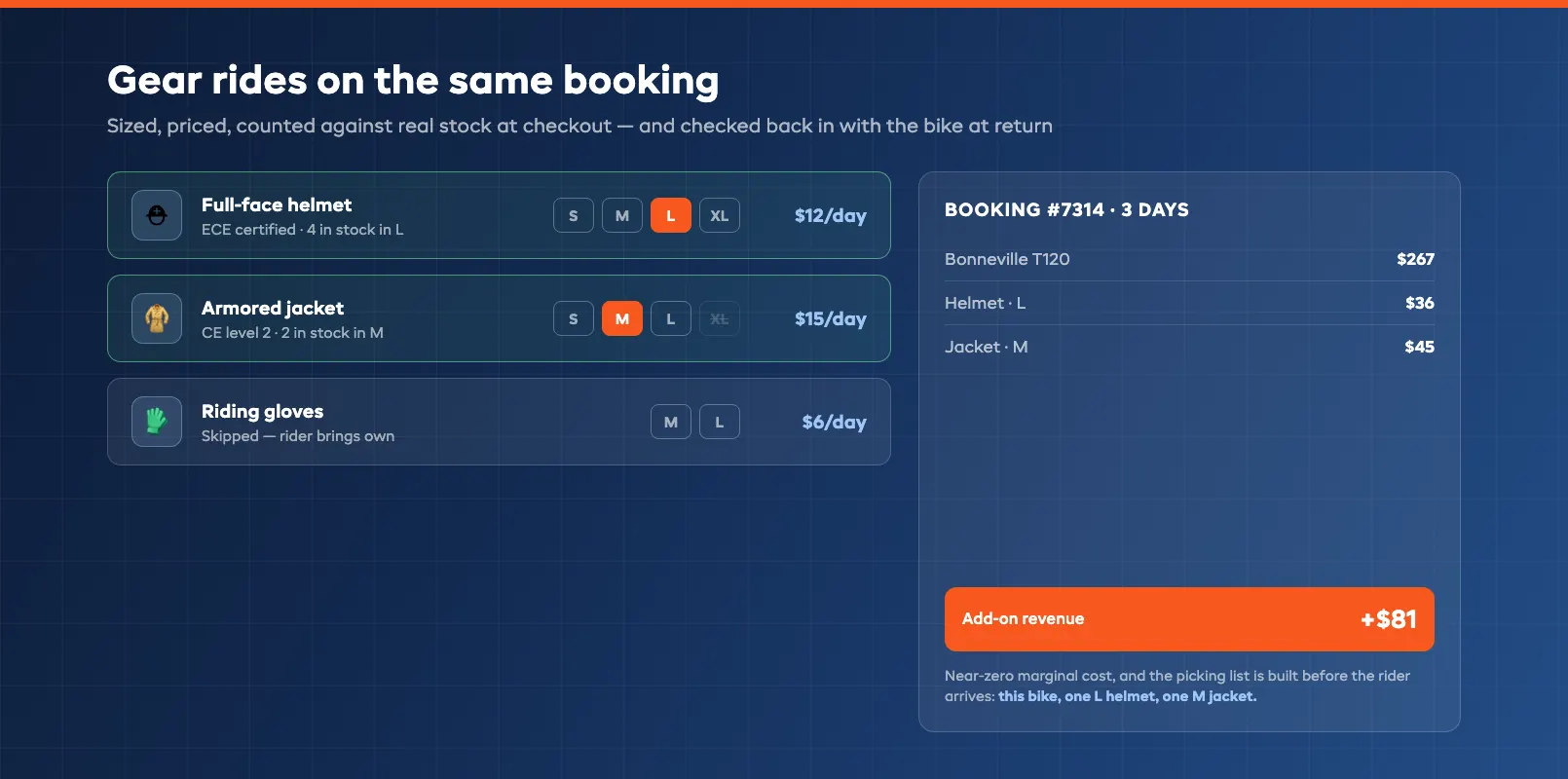
The fix is treating gear as inventory attached to the booking. During online checkout the rider adds a helmet and picks a size, adds a jacket, adds gloves — each with its own price, each counted against real stock so you never promise a large jacket you do not have. On collection day the picking list is already built: this rider, this bike, one large helmet, one medium jacket. On return, the gear checks back in with the bike, and anything missing is visible immediately rather than at the end-of-month rack count.
There is a margin story here too. A $12-a-day helmet and a $15-a-day jacket on a three-day hire adds $81 at close to zero marginal cost, and riders traveling light, which is most of the touring trade, take the add-ons gladly. Operators consistently underprice this because gear feels like an accessory to the sale. On the numbers, it behaves like the best line on the invoice: the full rate-card math, from day hire to touring weeks, is in our guide to pricing motorcycle hire.
Per-Bike Servicing
Motorcycles are less forgiving of missed maintenance than cars. A chain three thousand miles past adjustment, a rear tire run past its wear bar, brake pads at the backing plate, on a car these are defects; on a bike they are crash causes. Which is why generic rental software that tracks "cruiser, qty 6" as interchangeable stock is disqualified for motorcycle fleets on this section alone. The unit of record has to be the individual machine (this registration, this VIN) with its own odometer history and its own service schedule.
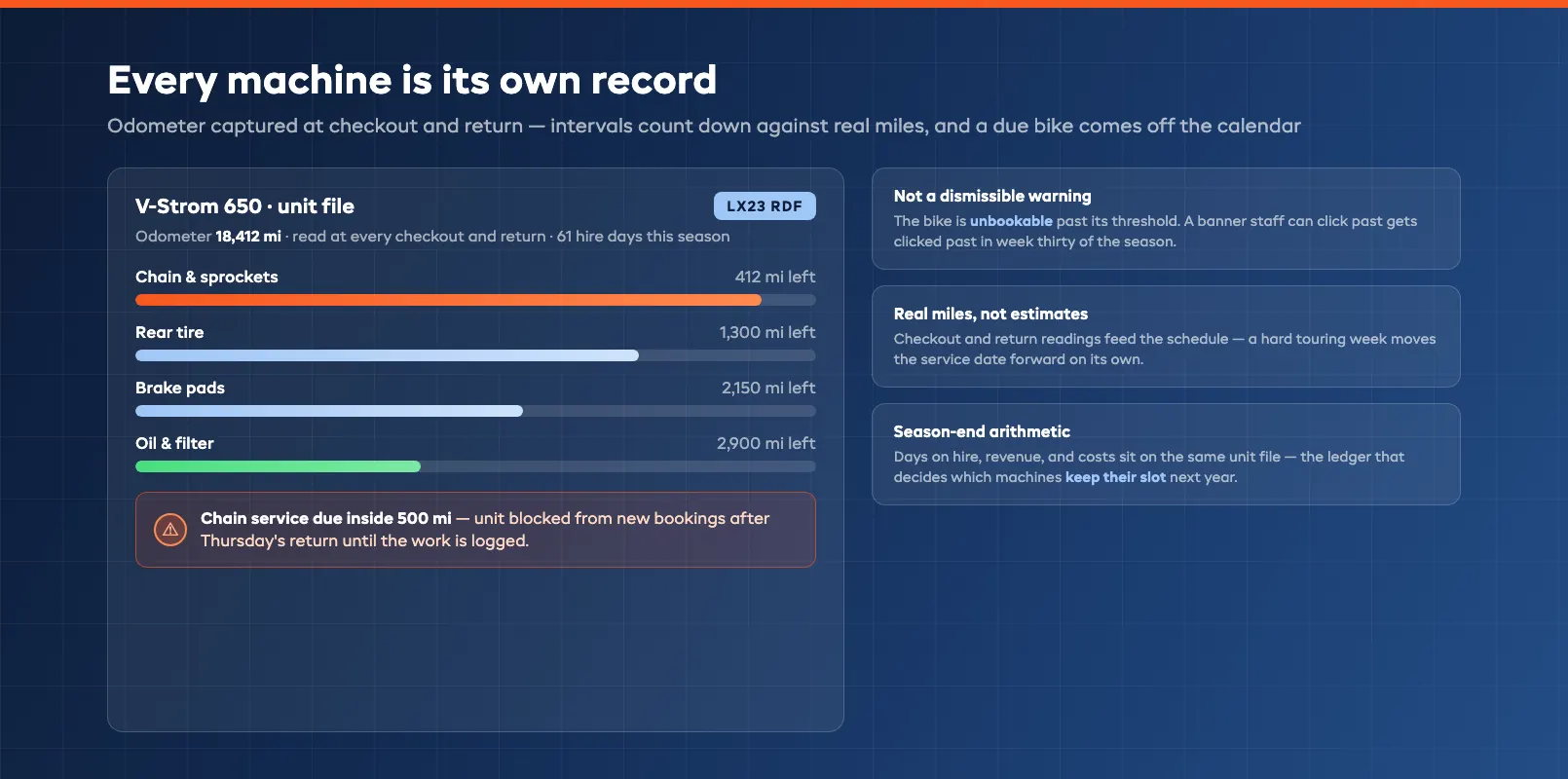
That means odometer readings captured at every checkout and every return, so the system knows true miles run per bike rather than estimates. Service intervals (chain and sprockets, tires, brake pads, oil, valve clearances on the models that need them) count down against those real miles, and when a bike crosses a threshold the system blocks it from the booking calendar until the work is logged. A warning banner staff can click past is not a block; in week thirty of the season, someone will click past it. The bike simply should not be bookable.
The same per-bike ledger is what tells you, at season end, which machines earned their keep. Days on hire, revenue, costs logged against the unit — the middleweight that ran all summer without drama keeps its slot, the temperamental one that ate two workshop weeks goes on the sale list. If you run cars alongside bikes, the same registration-level logic applies across the fleet (the car rental software side of the same platform works identically) one system, every unit tracked as its own business.
Deposits
Deposit practice from car hire mostly transfers to motorcycles, with one adjustment: the numbers are higher relative to vehicle value, because motorcycles fall over. A parked bike knocked off its stand is a brake lever, a mirror, a fairing panel, and paint — routinely $600–$1,000 of damage from an incident with no riding involved. Most operators hold $500–$1,500 as a card pre-authorization depending on the machine, sized to roughly cover the insurance excess plus the common drop damage.
The mechanics should run without anyone touching a terminal: the hold is placed before keys move, released automatically after a clean return, or partially captured (the documented repair amount, not a round number) when something comes back bent. Documentation is what makes the capture stick. A photo set at checkout (both sides, front, rear, tank, exhaust, levers and bar ends, existing scuffs) timestamped and stored on the booking, repeated at return, turns a damage conversation into a before-and-after comparison. Card issuers side with whoever has the file, and chargebacks die quickly against dated photos, a signed waiver, and a captured license all hanging off one booking record.
The Motorcycle Hire Software Checklist
Run any platform you are evaluating against this list, live, in the demo, not against the feature page:
- License gate. Can a booking reach checked-out without a license image and entitlement class on file? If yes, fail.
- Class match. Does the booking hold the rider's entitlement against the specific bike reserved, and flag a mismatch before collection day?
- Waiver automation. Is the waiver sent automatically at confirmation, chased automatically when unsigned, and stored against the booking?
- Gear as inventory. Can a rider add a helmet in a size during online checkout, with stock counted, and does gear check in with the bike at return?
- Per-bike record. Is each machine tracked by registration with odometer capture at checkout and return, not as interchangeable category stock?
- Service blocks. Does a bike past its service threshold come off the calendar as a hard block, rather than a dismissible warning?
- Deposit lifecycle. Pre-authorization placed at collection, auto-released on clean return, partial capture against documented damage, without manual terminal work?
- One record. License, waiver, gear, photos, deposit, and odometer all on the same booking, retrievable in one search?
A platform that passes all eight will run a motorcycle fleet properly. A platform that passes five will run it most of the time, and motorcycle hire is a business where "most of the time" is the expensive part.
FAQ
What does motorcycle rental software do that general rental software does not?
Three things: it verifies the rider, not just the booking — license images and entitlement class captured and matched to the machine before keys move; it tracks each bike as an individual unit with its own odometer history and mileage-based service schedule, rather than interchangeable category stock; and it handles riding gear as sized, priced inventory on the same booking. General rental platforms treat a fleet of motorcycles like a rack of kayaks, and the gaps show up exactly where the liability lives.
How do I verify a customer is licensed to ride the bike they booked?
Capture the license at booking, not at the counter (front and back photographed from the customer's phone during checkout) and record the entitlement class against the reserved bike. Motorcycle entitlements are tiered in most jurisdictions (M endorsements in US states, A2/A power classes in Europe, learner capacity limits in Australia), so the check is whether the class covers that specific machine. Good software surfaces a mismatch days before collection and will not release the checkout step without the license on file.
How big should a motorcycle rental deposit be?
Most operators hold $500–$1,500 as a card pre-authorization depending on the machine: higher relative to vehicle value than car hire, because a simple tip-over commonly does $600–$1,000 of lever, mirror, and fairing damage without a mile ridden. Size the hold to roughly your insurance excess plus typical drop damage, place it before keys move, release it automatically on a clean return, and capture only the documented repair amount when something comes back bent.
Should waivers be signed at the counter or before collection?
Before collection, every time. A waiver sent automatically when the booking confirms gets read and signed on the customer's own phone at their own pace, the system chases the unsigned without staff involvement, and collection day becomes keys and a walkaround instead of paperwork. The signed record (who, when, against which booking) stores with the license and photos, which is what makes it defensible if a claim ever turns adversarial.
Can I rent helmets and gear through the same system?
Yes, and you should, as inventory, not as a rack by the door. Helmets, jackets, and gloves get their own prices, sizes, and stock counts, riders add them during online checkout, and the items check out and back in with the bike. That closes three gaps at once: add-on revenue you were leaving unpriced, a record of who took what, and size availability confirmed at booking instead of discovered at the counter.
How much does motorcycle rental software cost?
Expect transparent monthly pricing rather than negotiated per-unit contracts. EquipDash annual plans start at $23/mo with a platform fee that steps down from 2% to 1% on higher tiers, and the pricing is public. As a sanity check for any quote: a fleet of ten to thirty bikes should cost tens of dollars a month, and setup fees or long lock-ins are a warning sign, not a norm.
in one place