Snowmobile Booking Software: Guided Tours, Rentals, and Gear
Snowmobile Booking Software: Guided Tours, Rentals, and Gear
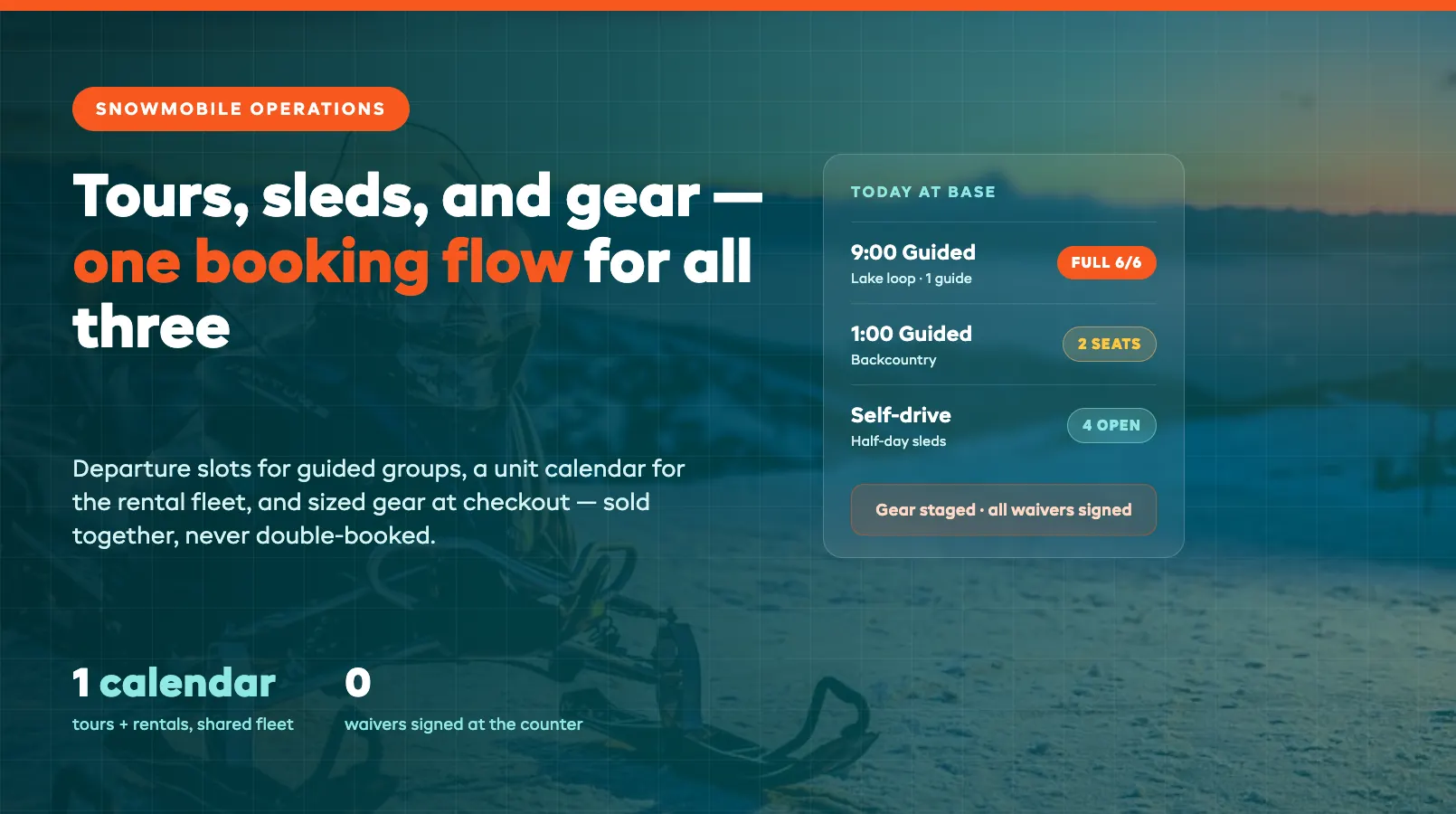
A snowmobile operation is really three businesses wearing one jacket. You sell seats on guided tours, you rent sleds to riders who want the keys and a trail map, and you outfit both groups with helmets, suits, and boots. Most booking tools were built for exactly one of those — and the cracks show the first Saturday all three sell at once.
This guide covers what booking software has to do differently for a sled operation: departure slots for tours, a unit calendar for rentals, sized gear at checkout, and deposits and waivers wrapped into the same flow. It is one piece of the bigger picture in the complete guide to running a snowmobile business.
Why a generic booking form breaks on snow
A contact form and a card reader will get you through your first quiet December. Then the season arrives, and the failure points stack up fast.
Tours and rentals use different inventory maths. A guided tour books by seat against a departure time — eight riders at 10am, capped by your guide ratio. A rental books a specific sled for a duration — unit 14 from 9am to 1pm. Force both through one generic calendar and you either cap rentals like tours and leave sleds parked, or free-sell tours like rentals and put eleven riders behind one guide.
Then there is the gear. Every rider needs a helmet; half need suits and boots. If sizes are not captured at booking, your crew burns the first half hour of every departure digging through bins while guests stand in the cold in running shoes.
At -20, admin you could tolerate in a summer business becomes the thing that makes groups miss the best light. The fix is not more staff at the counter — it is moving the paperwork to the week before.
Guided tours: departures, capacity, and the guide ratio
Tour booking runs on slots. You publish departures — say 9am and 1pm daily — each with a seat cap that comes straight from your guide ratio. Running one guide per six sleds on intermediate trails? The slot caps at six paying riders, and the software must refuse the seventh, not quietly accept them.
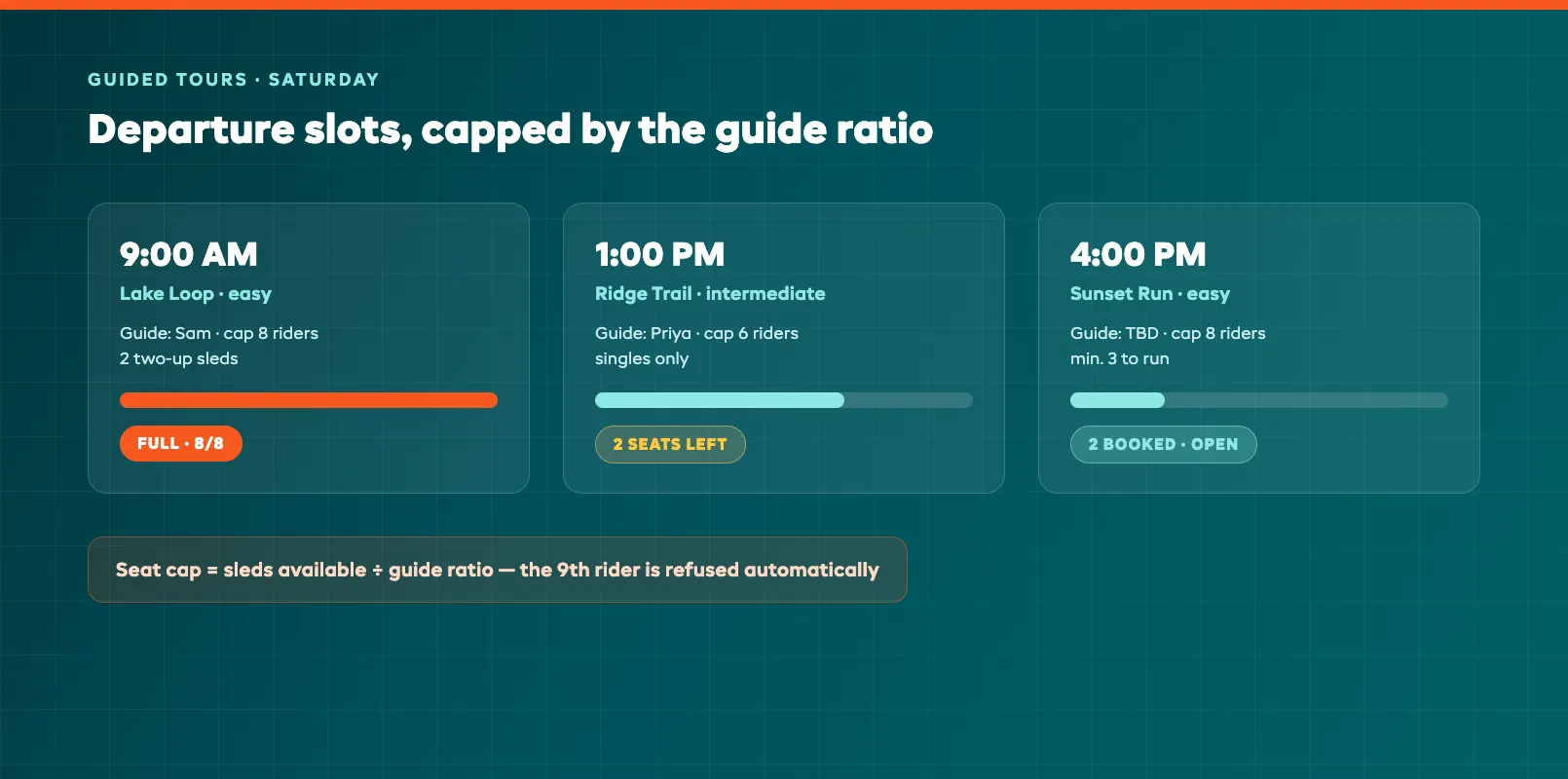
Good software gives you levers per departure, not just per product:
- Seat caps by trail difficulty — eight on the groomed lake loop, four on the backcountry route.
- Single and double pricing — a two-up sled carries a passenger at a lower rate but still consumes one machine.
- Minimum numbers — a 1pm departure that only makes sense with three riders should auto-flag when it is sitting at one the night before, so you can merge or reschedule early.
- Guide assignment — who is leading the 9am shows on the same screen as who booked it.
The pay-off is a morning that starts with a manifest instead of a phone. You know at 7am exactly how many sleds to fuel, which guide takes which group, and which riders still owe a waiver signature.
Self-drive rentals: the fleet calendar
Rental booking is a different product with different failure modes. The unit matters — sled 14 with 3,100 miles is not sled 22 that came back yesterday with a cracked cowl. So the calendar has to track individual machines, not a count.
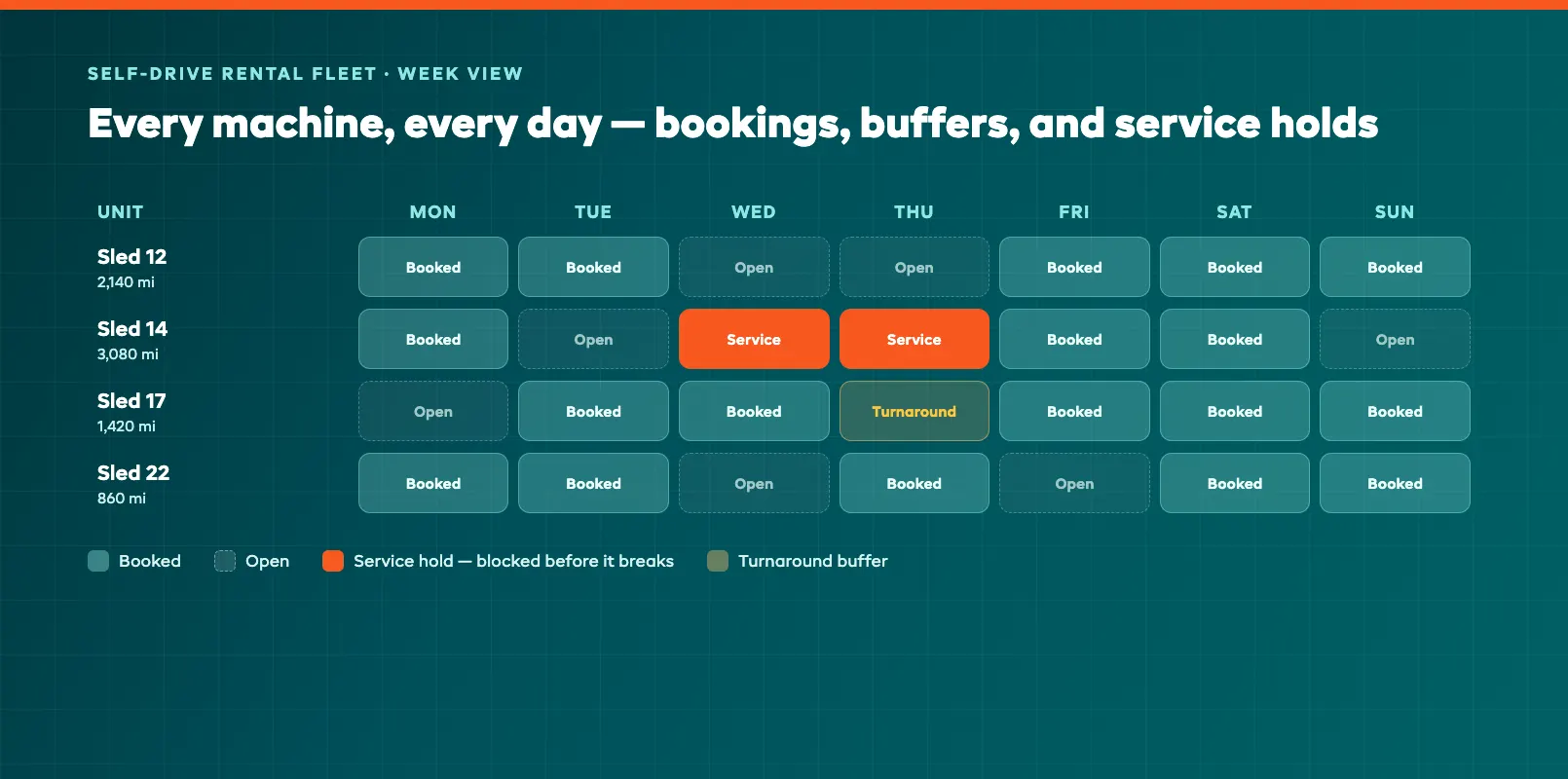
Three things separate a real fleet calendar from a booking grid:
Maintenance blocks. A sled due its 500-mile service gets blocked out before it gets rented, not after it fails to start at the trailhead. If the calendar cannot hold a unit back, your maintenance schedule is a suggestion. Setting the right intervals in the first place is its own discipline — covered in the guide to snowmobile fleet maintenance and pre-ride inspections.
Turnaround buffers. A machine returned at 1pm is not ready at 1pm — it needs fuel, a walk-around, and a wipe-down. A 30-60 minute buffer between rentals, applied automatically, is the difference between a schedule and a queue of annoyed riders.
Shared inventory with tours. This is the one most tools miss. If your 10am guided group takes six machines from the same fleet that serves self-drive rentals, both products must draw from one pool. Two disconnected systems will sell the same sled twice, and you will find out at 9:45 on your busiest morning.
Gear: sized at checkout, staged the night before
Gear is where snowmobile operations differ most from summer rental businesses. Nobody shows up dressed for -20 in a rental car and street clothes. Helmets are mandatory everywhere you operate; suits, boots, and gloves are the difference between a five-star day and a group that turns back after forty minutes.
The move is to sell gear as per-rider add-ons inside the booking, with sizes captured at checkout.
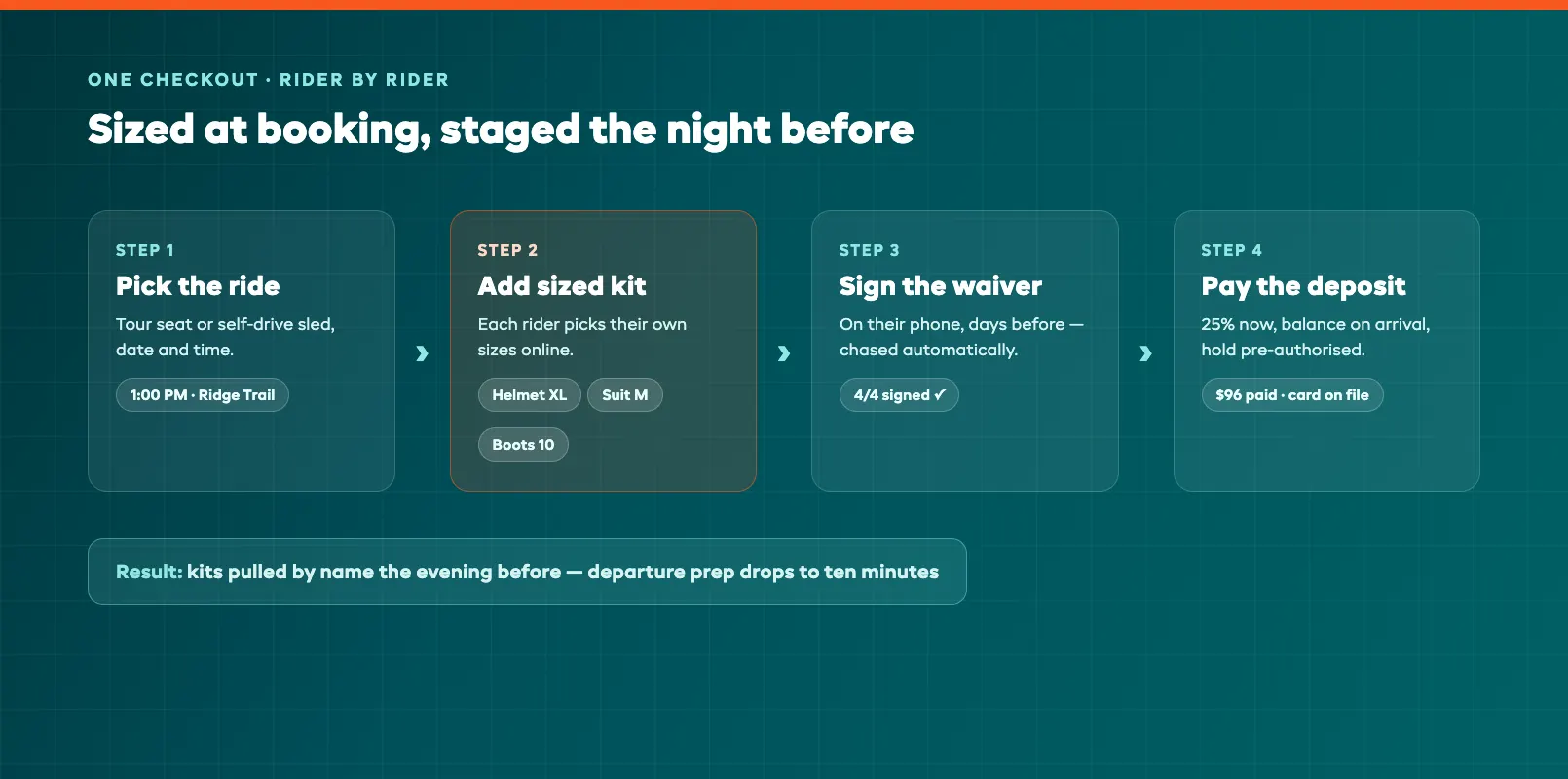
Handled this way, three things improve at once:
- Conversion. A $25 suit added with one click at checkout sells to most of the group. The same suit offered verbally at a busy counter sells to whoever asks.
- Staging. Your crew pulls kits by name and size the evening before — eight helmets, five suits, five boot pairs, labeled and hanging. Departure prep drops from thirty minutes to ten.
- Inventory truth. Helmet sizes are stock too. When the software knows you own six XL helmets and five are attached to Saturday bookings, it stops selling the seventh instead of letting the counter discover the shortage.
If your gear wall and your bookings live in different systems, weekends become a guessing game about whether the stock will stretch.
Deposits, waivers, and payment in one flow
The last piece is the money-and-paperwork layer, and the rule is simple: everything happens inside the same checkout, before arrival.
Booking deposits. Take 20-30% at booking for tours so a no-show costs the guest something, with the balance collected automatically before the ride or on arrival.
Security holds. Self-drive rentals need a refundable hold — commonly $300-500 pre-authorized on a card at check-in — against damage. Pre-authorization beats cash in an envelope: nothing to bank, nothing to argue about, released with a click when the sled comes back clean.
Waivers before arrival. The waiver link rides along with the confirmation email, and unsigned riders get chased automatically in the days before departure. Signature status belongs on the manifest, so the one guest who has not signed is a name you check at 7am — not a surprise at 8:55.
Reminders and weather messages. Confirmations, balance reminders, and what-to-wear notes should send themselves. When a storm closes trails, one message to every affected booking with a rebooking link beats an afternoon of phone calls.
The buying checklist
Before you commit to anything, test it against a snowmobile operator's week — not a demo video:
- Tours book by seat and departure, rentals by unit and duration, in the same system.
- One shared fleet pool — a sled on a tour cannot be sold as a rental in the same window.
- Per-departure seat caps tied to your guide ratios.
- Maintenance blocks and turnaround buffers on individual machines.
- Gear as sized, per-rider add-ons with its own stock counts.
- Deposits, security holds, and refunds handled on card, automatically.
- Waivers signed online, with signature status visible per booking.
- A manifest view your guides can read on a phone with gloves half-on.
Pricing models vary — flat monthly, per-booking fees, or a blend — but the structural test above matters more than a few dollars either way. A cheap tool that double-books your fleet on the first big Saturday is the most expensive option on the market. EquipDash covers this whole checklist — tours, unit-level rentals, and gear add-ons on one calendar — which is exactly the combination sled operations need. If you run terminology past new staff each winter, the snowmobile glossary is a useful onboarding page too.
Putting it together
Booking software is not the glamorous part of a snowmobile business — the mountains and the machines are. But it decides what your mornings look like for twelve weeks a year. Get the three products into one system and the day starts with fueled sleds, staged gear, a signed manifest, and guides who leave on time. Leave them in three systems and the day starts with a queue, a bin of unsorted helmets, and a phone that will not stop.
If you are still weighing up the whole operation — fleet, trails, permits, staffing — start with the complete guide to running a snowmobile business, then see how other operators structure things on the snowmobile operators hub.
FAQ
What does snowmobile booking software do?
It sells guided tour seats against departure times with capacity caps, rents individual sleds against a fleet calendar, and attaches gear like helmets and suits to each rider at checkout. It also collects deposits, captures signed waivers before arrival, and sends confirmations and reminders automatically — so the morning rush is loading sleds, not paperwork.
Can one system handle both guided tours and self-drive rentals?
Yes, and it should — most snowmobile operators run both. The catch is that tours book by seat and departure time while rentals book by unit and duration, which are different inventory models. Look for software that treats them as separate products sharing one calendar, so a sled assigned to the 10am tour can never be double-booked as an afternoon rental.
How should gear rental be handled in a snowmobile booking?
As per-rider add-ons inside the same checkout, sized at booking time. When each rider picks a helmet, suit, and boot size online, you stage the kit the night before instead of digging through bins while a cold group waits. Add-ons booked at checkout also convert far better than gear offered at the counter.
Should snowmobile operators take deposits on bookings?
Yes. A booking deposit of 20-30% protects tour seats against no-shows, and a separate refundable security hold — typically a few hundred dollars pre-authorized on a card — covers self-drive rental damage. Software should handle both automatically: charge the deposit at booking, place the hold at check-in, release it after the sled comes back clean.
Can waivers be signed before the tour instead of at the counter?
They should be. Send the waiver link with the booking confirmation and chase unsigned riders automatically in the days before the departure. A group of eight signing on phones at the counter costs you fifteen minutes of the best riding light; the same group signing at home costs you nothing.
What is the most important feature to check before buying?
Shared inventory between tours, rentals, and gear. Plenty of tools do one product type well. If tour seats, rental sleds, and helmet sizes live in three disconnected systems, you will oversell one of them on the first busy Saturday — usually the gear. One calendar, one guest record, one checkout is the test.
in one place