Weather, Snowpack, and Cancellations for Snowmobile Operators
Weather, Snowpack, and Cancellations for Snowmobile Operators
A snowmobile business sells a product it cannot control. Snowpack arrives late, a warm front turns the trail system to slush, a wind event closes the alpine — and every one of those days comes with paid bookings attached. How you handle a snowmobile tour cancellation is not a footnote in your terms and conditions. It is one of the most-read pages on your booking site and, handled badly, the most common trigger for chargebacks and one-star reviews in the snowbelt.
The fix is the same discipline that runs through the rest of a well-run operation: decide the rules before the season, write them down, and automate the follow-through. This guide covers the thresholds that make a go/no-go call objective, the timeline for making it, the reschedule-first recovery ladder, and the guest messaging that turns a canceled morning into a rebooked one. It sits alongside the complete guide to running a snowmobile business and pairs directly with how you price your tours, because the refund rules and the rate card are two halves of the same promise.
Write the thresholds down before the season starts
The worst version of a weather call is the one made fresh each morning by whoever opens the shop. It drifts. A busy Saturday nudges "marginal" toward "go"; a quiet Tuesday nudges it the other way. Guests notice the inconsistency, and so do guides.
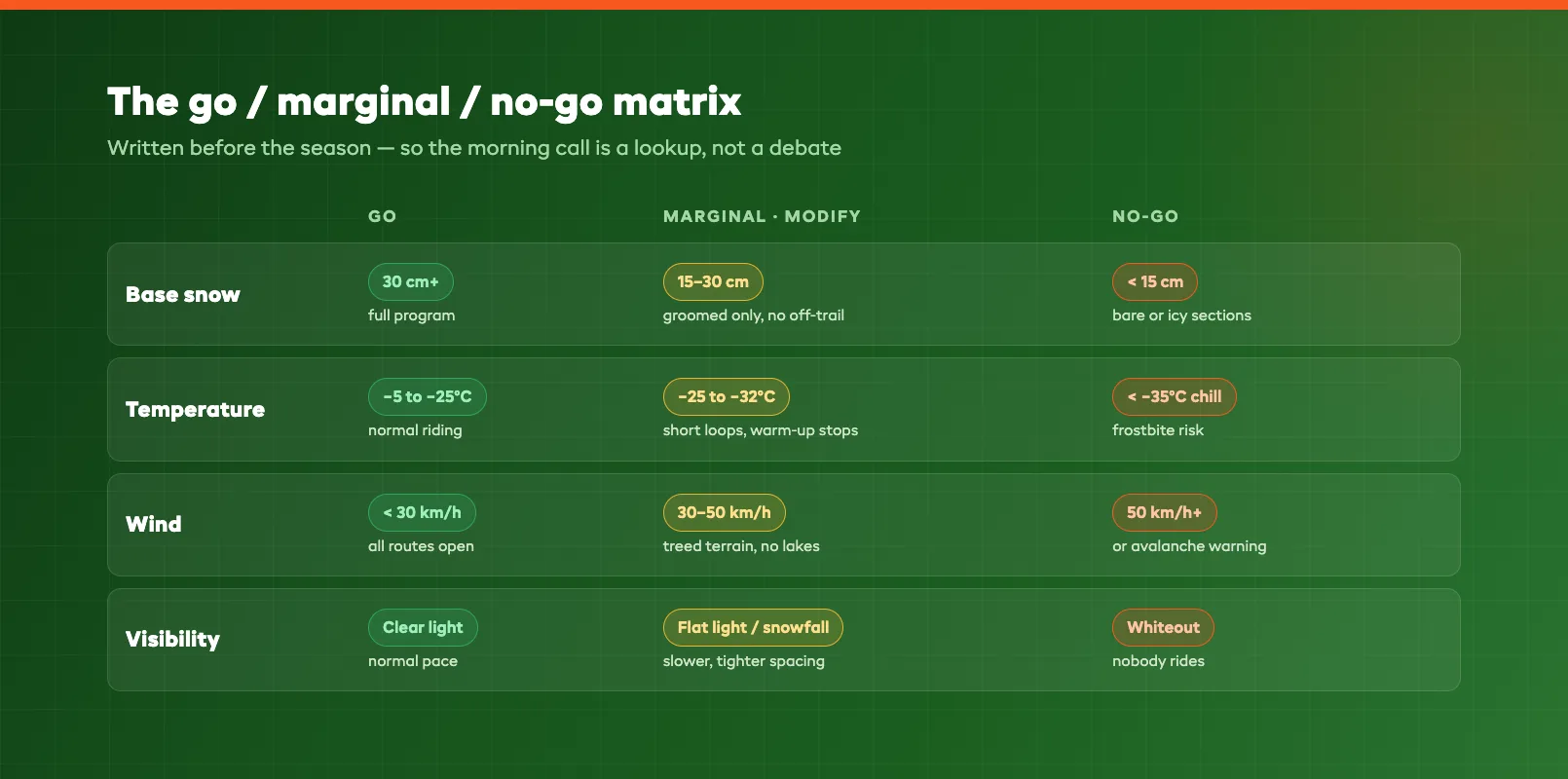
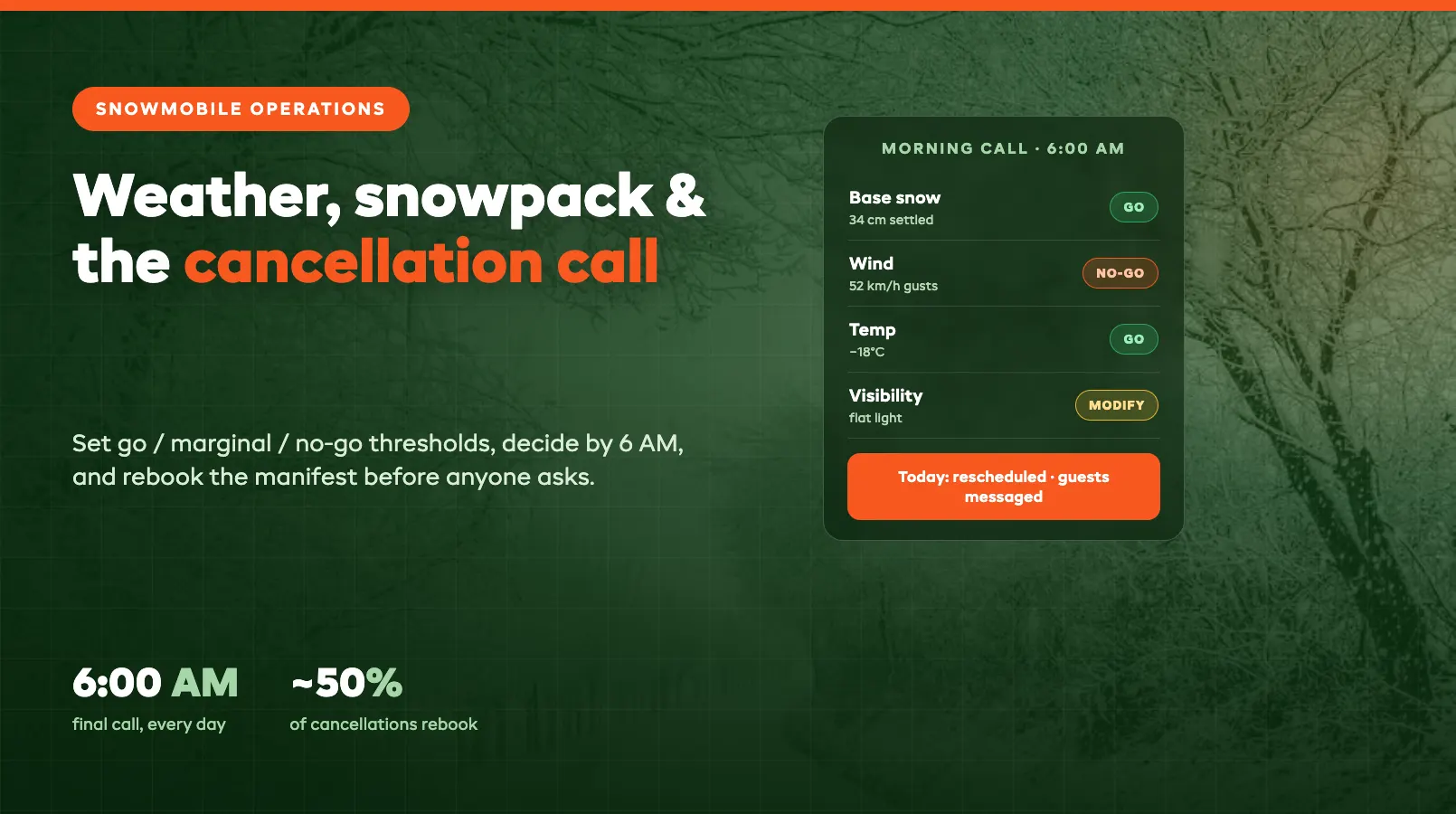
Replace judgment-on-the-day with a written matrix: for each factor, a green band where you always ride, an amber band where you modify, and a red band where you never ride. Typical numbers for a guided trail operation look like this — tune them to your terrain:
- Snowpack / base depth — green above ~30 cm of settled base on your trail system; amber at 15–30 cm (groomed trails only, no off-trail); red below ~15 cm or bare/icy sections on the route.
- Temperature — green from −5°C to −25°C; amber from −25°C to −32°C (shorter loops, extra warm-up stops, face-cover checks); red below about −35°C with wind chill, where frostbite risk outruns any waiver.
- Wind — green under ~30 km/h; amber 30–50 km/h (stay in treed terrain, skip lake crossings); red above ~50 km/h or any avalanche-terrain warning day for backcountry product.
- Visibility — green in daylight with defined light; amber in flat light or steady snowfall (guide slows pace, tighter spacing); red in whiteout.
Two things make the matrix work. First, the amber band is a modification band, not a maybe-band — it tells guides exactly what changes, so a marginal day still delivers a safe tour instead of a coin flip. Second, the red lines are non-negotiable and staff know it. When the number says no, nobody — not the owner, not a full manifest — argues it back to yes.
Make the call on a fixed timeline, not when the phone rings
A clear threshold still fails if the decision comes too late. Guests driving two hours to the staging area need to know the night before, not at the trailer.
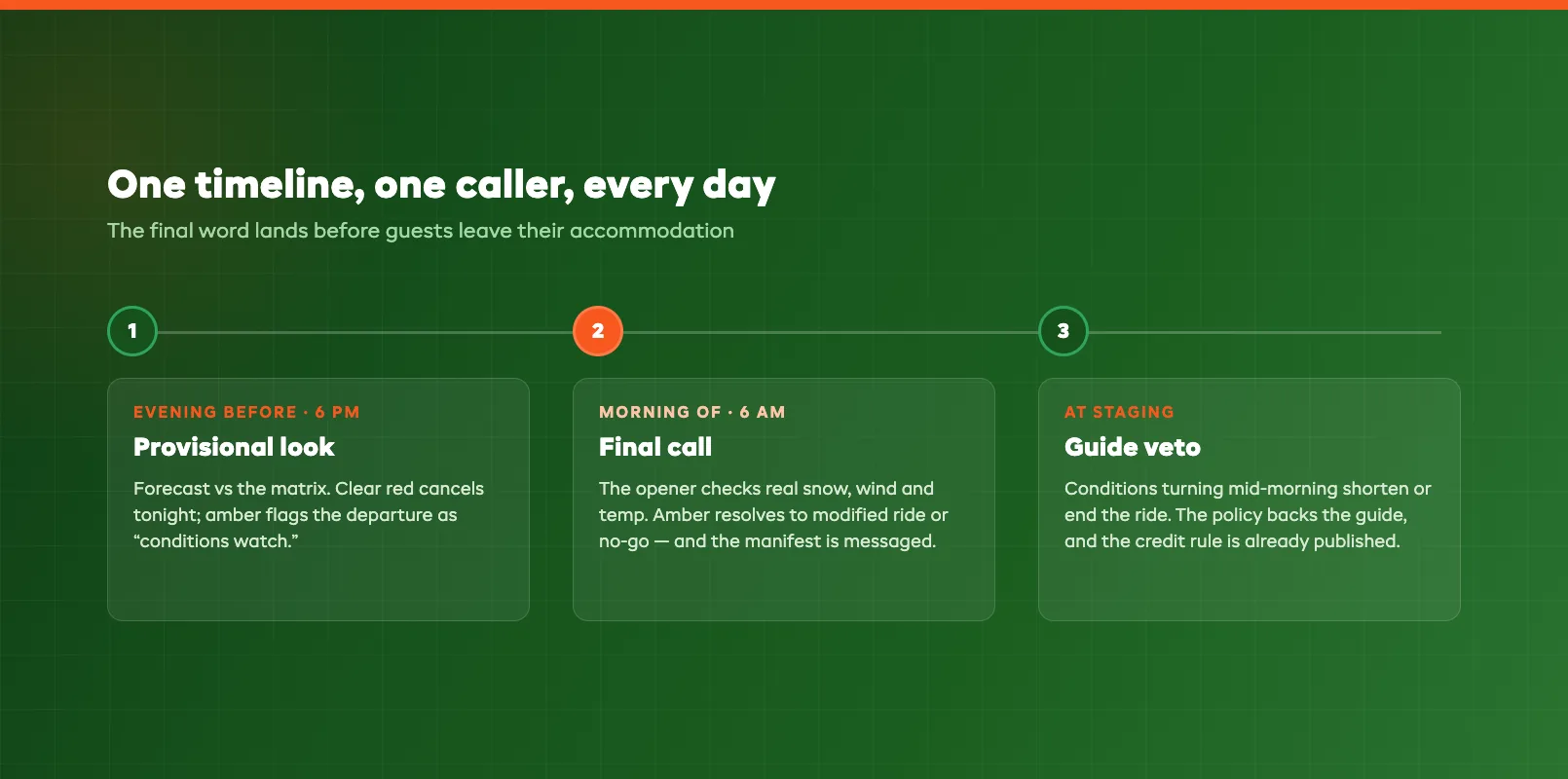
Run the same three checkpoints every operating day:
- Evening before, ~6 PM — review the forecast against the matrix. Clear red? Cancel now and message every booking on tomorrow's manifest. Amber? Flag the departure as "conditions watch" and tell guests a final call is coming by 6:30 AM.
- Morning of, ~6 AM — the person opening checks actual conditions: groomer reports, overnight snowfall, current temp and wind. This is where amber resolves to go-with-modifications or no-go. The call goes out before guests leave home.
- At staging — the guide holds a final veto. Conditions that deteriorate mid-morning cancel or shorten the ride, and the policy backs the guide completely. A tour cut short for weather earns a partial credit by the same published rules.
Who makes the call matters less than the fact that it is one named person per day working from the same sheet. If your guides rotate, build the morning check into the duty roster the same way departures are assigned in your guide scheduling system — the opener owns the 6 AM call, full stop.
Run the ladder: reschedule first, credit second, refund without a fight
When you cancel for weather, the money conversation follows immediately. The operators who keep the revenue — and the relationship — offer options in a deliberate order.
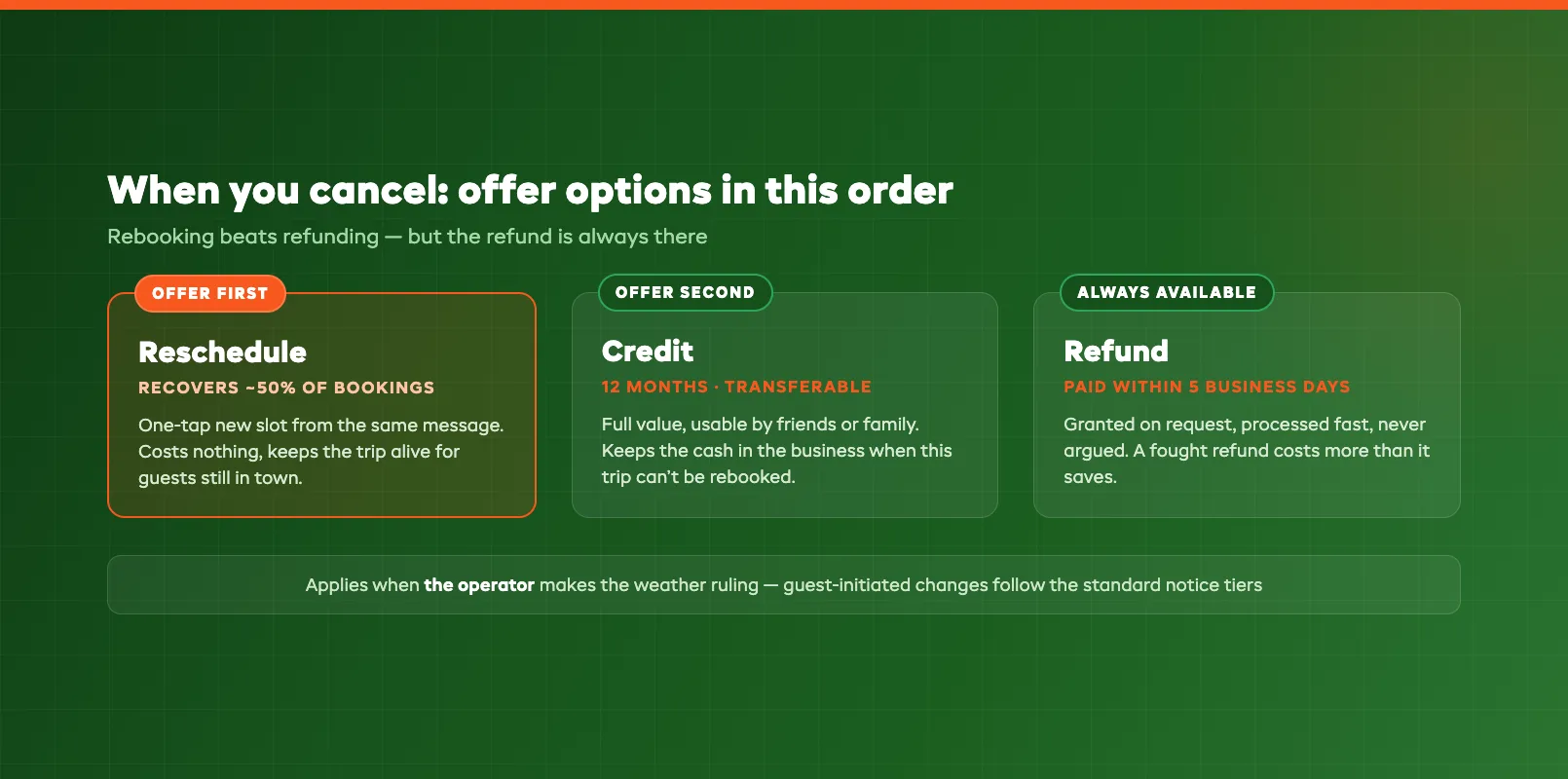
- Reschedule (offer first). "We ride Thursday, Friday, or next Saturday — pick a slot." In a multi-week trip-planning window this recovers half or more of canceled bookings at zero cost. Make it one tap from the cancellation message, not a phone queue.
- Credit (offer second). A 12-month credit for the full amount, transferable to friends or family. It keeps the cash in the business and, priced honestly, most guests who cannot rebook this trip take it.
- Refund (offer clearly, grant fast). When the operator cancels for weather, a full refund is always available and processed within a stated window — 5 business days is a fair public promise. Never make a guest chase a refund you owe them; the processing fee you save on a fought refund is a rounding error next to the chargeback and the review.
The ladder only applies when you make the weather call. Guest-initiated cancellations follow your standard notice tiers — full refund outside 72 hours, credit inside it, no refund for no-shows — and the two policies live side by side on the same page so nobody conflates them. One more line worth publishing: cold is not a cancellation reason. A −20°C bluebird day is a normal riding day with the right gear, and saying so at booking stops the "it looks freezing" refund request before it starts.
Tell guests before they ask
The measure of a good cancellation is that no guest ever discovers it by showing up. Every hour between your decision and your message is an hour where someone sets an alarm, loads a car, or starts driving.
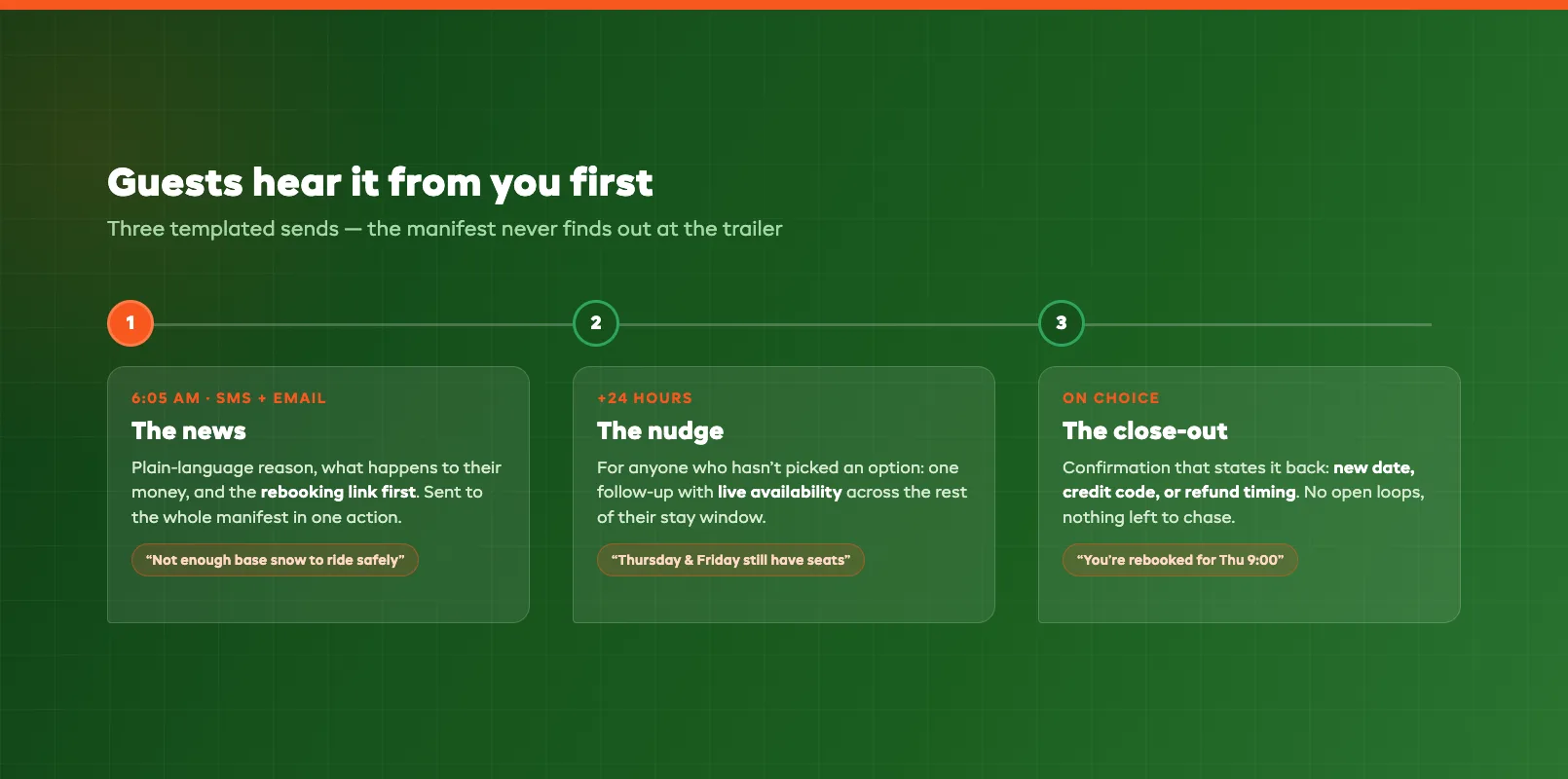
The sequence is short and worth templating word for word:
- The cancellation message — SMS plus email, sent to the whole manifest the moment the call is made. It names the reason in plain language ("not enough base snow on the north trails to ride safely"), states what happens to their money, and puts the reschedule link first.
- The rebooking nudge — for guests who have not chosen within 24 hours, one follow-up with live availability for the rest of their stay window.
- The close-out — whichever option they chose, a confirmation that states it back: new date, credit code, or refund timing.
This is exactly the kind of manifest-wide, condition-triggered messaging that snowmobile booking software should handle from a template — one action cancels the departure, releases or converts payments per your ladder, and messages every rider — because at 6:15 AM on a storm day, nobody has time to text fourteen guests by hand.
Publish the policy where the booking happens
A fair policy that guests discover after the storm still feels unfair. Put the short version — three or four sentences — directly on the booking page: what conditions cancel a tour, when the final call is made, and what guests get when you cancel. Repeat it in the confirmation email and reference it in the waiver, so the promise reads identically in all three places.
Being explicit up front also protects your pricing. Deposits, cancellation windows, and weather promises interact — a guest who prepaid in full reads a cancellation differently from one who paid a deposit — so review the policy and your tour pricing structure together each pre-season rather than letting them drift apart. If a term in the policy needs defining for first-timers — base depth, flat light, groomer report — link it to the snowmobile glossary instead of padding the policy itself.
Putting it together
A snowmobile weather policy is five decisions made once: thresholds written into a go/marginal/no-go matrix, a fixed evening-and-morning decision timeline with one named caller, a reschedule-credit-refund ladder that always favors rebooking, guest messaging that goes out before anyone asks, and a short public version of all of it on the booking page. Everything after that is execution on a template.
The payoff shows up twice. On storm days, mornings run calmly — the call is made, the messages are sent, half the manifest rebooks. And in shoulder season, when snow is genuinely uncertain, the operators with a visible, generous weather promise take the bookings that nervous guests would otherwise not make at all. For the rest of the operating playbook — fleet, deposits, staffing, pricing — start with the snowmobile business hub.
FAQ
What is a fair snowmobile tour cancellation policy?
When the operator cancels for weather or snow conditions: free reschedule offered first, a 12-month transferable credit second, and a full refund on request processed within about 5 business days. When the guest cancels: full refund outside a stated notice window (72 hours is common), credit inside it, and no refund for no-shows. Publish both halves side by side on the booking page.
How much snow do you need to run snowmobile tours?
Most guided trail operations want roughly 30 cm of settled base before running a full program, with a reduced groomed-trails-only product possible around 15–30 cm. Below that, exposed rocks and icy sections damage sleds and riders faster than any revenue justifies. Set your own number per trail system and treat it as a hard line, not a target.
When should operators make the weather call?
On a fixed timeline: a provisional call the evening before at a set hour, a final call by early morning — 6 to 6:30 AM works for most schedules — and a standing guide veto at staging. The final call must land before guests leave their accommodation, which for destination riders can mean two hours before departure.
Is it too cold to ride at -30°C?
Cold alone rarely cancels a tour — well-equipped operations ride comfortably to around −25°C and run modified shorter loops into the low −30s. The genuine red lines are extreme wind chill (frostbite in minutes on exposed skin), wind events, and whiteout visibility. State in your policy that cold is not a cancellation reason so gear anxiety does not become a refund request.
Should guests get a refund if the operator cancels for weather?
Yes, always — a full refund must be available whenever you make the call, no exceptions. But offer the reschedule and the credit first: presented well, most guests on a multi-day trip take a new slot, and the credit keeps cash with the business. Granting the refund quickly when asked is what keeps a canceled tour from becoming a chargeback.
What happens if weather turns bad mid-tour?
The guide's call is final: shorten the loop, hold in treed terrain, or turn the group around. Back it with a published partial-credit rule — for example, a tour cut in the first half earns a half credit — so the guide never weighs safety against a refund argument. Guests accept an early turnaround far more easily when the compensation rule already exists in writing.
in one place