How to Run a Snowmobile Tour and Rental Business
A snowmobile tour and rental business earns a year's living in a few frozen months, on machines that spend their whole working life at full throttle in deep snow. From the outside it looks like the best job in the world: sleds, mountains, winter mornings. From the inside it is a fleet that has to start at -20, a stack of waivers, avalanche forecasts, seasonal staff who arrive in November and leave in April, and the constant maths of how many riders one guide can safely lead through the trees.
The two decisions that shape everything else are the ones new operators tend to make by accident. First, whether you run guided tours, self-drive rentals, or a blend of both — that choice sets your fleet, your staffing, your insurance, and your margins. Second, how disciplined you are about keeping hard-used sleds ready to ride on the busiest mornings of a short season, because a machine in the workshop during peak week is revenue you never get back. This guide walks through the whole business end to end: your model, your fleet, trail access, guide ratios, briefings and waivers, maintenance, pricing, seasonal staffing, and the booking system that keeps the office running while you are out on the trail. If a term is new to you, the snowmobile glossary covers the vocabulary, and the snowmobile operator hub pulls the wider picture together.
Guided tours vs self-drive rentals: pick your model
Before you buy a single sled, decide what you are actually selling. A guided tour is an experience: the guest pays for the route, the scenery, the story, and a lead guide who keeps them safe and picks the line through the tricky sections. A snowmobile rental is access: the guest pays to take a sled out and ride, with far less hand-holding. The two models pull the business in different directions, and trying to run both without noticing the difference is how operators end up with the wrong fleet and the wrong insurance.
Guided tours earn more per seat and give you tight control. A guide is with the group the whole time, so your sleds stay on the routes you know, at the pace you set, and nobody buries a machine in a creek bed three valleys from the trailhead. The trade-off is labor: you pay a guide for every departure, and there is a hard limit on how many riders one guide can lead safely. Self-drive flips that maths. Without a guide per group your margin per sled can be higher and the product scales with machines instead of staff — but you carry more damage and liability risk in a sport where getting stuck is routine, you need a bigger deposit hold, and it only works on terrain where guests can ride without getting lost or hurt.
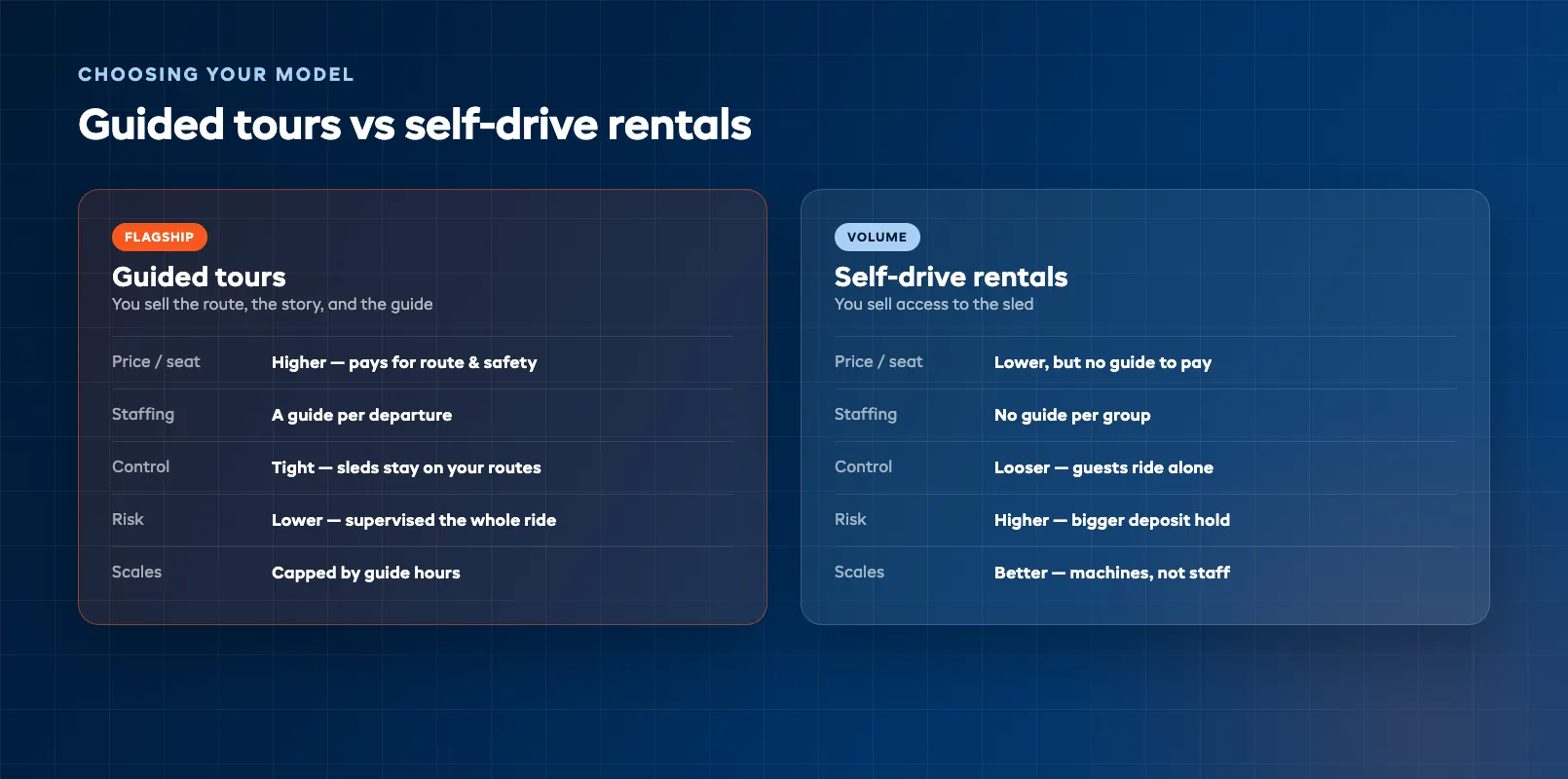
Most operators end up running both. Guided rides become the flagship — the thing people book, review, and remember — while self-drive fills capacity on easy, well-marked terrain for riders who can prove they can handle it. What matters is that you choose the balance on purpose. Your terrain, your insurance policy, and your appetite for digging strangers' sleds out of powder should decide the mix, not whatever machine happened to be for sale when you started.
Building your sled fleet
Your fleet is your biggest asset, your biggest cost, and the thing that decides whether peak week makes or loses money. The instinct for a new operator — usually a lifelong rider — is to buy the machines they love: long-track mountain sleds, big-power engines. That is almost always the wrong first move. The majority of your guests have never ridden before, and the machine that earns you money is the one that is stable, electric-start, and hard to get into trouble on.
A sensible starting fleet is built around mid-power trail sleds and a handful of two-up touring machines. The two-ups are quietly the most important sleds you own: they let couples, families, and nervous first-timers join a ride as a passenger without operating anything, which widens your market far more than another performance sled ever will. Someone who would never take the handlebars will happily ride behind a guide or a confident partner. Standardize on one or two models rather than a mixed fleet, so spare parts, staff training, and servicing all stay simple — ten different sleds means ten different service manuals and ten different sets of spares in a workshop with no time to spare.
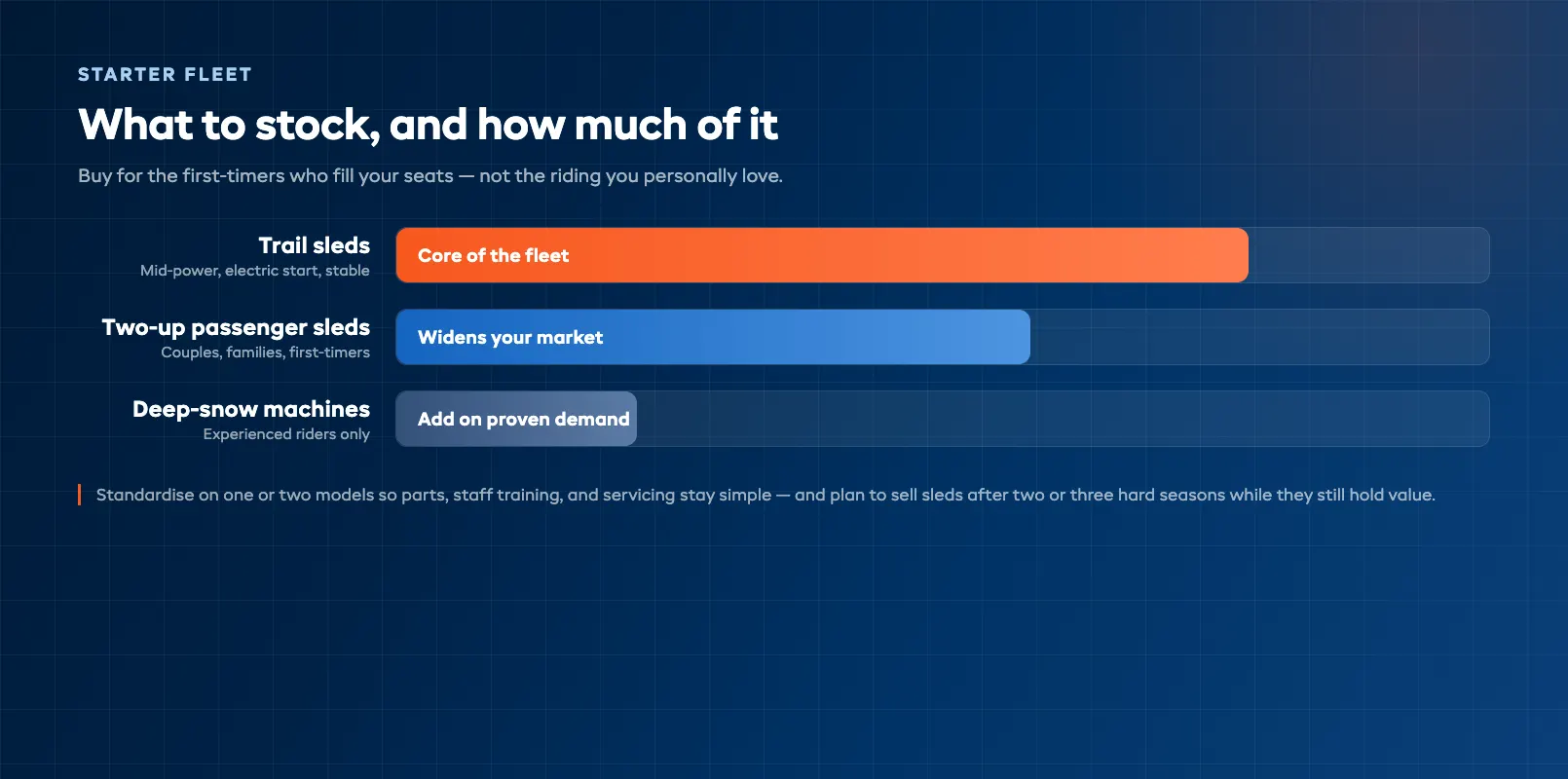
Size the fleet to demand you can actually fill, and remember that in this business the machine ages in hours and kilometres, not years. A rental sled can absorb a private owner's decade of use in two seasons, so plan the refresh cycle from day one: many operators buy new, run a sled hard for two or three seasons, and sell it while it still holds value. Deep-snow mountain sleds come later, when you have proven demand from experienced riders — and guides who can manage that terrain.
Trail access, permits, and where you can legally ride
This is the part that can stop the business before it starts, so handle it first. You cannot run tours or send rentals onto trails you have no right to use commercially, and "nobody has said anything yet" is not a right. Depending on your region, riding happens on club-groomed trail networks, private land, or public land managed by a government agency — and each comes with its own rules for commercial use.
Groomed trail networks are usually maintained by snowmobile clubs funded through trail passes, and commercial operators typically need trail passes for every sled plus, in many areas, a commercial agreement with the club or the land manager. Public land is often permit territory: commercial-use permits with insurance requirements, rider caps, and sometimes a waiting list for popular zones. Private land gives you the most control and often the best product — untracked snow your competitors cannot touch — but it costs lease money and depends on a landowner relationship you have to maintain. Whatever the arrangement, get it in writing, know exactly which trails and staging areas you are cleared to use, and understand the rules on group sizes, hours, and seasonal closures that come attached.
Access also shapes your product. A flat, well-marked club network suits self-drive rentals; alpine bowls and tree riding are guided-only territory, both for safety and because most permits demand it. Nail down access before you buy machines, because the terrain you can legally ride decides what kind of business you can actually run.
Guide ratios, group sizes, and trail roles
On a guided tour, your guides are the product and the safety system rolled into one. Get the ratio wrong and you either bleed money on over-staffing or, far worse, put riders in deep snow with no one close enough to help. There is no single legal number that applies everywhere, but there is a working standard experienced operators converge on.
Run a lead guide at the front and a sweep at the back of every guided group. The lead sets the pace, picks the line, and makes the calls; the sweep stays behind the last guest so no rider is ever behind a staff member or alone on the trail. For groups up to roughly six to eight sleds, a lead and a sweep is a sensible baseline; beyond that, add another guide. Tighten the ratio — and slow the pace — whenever the terrain gets technical, the snow gets deep, visibility drops, or there are first-timers and passengers in the group.
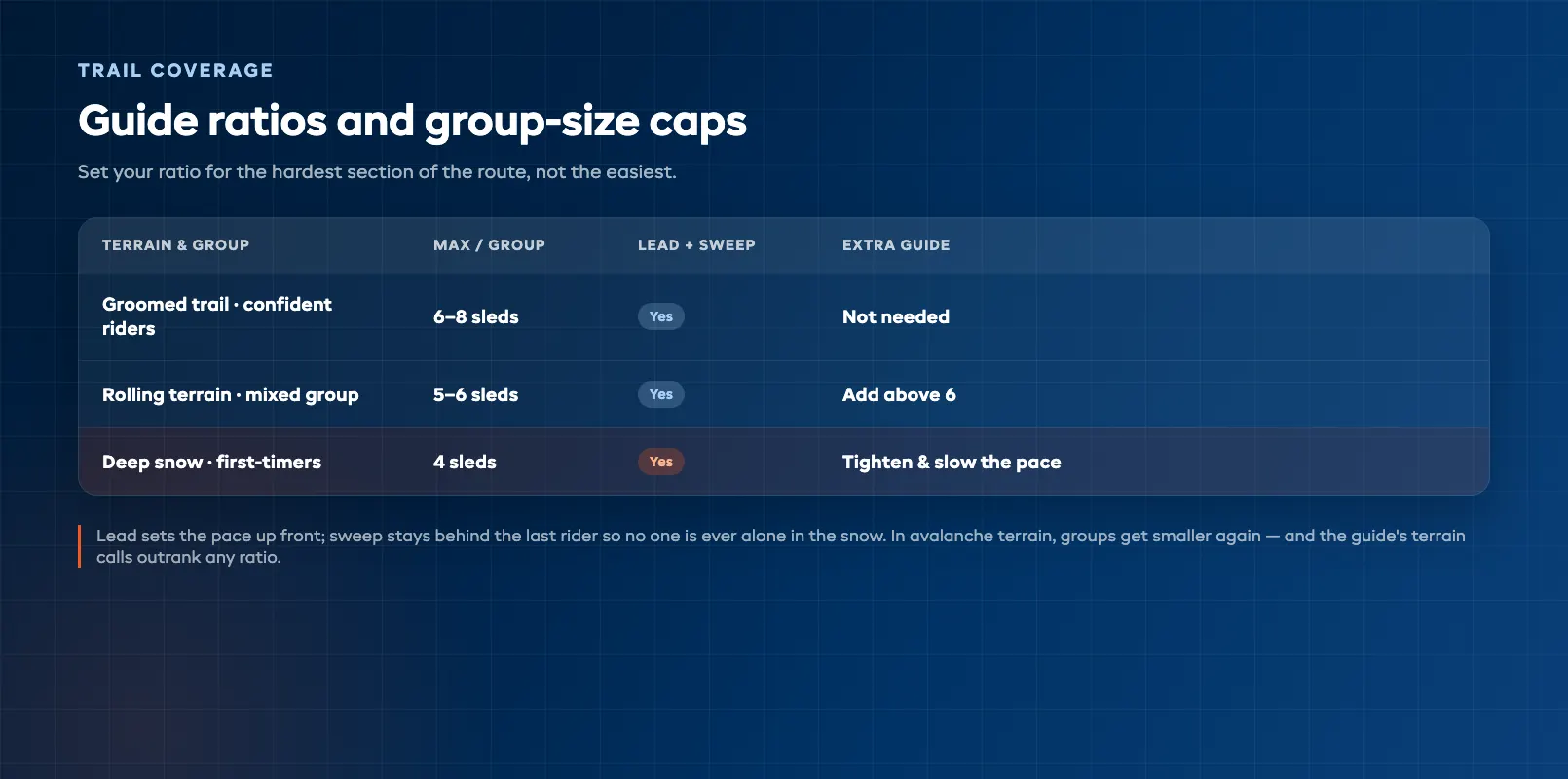
The principle is simple enough to explain to any new guide: every rider stays within sight of a guide, and nobody is ever left alone in the snow. Good guides also do the quiet work that keeps you out of trouble — reading the group, spotting the rider who is getting cold, tired, or overconfident, and using clear hand signals when engine noise and helmets make talking useless. In avalanche terrain the whole calculation changes: groups get smaller, spacing gets deliberate, and the guide's terrain choices matter more than any ratio. If your permit area includes avalanche terrain, your lead guides need real avalanche training, not a weekend course badge.
Briefings, avalanche awareness, and waivers that hold up
Every tour and every rental starts the same way: a consistent pre-ride briefing and a signed waiver. Skip or rush either and you are exposed twice over — first to the guest getting hurt, then to the fallout afterward. The briefing is not a legal formality to race through; it is the single biggest thing standing between a nervous first-timer and a rolled sled.
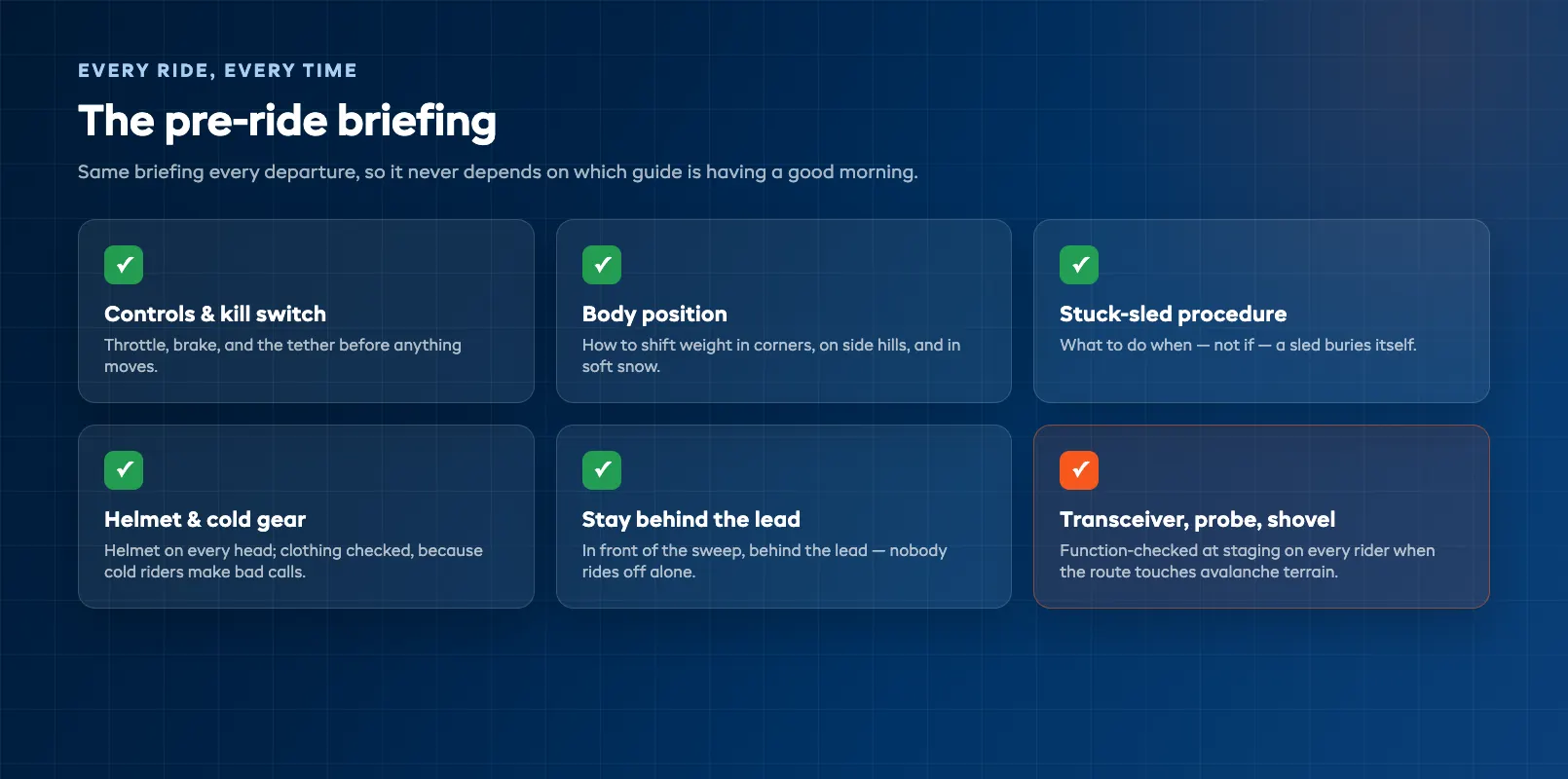
A good briefing is identical every time, so it does not depend on which guide is having a good morning. Cover the controls — throttle, brake, the kill switch and tether — how to shift body weight in corners and on side hills, what to do when (not if) a sled gets stuck, and the golden rules: stay behind the lead, in front of the sweep, and off the throttle when unsure. Fit and check the gear before anyone rides: helmet on every head, goggles, gloves, and clothing that can handle the cold, because a freezing guest makes bad decisions. Where the route touches avalanche terrain, the briefing extends to the equipment that goes with it — transceiver, probe, and shovel on every rider, with a function check at the staging area, not a mention in passing.
The waiver is the paper half of the same job. Every rider signs one that names the real risks of motorised snow sport, states they accept them, and releases your business — and it has to be signed by the right person. Minors cannot waive anything, so a parent or legal guardian signs on their behalf, and your booking flow should capture that consent when the booking is made, not on a clipboard at -15 while the group waits. Collect waivers digitally in advance, keep every signed form linked to its ride, and you can produce the exact document a guest agreed to in seconds if you ever need it.
Fleet maintenance: sleds that start at -20
Snowmobiles live a brutal working life. They run wide open in powder, digest ice and grit, get stuck and yanked out, and then sit overnight in temperatures that kill batteries and thicken oil. A fleet that is not maintained on a fixed schedule will fail you on exactly the day you can least afford it — a sold-out holiday morning with three groups at the staging area. The fix is not heroics; it is a boring, disciplined service program.
Track hours and kilometres on every sled and service on fixed intervals: oil and chaincase, clutch and belt, track tension and clips, skis and carbides, brakes, and a full inspection at set marks. A rental sled can pack a private owner's decade into two seasons, so a calendar-based schedule either services too late and gives you breakdowns, or too early and wastes money. Pull each machine off the line the moment it hits its number, and keep one or two spare sleds in the rotation so a service never cancels a departure.
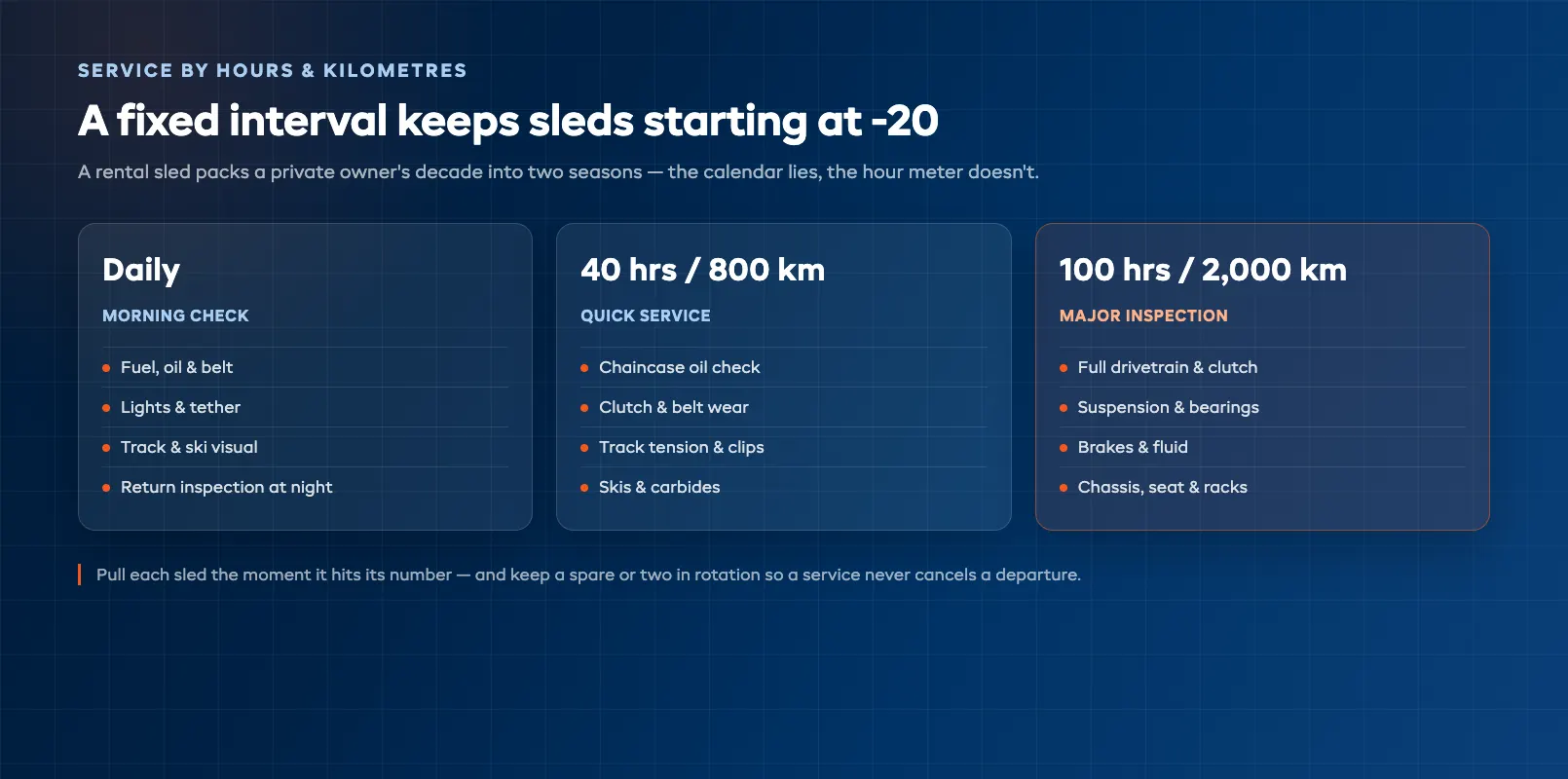
Build the daily habits around the schedule too: a morning check before the first departure — fuel, oil, belt, lights, tether — and a return inspection after the last, so damage gets caught the day it happens instead of the morning it strands a guest. Log every stuck recovery and every hard impact, because today's cosmetic bump is next week's bent suspension. The operators who stay reliable through peak season are not the ones with the newest sleds — they are the ones who never let a machine go out overdue. For the full service intervals, daily inspection routine, and damage-logging workflow, see the dedicated guide to snowmobile fleet maintenance and pre-ride inspections.
Pricing tours, rentals, and add-on gear
Price has to cover four things: the sled, the guide, the trail access, and the risk. New operators routinely price off the machine alone and wonder why the money never adds up. A guided tour carries a guide's wage, a share of every sled's depreciation, fuel, insurance, trail passes, and permits — plus the hard fact that a short season means every seat has to earn more than the same seat would in a year-round business. Price the tour as an experience, anchored against what the day is worth to the guest, not against the hourly cost of a sled.
Rentals price differently. Without a guide per group your labor cost drops, but risk and admin rise, so the deposit hold and the damage exposure get built into the number. Duration matters: an hourly rate for the trail loop, a half-day and full-day rate that reward longer bookings, and multi-day rates where your terrain supports it. Then layer on the add-on gear that carries the healthiest margin in the business — helmet and suit hire, boots and gloves, guided photo stops, fuel packages, and premium sled upgrades. Cold guests buy gear; a well-run gear counter often turns a thin ride margin into a real one.
Deposits deserve their own thought. Hold a clear, disclosed deposit against every rental, tie charges to a published damage schedule based on real repair costs, and separate routine stuck-sled recoveries from genuine damage in your policy. Charge peak pricing for holiday weeks without apology — a handful of peak dates usually carries the whole winter — and protect those dates with deposits and a firm cancellation policy, because an empty sled on the last Saturday of the holidays is revenue you never get back.
Seasonality and staffing a twelve-week business
A snowmobile operation is one of the most compressed seasonal businesses there is: in many regions the real season is twelve to sixteen weeks, and a slow snow year can shave weeks off either end. Build the entire budget around the winter and treat everything outside it as something you actively work to create, not something you wait for.
Staffing follows the same curve. Guides, gear-counter staff, and workshop help arrive before opening and leave after closing, so every winter starts with hiring and training a team that may be half new. Start recruiting early, pay attention to guide accreditation and avalanche training where your terrain demands it, and write the briefing scripts, trail protocols, and damage procedures down so the operation does not live in one veteran's head. The operators who keep good guides coming back run the best seasons — a returning guide who knows the terrain, the sleds, and the scripts is worth two new hires in December.
The off-season is not dead time; it is where next winter is won. Deep maintenance and rebuilds happen in the quiet months, high-hour sleds get sold while they still hold value, permits and insurance get renewed, and early-season dates get pre-sold to returning guests. Some operators run a summer product on the same base — ATV rides, hiking, boats — and share the workshop, the staff core, and the booking setup across both seasons. Weather still owns the schedule: a warm week, a storm cycle, or a high avalanche rating can close terrain with a day's notice, so publish a clear cancellation and reschedule policy at booking and apply it consistently. Offering a reschedule or credit before a refund keeps the money in the business while treating the guest fairly.
The booking and operations system that ties it together
Every piece above — departures, sled availability, guide rosters, waivers, deposits, gear sizes, cancellations — has to live somewhere, and a paper diary next to a phone that rings while you are leading a group through the trees is not it. In a twelve-week season there is no slack to absorb admin chaos: a double-booked sled or a missed waiver on a peak morning costs real money and real safety.
One booking and operations platform should hold the whole winter: the day's departure schedule, which sleds are booked and which are free, the waiver signed against each rider, the deposit taken and released, the gear sizes captured at booking, and the automatic reminders that cut no-shows on mornings when a no-show can never be resold. When a booking comes in, the sled is reserved, the waiver goes out, and the deposit is flagged — without anyone touching a spreadsheet. EquipDash is built for exactly this kind of operation, tying bookings, fleet, waivers, and deposits into one place so the trail work and the office work stop fighting each other. For a closer look at what to check before committing to a platform — departure slots, fleet calendars, sized gear add-ons, deposits, and waivers in one flow — see the guide to snowmobile booking software.
Putting it together
A snowmobile tour and rental business is not built on the sleds — it is built on the decisions around them. Choose your model on purpose, buy a fleet that suits your guests rather than your own riding, and never sell a seat on terrain you cannot legally use. Run guided groups with a lead and a sweep, brief every rider the same way, and collect a signed waiver before anyone touches a throttle. Service by hours so the fleet starts on the coldest mornings, price to cover the sled, the guide, the access, and the risk, and staff early so the team is ready when the snow comes.
Do those things well and the parts reinforce each other: a reliable fleet earns better reviews, better reviews fill peak weeks, and full peak weeks fund the machines and the guides that let you grow. Get the fundamentals right, put one system behind the operation, and you can spend the short season where it belongs — on the trail, not buried in the office.
FAQ
Do you need a license or permit to run snowmobile tours?
It depends on where you operate, and it is the first thing to nail down before you spend money on sleds. In most regions you do not need a special operator's license to lead guided rides, but you almost always need the legal right to use the trails you ride — a commercial agreement with the snowmobile club that grooms them, a lease on private land, or a commercial-use permit on public land. Many public land agencies cap commercial permits and require proof of insurance, and some popular areas have waiting lists. On top of trail access you will need business registration, liability insurance that specifically covers motorised snow sports, and in many places a requirement that guests hold a driver's license to operate a sled. Treat trail access and insurance as the two things that can stop the business dead, and confirm both in writing before you take a booking.
Are guided snowmobile tours or rentals more profitable?
Neither wins on paper alone. Guided tours earn a higher price per seat because the guest pays for the route, the guide, and the safety net, and your sleds stay under staff supervision the whole ride, which keeps damage down. The catch is the labor cost of a guide per group and a hard cap on how many riders one guide can safely lead. Self-drive rentals scale better because you are not paying a guide per departure, but they carry far more damage and liability risk in a sport where a stuck or rolled sled is routine, so deposits and inspections have to be tighter. Most established operators run both: guided tours as the flagship product and self-drive rentals on easy, well-marked terrain for experienced riders. The right mix depends on your terrain, your insurance, and how comfortable you are letting guests loose in the snow.
What snowmobiles should a new tour operator buy first?
Buy forgiving trail sleds, not the machines you would ride yourself. Most guests have never ridden before, so a core fleet of stable, electric-start trail sleds in the mid-power range covers the widest market, and a handful of two-up touring machines quietly becomes your most valuable asset — they let couples, families, and nervous first-timers join a ride as passengers, which widens your market far more than another high-performance sled ever will. Standardize on one or two models so parts, training, and servicing stay simple. Leave deep-snow mountain sleds until you have proven demand from experienced riders and guides who can support that terrain. Size the whole fleet to the guests you actually book, not the riding you personally love.
What guide-to-rider ratio is safe for snowmobile tours?
There is no single legal number, but the working standard most operators land on is a lead guide plus a sweep for groups up to around six to eight sleds, and an extra guide beyond that. The lead sets the pace and picks the line; the sweep stays behind the last guest so nobody is ever alone on the trail. Tighten the ratio and slow the pace when the terrain is technical, the snow is deep, visibility drops, or there are first-timers and passengers in the group. In avalanche terrain the calculation changes completely — groups get smaller, every rider carries a transceiver, probe, and shovel, and the guide's terrain decisions matter more than any ratio. Set your ratio for the hardest section of the route, not the easiest.
How do you handle snowmobile damage and deposits fairly?
The fairest system is the one both sides can see coming. Photograph or inspect every sled before it goes out and again when it comes back, hold a clear, disclosed deposit against each rental, and tell the guest up front what counts as normal wear versus chargeable damage. Snowmobiles get stuck, tipped, and bumped as a normal part of the sport, so your policy needs to distinguish a routine stuck-sled recovery from a bent A-arm or a ripped track. When something is genuinely damaged, charge against a published schedule tied to real repair costs rather than a number invented on the spot, and return the deposit fast when a sled comes back clean. Guests accept fair charges backed by before-and-after evidence; they resent surprises.
How do snowmobile operators make money in the off-season?
The honest answer is that most do not — they plan the year so the winter carries it. A snowmobile season is often twelve to sixteen weeks, so the operators who survive treat peak weeks like a harvest: peak pricing on holiday dates, full utilization on every sled, and a booking system that keeps no-shows low. The off-season is for the work there is never time for in January: deep fleet maintenance and rebuilds, selling off high-hour sleds while they still hold value, locking in next winter's permits and insurance, and pre-selling early-season dates. Some operators run a summer business on the same base — ATV tours, hiking, or boat rentals — and share the workshop, staff, and booking setup across both seasons. Build the budget around the winter weeks and treat anything else as a bonus you actively work for.
in one place