Snowmobile Rental Waivers and Rider Safety Briefings
Snowmobile Rental Waivers and Rider Safety Briefings
Handing a stranger the keys to a 600 cc machine that does 100 km/h on packed snow is not like renting out a paddleboard. Snowmobiling carries real risk — falls, collisions, cold injuries, terrain that changes by the hour — and when something goes wrong on the trail, the first two questions are always the same: what did the rider sign, and what were they told before they left the yard?
This guide covers both halves — the snowmobile rental waiver that holds up when tested, and the rider safety briefing that keeps most incidents from happening at all. It sits alongside the fleet side of safety in pre-ride inspections and maintenance, and both are part of the bigger picture in the complete guide to running a snowmobile business.
What a waiver protects you from — and what it doesn't
A waiver does two jobs. It proves the rider was told about the risks and accepted them, and it records the conditions of the rental — who may drive, where they may go, what happens if the machine comes back damaged. Signed by an informed adult, a well-drafted waiver will generally hold up for the ordinary risks of the sport: a rider who tips over on a corner, clips a tree well, or gets frost-nipped fingers on a cold run.
What it will not do is excuse you from your own obligations. No waiver protects an operator who sent out a sled with a known brake fault, skipped the briefing because the group was running late, or pointed renters at terrain that was closed for avalanche risk. Courts read waivers narrowly and read operator negligence broadly. The paperwork is one layer of protection; a machine that passed inspection that morning and a briefing that was actually delivered are the layers underneath it.
One more thing the waiver cannot do: replace insurance. Commercial liability cover is the backstop; the waiver is what keeps most claims from ever reaching it.
The clauses every snowmobile waiver needs
Have a lawyer in your state or province draft or review the document — enforceability rules vary, and a template copied off the internet is a false economy. But whatever the local wording, a snowmobile rental waiver should cover this ground:
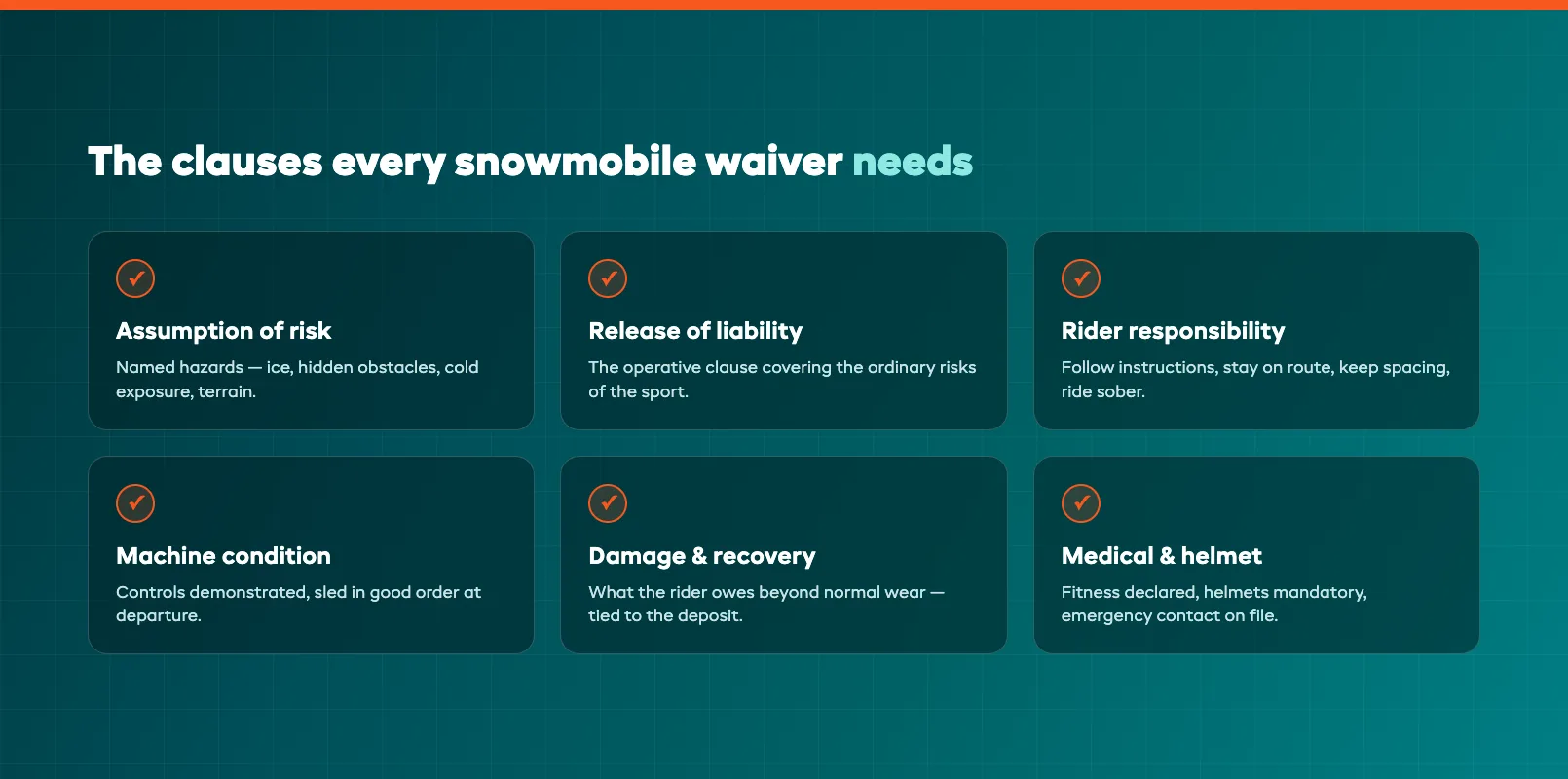
- Assumption of risk — named, snowmobile-specific hazards: variable snow and ice, hidden obstacles, other riders, cold exposure, avalanche terrain where relevant. Generic "outdoor activity" language is weaker than a list of the real risks.
- Release of liability — the operative clause releasing your business from claims arising from those ordinary risks.
- Rider responsibility — the rider agrees to follow staff instructions, stay on designated routes, keep spacing, and ride sober. Make speed and terrain rules explicit.
- Machine condition acknowledgement — the rider confirms the sled was demonstrated, the controls were explained, and the machine appeared in good working order at departure.
- Damage and recovery liability — what the rider owes for damage beyond normal wear, and who pays for recovery if a sled is abandoned or stuck off-route. Tie this to your deposit terms.
- Medical fitness and helmet acknowledgement — the rider declares they are fit to operate the machine and accepts that helmets are mandatory.
- Emergency contact and media consent — a next-of-kin line for every rider, and consent to use tour photos if you shoot them.
Keep the document readable. Two pages of clear language signed with understanding beats six pages of dense boilerplate a rider can later claim they never grasped.
A safety briefing riders actually remember
The briefing is where incidents are prevented, and the difference between a good one and a bad one is structure. Wing it and you will skip something on the one morning it matters. Work from a fixed script, in a fixed order, delivered the same way by every staff member:
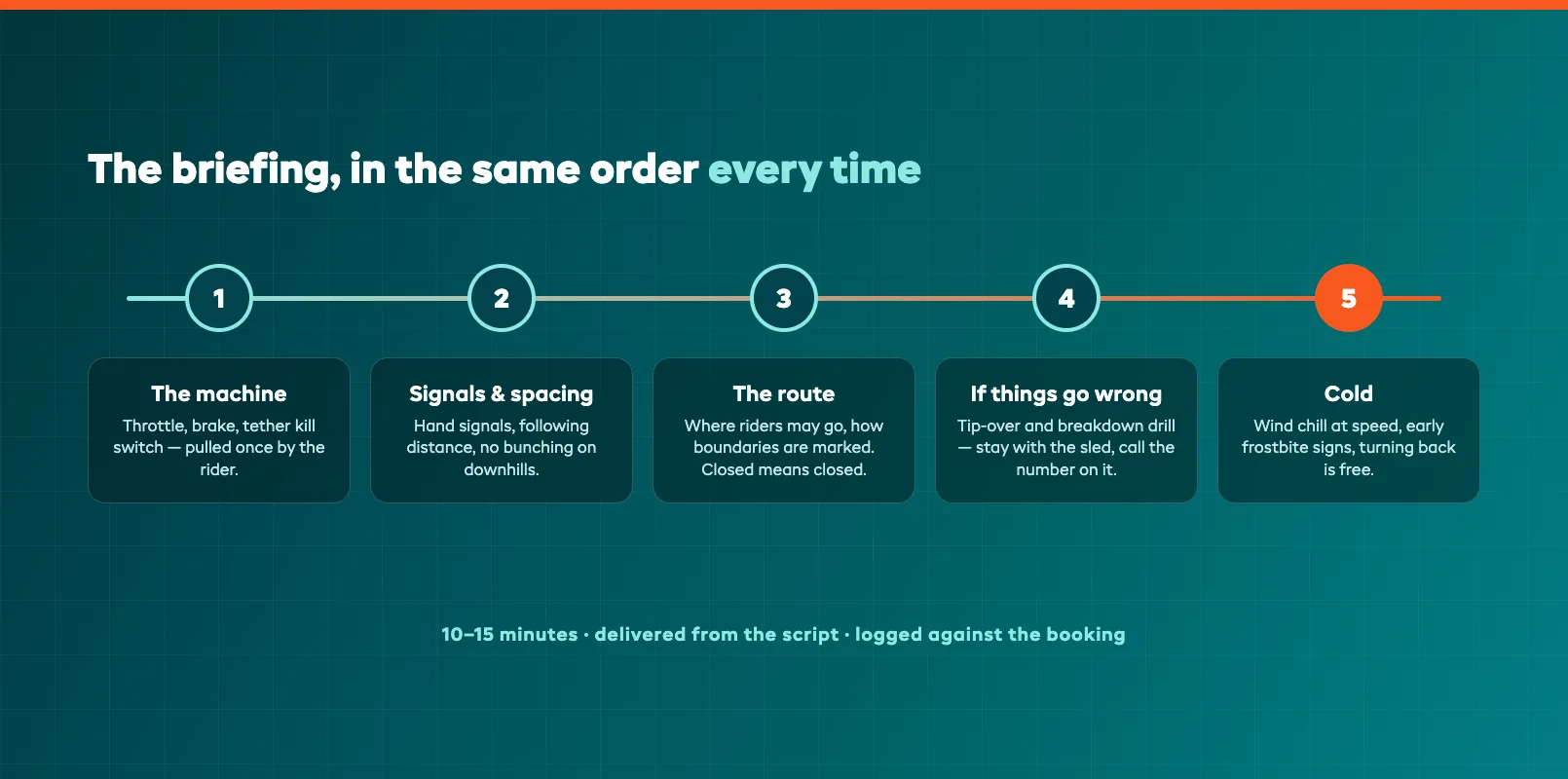
- The machine — throttle, brake, and how the sled steers with body weight. Show the tether kill switch, clip it to the rider, and have them pull it once so they feel the engine cut.
- Signals and spacing — the hand signals your group uses, minimum following distance, and why bunching up on a downhill is how sleds get rear-ended.
- The route — where riders may go, where they may not, and how boundaries are marked. If avalanche terrain borders your area, say so plainly and state the rule: closed means closed.
- When things go wrong — what to do after a tip-over or breakdown: stay with the machine, move off the trail, use the phone number or radio channel printed on the sled.
- Cold — how fast wind chill works at trail speed, what early frostbite feels like, and that turning back cold is free while riding on cold is not.
Ten to fifteen minutes covers all five for a rental group. Then record that it happened: who delivered the briefing, the date and time, and which riders attended. A briefing you cannot prove is a briefing that, legally speaking, may as well not have happened.
Signatures before anyone touches a sled
The worst place to collect a waiver is your counter at 8:55 am, from a guest holding gloves in one hand and coffee in the other. The signature is rushed, the reading is skipped, and — if you ever need to rely on the document — "I was handed a form and told to sign it" is exactly the story you do not want a rider telling.
Send the waiver digitally with the booking confirmation instead. The guest signs on their own phone the evening before, at their own pace, and the signed copy files itself against the booking with a timestamp. At check-in your staff see at a glance who has signed and who has not, and chase only the gaps. Walk-ins sign on a tablet at the counter — still digital, still stored, still legible in a way that a damp paper form never is. This is the same booking-to-arrival flow covered in snowmobile booking software, and EquipDash handles the send, the chase, and the storage automatically.
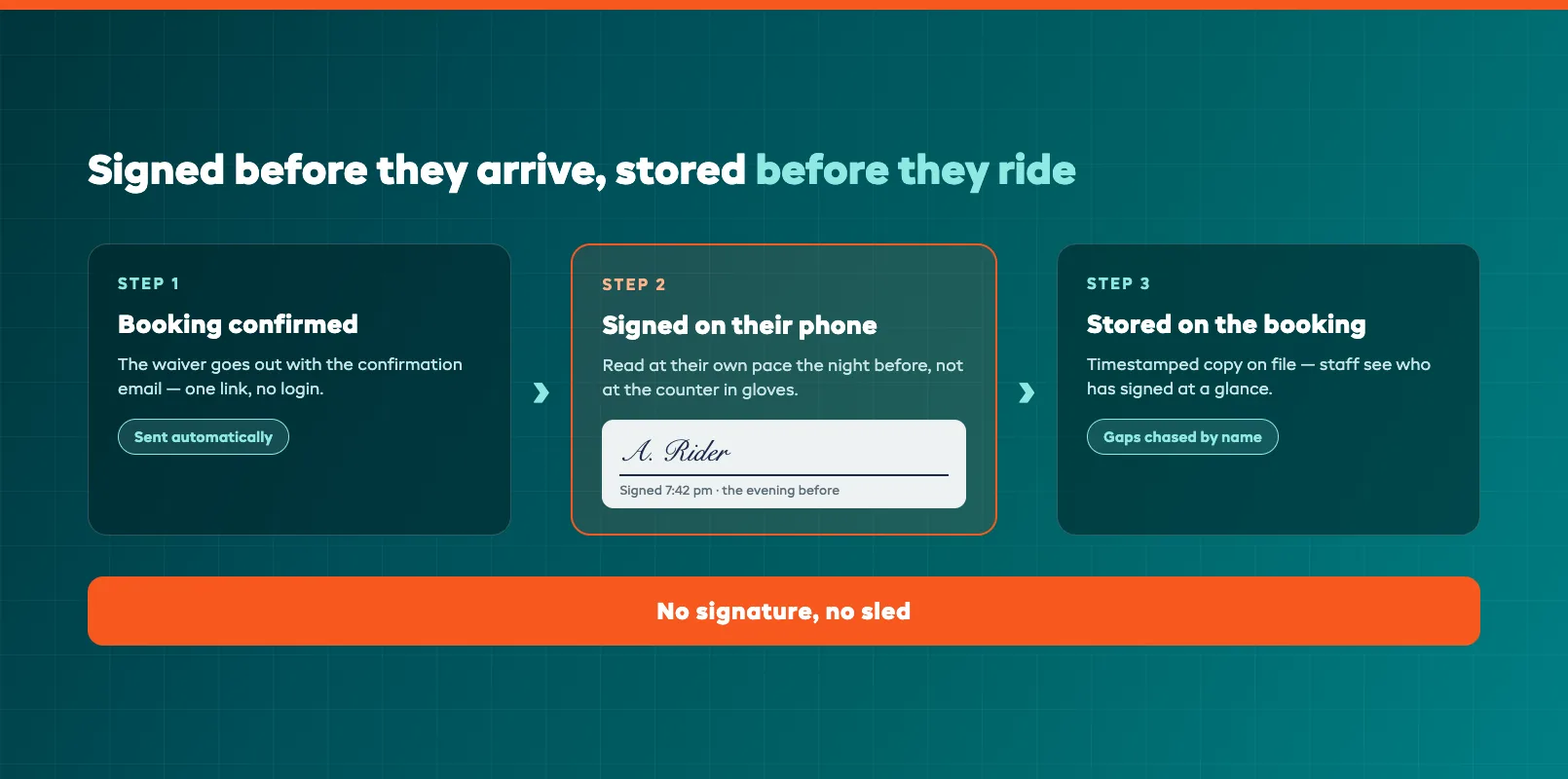
The rule that makes it all work is simple and absolute: no signature, no sled. Not "sign it when you get back," not "we'll sort it later for the group." The one rental that goes out unsigned is, by the oldest law in the business, the one that comes back on a recovery trailer.
Documenting incidents so the paperwork holds up
When something does happen — a tip-over, a collision, a rider with suspected frostbite — the file you build in the next hour decides how the next year goes. Claims commonly arrive months later, and by then memory is gone. The record is what answers.
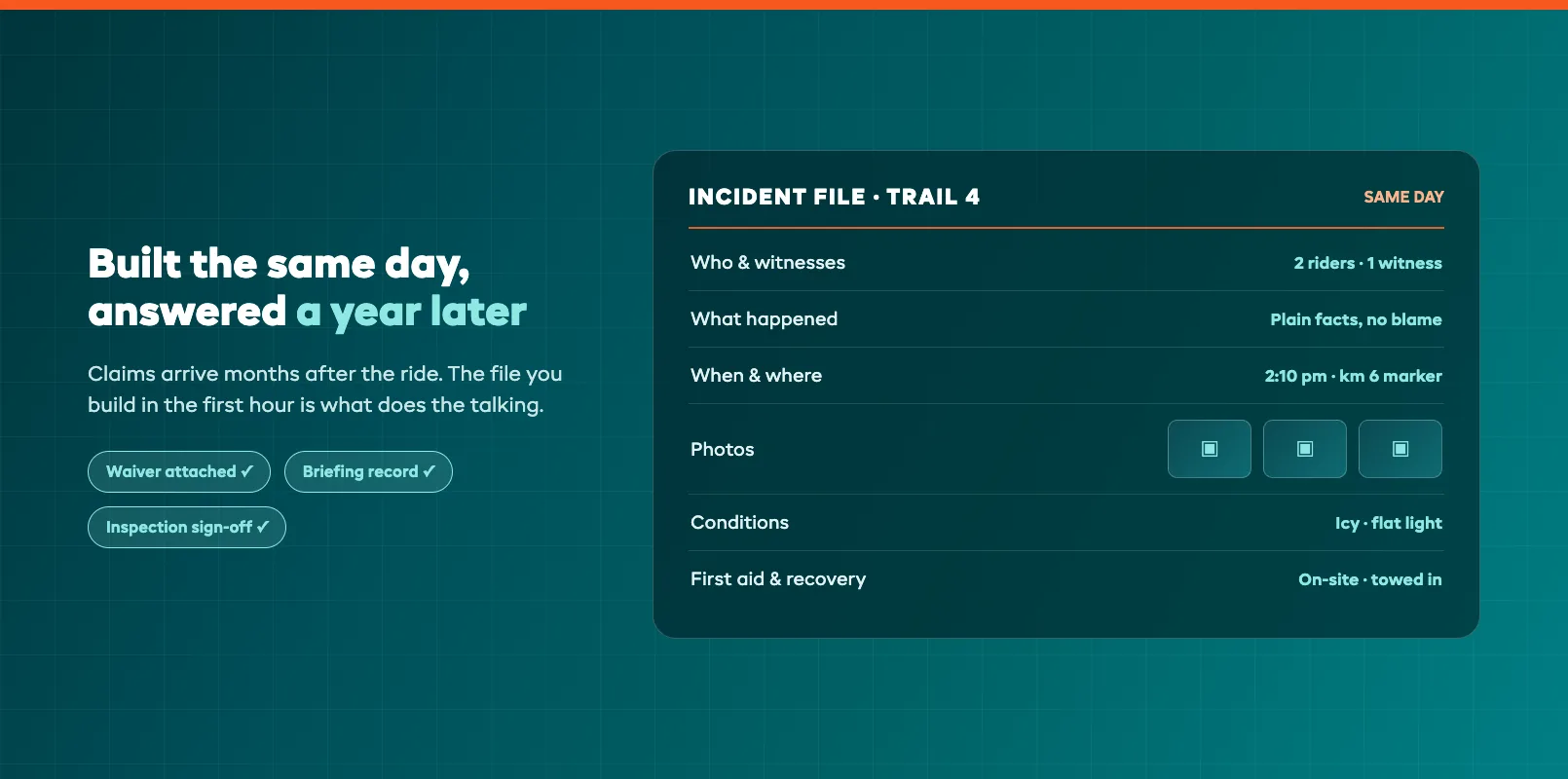
Same day, every time: who was involved and who saw it, with contact details. What happened, written in plain factual language — no speculation, no blame. When and where, precisely. Photos of the machine, the scene, and any visible injuries. Weather, light, and trail conditions at the time. What first aid was given and how the rider got back. Then attach the rider's signed waiver and the briefing record to the report, and store the bundle against the booking where it can be found in a minute, not a filing cabinet.
Riders decline to report things too — the guest who tipped a sled and says they're fine. Log it anyway, in two lines. If a claim surfaces later, the contemporaneous note that they declined assistance is worth a great deal.
Minors, groups, and the awkward edge cases
Minors. A minor's own signature is generally worthless, so a parent or legal guardian signs on their behalf — and in some jurisdictions even that cannot fully waive the child's own claim. Set a minimum driver age, enforce it without exception, and keep younger guests as passengers or on guided-only options. Guardian signature, every time, no matter how confident the sixteen-year-old looks.
Groups. One organizer cannot sign for twelve adults. Every rider signs individually — which is exactly why digital pre-arrival signing matters, because a bachelor party will not read anything at your counter. Send the group leader the booking, let the waiver chase each guest by name, and check the list at the door.
Language. If a meaningful share of your guests are not native speakers, offer the waiver in the languages you commonly see, and brief with demonstration as much as narration — pulling the tether teaches more than describing it.
Putting it together
The system is four documents that reference each other: a lawyer-reviewed waiver signed digitally before arrival, a scripted briefing with a record that it was delivered, a morning inspection log proving the machine was sound (see pre-ride inspections), and an incident report filed the same day anything happens. Together they answer the two questions every claim starts with — what did the rider sign, and what were they told — before anyone has to ask.
Guests notice, too. A shop that briefs properly, checks tethers, and has its paperwork in order reads as a professional operation, and professional operations get the repeat winter bookings. The full operational picture — fleet, guides, pricing, season — is in the complete guide to running a snowmobile business, and the snowmobile hub plus the snowmobile glossary cover the terms and tools that go with it.
FAQ
Do snowmobile rental waivers actually hold up in court?
A well-drafted waiver signed by an informed adult holds up in most jurisdictions for the ordinary risks of snowmobiling — falls, collisions with terrain, cold exposure. What it will not protect you from is gross negligence on your side: renting out a sled with a known brake fault, skipping the briefing, or sending riders into closed terrain. Have a local lawyer draft or review yours, because enforceability rules differ by state and province.
What clauses must a snowmobile rental waiver include?
At minimum: assumption of risk naming snowmobile-specific hazards, release of liability, rider responsibility and rule acceptance, machine condition acknowledgement, damage and recovery cost liability, medical fitness declaration, and helmet acknowledgement. Add media consent if you photograph tours, and an emergency contact line for every rider.
Can a minor sign a snowmobile waiver?
No — a minor's own signature is generally worthless. A parent or legal guardian must sign on the minor's behalf, and in some jurisdictions even a parental signature cannot waive the child's own future claim. Enforce your minimum driver age strictly, keep under-age guests as passengers or on guided tours only, and get the guardian signature every time.
How long should a snowmobile safety briefing take?
Ten to fifteen minutes covers a rental briefing done properly: controls and the tether kill switch on the machine, hand signals, group spacing and speed rules, where riders may and may not go, what to do after a breakdown or tip-over, and cold-exposure basics. Guided backcountry tours need longer for avalanche gear and terrain protocol. Shorter than ten minutes usually means something got skipped.
Should waivers be signed on paper or digitally?
Digitally, sent with the booking confirmation. Guests sign on their own phone before they arrive, the signed copy stores itself against the booking with a timestamp, and nobody is standing at your counter with wet gloves trying to hold a pen. Paper backups still make sense for walk-ins, but digital should be the default path.
What should you document after a snowmobile incident?
The same day: who was involved and who witnessed it, what happened in plain factual language, when and where, photos of the machine, the scene, and any visible injuries, weather and trail conditions, and what first aid or recovery followed. File it with the rider's signed waiver and the briefing record. A claim that arrives eleven months later is answered by that file, not by anyone's memory.
in one place