Hourly, Daily, Weekly: Pricing Cart Hire at Resorts and Communities
Hourly, Daily, Weekly: Pricing Cart Hire at Resorts and Communities
The same 4-seater does two different jobs. At the resort kiosk it goes out at 9am for two hours, comes back, goes out again at 1pm, and might do a third loop before dark - eleven or twelve hires a week, each one a fresh customer, a fresh waiver, a fresh handover. In the gated community ten minutes away, the identical cart goes out on Saturday to a family renting a house for the week and comes back the following Saturday with 40 miles on it. One rental. One handover. Seven days.
If both of those sit on a single flat day rate, one of them is being priced wrong. Charge the weekly family the resort's day rate times seven and you lose the booking to the operator who quoted a real weekly price. Charge the resort day-tripper a rate derived from the weekly and you have given away the most profitable hours on the fleet. The rate card has to hold both - and the good news is that the fleet does not care which one it is doing, so the pricing job is mostly about time, season, and risk. This guide covers the six pieces: the duration ladder, seasonal pricing, the weekly community product, deposits and damage, the add-ons, and the utilization figures that tell you what to move next. It assumes the fleet is already running on software that understands carts - if not, start with the golf cart rental software page, then come back for the numbers.
Rate Tiers by Duration
The ladder is the foundation. Every other rate on the card - seasonal, weekly, group - is a multiplier on it, so it needs to be right before anything else is.
The principle is simple: the price per hour falls as the hire gets longer, but it never falls so far that a long hire is cheaper for you to run than a short one. A cart on a week-long hire is earning while it sits in a driveway; a cart on two-hour loops is earning more per hour but costing you a handover, a charge cycle, and a walkaround every time. The ladder pays you for the handovers on the short end and for the availability you give up on the long end.
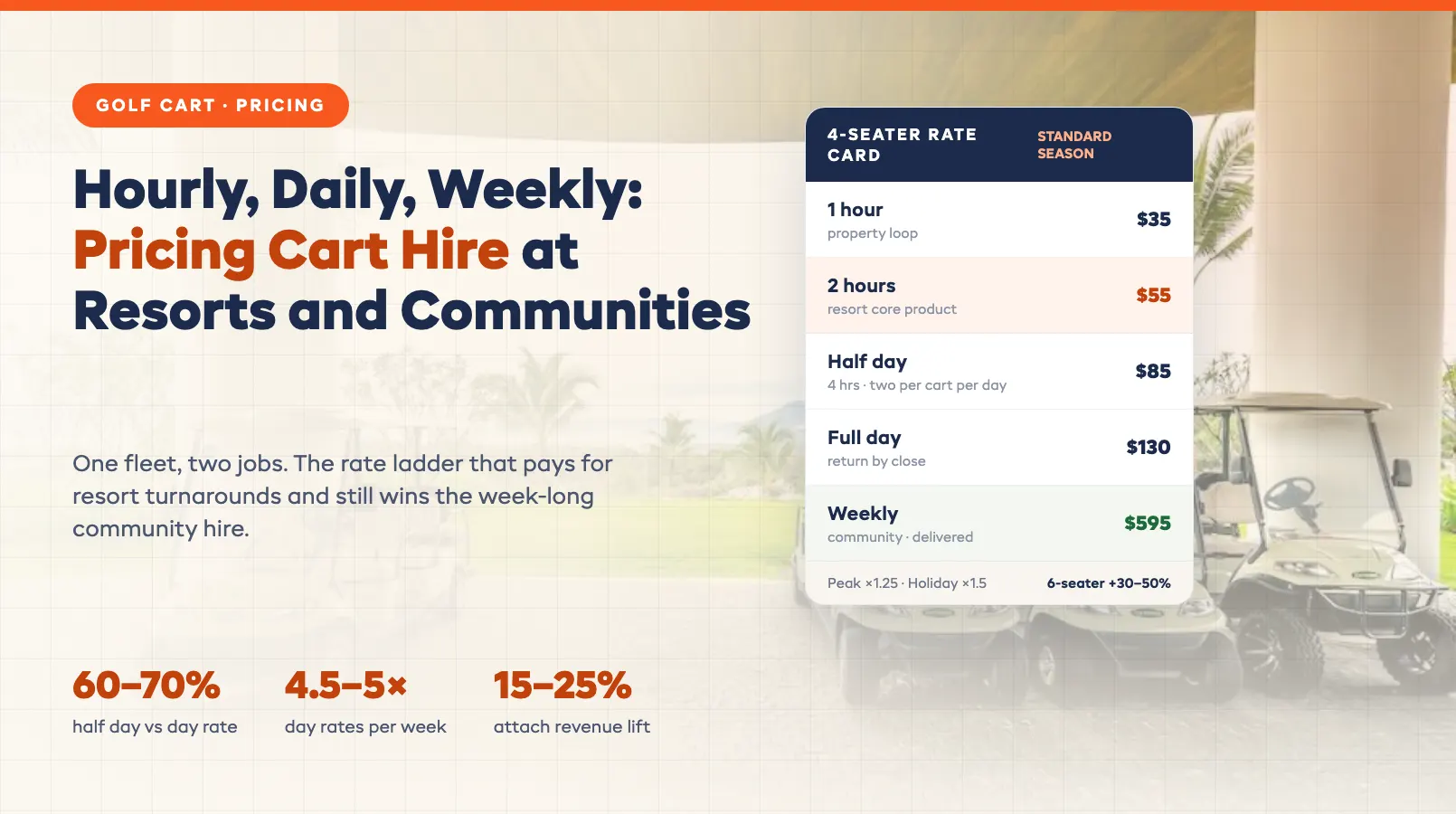
A working ladder for a standard 4-seater, mid-season, looks like this:
| Duration | Rate | Effective per hour | Notes |
|---|---|---|---|
| 1 hour | $35 | $35.00 | Loop around the property, kids' first drive |
| 2 hours | $55 | $27.50 | The resort's core product |
| Half day (4 hrs) | $85 | $21.25 | 60-70% of the day rate |
| Full day | $130 | ~$13 over 10 hrs | Return by close |
| 3 days | $330 | ~$110/day | Long weekend |
| Weekly | $595 | ~$85/day | Community and vacation-home hires |
The numbers are illustrative - your market sets the level - but the shape matters more than the level. Three rules to keep the shape honest:
- Half day sits at 60-70% of the day rate. Lower and every day-hire customer books a half day and returns late; higher and nobody buys it. The 60-70% band is also what lets a lithium cart run two half days on one calendar day, which is where the real yield comes from.
- Weekly sits at 4.5-5 day rates, not 7. At 4.5 days the customer sees a real saving and books the week instead of three separate days with gaps you cannot fill. At 5 you keep more margin but lose more bookings to the operator next door. Below 4 you have given away too much.
- The one-hour rate is a real price, not a loss leader. It carries a full handover on both ends. If it is cheap, it fills the fleet with the hires that cost you the most staff time per dollar.
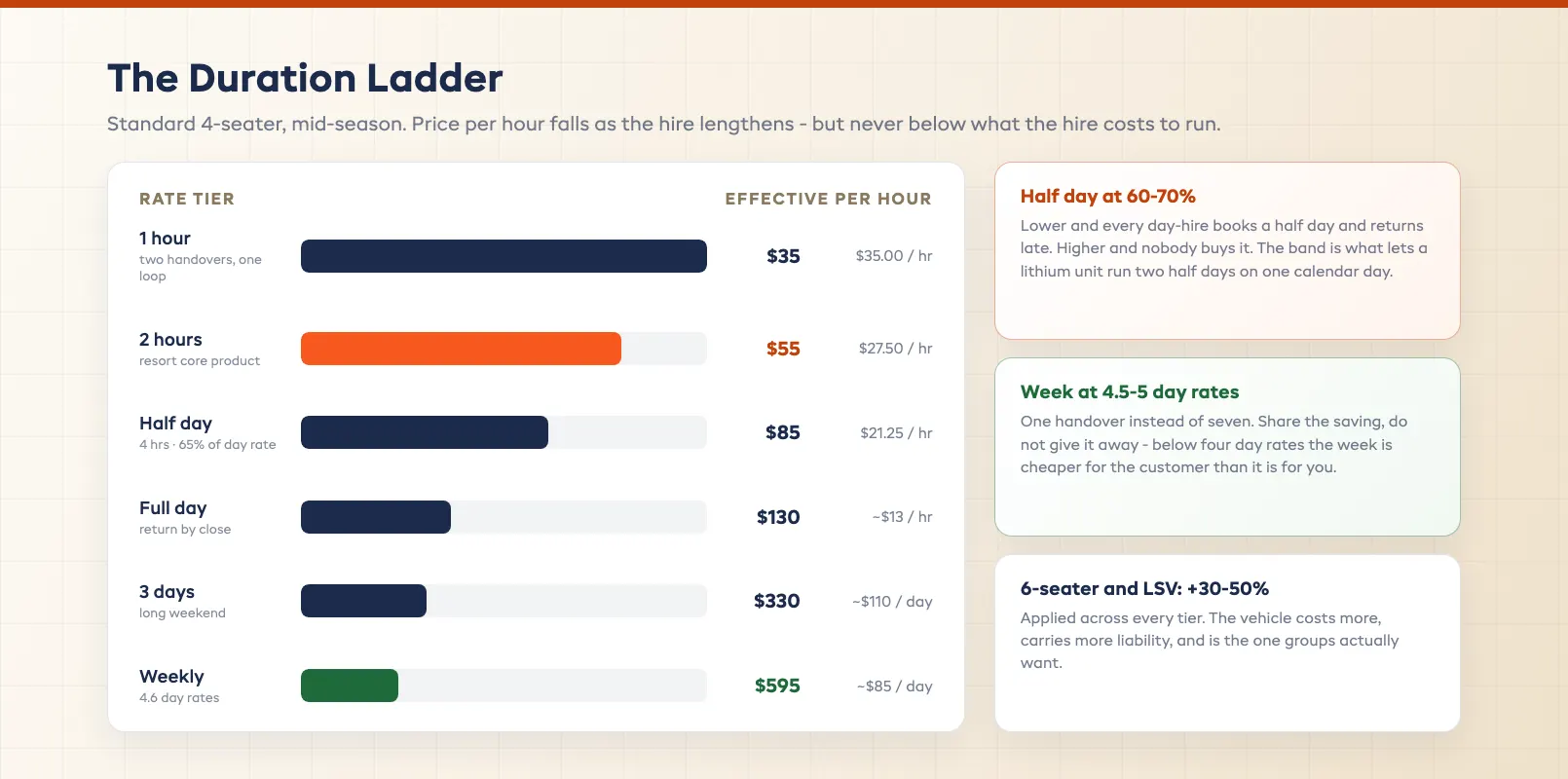
Two more tiers earn their place on most cards. A 6-seater or street-legal LSV carries a 30-50% premium across the whole ladder, because it is the cart families and groups want, and because the vehicle costs more and carries more liability. And an overnight rate - out at 4pm, back by 10am - fills the evening hours that day rates leave empty, at roughly 60% of the day rate. Overnight only works on lithium units or on a fleet with enough carts to spare the recharge window, which is why the charge cycle belongs in the pricing conversation from the start.
Seasonal Pricing
A resort cart fleet has a demand curve as steep as the hotel's. The week between Christmas and New Year, spring break, and every summer Saturday sell out by mid-morning; a Tuesday in early May has half the fleet sitting on chargers. A single rate card cannot be right on both days.
The fix is a small set of seasons with a multiplier on the base ladder, published so customers see them as rates rather than surprises:
| Season | Multiplier | What triggers it |
|---|---|---|
| Off-peak | 0.8x | Shoulder weeks, midweek in low season |
| Standard | 1.0x | The base ladder |
| Peak | 1.25x | Summer weekends, school holidays |
| Event / holiday | 1.5x | Christmas week, spring break, festival weekends |
Three seasons are usually enough; five is the practical maximum before staff and customers stop understanding the card. The multiplier applies to every tier on the ladder, so the weekly community rate rises in peak too - just as the vacation rentals around it do.
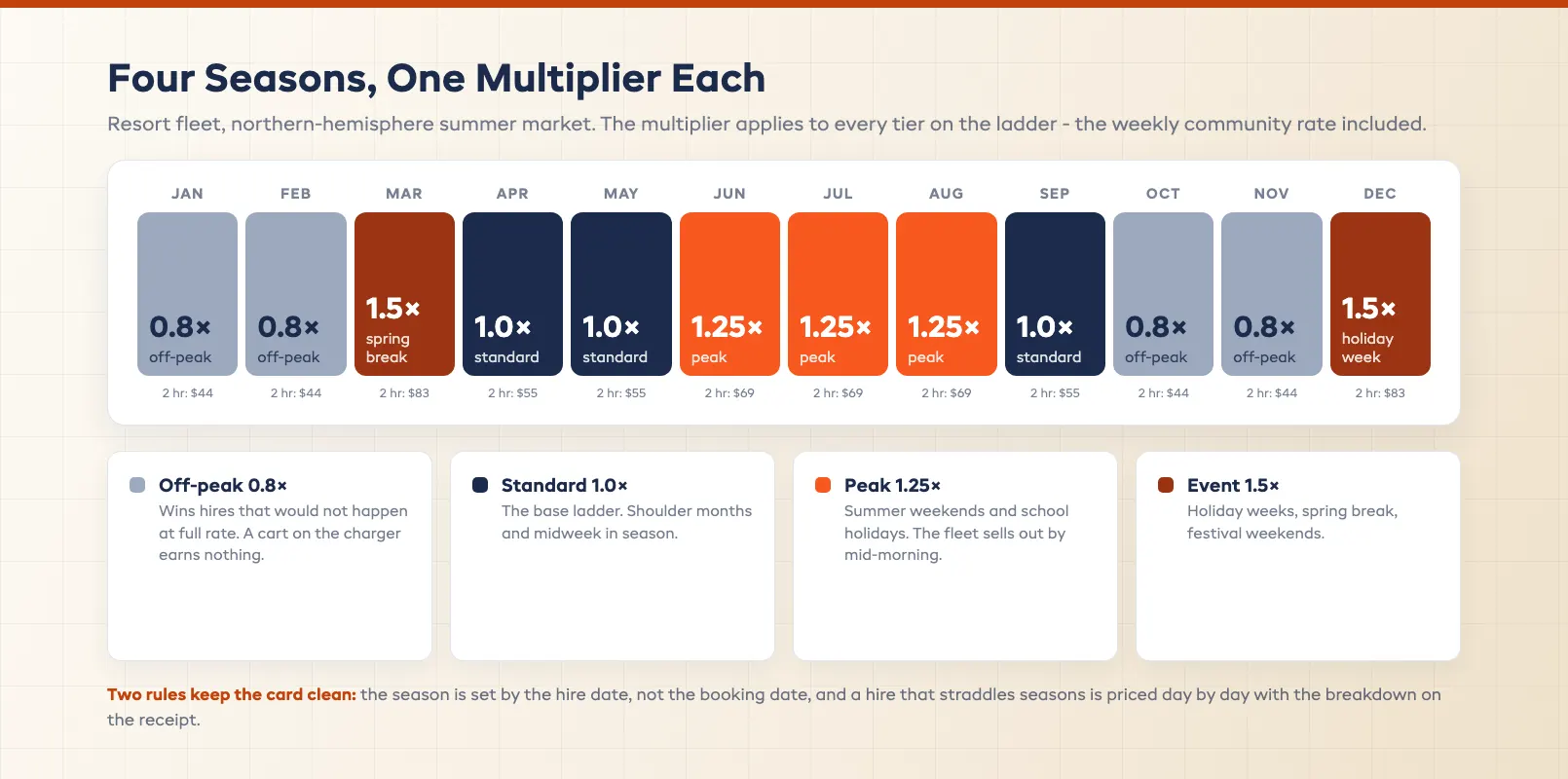
The part most operators skip is the off-peak discount. Cutting 20% in the shoulder season feels like leaving money on the table, but a cart on the charger earns nothing, and the hires you win at 0.8x are hires the customer would not have made at all. On a per-cart basis, a fleet that runs 45% utilization in the shoulder at 0.8x out-earns one running 25% at full rate. The board tells you which one you are.
Two seasonal rules that keep the card clean. First, the season is set by the hire date, not the booking date - a July hire booked in March is a peak hire. Second, if a hire straddles seasons, price each day at its own rate and show the customer the breakdown; an average rate for a week that spans a holiday looks like a mistake to whoever reads the receipt. Both are things the booking system should handle automatically from a calendar of seasons you set once a year. Dynamic pricing on top of that - lifting the last few units on a sold-out weekend, dropping a Tuesday afternoon that is 70% empty at 10am - is a real lever, but only once the seasonal base is stable and the board data is clean.
Weekly Community Hires
The gated community, the vacation-rental strip, and the island with no cars are a different business from the resort kiosk, and the weekly rate should be written as its own product rather than as a discounted stack of day rates.
What makes the community hire different:
- One handover, seven days. Your cost per hire is a tenth of the kiosk's. That is where the 4.5-5 day-rate pricing comes from - you are sharing the saving, not giving it away.
- Delivery is part of the product. Community customers rarely come to a kiosk. The cart is delivered to the house on arrival day and collected on departure day, and the delivery window is a bookable slot with its own fee - $25-40 each way is typical, waived on multi-week hires.
- The customer drives more, and drives slower. Weekly carts rack up miles but almost never come back with the damage a two-hour thrill loop produces. The risk profile is lower; the deposit can be too.
- Property managers are the channel. A rental agency managing 60 houses on the same street is worth more than any amount of walk-up trade. Give them a trade rate - 10-15% off the weekly, invoiced monthly - and a booking link they can drop into the guest's arrival email.
Write the weekly terms as a separate rate with its own rules: a delivery slot, a mileage or charge-condition expectation, a mid-week check-in if the hire runs over ten days, and a clear extension price. The extension matters. A family that decides on Thursday to stay until Tuesday should be quoted a per-day extension at the daily rate, not a second week - and it should be one tap in the booking they already have, not a phone call.
The delivery run itself is where weekly hires win or lose money. Saturday changeover on a vacation strip means twelve carts going out and twelve coming back in the same four-hour window. A single driver with a trailer can do it if the booking board shows the sequence and the addresses; two drivers guessing from a text thread cannot. The same live board that the kiosk uses for turnarounds doubles as the delivery run sheet.
Deposits and Damage
Pricing is not just what you charge; it is what you keep when a hire goes wrong. A rate card with no deposit policy is a rate card with a hidden discount on it.
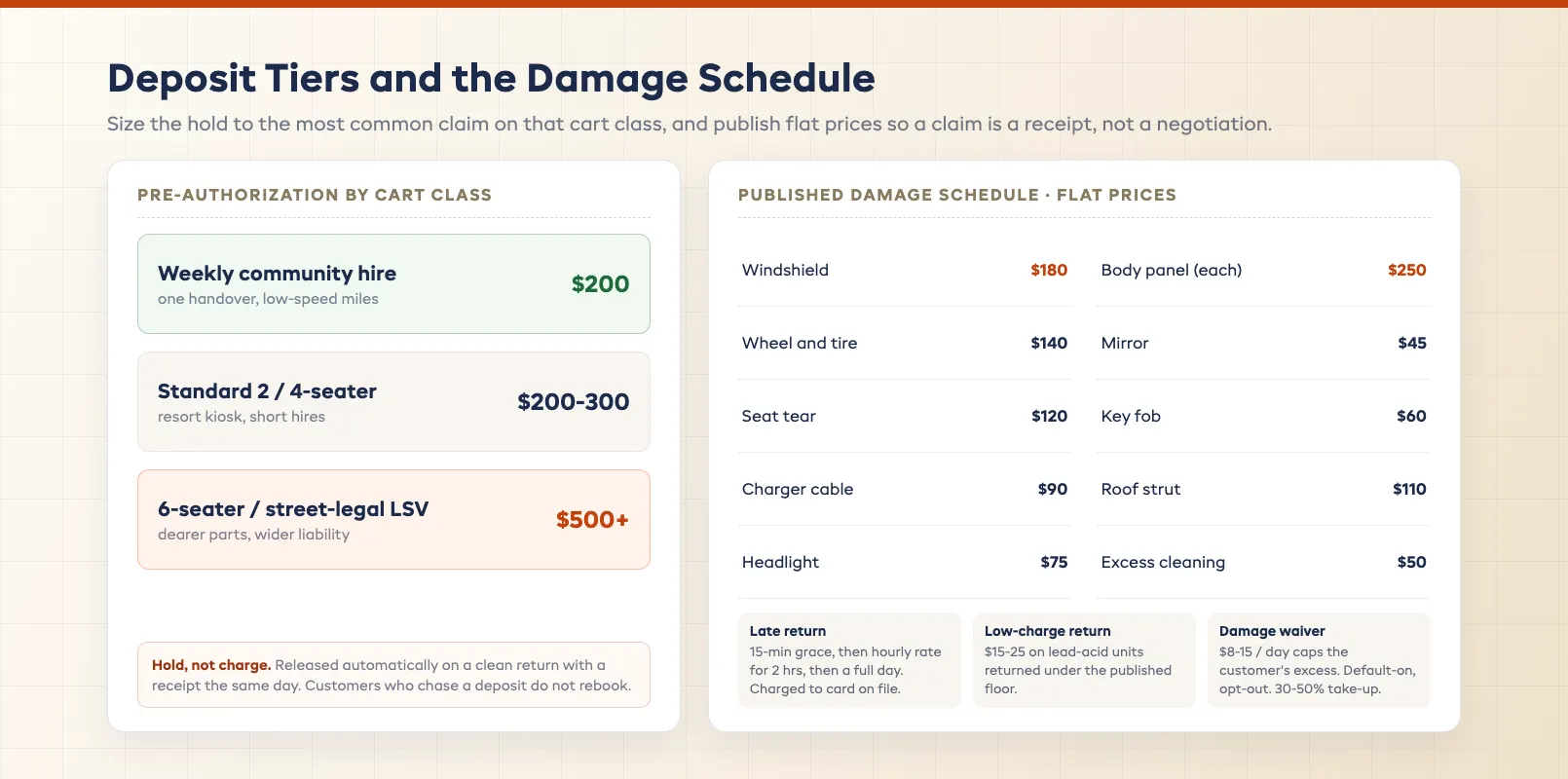
Size the deposit to the most common claim on that cart class, not to the cart's value. On a standard 2- or 4-seater, the typical claim is a windshield, a body panel, a mirror, or a charger cable left in a driveway - $150-400 in parts and labor. A $200-300 pre-authorization covers most of them. On a street-legal LSV or a premium 6-seater, the parts are dearer and the liability is wider, so $500 or more is the floor. Weekly community hires with a lower risk profile can sit at the low end of each band.
The deposit only works with three things around it:
- A published damage schedule. Flat prices for the ten most common repairs - windshield, body panel, wheel and tire, mirror, seat tear, key fob, charger cable, roof strut, headlight, cleaning - printed on the rate card and agreed at booking. A flat price nobody can argue with beats a "we'll assess it" that turns every claim into a negotiation.
- Photos at both ends. Timestamped walkaround photos at handover and return, taken as part of the checklist, attached to the booking. Without them the deposit is unenforceable in a chargeback; with them it almost never gets to one.
- Automatic release. Clean return, deposit released the same day, receipt sent. Customers who know the hold comes back book again; customers who had to chase it do not.
Two fees belong on the same card because they are pricing, not penalties. A late return fee - a 15-minute grace, then the hourly rate for the first two hours, then a full day - protects the next booking on that cart, and it needs to be automatic, charged to the card on file with a receipt that shows the agreed return time and the actual one. A low-charge return fee on lead-acid carts - $15-25 if the cart comes back under the floor you published - pays for the recharge hours that cart now cannot sell. Both fees are only defensible if they were on the rate card the customer agreed to at booking.
Attach Revenue
The cart is the ticket; the add-ons are the margin. On a well-run resort fleet, attach revenue adds 15-25% to the average booking value at almost no marginal cost, because the products already exist and the checkout is already open.
The add-ons that reliably sell:
- Cooler and ice - $10-15 a day. The single highest-attach item on beach and lake fleets.
- Child seat or booster - $5-10 a day, often free on weekly hires to win the family booking.
- Phone mount and charger - $5 flat. Trivial, and it sells to almost everyone.
- Bluetooth speaker - $10-15 a day. Check the community rules before offering it.
- Rain cover or enclosure - $10-15 a day, seasonal.
- Extra driver - $10-15 per hire on top of the license check. It is a real cost to you and customers accept it.
- Damage waiver - $8-15 a day to cap the customer's liability at a fixed excess. Take-up runs 30-50% when it is presented as the default with an opt-out, and it funds the repairs the deposit would otherwise be fighting over.
Present them at the point of booking, pre-selected where the customer would expect them, and price them as line items the customer can remove. Presented at the counter with a queue behind, attach rates fall by half. Presented in the online checkout with a picture and a one-line description, they sell.
The other attach lever is the upgrade. A customer who booked a 4-seater and arrives with six people is a 6-seater sale if one is charged and on the board - price the difference, take it on the card on file, and move on. A system that pools by cart type and knows what is ready makes that a ten-second conversation; one that does not makes it a refusal.
Utilization per Cart
Every decision above gets checked against one number: revenue per cart per week, split by hire type and season. Fleet-wide averages hide the answers; per-unit figures show them.
What the report should show for each cart:
- Utilization - hours on hire as a share of hours available, net of charging downtime. A resort 4-seater in peak should run 55-70%; a community cart on back-to-back weeklies can run 85%+ with one handover.
- Revenue per hire and per hour on hire. Short hires win per hour; weeklies win per handover. The ladder is right when both look healthy.
- Attach rate and attach revenue. Which units, which locations, which staff sell the add-ons.
- Maintenance and battery cost per unit. Set against the revenue line so the report shows margin per cart, not just turnover.
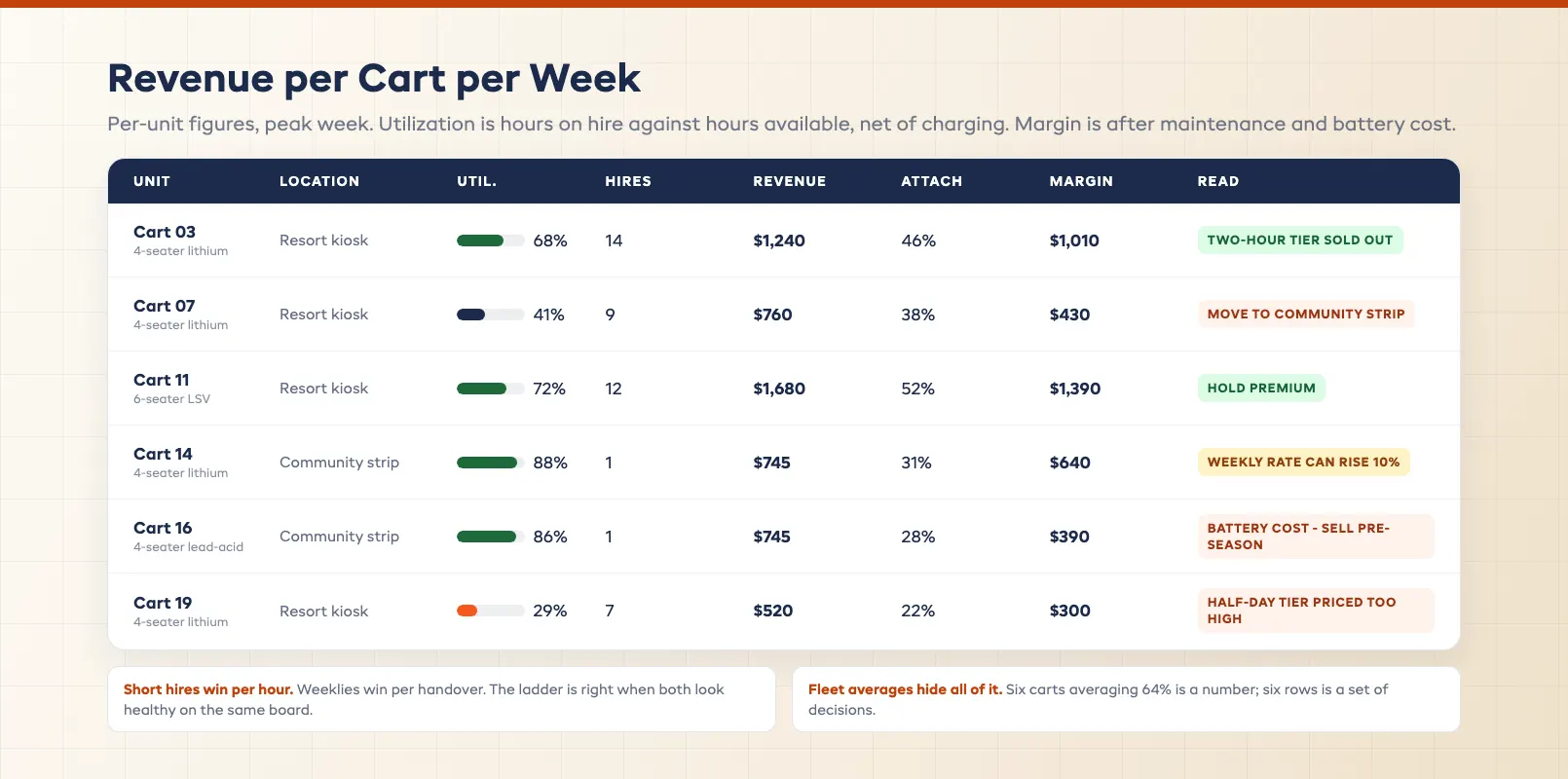
The report drives the rate card in three specific ways. If the two-hour tier is selling out by 10am on peak days while half days sit empty, the two-hour rate is too low or the half day is too high - move one. If weekly utilization on the community fleet is above 85% in season, the weekly rate can rise 10% without losing the property-manager channel. If off-peak utilization is under 30%, the 0.8x multiplier is not deep enough, or the off-peak card is not being marketed at all.
And it settles the fleet questions. A cart that runs 40% utilization at the resort might run 85% on the community strip; moving it is a pricing decision as much as a logistics one. A cart whose margin after battery cost has fallen below its siblings is a candidate for sale before the next deposit season - which the per-unit ledger flags months ahead of the customer who would otherwise have found out for you.
None of this needs a spreadsheet if the booking system already records the hire type, the duration, the season, the add-ons, and the unit on every booking. That is the point of running the fleet on software built for rentals: the pricing report is a by-product of taking the bookings, not a separate job. Plans start at $23/month on annual billing - see pricing for the current tiers, and the golf cart rental software page for the rate-ladder, seasonal, and deposit tools in detail.
The cart that does two jobs is not a pricing problem. It is a fleet that earns twice, as long as the rate card knows which job it is doing.
FAQ
How much should I charge for golf cart rental per hour, day, and week?
Build a ladder rather than a single rate. A working mid-season example for a standard 4-seater is $35 for one hour, $55 for two hours, $85 for a half day, $130 for a full day, $330 for three days, and $595 for a week - but the shape matters more than the numbers. Keep the half day at 60-70% of the day rate, the week at 4.5-5 day rates, and the one-hour rate high enough to pay for its two handovers. Add a 30-50% premium across the ladder for 6-seaters and street-legal LSVs.
Should I charge more for golf cart rentals in peak season?
Yes, and less in the shoulder. Three or four published seasons with a multiplier on the base ladder - around 0.8x off-peak, 1.0x standard, 1.25x peak, and 1.5x for holiday and event weeks - keeps the card understandable while matching demand. The off-peak cut matters as much as the peak lift: a cart sitting on a charger earns nothing, and hires won at 0.8x are usually hires that would not have happened at full rate. Set the season by the hire date, not the booking date, and price straddling hires day by day.
How should weekly community golf cart hires be priced differently?
As their own product. A weekly hire carries one handover instead of seven, drives more miles but with far less damage, and is usually delivered to a house rather than collected from a kiosk. Price it at 4.5-5 day rates, add a bookable delivery and collection slot at $25-40 each way, offer a per-day extension at the daily rate rather than forcing a second week, and give property managers a 10-15% trade rate on monthly invoice - they are the channel that fills the community fleet.
How much deposit should a golf cart rental take?
Size it to the most common claim, not the cart's value. A $200-300 card pre-authorization covers the windshield, panel, mirror, and charger-cable claims that make up most incidents on a standard 2- or 4-seater; street-legal LSVs and premium 6-seaters should start at $500. Pair the hold with a published damage schedule of flat repair prices, timestamped photos at handover and return, and automatic release on a clean return. A damage waiver at $8-15 a day, presented as the default with an opt-out, caps the customer's exposure and funds most of the repairs.
What add-ons make the most money on golf cart rentals?
Coolers with ice, child seats, phone mounts, Bluetooth speakers, rain enclosures, extra drivers, and a daily damage waiver. Together they add 15-25% to the average booking value on a well-run resort fleet at almost no marginal cost. The difference between a 20% attach rate and a 50% one is almost entirely where they are offered: pre-selected line items in the online checkout sell; the same items offered at a busy counter do not.
What utilization rate should a rental golf cart hit?
Measure hours on hire against hours available net of charging, per cart. A resort 4-seater on short hires should run 55-70% in peak season; a community cart on back-to-back weekly hires can run 85% or more because it has one handover a week. Track revenue per hire, revenue per hour on hire, attach revenue, and maintenance and battery cost per unit alongside it, so the report shows margin per cart rather than turnover - that is the figure that tells you which tier to move and which cart to sell.
in one place