Marquee Hire Software: Why a Saturday Wedding Is a Six-Day Booking
Marquee Hire Software: Why a Saturday Wedding Is a Six-Day Booking
A bride calls about Saturday 23 October. You have a 40ft x 80ft frame. Your calendar says it is free that weekend, so you quote it.
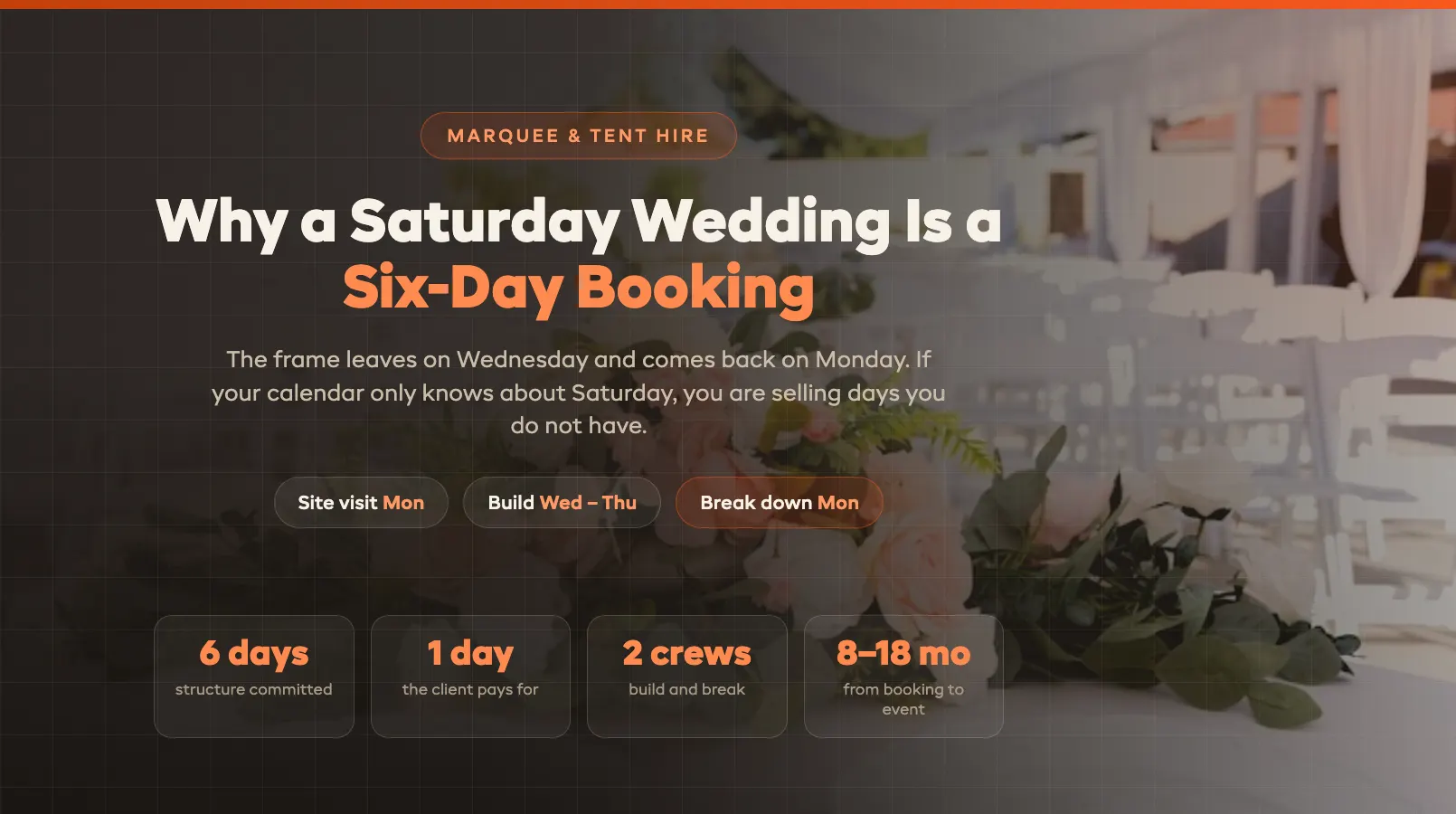
What the calendar does not say is that the same frame is being built on the Wednesday for a different client, comes down on the Monday after, and has a site visit booked on the Monday before. The frame is not free on Saturday 23rd. It is committed from the 18th to the 25th, and the only day anyone wrote down was the day the marquee was supposed to be full of people.
This is the problem that makes marquee hire different from every other kind of event rental. A chair company hires out chairs for a weekend. A sound company drops a rig on Friday and collects it Sunday. A marquee company commits a structure, a crew, a van and a piece of ground for the better part of a week, and then bills for one day of it.
Software that treats the booking as an event date will get this wrong. Every time.
The Booking Is Six Days Long, Not One
The unit of work in marquee hire is not the event. It is the commitment: the site visit, the build days, the event itself, and the break. For a mid-size frame at a private wedding that is usually five to seven days. For a county show or a three-day festival it can run to a two weeks.
Here is what a single job looks like when you write down all of it:
| Day | What happens | What is committed |
|---|---|---|
| Mon 18 Oct | Site visit and measure | 1 crew member, half day |
| Wed 20 Oct | Frame goes up | Structure, Crew A, van |
| Thu 21 Oct | Lining, flooring, lighting | Crew A, flooring stock, lighting |
| Fri 22 Oct | Client dressing and handover | Structure on site |
| Sat 23 Oct | Event | Structure on site |
| Mon 25 Oct | Break down and load out | Crew B, van |
One event date. Six committed days. The frame cannot be promised to anyone else across that whole window, and neither can the flooring, the lining or the lighting that went out with it.
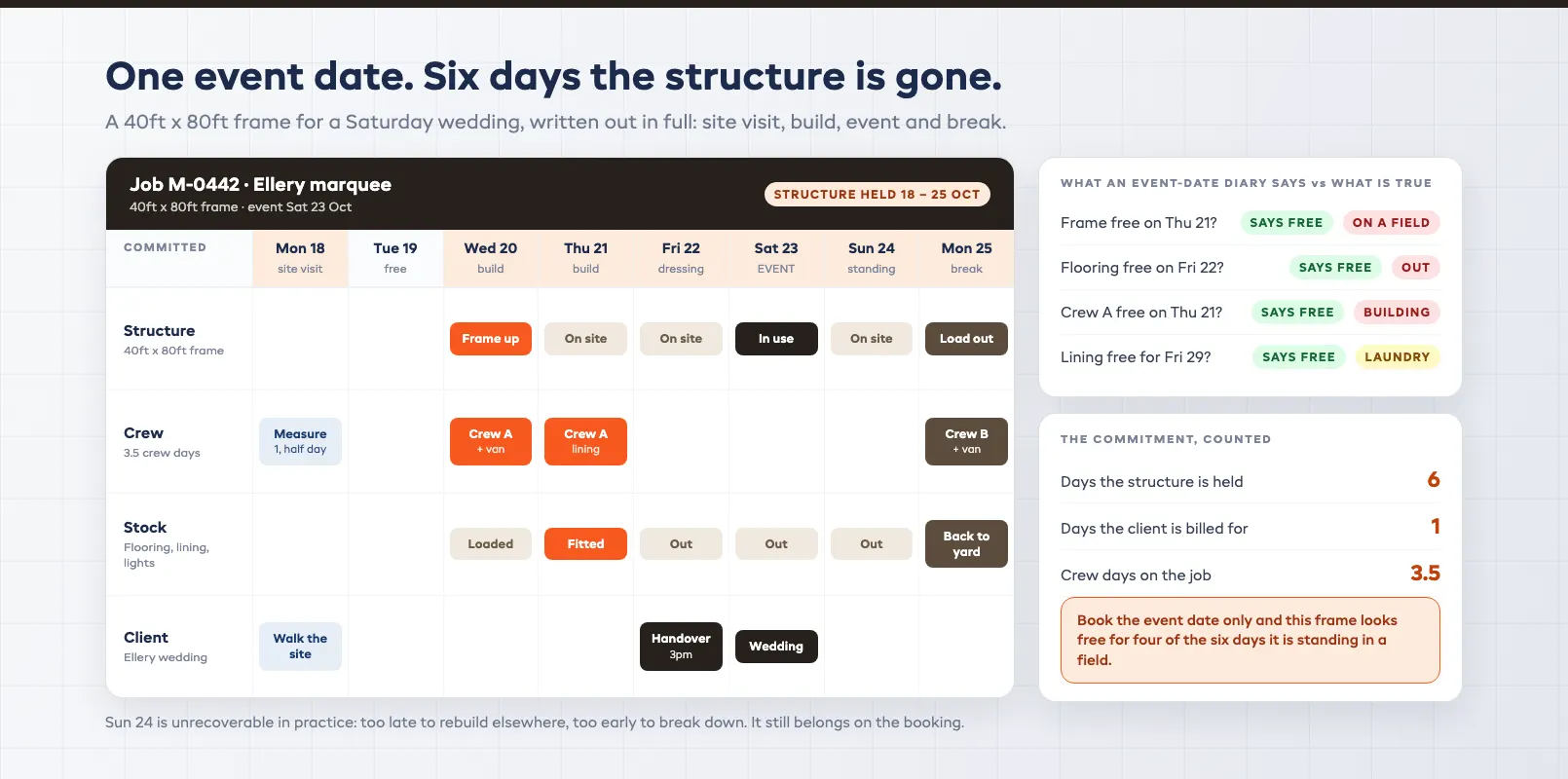
Most operators know this. The problem is where it lives. It lives in the head of whoever took the booking, in a wall planner with pencil on it, or in a spreadsheet where the build days are in a comment on the cell. None of those things answer the phone on a Tuesday when somebody asks whether the 40ft x 80ft is free on the 23rd.
The fix is not complicated, but it has to be structural. The booking has to hold the structure across the whole commitment, so that availability reflects the days the frame is physically unavailable rather than the day the client is celebrating. Marquee and tent rental software built for this blocks the frame from the build day to the break day and shows the diary accordingly.
Two things follow from that immediately. Availability stops lying, so quotes go out against structures that are genuinely free. And your usable weekends per season drop, which is uncomfortable but true: a frame that can turn around in two days does more weddings than one that needs six, and if you have never counted it, you are almost certainly over-promising your largest structures.
The stock that goes with the frame
The frame is the headline. The margin is in what goes inside it. Flooring, linings, drapes, furniture, lighting, heating and power all leave the yard on the same truck and come back on the same one, which means they are committed for the same six days.
Linings and drapes have a second problem. They come back dirty. A lining that returned on Monday is not available for the following Friday unless it has been through the laundry and is back on the rack, and treating laundry turnaround as downtime rather than as available stock is what stops you selling the same set of drapes to two weddings a week apart. The same logic applies across party and event rental generally, but linings are where it bites hardest because the turnaround is measured in days and the peak season is measured in consecutive weekends.
The Frame Is Booked. Is the Crew?
A marquee company sells structures and runs on people. The two get booked in separate places more often than anyone likes to admit, and the failure mode is specific: a build day arrives with a van, a frame and nobody to lift it.
Crew scheduling in this business is not general staff rostering. It has three things attached to it that a shift pattern does not cover.
Crews are assigned to a job, not a day. Crew A is not working Wednesday. Crew A is building the Ellery marquee on Wednesday and Thursday, which is a different fact, because if that build moves, Crew A's Wednesday moves with it.
Not everyone can do every job. Rigging, working at height, driving the truck, operating the lift: whoever is on the build needs the qualification for what the build requires, and the certificate needs a date on it. A crew list that does not know who is current is a crew list that will eventually put an expired ticket on a job.
Clashes are invisible until they are urgent. The classic is not two builds on the same day. It is a build that runs Wednesday to Thursday and a break down on the Thursday, both assigned to the same crew, booked six weeks apart by two different people. Nobody sees it until Thursday morning.
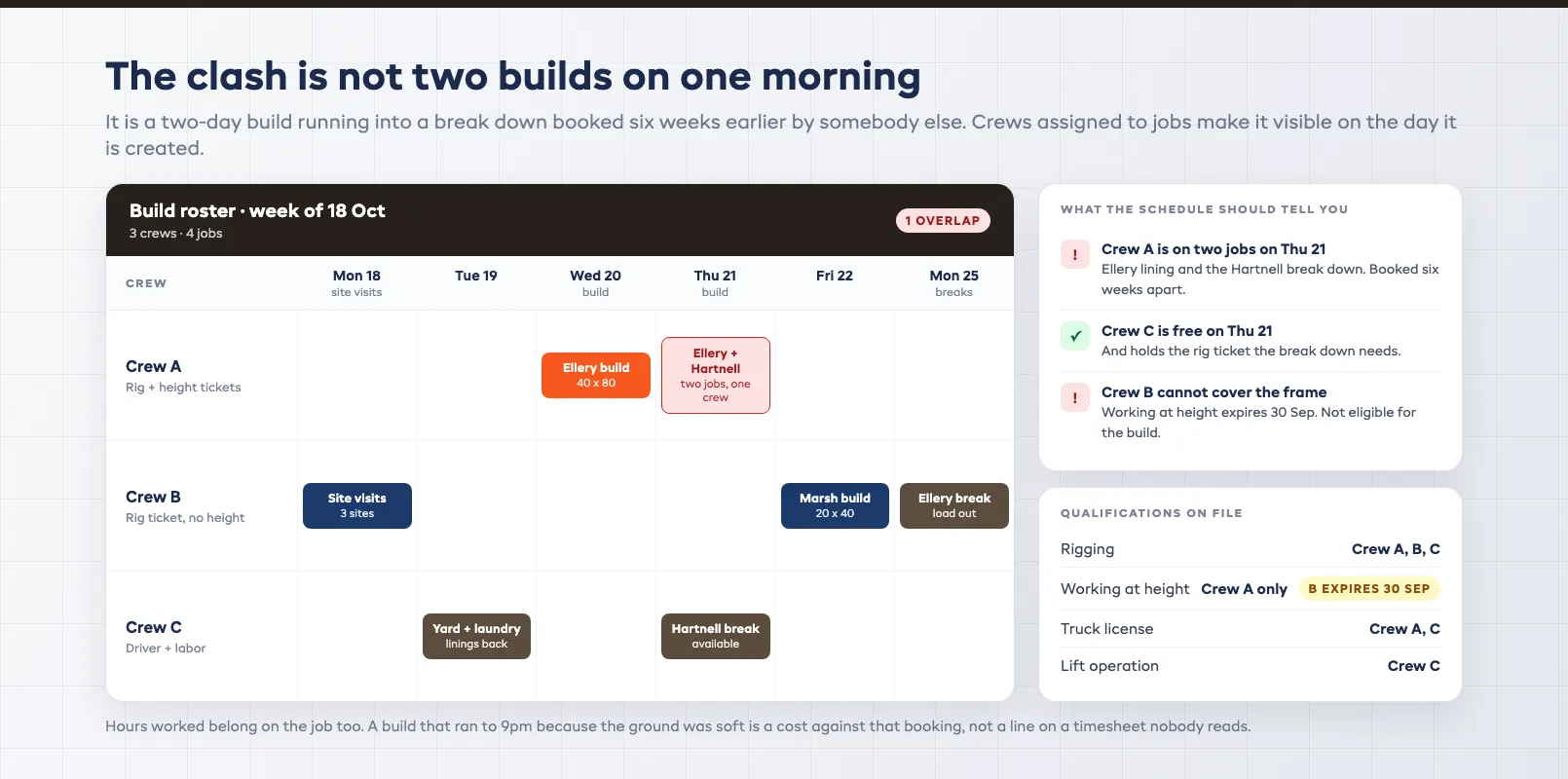
When crews sit on the same job record as the structure, all three get easier. The roster shows who is on which build and for which days. Certifications sit against the person with expiry dates so an out-of-date ticket surfaces before the morning of the build. And an overlap flags when it is created rather than when it bites. A Dash Agent can send the coming week's builds, breaks and crew assignments out every Thursday so the whole team starts the week with the same picture.
Hours belong on the job too. Marquee work is rarely a clean eight hours, and a build that ran to 9pm because the ground was soft is a cost against that job. Recording shifts against the booking rather than reconstructing them from memory at the end of the month is the difference between knowing your margin per structure and guessing it.
Site Visits Belong on the Job
Every marquee that goes up on ground you have not seen is a gamble. The visit is where you find the slope, the soft corner, the buried service, the gate that a 26-foot truck cannot get through, and the 130 feet of cable run nobody quoted for.
Site visits get lost because they do not look like bookings. They are half a day, one person, no stock, often weeks before anything else happens. So they go in a personal calendar, and then the person who did the visit is not the person who turns up to build, and the notes never travel.
Put the visit on the job and three things change. It shows on the schedule as committed time for whoever is doing it, which is how you stop a Monday disappearing into three unlogged site visits. The notes and the photos attach to the booking, so the build crew arrives already knowing about the slope and the gate. And access requirements make it into the quote before it is accepted rather than becoming an argument about a variation afterwards.
The practical version of this is a crew member standing in a field with a phone, adding photos and notes to the job in the app, and the office seeing them the same afternoon. That is worth more than a form that gets typed up on Thursday if anyone remembers.
When the Build Day Moves
Weather is not an edge case in this business. It is a weekly operating condition. High winds stop a build. Saturated ground stops a truck. A frame that cannot go up on Wednesday has to go up on Thursday, and that is where the rest of the job finds out how loosely it was connected.
Move a build day by 24 hours and all of this has to move with it:
- The crew assigned to that build, who may now clash with something else
- The van and the trailer
- The flooring and lining that were scheduled to follow the frame
- The client handover time on the Friday
- Sometimes the break day, if the schedule behind it is tight
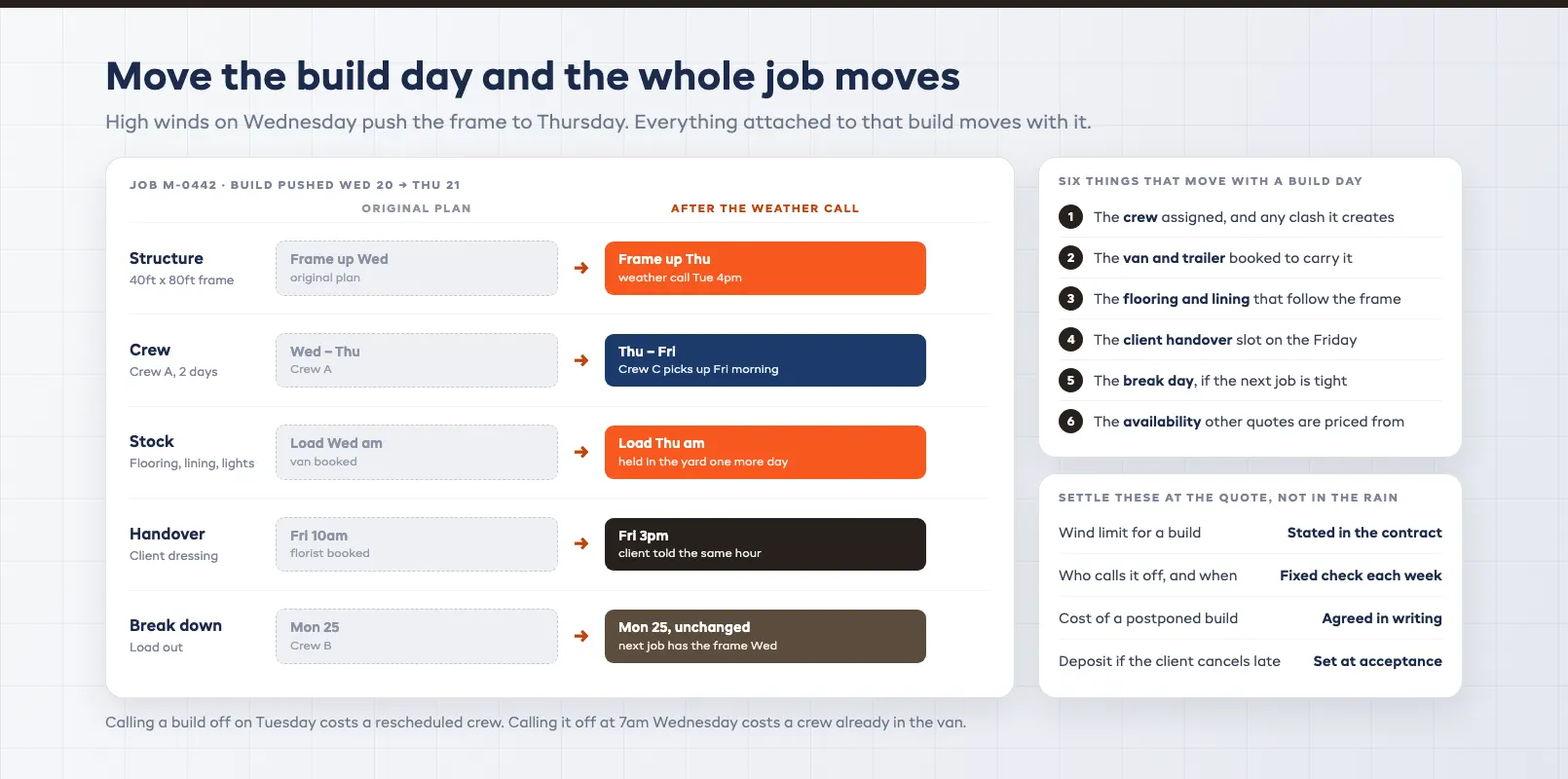
If those pieces live in one job, moving the build moves the commitment. If they live in four places, a weather call on Tuesday afternoon turns into two hours of phone calls and at least one thing that does not get told.
Contracts matter here as much as scheduling. Wind limits, the point at which a build is called off, who bears the cost of a postponed build, and what happens to a deposit if the client cancels after the frame is already loaded are all things to settle at the quote, in writing, signed. Handling it well when the weather turns is mostly about what you agreed when the sun was out.
Build a decision point into the week rather than improvising. Check the forecast against every build at a fixed time, decide, and tell the crew and the client in the same hour. The cost of calling a build off on Tuesday is a rescheduled crew. The cost of calling it off at 7am on Wednesday is a crew already in the van.
Quoted in November, Paid Before July
Marquee bookings are long-lead and high-value. A wedding is booked eight to eighteen months out. That is a long time for somebody to remember that a balance is due, and in most small operations that somebody is the owner.
The structure that works is staged, and it is tied to the event date rather than to the calendar month:
| Stage | Typical timing | Purpose |
|---|---|---|
| Deposit | On acceptance of the quote | Holds the structure and the dates |
| Interim | 3 to 6 months before the event | Spreads the client's cost, funds your season |
| Balance | 2 to 4 weeks before the build | Paid before the frame leaves the yard |
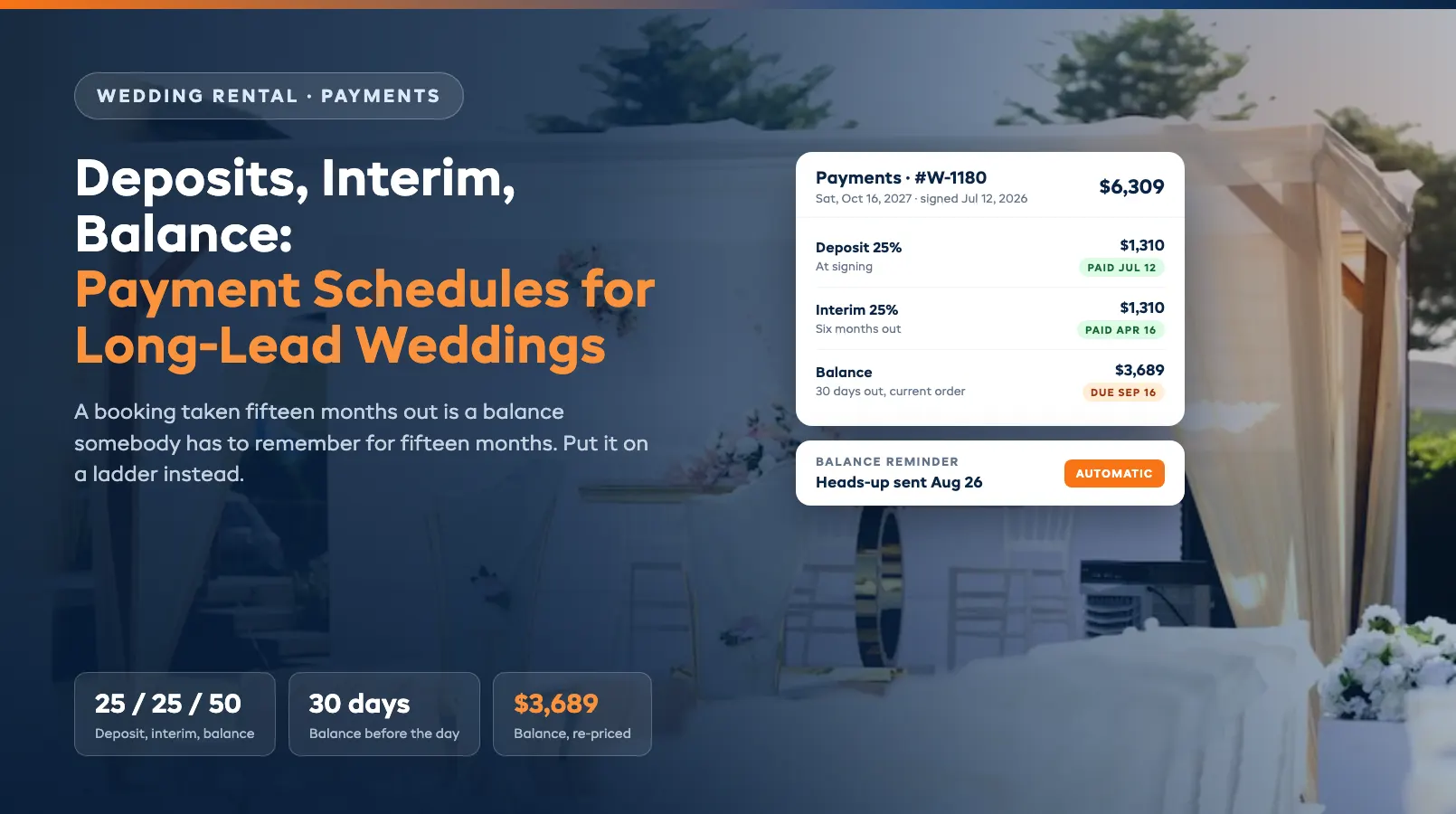
On an $8,400 job a 25% deposit is $2,100 at acceptance, an interim of the same size mid-way, and $4,200 due two weeks before the build. The client gets a schedule they can plan around. You get the money in before you incur the cost of the build.
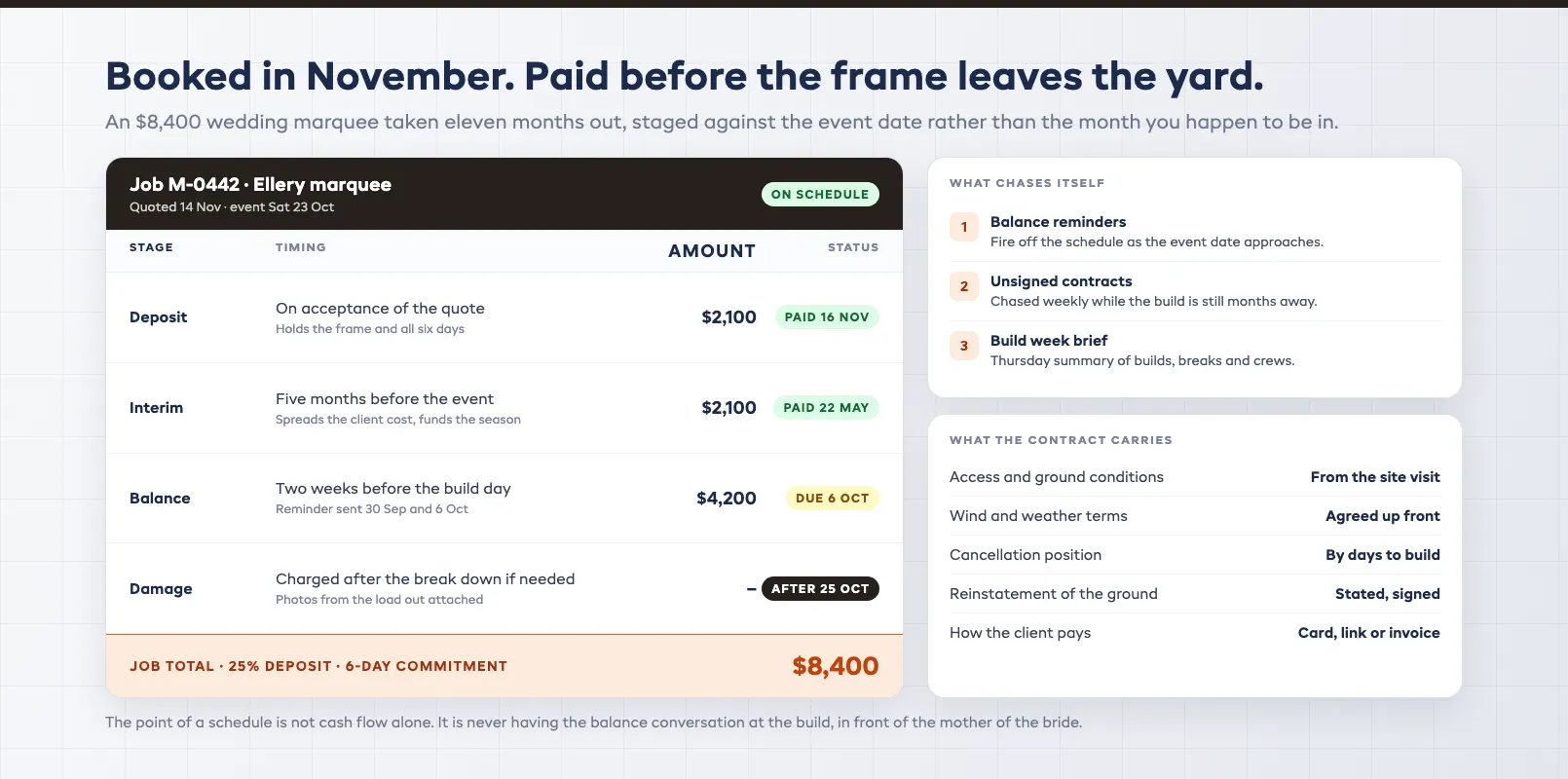
The chasing should not be a person's job. Reminders fire against the schedule, an agent follows up on an outstanding balance as the date approaches, and unsigned contracts get chased without anyone putting it on a list. What that buys you is not just cash flow. It is the absence of the conversation where a client arrives at the build day owing $4,200 and nobody wants to raise it in front of the mother of the bride.
Two more things belong in the same place as the payments. The quote should be built from real availability, so you are not pricing a structure that is committed elsewhere across the build week. And the contract should carry the access requirements, the wind and weather terms, the reinstatement position on the ground, and the cancellation terms, signed on screen rather than promised on the phone.
What to Check Before You Pick Marquee Hire Software
Most rental systems will demo well to a marquee company. The questions that separate them are all about the same thing: does the software understand that a booking is longer than an event?
- Can a booking block a structure across build and break days? If the answer involves a workaround, a note field or booking the event three times, it is not built for this.
- Does availability reflect the whole commitment? Ask what the diary shows for the Thursday in the middle of a Saturday job. If it shows the frame as free, you will double-sell it.
- Can crews be assigned to a specific build with specific days? Not a shift pattern. Named people, against a named job, on the days they are working.
- Do crew clashes surface before the week starts? Overlapping assignments should flag when they are made.
- Are certifications tracked with expiry dates? Rigging and working at height tickets go out of date quietly.
- Can site visits be scheduled on the job? With notes and photos that the build crew can see.
- Does moving a build date move the rest of the job? Test it in the demo. Move a build and watch what follows.
- Are flooring, linings, furniture and lighting booked on the same job as the frame? Separate lists mean separate mistakes.
- Is laundry turnaround handled as downtime? Linings that are back but not clean must not be sellable.
- Can payments be staged against the event date and chased automatically? For bookings taken a year in advance, this is the whole game.
- Can the crew work from a phone on site? Photos, sign-offs, job updates and taking a payment at the build.
- What does it cost across a season? Check the subscription and the transaction cost together on the pricing page rather than just the headline monthly figure.
If you want a shortcut through that list, the software designed around multi-day builds already answers most of it. EquipDash for marquee and tent hire holds the structure across the whole commitment, puts the crew and the site visit on the same job, moves everything together when a build date changes, and runs the payment schedule for long-lead bookings without anyone chasing it by hand.
The test is simple. Open the diary on a random Thursday in peak season. If it tells you the truth about what is in the yard, the software is doing its job.
FAQ
What is marquee hire software?
It is the system a marquee or tent company runs on: which structures are committed and for which days, which crew is on each build, what has been quoted, what has been paid, and what still needs chasing. The thing that separates it from general rental software is that a booking holds the structure for the build and break days as well as the event itself, so availability reflects the full commitment rather than the day the client cares about.
Why does a one-day event block a marquee for six days?
Because the structure has to be transported, erected, dressed, left standing through the event and then taken down. A typical private wedding runs to a site visit earlier in the week, a two-day build, the event, and a break down on the following working day. The frame, the flooring, the lining and the lighting are all unavailable for that entire window, which is why a calendar built around the event date will show stock as free when it is physically on a field an hour away.
How should build and break days be handled in a booking system?
They should be part of the booking, not a note attached to it. The job carries the site visit, the build days, the event days and the break day, and the structure is blocked across all of them. That way the diary shows the frame as committed on the Wednesday and the Thursday, quotes are built from real availability, and moving one date moves the rest of the job with it.
How do you stop crews being double-booked across two builds?
Assign crews to the job rather than to a day, and flag overlaps when the assignment is made. The common clash is not two builds starting on the same morning. It is a two-day build that runs into a break down booked weeks earlier by someone else. When both sit against the same schedule, the overlap shows up at the point of booking instead of at 7am on the day, and a weekly build brief gives the whole team the same picture before the week starts.
What happens to a booking when weather forces a build to move?
Everything attached to the build should move with it: the crew, the vehicle, the flooring and lining that follow the frame, the handover time, and the break day if the schedule behind it is tight. If those pieces live in one job that takes a minute. If they live in separate calendars and spreadsheets, it takes an afternoon of phone calls and something gets missed. The commercial side should be settled in advance too, with wind limits, cancellation terms and who bears the cost of a postponed build written into the signed contract.
How should payments be structured for a wedding booked a year in advance?
In stages tied to the event date rather than to the month you happen to be in. A deposit on acceptance holds the structure and the dates, an interim payment a few months out spreads the client's cost and funds your season, and the balance falls due a couple of weeks before the build so the frame does not leave the yard unpaid. Reminders should fire off that schedule automatically, because a balance due in July on a booking taken last November is not something anyone should be tracking in their head.
Can flooring, linings and furniture be booked on the same job as the frame?
They should be. Flooring, linings, drapes, furniture, lighting, heating and power leave on the same truck and are committed for the same days as the structure, so booking them on the same job is what keeps the package together. Linings need one extra rule: block them as downtime while they are being cleaned, so a set that came back on Monday is not offered to a client for Friday before it is back on the rack.
Do marquee companies need site visits scheduled in the system?
Yes, for two reasons. A site visit is committed time for a crew member and belongs on the schedule alongside the builds, otherwise three of them quietly swallow a Monday. And the notes and photos from the visit need to reach the build crew, who are often different people turning up weeks later. Access constraints, ground conditions and cable runs found on the visit also need to reach the quote before it is accepted rather than becoming a variation argument afterwards.
in one place