Rental Business Insurance: What Operators Actually Need (and What They Don't)

Rental Business Insurance: What Operators Actually Need (and What They Don't)
The renewal questionnaire turns up in February and asks eleven questions you cannot answer from memory. How much of last year's revenue came from guided trips rather than straight rentals. How many people you employed and how many were contractors. What your fleet is worth. What percentage of customers signed a waiver. How many incidents you logged and what you changed after each one.
Most operators guess. The guesses get typed into a form, the premium comes back, and everyone moves on. Then a claim happens, the adjuster reads the policy against the application, and it turns out the activity that produced the claim was never in the class the policy was rated for.
That is the real failure mode with rental insurance. Not being uninsured. Being insured for a slightly different business than the one you actually run, and not knowing it until the claim is on the table.
This is general information about how these policies are put together, not legal or insurance advice. Coverage terms vary by carrier, state and policy form, and the words in your own declarations and endorsements are the only ones that count. Use this to have a better conversation with your broker, not to replace them.
Your Insurance Is a Stack, Not a Policy
Operators talk about "my insurance" as if it were one thing. It is usually four or five separate policies, each covering a narrow slice, with seams in between where claims fall through.
General liability pays when someone who is not your employee gets hurt or has their property damaged, and you are alleged to be responsible. It pays their claim and it pays your defense. It is the policy the hotel partner, the marina and the city permit office all want to see.
Commercial property covers the building, the fit-out and the contents at a fixed address. Fire, theft, storm, at the location named on the policy. Note "at the location," because that is the seam.
Inland marine is the one most rental operators have never heard of and most rental operators need. Despite the name it has nothing to do with boats. It is the family of policies that covers property that moves, which is the exact description of a rental fleet. Your kayaks on a trailer, your bikes out with customers, your gear in a van are usually outside your property policy and inside this one.
Commercial auto and hired or non-owned auto. The shuttle van needs commercial auto. The part-timer running a customer back to the trailhead in their own car is what hired and non-owned is for, and it is cheap and routinely missing.
Workers compensation covers your own staff when they get hurt. Your general liability policy specifically will not. Most states require it once you have employees, and whether a seasonal guide you pay as a contractor is treated as an employee is decided by the state and the claim, not by the label on the invoice.
Umbrella or excess liability sits on top of the others and adds limit. It pays nothing until the policy underneath it is exhausted, and it only sits on top of the policies scheduled in it.
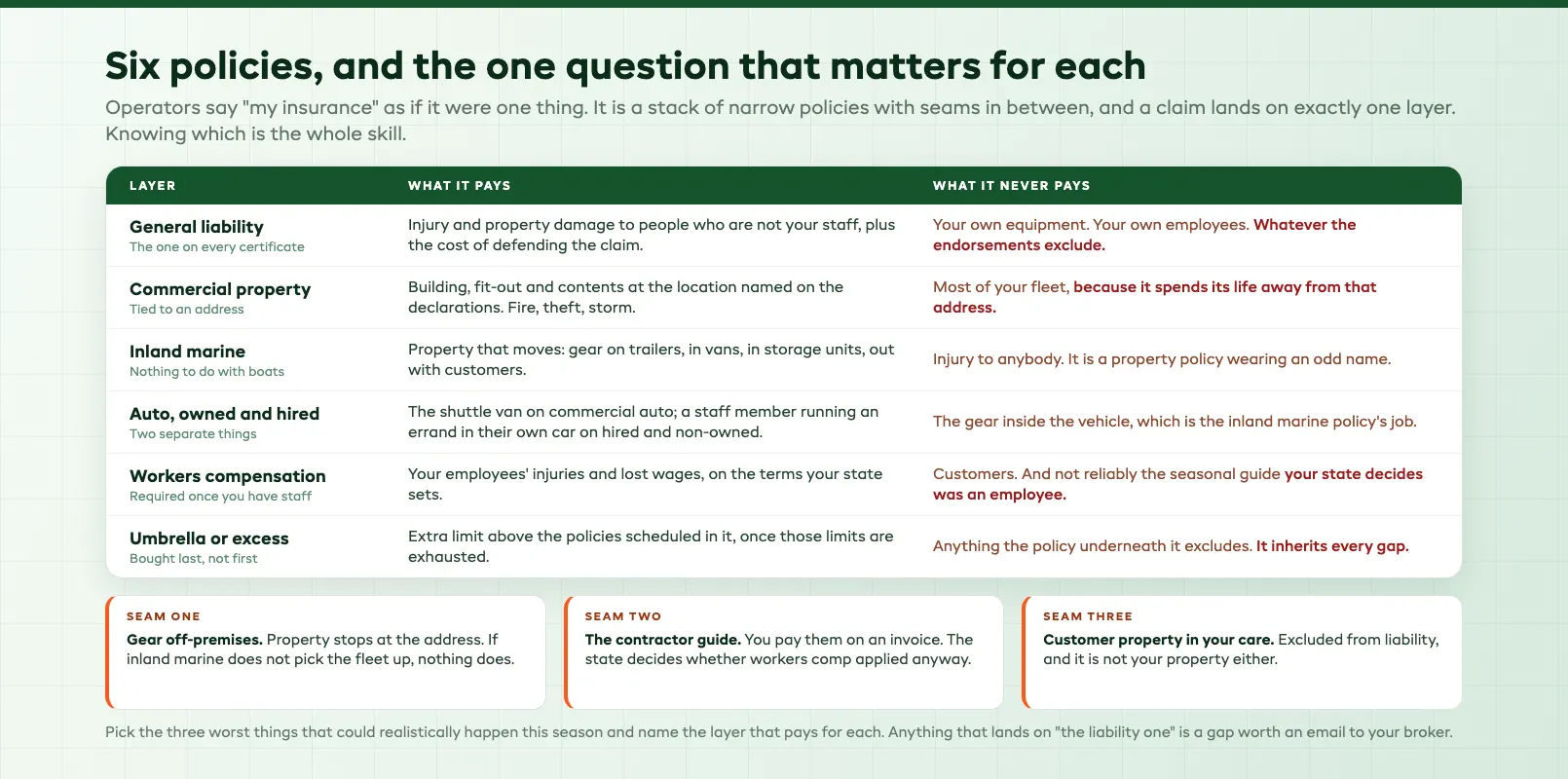
The useful exercise is not learning the names. It is taking the three worst things that could realistically happen in your operation, and naming which layer pays for each. A customer breaks an ankle on your dock. A van fire takes out twelve bikes overnight. A staff member wrecks a shoulder loading a trailer. If any of those three lands on "I think it's the liability one," you have a gap, and it is cheaper to find it in February than in July.
General Liability: Read the Exclusions, Not the Limit
Everyone can recite their limit. A million per occurrence, two million aggregate, which is the standard request and what most partners ask to see on a certificate. Almost nobody can name their exclusions, and the exclusions are the policy.
A few matter more than others for this industry.
Participation in the activity. Many policies written for activity and lesson businesses carry an endorsement excluding injury to participants in the activity itself. Read that slowly. A policy that covers a visitor slipping in your car park, but not a customer hurt during the lesson you sold them, is covering the risk you do not have and excluding the one you do. This is the single most important page in your policy. Find it and read it before anything else.
Instruction as a professional service. Once you are teaching rather than renting, a claim can be framed as bad advice rather than a physical hazard, and professional services exclusions can come into play. If lessons, guiding or coaching are a real part of your revenue, ask directly whether instruction is covered on the form you have.
Care, custody and control. Damage to a customer's property while it is in your hands is usually excluded. Storing customer boats over winter, holding bikes overnight between tour days, taking in gear for a tune are all this exclusion, and they all read like ordinary parts of the job.
Watercraft and aircraft. A standard liability form generally steps back from injuries arising out of watercraft you own or operate over a certain size. If anything you do happens on the water under power, assume you need marine liability alongside, and confirm rather than hope.
Contractual liability. Read your marina lease, your hotel partnership and your event contracts for what you promised to indemnify. You cannot insure a promise your policy does not cover, and operators sign these without checking whether their policy backs the promise.
Liquor. If you pour anything at a sunset cruise or a corporate day, a standard form's liquor exclusion applies, and host liquor coverage is a separate conversation.
Then three mechanics that decide whether your limit is really your limit.
Defense costs may sit inside the limit or outside it. If they are inside, a claim that costs $180,000 to defend and settles at $120,000 has consumed $300,000 of your million, and you would never know from the certificate. Ask which yours is.
The aggregate is the season's total, not the per-claim figure. Two moderate claims plus defense can exhaust an aggregate by August, and nothing refills it until renewal.
Occurrence versus claims-made changes what happens when you switch carriers. An occurrence form responds to injuries that happened during the policy period whenever the claim shows up. A claims-made form only responds if the claim is reported while the policy is live, which is why switching off a claims-made policy raises the question of tail coverage for the seasons behind you.
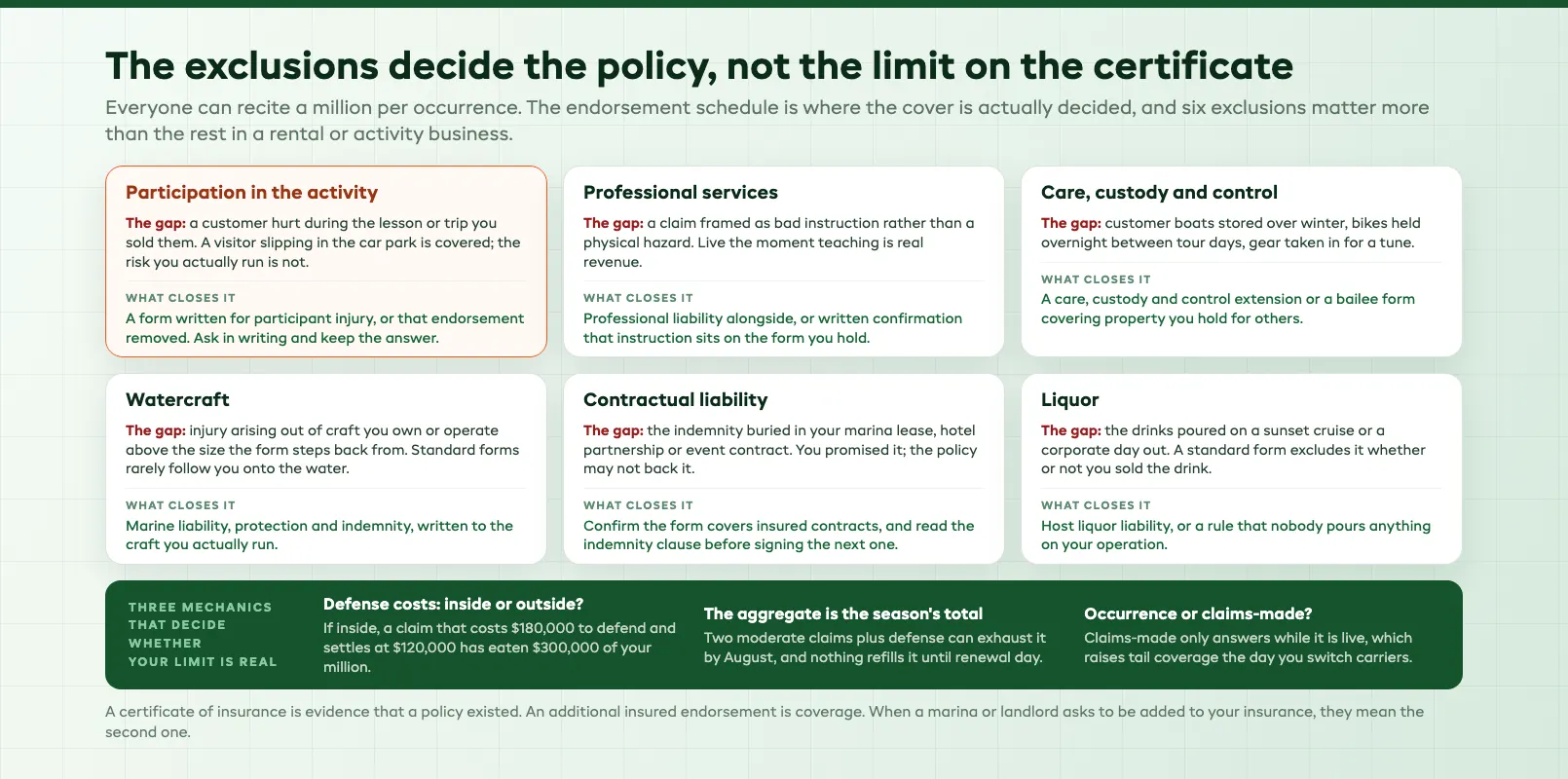
One more piece of vocabulary worth owning, because operators get it wrong in both directions. A certificate of insurance is evidence. It proves a policy exists on the day it was issued and confers nothing on the person holding it. An additional insured endorsement is coverage, and it is what a landlord, marina or municipality actually needs if they want your policy to defend them. When a partner asks to be "added to your insurance," they mean the endorsement. When they ask for a certificate and you send one, nobody has been added to anything.
Your Gear Is Not Covered by Your Liability Policy
This is the most common flat-out gap in a rental business, and it is worth stating plainly: general liability pays for harm you cause other people. It does not pay to replace your own equipment. Ever. For anything.
Your fleet is covered, if it is covered at all, by a property or inland marine policy, and four details decide whether the payout resembles the loss.
Where the gear was when it was lost. A property policy tied to your shop address may cover very little once the item is on a trailer, in a customer's hands or in a storage unit across town. Rental equipment spends most of its life away from the address on the policy. That is the whole point of the fleet.
Replacement cost or actual cash value. Actual cash value pays depreciated value, which for a four-year-old bike is a fraction of what a new one costs you in a market where you have to buy it in March. Replacement cost costs more in premium and is usually what you want on a fleet you must keep at full strength through the season.
Blanket limit versus a scheduled list. A schedule lists every item and its value. It is precise on day one and stale by July, because every purchase and disposal is an endorsement somebody has to remember to file. A blanket limit with a per-item sublimit covers the whole fleet against one number, and there is one number to keep current. For a fleet of 300 similar items, blanket is almost always the sane choice.
What counts as an occurrence, and the deductible attached to it. Twelve bikes stolen from one van is one claim with one deductible. Twelve bikes stolen from twelve customers across a season is twelve claims and twelve deductibles, which can add up to more than the loss.
Whichever structure you pick, the insurer will eventually want a fleet list with values, ages and serial numbers, and so will you the day after a theft. An asset register you already maintain for fleet management is the same document that supports the claim, which is a good reason for it to live somewhere other than a spreadsheet on one laptop.
There is a related number most seasonal operators leave uninsured, and it is bigger than their fleet. Business interruption, or loss of income, pays when a covered event stops you trading. A shop that loses six peak weeks loses most of the year, and the equipment payout does not touch that. When you price it, remember that a closure does not only cost you sales you never made. It also leaves you owing service to people who have already paid, including deposits and any outstanding gift card and voucher balances, which are real liabilities sitting on your books whether you are open or not.
What Operators Get Oversold
Brokers are not villains, but some of them sell packages, and packages have line items that are easy to add and hard to justify. Six worth questioning.
Excess liability bought before the primary policy is fixed. An umbrella only pays after the underlying limit is gone, and it only responds to what the underlying policy covers. Five million of excess over a liability policy that excludes participant injury buys you five million of the same exclusion. Spend the money on the primary form first, then buy limit on top.
Cyber cover at a token sublimit. If payments run through a hosted processor and no card numbers ever land in your system, your breach exposure is mostly your customer list and your email. That is real, and a $25,000 sublimit bolted onto a package will not fund a response to it. Either buy a standalone limit sized to your record count or put the premium into two-factor authentication and not storing what you do not need. A $25,000 sublimit mainly buys the feeling of being covered.
Employment practices cover for a business with three summer staff. Genuinely important once you have a real payroll and managers making hiring decisions. Thin for an owner-operator with two seasonal hires, especially when the retention is $10,000 and the claims it would face would settle for less than that. Ask what the retention is before you agree to the line.
A scheduled equipment list you will not maintain. Covered above, but it belongs here too, because it is sold as precision and delivered as a clerical job nobody does. A schedule that is six months stale is worse than a blanket limit, because you will find out which items are missing during the claim.
Customer damage protection sold to you as insurance. Charging customers a non-optional damage fee that you keep is a contractual damage waiver, not an insurance product, and how it can be described and sold varies by state. Keep it labeled honestly in the rental agreement, price it as what it is, and ask your broker before anyone calls it insurance in your marketing.
Three separate policies from three carriers because each was bought in a different panic. Small operators end up here by accident. A package policy that bundles property and liability is often cheaper and, more importantly, has fewer seams between forms for a claim to fall into.
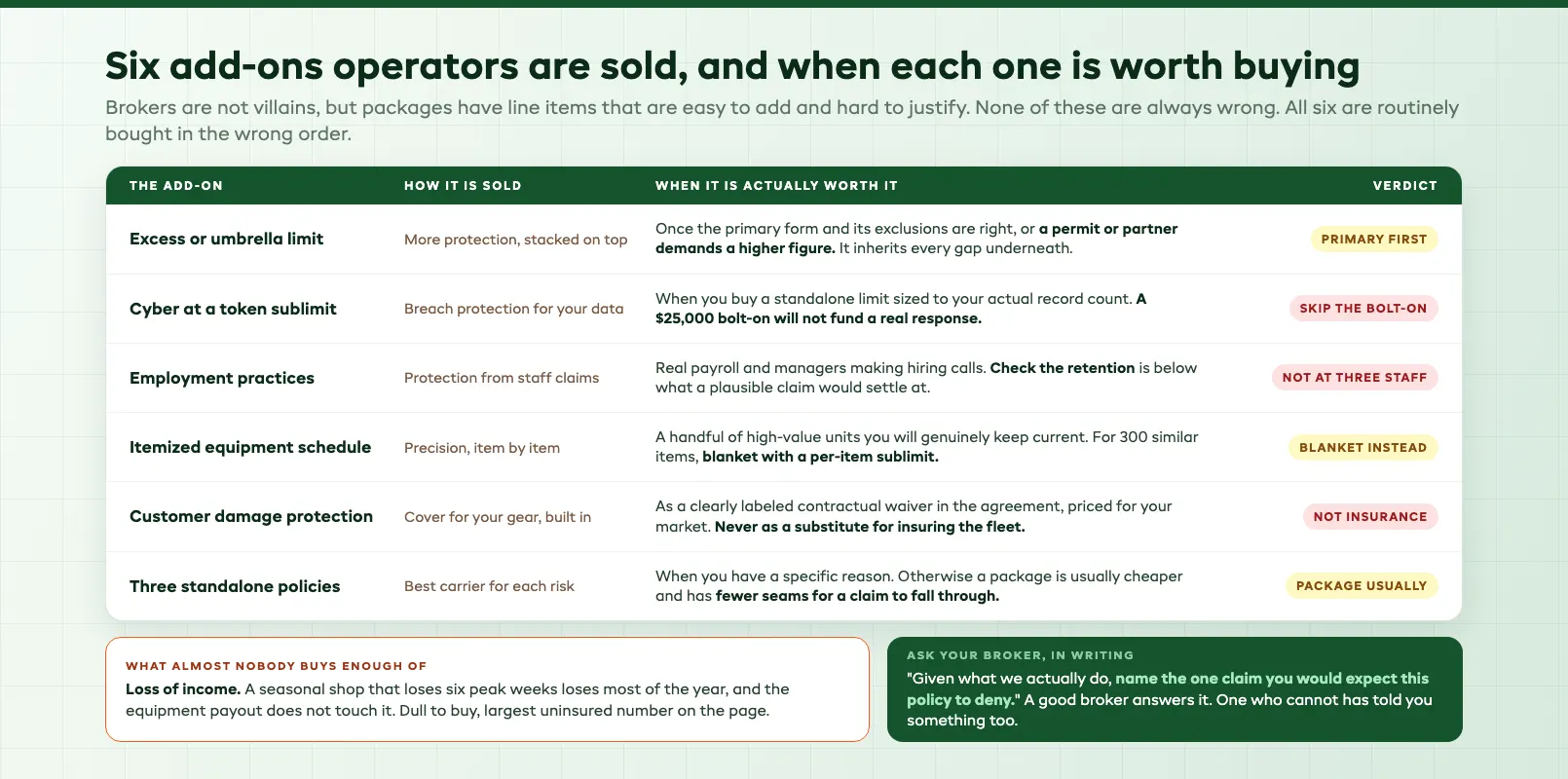
The flip side is the thing almost nobody buys enough of. For a seasonal business, loss of income is usually the largest uninsured number on the page, and it is dull to buy because it protects revenue rather than objects. Price it properly before you spend another dollar on add-ons.
Waivers and Insurance Do Different Jobs
Operators treat these as substitutes. They are sequential, and each does something the other cannot.
A waiver works before the claim, on the question of whether you should be liable at all. Insurance works after the claim, on the question of who pays. A signed waiver does not stop a claim being filed and it does not pay a dollar of anything. What it can do is get a claim dismissed earlier, which lowers the defense cost, which is the number that quietly destroys liability limits.
Three limits on waivers that are worth knowing before you rely on one. Enforceability varies significantly by state, and a handful of states are openly hostile to pre-injury releases. Gross negligence and reckless conduct are generally not waivable anywhere, so a waiver never covers you for skipping the brake check. And a parent signing away a minor's future claim is not reliably enforceable in every state, which matters for any operator whose customers are largely families.
None of that makes waivers optional. It makes the quality of the record decisive. A waiver that helps you is one you can produce, with the date and time it was signed, tied to the specific booking and the person who actually went out. A blurry scan of a clipboard sheet with nine names on it does not do that job. Insurers ask about this directly, and some price it, because a business where nearly every customer signs before arrival is a different risk to one where the counter staff get signatures when they remember.
That is the practical case for waivers signed on the customer's phone before they arrive. The signed document attaches to the booking and the customer profile with its timestamp, a consent tracker shows which upcoming bookings still have someone outstanding and chases them automatically until they sign, and signed PDFs can sync out to your own Google Drive folder so you keep a copy that outlives any one system. If you are still collecting signatures on paper, moving waivers online does more for your insurance position than any endorsement you can buy, and it costs less.
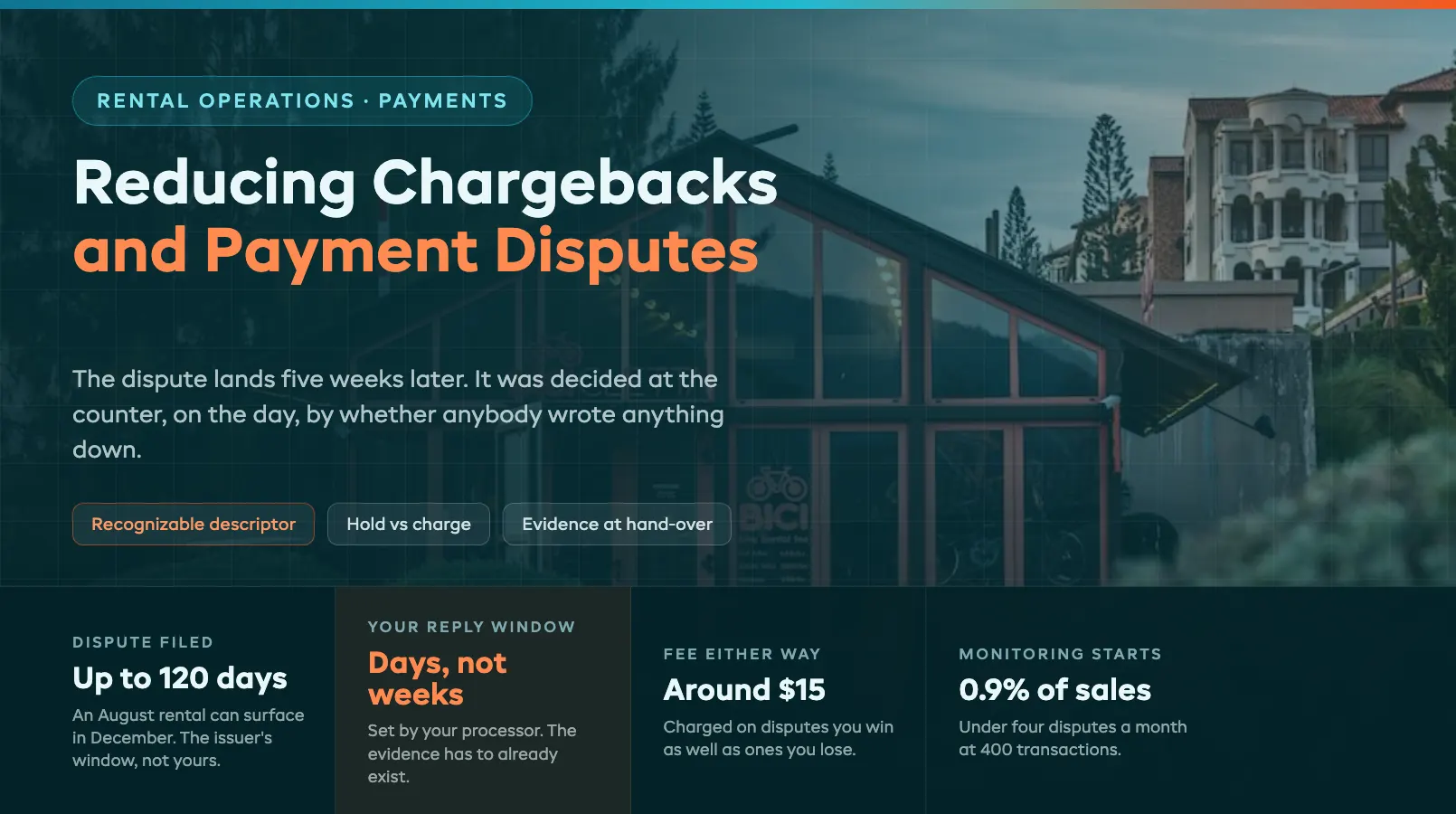
Two more habits belong next to the waiver. Log every incident, including the ones where nobody was hurt, with what happened and what you changed afterwards. And photograph equipment at hand-over, which is the same evidence that wins a payment dispute months later and the same evidence an adjuster asks for when a customer says the gear was faulty.
What the Underwriter Actually Asks For
Renewal is the one moment each year when your records become money. The questions are predictable, so the file can be ready.
Revenue split by activity type. Pure rental, guided, instruction, transport, retail. This drives your classification, and misclassification is the fastest route to a repriced policy mid-term or a denied claim. If guided trips grew from 5% to 30% of revenue and nobody told the carrier, that is the problem to fix this week.
Payroll and headcount by role, employees separated from contractors. With how the contractors are engaged, because the state may disagree with your label.
Fleet list with values, ages and counts. Same document as your asset register.
Your waiver form and how consistently it is signed. The form itself, plus an honest answer on coverage. "Roughly 95%, signed before arrival, attached to the booking" is a different answer to "we have a form."
Documented pre-rental inspection and maintenance intervals. Not a claim that you maintain things. Intervals per item type and a record showing they were followed. In practice that looks like service intervals set per product with a history behind each item, an item going unbookable while it sits in the workshop, and a standard inspection checklist with the safety-critical items flagged so the same checks happen whoever is on shift.
Your incident log, with the corrective action. An operator who logs eight near misses and can show what changed after each one presents better than one who reports none, because nobody believes the zero.
Staff qualifications and who signs off on them. Whatever certification your activity requires, with expiry dates you track rather than discover.
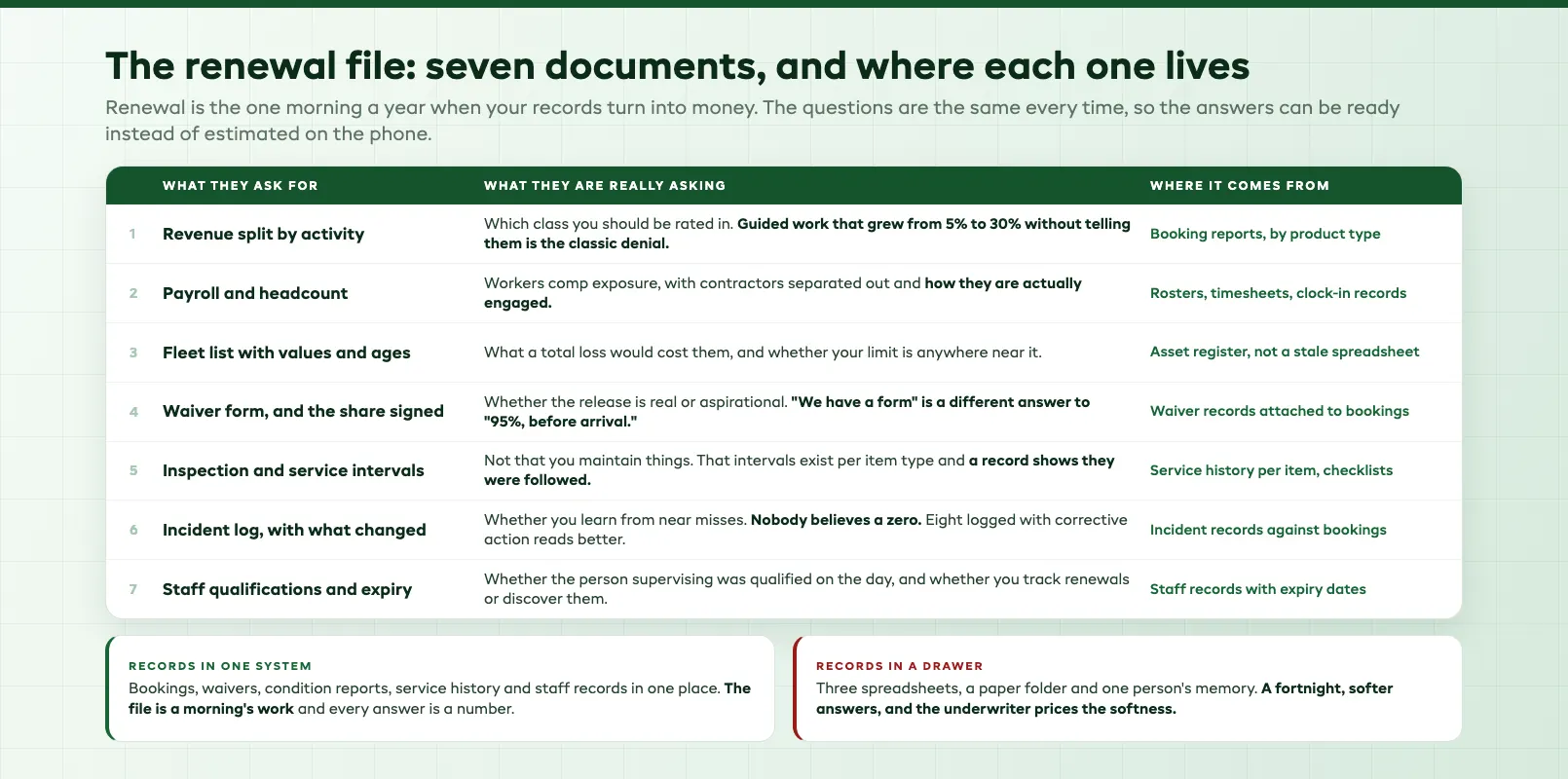
Notice what all seven have in common. Every one is a byproduct of running the operation in a system rather than in habits and memory. If bookings, waivers, condition reports, maintenance history and staff records live in one place, the renewal file is a morning's work. If they live in a drawer, three spreadsheets and one person's head, it is a fortnight, and the answers will be softer, which the underwriter prices. This is one of the less obvious arguments for running the shop on software: the operational record and the insurance record are the same record.
Reading Your Declarations Page in Ten Minutes
You do not need to read the whole policy. You do need to read the declarations and the endorsement schedule, and it takes about ten minutes once a year.
Work through it in this order. Named insured: is it every legal entity you actually trade through, including the one that owns the vans. Description of operations: does it describe what you do now, not what you did when you first bought the policy. Per-occurrence and aggregate limits, and whether defense costs erode them. Deductible per claim, and what counts as one claim. Occurrence or claims-made, and whether you have a tail exposure from a previous carrier. The endorsement schedule, which is where the exclusions that matter are added, including the participant exclusion. Additional insureds, and whether every partner who needs to be there is there. Policy period and whether it spans your season or splits it, because a renewal date in the middle of July is a bad idea for reasons that become obvious in July.
Then ask your broker three questions in writing and keep the answers. Is injury to a participant in our activities covered. Are defense costs inside or outside the limit. Given what we actually do, name the one claim you would expect this policy to deny.
That last question is worth more than any checklist. A good broker will answer it. A broker who cannot is telling you something too.
None of this is about buying more insurance. It is about knowing which layer pays for what, closing the two or three gaps most rental operators share, declining the add-ons that are sold on fear, and keeping the records that turn a renewal from a guess into an answer. The gap you can name is cheap to close. The one you find during a claim is not.
If your waiver, inspection, incident and fleet records currently live in several places, that is the part to fix before your next renewal, and it pays for itself in half a dozen other ways at the counter. EquipDash pricing starts at $23 a month on annual billing, with waivers, condition reports, maintenance history and bookings in the same system.
FAQ
What insurance does a rental business actually need at minimum?
For most operators the base is general liability for third-party injury and property damage, a property or inland marine policy that covers the fleet while it is away from your address, and workers compensation once you have employees. Add commercial auto if you own vehicles and hired or non-owned auto if staff ever drive their own cars for work. Beyond that it depends on what you do: on-water activity usually needs marine liability alongside general liability, and instruction may need professional liability. The order matters more than the list. Get the primary forms right for the activities you actually run before you spend anything on excess limit or optional add-ons.
Does general liability insurance cover my rental equipment?
No. General liability pays for harm you cause other people, not for replacing your own property. Equipment losses fall under a property or inland marine policy, and which one matters because a property policy is usually tied to the address on the declarations while a rental fleet spends its life on trailers, in vans and in customers' hands. Check three things on whatever covers your gear: whether it is covered off-premises, whether it pays replacement cost or depreciated actual cash value, and whether the fleet is insured on a blanket limit or an itemized schedule somebody has to keep current.
Do waivers replace the need for liability insurance?
They do different jobs at different times. A waiver addresses whether you should be liable and can get a claim dismissed earlier, which reduces defense costs. Insurance pays the claim and the defense once one is filed. A waiver never pays money and never stops a claim being filed. Enforceability also varies by state, gross negligence is generally not waivable anywhere, and a parent's pre-injury release on behalf of a minor is not reliably enforceable everywhere. Carry both, and treat the waiver's value as depending entirely on whether you can produce the signed record with its timestamp for the specific customer and booking.
Why would an insurer deny a claim from a rental business?
The two common reasons are both avoidable. The first is classification: the activity that produced the claim was not part of the operations the policy was rated for, usually because guided trips, lessons or on-water work grew after the policy was written and nobody told the carrier. The second is an exclusion nobody read, most often an endorsement excluding injury to participants in the activity itself, or a care, custody and control exclusion applying to customer property you were storing. Both surface at the claim. Both are found in ten minutes by reading the declarations and the endorsement schedule at renewal.
What does an underwriter want to see at renewal?
Revenue split by activity type, payroll and headcount with contractors separated from employees, a fleet list with values and ages, your waiver form plus an honest figure for how consistently it is signed, documented inspection and maintenance intervals with a history showing they were followed, an incident log including near misses with the corrective action you took, and current staff qualifications with expiry dates. Every one of those is a byproduct of running the operation in one system. Operators who can produce the file in a morning get better conversations and better pricing than operators who have to reconstruct it from memory.
Is an umbrella policy worth buying for a small rental operator?
Only once the policy underneath it is right. Excess liability pays nothing until the underlying limit is exhausted and it responds only to what the underlying policy covers, so buying five million of excess over a primary policy that excludes participant injury buys five million of the same exclusion. It also only sits above the policies scheduled in it, which means a gap in the primary stack stays a gap. Fix the primary forms and the exclusions first. Then buy limit on top, which is usually inexpensive, particularly if a partner or a permit requires a higher figure than your primary carries.
What is the difference between a certificate of insurance and being named as an additional insured?
A certificate is evidence that a policy existed on the day it was issued. It gives the holder no rights under your policy and no protection. An additional insured endorsement actually extends your coverage to that party, so your policy can defend and indemnify them for claims arising out of your operations. When a marina, landlord, hotel partner or municipality asks to be added to your insurance, the endorsement is what they mean. Sending a certificate is not the same thing, and if a contract requires the endorsement and you only supplied a certificate, you are in breach of the contract as well as uninsured for the risk you agreed to carry.
Can I charge customers a damage fee instead of insuring the equipment?
They are separate mechanisms and a fee is not a substitute for cover. A non-optional damage fee you keep is a contractual damage waiver, not an insurance product, and the rules on how it can be described and sold vary by state, so it belongs in the rental agreement clearly labeled for what it is rather than marketed as insurance. It also only addresses customer-caused damage. A van fire, a theft from a storage unit or storm damage to the fleet is nothing to do with a customer and needs a property or inland marine policy behind it. Charge the fee if it suits your market, and still insure the gear.
How often should I review my rental business insurance?
Once a year at renewal as a minimum, working through the declarations and the endorsement schedule rather than the certificate. Review it out of cycle whenever the business changes in a way the carrier was not told about: adding guided trips or lessons, buying a vehicle, opening a second location, taking on employees where you previously used contractors, starting to store customer equipment, or a fleet value that has moved materially. Those changes are what create the gap between the business described on the policy and the business you run, and that gap is where denied claims come from.
in one place