Private Tour vs Group Tour: Two Businesses, Different Unit Economics
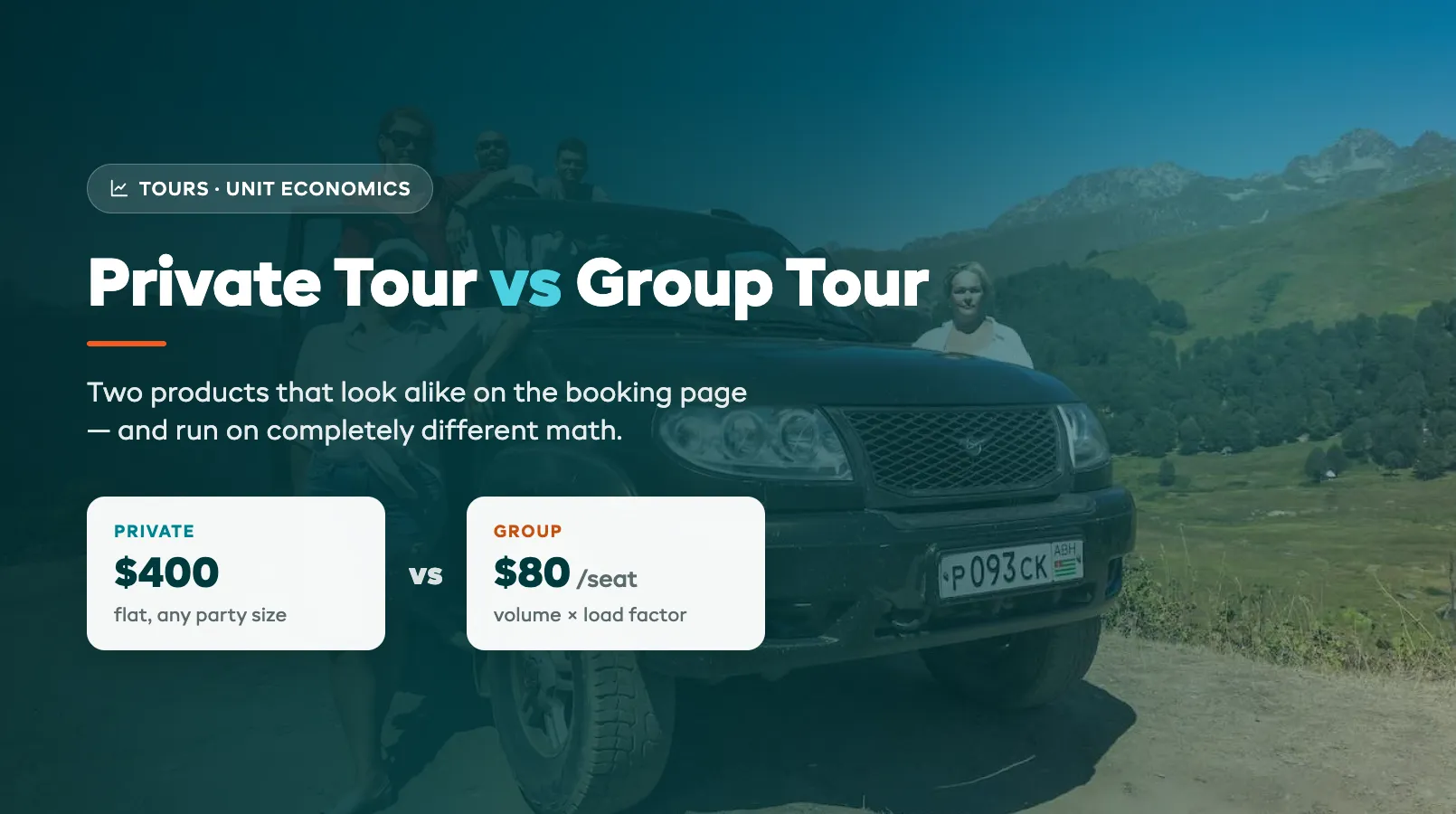
On the booking page, a private tour and a group tour can look almost identical — same guide, same route, same two hours on the water or the trail. Under the hood they're two completely different businesses. One sells a small number of high-value experiences. The other fills seats at a lower price and makes its money on volume. The customers want different things, the staffing math is different, the marketing channels are different, and the booking calendar behaves differently.
Operators get into trouble when they treat the two as one product with two price tags. You end up pricing the private tour like a padded group tour, or running a group operation with the hands-on service of a private one, and the margins quietly leak away. This guide breaks down where the economics actually diverge, so you can run each one on its own terms. For the wider operating picture, start with how to run a tour operator business.
Customer Profile: Who Actually Books Each One
The two products attract different people for different reasons, and that shapes everything downstream.
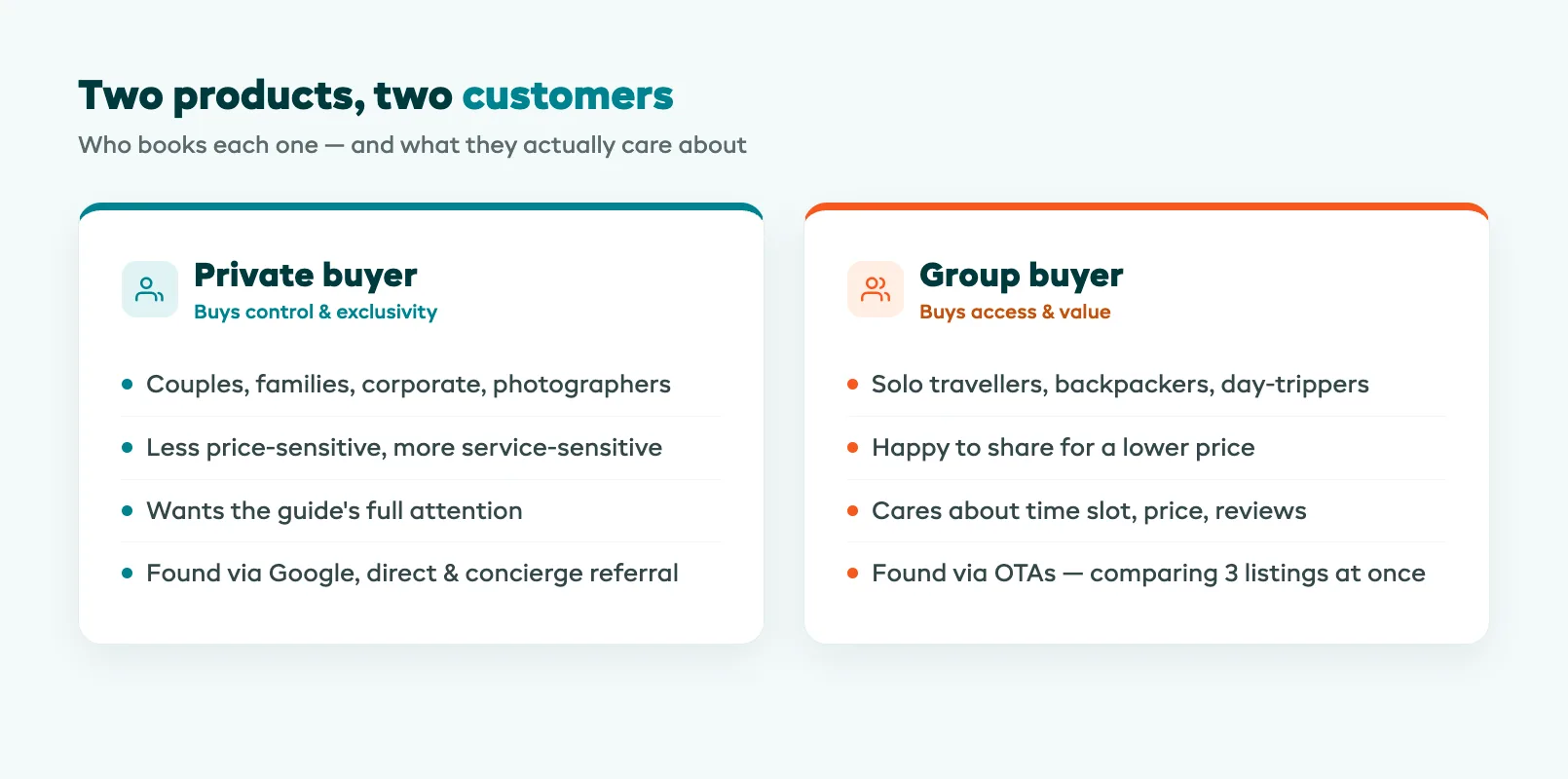
Private tour customers are buying control and exclusivity. They're couples celebrating an anniversary, families who want the guide's full attention, corporate groups, photographers who need to stop where they like, or travelers who simply don't want strangers on their trip. They're less price-sensitive and more service-sensitive — a clumsy booking experience or a vague itinerary will lose them faster than a high price will.
Group tour customers are buying access and value. Solo travelers, backpackers, cruise-ship day-trippers, and budget-conscious couples are happy to share the experience if it means a lower price and a fixed, easy-to-book departure. They care about the time slot, the price, and the reviews — in roughly that order. They expect a smooth, self-serve booking and they're comparing you against three other listings in the same tab.
Knowing which customer you're really serving tells you where to spend. Private buyers reward responsiveness and a premium feel. Group buyers reward availability, social proof, and frictionless checkout. Glossary terms like load factor and per-guest yield are worth getting straight here — the tour operator glossary defines the ones this article leans on.
Revenue Per Hour: The Number That Decides Everything
The single most useful comparison isn't price per ticket — it's revenue per guide hour. That's what tells you which product is actually paying your bills.
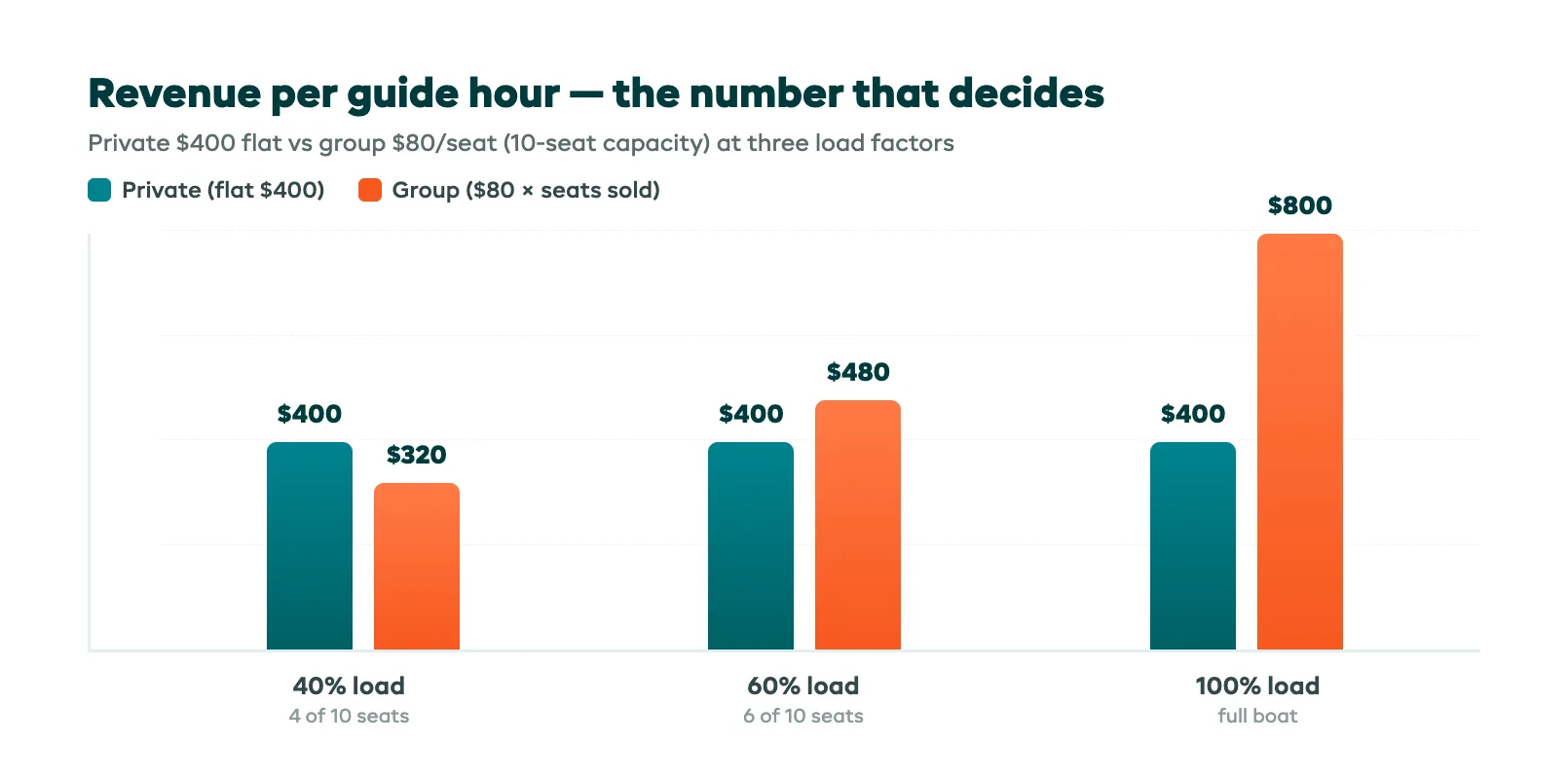
Take a simple example. A private half-day tour sells for $400 flat, regardless of party size. A group tour on the same route sells for $80 per person and seats up to 10. On paper the group tour looks far better: a full boat is $800, double the private rate. But group tours rarely run full. At a realistic 60% load factor you're carrying 6 guests, or $480 — still ahead of the private tour, but the gap has closed. Drop to 4 guests on a slow midweek morning and the group tour earns $320, now behind the private booking that was guaranteed at $400.
That's the whole game in one paragraph. Private tours give you a high, predictable floor per departure. Group tours give you a higher ceiling that you only reach when the boat fills. The operator's real job is knowing their average load factor by day and season, because that number decides which product to push and when. The math behind setting those numbers lives in tour operator pricing strategy.
Staff Ratios: Where the Costs Hide
Revenue is only half the equation. The cost side is mostly labor, and the two products consume it differently.
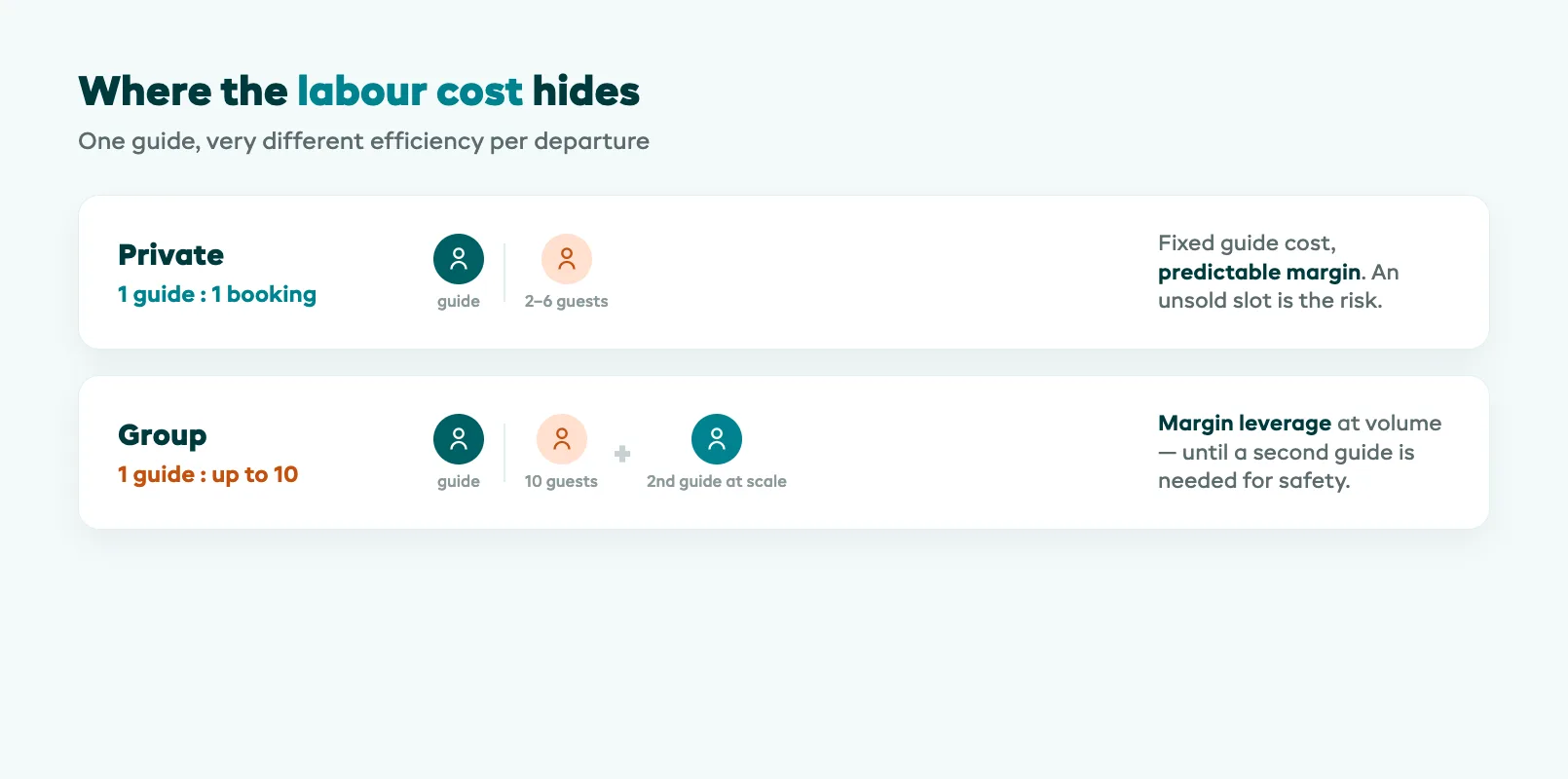
A private tour ties up one guide for one booking, no matter how many people are in the party. Two guests or six, you're paying the same guide cost — so your margin per guide hour is fixed and easy to predict. The risk is obvious: an unsold private slot is a guide paid to stand around, or a slot you simply didn't roster.
Group tours spread one guide across many guests, which is the source of their margin leverage. One guide and 10 guests is far better labor efficiency than one guide and two. But that leverage only works at scale, and scale brings its own costs: above a certain group size you need a second guide for safety and quality, vehicles get bigger, and the per-departure overhead climbs. The break-even on adding that second guide is a number every group operator should know cold. Managing those rosters across overlapping departures is its own discipline — multi-guide tour operations covers how to schedule it without double-booking.
Marketing Channels: Different Funnels Entirely
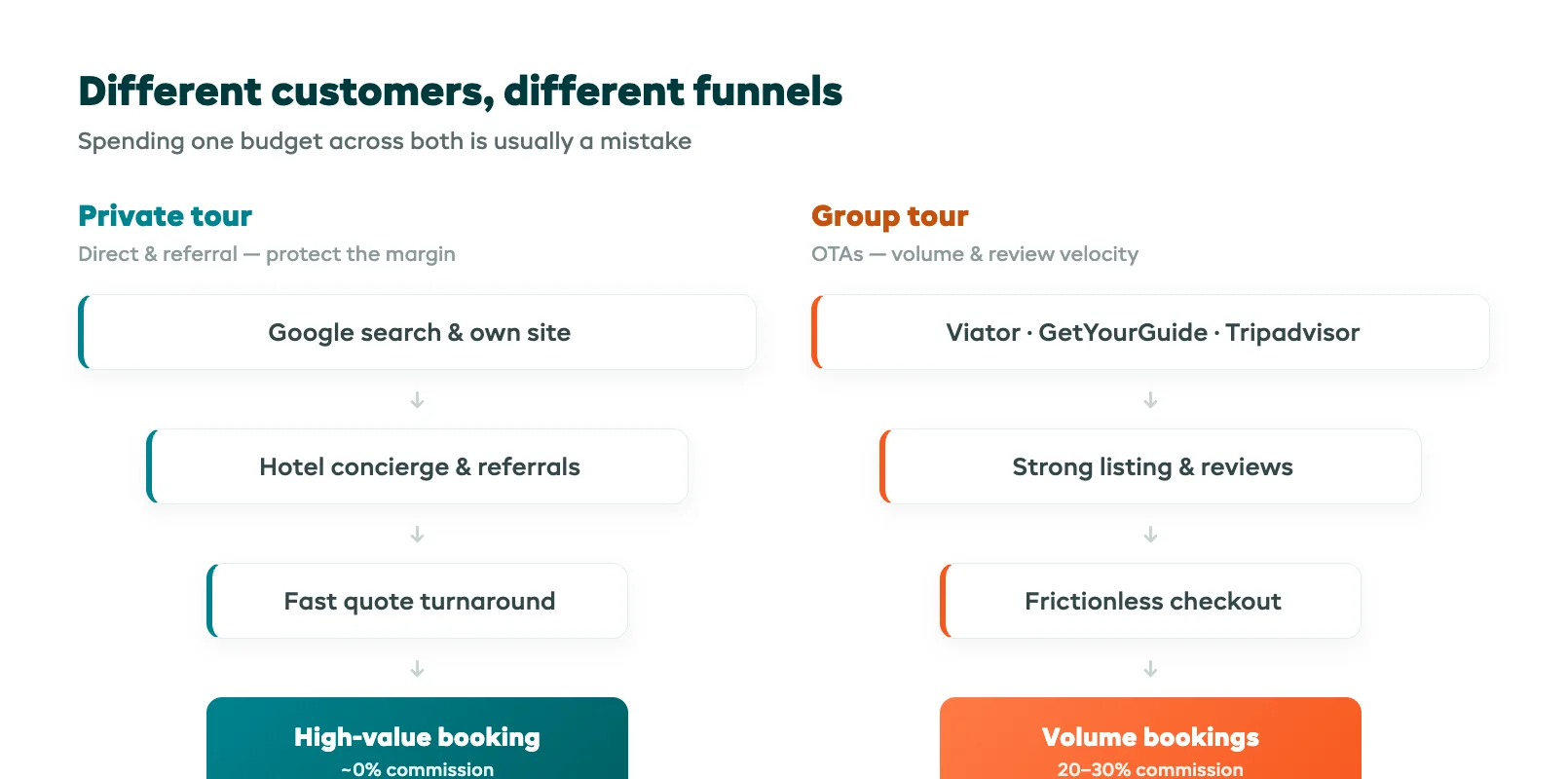
Because the customers differ, the channels that reach them differ too — and spending the same marketing budget across both is usually a mistake.
Group tours live and die on the OTAs. Viator, GetYourGuide, and Tripadvisor are where high-intent group buyers search, compare, and book, and a strong listing with steady review velocity can fill seats on its own. The trade-off is commission — 20% to 30% off the top — plus a crowded shelf where you're one of many. That model rewards volume and reviews, which is exactly what the group product is built for. The mechanics of working those channels are in OTA distribution for tour operators.
Private tours convert better through direct and referral channels. A couple planning an anniversary trip is more likely to find you through Google, your own site, a hotel concierge, or a past guest's recommendation than through a busy OTA grid. Direct booking also protects the margin that makes private tours worth running — paying 25% commission on a $400 private booking stings far more than on an $80 seat. Concierge relationships, a clean direct-booking page, and a fast quote turnaround do more for private revenue than another OTA listing ever will.
Booking Patterns: How the Calendar Behaves
The two products even fill the calendar differently, and that affects how you forecast and staff.
Group tours book in a steady, lead-time-driven pattern. Fixed departures, predictable seasonality, and a long tail of advance bookings make them relatively easy to forecast — you can see the season filling in week by week. The flip side is exposure to no-shows and last-minute cancellations, where one empty seat is lost revenue you can't recover. A tight cancellation policy and automated reminders matter here; the playbook is in tour no-show and cancellation strategy.
Private tours book in lumps. Demand is spikier — driven by special occasions, corporate calendars, and trip planning that lands whenever it lands — and lead times swing from months out to "are you free tomorrow?" The booking experience has to handle both the long-planned quote and the last-minute request without making the customer wait. Tools that smooth that out, like AI booking optimization for tours, help capture the spiky demand that a slow manual reply would lose. A simple booking-confirmation process keeps both patterns from slipping through the cracks.
Running Both: When It Works and When It Doesn't
Plenty of operators run private and group tours side by side, and done right it smooths revenue and uses idle capacity. Done wrong, it creates channel conflict and confuses customers.
The model that works treats them as distinct products sharing the same assets. You run scheduled group departures to keep the calendar busy and the reviews flowing, and you sell private tours into the gaps — early mornings, evenings, off-peak days, or by converting a quiet group slot into a booked private one. The key is that the two never cannibalise each other: a private booking should fill capacity you wouldn't have sold anyway, not pull a guide off a group departure that would have earned more.
Where it breaks down is pricing and promising. If your private tour is priced too close to a group ticket, buyers trade down and you lose the premium. If you over-promise private-level attention on a group tour, your costs balloon and your reviews suffer when you can't deliver. Clear product definitions, separate pricing logic, and disciplined scheduling are what keep the two profitable together. A shared operations layer — one calendar, one customer record, one set of AI tools for tour operators handling reminders and follow-ups — lets you run both without doubling your admin.
Pivot Triggers: When to Lean Harder Into One
Most operators don't choose once and stay there. The mix should shift as the business and the market move. A few signals tell you when to lean harder one way.
Lean toward private when your group load factors keep sliding, your direct and referral enquiries are climbing, your reviews mention wanting "just us," or your market is getting too crowded to win on price. High-value, low-volume is often the right move in a saturated market or a premium location.
Lean toward group when demand outstrips your private capacity, when OTA visibility is driving steady high-intent traffic, when your guides have spare capacity you're not monetising, or when you want predictable, forecastable revenue to plan staffing around. Volume is the right move when the demand is there and the operation can scale to meet it.
The tell, in both directions, is your revenue per guide hour trending over a full season — not a single good or bad week. Track that number by product, watch which one is climbing, and let the data, not the habit, decide where you push. The tours operator hub and a regular post-tour review request routine help you keep the inputs to that decision flowing.
The bottom line: private and group tours aren't two prices for one product — they're two businesses with different math. Run each on its own terms, watch the revenue-per-hour number, and let it tell you where to grow.
FAQ
Are private tours more profitable than group tours?
It depends entirely on your load factor. Private tours give you a high, guaranteed revenue floor per departure because the price is fixed regardless of party size. Group tours have a higher ceiling but only reach it when seats fill. At a typical 60% load factor a group tour often earns more per guide hour, but on slow days a private booking can come out ahead. Track revenue per guide hour by product to know which is actually winning for you.
What's a good load factor for group tours?
Most established group operators run somewhere between 55% and 70% average load factor across a full season, with peaks near capacity in high season and dips midweek and off-peak. The exact number matters less than knowing yours — it's the figure that decides whether a group departure out-earns a private booking on any given day, and whether adding a second guide makes sense.
Should I list private tours on OTAs like Viator or GetYourGuide?
Usually no, or only selectively. OTAs charge 20% to 30% commission, which stings far more on a $400 private booking than on an $80 group seat. Private buyers also convert better through direct, Google, and concierge referral channels. Use OTAs to fill group seats and drive review velocity; protect your private margin by pushing those bookings through direct channels.
Can I run private and group tours with the same guides and equipment?
Yes, and that's the most efficient model. Treat them as distinct products sharing the same assets: run scheduled group departures to keep the calendar busy, then sell private tours into the gaps you wouldn't otherwise fill. The rule is that a private booking should never pull a guide off a group departure that would have earned more — it should monetise idle capacity.
How do I price a private tour versus a group tour?
Price the private tour as a flat fee per booking that reflects exclusive use of the guide and asset, not as a per-person group ticket with a markup. Keep enough distance between the two so buyers don't simply trade down from private to group. A useful floor is that the private price should comfortably beat your average group revenue per departure, since one private booking ties up the whole slot.
When should I switch from group tours to private, or the other way?
Watch your revenue per guide hour over a full season, not a single week. Lean into private when group load factors are sliding, direct enquiries are climbing, or your market is too crowded to win on price. Lean into group when demand outstrips your private capacity, OTA traffic is steady, or you want predictable revenue to plan staffing around. Let the trend, not habit, decide.
in one place