Xola vs Rezdy: Which Is Better? (2026)
Xola vs Rezdy: Which Is Better? (2026)
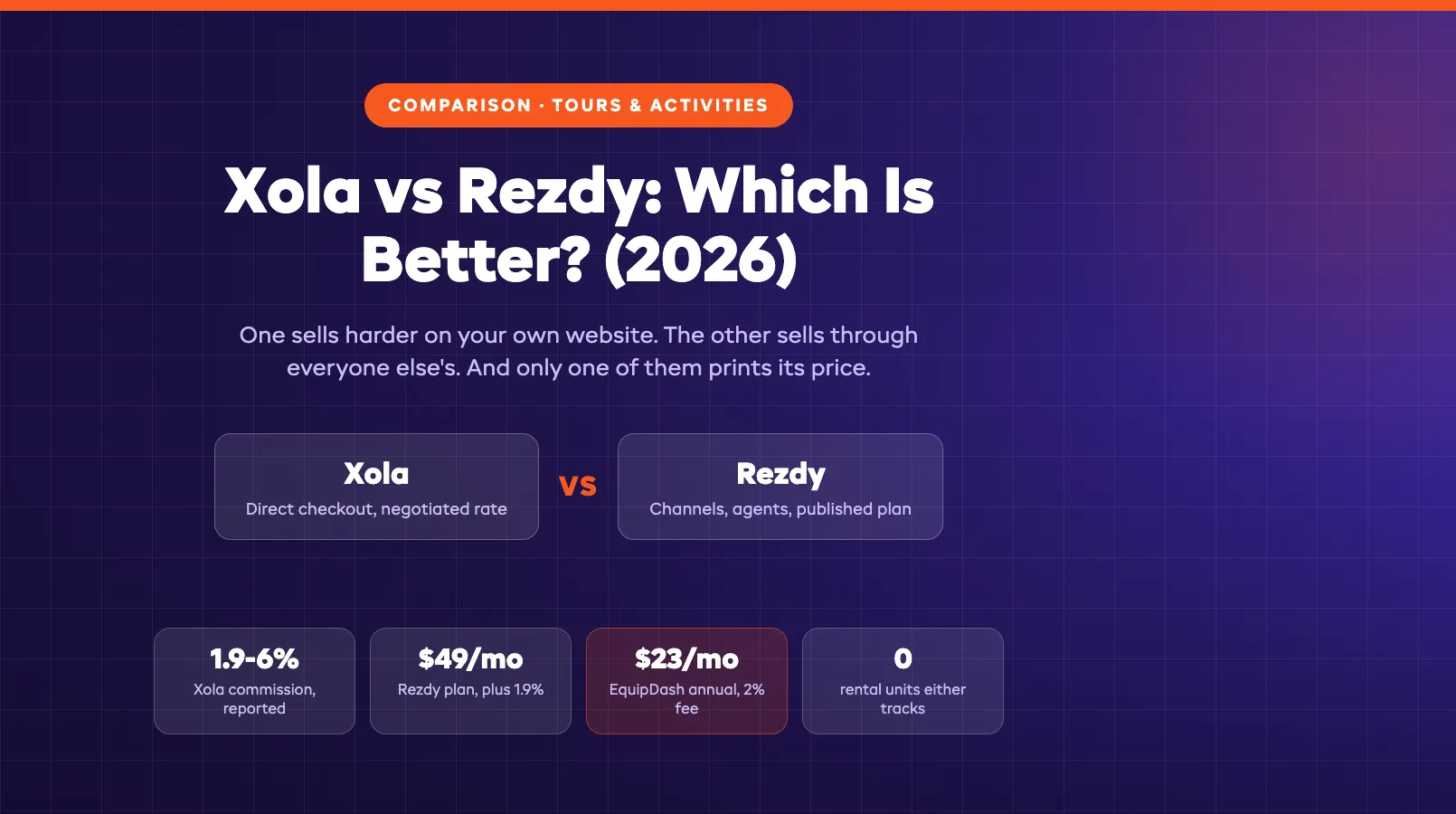
Xola and Rezdy end up on the same shortlist because they answer the same question in opposite ways. Xola assumes the booking is won on your own website, so it spends its energy on a checkout that converts and a recovery loop that chases the customers who wander off. Rezdy assumes the booking is won somewhere else, so it spends its energy on a channel manager and an agent portal that put your availability in front of marketplaces, hotel desks, and travel agencies. There is a second split underneath that one: Xola sets your rate in a sales call, Rezdy prints its price on the website. This guide runs the features, the cost math at real volume, and who should pick which, plus a third option if renting gear is a real part of what you sell.
Weighing one of these against an all-in-one platform? See the direct head-to-heads in our EquipDash vs Xola comparison and EquipDash vs Rezdy comparison, or score the whole field in the best Xola alternatives and best Rezdy alternatives guides.
Quick Comparison Table
The head-to-head at a glance. Xola keeps its rate behind a sales call, so its pricing row reflects what operators consistently report; Rezdy publishes a subscription and a per-booking fee you can read before you talk to anyone.
| Xola | Rezdy | |
|---|---|---|
| Built for | Tours, activities, and ticketed attractions | Tours and activities sold through channels |
| Best for | Direct-booking operators buying their own traffic | Operators plugged into resellers and marketplaces |
| Pricing model | Commission per booking, ~1.9-6% reported | Subscription from ~$49/mo plus ~1.9% per booking |
| Published pricing | No, set per operator | Yes |
| Checkout and recovery | Strong, abandoned booking recovery built in | Functional, plainer, more integration work on you |
| Channel manager | Limited OTA connections | Broad and neutral: Viator, GetYourGuide, Expedia, dozens more |
| Reseller and agent portal | No | Yes, with commissions tracked automatically |
| Payments | Native processing | Native processing plus third-party gateways |
| Scheduling at scale | Comfortable with fixed-capacity, ticketed formats | Handles volume, gets cluttered past 20 products |
| Equipment rentals | None | None |
Both are proven for pure tours and activities. Neither was built to track rental inventory, so hold that thought if kayaks, bikes, or ski gear share your counter.
Features Comparison
Day to day the two platforms overlap more than either sales team admits. Departure schedules, capacity caps, booking cutoffs, manifests, online payments, waivers at checkout: both do all of it competently. The differences that decide the choice sit at the two ends of the booking journey.
Checkout and conversion. Xola's home turf. The booking flow is fast, it holds up on a phone, and abandoned booking recovery follows up automatically with customers who started and stopped, with Xola claiming recovery in the 10-15% range. If your growth comes from your own site and your own ad spend, that loop is real money on traffic you already paid for. Rezdy's checkout works, but it is plainer, more of the site integration falls on you, and conversion tooling is not what the product is organized around.
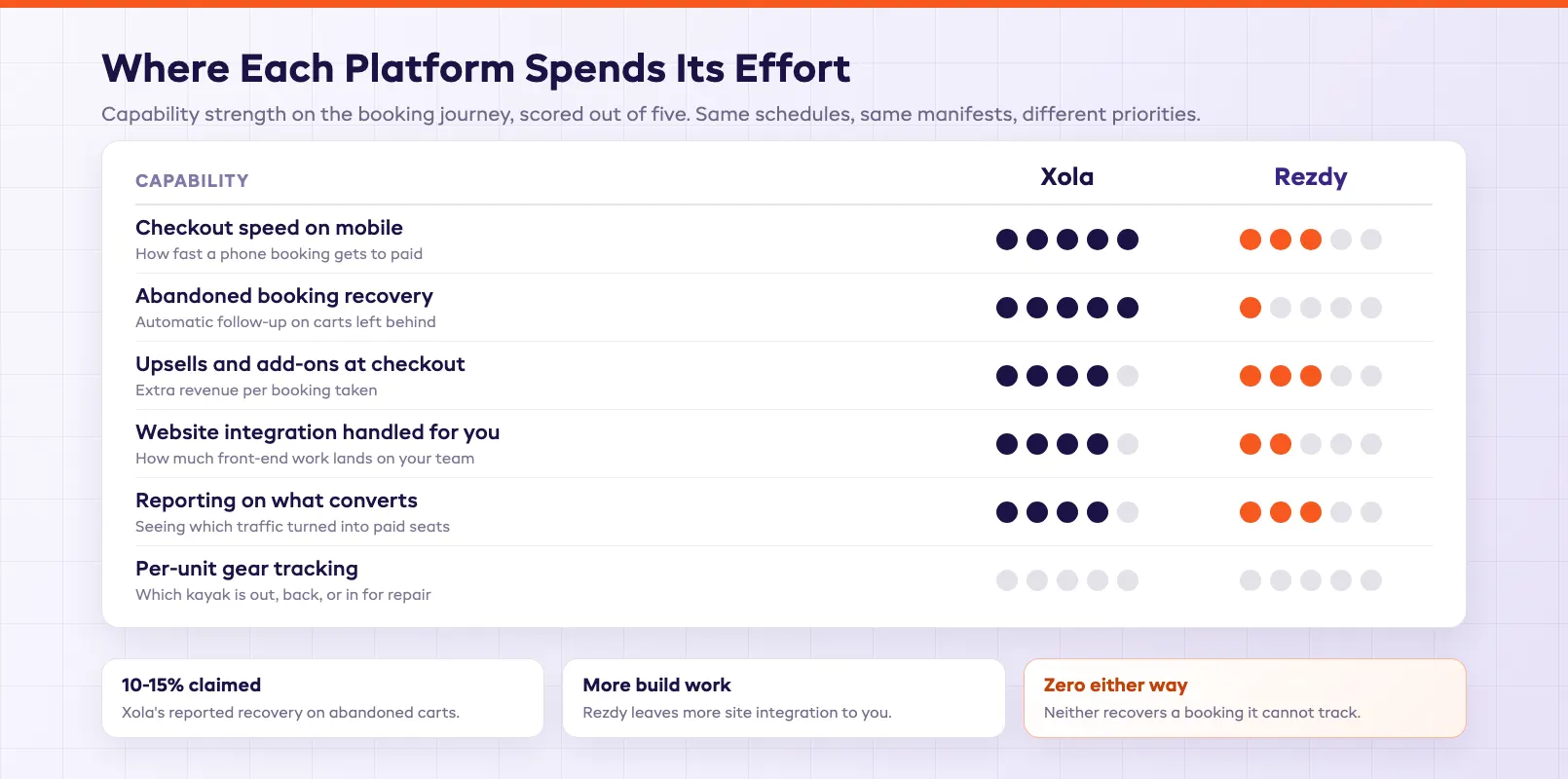
Distribution and resellers. Rezdy's, and it is not close. Its channel manager pushes live availability to Viator, GetYourGuide, Expedia, and dozens of other marketplaces on equal footing, with no parent company steering you toward one of them. The agent portal is the part operators underrate: hotel concierges, local travel agencies, and partner desks get their own login, book against the same calendar, and their commission is tracked without anyone reconciling a spreadsheet at the end of the month. Xola's OTA connections are thinner, and it has no equivalent for the offline reseller network.
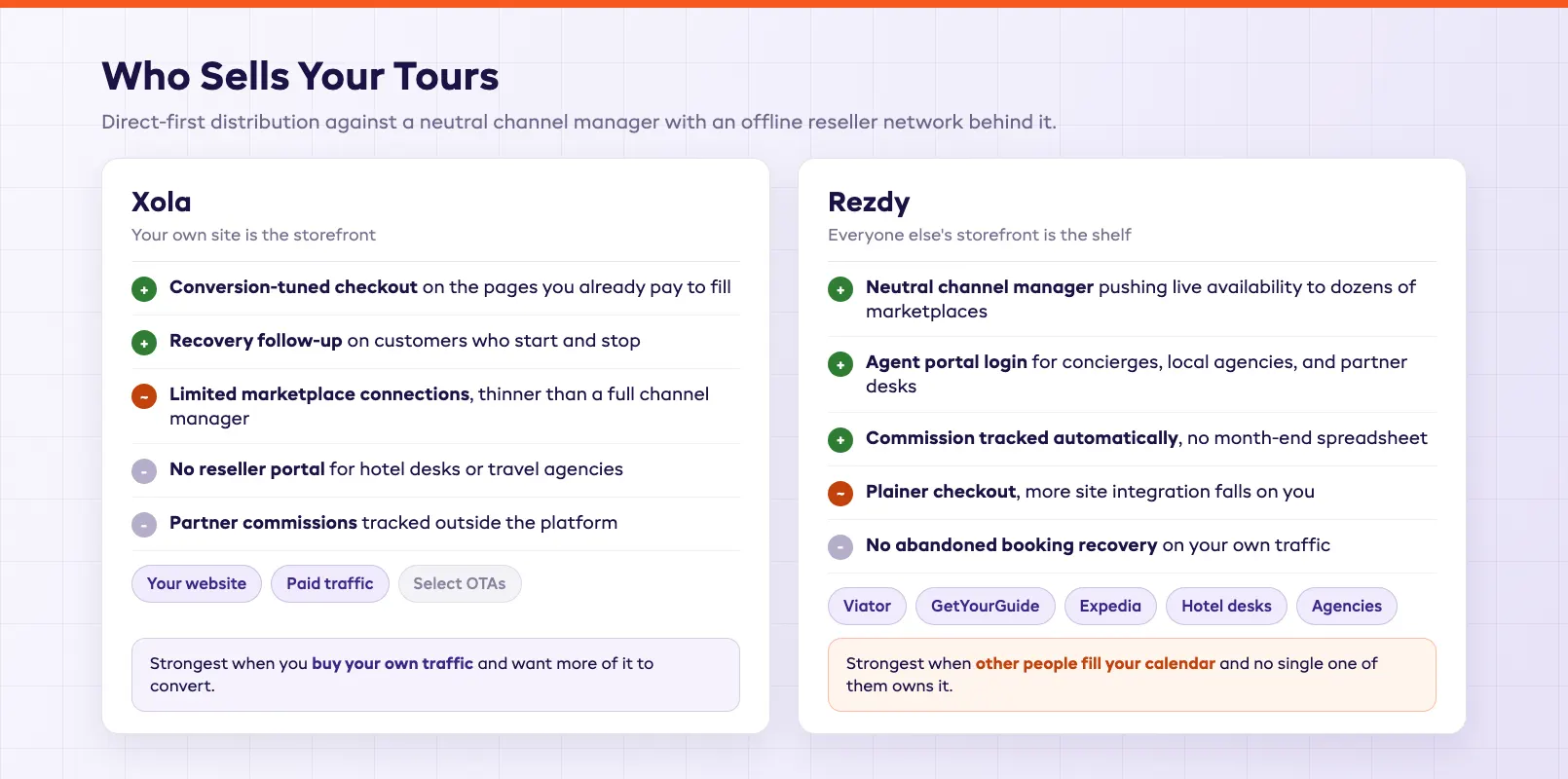
Scheduling and scale. Xola is comfortable with fixed-capacity ticketed formats where slot management is the whole job: escape rooms, zip lines, museums, attractions with timed entry. Rezdy carries volume across a wide catalog, though operators running 20 or more products with seasonal rates report the interface gets cluttered and complex pricing rules take more clicks than they should.
Setup and ownership. Rezdy is quicker to learn but hands you more of the website work. Xola gives you a tighter, more finished booking experience in exchange for living inside its ecosystem, including its payment processing. Neither is a done-for-you build, and both want a few weeks before your full catalog is live.
Where both fall short. Physical gear. Neither tracks per-unit inventory, check-in and check-out against a specific item, damage deposits tied to a serial number, or maintenance windows that block a unit while it is being repaired. A rental in tour-first software is just another time slot, which collapses the first time two bookings want the same ten kayaks on overlapping windows. Neither has an AI layer either, so reporting, waiver chasing, and follow-ups stay manual as the business grows.
Pricing Comparison
This is where the two part company hardest, and it is not really about the number.
Xola charges a commission on every booking, reported by operators between roughly 1.9% and 6%, absorbed by you or passed to the customer at checkout depending on the deal you strike. There is no published rate. Your software cost is a negotiation outcome, and the figure you get depends on your volume and how hard you pushed.
Rezdy publishes its model: a subscription from around $49 a month, plus a per-booking fee of roughly 1.9%. You can work out your baseline before the season starts and the variable slice stays small. The trade-off is paying the subscription through the quiet months, when a commission-only platform costs you close to nothing.
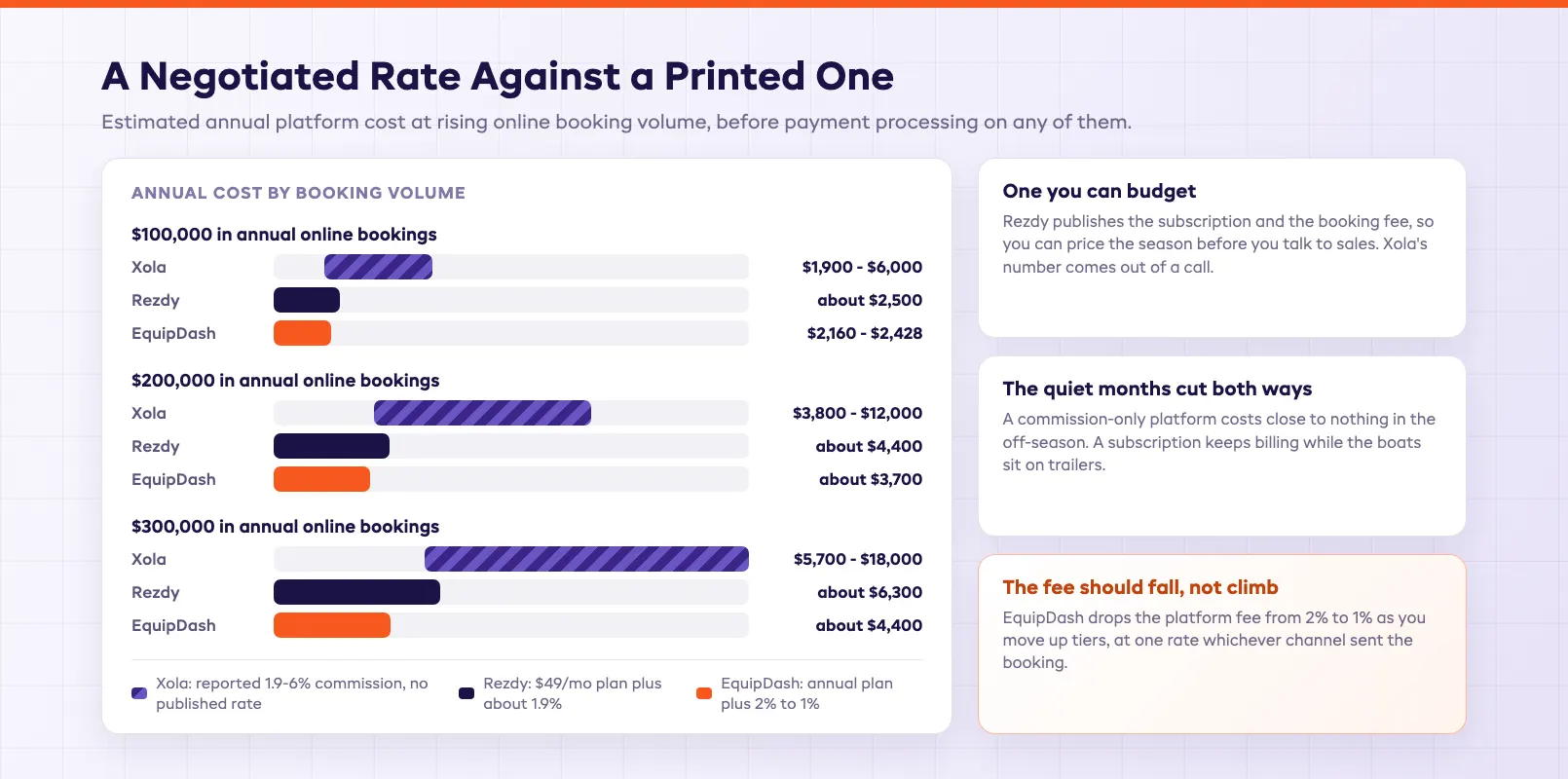
Run it at real volume. At $100,000 in annual online bookings, Rezdy lands near $2,500 all-in: about $600 of subscription plus roughly $1,900 in booking fees. Xola at a 1.9% rate is roughly $1,900 and at 6% is roughly $6,000, so the same platform is either the cheapest option on the table or more than twice the price of its rival, decided by a conversation. At $300,000 the spread gets louder: Rezdy sits around $6,300, while Xola runs from about $5,700 to $18,000. The lesson is not that one is cheaper. It is that only one of them lets you budget before you sign.
The counterweight for Xola is what the rate buys. If recovered checkouts genuinely add bookings you would not otherwise have taken, the fee on those bookings is a cost of sale. Be honest about how many of your bookings that actually describes. Whichever way you go, get the rate in writing, ask what happens to it when your volume doubles, and run last season's real numbers through both before you commit.
Best For: When to Choose Each
Neither platform is simply better. They are tuned for different ways of selling.
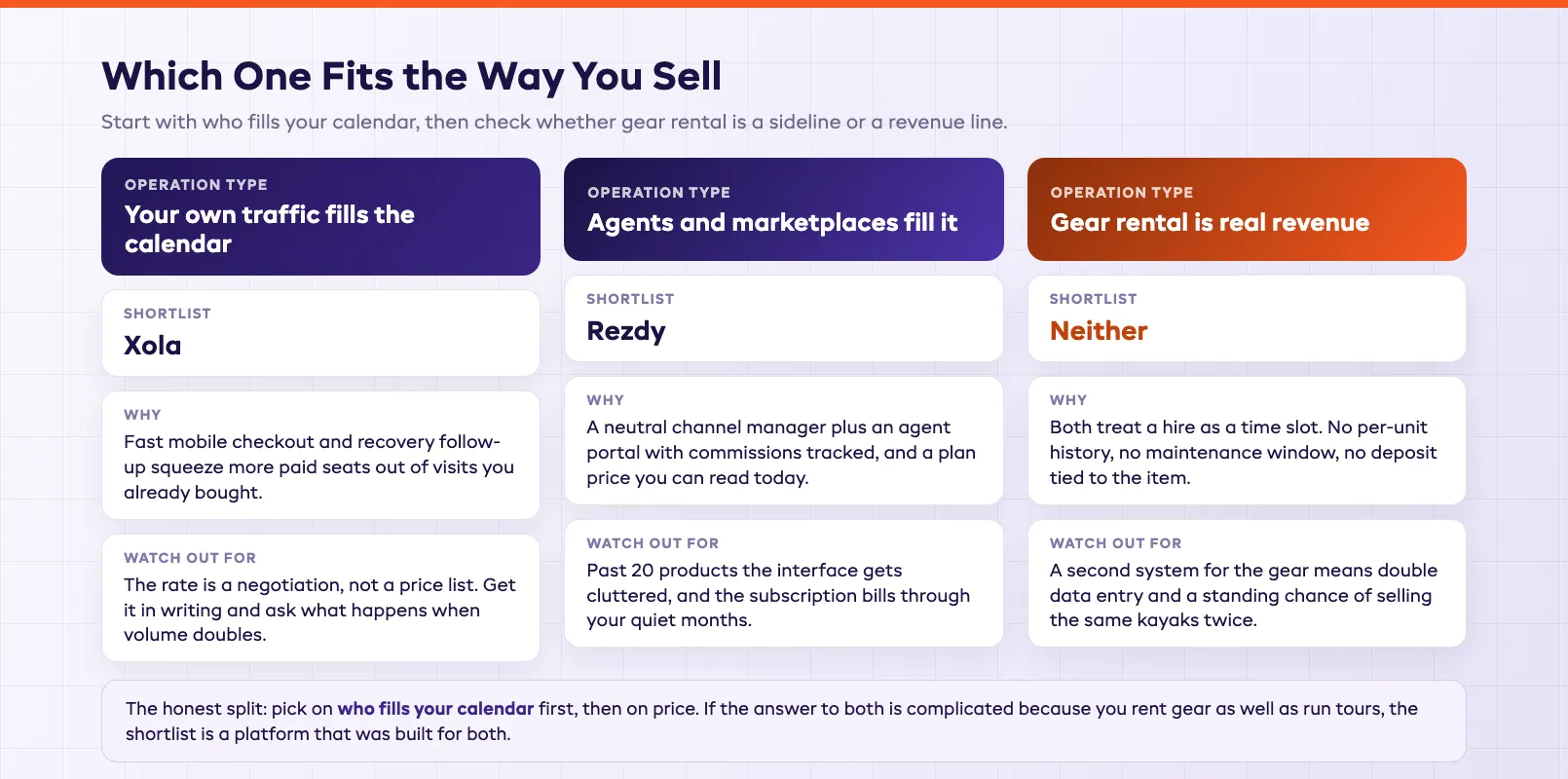
Choose Xola if your own website is where bookings are won. The fast checkout, the recovery loop, and native payments make it the strongest pick for operators buying their own traffic and trying to convert more of it, particularly ticketed fixed-capacity experiences where the calendar is simple and the funnel is everything. Go in knowing your rate is negotiated, and negotiate it properly.
Choose Rezdy if other people sell your tours. The neutral channel manager, the agent portal, and automatic commission handling make it the obvious base for operators working with hotel desks, local agencies, and several marketplaces at once, with no single one of them owning your calendar. The published subscription is the other half of the appeal: you know your software cost before the season opens.
Choose neither if equipment hire is a real slice of your revenue. That is no knock on either product, since neither was built to track physical inventory. Forcing gear through tour software means a second system, double data entry, and a standing risk of selling the same kayaks twice.
A Third Option: Rentals + Tours, Built for Both
If your business sells guided experiences and equipment hire under one roof, Xola and Rezdy both leave you running two systems. That is the gap an all-in-one platform closes.
EquipDash was built for operators who do both. The calendar that schedules the 9am kayak tour also tracks which boards are out, which came back, and which one is blocked for a fin repair before the next hire. Rentals get per-unit tracking, check-in and check-out with photos, maintenance windows, and deposits tied to the specific item. Tours get schedules, capacity, manifests, and waivers. A walk-in point of sale runs on the same system. One booking flow, one customer record, one dashboard. Dash AI adds the automation layer neither platform has: ask it for a revenue report, and let its agents chase unsigned waivers and late returns.
The pricing is public and flat, which already separates it from a negotiated commission: annual plans start at $23/mo with a 2% platform fee (Starter), then $55/mo at 1.5% (Growth) and $119/mo at 1% (Pro), so the fee falls as you grow instead of holding a fixed cut of every sale. At $100,000 in annual bookings that is roughly $2,160 to $2,428 all-in, one rate regardless of which channel the booking came from. See the full breakdown on the pricing page.
Be honest about the fit. An attraction living on its own paid traffic has good reasons to pick Xola, and an operator whose calendar is filled by agents and marketplaces may never outgrow Rezdy. But if gear is part of the picture, a platform that treats rentals as a first-class feature beats forcing them through software that does not. Already decided to move? The Xola migration guide and Rezdy migration guide walk through the switch step by step.
FAQ
What's the main difference between Xola and Rezdy?
Where each platform expects the booking to happen. Xola is built for your own website, with a conversion-focused checkout and abandoned booking recovery that chases customers who do not finish. Rezdy is built for everyone else's, with a neutral channel manager feeding Viator, GetYourGuide, Expedia and dozens more, plus an agent portal for hotel desks and travel agencies. The second difference is pricing: Xola negotiates a commission per booking, Rezdy publishes a subscription plus a small per-booking fee.
Is Xola or Rezdy cheaper?
Rezdy is the one you can price in advance. At $100,000 in annual online bookings it lands near $2,500 all-in, roughly $600 of subscription plus about $1,900 in booking fees. Xola at the bottom of its reported 1.9-6% range is cheaper at around $1,900, and at the top is around $6,000 for the same volume. Since Xola does not publish rates, the honest answer is that it depends entirely on the deal you negotiate, and only Rezdy lets you budget before you sign.
Does Xola have better checkout conversion than Rezdy?
Yes, and it is the main reason operators pick it. Xola's booking flow is fast and built for mobile, and its abandoned booking recovery follows up automatically with customers who start but do not finish, with claimed recovery in the 10-15% range. Rezdy's checkout is functional but plainer, and more of the website integration work falls on you. If your bookings come from your own traffic, that gap matters.
Which platform is better for OTA and reseller distribution?
Rezdy, clearly. Its channel manager pushes live availability to Viator, GetYourGuide, Expedia and dozens of other marketplaces on equal footing, with no parent company pulling you toward one of them, and its agent portal gives hotel concierges and travel agencies their own booking login with commissions tracked automatically. Xola's OTA connections are thinner and it has no equivalent reseller portal, so an operator whose calendar is filled by partners will feel the difference quickly.
Can Xola or Rezdy manage equipment rentals?
Not properly. Both are tour-and-activity platforms with no per-unit inventory tracking, no check-in and check-out workflow, no maintenance scheduling, and no deposits tied to a specific item. A rental becomes another time slot, which works for a couple of paddleboards by the hour and breaks down once the fleet grows and units go out for repair. Operators who rent gear alongside experiences usually end up running a second system or moving to a platform that handles both natively.
Is there an alternative that handles tours and rentals together?
Yes. EquipDash manages guided experiences, per-unit equipment rentals, and a walk-in point of sale in one system, with one calendar, one customer record, and one dashboard. Annual plans start at $23/mo with a platform fee that drops from 2% to 1% as you move up tiers, and the fee is the same whichever channel the booking came from.
in one place