Choosing Camera Rental Software: Serial Numbers, Kits and Pull Sheets
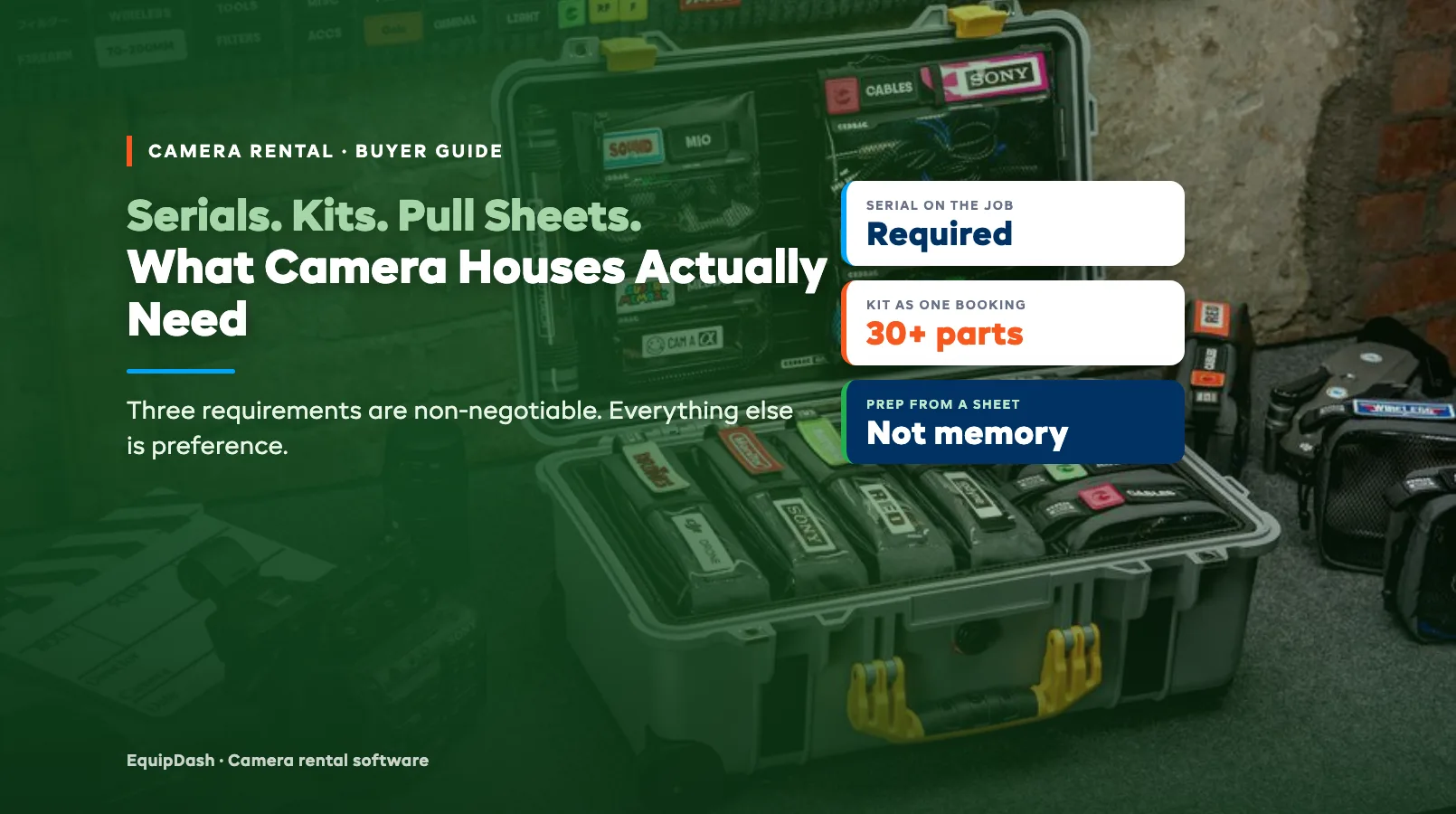
Choosing Camera Rental Software: Serial Numbers, Kits and Pull Sheets
A producer calls at 2 PM asking for an FX6 package for a three-day shoot starting Thursday. You say yes, then spend the next hour checking which body is free, whether the matte box is already promised, and who last packed that kit. By the time you send the quote, another house has already won the job. Camera rental software either closes that gap or it doesn't.
Most rental tools were built for fleets of the same thing: twenty kayaks, fifty bikes, a warehouse of tables. A camera house is different. Two FX6 bodies are not interchangeable once one has a soft corner and the other just came back from a sensor clean. A package is thirty pieces that have to travel together, and a missing cable is a lost morning on set. This guide covers the three requirements that are non-negotiable for a rental house, plus the preferences that decide which system you can live with day to day. For the product view, start with our camera rental software page.
Why bodies must be serial-tracked
In camera rental, the model is not the asset. "A 24-70" is a catalog line. The lens that went to last Tuesday's commercial is a specific serial number with its own rental count, condition photos, and service history. If your system only tracks quantity, you cannot answer which body left the building, which glass came back with a sticky focus ring, or which cage is due for a check.
Serial tracking has to sit on the booking, not in a side spreadsheet. When a prep tech scans a body into a job, that serial stays on the rental record permanently. When it comes back, the return photos and notes attach to the same serial. Three weeks later, when a producer asks whether you sent the "good" FX6 or the backup, you open the job instead of reconstructing a memory.
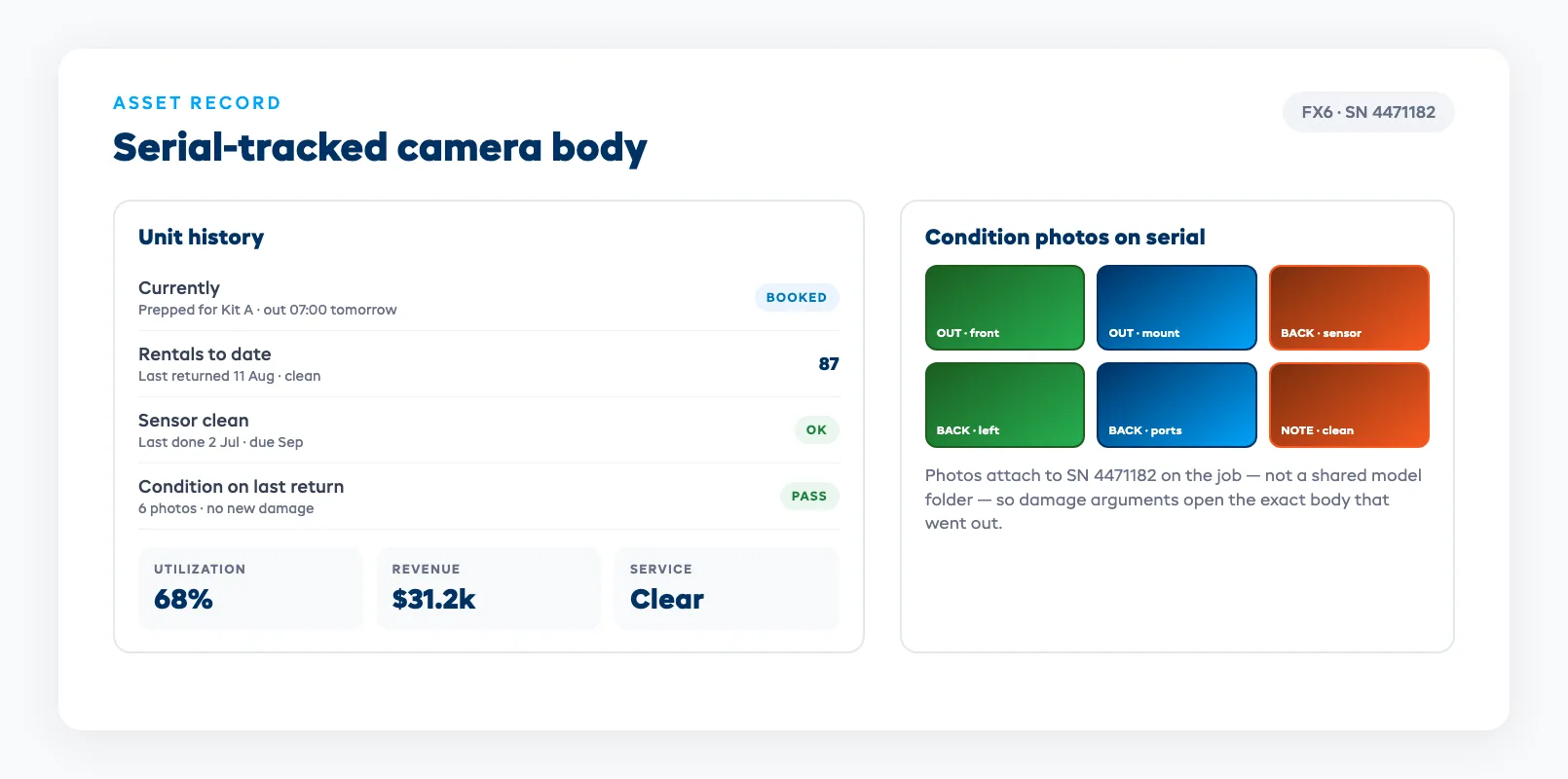
What that looks like in practice:
- Every rentable unit has a serial (or barcode). Bodies, lenses, monitors, gimbals, and high-value cages. Batteries and cables can stay as quantities if they are truly interchangeable.
- Status lives on the unit. Available, reserved, out, in service, and overdue. A sensor clean blocks that body without blocking every FX6 you own.
- History follows the serial. Who had it, how many days it has worked, what came back wrong, and when it was last calibrated.
Without that, damage arguments become opinion against opinion, and utilization numbers are guesses. Insurance claims are worse: you need the exact asset on the record, not a model name.
Kits that book as one item
A camera package is a product to the producer and a checklist to your prep bench. The producer books "Kit A for three days." Your system still has to reserve every component underneath and stop anyone else from promising the same matte box inside another kit.
Build the kit once. Name it, list every part, and treat the kit as one bookable item on the calendar. When someone books it, every component comes off availability for those dates. When prep runs, the tech works from that same list. Substitutions on the day update the sheet instead of living in someone's head.
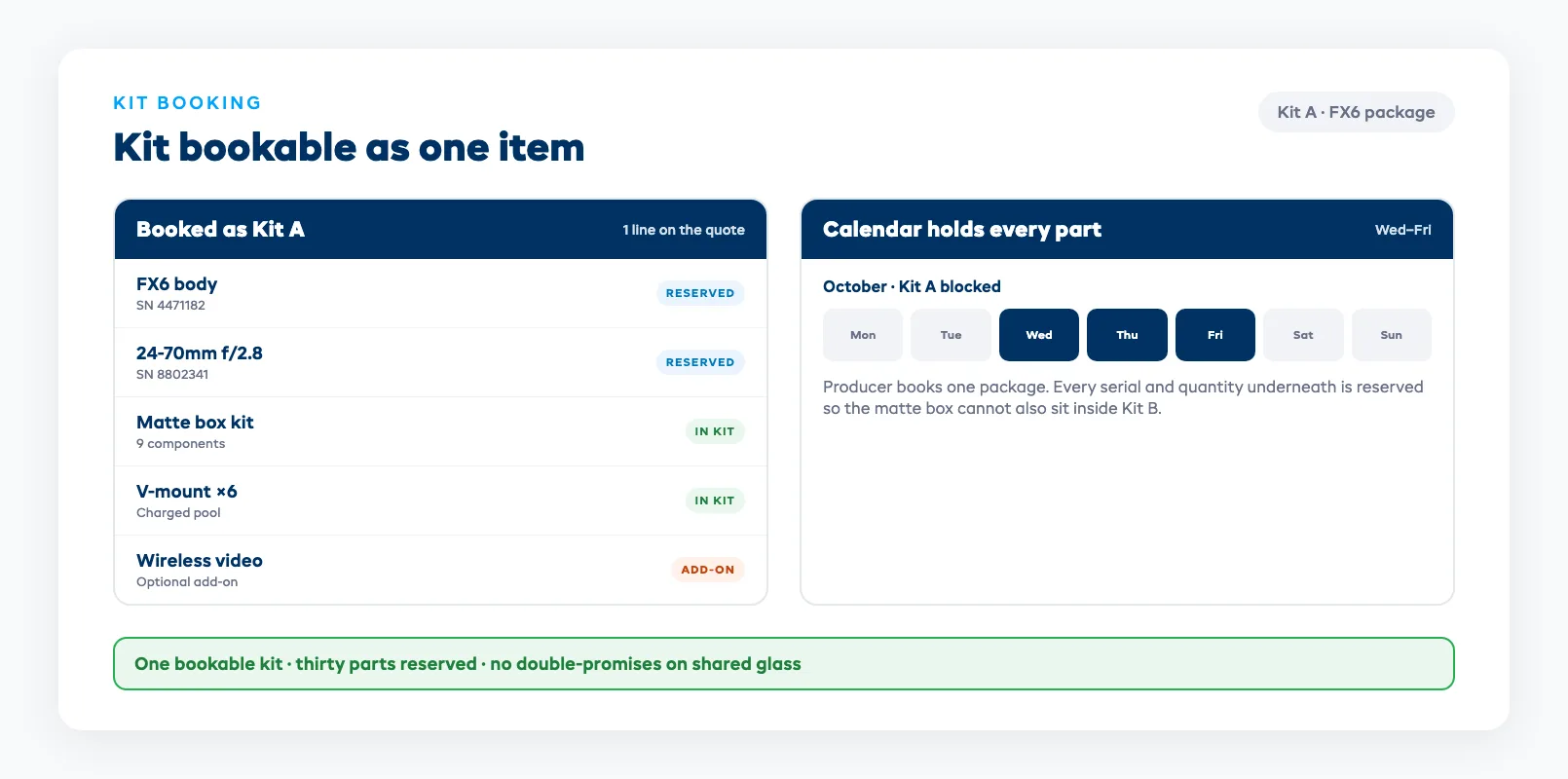
Good kit software does four things:
- Books the package as one line while still tracking each serial underneath.
- Blocks double-promises. A component inside Kit A cannot also sit inside Kit B for the same window.
- Lets you swap without rebuilding. Swap a body or lens on the morning and the kit sheet reflects it.
- Keeps optional add-ons separate. Extra primes, wireless video, and additional batteries attach to the job without rewriting the base kit.
If your current setup forces the counter to build every package from scratch at quote time, you will miss pieces under pressure. The kit list is how the house scales past the one prep tech who "just knows."
Pull sheets the prep bench works from
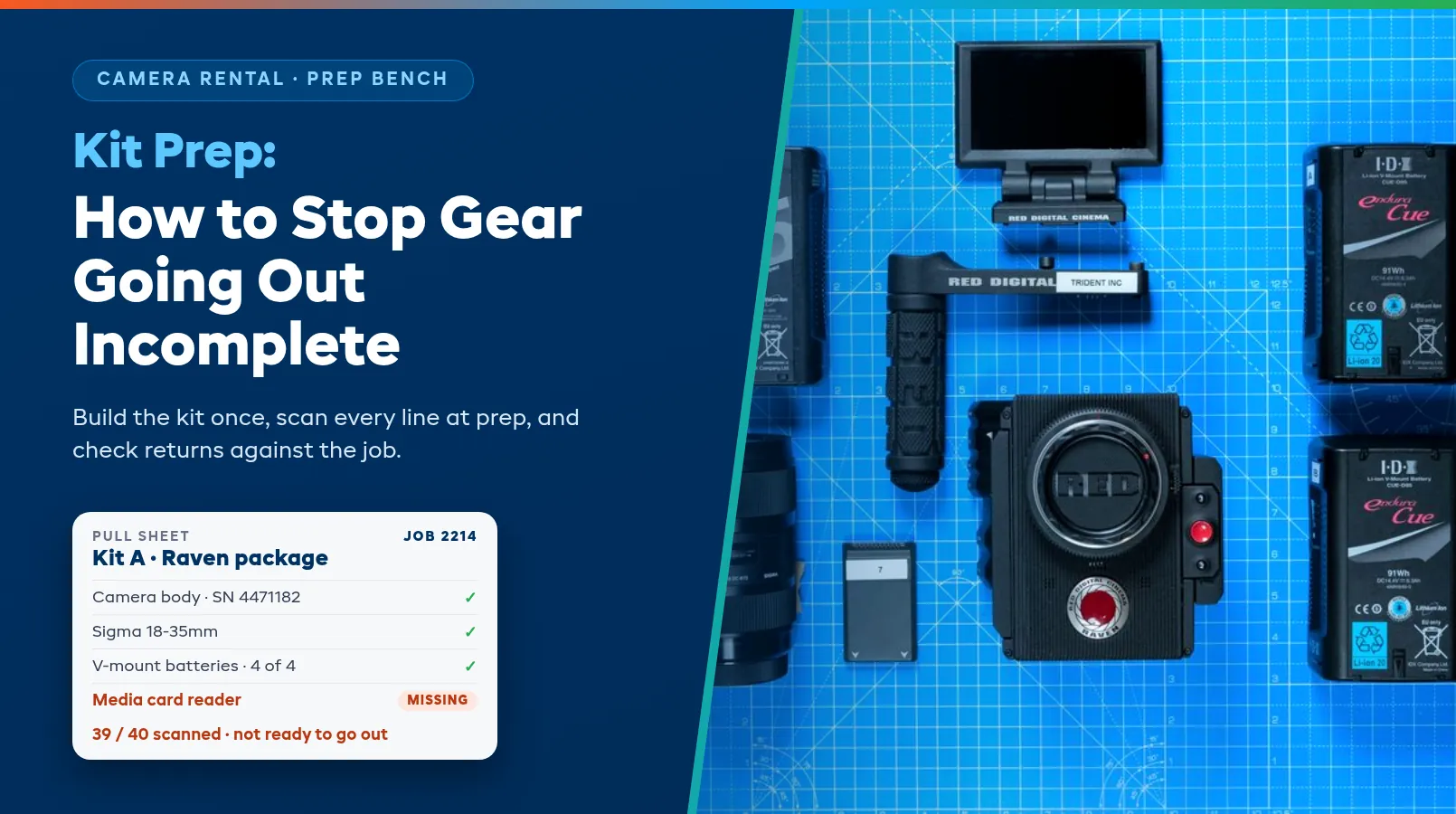
The pull sheet is the contract between the office and the bench. It should print (or open on a tablet) with every item, serial where it matters, and a clear place to mark scanned or substituted. Prep should not start with a phone call asking what the producer actually booked.
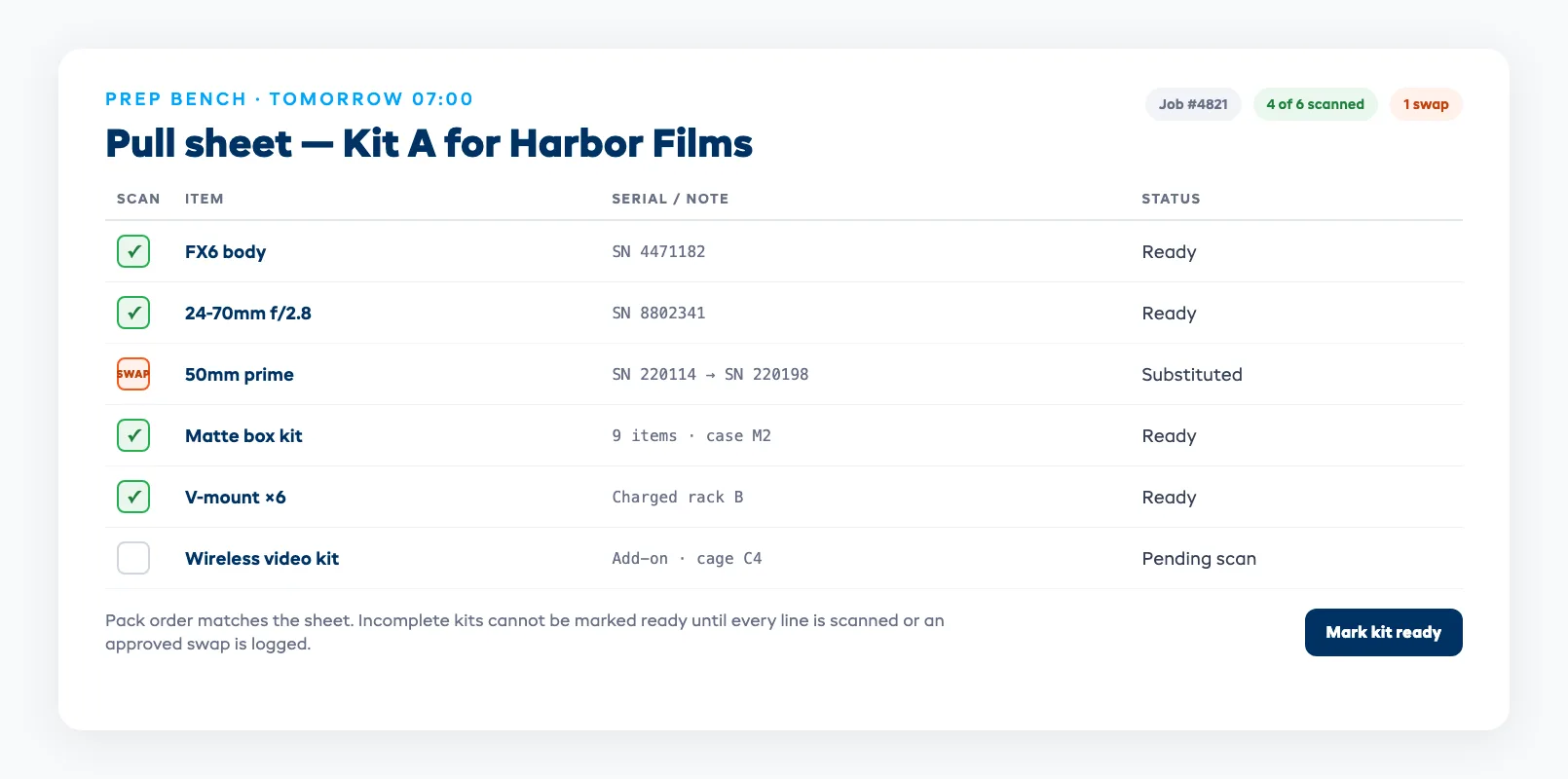
A usable pull sheet:
- Lists the kit and every component in pack order, not alphabetical chaos.
- Shows serials for bodies and glass so the right unit leaves the cage room.
- Has a scan or check column so incomplete kits cannot be marked ready.
- Survives a same-day swap without a rewrite from scratch.
Houses that still pack from memory lose mornings when the usual prep person is off. Houses that pack from a live sheet catch the missing V-mount before the van leaves. That is not a nice-to-have; it is the difference between a satisfied producer and a credit note.
Camera and AV shops often share the same warehouse and the same prep culture. If you also send speakers, desks, and crew, look at how AV rental software handles kits and pull sheets on the same job — the pattern is the same even when the gear is different.
Quote speed as a competitive weapon
Production books the house that answers first with a credible quote. A perfect quote tomorrow loses to a solid quote in an hour. Software helps only if you can build against live availability: which serials and kits are free on those dates, at which rate, with which deposit.
That means quotes pull from the same stock the prep bench uses. If the quote says Kit A is free and the calendar already has it on another job, you have sold a conflict. Live availability closes that loop. Saved package templates and rate cards cut the typing so the counter can send while the producer is still on the phone.
Speed without accuracy is just a faster way to overbook. The competitive edge is both: answer today, and send only gear you can actually hand over.
Deposits sized to package value
Camera packages are high value. A deposit that works for a weekend kayak does not cover an FX6 with glass. Your software should let you set deposits by package or by value tier, take them when the booking confirms, and keep the hold visible against the job until return and condition check are done.
Tie deposit rules to the kit, not to a one-size shop default. A two-body commercial package and a single mirrorless stills kit should not share the same hold. When damage shows up on return, the photos and serials on the job are what make the charge stick. Without that trail, the deposit conversation turns into a negotiation you will lose more often than not.
Sub-hire without losing the thread
Every house sub-hires. A specialty lens, a second gimbal, or overflow bodies for a festival week. The risk is that sub-hired gear lives in a spreadsheet while your own stock lives in the system, so nobody sees the full job.
Treat sub-hire as part of the same rental. Note the supplier, the cost, the serial if you receive one, and the return date. The pull sheet should show what you own and what you are bringing in. The quote should show the customer price even when your cost sits underneath. When the job wraps, you reconcile the sub-hire return the same day you reconcile your own cases.
If sub-hire is invisible to availability, you will promise a package you cannot complete, or you will forget to return a rented lens until the supplier calls.
Checklist: what to demand before you switch
Use this as a walk-through, not a brochure checklist. Sit with whoever runs prep and whoever sends quotes, and ask each question against a real job from last month.
- Can every body and lens carry a serial with its own status and history?
- Can a kit book as one item while components stay individually reserved?
- Does prep get a pull sheet that matches the booking, including swaps?
- Can you quote from live availability in minutes, not overnight?
- Can deposits scale with package value and stay tied to the job?
- Can sub-hire sit on the same job as owned gear without a side spreadsheet?
- When something comes back damaged, do photos and serials live on that rental?
If the answer to the first three is no, you do not have camera rental software yet — you have generic rental software with a camera price list. Everything else on the list is preference until those three are solid.
Camera houses that also cover lighting, audio, and event play-out often evaluate an AV-shaped tool at the same time. Keep the serial-and-kit bar the same either way: the gear is still individual assets that leave in cases and come back short if nobody checks the sheet.
Everything above is how a rental house protects the morning on set and the relationship with the producer. EquipDash is built around serial-level stock, kits, pull sheets, quotes from live availability, and deposits that match what is going out — see camera rental software if you want to try that workflow on your own list.
FAQ
What features matter most in camera rental software?
Serial-number tracking on bodies and glass, kits that book as one item while reserving every component, and pull sheets the prep bench can work from. Quote speed, deposits sized to package value, and clean sub-hire on the same job come next. Without the first three, the rest does not save you on a busy Thursday.
Why track camera bodies by serial number instead of by model?
Two bodies of the same model are not the same asset. One may be due for a sensor clean, another may have a soft corner, and only one of them went out on last week's job. Serials on the booking tell you exactly what left, what came back, and what needs service — without relying on someone's memory.
What is a pull sheet in a camera rental house?
A pull sheet is the prep list for a job: every item in the kit, serials where they matter, and a place to mark each piece scanned or substituted. The prep tech packs from the sheet instead of from a conversation, so incomplete kits get caught before the van leaves.
How should camera rental deposits be set?
Size the deposit to the package, not to a single shop default. High-value kits need holds that reflect replacement risk. Keep the deposit on the job until return and condition check are done, and keep outbound and return photos against the serials so damage charges are evidence-based.
Can camera rental software handle sub-hired lenses and bodies?
It should. Log the supplier, cost, and return date on the same job as your owned gear, show sub-hired items on the pull sheet, and reconcile them the day the cases come back. Side spreadsheets are how sub-hired glass gets forgotten until the supplier chases you.
Is camera rental software different from AV rental software?
The core is the same: kits, pull sheets, and assets that cannot be double-booked. Camera houses lean harder on serial-level glass and body history. AV shops often add crew and event timelines on the same job. Many warehouses run both; evaluate either tool against the same serial-and-kit standard. See our AV rental software page if crew and event play-out are part of your mix.
in one place