Booqable vs FareHarbor: Which Is Better? (2026)
Booqable vs FareHarbor: Which Is Better? (2026)
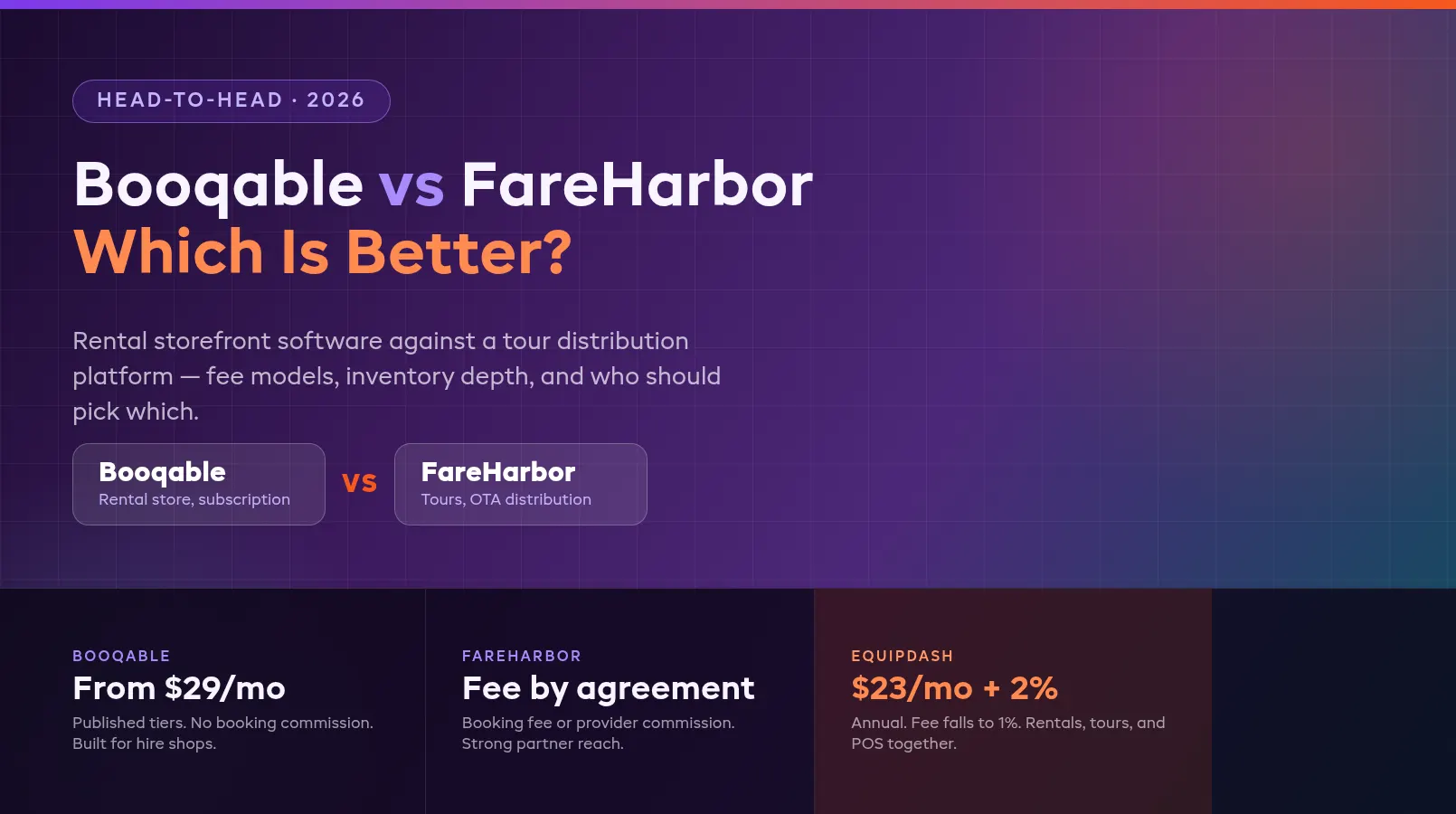
Booqable and FareHarbor show up on the same shortlists because both can take online bookings. They are built for different businesses. Booqable is rental software with a storefront, inventory, quotes, and contracts aimed at shops that hire out gear. FareHarbor is a tour and activity platform with strong distribution, specialist onboarding, and a fee model tied to bookings rather than a public subscription ladder.
Compare operating models: how you acquire customers, how you sell (storefront versus timed sessions), and what the system must protect on a busy Saturday. This guide covers features, pricing, and fit — then when a third option makes sense for mixed rentals and tours.
Still comparing the wider market? Start with our equipment rental software comparison or browse Booqable alternatives and FareHarbor alternatives.
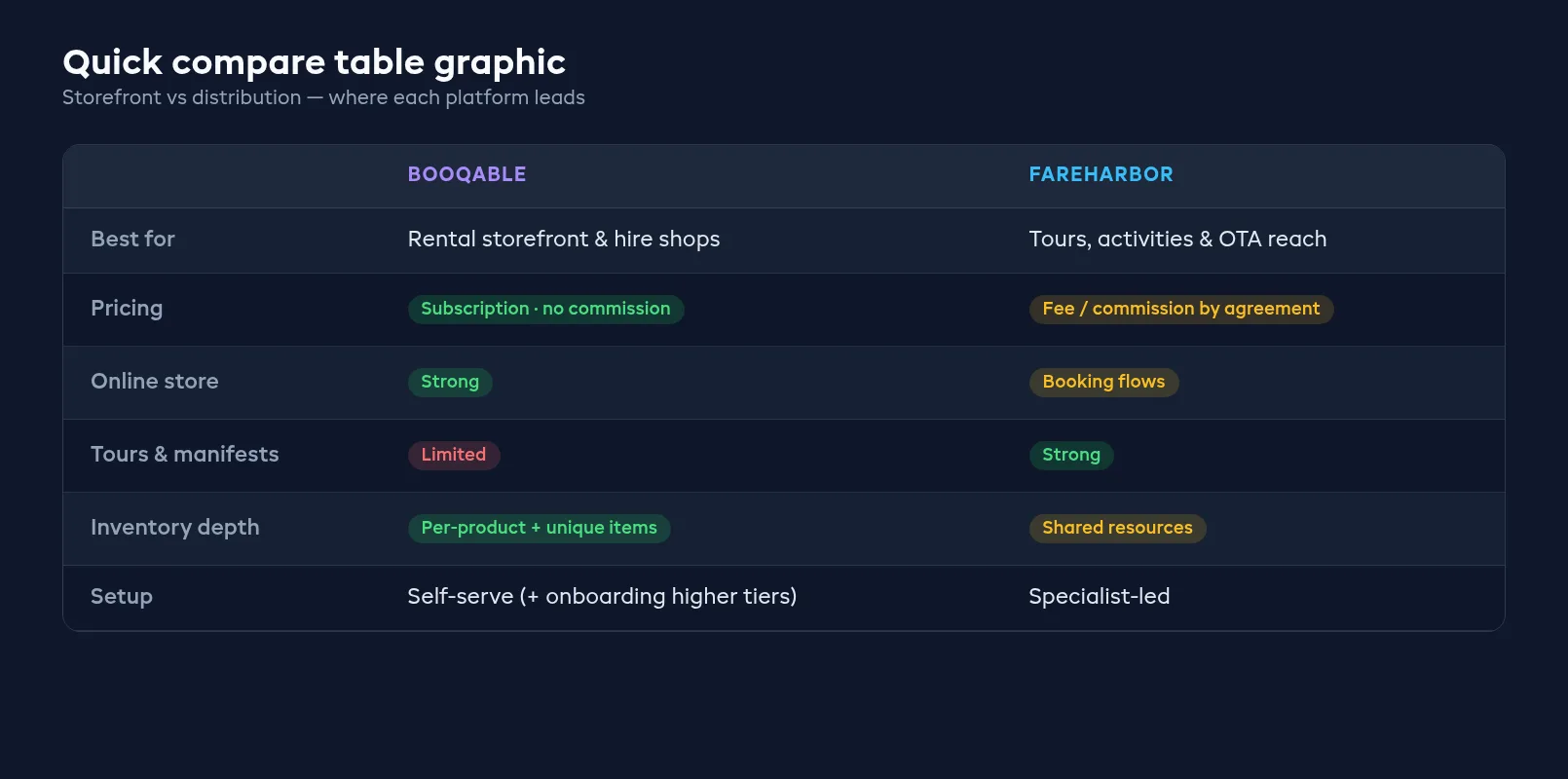
Quick Comparison Table
| Booqable | FareHarbor | |
|---|---|---|
| Built for | Equipment rental shops and online hire | Tours, activities, attractions, and supporting rentals |
| Best for | Operators that sell gear through a rental storefront | Operators that value OTA and partner distribution |
| Pricing model | Published subscription tiers; no booking commission | Customer booking fee or provider-paid commission (by agreement) |
| Online store | Strong built-in rental store and embeds | Booking flows and widgets; distribution-led acquisition |
| Tours and activities | Limited; not built around timed departures | Strong; manifests, capacity, crew, and resources |
| Inventory | Per-product stock, unique items, downtime, buffers | Resources shared across activities; cleaning blocks |
| Setup | Self-serve with optional onboarding on higher plans | Specialist-led onboarding |
| Support | Chat and email; calls on Grow and Scale | 24/7 support is advertised |
| Best fit | Pure or mostly rental e-commerce | High-volume tour and activity businesses |
Both stop basic double bookings. The real split is acquisition, fee structure, and whether the system thinks like a rental shop or a tour desk.
Features: Where Each Wins
Online store and rental checkout
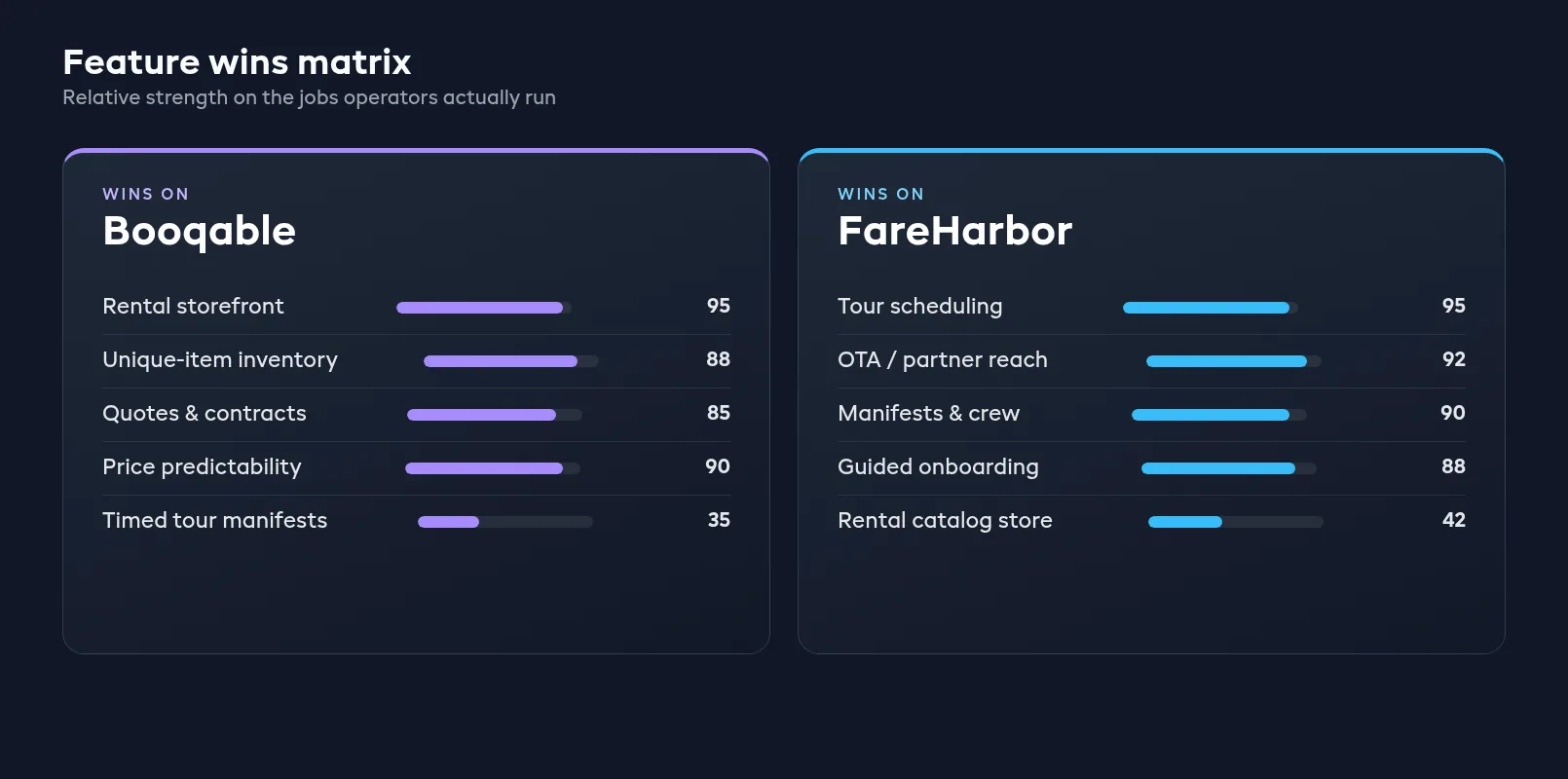
This is Booqable’s home turf. It ships a rental store experience — product pages, collections, date-range pricing, deposits, and a checkout you can host or embed. Customers browse gear like a shop and book a hire window. Website builder and mobile POS add-ons sit on top of the core plans when you need them.
FareHarbor’s strength is getting guests onto the right activity at the right time. Booking flows, widgets, and partner channels are built for tours. You can sell rentals as shared resources, but it does not try to feel like a full rental catalog storefront.
Tours, manifests, and guest operations
FareHarbor wins here. Timed departures, capacity, manifests, crew assignment, transportation options, and shared resources are first-class. Operators that run a grid of start times with guides and limited gear will feel native support for that day.
Booqable handles date-range availability, buffers, and fulfillment well. Timed multi-session tour scheduling is not its center of gravity. If most revenue is guided experiences, FareHarbor matches the work better.
Inventory depth and unit workflow
Booqable tracks stock per product and unique items, supports downtime scheduling, buffers between hires, packing slips, and detailed product history. That is the language of a rental yard: what is out, what is back, and what is offline for repair.
FareHarbor connects limited equipment, vehicles, guides, and spaces as resources to the activities that use them. Cleaning or turnaround blocks and calendar views help prevent oversell across offerings. If you need a full serial-level maintenance log, damage evidence, and check-in tied to a specific unit, test that exact workflow in a demo on either platform rather than assuming “inventory” means the same thing.
Distribution, setup, and support
FareHarbor makes distribution a core part of the offer. OTA and partner connections can bring demand you would not win from a local website alone. The trade-off is channel economics: who pays the fee, what partner bookings cost, and whether the customer record comes back cleanly.
Booqable’s pitch is direct rental revenue with no platform cut of bookings. Setup is largely self-serve; Grow and Scale include onboarding sessions. FareHarbor leans specialist-led, which helps complex catalogs and can mean more vendor involvement before go-live.
Pricing Comparison
Headline prices rarely tell the whole story. Model both against your real mix of online, offline, direct, partner, and OTA bookings — including refunds and payment processing.
Booqable pricing
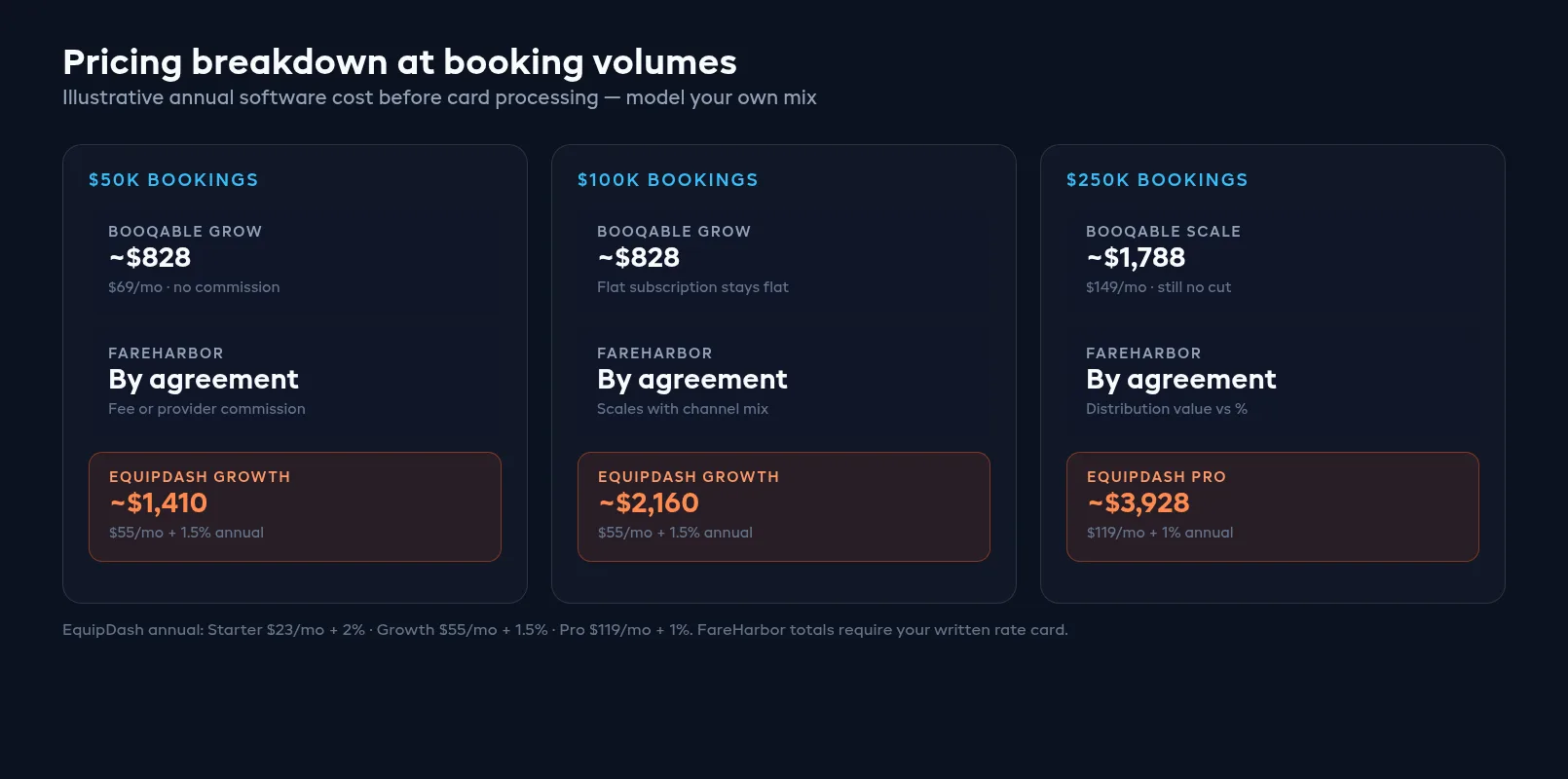
Booqable publishes subscription tiers with no commission on bookings. Public plans commonly list around $29/month for Start, $69/month for Grow, and $149/month for Scale on the discounted annual-style rates shown on its pricing page (monthly billing lists higher). Add-ons such as website builder, mobile POS, barcodes, deliveries, and extra locations are billed separately. Payment processing fees from Stripe or your processor sit on top.
At $100,000 in annual bookings with no platform commission, Grow is roughly $828/year before add-ons and card fees. Cost is predictable; the risk is still needing a second system for tours.
FareHarbor pricing
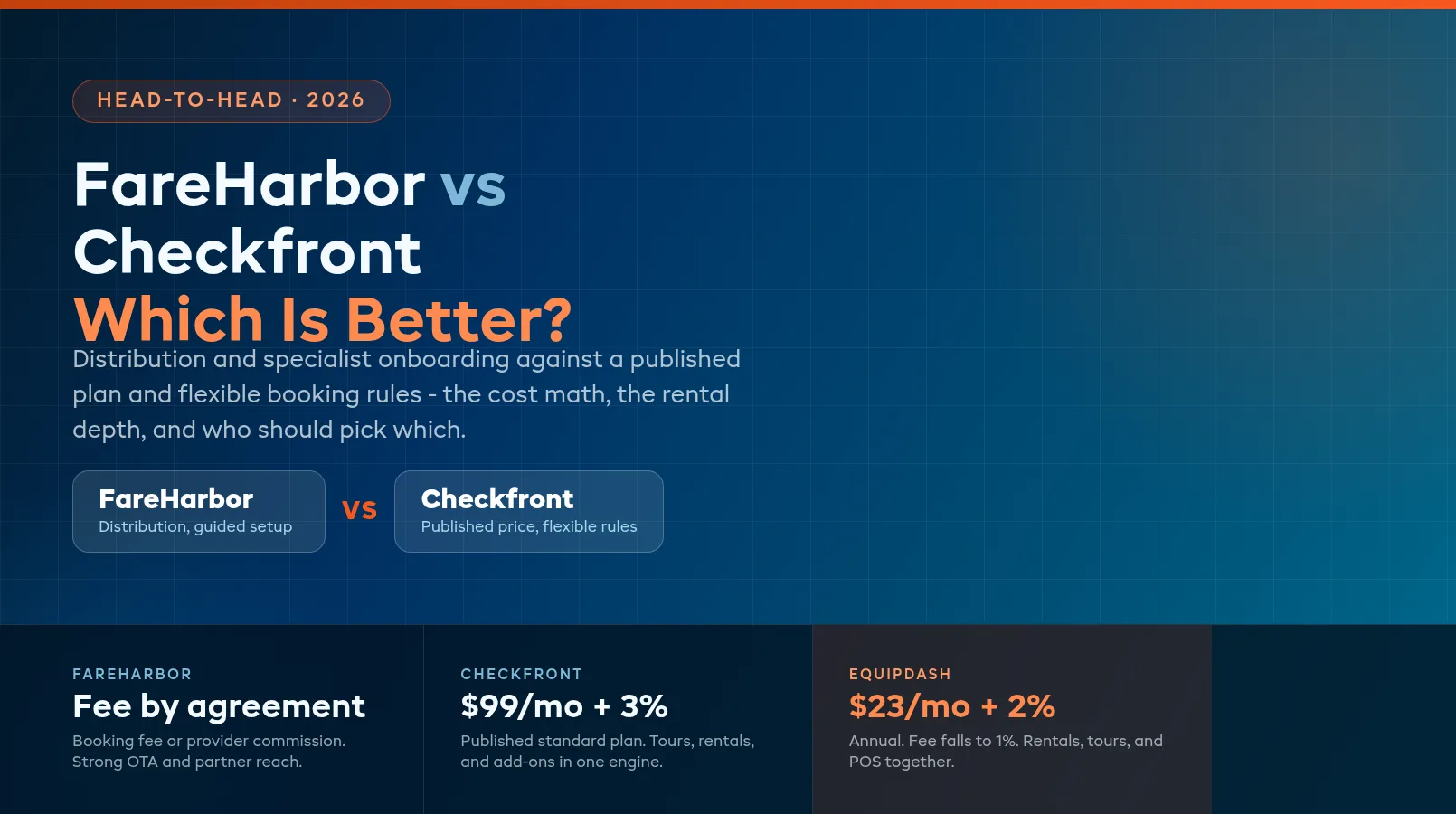
FareHarbor does not publish one universal provider price. Its terms describe a booking fee charged to the customer, or a provider-paid commission under separate commission terms. Distribution and API/partner bookings can carry their own economics. The exact rate belongs in your agreement.
That model can work when distribution produces bookings you would not have won alone. It is harder to forecast next to a flat subscription. Ask for a written example at your volume: direct, partner, OTA, refunds, and any add-on charges.
EquipDash as a third option
EquipDash is built for operators that sell both rentals and tours and want one system to understand both sides. Annual plans start at $23/month for Starter (2% platform fee), $55/month for Growth (1.5%), and $119/month for Pro (1%). Monthly list prices are $29 / $69 / $149 — prefer the annual figures when you compare totals. At $100,000 in annual bookings, annual-billing totals are roughly $2,276, $2,160, and $2,428 respectively before payment processing. See current EquipDash pricing.
The fit is not automatic. A pure online rental shop may prefer Booqable’s storefront. A tour operator that needs FareHarbor’s network first may have no reason to move. EquipDash is worth a look when rentals and experiences share stock, staff, customers, and payments — and you want fee visibility as volume grows.
Best For: When to Choose Each
Choose Booqable if
- Your business is primarily equipment hire sold through an online rental storefront.
- You want published subscription pricing with no platform commission on bookings.
- Per-product inventory, unique items, downtime, quotes, and contracts matter more than timed tour manifests.
- Your team can own setup, or you are fine with onboarding sessions on Grow/Scale.
- Tours are rare or handled by a separate process you accept.
Choose FareHarbor if
- Partner and OTA distribution are a major source of new demand.
- You want specialist help configuring a complex tour or activity catalog.
- 24/7 support and a managed relationship matter more than a public price list.
- Your operation is primarily tours, activities, or attractions, with rentals as a supporting product.
- You have modeled the fee on direct, partner, and OTA bookings and the margin still works.
Choose a third option if
- You need deeper rental operations plus tour scheduling in one dashboard.
- Gear hire and guided experiences share the same fleet, staff, and customer list.
- You want pricing that stays visible as booking volume grows.
- You want one counter workflow for walk-ins instead of stitching a rental store onto a tour engine.
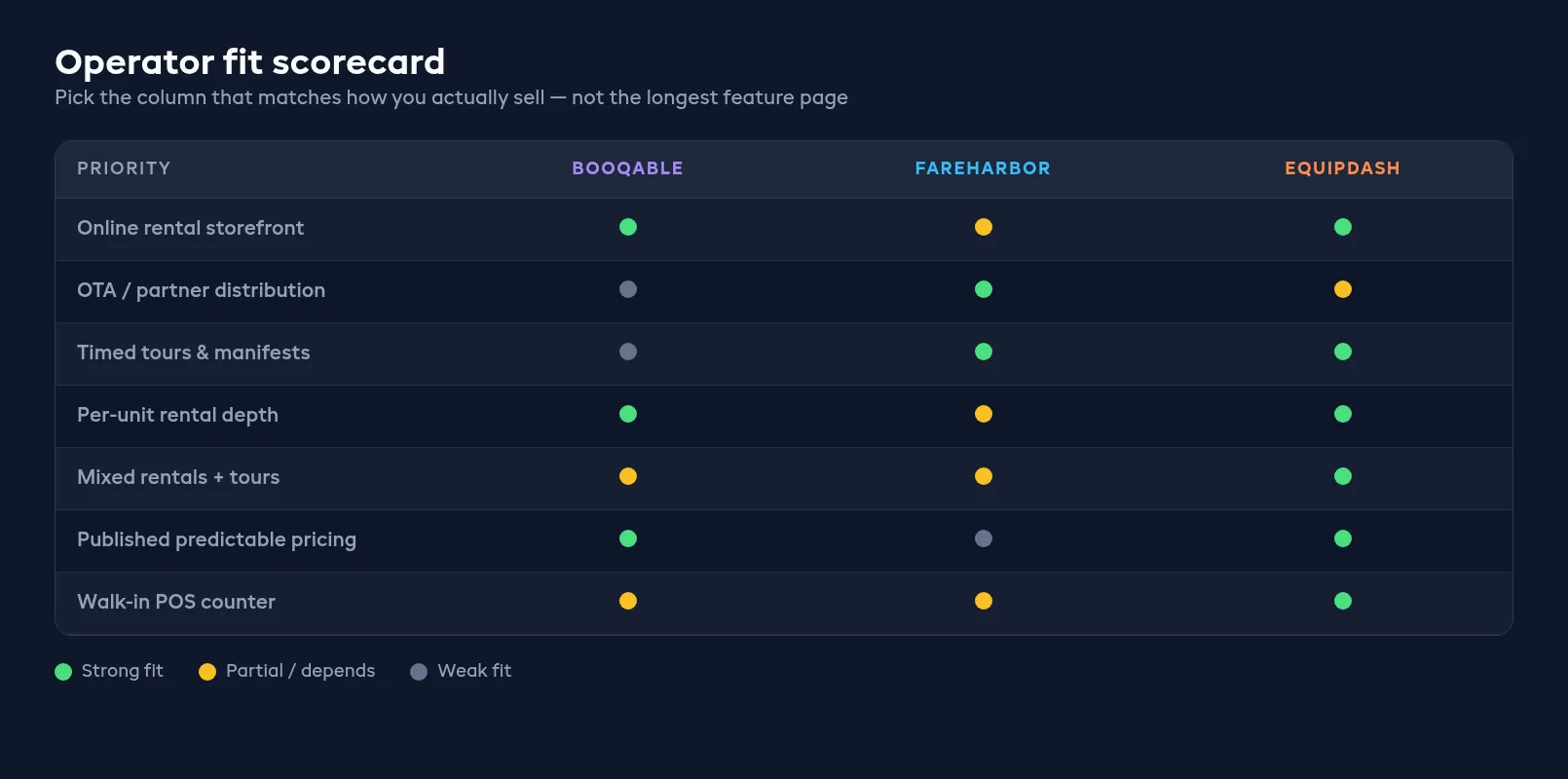
A Third Option: Rentals and Tours Without Two Systems
If you sell both — gear hire and guided sessions on the same fleet — Booqable alone leaves tour scheduling thin, and FareHarbor alone leaves the rental storefront thin. Two tools mean double data entry and a risk that the kayak booked for a 2pm hire is also on the 1pm tour.
EquipDash treats rentals and experiences as first-class together: shared availability, payments, waivers, and staff workflows, with annual plans and a declining platform fee. It will not out-store Booqable for pure online hire or out-distribute FareHarbor for OTA-heavy tours. If your week spans the rental counter and the tour manifest, one system that understands both beats two that each do half.
Still weighing the field? Read the wider equipment rental software comparison, Booqable alternatives, and FareHarbor alternatives.
FAQ
What is the main difference between Booqable and FareHarbor?
Booqable is rental software centered on an online storefront, inventory, quotes, and contracts for hiring out gear. FareHarbor is a tour and activity platform centered on booking flows, manifests, resources, and distribution through partners and OTAs. Both can take bookings; they optimize for different ways of selling.
Is Booqable cheaper than FareHarbor?
It depends on volume and channel mix. Booqable charges a published subscription with no booking commission; FareHarbor typically uses a customer booking fee or a provider-paid commission set in the agreement. At low direct volume, a flat subscription can look cheaper. At high OTA-driven volume, FareHarbor’s distribution value may outweigh a percentage — model both against your real booking mix.
Does FareHarbor handle equipment rentals?
Yes. FareHarbor supports rental inventory as shared resources, availability calendars, cleaning blocks, waivers, card holds, and reporting. Confirm that its resource workflow matches your needs for unit-level maintenance, damage evidence, and check-in before signing.
Is Booqable good for tours and activities?
Booqable is strongest for date-range equipment hire, not timed multi-session tour operations. You can sell experiences in limited ways, but capacity grids, manifests, and crew assignment are FareHarbor’s terrain. Pure tour operators usually shortlist FareHarbor or another activity-first platform.
Which is easier to set up, Booqable or FareHarbor?
Booqable is largely self-serve, with specialist onboarding sessions on Grow and Scale. FareHarbor provides a more guided, specialist-led setup. Ask both to configure one real rental, one tour (if you sell both), a shared resource, a deposit, a date change, and a refund before you judge setup speed.
Can one platform handle both rentals and tours well?
Not as a default with Booqable or FareHarbor alone — each covers one side strongly and the other lightly. Platforms such as EquipDash are built for operators that need per-unit rentals and guided experiences in one system. Run the same shared-fleet tests on any shortlist before you commit.
What is an alternative to both Booqable and FareHarbor?
EquipDash is an alternative for mixed rental and tour operators who want booking, inventory, payments, waivers, and staff workflows together, with annual plans from $23 per month and platform fees that decline by tier. Pure rental shops may still prefer Booqable’s storefront; distribution-first tour businesses may still prefer FareHarbor’s network.
in one place