Best Bike Rental Software in 2026: 9 Options Compared
Which one fits depends on what your shop does besides rent bikes. If the workshop is as busy as the rental counter and you sell on Lightspeed, look at Bike Rental Manager first. If bikes are one category next to camping or ski gear, look at Booqable. A small fleet that wants no monthly bill can start on Valet. EquipDash, our product, fits shops that run rentals and guided rides from the same bikes. It starts at $29/mo with a 21-day free trial, and waivers and the workshop start on the $69/mo plan.
In New Zealand, Australia and the UK this is bike hire software. Prices are in US dollars unless marked. Ask each vendor whether sales tax, GST or VAT is added on top. EquipDash bills shops in Australia, New Zealand and Canada in US dollars, with GST or HST added where it applies.
We compared nine options on frame sizes, workshop holds, waivers for walk-ups and guided rides that use the rental fleet. Prices and fees come from each vendor's own pricing page, checked in October and November 2026. Feature notes come from their sites, so test them in a trial. New to the terms? The bike rental glossary covers them.
Bike rental software compared
| Software | Starting price | Booking fee | Free trial | Best for |
|---|---|---|---|---|
| EquipDash | $29/mo, or $23/mo billed yearly | 1-2% on card payments, can be passed to the customer | 21 days, no card | Rentals and guided rides from one fleet |
| Booqable | 29/mo billed yearly, 35/mo monthly, in your local currency | No commission | 14 days, no card | Shops renting bikes alongside other gear |
| Bike Rental Manager | $859/yr for up to 50 bikes, billed yearly | 2.5% on revenue above $38,000 | Demo only | Shops that rent, repair, and run tours |
| Ribbe | No published price; transaction-based with a monthly minimum | Online booking fee paid by the customer | 14 days | Retail-first shops that rent on the side |
| Valet | No subscription | 5% per completed booking | Free to start | Small fleets that want no monthly fee |
| Checkfront | $99/mo | 3% on online bookings, absorb or pass on | Not stated | Guided e-bike rides plus rentals |
| FareHarbor | No subscription price published | Paid by the customer at checkout | Not stated | Bike tour companies with set departures |
| Twice Commerce | €99/mo for one location | 1.5% per processed payment | 14 days, no card | Shops mixing rental, resale, and retail |
| Lightspeed Retail | $89/mo (POS only) | Card rates apply | 14 days, no card | Shops already on Lightspeed POS |
Add card processing on top of every row.
What bike rental software has to handle
The booking is a medium e-bike on Saturday at 9, a child seat, and a helmet that fits each rider. The software has to know how many mediums you have at that location, which ones are out on a ride, and which are in the workshop with a bent rotor.

Shortlist two or three and test each against these in its trial.
- Frame sizes per location. Bookings should come off a count of each size at each shop, so you never promise a bike that's across town. Most riders give you their height, not a frame size, so the booking should ask for height and leave the size to staff if the rider isn't sure.
- Helmets counted like bikes. One helmet per rider, in each size. In New Zealand every rider has to wear one by law, and New South Wales requires an approved helmet, fitted and fastened. In the US plenty of adults turn one down, but count for everyone anyway. A family of four that books four bikes shouldn't find three helmets on the hook.
- E-bikes and their batteries. Hills, rider weight and assist mode all cut range, so the booking should record the range each rider needs and which battery is in which bike. It should also hold each bike's rider weight limit and, in the US, its class (1, 2 or 3), because e-bike laws differ by state.
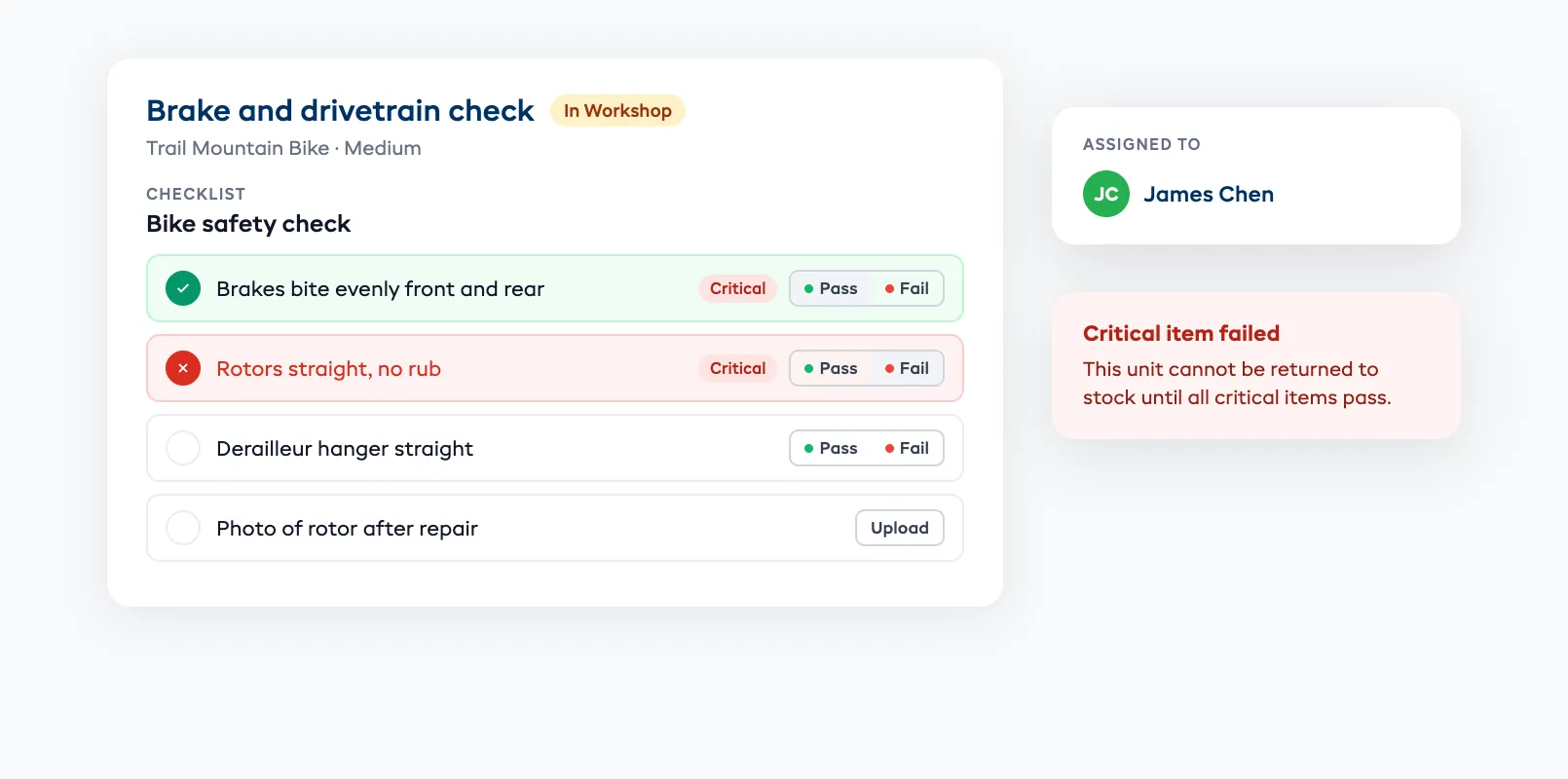
- Workshop status that blocks bookings. A bike flagged for repair at return should drop off the booking page until it's fixed, and you should be able to see who checked it if a rider complains later.
- A photo at handover, not just at return. On a mountain bike the arguments are about the derailleur hanger and the rotors, so photograph those when the bike goes out. When a rider says "that was already bent", the handover photo and a deposit held on the card give you something to point to.
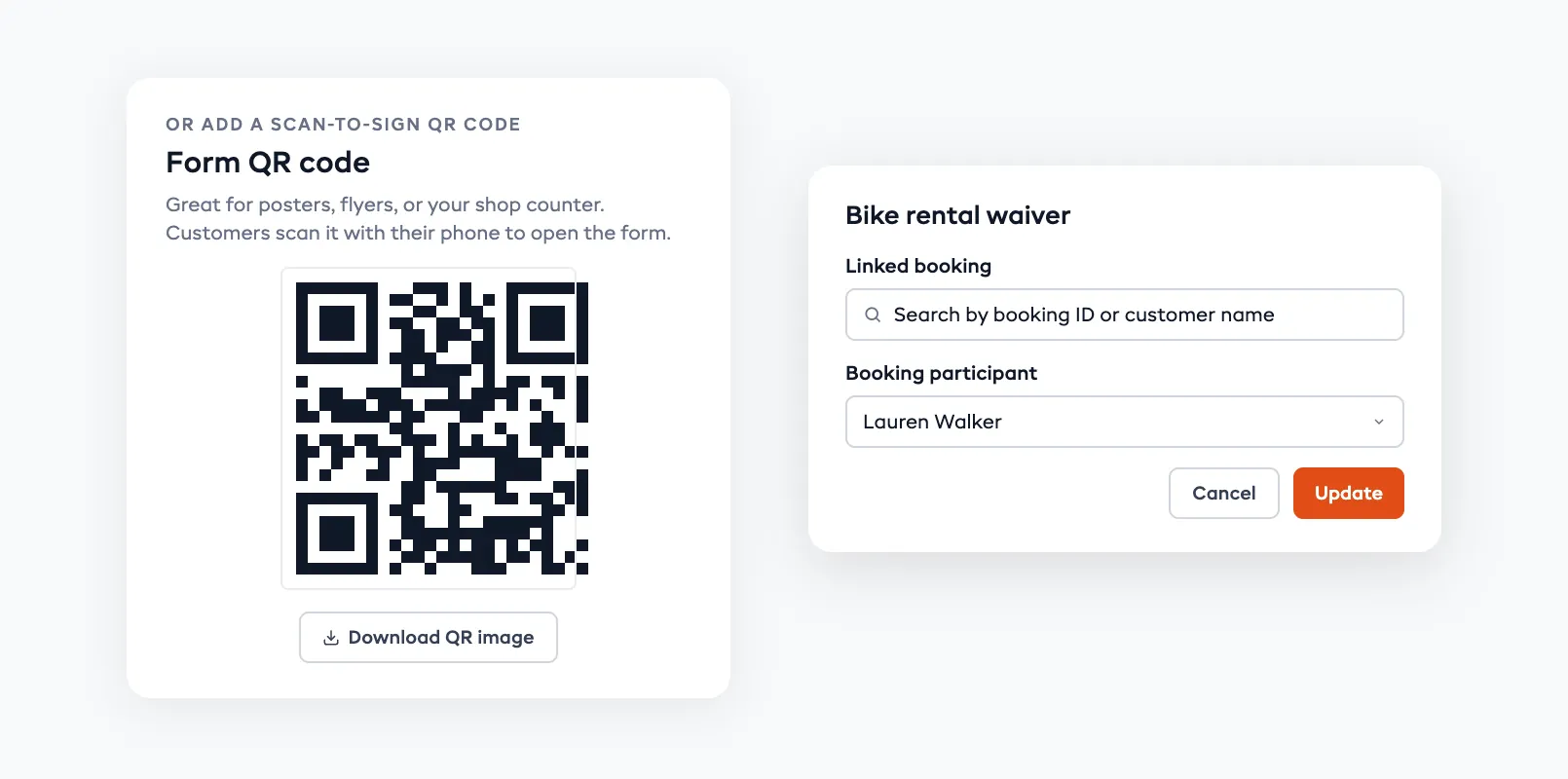
- Waivers for walk-ups too. Riders who booked can sign online with the booking. The couple who walked up need a QR code on the counter they can sign on their phone. Either way, the signed copy has to be easy to find if a claim comes in.
- Walk-ins at the counter. On a fine Saturday there are six people at the counter and two online bookings landing for the same e-bikes. Each walk-in has to come off the same count as soon as it's sold, or the e-bikes are double-booked. Ask how many taps it takes a seasonal hire in their first week to check one out.
- Rentals and guided rides together. If you run guided rides, the twelve mediums on the morning ride have to come off the rental calendar until they're back. A late return has to show up before the 1pm rental is standing at the rack, and the rider should get a text, so nobody is digging a phone number out of a form.
- Shuttle seats, if you run shuttle days (uplift days in New Zealand and Australia). Say the van has 12 seats and the trailer takes 14 bikes. A rider bringing their own bike takes a van seat and a trailer slot. A rider renting takes both plus a bike, and the run only goes if enough riders have booked by the night before. Ask each vendor to build that run in front of you.
- Moving across. Ask who moves the bookings you've already taken, whether you can run both systems side by side for a few weeks, and how your bikes and customer list come across. In EquipDash, our team enters the bookings you've already taken from your old system's export, and your customer list imports from a CSV. Switch in your quiet months.
- What it costs at your volume. Work any percentage fee out on your busiest month.
The 9 options, one by one
1. EquipDash
Best for: shops that run self-guided rentals and guided rides from the same fleet, at one location or several.
Price: $29/mo on Starter, or $23/mo billed yearly, for up to 2 team members, 1 location and 20 rental products. The product limit counts bike models, not individual bikes. Waivers, the workshop, barcode scanning and Dash AI start on Growth at $69/mo ($55/mo billed yearly), with up to 10 team members. A second location needs Pro at $149/mo. A booking fee of 2% on Starter, 1.5% on Growth, and 1% on Pro applies to card payments only, and you can pass it on to customers at checkout. 21-day free trial, no card. See pricing.
What it does for a bike shop: bikes are counted by frame size at each location, and scanning any bike shows whether it's out, on the rack, or in the workshop. On mountain bikes and e-bikes, a fit ticket records each rider's height, frame size (or "let staff advise") and ability, filled in at booking or at the counter, so the bike can be set up before the rider gets to the rack. For e-bikes, staff also note the range the rider needs and confirm the rider is within the weight limit.
Staff log each bike's condition with up to five photos at pickup and again at return, and each bike keeps its condition history. A bike marked damaged at return goes to the workshop on its own and comes off the booking page until it's back, and a workshop checklist records who checked it. If the rider owes for the damage, EquipDash sends a Stripe payment link with the condition report as evidence. A security deposit can be held on the card the rider saved when they paid online. For a walk-in at the counter, staff can hold the deposit on the card reader, or record a cash deposit on the booking.
Riders who booked are sent the waiver and reminded on a schedule you set, as often and as many times as you choose. Walk-ups scan the waiver's QR code at the counter and sign on their phone, and staff attach the signed form to the booking from the responses list. Waivers signed from a booking's link land on that booking, and you can export them all as PDFs. Walk-ins are sold at the counter POS from the same fleet. Each guided ride reserves its own list of bikes, so they come off the rental calendar for that ride. When a bike is late back, the rider is emailed and, once SMS is set up (it's on every plan), texted automatically, with a link to extend the rental if you allow online extensions.
A shuttle run can be set up as an experience with the van's seats as its capacity and a minimum number of riders to run. Each price carries its own gear list, so the rental price reserves a bike and both prices reserve a trailer slot once the trailer is set up as an item. If the run is short, you can cancel it and every rider is refunded in full.
Staff can ask Dash, the built-in AI assistant, which of today's bookings still have an unsigned waiver, or who's late back, and tell it to send bike 23 to the workshop.
With the AI Front Desk add-on ($49 a month on pricing, with 150 call minutes included), calls you don't pick up go to Dash. It checks what's free, quotes the price, and texts the caller a link to pay and sign the waiver.
Watch out for: EquipDash doesn't connect to Lightspeed, so a shop selling parts and new bikes on Lightspeed would run both. It doesn't track e-bike battery charge or which battery is in which bike, so on an e-bike-heavy fleet the morning charge check stays on a whiteboard or a spreadsheet. Waivers and the workshop need Growth, and a second location needs Pro. Customers, bikes and bookings you've already taken can be brought across, but past payments stay with your old system and your payment provider. It's newer than Bike Rental Manager or Checkfront, so there are fewer reviews from bike shops to read. More on the bike rental software page.
2. Booqable
Best for: rental shops where bikes are one category among many (camping gear, ski kit, party rentals).
Price: the Start plan is 29/mo billed yearly or 35/mo billed monthly, with no commission on bookings. Booqable's pricing page shows the number in your local currency with no symbol, so check which currency you're seeing before you compare. Every plan includes unlimited inventory and orders, so fleet size doesn't move the price. 14-day free trial, no card.
What it does for a bike shop: tracks each bike individually or by quantity, handles frame sizes as variations of one product, and from the Grow plan (69/mo billed yearly, 87 monthly) lets you schedule downtime so a bike in for repair can't be booked.
Watch out for: Start and Grow are single-location. A second shop means moving to Scale (149/mo billed yearly) plus 29/mo per extra location.
3. Bike Rental Manager
Best for: bike shops that rent, repair, and run tours, particularly those already using Lightspeed for retail.
Price: the Bronze plan is $859/yr, billed yearly, for up to 50 items and $38,000 of revenue. Above that ceiling it charges 2.5% on revenue. A fleet of 51 to 100 bikes needs Silver at $1,299/yr ($70,000 ceiling, 2% above it), 101 to 250 bikes needs Gold at $2,199/yr ($150,000 ceiling, 1.8% above it), and a bigger fleet needs Platinum at $3,769/yr. Prices are before tax, and the page also lists them in NZ$, A$, C$, £ and €. In New Zealand, Bronze is NZ$1,309 a year and Silver NZ$1,976. In Australia they're A$1,195 and A$1,805. Delivery and multiple locations are add-ons at $330/yr each. No published trial; demo on request.
What it does for a bike shop: covers rentals, repairs, tours, bike fitting, and selling ex-rental bikes in one system, with repair scheduling and a service history per bike, barcode scanning, and waivers. It syncs both ways with Lightspeed.

Watch out for: annual billing only, and the Lightspeed sync works with cloud Lightspeed, not the on-site or iPad versions.
4. Ribbe
Best for: retail-first bike shops that rent on the side. Ribbe also sells to rental and tour operators.
Price: Ribbe doesn't publish a price list. Pricing is transaction-based with a monthly minimum, there's no upfront software cost, and the online booking fee is paid by your customers. 14-day free trial.
What it does for a bike shop: tracks every bike by serial number, size, and location, creates repair work orders, takes card-hold deposits automatically, and collects waivers by QR code.
Watch out for: the reservation rates and the monthly minimum aren't published, so you'll need a quote to compare costs.
5. Valet
Best for: small bike rental and tour shops that would rather pay per booking than pay a monthly fee.
Price: no subscription. Valet takes 5% of each completed booking, built into the price customers see, and payments go to your own Stripe account.
What it does for a bike shop: tracks each bike with a QR code, sends maintenance alerts by ride count or date, handles delivery and pickup, and has a walk-up POS.
Watch out for: on $60,000 a year of online bookings, 5% comes to $3,000, the highest total in the cost table below.
6. Checkfront
Best for: shops running guided e-bike rides and rentals from one fleet.
Price: one plan at $99/mo plus a 3% fee on online bookings, which you can absorb or pass on to guests. Offline bookings carry no fee.
What it does for a bike shop: books by frame and size, sells child seats and helmets as add-ons, blocks bikes out for maintenance, and includes waivers at no extra cost.
Watch out for: walk-in sales rely on in-person card terminal support rather than a full POS.
7. FareHarbor
Best for: bike tour companies selling set departures, where guests pay the booking fee.
Price: FareHarbor doesn't publish a subscription price. Its model is a booking fee that the customer pays at checkout, and the rate isn't on its site. Its provider terms (effective January 2025) also bill the shop a processing fee for card payments, and a shop can ask for a commission model instead, where FareHarbor charges the shop rather than the customer.
What it does for a bike shop: shared equipment inventory across products, card holds on equipment, and waiver partner integrations.
Watch out for: its rentals page doesn't mention bikes, serial numbers or a repair status. Ask the rep to show you one particular bike held out while it's in the stand with a flat, with the rest of its size still bookable. Ask a rep, or an operator who uses it, what your customers pay per booking.
8. Twice Commerce (formerly Rentle)
Best for: shops that rent, resell, and sell new stock, from one location to several.
Price: €99/mo for one location (€1,188/yr), with all features included, plus 1.5% per processed payment. API, SMS, and storage are billed separately. 14-day free trial, no card.
What it does for a bike shop: tracks each item individually, groups sizes under one listing, requires a signed waiver before handover, and has an "in maintenance" status.
Watch out for: pricing is in euros, so outside the eurozone your cost moves with the exchange rate, and the 1.5% applies to every payment Twice processes.
9. Lightspeed Retail
Best for: bike shops already on Lightspeed POS that rent only a few bikes.
Price: the Basic plan is listed at $89/mo for one register. Lightspeed doesn't say whether that's billed monthly or yearly. 14-day free trial, no card. The cost of the rental tool you pair it with isn't public.
What it does for a bike shop: serial numbers and repair work orders inside a full retail POS.
Watch out for: Lightspeed has no rental booking of its own. Its bike shop page points rentals to HubTiger, which most shops know for workshop bookings and which also has a rental calendar, so you'll run two systems. Bike Rental Manager has a two-way Lightspeed sync; EquipDash doesn't connect to Lightspeed.
What it costs at your volume
This is a year of published fees on $60,000 of online bookings, with the shop absorbing every booking fee. Bike Rental Manager prices by fleet size and EquipDash by staff and bike models, so each gets a row per size. Card processing, and EquipDash texts from its prepaid SMS balance, come on top.
| Software | Subscription | Booking fees | Yearly total |
|---|---|---|---|
| Booqable (Start) | 348-420 in local currency | None | 348-420 in local currency |
| EquipDash (Starter, 2 staff, 20 bike models, no waivers or workshop) | $276-$348 | $1,200 (2%) | $1,476-$1,548 |
| EquipDash (Growth, waivers, workshop and up to 10 staff) | $660-$828 | $900 (1.5%) | $1,560-$1,728 |
| Bike Rental Manager (Bronze, up to 50 bikes) | $859 | $550 (2.5% of $22,000 above the ceiling) | $1,409 |
| Bike Rental Manager (Silver, 51-100 bikes) | $1,299 | None (under the $70,000 ceiling) | $1,299 |
| Bike Rental Manager (Gold, 101-250 bikes) | $2,199 | None (under the $150,000 ceiling) | $2,199 |
| Checkfront | $1,188 | $1,800 (3%) | $2,988 |
| Valet | $0 | $3,000 (5%) | $3,000 |
| Twice Commerce | €1,188 | $900 (1.5% of payments) | €1,188 plus $900 |
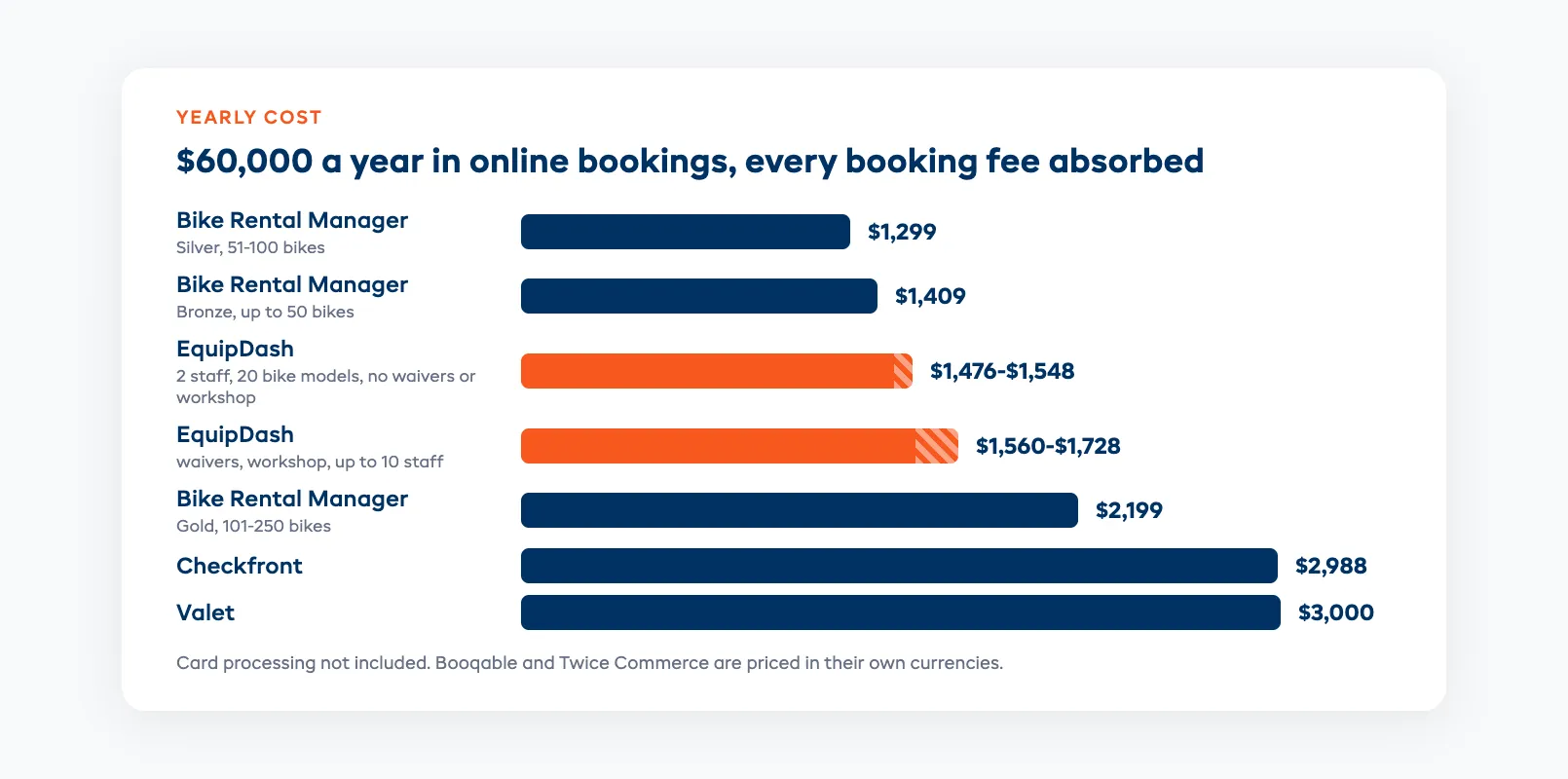
Booqable and Twice rows are in their own currencies. If you pass the booking fee on to customers, EquipDash and Checkfront come down to the subscription alone. Ribbe and FareHarbor don't publish enough to include, and Lightspeed is left out because the cost depends on a second tool.
These totals count online bookings only. If most of your rentals are counter walk-ins, EquipDash and Checkfront fees shrink with the online share (at $20,000 online, divide them by three). Bike Rental Manager's ceiling counts all revenue processed through it, including counter sales, tours and repairs, so a shop with counter and tour sales on top of $60,000 online reaches the ceiling sooner than its rows show. Ask Valet and Twice whether counter sales count toward their fees.
How to choose
- You rent and run guided rides from the same bikes: EquipDash or Checkfront, since both keep rides and rentals on one fleet calendar.
- Your workshop is as busy as your rental counter, and you're on Lightspeed: Bike Rental Manager.
- Bikes are one category in a wider rental shop: Booqable.
- You have a small fleet and want no monthly bill: Valet, as long as 5% of every booking stays acceptable.
- You sell and resell bikes across several stores: Twice Commerce.
For the two or three left on your list, set up one Saturday in each trial. Book a family of four with two frame sizes, a child seat, and a bike that went into the workshop that morning. Then add a couple who walked up without signing anything, and an e-bike that came back from the morning ride low on charge. Count how many screens each one takes. For the rest of the operation, see how to run a bike rental business and the bike fleet maintenance schedule.
Frequently Asked Questions
What is the best bike rental software for a small shop?
It depends on what else the shop does. A small fleet that only rents bikes and wants no monthly bill can start on Valet, which charges no subscription but takes 5% of each booking. If bikes sit next to other rental gear, Booqable starts at 29/mo billed yearly in your local currency, with no commission and unlimited inventory. If you run rentals and guided rides from one fleet, EquipDash starts at $29/mo with a 21-day free trial, and waivers start on the $69/mo plan.
How much does bike rental software cost?
Published starting prices run from no subscription (Valet, 5% per booking) to $29-$99 a month (EquipDash, Booqable, Checkfront) and $859 a year (Bike Rental Manager, up to 50 bikes; $1,299 for up to 100 and $2,199 for up to 250). As online bookings grow, the booking fee moves the total more than the subscription does. On $60,000 a year of online bookings, Valet's 5% is $3,000 while Booqable charges none. Card processing is extra on all of them.
Can one system handle bike rentals and guided bike tours?
Yes. EquipDash and Checkfront sell guided rides and rentals from the same fleet, so the bikes reserved for a guided ride come off the rental calendar for that ride. Bike Rental Manager also covers tours alongside rentals and repairs.
Do I need separate software for bike repairs?
Only if your rental tool can't hold a bike out for repair. Bike Rental Manager, Ribbe, and EquipDash all handle repair jobs alongside rentals. On EquipDash's Growth plan and up, a bike in the workshop comes off the booking page until staff take it out of the workshop, and a failed safety check on its checklist keeps it there. Lightspeed Retail handles repair work orders but needs a separate tool for rental bookings.
Can I pass booking fees on to customers?
With some systems. EquipDash and Checkfront let you absorb the online booking fee or pass it on at checkout. Ribbe and FareHarbor charge their online booking fee to the customer by default.
in one place